29 September 2013

Assistant Professor Position at Hampshire College

Joanna Morris from Hampshire College writes:

Hampshire College, an independent, innovative liberal arts institution, is accepting applications for an Assistant Professor of Linguistics in the School of Cognitive Science. The position carries a 4-course per year teaching load and also includes supervision of undergraduate concentrations and thesis projects. The area of specialization is open. We are particularly interested in candidates who have successful records in undergraduate teaching and who can make connections across the cognitive or neural sciences.

Hampshire College, located in Amherst, MA, is a member of the Five Colleges, Incorporated, a nonprofit educational consortium established in 1965 to promote the broad educational and cultural objectives of its member institutions which, along with Hampshire, include Amherst College, Mount Holyoke College, Smith College, and the University of Massachusetts Amherst.

The consortium fosters close academic collaboration, and facilitates intellectual communities and broad curricular and co-curricular offerings.  All members of the consortium benefit from the shared use of educational and cultural resources and facilities, including a joint automated library system. Students are allowed to register for nearly any course offered on any of the five campuses.

Hampshire's unique academic program requires that students work closely with a faculty committee to design and carry out a personalized course of study, the concentration.  A concentration may range from a plan of study similar to that of a traditional college major to a highly individualized program of study that encompasses several disciplines or areas of conceptual thought and understanding.   There are no courses that are required of all students, and faculty are encouraged to develop innovative interdisciplinary courses that introduce students to their intellectual passions and that explore new, cutting edge areas of scholarship.

The review of applications will begin November 1, 2013 and continue until the position is filled.  A Ph.D. is required at time of appointment, July 1, 2014. Hampshire College offers a competitive salary and comprehensive benefits. Applicants should submit the following: 1) letter of application; 2) curriculum vita; 3) teaching statement with descriptions of potential courses; 4) research statement and 5) three professional references via our website at http://jobs.hampshire.edu/

Hampshire College is an equal opportunity institution, committed to building a culturally diverse intellectual community and strongly encourages applications from women and minority candidates.

PRG on Thursday

Claire Moore-Cantwell writes:

PRG will meet on October 3, 7:30pm, chez Ivy.  We will be 
discussing Robert's paper which he is planning to submit to Phonology.  
Further details to follow.

A Language Acquisition position at Boston University

Boston University is currently searching for an Assistant Professor specializing in language acquisition and linguistic theory, and will be conducting interviews at the BUCLD and LSA meetings for applicants in attendance. The application deadline is OCTOBER 1.

For more information: https://academicjobsonline.org/ajo/jobs/2803

Kai von Fintel on howtobecomeaprofessor.com

UMass Alumnus and MIT's Associate Dean of Humanities, Arts and Social Sciences Kai von Fintel is interviewed about how to be come a linguist. Check it out here.

Call for papers: SALT

Semantics and Linguistic Theory (SALT) 24 will be hosted by the Linguistics Department of New York University on May 30 through June 1, 2014.

Invited Speakers:

    Emmanuel Chemla (ENS)

    Valentine Hacquard (Maryland)

    Lauri Karttunen (Stanford)

    Sarah Moss (Michigan)

The conference will be preceded by a series of tutorials on Formal Semantics Beyond Spoken Language, on May 29.

The abstract submission deadline is Monday, December 2, 2013, 11:59 pm EST. We expect to make notifications of acceptance in late February.

Detailed instructions are available at: http://www.nyu.edu/salt2014

Please direct inquiries to salt2014inquiry@gmail.com or reply to this message.

BUCLD Registration open

38th Annual Boston University Conference on Language Development

November 1-3, 2013

Keynote Speaker:

Elena Lieven, Max Planck Institute for Evolutionary Anthropology / University of Manchester

Plenary Speaker: 

CANCELED: Heather van der Lely, Harvard University

Unfortunately, Heather van der Lely's plenary address has been cancelled for health reasons. We regret that we cannot hear her address and wish her the best in recovery.

Symposia:

Saturday - 'Resolving A Learnability Paradox in the Acquisition of Verb Argument Structure: What have we learned in the last 25 years'

Ben Ambridge (University of Liverpool) (organizer)
Adele Goldberg (Princeton University)
Joshua Hartshorne (Massachusetts Institute of Technology) & Jesse Snedeker (Harvard University)
Steven Pinker (Harvard University) 

Sunday - 'A new approach to language learning: filtering through the processor'

Helen Goodluck (University of York) (organizer)
Lyn Frazier (University of Massachusetts, Amherst)
Colin Phillips (University of Maryland, College Park)

We would like to remind you that the deadline to pre-register for BUCLD 38 is Tuesday, October 23, 2013. By pre-registering not only will you receive a reduced rate for the conference, but you will also be able to check-in at the registration desk quickly and proceed to the various exciting talks without waiting in line. Regular full-price registration will continue to be available online from Thursday, October 24 through Tuesday, October 29. To register, please visit the following website:

http://www.bu.edu/bucld/conference-info/registration/

For general information on the conference including the full schedule, please visit:

http://www.bu.edu/bucld

Also, you can register for the Society for Language Development Symposium "Mechanisms of Word Learning" on Thursday October 31, 1-6pm through our website. The SLD would also like to announce their student award. Please see their website for more information:

http://www.bcs.rochester.edu/sld/symposium.html

Johnson in Leipzig

Kyle Johnson is giving a talk entitled "The Empty Category Principle and linearization" at the 28th Comparative Germanic Syntax Workshop Saturday, October 5 at the University of Leipzig. The Workshop's website is here.

25 September 2013

Akira Omaki speaks at department colloq

Akira Omaki of Johns Hopkins will be giving a colloquium:
Friday, Sept. 27, 3:30 pm
in Machmer E-37.

Title and abstract are below.

Learning to parse syntactic dependencies

Much psycholinguistic research has investigated the relation between distributional information and expectations in language comprehension. One way to study this relation is to examine how expectations arise during sentence processing in adults as a function of relevant distributional information in corpora. An alternate approach is to explore how such predictive behaviors grow in children as a result of relevant distributional information that accumulates over a longer period of time. This presentation will discuss a series of studies that explore the second approach, with a focus on learning and processing of non-local dependencies. The first part of the talk explores the role of transitional probability information (and its breakdown) in learning a dependency between 'is' and 'ing' (e.g., John is kick-ing the ball). It is shown that 15 month old infants, who generally do not demonstrate sensitivity to the co-occurrence of is and ing, can use statistical (ir)regularities and learn to detect the co-occurrence relationship after a few minutes  of exposure to input in the lab. The fact that children rely on distributional information to discover non-local dependencies makes it feasible that the acquired representations with statistical information may guide parsing of such non-local dependencies. The second part of the talk presents developmental research on comprehension of various wh-questions. It is shown that children's syntactic expectations in filler-gap dependency processing may be slightly different from the type of expectations that have been observed in adults, despite the fact that the distributional information available for children should fully support adult-like expectations. I will discuss implications of such findings for psycholinguistic models of syntactic predictions, as well as relevant linguistic and cognitive factors that may need to grow before adult-like predictive behaviors emerge.

22 September 2013

Clauss at LARC/Language Acquisition Lab on Wednesday

Magda Oiry writes:

Michael Clauss will present 

"Exploring the distinction between Wh clauses and Question clauses in Child English"

at the LARC meeting on Wednesday, September 25 at 12:15 in the Partee Room.

Everyone welcome!

Andrew Weir in Leiden

Andrew Weir gave a paper, "Fragment Answers and congruence with Question under Discussion" at the Identity in Ellipsis Conference at Leiden University yesterday, September 21. For more information about the conference, click here.

Call for papers: GLOW 37

The annual meeting of the Generative Linguists of the Old World will take place in Brussels April 2-11, 2014. In addition to the main colloquium, there will be a workshop on "Phonological Specification and Interface Interpretation" and another workshop on "Understanding Possession."  Paula Fikkert, John Harris and Bert Vaux are invited speakers to the first workshop, and Chris Barker and Kilu von Prince are invited speakers to the second workshop. Two page abstracts should be submitted by December 1, 2013. More information can be found here.

Lisa Green in Ithaca

Lisa Green will give a talk at Cornell entitled  "Inversion in African American English: When Negation Isn't Enough" on September 26 (Thursday).

Call for Papers: Representing the Speech of Others

(Re)presenting the Speech of Others

Date: 13-Mar-2014 - 14-Mar-2014
Call Deadline: 01-Dec-2013
Location: Groningen, Netherlands
Organization: Franziska Köder & Emar Maier
Hosted by the ERC project BLENDS
Contact: f.koder@rug.nl
--------------------------------------------------------------
https://sites.google.com/site/representing2014/
---------------------------------------------------------------

There are different ways of reporting what someone else has said. Common forms of speech reports are direct speech (Mary said 'I am sick') and indirect speech (Mary said that she is sick). Pretense and role play are closely related phenomena. Like in direct speech, someone engaging in role play adopts the perspective of another person and produces utterances from that shifted standpoint (I am sick) (Harris, 2000). Another interesting parallel is that children start to use speech reports and to engage in role play at around the same time, namely at two to three years of age. This is well before they pass standard false belief tests (at around four) which are often taken to be the hallmark of Theory of Mind and metarepresentation (e.g. Perner, 1991).

Since at least some forms of reported speech exhibit recursion, intensionality, and/or clausal embedding, this developmental gap may shed new light on the debate over the relationship between Theory of Mind and the syntax/semantics of recursive embedding (e.g. de Villiers & de Villiers, 2000). The aim of the conference is to discuss the cognitive and conceptual relationship of reported speech, pretense and cognitive abilities such as perspective-taking, metarepresentation and Theory of Mind.

Keynote Speakers:

- Paul L. Harris
- Josef Perner
- Jill de Villiers

Call for Papers:

We invite authors to submit an anonymous two-page abstract by 1 December 2013
, for a talk of 20 minutes plus 10 minutes discussion or a poster. Submissions should be made via Easychair. We welcome theoretically and empirically oriented contributions addressing some of the following topics of interest from the perspectives of (psycho)linguistics, philosophy, psychology or semantics.

Topics of Interest:

- Development of reported speech
- Development of pretense/ role play
- Direct and indirect speech
- Perspective shift, role shift, deictic/indexical shift
- Theory of Mind / mindreading
- Metacognition and metarepresentation

Barbara in London and Cambridge

Barbara is in England Sept 24-29 for a big conference and a little workshop. On September 25, she and Luigi Rizzi will be the two speakers at a small workshop organized by Ian Roberts at the University of Cambridge on “Formal Approaches to Linguistic Theory”, where her talk will be “The starring role of quantifiers in the history of formal semantics”. Then on Sept 26-27, she’ll be one of the speakers in a big conference in London sponsored by the British Academy, organized by Ian Roberts and Theresa Biberauer, on the theme “The Cognitive Revolution 60 Years On” . Her talk there will be “How syntax and semantics have provoked different views of linguistic competence.”

Call for abstracts: CHRONOS 11

The deadline for abstracts for Chronos 11 (11th International Conference on Actionality, Tense, Aspect, Modality/Evidentiality), which will take place in Pisa on 16--18 June 2014, is  31 October 2013. For more information go here.

In addition to the main session, of particular note is the variety of interesting workshops proposed.

18 September 2013

Psych! Evening on Wednesday

Brian Dillon writes:

Just a reminder that Psych! Evening Meeting #1 is tonight, at 7:30. Address is 181 Main Street, Apt C, Northampton (next to the Haymarket). The paper we're going to be discussing is " Towards a model of grammaticality judgments" by Markus Bader and Jana Häussler. For our first meeting we'll try and do a little planning for the semester, and then we'll have an informal discussion of the Bader and Häussler paper. It's a useful paper to read and think about for people using acceptability judgments in their work (which is an awful lot of us!)... and it raises enough interesting questions that there should be plenty to talk about. I'll provide beer, wine, and snacks.

15 September 2013

Ivan Sag 1949-2013

It is with sadness that WHISC notes the passing of Ivan Sag this week. Ivan was professor of linguistics at Stanford, where he had been since 1979. He graduated from MIT with a dissertation on Ellipsis in 1976. He died on Tuesday, September 10, after a three year battle with cancer. Stanford hosted a workshop in honor of Ivan's forty years in the field last Spring, and there are a series of tributes to him that can be found at the workshop's website.

Barbara Partee gives keynote at Princeton

Barbara Partee writes:

On Sept 14-15 I will be one of the keynote speakers at a conference at Princeton organized by a group of philosophy students there; the name of the conference is taken from the name of a 1979 paper of Barbara’s, “Semantics – Mathematics or Psychology?”. [https://sites.google.com/site/crnap2013/]. My talk will be “Changing Perspectives on the  “Mathematics or Psychology” Question”. (The question alludes to the clash between the Fregean and Chomskyan traditions.) The other keynote speaker will be Paul Pietroski of the University of Maryland. The conference is under the aegis of The Collaborative Research Network in Analytic Philosophy (CRNAP), a collaboration among Princeton, Oxford, the Jean-Nicod Institute, and Australian National University.

Workshop on the Acquisition of Quantification in October

On October 4-5 the department will host a Workshop on the Acquisition of Quantification, co-sponsored by LARC, ICESL, and the University of Massachusetts at Amherst.
 
Attendance is free if one registers before Sept, 27.
 
Information and a program can be found at http://blogs.umass.edu/moiry/workshop-quantification/
 

Workshop at Yale

A free mini-workshop on Imperatives, embeddability and politeness will be hosted by the Linguistics Department at Yale on October 17. The Workshop starts at 9:15 and runs to 5:30. The three talks are:

"Typology of Root Phenomena" by Shigeru Miyagawa

"Speech Style in Root and Embedded Imperatives" by Miok Pak, Paul Portner and Raffaella Zanuttini

"Embedded imperatives across languages: Too rare to expect, too frequent to ban" by Magdalena Kaufmann

If you plan on attending, write to raffaella.zanuttini@yale.edu for more information.

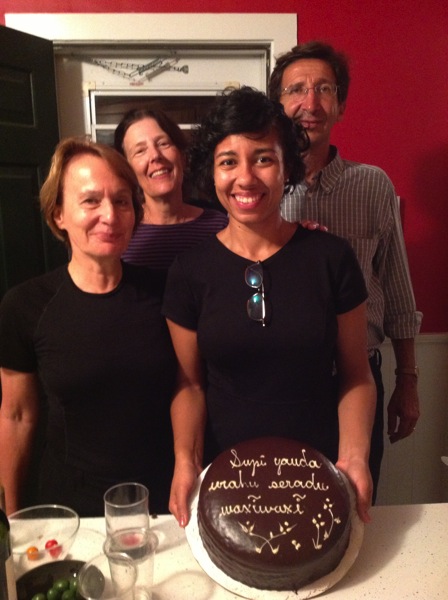
Suzi Lima is defended

Suzi Lima defended her dissertation on Monday, August 26 with flying colors. Her dissertation, "Counting and Measuring in Two Tupi Languages," passed the muster of this outsized committee: Seth Cable, Gennaro Chiercia, Chuck Clifton and co-chairs Angelika Kratzer and Lyn Frazier. 

Photo

Call for papers: Semantics and Philosophy in Europe 7 in June

The seventh "Semantics and Philosophy in Europe" colloquium (SPE 7) will be hosted by the Zentrum für Allgemeine Sprachwissenschaft (ZAS)  in Berlin on June 26-28 , 2014. The deadline for abstracts is February 1. For more information click here.

Gennaro Chierchia has a birthday

Barbara Partee writes:

On September 6, there was a surprise 60th birthday party for UMass PhD Gennaro Chierchia at Harvard (his birthday was Sept 10; by the time this note is published it should be safe to reveal that there will have been another surprise event in honor of his birthday, at Sinn und Bedeutung in the Basque Country during the week.) Gennaro was presented with a festschrift edited by his former students Ivano Caponigro and Carlo Cecchetto entitled From Grammar to Meaning:The Spontaneous Logicality of Language, including articles by Partee, Chomsky, Rizzi & Belletti, and others, and including as an appendix a play written at UMass in 1984 by Ray Turner and Kathy Adamczyk, dramatizing Gennaro and Ray's stormy collaboration on property theory.
 
At the party, Gennaro was presented with copies of the book inscribed by Chomsky and by Partee.  UMass faculty attending the celebration besides me were Lisa Selkirk, Angelika Kratzer, Tom Roeper, Lyn Frazier, and adjunct faculty member Vladimir Borschev.

The party turned out to be a complete surprise to Gennaro, even though Gennaro's wife Isa Orvieto was one of the planners, together with Ivano and Carlo. 

 
IMG 4549

09 September 2013

UMAFLAB meets on Friday

Seth Cable writes:

I'm very happy to announce that the first meeting of the UMAFLAB (UMass Funny Language Breakfast) will be this Friday at 9AM in room 301 of South College (the Partee Room).

This will be a short, purely organizational meeting, where we'll set up our schedule of meetings for the term. Thank you to everyone who wrote in mentioning an interest in presenting!

As another brief reminder about what UMFLAB is: the purpose of UMAFLAB is to bring together individuals with a shared interest in puzzling linguistic data, optimally (but not necessarily) from understudied or minority languages. *Presentations are always informal*. We are *not* looking for polished work or practice talks (though those are welcome).  Rather, participants are free to present any puzzles they like. They needn't have any analysis in mind; indeed, part of the fun of the group is hearing other people's thoughts on some difficult problem.

Thus, if all you have is an interesting pattern worth 'boggling at', that's perfect for our group (particularly if it's from an otherwise not-very-much-talked-about language or variety). For example, a run down of all the crazy data obtained during some recent field work (or experimental work, or whatever) would be quite ideal.

LARC/Acquisition Lab Meetings on Wednesdays: Meghan Armstrong this week

Magda Oiry writes:
 
Welcome back everyone and welcome to newcomers!
 
This year the acquisition lab LARC meeting will meet on *Wednesdays* from *12:15 to 1:15* in the Partee room (South college 301).
 
We will meet every other Wednesday.
 
Our first meeting will be this Wednesday, September 11. Meghan Armstrong, a new faculty member in Hispanic Linguistics (LLC) will be presenting on 'Child comprehension of belief state intonation in Puerto Rican Spanish'.

We will also do introductions and try to lay out an agenda for the semester.
 
Make sure you're on the mailing list: go to https://list.umass.edu/mailman/listinfo/ling-acquisition

Tom Ernst at Dartmouth this year

Tom Ernst will be teaching at Dartmouth this academic year. In the Fall, he'll be teaching their Introduction to Syntax course, and in the Spring, a course on Dialects. 

Seth Cable gets an NSF

Seth Cable has been awarded a three year grant from the National Science Foundation for "The Verbal Morpho-semantics and clausal architecture of Tlingit.  A brief description of the grant follows.

Congratulations Seth!

The Verbal Morpho-semantics and Clausal Architecture of Tlingit
 
This project will conduct detailed, theoretically-informed fieldwork upon the Tlingit language (Lingít, /ɬin.kít/), a highly endangered and understudied language indigenous to Alaska, British Columbia, and the Yukon. The project will focus upon aspects of the language related to the expression of time and possibility, as well as the nature of the language's relatively flexible word-order. 
 
This project will yield results of significance to both professional linguists and community members striving to learn Tlingit as a second language. Both groups will directly benefit from the collection of new Tlingit language data, given the language's status as highly endangered. In addition, study of the specific linguistic phenomena identified in this project will make distinct, important contributions to diverse areas of linguistic theory. For example, the investigation of word-order and sentence structure in Tlingit is expected to establish for linguists the existence of ‘covert A-scrambling’, a grammatical process whose existence is predicted by theory, but which has thus far not been definitively documented. Furthermore, study of the grammatical means by which Tlingit expresses the concepts of time and possibility will inform specific debates surrounding the extent to which languages vary in the expression of these concepts, thus probing deep and long-standing questions relating to human nature and the structure of human cognition. 
 
Beyond these technical results, this project will advance ongoing efforts to document, maintain and revitalize the growing number of endangered languages throughout the world, mitigating the inevitable and catastrophic language death that will occur by the end of this century. This project will uncover subtle grammatical generalizations of no small importance to the growing number of persons learning Tlingit as a second language. Moreover, the digital recordings and field reports made during this project will be added to the archives stored at the Sealaska Heritage Institute and the Alaska Native Language Archive, preserving for future Tlingit generations the voices and the words of their forebears.

The Psycholinguistic Evening Meetings

Brian Dillon writes:

This fall semester John Kingston and I would like to resurrect the great tradition of the UMass Psycholinguistics evening meetings. We invite you to join us for the Psycholinguistics Evening Meetings... Psych! (EM).
 
Psych! (EM) will meet every 2-3 weeks during the semester. It will function mainly as a reading group / journal club, as well as a venue for discussion of in-progress projects in Psycholinguistics. If there's a psycholinguistics paper you've been dying to read or some puzzling data you've been dying to discuss, an experimental technique you would like to talk about, then this is the venue! Psych! (EM) also intends to be a forum for discussion of technical / methodological issues related to the various experimental paradigms that people are using around the department. 
 
If you'd like to receive further updates on PsychEM meetings, please sign up for the *ling-psych mailing list*. Meeting announcements and information will be sent out to that mailing list. You can sign up for the list here: https://list.umass.edu/mailman/listinfo/ling-psych
 
Our first meeting will be Wednesday September 18th at 7:30pm, at my house in Northampton (181 Main St, Apt C). I'll provide beer and snacks. For this meeting we'll do our semester planning, and read 'Towards a model of acceptability judgments' by Markus Bader and Jana Häussler (here's a link that will work on campus: http://journals.cambridge.org/production/action/cjoGetFulltext?fulltextid=7802268). The (informal) discussion will be led by Brian.

PRG meets on Thursdays

Claire Moore-Cantwell writes:

You are cordially invited to Phonology Reading Group (PRG) meetings this 
semester.  They will take place in Northampton, at 7:30 pm on Thursdays, 
approximately every other Thursday, starting next week:

Thursday, Sept. 12, 7:30 pm
Location: 16 Main st., apartment 2A (Shayne and Amanda's place, 
directions below)
Topic: 'Effects of sonority on phonological inventories' By Ivy Hauser
Food: Bring your own take-out

Directions: enter through the first set of doors leading to Pho Vietnam, 
then turn immediately right. Open the door just beyond the mailboxes. Go 
upstairs one flight, turn left, then left again, to arrive at our 
apartment door.

M@90

Michael Kenstowicz from MIT writes:

The MIT Department of Linguistics is holding a workshop/conference on Stress and Meter on Sept. 20-21 entitled M@90. As the conference name suggests, it is intended to celebrate Morris' 90th birthday and honor the fundamental work he has done in these areas of research (as in so many others). The conference has a website (http://m90.mit.edu/) and we are asking attendees to register in order to know how many people to expect. There is also a Tabula Gratulatoria to which you can submit messages for best wishes, etc. 

Program in Informatics

The School of Computer Science announces a new program in Informatics through BDIC, which will eventually turn into a major in the School. If you are interested in Informatics or in the Computer Science major, you should attend a meeting Monday, September 9, at 4 PM in 150/151 Computer Science Building.

More information about the Informatics program may be found atwww.cs.umass.edu/informatics.

02 September 2013

Michelle McBride joins the Linguistics Department

With great pleasure, WHISC announces that  Michelle McBride assumed the duties of department secretary on July 29th. Step into the main office this week and join us in welcoming her to the department.

Town Meeting on Friday

John Kingston writes:

As we do at the beginning of each year, we will kick off the year with a town meeting in the department lounge on the third floor of South College on the first Friday of the Fall semester at 3:30. This year that's 6 September. We'll also take a group picture and individual pictures for the board outside the first floor entrance, so come dressed as you would want to be photographed.

Department Picnic Sunday, Sept. 8

Please come to the annual beginning-of-the-year potluck picnic / party to greet the new school year and welcome new faculty, new students, new visitors. Bring friends and family!

When: SUNDAY, September 8, starting at 3:30, continuing on into the evening

Where: 50 Hobart Lane, Amherst, 01002. (413) 549-4501 -- Barbara and Volodja's.

Hobart Lane is a small street that goes east off North Pleasant just a short distance north of the university, opposite Puffton Village, near the Crestview /Presidential Apartments bus stop. 50 Hobart Lane is a big white house on the left, near the end. The street sign may be missing; but in that case it’s the only street around there with a pole but no sign. 

The party will be outdoor/indoor; dress casual. The picnic will be held rain or shine!

We don’t set up a volleyball net anymore, but do bring other outdoor stuff. We have a croquet set, and badminton raquets and birdies, and there’s ping-pong in the basement.

Food and drink: Potluck

We'll have a charcoal grill, and some beer, wine and non-alcoholic beverages (more needed). Bring things to eat in any category. International foods most welcome! (If you aren't up for cooking, you can bring beer or wine, or cheese, or fruit, etc.) We'll likely start eating around 4:30 or 5:00.

Elizabeth Bogal-Allbritten invited speaker at SULA

Elizabeth Bogal-Allbritten has been invited to speak at the next meeting of the Semantics of Under-represented languages in the Americas, which will be held in May at the University of British Columbia.

Congratulations Elizabeth!

P Reading Group meets this Friday

Claire Moore-Cantwell writes

The first official PRG MEETING will be a joint breakfast meeting with the Sound Seminar, FRIDAY SEPT. 6th AT 9AM, in the PARTEE ROOM.

Undergraduate Research Assistants in Psychology

Alexandra Jesse writes:

We are currently looking for undergraduate research assistants to work in the Language, Intersensory Perception, and Speech (short: LIPS) lab in the Psychology Department. Positions are open starting Fall 2013. Ideal applicants are those who can commit to a longer time period.

The work within the LIPS lab falls within the area of Psycholinguistics. We examine how listeners recognize speech from hearing and seeing a speaker talk. In particular, we are interested in the time-course of recognizing words - both from listening and from lip-reading, how listeners adjust to a speaker's idiosyncratic pronunciations, and what happens to these processes when people get older. We use eye-tracking and other behavioral methods to address these questions, as well as EEG.

You can visit our website for more information:
http://lips.psych.umass.edu

Typical tasks of our research assistants are:
- help with finding stimuli for an experiments (e.g., selecting words, making nonwords)
- help with recording, annotating, and editing of speech materials for the experiments
- assist with recruitment, scheduling, and testing of participants
- attend & prepare for weekly lab meetings
- do administrative research-related tasks

The typical commitment of our research assistants during the school year is 9hrs/week, for 3 credits. You would be enrolled in Psych 398B, but this course can count as an elective towards your linguistics degree. Please contact me if you have any questions about how these credits can be applied to your degree in Linguistics. Other majors are of course also eligible to apply.

So if you are interested in the position, please contact me as soon as possible for more information and for an application form. Once you return the completed application form, we will then contact you to schedule for an interview. We will then also require a letter of recommendation. Therefore, if you are interested, please respond to this email as soon as possible.

Please send any inquiries to participate@lips.psych.umass.edu

Bogal-Allbritten and Cable fill NLS

The recent issue of Natural Language Semantics (vol. 21.3) is an all UMass issue. It contains Seth Cable's article "Beyond the past, present, and future: towards the semantics of graded tense in Gikuyu" and Elizabeth Bogal-Allbritten's article "Decomposing notions of adjectival transitivity in Navajo."

Congratulations Seth and Elizabeth!

Department Colloq schedule announced

Mike Clauss and Claire Moore-Cantwell announce:

The Fall 2013 Colloquium Series has been scheduled! Lots of exciting talks to look forward to this coming semester.
 
9/27 - Akira Omaki (Johns Hopkins) 
10/25 - Adam Albright (MIT)
11/1 - Tim Hunter (Minnesota)
11/22 - Jon Gajewski (UConn)
 
Jason Merchant and Naomi Feldman were also both invited, but cannot make it this semester; they will thus be coming some time in the Spring semester to give colloqs.
 
In addition to these four talks, there will be a talk on 11/15 by Phonology Guru Elliot Moreton from UNC; more details on Professor Moreton's stay as Guru to come separately.

SNEWS at MIT in November

Aron Hirsch and Wataru Uegaki at MIT write:

We are pleased to announce that MIT will be hosting this year's SNEWS (Southern New England Workshop in Semantics) on November 16th (Sat). SNEWS is an annual student-run workshop where graduate students in the Southern New England area can present their work in semantics/pragmatics and receive feedback in an informal setting. Students are invited to present their ongoing work on any topic in semantics and pragmatics - theoretical and/or experimental methodology. Universities that have participated in the past include Brown, UConn, Harvard, UMass, MIT and Yale.

The workshop website can be found here: http://web.mit.edu/wuegaki/www/snews/

Call for papers: International Conference on Linguistics at Petra

The first meeting of the International Conference on Linguistics will take place November 19-21 at Al-Hussein Bit Talal University in Petra Jordan. Papers in syntax, semantics, morphology, phonology and psycholinguistics in English, French and Arabic are sought. The deadline for abstracts is October 6. Invited speakers are Hamida Demirdache, Abbas Benmamoun and Basil Hatim. For more information, go here.

Sinn und Bedeutung at the University of the Basque Country

Sinn und Bedeutung 18 takes place this month in Vitoria-Gasteiz in the Basque Country of Spain. UMass alumnus Florian Schwarz is giving a talk "An experimental comparison between presuppositions and indirect scalar implicatures" with Jacopo Romoli. The invited speakers include UMass alumni Maribel Romero and Gennaro Chierchia. For a full schedule, go here.

Tim Austin named Provost at Duquesne University

UMass alumnus Tim Austin (1977)  has been named provost and vice president for academic affairs at Duquesne University in PIttsburgh, effective July 15. For the full scoop, go here.

A report from the Rio Institute on "Recursion in Brazilian languages and Beyond"

Tom Roeper writes:

The Rio Institute on "Recursion in Brazilian languages and Beyond" was a great success---in both English and Portuguese. It involved 16 different indigenous languages with representative native speakers of
Piraha, Wapachana, Kuikuro and many others. [A great set of pictures and brief descriptions of each talk are available on Facebook under "Recursion in Brazilian Languages".] And there was a great mix of faculty, visitors, and graduate students from Brazil and abroad. It was very well organized by Professor Marcus Maia, a UMass visitor last year.

The first section involved fieldwork with two Piraha speakers. It was a wonderful circus with loads of current and former UMass folks getting into the act: Luiz Amaral, Bart Hollebrandse, Uli Sauerland, and Ana Perez (I was good at keeping an eye on the experimental setups--but was hopeless in parsing the tonal sentences---Luiz somehow, magnificently, figured out how to do it.) Recursion in PP's, adjectives, relative clauses, and sentences were explored with pictures, and
most successfully acting out. The monolingual Piraha speaker resisted for an hour acting out PP-DP recursion (roughly: ``put the penny in the box on the chair on board on the floor'') but then spontaneously produced PP-PP cases "put the penny on the floor on the board on the chair in the box") and then comparable cases were easy. While the sessions were a bit chaotic (will be available on Youtube soon), they are really pilots for two talented graduate students who will go to the Piraha for a year in Sept.

The conference involved a variety of papers with presentation of PP and possessives-recursion experiments on a common model from half a dozen Indian languages, Portuguese, and Japanese. There was obvious pride among the Indians and researchers in having accomplished co-ordinated research on complex constructions.

Also from UMass: Suzi Lima made two terrific presentations (and she will be co-ordinating further research soon), Bart Hollebrandse, Ana Perez, Jon Nelson, and Luiz Amaral made presentations (and I gave a keynote). Terue Nakato's providing parallel experiments in child Japanese to the work in Wapachana and elsewhere made the common character of human languages stunningly clear.

Then courses: Ana Perez gave a very nice course on her recent results with recursion among bilinguals and across constructions, Luiz Amaral and I gave a bilingual course on Multiple Grammars, and Uli Sauerland did a Fieldwork course exploring a variety of structures with native speakers. Andrew Nevins gave a course exploring intonation and recursion.

Personal View: it was extremely gratifying to me to see acquisition methods extended to fieldwork in a coordinated fashion---very promising.In a letter to some participants I wrote:

"    Altogether it was an amazing, inspiring, and historic Institute.  It begins to fulfill the promise of linguistics I think.  We are building--through a common event-- a community which reaches from sophisticated questions in mathematical linguistics, to linguistic theory, fieldwork, acquisition techniques, and pedagogical grammars.  Questions remain alive in all these areas---but each domain benefits from the intermingling of ideas long before "established results" are available.     Each area, and each person, should feel empowered to make the (provisional and reversible) decisions of how to borrow knowledge.  Those in linguistic theory must be able to choose the version of mathematical recursion needed, the acquisition student chooses the version of linguistic theory he/she wants, the fieldworker sees what can be adapted to fieldwork, and the teacher envisions how it will work as pedagogy.    Equal partners in each step of this process is what does and will make it work.  This institute contributes to a responsible intellectual culture with a real ladder between theory and practice.  It can be a worldwide model of how cooperation can proceed."

04 June 2013

Knowledge and Culture postdoc

There is a 3-year postdoc position available in the project coordinated at Leiden University, "Knowledge and culture" (subproject 2: Language and number). Please see this for further details. If you have any question, please address them to the project leader, Johan Rooryck: j.e.c.v.rooryck@hum.leidenuniv.nl.

Barbara in Scotland

Barbara Partee presented a talk at the Arché 2013 Philosophy of Semantics Workshop May 25-27 at St. Andrews, Scotland (http://www.st-andrews.ac.uk/arche/events/event?id=659). Her talk was entitled “The History of Formal Semantic Practice and its Relation to Foundational Problems”. Barbara writes that the workshop seemed designed to probe controversial foundational issues, and she had been looking forward to it with a mix of eagerness and trepidation. (Her own talk discused some of those issues but at the same time agrees with the last page of the Heim and Kratzer textbook: linguists know, and sometimes care, about issues at the foundation of formal semantics, but worrying about them mostly doesn’t get in the way of “doing” formal semantics. Linguists qua linguists tend to be instrumentalists and tend to appreciate any theory that helps to give good explanations of linguistic phenomena.)

WHISC whisks

away to vacationland.

21 May 2013

Rajesh Bhatt returns as UC Guru

Rajesh Bhatt spent last week as the inaugural linguistics guru at the University of Chicago. WHISC has learned that several members of the University Chicago linguistics community report enlightenment.

Call for abstracts: Workshop on the Acquisition of Quantification

UMass will sponsor a Workshop on the Acquisition of Quantification October 4-5 2013. The call for abstracts is below.

Website: http://blogs.umass.edu/moiry/workshop-quantification/

Invited Speakers:

Martin Hackl (Massachusetts Institute of Technology)
Julien Musolino (Rutgers University)
William Philip (University of Utrecht)

We invite abstracts for 20-minute talks and poster presentations on all aspects of quantification in first and second language acquisition, bilingualism, and language disorders. Abstracts should not exceed 2 pages, including data and references, and should be submitted online via the EasyAbs system (http://linguistlist.org/easyabs/Quantification).

Deadline for submission: July 1, 2013
Notification of acceptance: Before August 15, 2013

Organizing committee: Luiz Amaral, Michael Clauss, Jeremy Hartman, Barbara Pearson, Magda Oiry, Tom Roeper.

Meeting email: acquisition workshop at linguist.umass.edu

Michael Becker goes to Stony Brook

In the Fall, Michael Becker will be moving from a tenure-track job in
the Linguistics Department at Indiana University to at tenure-track
job in the Linguistics Department at Stony Brook University.
Congratulations, Michael, and welcome back to the Atlantic Ocean!

Workshop on Prosody in Sentence Processing next week

There will be a Workshop on Explicit and Implicit Prosody in Sentence Processing on May 30 and 31 in 1634 Lederle Graduate Research Center.  Mara Breen from Mt. Holyoke will be presenting a paper as will UMass regulars Adrian Staub, Chuck Clifton, Kristine Yu and Ilaria Frana.  For a schedule, click here.

Anisa Schardl goes to Swarthmore

Anisa Schardl has accepted a one-year position teaching at Swarthmore in the Fall. Congratulations Anisa!

Recursion in Brazilian Languages and Beyond project

LARC  is one of the sponsoring organizers of the Recursion in Brazilian Languages and Beyond conference, which will take place in the first week of August in Rio de Janeiro. UMass alumni Ana Perez-Leroux, Bart Hollebrandse will give papers, as will Jon Nelson, Luiz Amaral, and Suzi Lima. Tom Roeper gives one of the Keynotes: "Recursion typology and the Acquisition Path." Tom Roeper writes that there will be a small institute with courses associated with the conference that Luiz Amaral, Ana Perez-Leroux, Uli Sauerland and Tom Roeper will be teaching at.
 
For more information, go to:


Anisa in Iceland and a call for abstracts to a workshop on Heritage languages


Anisa Schardl writes:

Last week, I gave a talk at the 25th Scandinavian Conference of Linguistics at the University of Iceland.  Link to the program:

https://conference.hi.is/scl25/call-for-papers/

Andries Coetzee was also there.  I've attached photographic evidence.

P.S.  Maybe other people want to go to Iceland?  There is going to be a
workshop on heritage languages in the Americas.  Abstracts are due by the end of the month.

http://conference.hi.is/heritagelanguages/

Iceland 181

Roeper in Irvine

Tom Roeper gave a talk on May 8th at the Cognitive Science Center at the University of California, Irvine entitled "How Interfaces Guide Acquisition: frequency, recursion, and the Strong Minimalist Thesis."

12 May 2013

Mike Clauss at AFLA 20

Mike Clauss presents his paper "Optional V2 and the Left Periphery in Tuvaluan" at the Austronesian formal Linguistics Association meeting at the University of Texas at Arlington on Saturday, May 18th. For more information about AFLA, go here.

Congratulations Mike!

Call for papers: Identity in Ellipsis

20-21 September: Identity in Ellipsis Conference

On 20 and 21 September 2013, LUCL is hosting the conference 'Identity in Ellipsis'.

Identity in Ellipsis

Identity in ellipsis is a long-standing issue in linguistics. Virtually all accounts of ellipsis phenomena assume that the elided material must be identical in some way or other to material in a suitable antecedent available in the discourse. The nature of the identity condition   and its precise formulation is under heated debate in current research. The main question is whether identity holds at some syntactic level of representation, or some semantic one, or both. 
The syntactic account of identity (Sag 1976, Williams 1977, Fiengo & May 1994, Chung et al. 1995, Baltin 2012, Johnson 2012, Chung 2013) holds that ellipsis is recovered under a form of structural identity with the antecedent, defined over phrase markers of some sort, in most but not all cases, identical LF representations. Clearly, surface identity is not required, as shown by possible inflectional differences on verbs (see Warner 1985 for exceptions, and Lasnik 1995 for an account), cf. (1). 

(1)       a.         They eat nattoo and John [ eats nattoo ], too.           
           b.         John has eaten nattoo and Bill may [ eat nattoo ], too. 

Semantic accounts, on the other hand, operate with an identity relation stated purely over semantic representations (Dalrymple et al 1991, Sag & Hankamer 1984, Hardt 1993, Ginzburg and Sag 2000, Merchant 2001, Anderbois 2011). Support for the semantic approach comes from various phenomena. One is 'vehicle change' (Fiengo and May 1994), others are syntactic mismatches of the kind in (2) (Merchant 2005): 

(2)       I remember meeting him, but I don't remember when [ I met him ].

Semantic accounts are also supported by the availability of non-isomorphic antecedents in clausal ellipsis like sluicing (Postdam 2007, Vicente 2008, van Craenenbroeck 2010). 
Syntactic identity is heavily supported by the lack of argument structure alterations (Chung 2006) and the lack of active-passive mismatches in clausal ellipsis (Merchant 2008), such as (3), since active and passive sentences differ from each other only in their syntax but not in their semantics.

(3)       *Joe was murdered, but we don’t know who [ murdered Joe ].

In addition to purely syntactic and semantic approaches, there also exist 'hybrid' approaches, according to which both semantic and syntactic identity can guide the recovery of the elided material. In the most prominent type of hybrid approach (Kehler 2002), it is the discourse relation between the elliptical clause and its antecedent that determines the choice between syntactic and semantic identity and impacts the elidability of constituents.

Psycholinguistic research on ellipsis has also begun to address the issue of ellipsis identity, in order to understand what guides the parser in the recovery of the antecedent. It has been found that various forms of antecedent-ellipsis mismatches receive a systematic cline of acceptability (Kim et al 2011), which might suggest that identity is syntactic but non-identical ellipsis can be 'repaired' and become acceptable if the repair is not too difficult (Arregui et al 2006).

Call for abstracts

We invite abstracts that bear on the identity condition on ellipsis from theoretical and experimental angles, addressing the issue of identity in any language. In particular, questions that the conference seeks to address include – but are not limited to – the following: 

  • Does ellipsis need syntactic or semantic identity, or both?
  • What is the role of discourse in determining which kind of identity is required?
  • Are there differences in identity across small and large ellipses (clausal vs. predicate ellipsis)?
  • Are there cross-linguistic differences in the kind of identity ellipsis requires?
  • Under which conditions can ellipsis sites be non-isomorphic to their antecedent?
  • What is the role of extralinguistic material in the recoverability condition in ellipsis?
  • Which psycholinguistic methodology can be used to address the identity issue?
  • How can we integrate experimental and theoretical approaches into one coherent model?


Submission guidelines
 
Abstracts are invited for 30-minute oral presentations (plus 10 minutes for discussion) and a poster session. Abstracts should not exceed two pages, including data, references and diagrams. Abstracts should be typed in at least 11-point font, with one-inch margins (letter-size; 8″ ½ by 11″ or A4) and a maximum of 50 lines of text per page. Abstracts must be anonymous and submissions are limited to 2 per author, at least one of which is co-authored. Only electronic submissions will be accepted. Please submit your abstract to identitycondition@gmail.com by 15 June 2013.

Invited speakers

We are pleased to announce that the following invited speakers have agreed to give a talk:

- Jeroen van Craenenbroeck 
- Jason Merchant 
- Gary Thoms

Selection committee

Lobke Aelbrecht, Enrico Boone, Jeroen van Craenenbroeck, James Griffiths, Kyle Johnson, Marjo van Koppen, Anikó Lipták, Jason Merchant, Andrés Saab, Bobby Ruijgrok, Erik Schoorlemmer, Gary Thoms, Mark de Vries.

Organizing committee

Enrico Boone, Anikó Lipták and Bobby Ruijgrok

Important dates

Abstract submission deadline: 15 June, 2013

Notification of acceptance: 15 July, 2013

Conference dates: September 20-21, 2013


Call for papers: Workshop on pronouns

Call for papers: The Impact of Pronominal Form on Interpretation

Date: 15-17 November 2013
Call Deadline: July 28th 2013

Meeting Description:
Pronouns can vary along two dimensions: (i) their interpretation (e.g., free vs.  syntactically bound vs. donkey pronouns) and (ii) their form (e.g., personal vs. clitic vs.  null vs. demonstrative pronouns). The goal of this workshop is to bring together recent  advances bearing exactly on the interplay of the two, e.g. how do choices along one dimension restrict the possible choices along the other one?

Invited Speakers:
Peter Bosch (University of Osnabrück)
Paul Elbourne (QMUL)
Irene Heim (MIT)
Martina Wiltschko (UBC)

Commentators for invited talks:
Vera Hohaus (University of Tübingen)
Gerhard Jaeger (University of Tübingen)
Jacolien van Rij (University of Tübingen)
Ede Zimmermann (University of Frankfurt)

Discussion: Current pronominal issues at the syntax-semantics interface
Uli Sauerland (Harvard/ZAS Berlin)
Sarah Zobel (University of Tübingen)

Call for Papers:
We invite submissions for 30-minute talks plus 10 minutes for discussion. Abstracts must  be anonymous, in PDF format, 2 pages (A4 or letter), in a font size no less then 12pt, and  with margins of 1 inch/2.5cm. Please submit abstracts via EasyAbs (see link below) no
later than July 28th, 2013.

Abstract submission link: http://linguistlist.org/easyabs/pronouns2013

Ideal submissions to this workshop might involve (but are not limited to) the following  components (individually or in combination):

- Experimental testing using methods from psychology/the cognitive sciences.
- Novel empirical findings (e.g. from corpus work), which shed light on pronouns
at the syntax-semantics interface.
- Potential extensions of current syntactic-semantic approaches to pronouns to
accommodate other pronominal classes (e.g. null pronouns, demonstratives).- Diachronic shifts of the pronominal form and interpretation.
- Recent developments concerning (anti-)logophoricity.
-Comparisons of quantifier-variable readings contrasting null pronouns with
overt pronouns.
- The cross-linguistic distribution of demonstrative pronouns and their comparison
to personal pronouns.
- Semantic differences between clitic pronouns and non-clitic pronouns.

• For questions or inquiries, please contact: pritty.patel-grosz@uni-tuebingen.de 

Organisational Committee
Katrin Axel-Tober (University of Tuebingen)
Patrick Grosz (University of Tuebingen)
Pritty Patel-Grosz (University of Tuebingen/SFB 833)

For more information, go here.

Call for Papers: BUCLD 38

The 38th Annual Boston University Conference on Language Development will take place at BU on NOVEMBER 1-3, 2013.

 Keynote Speaker:

Elena Lieven, Max Planck Institute for Evolutionary Anthropology / University of Manchester

Plenary Speaker:

Heather van der Lely, Harvard University

Submissions of abstracts for 20-minute talks are now being accepted at:

http://www.bu.edu/bucld/abstracts/abstract-submission/

DEADLINE. All submissions must be received by 8:00 PM EST, May 15, 2013.

Submissions that present research on any topic in the fields of first and second language acquisition from any theoretical perspectives will be fully considered, including: Bilingualism, Cognition & Language, Creoles & Pidgins, Dialects, Discourse and Narrative, Gesture, Hearing Impairment and Deafness, Input & Interaction, Language Disorders, Linguistic Theory, Neurolinguistics, Pragmatics, Pre-linguistic Development, Reading and Literacy, Signed Languages, Sociolinguistics, and Speech Perception & Production.

A suggested format and style for abstracts is available at:

http://www.bu.edu/bucld/abstracts/abstract-format/

NEW THIS YEAR: SYMPOSIUM PROPOSALS

 We are also soliciting proposals for a 90-minute symposium on a common theme on any topic likely to be of broad interest to the conference attendees. The symposium format is open, but has frequently included 2-3 speakers presenting research from differing angles on a common theme. We anticipate including two such symposia in the schedule, one being the Saturday lunchtime symposium, the other closing the conference on Sunday. Proposals should include a list of potential participants and a specification of the format, and should name at least one organizer who will be able to work with the BUCLD organizing committee in setting up the symposium and lining up participants. Submissions can be sent by email to abstract@bu.edu with "Symposium proposal" indicated in the subject line. Please limit symposium proposals to 1000 words or fewer.

 DEADLINE. Same as for abstracts, 8:00 PM EST, May 15, 2013.

 Decisions on symposia will be made by June, so that organization can begin, with the goal

of having all participants confirmed by July.

FURTHER INFORMATION

General conference information is available at:

http://www.bu.edu/bucld

Questions about abstracts and symposia should be sent to abstract@bu.edu

Call for papers: Countability Workshop in Düsseldorf

Abstracts are solicited for presentations which address theoretical or empirical issues (i) in the study of the mass/count distinction in the nominal domain as well as (ii) the parallel distinction(s) in the verbal domain.

Topics of particular interest include (but are not limited to):

- cognitive basis of countability, its grammatical manifestations and sources for the cross-linguistic variation in its encoding

- relations between count and non-count meanings, sort-shifting, type-shifting, and coercion

- vagueness and gradations of individuation, mess and neat mass nouns

- parallels and differences in the counting and measuring for noun and verb meanings

- corpus-based and psychological evidence for the distinction between count and non-count meanings

- computational modeling


Submission Details

Abstracts must be anonymous, no longer than 2 pages, in PDF format and sent via email to countability.ddorf.submit@gmail.com. Prospective speakers may submit abstracts for one single-authored and one co-authored paper. All abstracts will be reviewed anonymously by at least two reviewers. Abstracts should not include the authors’ names, and authors are asked to avoid self-references.


After submitting your abstract, please send a separate email to countability.ddorf.submit@gmail.com with the following information:


- Title of the talk

- Name of author(s)

- Affiliation(s)

- Address(es)

- Phone number(s)

- Email address(es)


Important dates

Abstract Submission Deadline: July 1, 2013

Notification of acceptance: July 15, 2013

Workshop: September 16-17, 2013


Invited Speakers

David Barner (University of California at San Diego)

Gennaro Chierchia (Harvard University)

Jenny Doetjes (Leiden University)

Scott Grimm (Pompeu Fabra University)

Manfred Krifka (Humboldt University and Center for General Linguistics, Berlin)

Fred Landman (Tel Aviv University)

Susan Rothstein (Bar Ilan University)

Tobias Stadtfeld (Bochum University)

Roberto Zamparelli (University of Trento)


Conference Organizers

Hana Filip (Heinrich Heine University)

Christian Horn (Heinrich Heine University)


Contact

countability.ddorf@gmail.com


Submission of abstracts

countability.ddorf.submit@gmail.com

Stefan Keine gets Graduate School Fellowship

Congratulations to Stefan Keine who has been awarded a Graduate School Fellowship for next year.

Postdoc position at Ruhr University Bochum

The Chair of Philosophy of Language and Cognition at the Ruhr University Bochum invites applications for
 
A PHD OR POSTDOC STIPENDIARY FELLOWSHIP
 
in
 
PHILOSOPHY OF LANGUAGE/NEUROLINGUISTICS/NEUROSEMANTICS
The candidate should have a strong interest in questions at the interface between philosophy of language and linguistics, with a focus on the semantics and/or pragmatics of natural language. Some background in logic or formal semantics would be welcome. The successful applicant will be expected to actively contribute to an interdisciplinary research endeavor that among others involves the use of EEG methods.
 
The position will be filled either with a PhD candidate or a postdoc and will run until 31 December 2015. The position will be part of the international and interdisciplinary Mercator Research Group “Structures of Memory”. The main language of communication of the Research Group is English.
 
Depending on qualification, the stipendiary fellowship will match the net income of a
 
• 50% TV-L E13 position (PhD candidate, approx. 1300€/month),
• 75% TV-L E13 position (advanced PhD candidate/early postdoc, approx. 1700€/month),
• 100% TV-L E13 position (postdoc, approx. 2100€/month), respectively.
 
Applications should be sent electronically to jobs-mrg1phil@rub.de by June 15, 2013, and specify the name of the position and whether a PhD or postdoc stipendiary fellowship is applied for. They should include a statement of interest (not more than one page), a CV, a list of publications, copies of relevant certificates and diploma, one letter of reference and the names of two further referees. We regret that we will not be able to return any submitted material and send out negative notifications.
 
For further information please visit the webpage http://www.ruhr-uni-bochum.de/phil-lang or contact Professor Markus Werning (markus.werning@rub.de) directly.
 

06 May 2013

Field Methods presentations tomorrow

Alice Harris and Kristine Yu write:

Faculty and grad students are invited to hear talks on Dzongkha, the language we focused on this semester in field methods.  Talks will be in Dickinson 206, beginning at 12:00 tomorrow, May 7.

12:00   Nick LaCara, "The Structure of Nominal Phrases in Dzongkha"

12:30   Mike Clauss, “Converbs in Dzongkha”

1:00   Kristine Yu, “Tone and voice quality in Dzhongka + building a speech corpus”

1:30   Alice Harris, “Preliminary description of comparatives and of relative clause constructions”

Please feel free to bring a brown-bag lunch.  Homemade desserts will be available.

Yu gets a Mellon Mutual Mentoring Grant

Kristine Yu has been awarded a 2013-14 Mellon Mutual Mentoring grant that will be used to build a prosody team among many  faculty spread across the Five Colleges, including: Brian Dillon, Jeremy Hartman, Magda Oiry, Luiz Amaral, Mara Breen, Emiliana Cruz, Gwyneth Rost, Adrian Staub, Mary Andrianopoulos, Seth Cable, Chuck Clifton, Lyn Frazier, LIsa Green, Angelika Kratzer, Lisa Green and John McCarthy.

Congratulations Kristine!

Call for Papers: Phonology 2013

Joe Pater writes:

We are seeking high quality unpublished research in all areas of phonology for presentation at Phonology 2013, to be held November 8-10 on the campus of the University of Massachusetts Amherst. This is planned to be the first in an annual series of general phonology conferences, to be held at a different location each year. In addition to the invited speakers, there will also be oral and poster presentations selected through abstract review. All oral presentations will be published in an on-line conference proceedings. Abstracts should be anonymous, and a maximum of 2 pages in 12 point font, figures and references included. They can be submitted at http://linguistlist.org/easyabs/phonology-2013. The deadline is midnight US EST, Wednesday July 1. 

Invited Speakers
John McCarthy, UMass Amherst
Sharon Peperkamp, LSCP Paris
Kevin Ryan, Harvard University

The research presentations will take place November 9-10. On November 8, we will hold a tutorial workshop on "Computational and Experimental Methods in Phonology". The full schedule is TBA, but we are pleased to announce three of the tutorials now:

John Kingston, UMass Amherst "Octave/Matlab scripting for Psychtoolbox" 
Lisa Sanders, UMass Amherst "ERP methods for phonology"
Brian Smith, UMass Amherst "Corpus phonology in R"

Kingston gets CHFA grant for fieldwork

John Kingston got a CHFA grant to fund fieldwork on the Otomanguean languages, Chatino and Chinanteco, of Oaxaca this June and July. He'll be working closely with Emiliana Cruz of our Anthropology Department and Tony Woodbury of the Linguistics Department at the University of Texas, Austin on the phonetics and phonology of tone in Chatino, and with Mario Chavez Peon of CIESAS-DF on the same phenomena in Chinanteco.

Congratulations John!

New Linguistics Blog

Barbara Partee writes:

There’s a new blog, “History and Philosophy of the Language Sciences”, edited by James McElvenny at the University of Sydney. I’m the invited author of the third post in it, ‘On the history of the question of whether natural language is “illogical”’, which came out on May 1. For now, new posts are planned weekly. Here’s the blog address: http://hiphilangsci.com/.

Call for Papers: Old World Conference in Phonology

11th Old World Conference in Phonology (OCP 11)
Leiden University Centre for Linguistics (LUCL), Meertens Instituut Amsterdam
22-25 January 2014

Invited Speakers:

Adamantios I. Gafos (University of Potsdam)
Silke Hamann (University of Amsterdam)
Alan Prince (Rutgers University)

The Leiden University Centre for Linguistics (LUCL) and the Meertens  
Instituut Amsterdam are proud to announce that the eleventh Old World  
Conference in Phonology (OCP 11) will take place in Leiden and  
Amsterdam from 23 to 25 January 2014. It is organised by a group of  
local phonologists and follows in the line of previous OCP  
conferences, which have been held in Leiden, Tromsø, Budapest, Rhodes,  
Toulouse, Edinburgh, Nice, Marrakech, Berlin, and Istanbul.

The conference will be preceded by a workshop on the relationship  
between phonetics and phonology on 22 January. Everyone attending the  
conference is very welcome to attend the workshop, too.

Pre-Conference Workshop on the Relationship between Phonetics and Phonology:

During the last years a special attention has been devoted to the  
relationship between phonetics and phonology. However, most of the  
questions dealing with the role of phonetics in formal models of  
phonology are still unanswered. As a matter of illustration, some of  
these questions are the following: are phonological features grounded  
in phonetics, or are they substance-free? If features are grounded in  
phonetics, are they based on articulation or acoustics? Is the mapping  
between the phonological output and phonetics a direct or an indirect  
one? Should functional explanations of phonological patterns be  
included in formal phonology, or are synchronic phonological patterns  
just phonetically arbitrary, meaning that those explanations do not  
belong to grammar but to other theories such as sound change? How is  
metrical structure reflected in phonetics? (How) should phonetic  
variation in the speech signal be captured in phonological theory?

Local Organizers:

Chair: Björn Köhnlein
Bert Botma
Ben Hermans
Frans Hinskens
Claartje Levelt
Kathrin Linke
Etske Ooijevaar
Marc van Oostendorp
Marijn van ?t Veer
Secretary: Francesc Torres-Tamarit

Call for Papers:

Abstracts for presentation as either talks or poster papers can be  
submitted on any phonological issue (theoretical or empirical).

For the main conference, we invite abstracts either for an oral  
presentation of 20 minutes (followed by 10 minutes of discussion) or  
for poster presentation.

For the workshop, we invite submission of abstracts for an oral  
presentation of 20 minutes (followed by 10 minutes of discussion).

Abstracts must be anonymous and no longer than two pages, including  
examples and references. Submissions are restricted to one  
single-authored and one co-authored abstract. The conference language  
is English: abstracts and talks will be in English.

Page format: A4, 2,54 cm (one inch) margins on all sides, 12-point  
font, single line spacing
File format: .pdf

Important Dates:

Deadline for abstracts: 15 September 2013
First call for papers: 29 April 2013
Second call for papers: 15 July 2013
Last call for papers: 1 September 2013
Notification of acceptance: 1 November 2013
Main conference: 23-25 January 2014
Pre-conference workshop: 22 January 2014

28 April 2013

LARC/Acquisition Lab meeting Monday

Magda Oiry writes:

Join us this coming Monday April 29th at 12:15 in the Partee room (South College 301) for the last LARC lab meeting of the semester.
 
We will hear about:
 
PP recursion from different angles
with Luiz Amaral, Athulya Aravind, Jill de Villiers, Andie Faber, Jon Nelson and Tom Roeper.
  
Everyone welcome!

Celebrating graduating seniors

John Kingston writes:

The celebration for graduating seniors will be held Thursday, May 2nd,  
1-2:30 in the department lounge. We'll have pizza and cake and gifts.

We'll be taking pictures, so please come in a form that you would want  
to be depicted in.

Ferreira talks on May 1

Victor Ferreira (UC, San Diego) will talk on Wednesday 5/1, at 12:00-1:15 in Tobin 521B. A title and abstract of his talk follows

How do speakers' choices bring about successful communication?

Every produced utterance requires a speaker to make a cascade of choices: what words to use, what information to mention, what way to assemble a sentence. What principles guide such choices so as to allow successful communication? Explanations often default to the need to cater to listeners: Use words, include information, or assemble sentences per your listener's needs. In this talk, l describe research from my lab that points to a different principle: Speakers' choices are made to cater to speakers' needs. This fits with a broader division of labor for communicative success, whereby speakers work to speak efficiently, listeners work to understand speakers, and grammars constrain everyone so that everything works out.

Mini-Conference on Thursday

Joe Pater writes:

Our departmental mini-conference will take place Thursday May 2nd. The talks will go from 9:30 - 12 in Machmer E-37, and will include presentations from all of our second years: Michael Clauss, Hannah Greene, Stefan Keine, Jérémy Pasquereau, and Shayne Sloggett. We will also have a poster session in the halls of South College immediately afterwards. All those who have promised posters, and anyone else who would like to participate, should claim their spot whenever they like before the poster session starts. I'm hoping that people will leave them up afterwards, so that we have some new art on the walls. Let's say that the poster presenters will be beside their posters from at least 12:15-12:45.

Ivy Sichel speaks on Friday

Ivy Sichel will give a talk entitled "(Resumptive) Pronouns and Competition" at 3:30 in the Partee Room on Friday, May 3. An abstract follows.

A Minimalist hypothesis about resumptive pronouns is that they should be no different from ordinary pronouns (McCloskey 2006). This paper substantiates the Minimalist hypothesis with respect to a particular view of pronouns: pronouns are ‘elsewhere’ elements. Just as the interpretation of ordinary pronouns, on this view, is determined by competition with anaphors, it is argued that the interpretation of resumptive pronouns is determined by competition with gaps. Based on systematic differences between optional and obligatory pronouns, I argue that the tail of a relative clause movement chain is realized as the least specified form available, ultimately a gap. Since the interpretive properties of resumptive pronouns are fully determined by external factors, pronouns must be part of the syntactic derivation, and not lexical items merged from the (traditional) lexicon.

LaCara at Rutgers

Nick LaCara gives a talk at  Rutgers University this Friday, May 3. 

LING 606 presentations

Kristine Yu writes:

You're all cordially invited to a special edition of PRG, featuring our first years on their term projects for 606. 
 
Time: 6:30pm, Tuesday 4/30
 
Location: My place, 36 Orchard St Apt 3, Northampton
    Nearest bus stop: Sheldon Field/Day Ave Park and Ride
     Call me if you get lost: 408 209 2842
 
Sustenance: Hungry Ghost Pizza, growlers, feel free to bring other stuff 
    Students: please send me requests for types of pizzas by Monday
 
Talks: (Preliminary titles below, final titles and abstracts will be posted in South College on Monday)
 
Hsin-Lun Huang: How finite-state grammar is not enough for tone sandhi in Mandarin Chinese
 
Jon Ander Mendia: The intonation of focus in Standard Basque
 
Yohei Oseki: Phases and prosodic spell-out of adjuncts in Japanese
 
Ethan Poole: Finnish consonant gradation in Harmonic Serialism
 
Amanda Rysling: Our confusion stems from discrimination: why comparison might be a better approach 
  
Megan Somerday: Morphological Troubling Theory

Lisa Sanders and Adrian Staub at May Fest

Lisa Sanders and Adrian Staub will be giving presentations at this year's MayFest on May 3 and 4 at the University of Maryland. For more information go here.

DGfS summer school in Berlin

The DGfS summer school in linguistics is sponsored by Humboldt University in Berlin this August. Early registration ends on Tuesday, April 30. For more information go here or here.

Pater and Sanders get CHFA grant

Joe Pater and Lisa Sanders of Psychology received a Collaborative Research grant from the College of Humanities and Fine Arts for their project on "Measuring brain activity in phonological learning.

Congratulations Joe and Lisa!

Tbilisi Symposium on Language, Logic and Computation

***********************************************************************
Call for Papers: Extended submission deadline

THE TENTH INTERNATIONAL TBILISI SYMPOSIUM ON
LANGUAGE, LOGIC AND COMPUTATION

23-27 September 2013
Gudauri, Georgia

http://www.illc.uva.nl/Tbilisi/Tbilisi2013
***********************************************************************
CALL FOR PAPERS

The Tenth International Tbilisi Symposium on Language, Logic and
Computation will be held on 23-27 September 2013 in Gudauri,
Georgia. The Programme Committee invites submissions for contributions
on all aspects of language, logic and computation. Work of an
interdisciplinary nature is particularly welcome. Areas of interest
include, but are not limited to:

* Algorithmic game theory
* Computational social choice
* Constructive, modal and algebraic logic
* Formal models of multiagent systems
* Historical linguistics, history of logic
* Information retrieval, query answer systems
* Language evolution and learnability
* Linguistic typology and semantic universals
* Logic, games, and formal pragmatics
* Logics for artificial intelligence
* Natural language syntax, semantics, and pragmatics

Authors can submit an abstract of four pages (including references) at
the EasyChair conference system here:

http://www.easychair.org/conferences/?conf=tbillc2013

PROGRAMME

The programme will include the following invited lectures, tutorials
and workshops.

Tutorials:

Logic: Rosalie Iemhoff (Utrecht University)
Language: Daniel Altshuler (University of Duesseldorf)
Computation: Samson Abramsky (University of Oxford)

Invited Lectures:

Balder ten Cate (University of California at Santa Cruz)
Agata Ciabattoni (Vienna University of Technology)
Thomas Colcombet (University of Paris)
Galit Sassoon (University of Jerusalem)
Alexandra Silva (Radboud University Nijmegen)
Sergei Tatevosov (Moscow State University )

Workshops:

Workshop on Algebraic Proof Theory

Invited speakers:
Matthias Baaz (Vienna University of Technology)
Alessio Guglielmi (University of Bath)
Kazushige Terui (University of Kyoto)

Organisers:
Agata Ciabattoni and Rosalie Iemhoff

More information:
http://www.illc.uva.nl/Tbilisi/Tbilisi2013/Workshops/

Workshop on Aspect

Invited speakers:
Roumyana Pancheva (University of Southern California)
Hans Kamp (Stuttgart University/University of Texas at Austin)
Corien Bary (Radboud University Nijmegen)

Organisers:
Daniel Altshuler, Daniel Hole and Sergei Tatevosov

More information:
http://www.illc.uva.nl/Tbilisi/Tbilisi2013/Workshops/

22 April 2013

Linguistics Club sponsors presentation by Google representative today

Jeremy Cahill writes:

Linguistics Club invites linguistics and computer science majors to  
join us next Monday for a presentation by Google representative Shiri  
Dori-Hacohen.

Shiri will discuss internships and other opportunities at Google.

Aaron Schein, UMass Linguistics graduate and Artificial Intelligence  
Engineer at MITRE Corporation, will also be in attendance.

WHEN: Monday, April 22, 5:30 - 7:30 PM
WHERE: Machmer E-37

Sign up here: http://bit.ly/GoogleUMass

or RSVP at: jccahill@student.umass.edu

Space is limited!

Aravind and de Villiers in LARC/Language Acquisition Lab today

Magda Oiry writes:

Please join us Monday, April 22 in the Partee room (301, third floor of South College) at 12:15 to hear:

"Assessing Bilingual 3-­5 year Olds’ Language"

by Athulya Aravind and Jill de Villiers.

Everyone welcome!

Anton Ingason speaks on Thursday

Anton Ingason will give a tutorial on using annotated corpora for syntactic research on Thursday, April 25, from 2:30--5:00 in the Partee Room. The last hour will be a hands-on tutorial. A brief abstract follows.

Using Annotated Corpora for Syntactic Research

Parsed corpora are powerful tools for collecting quantiative evidence for syntactic research. This introduction to the use of parsed corpora will focus on the following:

- Appropriate and inappropriate uses of a parsed corpus
- Types of results that have been made possible by currently available corpora
- The annotation scheme of the Penn Parsed Corpora for Historical English (which is being applied to an increasing number of languages with minor modifications)
- How do you run your own queries?

For the last and most important part, we will use the Icelandic Parsed Historical Corpus (IcePaHC), which is freely available. You do not need to know Icelandic for the purposes of the tutorial! It would be useful to download the corpus and set it up on your laptop in advance.

Download IcePaHC 0.9 from here (Windows or Platform Independent):
http://www.linguist.is/icelandic_treebank/Download

The Windows version has an automatic installer. The platform independent version (Mac OS or Linux) requires you to have Java installed and open a terminal to run a command from the directory where you save the corpus:

java -jar corpald-icepahc-0.9.jar

Useful materials:

CorpusSearch Users Guide (especially "Query Language" section):
- http://corpussearch.sourceforge.net/CS-manual/Contents.html

Alex Drummond speaks on Tuesday

Alex Drummond will give a talk tomorrow, Tuesday, April 23, at 4PM in Dickinson 206. His talk is entitled "Deriving the Right Roof Constraint from a preference for merge over move." 

Anton Ingason speaks on Friday

Anton Ingason gives a talk on Friday, May 26, from 2:00--3:30 in Dickinson 206 entitled "Causation of Experience in Icelandic." An abstract can be found here.

Incoming Class

Alice Harris writes with an introduction to the incoming class of graduate students. They are:

Caroline Andrews graduated from the University of California, Santa Cruz. She worked as a volunteer at the Institute for Cognitive Science at the University of Colorado and is now volunteering on Alice Taffs project on documenting Tlingit. Caroline is interested in psycholinguistic work on less-studied languages and in the syntax-semantics interface.

Sakshi Bhatia has completed a BA, MA, and MPhil at the University of Delhi. She has worked on case in Indic languages (especially Mirzapur), on code switching from a Minimalist perspective, and on other syntactic topics, sometimes collaborating with Jyoti Iyer (see below). Sakshi plans to continue to work on formal syntax and semantics.

David Erschler did his undergraduate work at the Independent University of Moscow and earned a Ph.D. in mathematics at Tel Aviv University. As a self-taught linguist, he has published on typology, diachronic linguistics, and generative syntax and has worked extensively on Ossetic, an Iranian language spoken in the Caucasus. He is presently working at the University of Tuebingen and collaborating with linguists at the Max Planck in Leipzig. At UMass he wants to work on syntax and the syntax-phonology interface. 

Ivy Hauser works in phonetics and phonology and is interested in phonological inventories, speech perception and production, and sociophonetics. She has written on the role of sonority in structuring phonological inventories and on speech tone perception. She comes to us from the University of North Carolina.

Jyoti Iyer has completed a BA, MA, and MPhil at Jawaharlal Nehru University in New Delhi. She is interested in working on the syntax-semantics interface and has worked on nanosyntax, comparatives, grammaticalization, and the semantics of modals, among other topics. 

Leland Kusmer comes to us from Swarthmore, where he took a fieldmethods course on Akan. He pursued this language on his own all the way to Ghana. Leland and Caroline (see above) worked together at the Institute for Collaborative Language Research on the Uda language of Nigeria. Leland is interested in combining linguistic theory with work on endangered languages.

Katya Vostrikova did undergraduate and graduate work in the philosophy of language, with her graduate degree from the Russian Academy of Sciences. She is interested in the syntax-semantics interface, especially the semantics of quantification. 

Coral Williams' interests lie particularly in phonology. She has written on metathesis in Kambaata, a Highland East Cushitic language. Coral also has experience working in a lab to find effective clinical treatments for children with atypical linguistic development. She comes to us from the University of Indiana.

Suzi Lima goes to Harvard

Suzi Lima has accepted a one-year research postdoc at Harvard's Psychology Department working with Jesse Snedeker. Suzi writes "My research project investigates the acquisition of number words by Brazilian indigenous children, and how it affects their understanding of number concepts, exact numerosities and counting."

Congratulations Suzi!

Kratzer gives talk

Angelika Kratzer, who is presently a fellow at the Radcliffe Institute for Advanced Study at Harvard, will give a presentation entitled "Mapping Possibilities" at 4pm today in the Sheerr Room at Fay House, 10 Garden Street, Cambridge. For more information, go here.

Yohei Oseki goes to NYU

Visiting Scholar Yohei Oseki writes:

I've accepted an admission to the Ph.D. program in Linguistics at New York University. I will work mainly on syntax and morphology, as well as neurolinguistics of them.

Congratulations Yohei!

Undergraduate RAships in Psychology

Alexandra Jesse writes:

We are currently looking for undergraduate research assistants to work in the Language, Intersensory Perception, and Speech (short: LIPS) lab in the Psychology Department. Positions are open starting Fall 2013. Ideal applicants are those who can commit to a longer time period.

The work within the LIPS lab falls within the area of Psycholinguistics. We examine how listeners recognize speech from hearing and seeing a speaker talk. In particular, we are interested in the time-course of recognizing words - both from listening and from lip-reading, how listeners adjust to a speaker's idiosyncratic pronunciations, and what happens to these processes when people get older. We use eye-tracking and other behavioral methods to address these questions, as well as EEG. 

You can visit our website for more information:
http://lips.psych.umass.edu

Typical tasks of our research assistants are:
- help with finding stimuli for an experiments (e.g., selecting words, making nonwords)
- help with recording, annotating, and editing of speech materials for the experiments
- assist with recruitment, scheduling, and testing of participants
- attend & prepare for weekly lab meetings
- do administrative research-related tasks

The typical commitment of our research assistants during the school year is 9hrs/week, for 3 credits. You would be enrolled in Psych 398B, but this course can count as an elective towards your linguistics degree. Please contact me if you have any questions about how these credits can be applied to your degree in Linguistics. Other majors are of course also eligible to apply.

So if you are interested in the position, please contact me as soon as possible for more information and for an application form. Once you return the completed application form, we will then contact you to schedule for an interview. We will then also require a letter of recommendation. Therefore, if you are interested, please respond to this email as soon as possible.