23 March 2013

Call for Papers: JeNom 5

JeNom 5: Eventualities beyond verbs

The 5th workshop on nominalizations
Les 5èmes Journées d'étude sur les nominalisations

June 20-21, 2013

Webpage: http://parles.upf.edu/llocs/glif/pub/jenom5/


Call for papers:

JeNom 5 aims at bringing together researchers who are concerned with the argument structure and the temporal/aspectual properties of noun phrases and other nominal constituents in various languages and frameworks. The JeNom Workshops originated in France (which explains its French acronym: Journées d'études sur les Nominalisations); the most recent edition was held in Stuttgart, JeNom3 at the University of Paris 8. This year's JeNom will be held at Universitat Pompeu Fabra, Barcelona, with the support of the CNRS lab UMR 7023 Structures Formelles du Langage & Université de Paris 8.

We invite submissions on any aspect of the study of nominal expressions (morphology, syntax, semantics, and/or interfaces) in various languages and theoretical frameworks.

This year's meeting aims at broadening the topic and at moving beyond the morphology, syntax and semantics of nominalizations of eventive verbs. The overarching topic concerns the representation of eventualities beyond the verbal domain. Topics include, but are not limited to the following:


The role of the noun in light verb constructions
Cognate object constructions
Nominal compounds
Noun incorporation
Deverbal nouns and adjectives, particularly nominalizations derived from stative verbs
Deadjectival and denominal verbs
Events/states in participles and/or adjectives
The nature of the morphology that derives nouns from verbs and adjectives, and adjectives from verbs and nouns
Hybrid categories
Non-derived event nouns (e.g. trip)
Individuation of events in nominals

Each talk will receive 30 minutes for presentation and 10 minutes for discussion. Abstracts should not exceed 2 pages in length (A4 or letter-size), in 12 pt. font, with 1-inch/2,5-cm margins, including examples and references. The language of the submissions and the presentations will be English.

Please submit your abstract here.

Invited speakers:

Paolo Acquaviva (University College Dublin)
Fabienne Martin (University of Stuttgart)
Andrew McIntyre (Humboldt University Berlin)

Important dates:

Deadline for abstract submission: March 30, 2013
Notification of acceptance: April 30, 2013
Workshop dates: June 20-21, 2013

Contact e-mail address: jenom5barcelona@gmail.com

Second Call for Papers: SPE 6

*SEMANTICS AND PHILOSOPHY IN EUROPE 6 (SPE6)*

It is our pleasure to announce the 6th Semantics and Philosophy in
Europe Colloquium (SPE6), which this year will take place in St
Petersburg during the White Nights.

Place: Bobrinsky Palace, Faculty of Liberal Arts and Sciences (Smolny
College), St. Petersburg State University, St Petersburg, Russia
Time: June 10-14, 2013


*INVITED SPEAKERS*

*GENERAL SESSION*
Barbara Partee (University of Massachusetts, Amherst / Moscow University)
Kjell Johan Saebø (University of Oslo)

*SPECIAL SESSIONS*
[1] The Interface between Linguistic Semantics and Philosophy of Mind
Berit Brogaard (University of Missouri, Saint Louis)
Frances Egan (Rutgers University)
Scott Soames (University of Southern California)
Tutorial:
Robert Matthews (Rutgers University)
Friederike Moltmann (IHPST (Paris1/ENS/CNRS), Paris)

[2] The Status of Semantics in the History of Generative Grammar
John Collins (University of East Anglia)
Wolfram Hinzen (Durham/Barcelona)
Robert May / Adam Sennett (UC Davis)
Howard Lasnik (University of Maryland)

[3] Empirical Methods in the Investigation of Semantics
Erica Cosentino (Calabria/Bochum)
Tatiana Chernigovskaya (St Petersburg State University / NRC
Kurchatov Institute , Moskow)
Natalia Slioussar (Utrecht/ St Petersburg State University)
Markus Werning (Bochum)

*Abstract Submission Details:*
Please send an anonymous two-page long abstract with to: slioussar@gmail.com


In the subject field of the e-mail, please mention SPE6 abstract .In the body of the e-mail please specify whether the submission is for the general session or one of the special sessions and mention title and your name, affiliation, and e-mail address.

*Abstract Submission Deadline:* March 22, 2013
*Notification of Acceptance:* April 5, 2013

*Organizing Committee of SPE6:*
Berit Brogaard, Tatiana Chernigovskaya, Wolfram Hinzen, Robert
Matthews, Robert May, Friederike Moltmann, Natalia Slioussar, Markus Werning, Ede Zimmermann

Here is the Conference Website

Agreement in Verse

Agreement in Verse

Do you know
that the key to my heart
and the cupboards is missing?

I heard you
and she have a spare.
All is well; I will wait

for the locksmith
is busy. Which keys
does his specialty

store make these
days? ‘Cause whichever
is best are the ones

I request.
But they must be alike:
where each one is the same as

all others,
and all are the same
as each one. For the way

to men’s hearts
is their stomachs and via
the locked kitchen cabinets.

- Joshua Levy

Linguistics Summer School in St. Petersburg

John Bailyn writes:

I hope everyone there is doing well. Please let your advanced Linguistics UG students and graduate students know about the exciting opportunity to study at the NY-St. Petersburg Institute of Linguistics, Cognition and Culture (NYI-XI), which will be held this summer for the 11th year in St. Petersburg, Russia. The dates are July 15-August 2, 2013. (With participation from your faculty again, as usual - Rajesh will be back for the 2nd year).

NYI's lineup of Linguistics and Cognitive Psychology faculty for summer 2013 include:

John F. Bailyn (Stony Brook)
Rajesh Bhatt (UMass, Amherst)
Janet Dean Fodor (CUNY Graduate Center)
Jerry Fodor (Rutgers University)
Caroline Heycock (University of Edinburgh)
Sabine Iatridou (MIT)
Jaye Padgett (UC Santa Cruz)
Roumyana Pancheva (USC)
Sergei Tatevosov (Moscow State University)

All seminars are in English and no Russian language knowledge is required.

(There are also 8 faculty in Cultural and Media studies, see website for details)

There are two ways US-based students can participate:

i) Through Stony Brook's 4-week Study Abroad Program, students can earn 3-9 transferable credits. Russian language and culture courses are offered in addition to Linguistics, Cognitive and Cultural Studies Courses at NYI, a cultural program, optional trip to Moscow and other program highlights. 4-week Study Abroad Program dates are July 6-August 4, 2013.

For more information, visit: http://www.stonybrook.edu/studyabroad/shorts_russia.html The current application deadline is March 29, 2013, though we anticipate it will be extended to April 15, 2013.

ii) Through NYI's "Direct Linguistics Participation Program", US Linguistics students may attend the 3-week NY Institute program without paying US tuition, taking 4 Linguistics/Cognitive Studies seminars of their choice. Russian language courses, cultural program and excursions are not available. This option does not provide any transferable credits, but students receive a Certificate of Completion form NYI. Direct Participation Program dates are July 12-August 4, 2013.

Students interested in NYI's Direct Participation Program should contact Prof John Bailyn directly at john.bailyn@stonybrook.edu for details.

Johnson in Hong Kong

Kyle Johnson gave a talk on Friday, March 22  ("The Antecedence Conditions on Ellipsis Aren't Proprietary") at the Workshop on the Syntax of Ellipsis sponsored by the TT Ng Chinese Language Research Centre at the Chinese University of Hong Kong. More information is here.

UMass at Potsdam

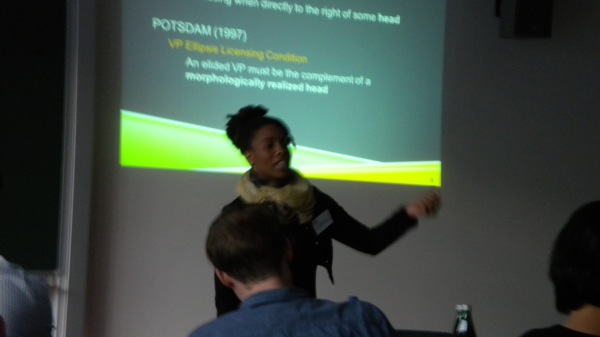
The 35th annual meeting of the German Society of Linguistics was held in Potsdam March 12-15, and UMass was well represented. Tom Roeper gave a talk entitled "What should a theory of interfaces tell us about the acquisition path for discourse coherence?" UMass alumnus Jeff Runner gave a talk entitled "Syntactic Structure, information structure, and lexical effects on null and overt subject conprehension in Spanish." Tracy Conner gave her talk "Overt functional heads license ellipsis: a unified account of VP-ellipsis and ellipsis in possessive DPs."  Nick LaCara gave his talk " Inversion, deletion, and focus in as-parentheticals." UMass alumnus Florian Schwarz gave a talk entitled "Weak definites and Kinds of Events." Ellen Woolford gave her talk "A hybrid approach to agreement typology: MP+OT." And, finally, UMass alumnus Winfried Lechner gave a talk entitled "Notes on the Duke of York." Nick has sent the following photos as proof.

DSCN2536DSCN2515DSCN2487

10 March 2013

LARC/Acquisition Lab meeting tomorrow

Magda Oiry writes:

Please join us on Monday, March 11 in the Partee Room (South College, room 301) at 12:10  for two presentations:

Andie Faber: "Experimental considerations for Gender Constraints in L2 Acquisition"

Michael Clauss:  "Implicit clauses and (apparent) partial movement in child English"

UMass in "Linguistic Derivations and Filtering"

Hans Broekhuis and Ralf Vogel's "Linguistic Derivations and Filtering" has appeared in the Advances in Optimality Theory series by Equinox Press. UMass alumna Jane Grimshaw's paper "Last resorts: A typology of 'do'-Support" appears in this volume along with a paper by John McCarthy and Kathryn Pruitt ("Sources of Phonological Structure") and another by Ellen Woolford ("Aspect splits and parasitic marking"). 

Congratulations Ellen, Kathryn, John and Jane!

UMass at FASAL

The third meeting of Formal Approaches to South Asian Languages (FASAL) is meeting this weekend at the University of Southern California in Los Angeles. Rajesh Bhatt, along with co-authors K.V. Subbarao and Vanlal Hmar, is presenting a paper entitled "A-bar Movement and Ergativity in Hmar." And Stefan Keine is presenting his paper "Long-Distance Agreement, Improper Movement and the Locality of Agree."

Professorship in Pragmatics at University of Konstanz

The Department of Linguistics in the Faculties of Humanities at the University of Konstanz invites applications for a Junior Professorship in Pragmatics (Salary Scale W 1) with expertise in formal pragmatics and/or experimental pragmatics, to be filled by the winter semester 2013/2014.

The selected candidate is expected to carry out research in pragmatics and teach courses both at the undergraduate (BA, Lehramt) and graduate level (MA, Ph.D.). Cooperation with existing and planned research proposals at the department is expected.

Recent doctoral graduates of outstanding quality may apply. We are interested in candidates who have an excellent international publication record, as shown for example by an outstanding dissertation, publications in established linguistic journals, conference papers and awards, and who exhibit strong skills in the classroom. For further information please contact Prof. Maribel Romero Sangüesa at: maribel.romero@uni-konstanz.de or by phone +49(0)7531/88–2728.

The University of Konstanz is an equal opportunity employer and tries to increase the number of women in research and teaching.

The University of Konstanz encourages disabled people to apply. They will be given preference if appropriately qualified.

The University of Konstanz has been certified as a family-friendly institution by the Hertie Foundation and ist committed to further the compatibility of work and family life.

The University of Konstanz offers a „Dual Career Program“. Information can be obtained from: http://www.uni-konstanz.de/dcc.

Applications including a CV, a list of publications, a record of teaching experience, photocopies of academic degree certificates as well as a completed submission form (see pdf-link below) and reference to Job Offer No. 2013/045 must reach the head of the Faculty of Humanities at the University of Konstanz at the latest by April 5th, 2013.

The application documents will be electronically processed and not returned.

For further information, please contact via e-mail: Geist.Sektion@uni-konstanz.de.

Application form: http://rz157.wwwdns.rz.uni-konstanz.de/files/pdf/uploads/Bewerberbogen2013045.PDF


Call for Papers: Sinn und Bedeutung

Sinn und Bedeutung 18,
11-13 September 2013, University of the Basque Country in Vitoria-Gasteiz

2nd Call for papers:
We invite abstract submissions for 45 (35+10) minute oral presentations or posters devoted to natural language semantics, pragmatics, the syntax-semantics interface, psycholinguistic studies related to meaning, and the philosophy of language. Abstracts should contain original research that, at the time of submission, has neither been published nor accepted for publication. One person can submit at most one abstract as sole author and one abstract as co-author (or two co-authored abstracts). Abstracts must be submitted electronically in PDF format. Submissions should be anonymous and not reveal the identity of the author(s) in any form (e.g., references, file name or properties of the abstract). Abstracts must not exceed two pages in letter-size or A4 paper, including examples and references, with 2.5 cm (or 1 inch) margins on all sides and 12-point font size. When you submit your abstract, you will be asked to indicate whether you would like it to be considered for a talk, a poster or both.

Abstracts should be submitted via EasyChair, using the following link:

https://www.easychair.org/conferences/?conf=sub18

Invited Speakers:
David Barner (University of California, San Diego)
Gennaro Chierchia (Harvard University)
Luisa Martí (University of Kent)
Maribel Romero (Universität Konstanz)

Important dates:
Submission deadline: April 15, 11:59 PM, CET
Notification of Acceptance: June 10
Conference dates: September 11-13

Contact: sub18.basquecountry@gmail.com

Webpage: https://sites.google.com/site/sub18bc


Call for Papers: ILLS 5

The Illinois Language and Linguistics Society’s 5th Conference will be hosted on the University of Illinois at Urbana-Champaign (UIUC) campus on April 5-7, 2013. For those of you who are not familiar with the conference, this is an annual graduate student run conference on topics pertaining to language and linguistics. As a student run conference, it is fully dependent and enriched by the participation of students. Even if you are not a graduate student, we would be delighted to have you! Undergraduates, post-docs, professors, and anyone in between is welcome! This year Professors Michael Kenstowicz (MIT), Carrie Gillon (Arizona State) John Rickford (Stanford), Ryan Shosted (UIUC) and Zsuzsanna Fagyal (UIUC) are our invited speakers. They will be featured along with a number of competitively selected international graduate students. This year’s special topic is minority languages, although papers on a variety of topics will be presented. Here is a link to the website for more information including a conference schedule. Registration is open until the day of the conference; however, to help with scheduling we would greatly appreciate it if you register by April 2, 2013. Register here for the conference and the reception. If you have any questions, please do not hesitate to contact us, whether it is about the conference itself, housing, travel, or anything else! Direct your questions to Marissa Goldrich at goldrch2@illinois.edu<mailto:goldrch2@illinois.edu>.

09 March 2013

PsychoSyntax meeting

Brian Dillon writes:

We'll be meeting again this Monday, 3/11, at 3pm in the Partee Room,  like usual! This week, Shayne and I will present Mauner and Koenig's  (2000) article, "Linguistic vs. Conceptual Sources of Implicit Agents in
Sentence Comprehension" (You may find the paper here:).

After discussing the findings in that paper, Shayne will present some pilot data he's collected and thoughts on follow-up experiments... it'd be great if you could come and give feedback on the topic!

03 March 2013

Laura Benua passes

We have learned recently that Laura Benua died of a heart attack on February 21. Laura received her PhD from UMass in 1997 with an influential dissertation on Phonology and Morphology. She had a position at the University of Maryland for a number of years, but left that job in order to devote herself to teaching in New York City public school system. She was a lovely person and a dear friend to many of us. For those who knew her, this is a devastating loss.

There is a service for her today at Nyack, New York, where her home is. A memorial page has been established here, and you can read more about Laura's linguistic career on Eric Bakovic's blog, here.

Paula Menendez-Benito gives department colloq on Monday

Paula Menedez-Benito (University of Goettingen) will give the department colloquium tomorrow, Monday, March 4th at 4:00PM in Machmer W-27. The title of her talk is "Epistemic Indefinites," and an abstract follows.

Epistemic Indefinites: The Case of Spanish

(joint work with Luis Alonso-Ovalle (McGill))

Across languages, we find epistemic indefinites, existential determiners that signal ignorance on the part of the speaker (see Haspelmath (1997)). Over the last fifteen years, a substantial body of work on the semantics of epistemic indefinites has appeared (see references in Alonso-Ovalle and Mene ́ndez-Benito (to appear)). Taken together, these studies outline a research program that aims to provide an explanatory semantic typology of epistemic indefinites by determining across which parameters epistemic indefinites can vary, how these parameters interact, and why. The work presented in this talk contributes to this enterprise by analyzing the epistemic effect of Spanish "algu ́n," and investigating the interaction of this effect with number morphology.

In its singular form, Spanish algu ́n conveys speaker’s ignorance. By using "alga ́n" in (1a), the speaker signals that she does not know which student María married. Hence, it would be odd for her to add a namely continuation that explicitly identifies the student in question, as in (1b). Surprisingly, the plural version of "algu ́n," "algunos," does not trigger an ignorance effect, as shown by (2). This talk provides an account of the contrast between (1) and (2). We will argue (i) that the epistemic effect of "algún" comes about because this item imposes an anti-singleton constraint on its domain of quantification, and (ii) that the interaction of this constraint with plural morphology blocks the epistemic effect. The talk also reports on work in progress that extends this account to the complex determiner "algu ́n que otto," which conveys an ‘I don’t know how many’ effect (witness (3)). The picture that emerges from this investigation is that epistemic effects triggered by indefinites are linked to properties of the domain of quantification, such as the size of the domain, its internal structure, and the type of entities quantified over.


(1) a. María se casó con algún estudiante.

           María married with ALGUN student

           (Maria married some student or other.)

      b. María se casó con algún estudiante # en concreto con Juan.

           María married with ALGUN student namely Juan

         (Maria married some student or other, namely John.)

(2) María vive con algunos estudiantes, en concreto con Pedro y con Juan.

      María lives with ALGUNOS student, namely Pedro and Juan

     (Maria lives with some student, namely Pedro and Juan.)

(3) María vive con algún que otro estudiante.

      María lives with ALGUN QUE OTRO student

      (Maria lives with students --- I don't know how many.)

Acquisition Lab/LARC meeting tomorrow

Magda Oiry writes:

This coming Monday, we will meet for a new acquisition lab / LARC meeting in the Partee Room at 12:05 to hear two presentations:

Andie Faber: "Experimental considerations for Gender Constraints in L2 Acquisition"

and 

Rama Novogrodsky, Seth Cable and Tom Roeper: "Acquisition of Each/every and Event Separation"

Paula Menendez-Benito gives talk on Tuesday

Paula Menendez-Benito will give a semantics talk on Tuesday, March 5, at 4:00PM in Machmer W-27. A title and abstract follow.

On Choosing Randomly

(joint work with Luis Alonso-Ovalle (McGill))

Many languages have indefinites that trigger modal inferences in the absence of an overt modal. Some of these items signal speaker’s ignorance. Others indicate that an agent made a random choice. While the former type has received a lot of attention in recent years (see Alonso-Ovalle and Mene ́ndez-Benito (to appear) for references), random choice indefinites are comparatively less studied (but see Choi (2007); Choi and Romero (2008); Alonso-Ovalle and Mene ́ndez-Benito (2011)). This talk paves the way towards a better understanding of random choice indefinites by analyzing the interpretation and distribution of Spanish "uno cualquiera."

The sentence in (1) illustrates the random choice reading of "uno cualquiera": (1) can be understood as saying that Juan took a card and that his choice was indiscriminate. This reading has a restricted distribution. Cases like (1), where "uno cualquiera" is in object position, are ambiguous between the random choice reading and an evaluative reading that conveys that Juan took an unremarkable card (and is compatible with him having chosen the card carefully.) In subject position, only the evaluative reading is available: (2) can only mean that an unremarkable student spoke.

(1) Juan cogio ́ una carta cualquiera. 

       John took a card CUALQUIERA.

(2) Hablo ́ un estudiante cualquiera.

      Spoke a student CUALQUIERA


We argue that "uno cualquiera" introduces a modal component that is anchored to the event described by the sentence. This component derives the random choice reading of sentences like (1) (roughly, that the agent’s decision is compatible with any of a number of actions under consideration), and blocks the random choice reading of (2) by deriving a contradiction. Our proposal is in line with some recent work on verbal modality where modal domains are projected from small particulars (events or individuals), rather than from whole worlds (see Hacquard (2006, 2009); Kratzer (2012)).

Nazarov at PRG on Thursday

This Thursday, March 7, Alex Nazarov will be presenting a paper to PRG, which meets at Packards in Northampton at 6:30. 

Nick LaCara at SRG on Thursday

Jason Overfelt writes:

Please join us this Thursday (March 7th) at 6:30p for a meeting of the Syntax Reading Group.  This week we will be hearing a practice talk by Nick LaCara titled `Inversion, deletion, and focus in as-parentheticals'.  The meeting will be at Elizabeth's place at 50 Phillips Place in Northampton.  Bring $5 for pizza or your own dinner.

LaTeX for Linguistics Workshop on Wednesday

Jeremy Cahill of the Linguistic Club writes:

Linguistics Club invites you to join us next Wednesday for an interactive LaTeX workshop!

WHEN: Wednesday, March 6, 5:30 - 7:30 PM
WHERE: Machmer W-15

Presenters Felix Lehmann, Steffen Hildebrandt, and Ilia Kurenkov will cover LaTeX basics as well as tools for linguistic typesetting. To get the most out of the workshop, make sure to bring a laptop (no installation required -- just internet access). Check out the attached flyer to see a bit of LaTeX in action.

{ What is LaTeX? A (free) document preparation system widely used by professional linguists, mathematicians, and others with unusual typesetting needs or who just want their documents to be of very high quality. }

Space is limited!

Sign up here: http://bit.ly/UMassLaTeX

or RSVP at: jccahill@student.umass.edu

Call for Papers: Tbilisi Symposium on Language, Logic and Compuatation


THE TENTH INTERNATIONAL TBILISI SYMPOSIUM ON
LANGUAGE, LOGIC AND COMPUTATION

23-27 September 2013
Gudauri, Georgia

http://www.illc.uva.nl/Tbilisi/Tbilisi2013
***********************************************************************
CALL FOR PAPERS

The Tenth International Tbilisi Symposium on Language, Logic and
Computation will be held on 23-27 September 2013 in Gudauri,
Georgia. The Programme Committee invites submissions for contributions
on all aspects of language, logic and computation. Work of an
interdisciplinary nature is particularly welcome. Areas of interest
include, but are not limited to:

* Algorithmic game theory
* Computational social choice
* Constructive, modal and algebraic logic
* Formal models of multiagent systems
* Historical linguistics, history of logic
* Information retrieval, query answer systems
* Language evolution and learnability
* Linguistic typology and semantic universals
* Logic, games, and formal pragmatics
* Logics for artificial intelligence
* Natural language syntax, semantics, and pragmatics

Authors can submit an abstract of four pages (including references) at
the EasyChair conference system here:

http://www.easychair.org/conferences/?conf=tbillc2013

PROGRAMME

The programme will include the following invited lectures and
tutorials.

Tutorials:

Logic: Rosalie Iemhoff (Utrecht)
Language: Daniel Altshuler (Duesseldorf)
Computation: Samson Abramsky (Oxford)

Invited Lectures:

Balder ten Cate (Santa Cruz)
Agata Ciabattoni (Vienna)
Thomas Colcombet (Paris)
Galit Sassoon (Jerusalem)
Alexandra Silva (Nijmegen)
Sergei Tatevosov (Moscow)

WORKSHOPS

There will also be a workshop on Algebraic Proof Theory organized by
A. Ciabattoni and R. Iemhoff and a workshop on Aspect organized by
D. Altshuler, D. Hole and S. Tatevosov. More information can be found
on the TbiLLC website.

PUBLICATION INFORMATION

Post-proceedings of the symposium will be published in the LNCS series
of Springer.

IMPORTANT DATES

Submission deadline: May 1, 2013
Notification: July 1, 2013
Final abstracts due: August 1, 2013
Registration deadline: September 1, 2013
Symposium: September 23-27, 2013

Programme and submission details can be found at:

http://www.illc.uva.nl/Tbilisi/Tbilisi2013/

24 February 2013

LARC meeting tomorrow

Magda Oiry writes:
 
Please join us this Monday, February 25, in the Partee Room (South College 301) at 12:05 for a new LARC acquisition lab meeting.
 
Here is the detailed program:
 
1. Hristo Kyuchukov ---our former visitor and collaborator will give us a brief update on his efforts to create a language disorders test for Roma children in Eastern Europe
 
2. Tom Roeper and Luiz Amaral will seek from everyone whatever suggestions they have for instances where Transfer occurs and crucially where it does not occur in L2 and bilingualism.
 
3.  Tom Roeper will outline an experiment on: Do children have restrictions on Wide-Scope quantifiers in Nominalizations (work with Masaaki Kamiya and Angeliek van Hout).
 
Any questions to Magda, moiry@linguist.umass.edu.

Everyone welcome!

Phonetics Lab meeting on Tuesday

John Kingston writes:

The next Phonetics Lab meeting will be held Tuesday, 4-5:30, 26 February 2013. The usual sustenance and refreshment will be provided, spiced with all the gory details of on-going experiments. It's also time to put your best face forward, as we'll be taking head shots to post on the lab's new website.

Vincent Homer gives colloq on Friday

On Friday, March 1, Vincent Homer (École normale supérieure) will give a colloquium entitled "Polarity and Grammar." The talk is at 3:30 in Machmer E-37. An abstract follows.

The licensing of polarity items is an old and difficult problem. It is hard to find the exact conditions that govern the distribution of those elements (e.g. some, any), not simply due to the intrinsic complexity of the patterns, but also because it is not even clear whether one should look for conditions couched in syntactic or semantic terms.

The discovery, due to the seminal work of Fauconnier (1975) and Ladusaw (1979), that downward-monotonicity is a characteristic property of the set of expressions whose presence can make an NPI acceptable (e.g. any in (1)), was a breakthrough which could have decisively tipped the scales in favor of a semantic approach.

(1) John didn’t understand anything.

That is, it could have become universally accepted that an NPI is only acceptable in a sentence S if it is in a position within S in which downward inferences are supported. But in fact, a vast majority of researchers who work on the topic view licensing essentially as a syntactic relation between a polarity item and an operator equipped with a certain negative feature, and do not take the monotonicity of the environment of the NPI as a direct factor. There is at least one good reason that supports their move: adding a negative expression to (1) does not lead to anti-licensing (2), as might be expected on strictly semantic grounds, given the monotonicity reversal; the acceptability of (2) is expected on the other hand if all that any requires is a structural relation with at least one appropriate operator above it:

(2) It is impossible that John didn’t understand anything.

In this talk, I propose a general account of licensing, both for NPIs and PPIs, which goes against the grain of the dominant syntactic approaches, as it maintains that polarity items are directly sensitive to the monotonicity of their environment. The theory, which relies on a few simple principles, also accounts for a number of unnoticed facts, and sheds new light on the dedicated mechanisms which evaluate the acceptability of polarity items, and on their interaction with other interpretative processes.

Aleksei in Amherst Choral Society

Alex writes:

Colleagues! I will be performing with the Amherst College Choral Society (and Symphony Orchestra) for the last time this upcoming March 2 at 8:00 PM. The concert will take place at Buckley concert hall on the Amherst College campus (tickets will presumably be $15, or $5 (for five college students)). We will be singing the magnificent Lord Nelson Mass (Missa in angustiis) by Joseph Haydn; the program will also feature the Tragic Overture by Johannes Brahms. Come and support good choral singing, and enjoy the beautiful music!

Vincent Homer gives talk on Thursday

On Thursday, February 28, Vincent Homer from the École normale supérieure-Paris will give a talk at 4:00 in Machmer W-27. His talk is entitled "Escape!" and an abstract follows:

Escape!

Modal verbs have intriguing scopal properties, which have received relatively little attention in the semantic literature. Compare can and must (both interpreted deontically):

(1) John can’t jog.
(2) John mustn’t jog.

If we are right to treat can as having existential force and must as having universal force, there is a puzzle: can takes obligatory narrow scope in (1), while in the exact same frame, must takes obligatory wide scope (2). This talk has one main goal: show that the contrast is due to a movement–I label it escape–which only certain modals can undergo. In the case at hand, it is must that moves because it is unacceptable in a negative environment, while can doesn’t move, because it has no reason to do so. I will study escape in detail, (i) because it has properties that set it apart from other known displacements, viz it is motivated by polarity and it is a last resort, and also (ii) because of the original light it sheds on modals and on the interplay of syntax and semantics in the mechanism of polarity item licensing.

UMass in NLLT

The most recent issue of Natural Language and Linguistic Theory contains the article "Passivization, reconstruction and edge phenomena: connecting English and Japanese Nominalizations," by Angeliek van Hout, Masaaki Kamiya and Tom Roeper.

Postdoc on discourse particles in Stuttgart

Post Doc, full time, 12 months
Location: University of Stuttgart, Germany
Email: cornelia.ebert AT ling.uni-stuttgart.de

We invite applications for one post-doc position in theoretical linguistics (semantics/pragmatics) at the University of Stuttgart, Germany, available from May 1st. The position is for 1 year. Salary is according to the German TV-L E13 scale. 

The candidate will contribute to the project C4 of the Sonderforschungsbereich (collaborative research center) 732,
(http://www.uni-stuttgart.de/linguistik/sfb732/), 'Incremental Specification in Context'. The project investigates discourse particles and their interpretation in context.

Desired qualifications:

- Ph.D. in Linguistics or a closely related field
- Specialization in/interest in formal semantics and pragmatics

We offer the opportunity to work on cutting-edge research projects in a dynamic and international research team with up-to-date infrastructure and resources. English is the working language; nevertheless, an ability to speak, or willingness to learn, German is appreciated.

Please send inquiries and applications to Cornelia Ebert by March 15, 2013 (see contact information below). Applications should be in PDF format and include a CV, a list of publications and the names of two references.

The University of Stuttgart is committed to increasing the proportion of women in research and teaching. Qualified women are encouraged to apply. According to German law, disabled candidates with equal qualification will be given preference.

Application email: cornelia.ebert AT ling.uni-stuttgart.de

Contact information

Dr. Cornelia Ebert
Department of Linguistics/Germanic Studies
http://www.uni-stuttgart.de/ilg
cornelia.ebert AT ling.uni-stuttgart.de

UMass in Language and Linguistics Compass

The latest issue of Language and Linguistics Compass has a couple articles by current and former members of the UMass linguistics community:

"Two Views on Epistemic Indefinites" by Louis Alonso-Ovalle and Paula Menendez-Benito

and

"Pied-Piping: Comparing Two Recent Approaches" by Seth Cable

Check them out: http://onlinelibrary.wiley.com/journal/10.1111/(ISSN)1749-818X

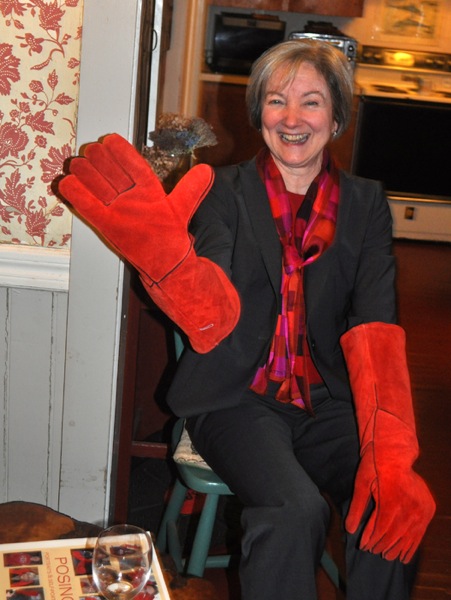
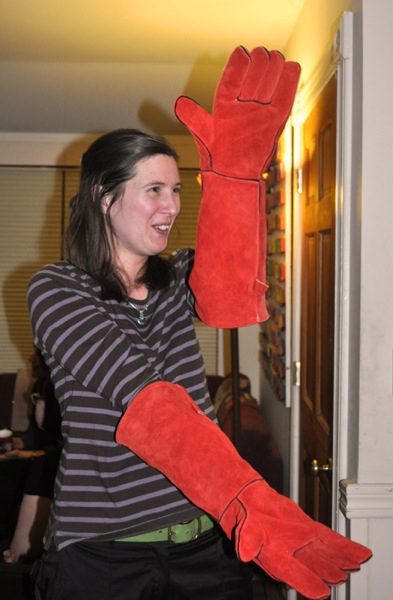
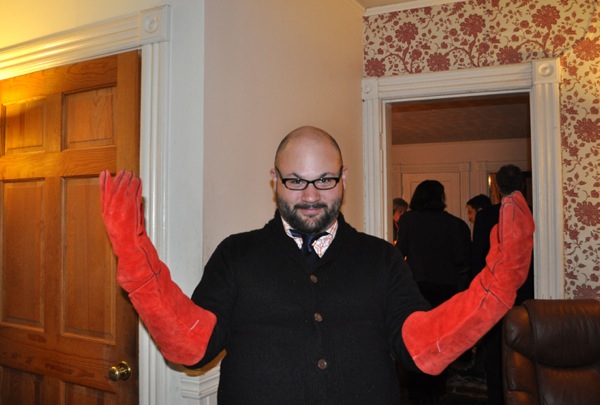
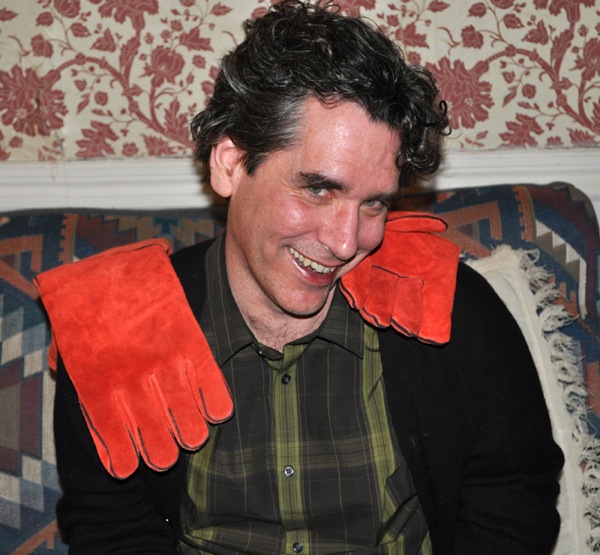
A red glove event at Tom and Laura's

Jeremy

Lisa

Rajesh

Lyn

Brian

Alice

Elizabeth

John

Kristine 2

Magda 2

Seth

Floris

Joe


Call for papers: Phonetics and Phonology in Iberia

The link below will take you to the second call for papers of PaPI 2013. The conference website can also be found at http://ww3.fl.ul.pt/laboratoriofonetica/papi2013/ .

17 February 2013

Floris Roelofsen gives presentation on Thursday

Floris Roelofsen will present "An inquisitive perspective on meaning: the case of disjunction" on Thursday, February 21 at 4:00 in Machmer W-27. An abstract follows.

A primary function of language is to allow for the exchange of information through a process of raising and resolving issues. To model this process, it is useful to have a notion of meaning that captures both informative and inquisitive content. This talk presents such a notion of meaning, and illustrates its advantages with respect to the classical, purely informational notion, focusing on the case of disjunction. The first part of the talk shows how the two main existing views on disjunction can be reconciled adopting an inquisitive perspective on meaning. The second part of the talk presents a uniform analysis of disjunctive questions and assertions in English, paying special attention to differences in form (e.g. declarative vs interrogative) and intonation (e.g. final rise vs final fall).

Floris Roelofsen gives colloquium on Friday, Feb. 22

Foris Roelofsen will present "Polarity Particles," in the department colloquium on Friday, February 22, at 3:30 in Machmer E-37. An abstract follows.

Polarity particles—words like yes and no—play a basic role in communication, and yet, their interpretation and distribution gives rise to a number of intriguing puzzles. This talk seeks to deepen our understanding of polarity particle systems cross-linguistically, revealing both their common core and the ways in which they vary from language to language. This investigation also has wider implications for linguistic theory, since polarity particles offer a valuable window onto the semantics of polar questions and assertions, which both license polarity particle responses. The common semantic core of polar questions and assertions is captured within the framework of inquisitive semantics. Subsequently, the account is extended to capture more involved patterns in the distribution of polarity particles, in particular in response to negative questions and assertions. The main predictions of the account concerning English are corroborated experimentally, and the cross-linguistic predictions are substantiated by data from German, French, Romanian, and Hungarian.

P Reading Group meets on Tuesday

Claire Moore-Cantwell writes:

We will meet Tuesday night to have a discussion about constraint  induction.  Everyone who works on constraint induction, come prepared to  talk a little bit about what you do; all others come with  questions/discussion points if you've got them.

Location: Kristine's place. 
Time:  8pm on Tuesday 19 February

Suzi Lima at Harvard

This Tuesday, February 19th, Suzi Lima will present a talk in the Language and Cognition Group entitled "Individuation and Counting in Yudja Tupi."

Lisa Sanders talks on Friday

Lisa Sanders will be presenting a talk on ERP measures of phonological learning in an artificial language on Friday, Feb. 22, at 9:30 in Tobin 423.

All are welcome!

Newton International Fellowships Announced

New Round of Newton International Fellowships Announced

A new round of Newton International Fellowships - an initiative to fund research collaborations and improve links between UK and overseas researchers - has now opened. The Newton International Fellowships are funded by the British Academy and the Royal Society and aim to attract the most promising early-career post-doctoral researchers from overseas in the fields of the humanities, the natural, physical and social sciences.

The Fellowships enable researchers to work for two years at a UK research institution with the aim of fostering long-term international collaborations. Newton Fellows will receive an allowance of £24,000 to cover subsistence and up to £8,000 to cover research expenses in each year of the Fellowship. A one-off relocation allowance of up to £2,000 is also available. In addition, Newton Fellows may be eligible for follow-up funding of up to £6,000 per annum for up to 10 years following completion of the Fellowship to support activities which will help build long-term links with the UK. The scheme is open to post-doctoral (and equivalent) early-career researchers working outside the UK who do not hold UK citizenship.

Applications are to be made via the Royal Society’s online application system which is available at https://e-gap.royalsociety.org/

The closing date for applications is Wednesday 10 April 2013. Further details are available from the Newton International Fellowships website: www.newtonfellowships.org

The British Academy
10-11 Carlton House Terrace, London SW1Y 5AH
020 7969 5200 britac.ac.uk

Mike Terry and Mako Hirotani in the news

www.tinyurl.com/KinstonLanguageStudy

Cable's papers virtually appear

Seth Cable's paper "Reflexives, Reciprocals and Contrast," has appeared in the electronic version of Journal of Semantics. And his paper "Beyond the Past, Present and Future: Towards the semantics of 'graded tense' in Gikuyu" has appeared in the electronic version of Natural Language Semantics.

WCCFL

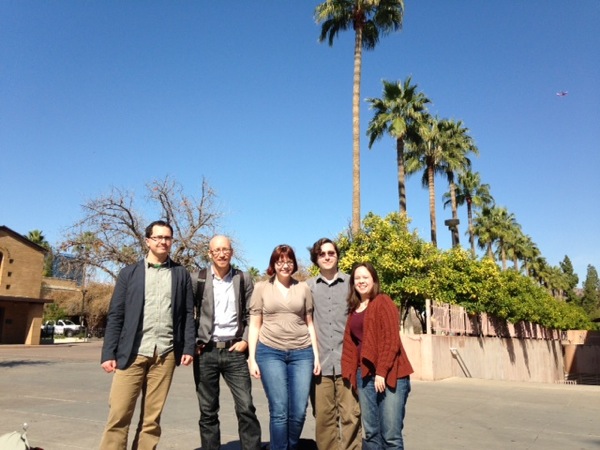
The West Coast Conference in Formal Linguistics met  in Tempe Arizona last weekend. UMass was well-represented. The following present and past students gave papers:

Chris Davis
Martin Walkow
Robert Staubs
Anisa Schardl
Elizabeth Bogal-Allbritten
Min-Joo Kim
Shigeto Kawahara
Satoshi Tomioka
Kyle Rawlins
Bern Samko
 
Junko Shimoyama and Luis Alonso-Ovalle were also scheduled to give a talk, but the Winter storm trapped them in Montreal.
 
You can see more at:


Elizabeth Bogal-Allbritten has sent partial proof:
 
Wccflphoto
 
(NB: This was the same weekend that 20 inches of snow fell upon the Happy Valley.)

10 February 2013

Lisa Green talks at Yale on Friday

Lisa Green gives a talk this Friday, February 15, at Yale University entitled "Aspect, Events and Variation."

Yasutada Sudo gives talk Monday (tomorrow)

Yasutada Sudo (Institute Jean Nicod, Ecole Normale Supérieure) will give a talk on Monday, February 11 at 4:00 in Machmer E-37. The title and abstract follow.

Title: The Problem of Non-entailed Presupposition: Toward a Multi-dimensional Theory of Presupposition

Abstract:

Presupposition is intensively discussed in the theoretical literature today, and a multitude of competing theories have been put forward that differ both conceptually and empirically (Beaver 2001, Beaver & Krahmer 2001, Chemla 2009, Fox 2008, 2012, George 2008, Geurts 1999, Heim 1983, Peters 1979, van der Sandt 1992, Schlenker 2008, 2009, 2010a,b). The goal of this talk is to contribute to this debate by raising an empirical problem for current theories, and to motivate the 'multi-dimensional' view of presupposition. The key observation is that some predicates have presuppositions that are not entailed by their assertive meanings (in the sense of generalized entailment), which I call 'non-entailed presuppositions'. I claim that when combined with certain quantifiers, predicates with non-entailed presuppositions give rise to meanings that pose a serious challenge for current theories of presupposition. In particular, the problem illustrates the need for a more expressive theory where assertive meanings and presuppositions can be true or false independently from each other. To this end, I advocate a multi-dimensional theory of presupposition. The multi-dimensional view was once popular in the 70's (Karttunen & Peters 1979), but it is now known that it faces an empirical problem called the 'Binding Problem' in quantified sentences. This was once considered to be a fatal problem for the multi-dimensional view and led to the development of modern one-dimensional theories, but I will offer a solution in the second talk.

Suzi Lima at LARC/Acquisition Lab

Magda Oiry writes:

This Monday, Suzi Lima will present her work in the lab acquisition / LARC meeting:

"How bilingual Yudja speakers (Tupi; Brazil) perceive quantities in their second language (Brazilian Portuguese)"

We will meet in the Partee room at 12/12:10.

Everyone is welcome!

Yasutada Sudo gives talk on Tuesday: Presupposition Projection in Quantified Sentences

Yasutada Sudo (Ecole Normale Supérieure) will give a talk at 4:00Pm on Tuesday, February 12, in Machmer W-26. The title and an abstract of his talk follow.

Title: Presupposition Projection in Quantified Sentences and Cross-Dimensional Anaphora

Abstract:

Presupposition projection in quantified sentences has been a particularly tantalizing issue for theories of presupposition (Karttunen & Peters 1979, Heim 1983, van der Sandt 1992, Beaver & Krahmer 2001, George 2008, Schlenker 2008, 2009, Chemla 2009, Fox 2012). In this talk I will offer a novel theory of presupposition projection in quantified sentences. Its main empirical support comes from the hitherto unnoticed correlation between presupposition projection through quantifiers and cross-sentential anaphora with quantificational antecedents: those quantifiers that support 'maxset anaphora' give rise to universal presuppositions, and those quantifiers that support 'refset anaphora' give rise to presuppositions weaker than universal presuppositions. I propose a multi-dimensional theory of presupposition where this correlation is directly captured by the mechanism of 'cross-dimensional anaphora'. The resulting theory, I claim, is empirically superior to its alternatives (cf. the first talk). In particular, it solves the Binding Problem that has plagued the multi-dimensional view of presupposition. Furthermore, it is also conceptually attractive in that it gives a principled explanation of the projection properties of quantificational expressions based on their anaphoric properties.

PsychoSyntax schedule

Brian Dillon writes:

The PsychoSyntax schedule for this semester is arrived! Here are the meeting we have scheduled:

2/11: No meeting
2/25: Tracy. Licensing ellipsis and its interaction with variable rules in AAVE
3/11: Shayne & Brian. Discussion of Mauner & Koenig (2000): Linguistic vs. conceptual sources of implicit agents in sentence comprehesion
3/25: Amanda. A closer look at syntactic satiation effects
4/8: Open time
4/22: Yangsook. Processing antecedent-anaphor dependencies in Korean.
5/6: Open time.

Meetings will take place at 3pm in the Partee Room (301 South College). If you'd like to present during one of our remaining open date, shoot me an email. 

Linguistics Club Game night on Wednesday

Jeremy Cahill writes:

We invite you to come join us for Game Night, featuring Phonetic and  
Standard Scrabble, Bananagrams, Boggle, and more. Pizza will be  
provided.

What:  Game Night
Where: 301 South College (next to Du Bois Library)
When:  Wednesday 2/13 at 5:30 PM

RSVP appreciated for head count:  jccahill@student.umass.edu

Have any board game suggestions? Please let me know.

Noah Contant gives practice talk

Seth Cable writes:

Hi Everyone,

I'm writing to announce that our own Noah Constant will be presenting a practice job talk next Friday (2/15) in the Partee Room at 9AM.

Everyone is cordially invited and encouraged to come. I'll be bringing some breakfast items ; )

Post-Doc position in semantics/pragmatics in Düsseldorf

The Cooperative Research Center (CRC) 991 'The Structures of Representation in Language, Science and Cognition', which is funded by the German Science Foundation at the Heinrich-Heine University, Dusseldorf seeks a postdoctoral researcher. The CRC brings together faculty and students from the departments of General Linguistics, Computational Linguistics, Philosophy, Romance and German Depts. The successful candidate will be expected to contribute to this interdisciplinary community.

The successful candidate will contribute to a research project whose goal is to better understand how compositional semantics interacts with discourse structure and discourse coherence. The focus of the project is context dependence of temporal expressions (e.g. tense, aspect, temporal adverbials) with the aim of proposing semantic constraints imposed by temporal expressions on anaphora resolution. Prior research on temporality and discourse dynamics is not required.

The appointment will be for two years, starting October 1, 2013, with the possibility of renewal for four more years thereafter (until 2019). Applicants must have completed their PhD degrees by the time of the appointment. The department welcomes international applications.

Applications should be sent in pdf format via email (subject line “Job application – Post Doc”) to: Daniel Altshuler (daltshul@gmail.com). Dossiers should include a CV, one representative publication, and a short letter summarizing: (a) your research activity and (b) why you would like to work on the context dependence of temporal expressions. Candidates should also arrange for three letters of reference to be sent directly to the email above. Applications should be received by April 1 for full consideration.
The Heinrich-Heine-University is an equal opportunity employer and encourages applications from women, minorities and handicapped applicants, who will be given preference in case of equal qualifications.

The availability of this position is subject to budgetary approval.

Special PsychoSyntax event on Friday

Brian Dillon writes:

We'll be having a special PsychoSyntax event next Friday (2/15). Abhijit Debnath will join us and talk about his work on the "Minimal Agent-Predicate" preference in sentence comprehension and present some processing experiments in Bangla. See the attached abstract from this years WCCFL. We'll meet at 3:30pm in Partee 301 (the empty colloq slot).

Debnath

LSA Summer Institute at the University of Michigan

The Linguistic Society of America's Summer Institute takes place this June 24-July 19 at the University of Michigan campus in Ann Arbor. UMass faculty Seth Cable, Lisa Green, Angelika Kratzer and Lisa Selkirk are teaching classes, as are UMass alumni Anne-Michelle Tessier and Gillian Gallagher. Joe Pater will be a discussant at the workshop "Universality and Variability: New Insights from Genetics."

For more information, see: http://lsa2013.lsa.umich.edu

Fellowships are available; see http://lsa2013.lsa.umich.edu/about/registration-and-fellowship-information/

Postdoctoral Research position at the Max Planck Institute for Psycholinguistics, Nijmegen

Alexandra Jess and John Kingston recommend:

Postdoc

PhD position at Max Planck Institute for Psycholinguistics, Nijmegen

PhDJohn Kingston and Alexandra Jesse recommend:
03 February 2013

ICESL Workshop

Joe Pater writes:

Mark your calendars for the 3rd Annual ICESL Workshop, Friday April 26th, 3:30 - 6:30. Our speakers will be Lyn Frazier of Linguistics (presenting collaborative work with Chuck Clifton and Brian Dillon) and Gwyneth Rost of Communication Disorders. We'll have a poster session too, which is a great way to get conversations about our research going, so get postering ("old" posters welcome too, of course!).

Ezra Keshet gives a guest lecture in LING 752

Ezra Keshet will give a guest presentation in the Topics in Syntax seminar on Thursday. The talk will begin at 4:00 PM and will be in Machmer W-27 (not the room the seminar is normally scheduled for).

Title: Answering Questions about Coherence and Anaphora"

Abstract:

As I will argue in my general-audience talk (and preview here), discourse coherence relations between sentences can constrain pronoun referents in a way suitable to generate sloppy readings in ellipsis contexts. For instance, sentence (1d), which stands in a RESULT relation to (1c), most easily means that people didn’t vote for Nixon:

 (1)  a. Kennedy looked good on TV.         b. People voted for him.

        c. Nixon looked bad on TV.                 d. People didn’t.

In this talk, I claim that coherence relations are a type of projective meaning (see Tonhauser et al. 2013) that determines a hidden Question Under Discussion (QUD) as defined by Roberts (2012). For instance, (1b) is understood as a response to the (hidden) QUD What resulted from Kennedy looking good on TV? while (1d) is the response to QUD What resulted from Nixon looking bad on TV? (See Kehler 2009) for a previous suggestion along these lines.)

Pronouns in the answers to questions are often quite constrained in their interpretations:

(2) Q: Who does Bill like?  A: He likes Mary. [He must refer to Bill]

I argue that these constraints on pronouns follow from a very small modification to theories of Focus/Givenness such as Rooth (1992) and Schwarzschild (1999). Under Rooth’s system, for instance, a ~ (‘squiggle’) operator effectively ensures that the answer in (2) appears in the Hamblin (1973) denotation of the question. The ~ operator, I argue, can alter the local assignment function to achieve its purpose, setting the referents of pronouns such as he in (2) to properly fit them into the question denotation. With this machinery in place, the pronoun him in (1b) can receive a locally-derived meaning (Kennedy) via the ~ operator but this meaning can have a different extension (Nixon) when picked up by the ellipsis site in (1d).

Next, I extend this analysis to embedded coherence relations, especially in quantified sentences containing a donkey pronoun, such as (3). The “consequent” clause he cries in (3) stands in a RESULT relation to the “antecedent” clause Jill teases a boy. In fact, this consequent stands in several different RESULT relations to the antecedent – one for each situation quantified over by whenever. I argue that the consequent clause is therefore evaluated with respect to a slightly different QUD for each situation quantified over, analogous to the way the phrase his sister in (4) generates a slightly different presupposition for each boy quantified over by every. Since each QUD for the consequent potentially pertains to a different boy, the pronoun he in he cries can end up referring to different boys (but in each situation refers to the boy that Jill teased in that situation).

(3) Whenever Jill teases a boy, he cries.

(4) Every boy loves his sister.

Staubs practices WCCFL on Tuesday

Claire Moore-Cantwell writes:

Robert Stabus will give a practice talk for his upcoming WCCFL talk at Presley's place Tuesday night at 6:30.  Please bring snacks/drinks!

Call for Papers: Semantics and Philosophy in Europe 6

First Call for Papers

Semantics and Philosophy in Europe 6

It is our pleasure to announce the 6th Semantics and Philosophy in Europe Colloquium (SPE6), which this yearwill take place in St Petersburg during the White Nights.

Place: Bobrinsky Palace, Smolny College, St Petersburg
Time: June 10-14, 2013

INVITED SPEAKERS
GNENERAL SESSION:
Barbara Partee (University of Massachusetts, Amherst /Moscow University)
Kjell Johann Saebo (University of Oslo)

SPECIAL SESSIONS:

[1] The Interface between Linguistic Semantics and Philosophy of Mind
Berit Brogaard (University of Missouri, Saint Louis)
Frances Egan (Rutgers University)
Scott Soames (University of Southern California)
Tutorial:
Robert Matthews (Rutgers University)
Friederike Moltmann (CNRS, Paris)

[2] The Status of Semantics in the History of Generative Grammar
John Collins (University of East Anglia)
Wolfram Hinzen (Durham/Barcelona)
Robert May / Adam Sennett (UC Davis)
Howard Lasnik (University of Maryland)

[3] Empirical Methods in the Investigation of Semantics
Erica Cosentino (Calabria/Bochum)
Tatiana Chernigovskaya (St Petersburg)
Natalia Slioussar (Utrecht/ St Petersburg)
Markus Werning (Bochum)

Abstract Submission Details:
Please send an anonymous two-page long abstract to:slioussar@gmail.com
On a separate page please specify whether the submission is for the general session or one of the special sessions andmention title and your name, affiliation, and e-mail address

Abstract Submission Deadline: March 22, 2013
Notification of Acceptance: April 5, 2013

Organizing Committee of SPE6:
Berit Brogaard, Tatiana Chernigovskaya, Wolfram Hinzen,Robert Matthews, Robert May, Friederike Moltmann, Markus Werning, Ede Zimmermann

Conference website: TBA

Ezra Keshet gives department colloquium

Ezra Keshet (University of Michigan) will present "Two Effects of Context on Truth-Conditional Meaning" at the department colloquium this Friday (February 8) at 3:30PM in Machmer E-37. An abstract of his talk follows.

The lexical items and syntactic structure of a sentence play a large role in its interpretation, but other factors often contribute as well, such as the time/place of utterance, other sentences in the same discourse, salient surrounding objects; extralinguistic goals; and more. This talk presents case studies highlighting the semantic effects of two such suprasentential factors:  focus/information structure, and discourse coherence.

The first study involves so-called conditional conjunctions such as (1) whose meanings are quite similar to conditional sentences involving the word if as in (2):

(1) You get there early enough, and you usually find a seat.

(2) If you get there early enough, you usually find a seat.

I will present evidence that such sentences require a particular information structure, namely one where the first clause is Given in the context (or accommodated as Given). I argue that the conditional meaning results from the interaction between a modal quantifier such as usually in (1) and this information structure. A standard if-clause generally serves to restrict a modal quantifier (see Kratzer 1986) and since Given material tends to join the restriction of quantifier as well, this information structure mimics the effect of an if-clause.

The second study examines how discourse coherence can constrain pronoun referents in a way previously thought to require syntactic c-command. Coherence is the name for the unspoken links between clauses in discourse, as shown in (3), which is most easily understood to mean (4):

(3) Ezra flew into Hartford. He’s giving a talk at UMass.

(4) Ezra flew into Hartford because he’s giving a talk at UMass.

Hobbs (1979) noted that the establishment of such coherence relations also constrains pronoun reference, for instance constraining he in (3) to refer to Ezra when the discourse is understood as in (4). Ross (1967) described two readings for pronouns in ellipsis, as shown in (5). Most linguists, following Reinhart (1983), claim that the sloppy reading requires a c-commanding antecedent, such as Bill, which c-commands his in (5). I argue instead that discourse coherence constraints on pronouns can also generate sloppy readings, as shown in (6) and (7).

(5) Bill loves his dog. John does, too.

a. ...John loves Bill’s dog, too. (strict reading)

b. ...John loves John’s dog, too. (sloppy reading)

(6) The man who called Jane asked her out. The man who emailed Vera did ask Vera out, too.

(7) Kennedy looked good on TV. People voted for him.

Nixon looked bad on TV. People didn’t vote for Nixon

Roeper's Roast

On Monday, January 25, there was a congratulatory toast and roast event at the weekly LARC/Language Acquisition Lab meeting for Tom Roeper in celebration of his becoming a Fellow of the Linguistic Society of America this September. Tom joins several other UMass faculty ---  Emmon Bach, Barbara Partee, Lisa Selkirk, John McCarthy, Alice Harris and Angelika Kratzer --- on the roster of LSA fellows. 

Congratulations Tom!

Call for papers: Workshop in Memory of Tanya Reinhart

The linguistics department at Tel-Aviv University is proud to announce the 1st graduate student workshop in memory of Professor Tanya Reinhart, which will take place on April 11th, 2013.

MA students and PhD students not having submitted their dissertation in Linguistics by April 2013 are invited to submit abstracts of their research in all areas of theoretical linguistics, psycholinguistics, or neurolinguistics.

Papers will be allotted 20 minutes for presentation plus 10 minutes for discussion.

Invited Speaker: Idan Landau, Ben Gurion University.

Length:
Up to two single spaced A4 pages with 2.5 cm margins, typed in 12-point Times New Roman.

Format:
Abstracts must be anonymous and in pdf format.

Submission:
To submit your abstract, please send it to tau.linguistics.workshop@gmail.com no later than February 1st. Please state your name and affiliation in the body of the message.

Important dates:
Deadline for submission: 1 February 2013

Notification of acceptance: 1 March 2013

Workshop: 16:00 – 19:30, 11 April 2013

Contact info: tau.linguistics.workshop@gmail.com

Spring Colloquium series

Claire Moore-Cantwell writes:

We are pleased to announce the UMass spring Colloquium series.

5 April: Julien Musolino (Rutgers)
19 April: Ryan Bennet (Yale)

There will also be a syntax guru (Eric Potsdam) and a phonology guru 
(Eric Bakovic).  Eric Potsdam will be giving a talk March 29, and Eric 
Bakovic will be giving a talk in April, tentatively set for the 12.

27 January 2013

UMAFLAB meets this Friday

Seth Cable writes:

I wanted to send out a general announcement that the first, organizational meeting of UMAFLAB for this term will be held *this Friday* at 9AM in the Partee Room. 

If you'd like to come, please let me know. Also *definitely* let me know if this time/date will not be possible for you, as there are some alternatives we could choose from.

For those who might have missed the first general announcement a few weeks back, UMAFLAB (The UMass Funny Languages Breakfast) brings together individuals with a shared interest in puzzling linguistic data, optimally (but not necessarily) from understudied or minority languages.

*Presentations are always informal*. We are *not* looking for polished work or practice talks (though those are welcome). Rather, participants are free to present any puzzles they like. They needn't have any analysis in mind; indeed, part of the fun of the group is hearing other people's thoughts on some difficult problem.

Thus, if all you have is an interesting pattern worth 'boggling at', that's perfect for our group (particularly if it's from an otherwise not-very-much-talked-about language or variety). For example, a run down of all the crazy data obtained during some recent field work (or experimental work, or whatever) would be quite ideal.

As the name suggests, our meetings are typically in the morning, with some breakfast item served.  However, the schedule is always flexible, if it turns out that most people can't make it in the morning. 

So, if you'd at all be interested in being part of such an endeavor, just let me know!

Presley at PRG on Thursday

Presley Pizzo will be leading a discussion in PRG on how to choose between theories. 

Time: Thursday, Jan. 31 at 6:30PM

Location: Packards!

Jeremy Hartman at Acquisition meeting tomorrow

Barbara Pearson writes:

We have a topic for Monday's acquisition meeting.
{Jan 28, noon -1:30, Partee Room 301)

Speaker:  *Jeremy Hartman*, our new Language Acquisition professor (Office: South College 220)

Topic, *"Agentivity, affectedness, and 'target-state' passives in
acquisition"*:  Work in progress.

Please join us for our first meeting of the new semester.  We have Jeremy's talk, and some business matters to discuss (Plans and kudos). Come learn about the framework for a Research Workshop we hope to organize this semester.

Questions to me (while Magda, our meeting coordinator, is away this week):

bpearson@research.umass.edu

Semantics job at UCL: Deadline March 1

The Linguistics Research Department at UCL is looking for a semanticist with a strong commitment to world- class research. The appointment will be at Lecturer, Senior Lecturer or Reader level (Lecturer is comparable to Assistant Professor; Reader is comparable to Associate Professor). The successful candidate will have a record of high-quality publications commensurate with the stage of their academic career. He or she will contribute to the department’s research, teaching, graduate supervision, and administration.

The Linguistics Research Department has recently become part of a new Division of Psychology and Language Sciences at UCL, which offers enhanced opportunities for cross-disciplinary research. The appointment also follows a move to newly refurbished premises where the infrastructure exists for the successful applicant to build up their own research team.

The successful applicant will start work at UCL on 1 September 2013. 

The successful candidate will hold a doctorate in linguistics or a cognate discipline and will be engaged in a program of original research that enhances the department’s research portfolio and that can give rise to PhD projects and applications for research funding.

Informal enquiries can be made to Dr Nathan Klinedinst (+1 (864) 315 9878, n.klinedinst@ucl.ac.uk) or to the Head of Department, Prof Ad Neeleman (+ 44 (0) 20 7679 4045, a.neeleman@ucl.ac.uk). 

Anisa and Elizabeth at SRG this Thursday

Anisa Schardl and Elizabeth Bogal-Allbritten will give presentations in this week's SRG. Watch this spot for updates.

Call for papers: ILLS

The 5th annual meeting of the Illinois Language and Linguistics Society (ILLS), to be held April 5-7, 2013 at the University of Illinois at Urbana-Champaign is currently accepting submissions. Please pass this on to interested students to inform them of this opportunity.

Thank you for your time,
ILLS5 Committee

Marissa Goldrich
Itxaso Rodriguez
Megan Kennedy
Lydia Medill
Kate Lyons

The 5th annual meeting of the Illinois Language and Linguistics Society will be held April 5-7, 2013 at the University of Illinois at Urbana-Champaign.  ILLS is a graduate student conference open to all subfields of linguistics. In addition to the general conference and a Saturday poster session, this year's meeting will include a special session Saturday, April 16th on the topic of ‘Minority languages’.  We encourage submission and are currently accepting abstracts for topics in general linguistics and minority languages.  Deadline for submission is January 31st.

All talks will be given 20 minutes for presentation and 10 minutes for questions. Abstracts will also be considered for a Saturday poster session. The top 4 submitted student abstracts will be awarded $200 to cover conference travel costs.

Abstracts should be maximum 500 words, with one extra page allowed for images, data, and/or references. Abstracts should be submitted via EasyAbs on LinguistList.org in PDF format with NO IDENTIFYING INFORMATION of the presenter in the document.

For more information: http://linguistlist.org/callconf/browse-conf-action.cfm?ConfID=152391

The conference URL is: http://ills.linguistics.illinois.edu/current/index.html

Please contact lso.illinois@gmail.com <mailto:lso.illinois@gmail.com> with any questions you may have.

Invited Speakers:
Zsuzsanna Faygal (University of Illinois at Urbana-Champaign)
John Rickford (Stanford University)
Carrie Gillon (Arizona State University)
Ryan Shosted (University of Illinois at Urbana-Champaign)
Michael Kenstowicz (Massachussetts Institute of Technology)

Class on Georgian

Mariam Tsiskarishvili will be teaching an informal class on Georgian.
Meeting times will be scheduled with eveyone's availability in mind.
Monday or Friday after 5:00pm are possible times.

If you are interested and would like further information please contact 
Mari.

m_tsiskarishvili@yahoo.com
mariam@linguist.umass.edu

Tom Ernst in the Chronicle for Higher Ed

The latest issue of the  Chronicle for Higher Education features Tom Ernst in an article on independent scholars (with cameos from Rajesh and Jonathan Bobaljik). Take a look:

http://chronicle.com/article/Some-PhDs-Choose-to-Work/136729/

Kathryn Pruitt ASU

Kathryn Pruitt has accepted a tenure-track position as a phonologist in the linguistics program at Arizona State University.

Congratulations, Kathryn!

Undergraduate RAs in Psychology

Alexandra Jesse from Psychology writes:

We are currently looking for undergraduate research assistants to work in the Language, Intersensory Perception, and Speech (short: LIPS) lab in the Psychology Department. Positions are open starting this Fall semester. Ideal applicants are those who can commit to a longer time period.

The work within the LIPS lab falls within the area of Psycholinguistics. We examine how listeners recognize speech from hearing and seeing a speaker talk. In particular, we are interested in the time- course of recognizing words - both from listening and from lip-reading, how listeners adjust to a speaker's idiosyncratic pronunciations, and what happens to these processes when people get older. We use eye-tracking and other behavioral methods to address these questions, as well as EEG. 

You can visit our website for more information:
http://lips.psych.umass.edu

Typical tasks of our research assistants are:
- help with finding stimuli for an experiments (e.g., selecting words, making nonwords)
- help with recording, annotating, and editing of speech materials for the experiments
- assist with recruitment, scheduling, and testing of participants
- attend & prepare for weekly lab meetings
- do administrative research-related tasks

The typical commitment of our research assistants during the school year is 9hrs/week, for 3 credits. You would be enrolled in Psych 398B, but this course can count as an elective towards your linguistics degree. Please contact me if you have any questions about how these credits can be applied to your degree in Linguistics. 

So if you are interested in the position for the Spring, please contact me as soon as possible for more information and for an application form. Once you return the completed application form, we will then contact you to schedule for an interview. We will then also require a letter of recommendation. Therefore, if you are interested, please respond to this email as soon as possible. Enrollment has to be completed by January 29th for this position.

Elizabeth Bogal-Allbritten at SRG

Elizabeth Bogal-Allbritten gave a presentation at the SRG this past Thursday, January 24, entitled "Wondering about Alternatives in Navajo"

Bhatt at Rutgers

Rajesh Bhatt gave the following colloquium talk at Rutgers University on Friday, January 25.

Title: Many or More

Abstract:
Most Modern Indo-Aryan languages lack dedicated degree morphology. Comparative constructions are typically marked by a marker like the Hindi-Urdu `zyaadaa'/`adhik', which is often absent is adjectival comparatives. It is however required in non-adjectival comparatives. Earlier work that has identified this marker as the comparative degree head is unable to handle this asymmetry. I argue that `zyaadaa/adhik' does not by itself encode comparative meaning; it merely makes available a degree variable. I will show that this conception of 'zyaadaa' allows for us to handle a number of environments where 'zyaadaa' does not contribute a comparative meaning. The actual meaning of comparison I will take to be introduced by a covert comparative operator. Like the covert negation assumed in treatment of negative concord, this covert comparative operator needs to be licensed. It can be licensed by 'zyaadaa' or by the standard marker (the -se ‘than’ phrase). I will end with an examination the cross-linguistic grammaticization of comparative markers in the context of Schwarzschild's proposal for Hebrew `yoter'.

20 January 2013

Phonetics Lab Meeting this Tuesday

John Kingston writes:

Phonetics Lab meetings will start this Tuesday, 22 January 2013, and continue every other week until the end of the semester. The agenda for the first meeting is to assess progress in all the current experiments and make plans for completing them this semester.

ECO 5 at UConn in March

Jason Overfelt writes:

ECO 5, is being held at UConn this year on March 30th.  This is a very friendly environment to present any polished or unpolished work you would like to get some feedback on or get a bit of practice with before presenting it on a larger stage.  The conference is intended primarily for 1st through 3rd year students, but it is open to everyone.  If you're interested in being one of the three UMass representatives, please let me know.  Mamoru Saito will be visiting UConn that weekend and it is (reportedly) highly likely to be in attendance.

Call for papers: Manchester Phonology Meeting

Kristine Yu writes:

Just a quick reminder that abstracts are due for the Manchester Phonology Meeting January 31.

http://www.lel.ed.ac.uk/mfm/21mfm.html

Deadline Extended for qUALMS and GLEEFUL

Adam Liter, from Michigan State University writes:
 
I am writing on behalf of the q Undergraduate Association for Linguistics at Michigan State (qUALMS). As you may remember, you received an email from us near the end of 2012 asking for your help in distributing the call for papers for the third annual Great Lakes Expo for Experimental and Formal Undergraduate Linguistics (GLEEFUL).
 
We would greatly appreciate your help in distributing another version of the call for papers with an extended deadline. The deadline for submissions to GLEEFUL has been extended February 1. The updated call for papers is attached in PDF format. It can also be viewed on LinguistList, and additional submission information can be found at our website.

Deadline extended: WSCLA 18

WSCLA 18 -- abstract deadline extended by one week

The 18th Workshop on Structure and Constituency in Language of the Americas (WSCLA 18) will take place at the University of California, Berkeley on April 5-7, 2013.

New abstract submission deadline: Monday, January 21, 2013

The central objective of this workshop is to bring together linguists who are engaged in research on the analytic study of the Aboriginal languages of the Americas so that they may exchange ideas across theories, language families, generations of scholars, and, importantly, across the academic and non-academic communities that are involved in language maintenance and
revitalization.

The following invited speakers have been confirmed:

- Judith Aissen (UC Santa Cruz)
- Ewa Czaykowska-Higgins (University of Victoria)
- Monica Macaulay (Wisconsin)
- B'alam Mateo Toledo (CIESAS)
- Joyce McDonough (Rochester)
- Andrés Salanova (Ottawa)
- Maziar Toosarvandani (MIT)
- Lorna Williams (University of Victoria)

Abstracts are invited for papers in any area of formal linguistics (including phonetics, phonology, morphology, syntax, semantics, and pragmatics) within any theoretical framework. We welcome papers that address diachronic, sociolinguistic, or applied topics from a formal perspective, and we are especially interested in papers seeking to relate the interests of formal linguists and the concerns of indigenous communities.

Abstract submission guidelines:

- Abstracts must be submitted in PDF format with the filename PaperTitle.pdf (where PaperTitle is the title or a clear abbreviated version of it. No punctuation or spaces.)

- Abstracts must be anonymous. Author name(s) must not appear on the abstract or file name. In addition, be sure to remove any author name in the document properties of the PDF file.

- Abstracts must not exceed 2 pages in length including references and examples

- Minimum 12pt font size, 1 inch margins

Abstracts should be sent as a PDF attachment to:
wscla18@socrates.berkeley.edu

Abstract submission deadline: January 21, 2013
Contact info: wscla18@socrates.berkeley.edu

For further information, please see the conference website:
http://linguistics.berkeley.edu/~wscla/

McCCLU 2013: Call for Papers

The seventh annual McGill Canadian Conference for Linguistics Undergraduates - McCCLU - will be held on March 15th, 2013- March 17th 2013.

It will again be hosted at McGill University, Montreal, by the Society of Linguistics Undergraduates of McGill - SLUM. The aim of this conference is to encourage original endeavors into the world of research as well as to enrich the present academic undergraduate community within the field of linguistics.

We are now calling for undergraduate students to submit abstracts for presentation at the conference on any subject matter within the domain of linguistics. Each abstract should detail material for a 20-minute presentation, with a 10-minute question period on  issues raised afterward. Abstracts should be a maximum of one page in length (12 point font, 1 inch margins) and submitted online to  http:// linguistlist.org/easyabs/mccclu2013 by January 25th, 2013.

For further information, please visit our blog at: mccclu2013.blogspot.com. Should you have any other questions please email us at mccclu2013@gmail.com

PsychoSyntax and CSL Lab meetings on Mondays

Brian Dillon writes:

We're set to have PsychoSyntax on Mondays at 3pm. The first meeting is 1/28, in the Partee Room, and we will meet biweekly after that. The first order of business will be to hammer out a presentation schedule, so come ready to volunteer yourself and your work!

It looks like we'll have time to actually get into some fun science in our first meeting, as well. If so, I'll volunteer myself to present something from one of the in-progress projects going on around here, and so we can hit the ground running.

For CSL Lab RAs (and folks who are interested in hanging out in the CSL lab, seeing ongoing projects, and getting involved!): our meeting times will also be Mondays at 3pm. We will meet on the weeks that PsychoSyntax does not meet, starting Monday 1/22, in Bartlett 11.

Partee Lecture in Mexico

Barbara writes:

Volodja are I are in Mexico for a couple of weeks mixing business and pleasure. I spent Jan 14-17 at El Colegio de Mexico consulting with Josefina García Fajardo and my colleagues in a project on determiners in Spanish and in Yucatec Maya, and with the 7 PhD students of the Linguistics Program about their planned dissertation projects. On Thursday the 17th, I gave a public lecture, “La cuantificación y tipología semántica”. Everything on all four days was in Spanish, though I note that Russian words were continually trying to emerge (and occasionally emerging), even though  Volodja and I tried to keep our own conversations in English. Those work days are being followed by an 8-day trip around the Yucatan, followed by two days back in Mexico City visiting with Josefina before returning to Amherst Jan 28.

UMAFLAB

Seth Cable writes:

Happy New Year! And, with a new year comes a new session of UMAFLAB (the UMass Funny Languages Breakfast)!

What is UMAFLAB, you might ask? Well, the purpose of UMAFLAB is to bring together individuals with a shared interest in puzzling linguistic data, optimally (but not necessarily) from understudied or minority languages.

*Presentations are always informal*. We are *not* looking for polished work or practice talks (though those are welcome). Rather, participants are free to present any puzzles they like. They needn't have any analysis in mind; indeed, part of the fun of the group is hearing other people's thoughts on some difficult problem.

Thus, if all you have is an interesting pattern worth 'boggling at', that's perfect for our group (particularly if it's from an otherwise not-very-much-talked-about language or variety). For example, a run down of all the crazy data obtained during some recent field work (or experimental work, or whatever) would be quite ideal.

As the name suggests, our meetings are typically in the morning, with some breakfast item served. However, the schedule is always flexible, if it turns out that most people can't make it in the morning.

So, if you'd at all be interested in being part of such an endeavor, please let me know! I'd like to begin scheduling soon our first organizational meeting of the semester, so if you could also let me know what days/times would work out best for you, that would greatly appreciated!

Graduate Student Workshop in Memory of Tanya Reinhart

The linguistics department at Tel-Aviv University is proud to announce the 1st graduate student workshop in memory of Professor Tanya Reinhart, which will take place on April 11th, 2013.

MA students and PhD students not having submitted their dissertation in Linguistics by April 2013 are invited to submit abstracts of their research in all areas of theoretical linguistics, psycholinguistics, or neurolinguistics.

Papers will be allotted 20 minutes for presentation plus 10 minutes for discussion. Invited Speaker: Idan Landau, Ben Gurion University.

Length: Up to two single spaced A4 pages with 2.5 cm margins, typed in 12-point Times New Roman.

Format: Abstracts must be anonymous and in pdf format.

Submission: To submit your abstract, please send it totau.linguistics.workshop@gmail.com no later than February 1st. Please state your name and affiliation in the body of the message.

Important dates: Deadline for submission: 1 February 2013 Notification of acceptance: 1 March 2013 Workshop: 16:00 – 19:30, 11 April 2013 

Contact info: tau.linguistics.workshop@gmail.com

UMass at the LSA

The annual meeting of the Linguistic Society of America met January 3-6 in Boston this year, and UMass were well represented in the poster sessions. These included:

Andrew Weir, poster: "Article drop in headlines: failure of CP level Agree"

Anisa Schardl, poster: "Simple partial movement and clefts"

Nick LaCara: "*On the table lay a book, and on the sofa did too: ellipsis, inversion and why they are bad together"

Elizabeth Bogal-Allbritten and Anisa Scheardl "Expressing uncertainty with "gisa" in Tshangla"

and


Jeremy Hartman, with Paul Marty, Peter Graff, Steven Keyed: "Biases in word learning: the case of non-myopic predicates"

16 December 2012

Noah Constant's paper appears in Linguistics and Philosophy

WHISC is please to announce that Noah Constant's paper, "English rise-fall-rise: a study in the semantics and pragmatics of intonation" has been published in Linguistics and Philosophy. Take a look:

http://www.springerlink.com/openurl.asp?genre=article&id=doi:10.1007/s10988-012-9121-1

Congratulations Noah!

Call for Papers: ESSLLI

First Call for Papers
ESSLLI 2013 STUDENT SESSION

Held during
The 25th European Summer School
in Logic, Language and Information

Düsseldorf, Germany, August 5-16, 2013

Deadline for submissions: April 1st, 2013
https://www.easychair.org/conferences/?conf=essllistus2013

ABOUT:

The Student Session of the 25th European Summer School in Logic, Language, and Information (ESSLLI) will take place in Düsseldorf, Germany on August 5-16, 2013. We invite submissions of original, unpublished work from students in any area at the intersection of Logic & Language, Language & Computation, or Logic & Computation. Submissions will be reviewed by several experts in the field, and accepted papers will be presented orally or as posters and will appear in the student session proceedings in Springer. This is an excellent opportunity to receive valuable feedback from expert readers and to present your work to a diverse audience.

A SEPARATE POSTER SESSION: Note that this year there are two separate kinds of submissions, one for the oral presentations and one for the posters. This means that papers can be directly submitted as posters. Reviewing and ranking will be done separately. We particularly encourage submissions for posters.


More detailed guidelines regarding submission can be found on the Student Session website: http://stus2013.loriweb.org/, (links to previous years' proceedings are also available there).

Please direct inquiries about submission procedures or other matters relating to the Student Session to margotcolinet@gmail.com

For general inquiries about ESSLLI 2013, please consult the main ESSLLI 2013 page, http://esslli2013.de/.

Call for papers: Recursion in Brazilian Languages and Beyond

The Graduate Program in Linguistics of the Federal University of Rio de Janeiro and the Language Acquisition Research Center at UMass are sponsoring a conference on recursion at the Federal University of Rio de Janeiro August 7-9, 2013. Papers from different areas of theoretical, descriptive and experimental linguistics are sought.  More information can be found in the poster below.

Call recursion

Call recurse2

New: Annual Review of Linguistics

Barbara Partee writes:

Mark Liberman and I will be Co-Editors of the newly established Annual Review of Linguistics, the 45th journal in the Annual Reviews series.  You can read about Annual Reviews here: http://www.annualreviews.org/ . (Linguistics isn’t listed there yet – it was just officially approved today, December 15, 2012.)

Roeper on the road

Tom Roeper was traveling in Germany in the first week of December. He served as an advisor to the German Ministry on Science for the evaluation of the Zentrum fur allgemeine Sprachwissenschaft in Berlin, and he gave a talk at the Max Planck Center for Neurolinguistic and Cognition in Leipzig. His talk: "Formal and Empirical approaches to recursion -- prospects for neurosciences."

Welcome home, Tom.

Call for abstracts: Toronto Undergraduate Linguistics Conference

The Society of Linguistics Undergraduate Students (SLUGS) at the
University of Toronto is excited to announce its 6th annual Toronto
Undergraduate Linguistics Conference (TULCON), to be held on March 1-3, 2013!

TULCON is a great opportunity for undergraduate linguists to meet their
peers, share their work, and further their appreciation for linguistics
and language-related studies.

We invite research, complete or in progress, from any area of linguistics.
Abstracts should be approximately 500 words in length (not including
references). Please submit your abstracts in .pdf or .doc (NOT .docx)
format to tulcon2013@gmail.com by Sunday January 27, 2013. In your
submission, please indicate whether you would like to present a talk or a
poster during our poster session. Speakers will have the opportunity to
present for 20 minutes, followed by an additional five-minute question
period.

Citizens of countries who require a visa to enter Canada may submit
abstracts early. In your submission, please indicate approximately how
much time you require to secure your visa. We will try our best to review
your abstract and send notification of acceptance at an earlier date.

Stay tuned for more announcements about registration in the near future!
If you have any questions, please contact us at tulcon2013@gmail.com.

09 December 2012

Jelena Krivokapic speaks on Tuesday

Kristine Yu writes:

I'm excited to announce an invited talk by Jelena Krivokapic (Yale) on Tuesday, December 11, at 2pm in Machmer E37. The talk is on prosody and is designed to be suitable for general audiences. Please also let me know if you'd like to meet with Jelena on Tuesday and if so, when you are free.
 
Cheers,
Kristine 

Prosodic structure and its broader cognitive context
 
Jelena Krivokapić
Yale University
 
Prosody refers to the level of linguistic structure above the segmental level, such as phrasal organization, rhythmic structure, and prominence. In this talk I examine the temporal and structural properties of phrasal organization and rhythmic structure as reflected in speech production and perception, as well as in the broader cognitive context of language use. I will present a series of experimental studies examining a) the effect of prosodic structure on pause duration in utterances, b) the extent of boundary effects as shown in the articulation of gestures near phrase junctures, c) categoricity and gradiency in the perception of prosodic boundaries, d) recursion in prosodic structure, and e) prosodic convergence. The results inform our understanding of the linguistic representation of prosodic structure and its relation to processes involved in producing spoken language.

Call for Papers: McGill Conference of Linguistics Undergraduates

The McGill Linguistics Undergraduate club writes:

You are invited on behalf of the Society of Linguistics Undergraduates at McGill to the 7th annual McGill Canadian Conference of Linguistics Undergraduates (McCCLU). This year, the conference will take place the weekend of March 8th, 2013 at McGill University. We are now accepting abstract submissions to present at the conference on any subject matter within the domain of linguistics. Each abstract should detail material for a 20 minute presentation, with a 10 minute question period. Abstracts should be a maximum of page in length (12 point font, 1 inch margins) and submitted online to http://linguistlist.org/easyabs/mccclu2013 by January 15, 2013.

For further information, please visit our blog at: mcclu2013.blogspot.com. Should you have questions, please email us at mcclu2013@gmail.com

Brian Dillon spoke at the Ling Club

Brian Dillon gave a talk "Agreement Attraction in Production" to the Linguistics Club last Wednesday, December 5.