WHISC ends for the Summer with this issue. We’ll return at the end of August, when things begin to ramp up for the Fall.
05 June 2016
UMass at Speech Prosody 2016
Speech Prosody 2016 was hosted by Boston University from Tuesday, May 31 through Friday 3 in Boston. UMass was represented by
alumna Emily Elfner, who gave the tale “Subject/Object complexity and prosody boundary strength in Irish"
alumnus Jesse Harris, with Sun-Ah Jun and Adam Joyer, who gave the talk “Implicit prosody pulls its weight: Recovery from garden path sentences.”
Mara Breen, with Sarah Weidman and Katherine Haydon, gave the talk “Prosodic speech entrainment in romantic relationships."
Covadonga Sánchez-Alvarado and Meghan E. Armstrong gave the talk “Pitch scaling and the perception of contrastive focus in L1 and L2 Spanish."
Alumna Amy Schafer, with Múria Esteve-Gibert, Cristel Portes, Barbara Hemforth and Mariapaola D’Imperio, gave the paper “Intonation in the processing of contrast meaning in French: An eye-tracking study."
Meghan Armstrong organized a special session on Rising intonation in English and beyond, and gave a talk, with Maria Del Mar Vanrell, at that session entitled “Intonational polar question markers and implicature in American English and Majorcan Catalan.” She also, with Page Piccinini and Amanda Ritchart, gave the poster “Non-Question rises in narratives produced by mothers and daughters."

Roeper in Delhi
Tom Roeper gave a virtual talk at the colloquium series at IIT in Delhi on June 1. The title of his talk was “Minimalism and Acquisition."
Call for papers: LSA
The 2017 annual meeting of the Linguistic Society of America will be January5-8 in Austin, Texas. Abstracts will be accepted for 20 minute papers and for posters until July 31, 2016. Abstracts are to be submitted through the LSA website. For more information, go here.
Call for papers: Towards an Ontology of Modal Flavors
Our understanding of modal meanings is crucially based on the notion of various modal flavors, which distinguish, for example, between epistemic and deontic readings. However, neither within nor across linguistic subfields is there any consensus about the exact ontology of those modal flavors. Thus, a common assumption in formal semantics is that there is a hierarchical distinction between modal meanings: there is a fundamental difference between epistemic and non-epistemic meanings, and the non-epistemic meanings can be split further into flavors such as deontic, bouletic, etc. (e.g., Hacquard, 2011). But the seminal typological study by Bybee et al. (1994) and subsequent work suggest that the distinction between participant-internal and participant-external flavors may be just as significant as the distinction between epistemic and non-epistemic ones. Moreover, current formal semantic approaches do not predict any interesting correlation between the dimensions of modal flavor and modal force, though Rubinstein (2012) has recently argued for some non-trivial correlations between force and varieties of non-epistemic modality. Meanwhile, typological research shows that the distinction between necessity and possibility may not apply to participant-internal flavors (Nauze, 2008). Insights from related disciplines likewise fail to converge. Thus, experimental research indicates that the distinction between moral and physical laws may not be as salient on a psychological level as one might expect from traditional approaches to modal flavors (Phillips, 2015).
This workshop aims to provide a forum for researchers in formal semantics, typology, syntax, language description, psycholinguistics and language acquisition to address these issues in the analysis of linguistic modality, in order to gain a better understanding of the role of modal flavors in grammar and cognition.
Invited speaker:
alumna Aynat Rubinstein (Hebrew University of Jerusalem)
Organizers:
Kilu von Prince (Humboldt-Universität zu Berlin)
Ryan Bochnak (University of Manchester)
Anne Mucha (Universität Potsdam)
References:
Bybee, J. L, Perkins, Revere, & Pagliuca, W. 1994. The evolution of grammar: Tense, aspect, and modality in the languages of the world. The University of Chicago Press.
Cinque, Guglielmo. 1999. Adverbs and functional heads: a cross-linguistic perspective. Oxford University Press.
Hacquard, Valentine. 2011. Modality. Pages 1484–1515 of: von Heusinger, Klaus, Maienborn, Claudia, & Portner, Paul (eds), Semantics: An international handbook of contemporary research. de Gruyter.
Nauze, Fabrice. 2008. Modality in typological perspective. Amsterdam: Institute for Logic, Language and Communication.
Phillips, Jonathan Scott. 2015. The psychological representation of modality. Ph.D. thesis, Yale University.
Rubinstein, Aynat. 2012. The roots of modality. Ph.D. thesis, University of Massachusetts, Amherst.
Call for Papers:
We invite abstracts for talks (20 minutes presentation + 10 minutes for questions) for the workshop “Towards an ontology of modal flavors” to take place during the 39th Annual Meeting of the Deutsche Gesellschaft für Sprachwissenschaft, taking place March 8-10, 2017 at the Universität des Saarlandes in Saarbrücken, Germany (Homepage: http://dgfs2017.uni-saarland.de/wordpress/ , LinguistList: http://linguistlist.org/callconf/browse-conf-action.cfm?ConfID=246576).
We invite contributions from a variety of fields including modal logic and formal semantics, typology, syntax, language description, psycholinguistics and language acquisition to discuss the nature of modal flavors and address, for example, one of the following questions:
- What are possible candidates for modal flavors?
- How strict are the boundaries between modal flavors? Are some distinctions more fundamental than others?
- Are some of the distinctions between modal flavors based on a difference in syntactic positions, resulting in different interactions with negation and tense/aspect (as proposed by Cinque 1999, Hacquard 2011 and others)?
- Are the dimensions of force and flavor independent from one another?
- Are the dimensions of force and flavor sufficient to account for all the distinctions we find in natural languages?
Abstracts should be a maximum of two pages (references may be on a third page), using a 12-point font and 2.5cm/1 inch margins on all four sides. Please submit anonymous abstracts in pdf format to modalflavorsag
Important dates:
Call deadline: August 15, 2016
Notification of acceptance: September 10, 2016
Workshop dates: March 8-10, 2017
Roeper in Frankfurt
Tom Roeper will be giving a talk entitled “Abstract Triggers and Acquisition” at the University of Frankfurt on June 28th.
29 May 2016
Slogget at Santa Cruz
Shayne Slogget will give a talk at the University of California at Santa Cruz this Wednesday, June 1. The title of his talk is “Do comprehenders violate Binding Theory? Depends on your point of view."
Call for papers: Conditionals at the Crossroads
Full Title: Conditionals at the Crossroads of Semantics and Pragmatics
Date: 10-Nov-2016 - 11-Nov-2016
Location: Konstanz, Germany
Web Site: https://sites.google.com/site/conditionalsatthecrossroads/
Linguistic Field(s): Pragmatics; Psycholinguistics; Semantics
Call Deadline: 24-Jul-2016
Meeting Description:
Invited speakers:
Itamar Francez (University of Chicago)
Daniel Lassiter (Stanford University)
Karen Lewis (Columbia University)
UMass alumnus Kyle Rawlins (Johns Hopkins University)
The workshop aims to bring together scholars working on linguistic issues both at the sentential and discourse level as well as scholars working at the junction of linguistics and philosophy.
Particular topics of interest are but are not limited to:
- Epistemic modals in probabilistic and non-probabilistic epistemic models
- Tense, aspect and mood in the semantic composition of conditionals
- Sobel sequences and related patterns
- Licensing of Negative Polarity Items in conditionals and related constructions
- Discourse particles and their occurrence in conditionals
- Conditional perfection and other inferences derived from the interaction between conditionals and discourse
- Semantics and pragmatics of quirky conditionals such as biscuit conditionals, chimeric conditionals, optative conditionals etc.
Organizers: UMass alumna María Biezma and Maribel Romero
Contact: conditionalsatthecrossroadsgmail.com
Meeting website: https://sites.google.com/site/conditionalsatthecrossroads/
Call for Abstracts:
We invite papers on the semantics and pragmatics of conditionals both from a theoretical and an experimental perspective.
We invite submission of abstracts for 30-minute oral presentations (with additional 15 minutes for discussion). Abstracts must be anonymous and should be at most 2 pages (A4 or US Letter) in length, including examples and references, using a 12pt font with 1 inch (2.5 cm) margins on all four sides. The abstract must be submitted as a single PDF. Submissions are limited to two per author, with at most one paper being single-authored.
Deadline for Submission: 24 July 2016
Submit your abstract via EasyAbs: http://linguistlist.org/easyabs/condcrossroads
(Abstract Submission opens on 1 June 2016)
22 May 2016
Jack Duff interns at Hellenic Studies
UMass linguistics and classics major Jack Duff will be a summer inter at Harvard University’s Center for Hellenic Studies in Washington D.C. this summer. You can learn more here. Congratulations Jack!
Call for papers: CGSW
The 31st edition of the Comparative Germanic Syntax Workshop will be a historic one as this will be the first CGSW to be held in Africa.
Stellenbosch University in South Africa’s beautiful Western Cape Province will be hosting this meeting, which will take place on 2-3 December 2016.
Invited Speakers
Roland Hinterhölzl (Venice)
Jason Merchant (Chicago)
Tarald Taraldsen (Tromsø)
Call for papers
We invite abstracts for thirty-minute talks (followed by ten minutes of discussion) on any aspect of comparative Germanic syntax, including diachronic syntax. Given the location of the conference, we are also very interested in research focusing on lesser studied Germanic varieties, particularly those that have developed and/or been used in contact situations, including “extraterritorial” varieties of continental Germanic. Papers focusing on formal aspects of “non-standard” varieties and on phenomena like code-switching are also very welcome, as are papers considering how aspects of the structure of non-Germanic languages spoken in southern Africa (may) have impacted on the structure of Germanic languages spoken in this part of the world.
Abstract Guidelines
Abstracts should not exceed two pages, with 2.5cm margins on all sides and a font size of 12pt. This includes data, references and diagrams.
Each author may submit no more than one single-authored and one co-authored abstract, or two co-authored ones.
Abstracts must be anonymous and prospective presenters should submit their abstract in pdf to:
http://conferences.sun.ac.za/index.php/cgsw31/cgsw31/about/submissions#onlineSubmissions
The deadline for submission is 31 May 2016.
Notification of acceptance by 1 July 2016.
Further information
Please feel free to visit the conference website at the following address:
http://conferences.sun.ac.za/cgsw31.
Here, you will (in due course) find information regarding CGSW31 itself, a pre-CGSW31 workshop involving international researchers (see below), visa applications, travel, and accommodation.
For local (Stellenbosch-related) information, please contact Erin Pretorius: erink@sun.ac.za
For directly CGSW-related information, please contact Theresa Biberauer: mtb23@cam.ac.uk
Additional workshop
This year, CGSW will be accompanied by a pre-workshop taught by Theresa Biberauer, Mara Frascarelli, Roland Hinterhölzl and Ian Roberts.
We look forward to receiving your abstracts! And then to welcoming you in Stellenbosch at a wonderful time of year!
UMass at Manchester Phonology meeting
The University of Manchester is hosting the the Twenty-Fourth Manchester Phonology Meeting May 26-28th. UMass is represented by
alumna Nancy Hall who is giving the talk “A phonetic study of closed syllable shortening in Palestinian Arabic."
Coral Hughto who is giving the talk “Typological prediction of an interactive learning model"
Leland Kusmer and Ivy Hauser who are giving the talk “Wrong side reduplication in Koasat"
For more information, go here.
Summer Writing Camps
The Office ofProfessional Development and the Writing Center are pleased to offer aSummer Writing Series to help graduate students set goals and stay ontrack in a quiet and supportive environment. Optionally, writingconsultants will be available to meet with writers to discuss any typeof writing.
This Summer Writing Series will take place on Tuesdays (through July26th) from 9am - 1pm in the Writing Center (Du Bois Library lowerlevel). Coffee and snacks will be provided. Come late or leave early;come one week or attend them all.
Series pre-registration (once) is required:
http://goo.gl/forms/Lhshl1sk8SKfSlW22
A limited number of consultations are available for advance registration here.
Additional consultations are available for on-site sign-ups on afirst-come, first-served basis.
Summer School in Göttingen
Summer School on Complex Clauses/Germany
Host Institution:University of Göttingen, Germany
Coordinating Institution:University of Göttingen, Germany
Coordinating Institution:University of Göttingen, Germany
https://www.uni-goettingen.de/de/535725.html
Dates:8-Aug-2016 to 12-Aug-2016
Location:Göttingen , Germany
Focus:Linguistics in Göttingen (LinG) proudly announces a five-day summer school on Complex Clauses, held in Göttingen. During this summer school, four tutorials (1,5 hour per day each) will be held, featuring well-known teachers. In addition, there will be a poster session, where students can present and discuss their work, as well as evening lectures.
Minimum Education Level:BA
Additional Qualifications:The school is intended for 20 graduate students, PhD students or postdocs, working on, or interested in, the topic.
Full Summer School Description:
Four courses (1,5 hours/day for 5 days):
Dates:8-Aug-2016 to 12-Aug-2016
Location:Göttingen , Germany
Focus:Linguistics in Göttingen (LinG) proudly announces a five-day summer school on Complex Clauses, held in Göttingen. During this summer school, four tutorials (1,5 hour per day each) will be held, featuring well-known teachers. In addition, there will be a poster session, where students can present and discuss their work, as well as evening lectures.
Minimum Education Level:BA
Additional Qualifications:The school is intended for 20 graduate students, PhD students or postdocs, working on, or interested in, the topic.
Full Summer School Description:
Four courses (1,5 hours/day for 5 days):
Courses:
Jaklin Kornfilt (Syracuse University): Complex Clauses in some head-final languages (with particular attention to Turkish and Turkic)
UMass alumnus Keir Moulton (Simon Fraser University): Ingredient of Embedding
Hans-Martin Gärtner (Hungarian Academy of Sciences): Issues in Special and Minor Sentence Type
Magdalena and Stefan Kaufmann (UConn): Current topics in the semantics and pragmatics of conditionals
Evening lectures:
Beáta Gyuris (Hungarian Academy of Sciences): The semantics and pragmatics of embedded interrogatives in Hungarian
Uwe Junghans and Hagen Pitsch (University of Göttingen): Complex sentence structures in Slavic
Tuition:100 (EUR)
Tuition Explanation:Tuition includes coffee breaks and free lunch on all 5 days.
Registration Dates:1-Apr-2016 to 23-May-2016
Contact person information:Edgar Onea
Email:edgar.onea@zentr.uni-goettingen.de
Apply by mail:julia.steinmetz@zentr.uni-goettingen.de
----------------
Apply by email:julia.steinmetz@zentr.uni-goettingen.de
Registration Instructions:Interested? Send an email to julia.steinmetz@zentr.uni-goettingen.de by May 23 with a short description of your research interests and a short motivation why you would want to attend the school. Together this should be no more than 500 words. Please consult the website https://www.uni-goettingen.de/de/535725.html on accommodation information and financial aid. Notification of acceptance by the June, 1 the latest.
Roeper at University of Toronto
Tom Roeper will be giving a talk entitled “Recursion and Interfaces” at a workshop on Complexity in Learnability and Development that the University of Toronto is hosting this Wednesday, May 25. Tom’s paper reports on his work with Petra Schulz. The Workshop is organized by UMass alumna Ana-Teresa Pérez-Leroux, who will also be giving talks at the workshop. For more information, go here.
15 May 2016
Graduate Commencement
Presley Pizzo, Claire Moore-Cantwell and Brian Smith took delivery of their well-earned PhD diplomas at the Graduate Commencement on Friday, May 6th.
Congratulations!

Johnson in California
Kyle Johnson gives a talk at the University of California-Santa Cruz on Friday, May 20, entitled “Building a Trace."
UMass at WAFL 12
Central Connecticut College is hosting the 12th Workshop on Altaic Formal Linguistics this weekend, May 13-15. UMass is represented by:
Deniz Özyildiz, who is giving the poster “*Say what? A Turkish word order restriction explained by prosody."
and
alumnus Satoshi Tomioka, who is giving the invited talk “Purposeful Questions: A New Embedding Strategy."
For more information, go here.
Linguists at HFA Senior Recognition Ceremony
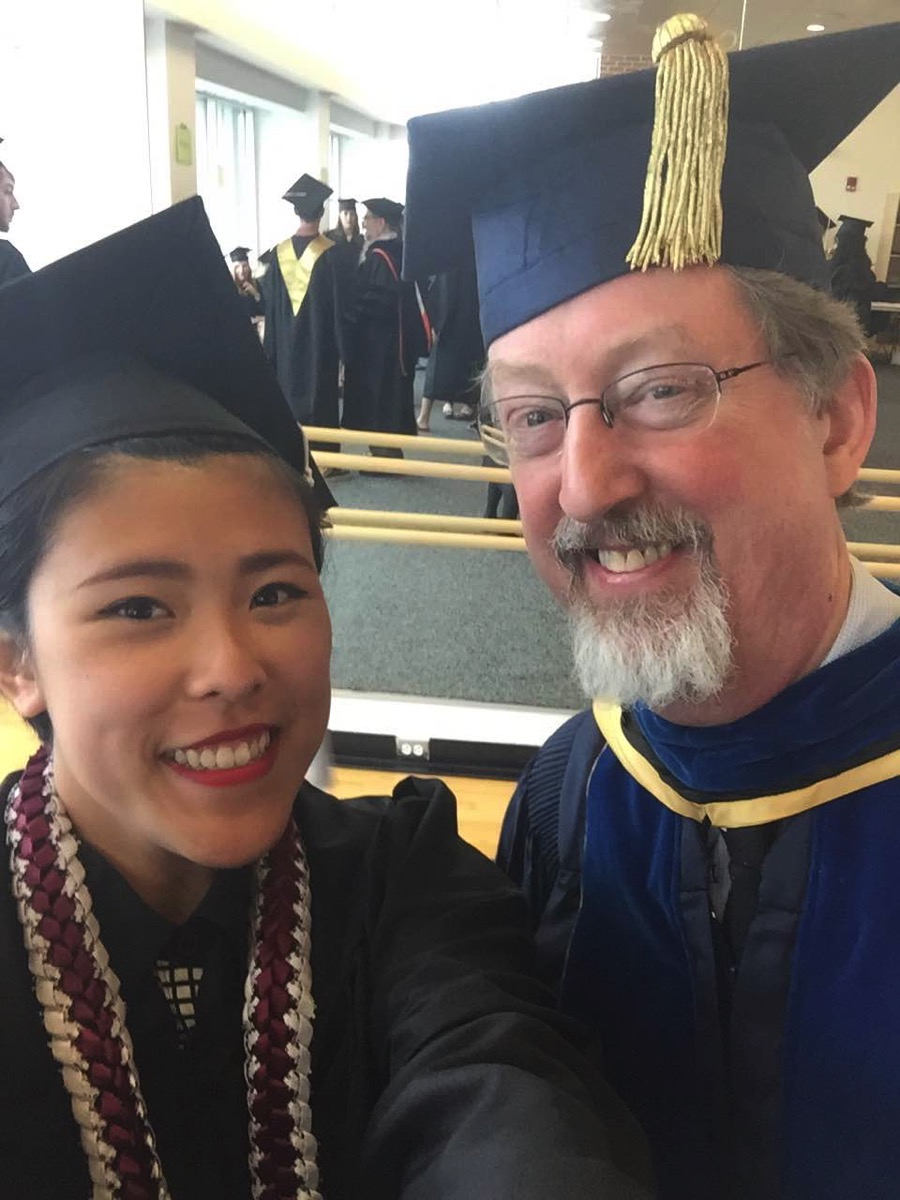
Some pictures of freshly graduated linguists at the Humanities and Fine Arts Senior Recognition Ceremony last Saturday, May 7.
Congratulations!


08 May 2016
Subscribe to:
Posts (Atom)