UMass linguistics and classics major Jack Duff will be a summer inter at Harvard University’s Center for Hellenic Studies in Washington D.C. this summer. You can learn more here. Congratulations Jack!
Showing posts with label undergraduate. Show all posts
Showing posts with label undergraduate. Show all posts
22 May 2016
15 May 2016
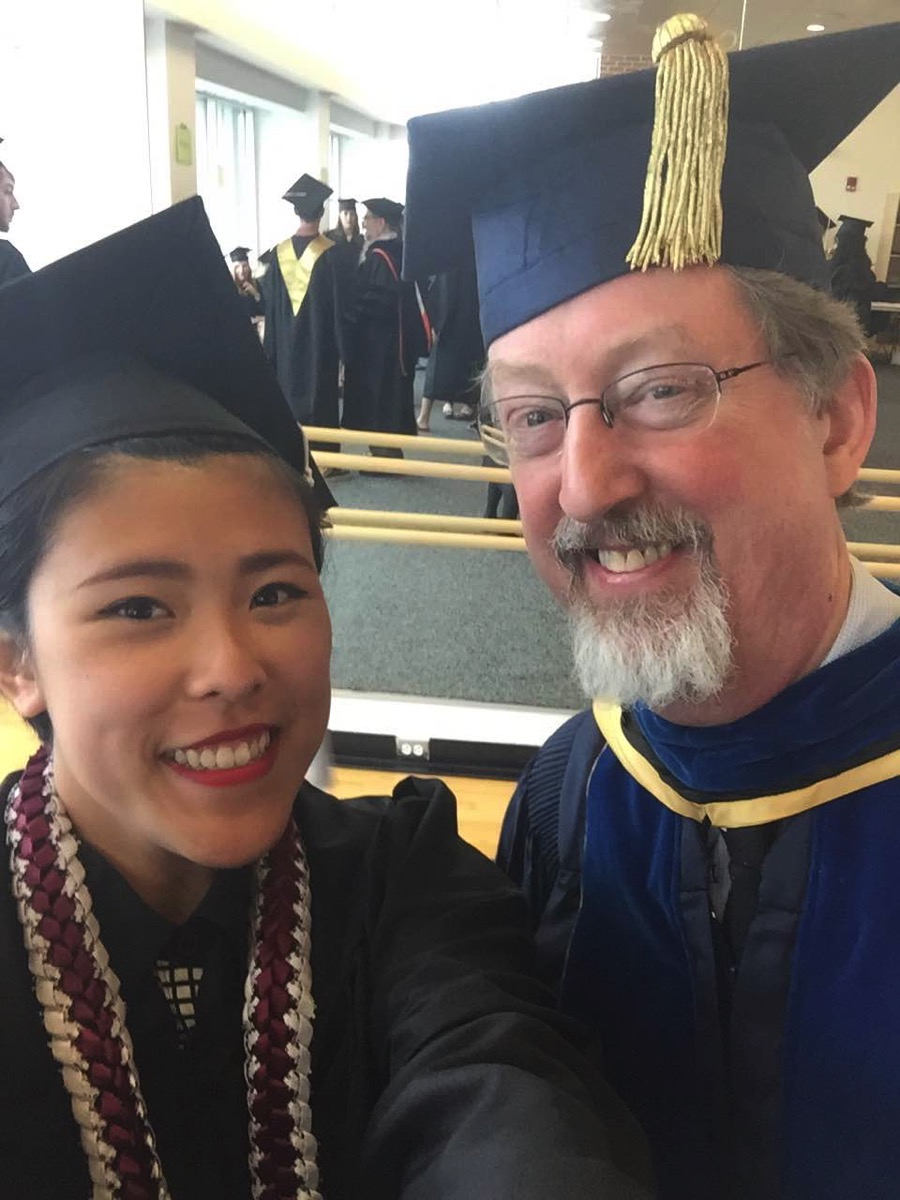
Linguists at HFA Senior Recognition Ceremony
Some pictures of freshly graduated linguists at the Humanities and Fine Arts Senior Recognition Ceremony last Saturday, May 7.
Congratulations!



08 May 2016
24 April 2016
UMass at Undergraduate Research Conference
The 22nd annual Annual Undergraduate Research Conference took place last Friday, April 22, in the Lincoln Campus Center. The Linguistics Department was represented by:
Ashley Lee, who gave the talk: “Gender Assignment in German Loan Nouns from English."
Stephanie Rich presented the poster “Why not Both? Incremental Processing of Syntactic and Semantic Ambiguities."
Anthony Yacovone presented the talk “Investigating the role of predictability during syntactic resolutions."
Congratulations!
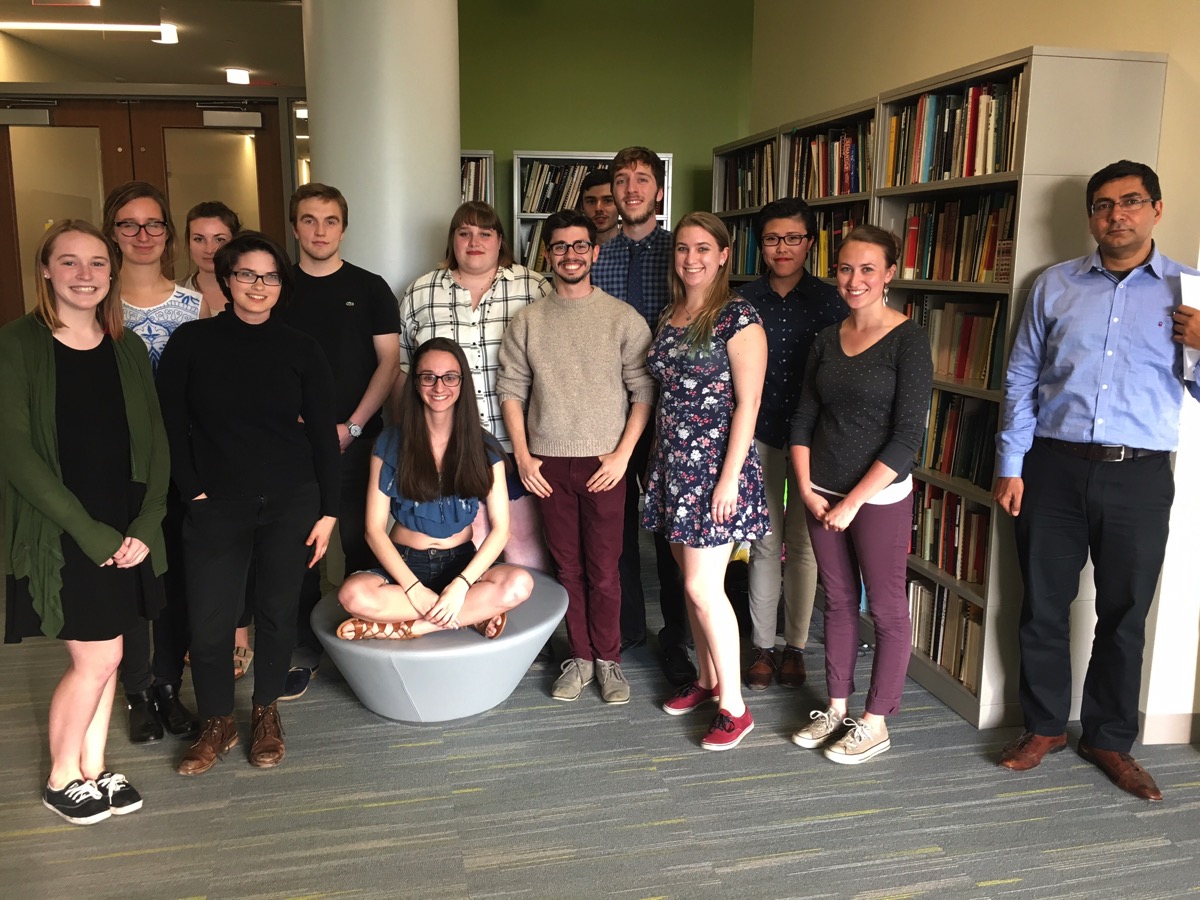
Graduating Seniors at LINGLE
The Year End Lingle happened on Thursday, April 21, in the linguistics department and about half of the graduating seniors were able to show up to be fêted. They, and Rajesh Bhatt, are pictured below.
Congratulations to them, and to all our other graduating seniors!
17 April 2016
Year End Lingle on Thursday
The year end Lingle (Linguistics Majors Mingle) will happen in the UMass Linguistics Department lobby on Thursday, April 21 at 6PM. Come celebrate the end of the year and say farewell to our graduating seniors!
Call for volunteers to work at Speech Prosody 8
CONFERENCE: Speech Prosody 8
WHEN: May 31 to June 3, 2016
WHERE: Boston University
CONFERENCE WEBSITE: http://sites.bu.edu/speechprosody2016/WHO?
Volunteers should be students (any level) who are interested inattending the conference at no cost.
VOLUNTEER JOB DESCRIPTION:
By volunteering for two 4-5 hour shifts, your registration will be waived for the conference (the banquet fee is separate if interested). Volunteer jobs include registering conference goers, overseeing poster sessions, and helping with technical support.
*PLEASE CONTACT JILL THORSON IF INTERESTED AT: J.THORSON@NEU.EDU
10 April 2016
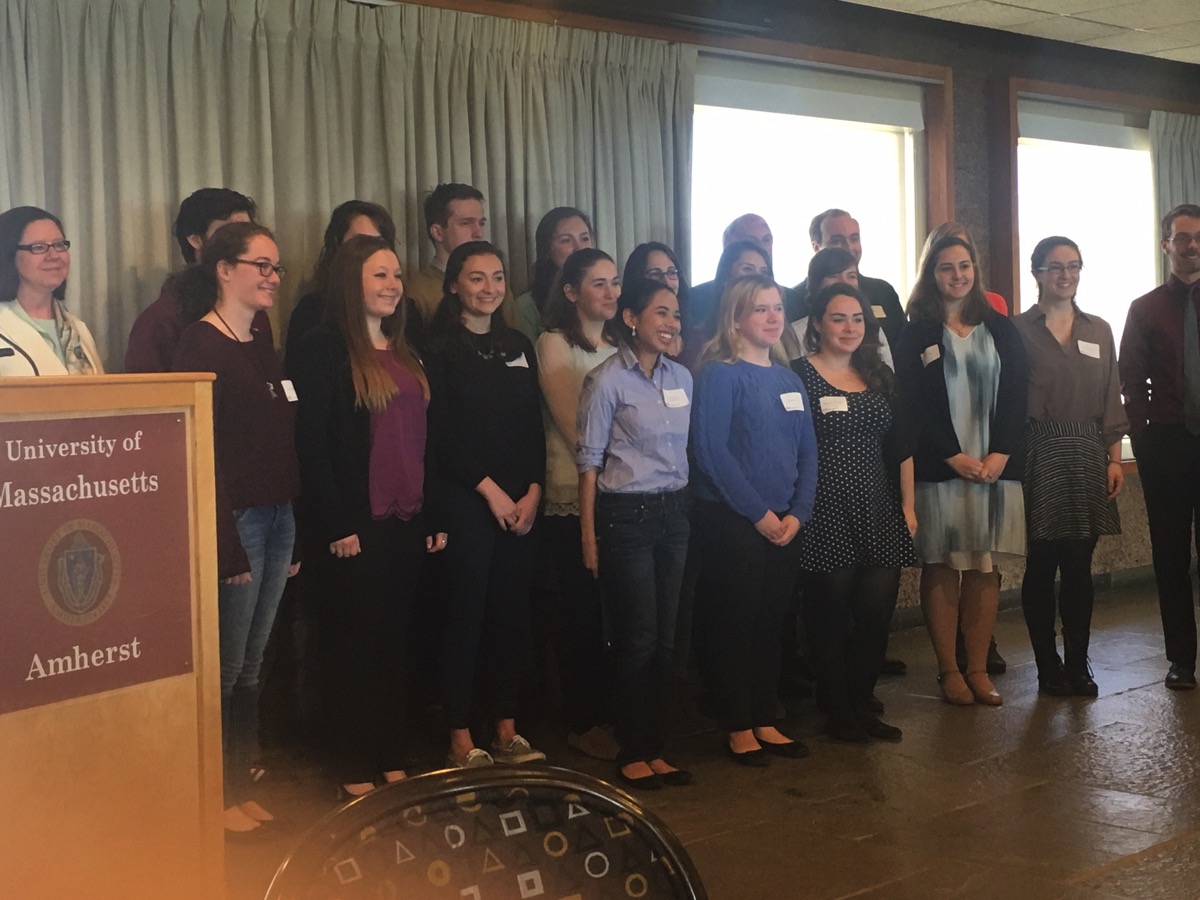
Linguistics Scholarship winners
Linguistics majors Megan Shelb, Abigail Williams, Valerie Higgins and Joanna Nevins were awarded scholarships this year by the college of Humanities and Fine Arts. This Saturday, April 16, there was an awards brunch honoring these, and other, students. Below is a picture of all the honorees featuring Joanna and Megan at the far left of the first row. Congratulations!
27 March 2016
The Fourteenth Annual New York St. Petersburg Institute
St. Petersburg State University is hosting the fourteenth annual New York St. Petersburg Institute of Linguistics, Cognition and Culture from July 11 to July 29 this summer. Stony Brook University is the coordinating institute.
The Institute is open to advanced undergraduate and graduate students from all backgrounds and countries interested in comparative and formal approaches to theoretical linguistics and cognition as well as cultural and media studies. Minimum Education Level: Current Undergraduate (Grads welcome as well)
Description:
Participants create their own study program from seminars in the following fields:
- Generative Linguistics (Syntax, Semantics, Phonology, Morphology)
- Cognitive Science (Cognitive Psychology, Musical Cognition)
- Cultural Studies (Critical Cultural Studies, Women’s & Gender Studies, Islamic & Religious Studies, Film & Media Studies,…)
2016 Linguistics/Cognitive Studies Faculty:
- John F. Bailyn (Stony Brook University)
- Miloje Despić (Cornell University)
- Sabine Iatridou (Massachusetts Institute of Technology)
- Roumyana Pancheva (University of Southern California)
- Maria Polinsky (University of Maryland)
- Irina Sekerina (CUNY Graduate Center)
- Sergei Tatevosov (Moscow State University)
- Marc van Oostendorp (University Leiden)
- Susi Wurmbrand (University of Connecticut)
More information can be found here:
20 March 2016
Post-baccalaureate research positions at University of Maryland
The Department of Linguistics at the University of Maryland, is looking to fill up to four full-time positions for post-baccalaureate researchers.
Starting date for all positions is Summer/Fall 2016. Salary is competitive, with benefits included. The positions would be ideal for individuals with a BA degree who are interested in gaining significant research experience in a very active research group as preparation for a research career. Applicants must already have permission to work in the US, or be a Canadian citizen or permanent resident, and should have completed a BA or BS degree by the time of appointment. The ability to interact comfortably with a wide variety of people (and machines) is a distinct advantage. Applicants may request to be considered for all four positions.
The positions are open until filled. For best consideration, applications should be submitted by April 1st, 2016. However, review of applications will begin immediately.
Positions #1–#2: Baggett Research Fellowships
Baggett Fellowships are full-time positions. Fellows can pursue research in linguistics, cognitive (neuro-)science of language, language acquisition, or computational modeling. 1–2 positions are available for 2016-2017. Positions are for one year and are not renewable.Contact: Dr. Andrea Zukowski (zukowski -at- umd -dot- edu) Application requirements
Further details on just the Baggett positions
Position #3: Research Assistant in Psycholinguistics/Cognitive Neuroscience
This person will be involved in all aspects of studies of language comprehension using behavioral and neuroscientific techniques, including electrophysiological brain recordings (training provided). The person will also contribute to Maryland's Language Science program. Previous experience in (psycho)linguistics preferred. 1 year initial appointment, possibility of extension.Contact: Dr. Colin Phillips (colin -at- umd -dot- edu) Application requirements
Position #4: Research Assistant in Syntax and Morphology
This person will be involved in all aspects of syntactic analysis of several languages, some of which are new to the study of linguistics, using methods of morpho-syntactic analysis and corpus construction (training provided). The person will also assist in bibliographical research and website construction.The person will also contribute to Maryland's Language Science program. Previous experience in linguistics preferred. 1 year initial appointment, possibility of extension.Contact: Dr. Maria Polinsky (mpolinsky -at- gmail -dot- com) Application Requirements
13 March 2016
Julianne Chaloux gets internship in the SCALE workshop
Former Linguistics RA Julianne Chaloux has been offered a summer internship position in the annual SCALE workshop hosted by Johns Hopkins University's Human Language Technology Center Of Excellence. Congratulations, Julianne!
TESOL Teacher Training course this summer at Hampshire
TESOL Teacher Training Course
Summer 2016 @ Hampshire College JUNE 6—July 1, 2016
tesol.hampshire.edu [2]
Teaching ESL/EFL (English as a Second Language/English as a Foreign Language) has become a growing field as cultures and economies globalize. The ultimate goal of this course is for participants to be prepared for actual teaching situations and be confident as TESOL instructors/tutors. Acquiring a TESOL certificate can lead to teaching opportunities around the world.
Now in its fourth year, the TESOL TEACHER TRAINING COURSE AT HAMPSHIRE COLLEGE is a proven training ground for students and professionals interested in global education. Through the course, you'll develop a philosophy of teaching values and practices, learn from peer teaching and peer feedback, plan lessons and other teaching materials, and practice action research skills to understand what goes on in the foreign language classroom. Our practice-based approach is grounded in a comprehensive overview of the history of methods for Teaching English to Speakers of Other Languages, along with a critical examination of the underlying principles of these methodologies.
TUITION AND FEES
Tuition: $2,500
Room: $904
MEALS
Participants can chose to purchase meals daily in our dining commons
and/or chose to prepare their own meals in their condo-style living
quarters.
APPLY NOW! Applications are accepted on a rolling basis
IMPORTANT DATES TO REMEMBER
April 3 / Priority Deadline for all applications
April 11 / Tuition Discount Deadline (all payments must be received in
order to receive 15% tuition discount)
May 1 / Application Deadline (application materials must be submitted)
May 15 / Payment Deadline (all payments must be submitted)
QUESTIONS? Email tesol@hampshire.edu
Why you should make UMass your destination abroad
An article about UMass by visiting student Alberto Moron Hernandez has appeared in Manchet — the newsletter of the Department of Linguistics and English at the University of Manchester.
06 March 2016
Study Linguistics in St. Petersburg this summer
John Bailyn writes:
Study with world-class Linguists and Psychologists through the Linguistics Intensive track of Stony Brook’s “Explore St. Petersburg!” Study Abroad Program, which will be held this summer for the 14th year IN ST. PETERSBURG, RUSSIA. The dates are JULY 9 – AUGUST 7, 2016. More information can be found here: http://advancedrussian.org/
• Earn 3-6 credits
• Study together with students from other countries
• Research internships available
• No knowledge of Russian required (all seminars in English)
• Mini-fellowships of $500 and $1000 available
APPLICATION DEADLINE IS MARCH 15, 2016!
*Late applications possible (until April 1) if space remains*
For information about how to apply, go here.
NYI's lineup of Linguistics and Cognitive Psychology faculty for summer 2016 includes:
John F. Bailyn (Stony Brook) Musical Cognition, Syntax
MILOJE DESPIC (UConn) Syntax, Morphology
SABINE IATRIDOU (MIT) Syntax, Semantics
MARC VAN OOSTENDORP (Leiden) Phonology
ROUMYANA PANCHEVA (USC) Syntax, Semantics
MARIA POLINSKY (UMD) Experimental Syntax, Universals
IRINA SEKERINA (CUNY) Psycholinguistics,Cognitive Psychology
SERGEI TATEVOSOV (Moscow State) Formal Semantics
SUSI WURMBRAND (UConn) Syntax
Additionally, there will be Cultural studies and Women's and Gender studies faculty as well!
NEST at UMass
UMass hosted the annual meeting of New England Sequencing and Timing yesterday, March 5. UMass was represented by the paper “Lexical knowledge is available, but not always used, very early,” by Amanda Rysling, John Kingston, Adrian Staub, Andrew Cohen, Jeffrey Starns and Anthony Yacovone. You can find a full schedule of events here.
14 February 2016
Lingle on Tuesday
This term’s Lingle (the Linguistics Majors Mingle) will meet on Tuesday, February 16, at 5PM in ILC N400. The Lingle will be devoted to the ways in which majors can prepare for non-academic jobs.
Masters in Computational Linguistics at Rochester University
The Computational Linguistics MS program at Rochester trains students to be conversant both in the analysis of language and in computational techniques applied to natural language. The curriculum consists of courses in Linguistics and Computer Science for a total of 32 credit hours.
Graduates from the Computational Linguistics MS program will be prepared for both further training at the PhD level in Computer Science and Linguistics and Computational Linguistics positions in industry. A growing number companies such as Google, Amazon.com, Nuance, LexisNexis, Oracle and many others are searching for employees with advanced degrees in Computational Linguistics for positions ranging from speech recognition technology to improving translation systems to developing bettermodels of language understanding.
For fullest consideration, applicants should submit completed applications by March 1, though applications will continue to be considered as space permits. All documents and application materials should be uploaded in the online application (https://apply.grad.rochester.edu/apply/). Fees for applications received by February 15 waived (more information: https://apply.grad.rochester.edu/register/ASEwaiver).
Direct questions to jeffrey.runner@rochester.edu
For more information about the program, go here.
07 February 2016
PhD positions and Postdocs in Amsterdam
There are a number of vacancies for PhD students and Postdocs in the inquisitive semantics group in Amsterdam. The projects are briefly described below. The deadline for applications is 15 March 2016, and the projects will start in the fall.
If you are interested in one of these positions, please get in touch with:
- Floris Roelofsen (floris.roelofsen@gmail.com)
- Ivano Ciardelli (i.a.ciardelli@uva.nl)
Project 1 (PhD, 4 years): First-order inquisitive logic
This project is intended for a PhD student with a background in logic.Intended starting date: 1 September 2016.Apply through the UvA website.
One important novelty of the inquisitive approach is that it brings out the fact that questions have an important role to play in logic. For instance, suppose we know that Alice and Bob live in the same city. Then, information about Alice’s city of residence yields information about Bob’s city of residence. In inquisitive logic, this takes the form of an entailment:
Alice and Bob live in the same city, where Alice lives |= where Bob lives
Thus, in inquisitive logic we can reason not only, as usual, with particular pieces of information (e.g., that Alice and Bob live in the same city), but also with information types (e.g., Alice’s city of residence), which may be instantiated by multiple pieces of information (that Alice lives in Amsterdam, that Alice lives in Paris, etc). Thus, bringing questions into play leads to an exciting generalization of the fundamental notions of classical logic.
The aim of the project is to explore the consequences of this new perspective, carrying out a thorough investigation of first-order inquisitive logic. What makes this especially urgent is that an extremely broad range of questions are expressible by means of a first-order logical language.
Understanding how to reason with these questions is not only important from a mathematical and philosophical point of view, but also stands to have impact in applications, since question entailment generalizes the notion of functional dependency which is central to database theory and dependence logic. Thus, an axiomatization result would provide effective methods to reason about first-order dependencies.
Project 2 (PhD, 4 years): An inquisitive perspective on quantification in natural language
This project is intended for a PhD student with a background in formal semantics.
Intended starting date: 1 September 2016.Apply through the UvA website.
On the standard view, quantifiers like every man and many students are treated as operators that map properties to truth-values. While this approach allows for an insightful characterization of quantifiers’ truth-conditional contribution, it also has some important limitations. First, interrogative quantifiers like which men and how many students are squarely beyond its scope. Second, even quantifiers like every man are problematic when they occur in questions. For instance, to interpret the question What did every man eat? as ‘for every man x, what did x eat?’, the quantifier needs to scope out of the question; but this is impossible, if its argument is required to be a property.
Inquisitive semantics suggests a simple shift in perspective that simultaneously addresses both these issues. It becomes possible to pursue an account of quantifiers that captures (i) their potential to generate inquisitive content, which is necessary to deal with interrogative quantifiers like which men, and (ii) their ability to propagate inquisitive content, which is necessary to deal with quantifiers scoping out of questions.
We also expect inquisitive semantics to enable us to decompose quantifiers into semantically more primitive parts. A key observation in this regard is that, across languages, quantifiers are often built up from question words. We aim to explain this connection and to show how the meaning of quantifiers can be derived in a systematic way from the inquisitive elements they contain.
Project 3 (Postdoc, ~2.5 years): Applications in computer science and experimental ratification
This project is intended for one or two Postdocs with a background in logic and/or formal semantics/pragmatics, preferably with a particular interest in one or both of the following: (i) computational applications of logic in computer science, in particular in database systems, (ii) experimental semantics/pragmatics.
Intended starting date: 1 September 2016.
Apply through the UvA website.
Inquisitive semantics has so far been used to shed new light on theoretical issues in semantics, pragmatics, logic, and philosophy of language. The aim of this project is to broaden this scope in two directions. First, we will explore practical applications of inquisitive logic in computer science, in particular in database systems. Suppose we have a database and we get a new query. Then instead of looking at the database itself, we may look at the already stored queries, and see whether they entail the new query (in the inquisitive sense). If so, it may be possible to resolve the new query without having to re-consult the database itself, with a substantial gain in efficiency. This is a widely used technique in database systems, but inquisitive logic may make it possible to deal with a much wider range of queries than current systems do.
Second, we want to carry out a number of experiments to corroborate the empirical predictions that are made by linguistic theories formulated in inquisitive semantics, and to further develop these theories guided by the obtained empirical results. Relevant phenomena include (but are not restricted to) the interpretation of disjunction, questions, question-embedding verbs, and other operators that arguably generate and/or propagate inquisitive content, such as quantifiers, modals, and conditionals.
Project 4 (Postdoc, ~2.5 years): A fully compositional dynamic inquisitive semantics
This project is intended for a Postdoc with a background in formal semantics, preferably with a particular interest in compositionality and dynamic semantics.
Intended starting date: 1 October 2016.
Apply through the UvA website.
Most work on inquisitive semantics so far has focused on InqB, the inquisitive counterpart of classical first-order logic. In order to obtain a full-fledged inquisitive framework for natural language semantics, this basic system needs to be extended in two ways. First, we need to allow for meaning composition at the sub-sentential level. Second, we need to capture dynamic aspects of meaning, e.g., cross- and inter-sentential anaphoric dependencies and presuppositions. The goal of this project is to develop a fully compositional dynamic inquisitive semantics, and to apply this framework to a number of linguistic phenomena involving inquisitiveness below and beyond the sentence boundary.
31 January 2016
For Sophomores and Juniors: Linguistics Field School
The Linguistics Department of Swarthmore College and Haverford College will host a 5-week Linguistics Field School consisting of two weeks at Haverford College and three weeks of community-based work in Mexico (with Prof. Brook Danielle Lillehaugen) or in the Navajo Nation (with Prof. Ted Fernald).
Host Institutions: Swarthmore College and Haverford College. In Oaxaca: Biblioteca de Investigación Juan de Córdova and Centro de Estudios Tecnológicos, industrial y de servicios (CETis) #124. In the Navajo Nation: Navajo Technical University (NTU)
Dates: May 23 through June 25, 2016
Locations: Haverford, PA; Oaxaca, Mexico; Crownpoint, New Mexico
Description: The program will recruit a cohort of 12 undergraduates who have shown a strong interest in and commitment to linguistics, digital tools, and/or related fields. Students will being the program at Haverford College, where they will receive ten days of intensive training in linguistic field methods, digital recording, data analysis, field ethics, and allied disciplines. Students will then join local community language revitalization projects in Oaxaca, Mexico and the Navajo Nation for three weeks (6 students at each site), where they will work closely with language activists and scholars on a variety of projects. For the Navajo project, students will work on programming and testing a web-based application for generating Navajo verbs. The last 5 days will take place at Haverford College where students will receive follow-up training and process their field data.
Interested students may find the NSF REU Linguistics Field School Facebook group useful in getting a sense of the experience. The Twitter hashtag is #LingFieldSchool.
Funding: All travel and living expenses will be covered, and students will also receive a generous weekly stipend.
Qualifications: Applicants should be currently enrolled undergraduates who have completed at least one year of college level studies. Students who will complete their B.A. by June 2016 are not eligible. We especially welcome applications from students of community colleges, tribal-affiliated colleges in the US, and institutions where no linguistics major is available. Fluent or heritage speakers of Zapotec or Navajo are especially encouraged to apply. This project is funded by the National Science Foundation's Research Experiences for Undergraduates (REU) program (grant #1461056), which limits applicants to US citizens or permanent residents. Students should have experience (such as course work) in at least two of the following areas and demonstrated interest in others: linguistics, languages indigenous to the Americas (including Zapotec and Navajo), programming, web design, and digital humanities. For Oaxaca: applicants must have a valid passport at the time of application; competency in Spanish is necessary and programming experience with Android apps or iPhone apps is an asset. For the Navajo Nation: an introductory computer science course or data structures course is desirable, or programming experience with Python or a web framework like Django.
Application Instructions: The application is available here. Applications will require one letter of recommendation which must be emailed directly from the recommender to linguistics@swarthmore.edu by the application deadline. The selection process is highly competitive and detailed letters that address the student’s potential for success in this type of program will be most helpful in determining the final cohort.
Application deadline: February 15, 2016.
24 January 2016
Linguistics Club meets tomorrow
The first meeting of the Linguistics Majors Club meets tomorrow, January 25, at 4PM in the Integrated Learning Center N400. If you are interested in any of the linguistics majors, or in linguistics or linguists, come!
Subscribe to:
Posts (Atom)