Showing posts with label faculty. Show all posts

05 June 2016

UMass at Speech Prosody 2016

Speech Prosody 2016 was hosted by Boston University from Tuesday, May 31 through Friday 3 in Boston. UMass was represented by 

alumna Emily Elfner, who gave the tale “Subject/Object complexity and prosody boundary strength in Irish"

alumnus Jesse Harris, with Sun-Ah Jun and Adam Joyer, who gave the talk “Implicit prosody pulls its weight: Recovery from garden path sentences.”

Mara Breen, with Sarah Weidman and Katherine Haydon, gave the talk “Prosodic speech entrainment in romantic relationships."

Covadonga Sánchez-Alvarado and Meghan E. Armstrong gave the talk “Pitch scaling and the perception of contrastive focus in L1 and L2 Spanish."

Alumna Amy Schafer, with Múria Esteve-Gibert, Cristel Portes, Barbara Hemforth and Mariapaola D’Imperio, gave the paper “Intonation in the processing of contrast meaning in French: An eye-tracking study."

Meghan Armstrong organized a special session on Rising intonation in English and beyond, and gave a talk, with Maria Del Mar Vanrell, at that session entitled “Intonational polar question markers and implicature in American English and Majorcan Catalan.” She also, with Page Piccinini and Amanda Ritchart, gave the poster “Non-Question rises in narratives produced by mothers and daughters."

Roeper in Delhi

Tom Roeper gave a virtual talk at the colloquium series at IIT in Delhi on June 1. The title of his talk was “Minimalism and Acquisition."

Roeper in Frankfurt

Tom Roeper will be giving a talk entitled “Abstract Triggers and Acquisition” at the University of Frankfurt on June 28th.

22 May 2016

Roeper at University of Toronto

Tom Roeper will be giving a talk entitled “Recursion and Interfaces” at a workshop on Complexity in Learnability and Development that the University of Toronto is hosting this Wednesday, May 25. Tom’s paper reports on his work with Petra Schulz. The Workshop is organized by UMass alumna Ana-Teresa Pérez-Leroux, who will also be giving talks at the workshop. For more information, go here.

15 May 2016

Johnson in California

Kyle Johnson gives a talk at the University of California-Santa Cruz on Friday, May 20, entitled “Building a Trace."

Linguists at HFA Senior Recognition Ceremony

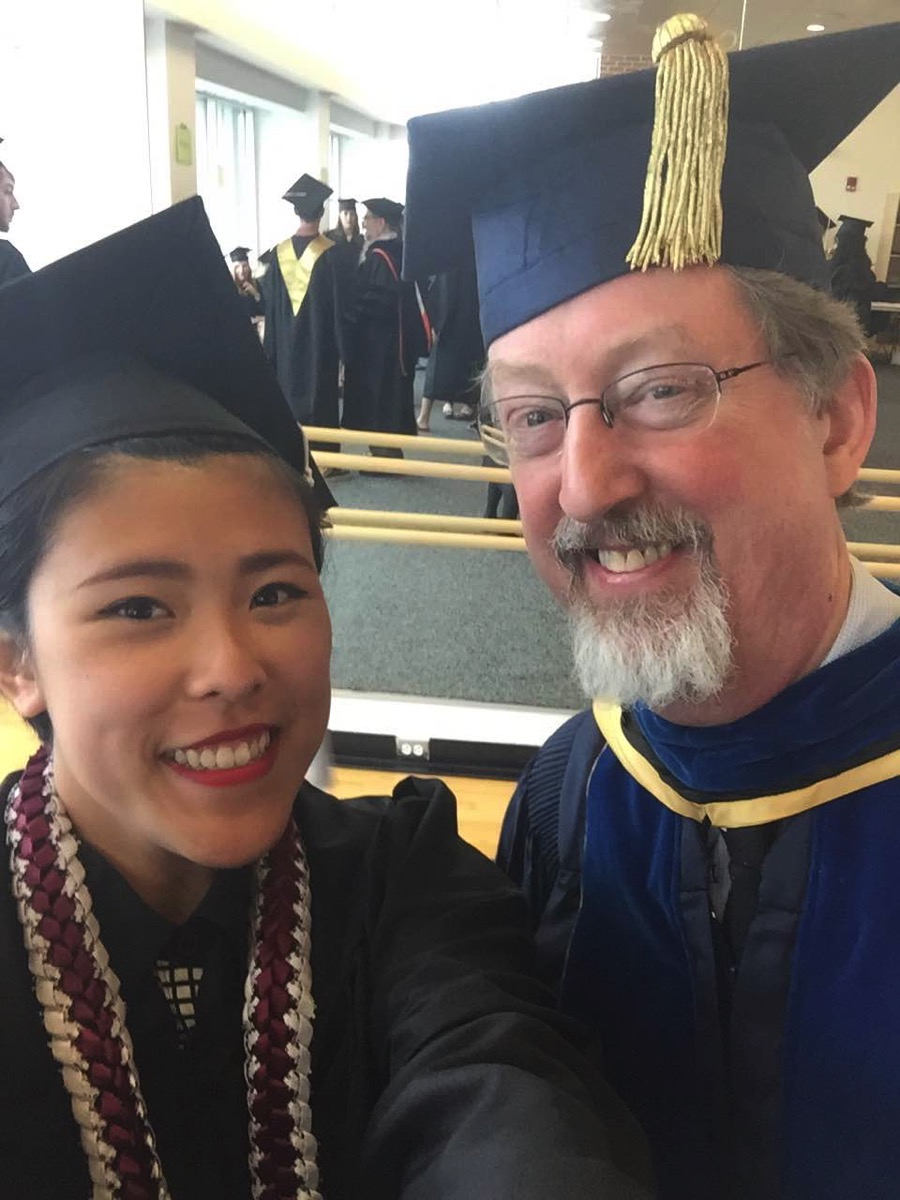
Some pictures of freshly graduated linguists at the Humanities and Fine Arts Senior Recognition Ceremony last Saturday, May 7.

Congratulations!

Under1

Under2

Under3

08 May 2016

Kratzer at UPenn

Angelika Kratzer gave a colloquium talk entitled “Evidential Moods” to UPenn’s linguistics department on Thursday, May 5.

UMass at FASL

Cornell University is hosting the Twenty Fifth annual meeting of Formal Approaches to Slavic Linguistics on May 13-15. Gaja Jarosz and alumnus Michael Becker are giving plenary talks. Gaja’s is entitled “Sonority sequencing in Polish: Defying the sttimulus?” and Michael’s is entitled “Inconspicuous unfaithfulness in Slovenian.” For more information, go here.

01 May 2016

UMass at SULA

UC, Santa Cruz is hosting the ninth meeting of Semantics of Under-Represented Languages in the Americas on May 6-8. UMass is represented by:

Alumna Amy Rose Deal, who is giving the talk “Legacy Documentation: What can we learn?"

Seth Cable, who is giving the talk “Negation and negative antonyms in Tlingit."

Alumna Suzi Lima, who is giving the talk “On the interpretation of object denoting nouns in Yudja"

For more information, go here.

24 April 2016

Jeremy raps

Jeremy Hartman will give an Acquisition Rap at MIT on Saturday, April 30 at a conference in honor of Ken Wexler on the occasion of his retirement. Jeremy’s rap is “Building a corpus for root infinitives.” For more information about the event, and Jeremy’s rap, go here.

Gaja, Brian and Kristine are featured at Data Science Tea

Data Science Tea - Linguistics Spotlight

What: tea, refreshments, presentations and conversations about topics in data science

Where: Computer Science Building Rooms 150, 151

When: 4-5:30pm Tuesday April 26

Who: You! Especially PhD & MS students, and faculty interested in data science.

Professor Kristine Yu - The learnability of tones from the speech signal

Many of the world's languages are tone languages, meaning that a change in pitch (how high or how low the voice is) causes a change in word meaning, e.g. in Mandarin, "ma" uttered with a rising pitch like in an English question (Did you go to class today?) means "hemp", but "ma" uttered with a falling pitch like in an English declarative (Yes!) means "to scold". This talk discusses initial steps in using machine learning to find out the best way to parametrize tones in an acoustic space, in order to set up the learning problem for studying how tone categories could be learned. I look forward to your comments and suggestions!

Professor Gaja Jarosz - Computational Models of Language Development: Nature vs. Nurture

Recent work on phonological learning has utilized computational modeling to investigate the role of universal biases in language development. In this talk I review the latest findings and controversies regarding the status of a particular language universal, Sonority Sequencing Principle, traditionally argued to constrain the sound structure of all human languages. I argue that explicit computational and statistical models of the language development process, when tested across languages (English, Mandarin, Korean, and Polish) allow us to disentangle the often correlated predictions of competing hypotheses, and suggest a crucial role for this universal principle in language learning. 

Professor Brian Dillon - Serial vs. parallel structure-building in syntactic comprehension

In this talk I give a brief overview to theories of human syntactic comprehension. An important theoretical question in this area is whether the human sentence processor creates and maintains a single syntactic description of a sentence, or if instead it maintains multiple, parallel parses of the input. This question is of wide-ranging theoretical importance for theories of human syntactic processing, but the empirical data that distinguish serial from parallel parsing behavior are unclear at best (Gibson & Pearlmutter, 2000; Lewis, 2000). In this talk I reexamine this theoretical question, and present in progress work with Matt Wagers (Linguistics, UC Santa Cruz) that uses tools from mathematical psychology (Signal Detection Theory) to derive novel empirical predictions that distinguish serial vs. parallel processing, a first step on the road to reevaluating this old, but perptually important, theoretical question.

Gaja gives a talk at 5 at 4

Gaja Jarosz is one of five incoming HFA faculty who are giving a short presentation at the “5 at 4” cocktail hour that the Dean of HFA is sponsoring on April 27. Gaja’s talk is entitled “ .” the event is at 4PM in The Hadley Room, Campus Center.

17 April 2016

Kingston on the road

John Kingston gave a talk last Wednesday, April 13, at the Workshop on (Morpho)-phonological Processing at Oxford University. His talk presents work with Amanda Rysling, Adrian Staub, Andrew Cohen and Jeffrey Starn; the title is “When do words influence perception? Converging evidence that Ganong effect is early and variable”

And last Friday, April 15th, he presented the paper “Misperception, coarticulation, and sound change,” work with Amanda Rysling, Alexandra Jesse, and Robert Moura, at the Worshop on Articulatory Control at the Laboratories de Phonetique et Phonologie, Paris 3.

10 April 2016

Kingston on the road

John Kingston will give a talk on Wednesday, April 13, at the Workshop on (Morpho)-phonological Processing at Oxford University. His talk presents work with Amanda Rysling, Adrian Staub, Andrew Cohen and Jeffrey Starn; the title is “When do words influence perception? Converging evidence that Ganong effect is early and variable”

And on Friday, April 15th, he will be presenting the paper “Misperception, coarticulation, and sound change,” work with Amanda Rysling, Alexandra Jesse, and Robert Moura, at the Worshop on Articulatory Control at the Laboratories de Phonetique et Phonologie, Paris 3.

Tracking the Human Mind in Attitude and Speech Reports

Angelika Kratzer writes:

You (and your friends, students, colleagues) are all invited to a symposium on:

Tracking the Human Mind in Attitude and Speech Reports

Saturday, April 16 10:00 AM - 1:00 PM

Integrative Learning Center, N 400 

Please spread the word! Catered reception starting at 1:00 PM. This might or might not be a substitute for lunch. 

9:30

Coffee, settling down

10:00  - 10:55

Kate Davidson, Linguistics Department, Harvard University 

Our cat went "meow" and my dog was like "feed me!": iconic attitude reports in spoken and sign languages.

Hadas Kotek, Linguistics Department, McGill University Chair & last question or comment. 

11:05 - 12:00

Jonathan Phillips, Moral Cognition Lab, Psychology Department, Harvard University

Factive Theory of Mind

Angelika Kratzer, Department of Linguistics, UMass AmherstChair & last question or comment. 

12:10 - 1:05

Shevaun Lewis, Language & Cognition Lab, Cognitive Science Department, Johns Hopkins University

The Role of Pragmatics in Language Development and Processing

Amy Rose Deal, Linguistics Department, UC BerkeleyChair & last question or comment. 


The Symposium is offered and organized by members of the 2015/2016 SIAS (Some Institutes for Advanced Study) Summer Institute. Financial support for the symposium comes from Research and Professional Development Funds provided by UMass Amherst, which are gratefully acknowledged.  More information about the 2015/2016 SIAS Summer Institute: 

http://nationalhumanitiescenter.org/sias/

Call for papers: NELS

UMass is hosting the Forty Seventh annual meeting of the North East Linguistic Society in early October, 2016. Invited speakers are Klaus Abels, Cleo Condoravdi, Roumyana Pancheva and our own Gaja Jarosz. There are two special sessions: one on linearization of syntactic structures and one on grammatical illusions at the grammar-processing interface. Deadline for abstracts is the last minute of June 15.

For more information, go here.

UMass at ECO 5

MIT is hosting the Graduate Student Workshop this Saturday, April 16, from 9:15 to dinner. UMass is represented by:

Deniz Ozyildiz who is giving the talk “Factivity alternates, at least in Turkish."

Nadine Balbach, Jeremy Hartman and Tom Roeper, who are giving the talk “Everyone but me — Children Acquiring the different notions of `but’ in Quantified Sentences."

Polina Berezovskaya will present the talk “Processing Ambiguous Degree Constructions Cross-Linguistically"

For more information, including a schedule and how to register, go here.

Bhatt at UPenn

Rajesh Bhatt is giving an invited colloquium talk on April 14 at the University of Pennsylvania. The title of his talk, which reports on joint work with Vincent Homer, is “PPIs and Movement in Hindi-Urdu.” An abstract follows.

Typically, Positive Polarity Items (PPIs), e.g. `would rather', cannot be interpreted in the scope of a clausemate negation (barring rescuing or shielding) (Baker 1970, van der Wouden 1997, Szabolcsi 2004 a.o.):

1a. John would rather leave.

1b. *John wouldn't rather leave.

The scope of most of them is uniquely determined by their surface position. But PPI indefinites are special: they can surface undernegation and yet yield a grammatical sentence under a wide scope interpretation:

2. John didn't understand something.ok: SOME > NEG;*NEG > SOME

Here we address the question of the mechanism through which a   PPI ofthe `some' type  takes wide scope out of an anti-licensingconfiguration. One possibility is (covert) movement, another is mechanisms that allow indefinites to take (island-violating) ultra-wide scope such as choice functions (Reinhart 1997). The relevant configurations that have motivated choice functions for other languages can be set up for Hindi-Urdu too.

We can therefore assume that a device that generates wide-scope for indefinites without movement is available in Hindi-Urdu too. We show that in Hindi-Urdu at least,  this device is unable to salvage PPIs in the relevant configuration. Only good old fashioned overt movement does the needful. If we think of overt movement in Hindi-Urdu as being the analogue of covert movement elsewhere, then the Hindi-Urdu facts are an argument that it is movement, albeit covert, that salvages PP Is in English too, not alternative scope-shifting devices. We explore whether the conclusion from Hindi-Urdu does in fact extend to English.

Dillon at Northwestern

Brian Dillon gave a colloquium talk at Northwestern University on Friday, April 8. A title and abstract follow.

Grammatical illusions in sentence processing: At the interface of performance and competence

One question of interest for psycholinguists is the question of how closely real-time sentence processing routines align with grammatical knowledge: does the competence grammar directly constrain sentence comprehension, or does it play a secondary role, 'cleaning up' the results of a comprehension process driven by heuristic processes (e.g. Lewis & Phillips, 2015; Patson & Ferreira, 2007; Townsend & Bever, 2001)? Much experimental work has provided evidence for the view that the human sentence processor is fairly directly constrained by grammatical knowledge even at the earliest stages of analysis, suggesting a very tight link between grammatical knowledge and the sentence processor. However, a puzzle for this view is the observation that there are many apparently simple grammatical constraints, such as subject-verb agreement, that comprehenders seem unable to accurately apply during comprehension (e.g. Wagers, Lau & Phillips, 2009). Such 'grammatical illusions' have been accounted for by appealing to independently motivated aspects of the parser, such as an interference-prone working memory architecture (Phillips, Lau & Wagers, 2011; see also Frazier, 2015).

Research on grammatical illusions has generated a wealth of psycholinguistic data that bears on when, and how, grammatical constraints guide the analysis of linguistic input. Overall the data reveal a pattern of 'selective fallibility': some linguistic dependencies fall prey to grammatical illusions quite readily, others do not (Phillips et al, 2011). This leads to an important theoretical question which is the focus of my talk: when, and why, do comprehenders violate grammatical constraints during sentence comprehension? In this talk, I will review some of the work in this area, and discuss processing models that have been proposed to account for these processor-grammar divergences. I will then discuss two case studies from our group at UMass Amherst on the processing of reflexive binding dependencies (work with Shayne Sloggett) and the licensing of negative polarity items in comprehension (work with Jon Ander Mendia and Ethan Poole) that provide new insight into the factors that create grammatical illusions in comprehension. These studies suggest that some grammatical illusions actually have grammatical bases, reflecting 'subgrammatical' linguistic constraints. This study suggests that grammaticality illusions are no mere performance errors; instead, they are regular and predictable behavior that provides a unique window into normal grammatical mechanisms and normal processing mechanisms alike.

03 April 2016

LinguistList Fund Drive!

Barbara Partee writes:

The Linguist List fund drive for 2016 has begun.

http://funddrive.linguistlist.org/         

Linguist List has great value for everyone, but it's easy to take it for granted, like Wikipedia (which also needs support.) The second "Linguist of the Day" this year is Gary Holton (http://funddrive.linguistlist.org/linguists/) of the University of Alaska, one of whose main specializations is language documentation. He tells on his post there how crucial Linguist List has been in getting the linguistic community together to develop best practices for fieldwork, documentation, archiving, etc, often in cooperation with NSF and other entities. There's one good reason right there.     

Linguist List also revolutionized the whole business of job postings and job searches. We used to have to submit a job description to a print journal and/or the LSA Bulletin and/or some MLA publication, I forget what, with a tight deadlines followed by a long wait before the announcement appeared, and it was all very cumbersome and awkward.     

And of course the calls for papers for conferences etc -- now they reach linguists everywhere, getting rid of the unintentional but inevitable discrimination that resulted from the fact that conference organizers were dependent on the mailing lists they had, and those often didn't reach many independent scholars or scholars at small schools or scholars abroad. Now if you have access to internet you have access to all that information, thanks to the fact that Linguist List is the recognized clearing house that everyone will send their conference information to.   

And on an on -- Linguist List is probably of value to you in more ways than you've ever realized, especially if you're of a young enough generation that it has always been there, as far as you've been aware.     

They've been through a labor-intensive transition period the last couple of years, changing leadership as Helen Aristar-Dry and Anthony Aristar retired and Damir and Malgorzata Cavar took the helm, and the whole operation moved from Eastern Michigan University to the University of Indiana. They had to skip the fund drive the first year of the transition because they had no time or staff to mount one. They did have one last year and were moderately successful. But they really really need our help this year. All the funds that are raised go to supporting graduate students who help keep Linguist List running. The goal this year is $79,000, and they really need to reach it.     

As usual, there are various challenges. Right now, with things just starting up, UMass Amherst happens to be tied for third in the university challenge -- but that could change fast, since we're third at a total of $300 with just 2 donors. (http://funddrive.linguistlist.org/university/) But if lots of us would jump in quick with whatever gift we can afford, I hope we can at least stay in a good respectable top 10% or so.     

http://funddrive.linguistlist.org/donate/