Presley Pizzo, Claire Moore-Cantwell and Brian Smith took delivery of their well-earned PhD diplomas at the Graduate Commencement on Friday, May 6th.
Congratulations!
Presley Pizzo, Claire Moore-Cantwell and Brian Smith took delivery of their well-earned PhD diplomas at the Graduate Commencement on Friday, May 6th.
Congratulations!

The Second Year students present their work at a Mini-Conference this Thursday, April 28 starting at 9:30 in ILC N400. A schedule follows.
9:30 Petr Kusily: Embedded under Past: Novel data and puzzles for Present and Future in Japanese, Russian and English
10:00 Rodica Ivan: Binding within PPs
10:30 Deniz özyildiz: Factivity Defteated
11:00 Break (with refreshments)
11:30 Georgia Simon: Getting Specific about Underspecification
12:00 Thuy Bui: The Vietnamese Perfect
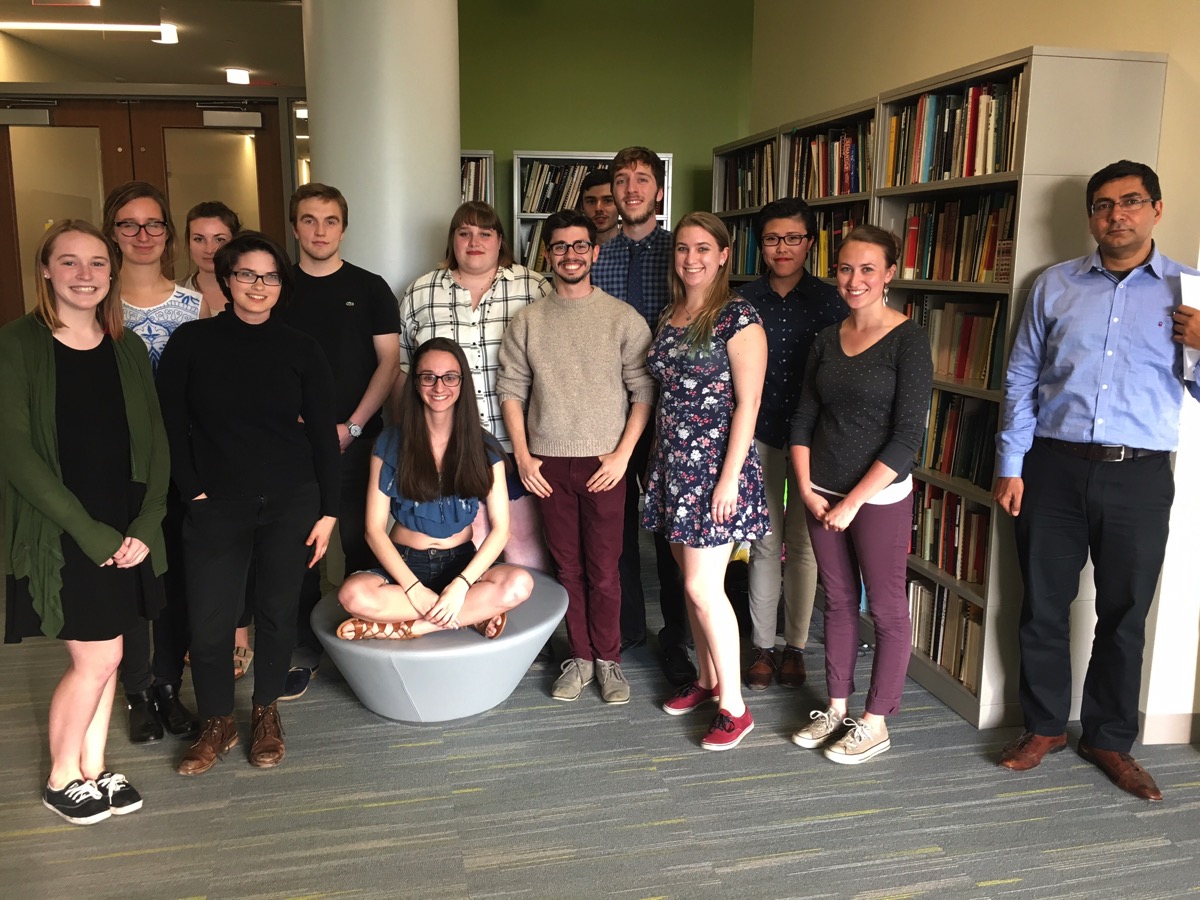
The Year End Lingle happened on Thursday, April 21, in the linguistics department and about half of the graduating seniors were able to show up to be fêted. They, and Rajesh Bhatt, are pictured below.
Congratulations to them, and to all our other graduating seniors!
The year end Lingle (Linguistics Majors Mingle) will happen in the UMass Linguistics Department lobby on Thursday, April 21 at 6PM. Come celebrate the end of the year and say farewell to our graduating seniors!
David Pesetsky (MIT) will give the department colloquium on Friday, April 15, at 3:30 in ILC N400. The title of his talk is “Exfoliation: towards a derivational theory of clause size.” An abstract follows.
We too easily become used to facts about language that should strike us as strange. One of these is the menagerie of clause-types and clause-sizes in the world's languages categorized with ill- understood labels such as finite, non-finite, full, reduced, defective, and worse. For almost a half-century, the standard approach to these distinctions has treated them as a consequence of lexical choice — a legacy of arguments by Kiparsky & Kiparsky (1970) and Bresnan (1972), who showed (1) that verbs that select a clausal complement select for the complementizer and finiteness of that complement, and (2) that finiteness and complementizer choice have semantic implications. In an early-1970s model of grammar in which selection and semantic interpretation were properties of Deep Structure, these discoveries directly entailed the lexicalist view of clause type that is still the standard view today. So compelling was this argument at the time, that its 1960s predecessor (Rosenbaum 1967) was all but forgotten — the idea that distinctions are derivationally derived as the by-product of derivational processes such as Raising. As a consequence, it has gone unnoticed that in a modern model of grammar, where structure is built by Merge (and both selection and semantic interpretation are interspersed with syntactic operations), the arguments against the derivational theory no longer go through.
In this talk, I present a series of arguments for a modernized return to a derivational theory. I argue that a reduced clause is the response to specific situation: a clause-external probe that has located a goal such as the subject in the upper phase of its CP-complement, when that goal does not occupy the edge of its CP. Since anti-locality prevents that goal from moving to the clausal edge (Erlewine 2015 and predecessors), a last-resort operation called Exfoliation deletes outer layers of the clause until the goal occupies the edge without movement. If the goal was a subject occupying a low enough position, the result is an infinitive. If the goal occupied a higher position, the result is a finite clause missing its complementizer. My starting point is the paradigm in (a)-(d). Because a standard approach assumes that every infinitive is born infinitival, the contrast between (a) and (b) is usually treated as a puzzle of case theory: why does moving the subject in (b) eliminate its case problem visible in (a)? The derivational approach invites an entirely different question: why should the embedded clause in (a) be infinitival in the first place? Since no probe targets the embedded subject in (a), Exfoliation should not have taken place, and the clause should have remained finite (I assure you that Mary is the best candidate). Only in (b), where an Ā-probe has targeted the embedded subject, is Exfoliation justified, hence the possibility of an infinitive. Example (c) also shows Exfoliation, deleting only the complementizer because the subject is higher than in (b), and (d) is impossible because no Exfoliation took place — thus explaining the that-trace effect as part of the same paradigm.
a. *I assure you Mary to be the best candidate.
b. Mary, who I assure you __ to be the best candidate. (Kayne 1983)
c. Mary, who I assure you __ is the best candidate.
d. *Mary, who I assure you that __ is the best candidate.
Similar effects with A-movement arise in the behavior of English wager-class predicates and raising in Lusaamia (Carstens & Diercks 2014), as well as with other Ā-phenomena such as anti- Agreement (Baier 2015). Finally, I provide an independent argument for the last-resort nature of Exfoliation from Zulu Hyper-Raising, based on a simplified version of a proposal by Halpert (2015).
UMass is hosting the Forty Seventh annual meeting of the North East Linguistic Society in early October, 2016. Invited speakers are Klaus Abels, Cleo Condoravdi, Roumyana Pancheva and our own Gaja Jarosz. There are two special sessions: one on linearization of syntactic structures and one on grammatical illusions at the grammar-processing interface. Deadline for abstracts is the last minute of June 15.
For more information, go here.
Kathryn Davidson (Harvard) will give the department colloquium on Friday, April 8 at 3:30 in ILC N400. A title and abstract of her talk follow.
Title:
Combining imagistic and discrete components in a single proposition: The case of sign language classifier predicates
Abstract:
Classifier predicates in sign languages (also known as "depicting verbs") have both discrete and imagistic components: they participate fully in the grammar as verbs and involve categorical handshapes that agree with the subject, but also have an obligatory "gestural" component that psycholinguistic experiments have shown are interpreted in an analog and iconic way. Understanding how to treat these verbs in a formal semantic system is therefore a challenge. In this talk I will draw parallels with work on quotation and attitude reports to introduce an analysis of classifier predicates involving the notion of an iconic "demonstration of events". I will also present corpus data from bimodal (sign/speech) bilingual blended utterances that sheds light on the syntax/semantics of classifier predicates. Finally, I will discuss extensions of this analysis of classifier predicates to formal semantic analyses of gesture.
Raffaella Zanuttini (Yale University) will give the Freeman Lecture this year on Friday, April 1 in room S211 of the Integrative Learning Center at 3:30. Her talk, “Discovering Grammatical Diversity in American English” is based on the research carried out by the Yale Grammatical Diversity Project which she founded. You can learn more about the Project here.
Amy Rose Deal (UC, Berkeley) will give the department colloquium on Friday, March 25 at 3:30 in ILC N400. A title and abstract of her talk follow.
Title:
Shifty asymmetries: toward universals and variation in shifty indexicality
Abstract:
Indexical shift is a phenomenon whereby indexicals embedded in speech and attitude reports depend for their reference on the speech/attitude report, rather than on the overall utterance. For example, in a language with indexical shift, "I" may refer to Bob in a sentence like "Who did Bob think I saw?". The last 15 years have seen an explosive growth in research on indexical shift cross-linguistically. In this talk, I discuss three major generalizations that emerge from this work, and present a theory that attempts to explain them. The account that I develop concerns the syntax of indexical shift along with its semantics, and has consequences for the linguistic encoding of attitudes de se. Throughout the talk I will exemplify indexical shift primarily, though by no means exclusively, with data from original fieldwork on Nez Perce.
The Sixth meeting of Formal Approaches to South Asian Languages will meet March 12-13 at UMass. The talks are all held in ILC N400 and there is no registration fee. Everyone is welcome.
UMass is represented by:
Sakshi Bhatia and Ethan Poole who are giving the talk “Deriving subject and anti-subject orientation"
Alumna Amalia Gnanadesikan who will be presenting the poster “Coda-Onset Asymmetries in Dhivehi"
and
UMass visitor Konstantin Sachs who will be presenting the paper “A Movement Approach for Multi-Head Correlatives — Evidence from NPIs and Islands”
For more information, go here.
Thuy and Rodica will give a report on ConSOLE in Syntax Workshop tomorrow, February 1. Syntax Workshop meets on Mondays from 4:30-5:30 in ILC N458.
Leland Kusmer writes:
We're going to start SpectroLunch for the semester, and you should come!
For those who don't know: Once a week, a bunch of us get together and eat snacks while practicing our spectrogram reading. It's a lot of fun, and a good way to practice this important skill and to learn weird things about English phonetics. (Did I mention there are snacks?) It's totally informal and you don't need any prior knowledge of spectrogram reading — just come and join in! We meet at 10AM on Fridays.
The linguistics department hosted the Second Annual Cognitive Science Workshop last Friday (January 29) from 2:30-5:00. Recent UMass faculty Gaja Jarosz (Linguistics), Brendan O’Connor (Computer Science) and Christopher White (Music) gave presentations.
Seth Cable and Peggy Speas write:
Happy New Year! And, with a new year comes a new session of UMAFLAA (the UMass Funny Languages Afternoon — formerly UMass Funny Languages Breakfast)!
What is UMAFLAA, you might ask? Well, the purpose of UMAFLAA is to bring together individuals with a shared interest in puzzling linguistic data, optimally (but not necessarily) from understudied or minority languages.
*Presentations are always informal*. We are *not* looking for polished work or practice talks (though those are welcome). Rather, participants are free to present any puzzles they like. They needn't have any analysis in mind; indeed, part of the fun of the group is hearing other people's thoughts on some difficult problem.
Thus, if all you have is an interesting pattern worth 'boggling at', that's perfect for our group (particularly if it's from an otherwise not-very-much-talked-about language or variety). For example, a run down of all the crazy data obtained during some recent field work (or experimental work, or whatever) would be quite ideal.
As the name suggests, our meetings will be in the afternoon. Our preliminary plan is to meet during the colloquium slot when no colloquium has been scheduled.
The first meeting will be soon announced. If you’re interested in presenting something, get in touch with Seth.
Jon Sprouse (UConn) will give the department colloquium at 3:30 on Friday, December 4, in ILC 400. A title and abstract will be posted here when they become available.
Laura McPherson (Dartmouth College) will give the department colloquium this Friday at 3:30 in N400. The title of her talk is “Constraint Interaction and the role of spell-out in Dogon tonosyntax,” and an abstract follows.
The Dogon languages of Mali share a unique system of replacive grammatical tone in the DP, where a word’s lexical tone is completely overwritten by tonal overlays in particular morphosyntactic positions. Unlike more typologically common systems of replacive tone, which tend to be triggered by morphemes or morphological features and are confined to a single word, Dogon overlays in the DP may span multiple words and are triggered by certain c-commanding syntactic categories or positions (hence, tonosyntax). In cases where a word is targeted by more than one potential trigger, the Dogon languages differ in their resolutions. I argue that these changes are inherently morphological in nature, despite occurring at the phrase-level rather than the word-level, and propose a construction-based model in which phrase-level morphological constructions encode idiosyncratic phonological changes sensitive to both syntactic category and syntactic structure. Constructional schemas are implemented in the grammar as constraints (construction constraints). The variation found in the Dogon language family is descriptively quite complicated, with no two languages working in exactly the same way, but in this talk, I show that the surface patterns falls out naturally in a maximum entropy (Goldwater and Johnson 2003, Hayes and Wilson 2008) model with weighted constraints, capable of capturing both within-language and between-language variation.
Additionally, data from the tonosyntax of possession and relative clauses provide evidence for the role of phases in determining morphophonological form. In particular, the application of tonal overlays is often, though (crucially) not obligatorily, blocked on material that has spelled out in a previous cycle. I argue that these effects provide evidence for transcyclic faithfulness constraints, which penalize alterations to the morphophonological form of spelled out material in later grammatical cycles. Like all constraints, these too are shown to be violable, with different Dogon languages displaying varying degrees of faithfulness to phasal targets. Thus, the Dogon data show that while spelled out material may be resistant to later phonological changes, it is not immune to it, as argued by proposals such as Lowenstamm (2010) or Newell and Piggott (2014).
Howard Lasnik (University of Maryland) will give the department colloquium on Friday at 3:30 in ILC N400. The title of his talk is "Clause-mates, Phases and Two Families of Questions.” An abstract is here.
Lisa Green writes:
The schedule for the remaining activity is below.
November 6th: Discussion of "How to Neutralize a Finite Clause Boundary:Phase Theory and the Grammar of Bound Pronouns: by Thomas Grano and Howard Lasnik
November 13th: David Erschler talks
November 20th: Open
November 27th: Thanksgiving break (We will not meet.)
December 4th: Rodica Ivan talks
Leland Kusmer:
Our next meeting will be this coming Monday, October 26th, at 7:30pm as usual. Two of our visitors — Lisa and Georgia — will be presenting their own work. The meeting will take place at the home of Lisa, Michael, and Jai Eun — 183 Bridge Street in Northampton.
As always, please remember to RSVP so that we can get food for you:
The departments of Linguistics and Psychology are hosting a workshop on Agreement Thursday and Friday of this week (Oct. 28 and 30). Registration is free, but if you plan on attending, you should rsvp here. Thursday’s talks are on “Agreement and Linear Order,” and Friday’s on “Experimental and theoretical approaches.” Thursday’s talks are in ILC N400 and Friday’s talks are in ILS S211.
For a schedule and more information, go here.