05 February 2012

University of Cambridge invites applications for PhD studentships in Linguistics

University of Cambridge, Faculty of Modern and Medieval Languages

Applications are invited for three PhD studentships covering the period 1 October 2012 to 30 September 2015, working under the general supervision of Professor Ian Roberts in the Faculty of Modern and Medieval Languages (although each student will in fact be assigned to a four-member PhD committee). This award has become available as a result of an ERC Advanced Grant “Rethinking Comparative Syntax” (see http://www.mml.cam.ac.uk/dtal/research/recos/). Successful applicants for these awards are expected to begin PhD study on 1 October 2012 and will receive a student stipend sufficient to meet the fees and maintenance requirements.

Qualification requirements

Candidates should hold or be in the process of obtaining a Master's degree (or equivalent) in Linguistics, with a specialisation in Syntax, and have attained or expect to obtain a mark of distinction. Excellent writing skills in English and knowledge of some language(s) other than English are desirable. Eligible candidates must submit an advanced proposal of research relevant to the “Rethinking Comparative Syntax” project, specifying how their research would contribute to the typological and theoretical goals of the project. Applicants are encouraged to look at the project website (http://www.mml.cam.ac.uk/dtal/research/recos/) to identify one or more areas of research to which they feel they would be able to contribute via their doctoral work. Applicants can be from the UK, EU or overseas.


Closing date 14 March 2012.

Application Procedure

Candidates will fall into two brackets:

1. You may already be applying/have applied for a PhD in the Department of Theoretical and Applied Linguistics, and have timed your application to meet funding deadlines such as that set for the AHRC (13 January 2012).

2. You may only be interested in applying for this studentship.

1. If you have already made an application for the PhD through the Board of Graduate Studies, please email Siobhán Carew (sw334@cam.ac.uk) and give her your Application Number. Please note that applicants who have already submitted a PhD application will need to write a 500-1000 word research proposal specifically for this application, along the lines outlined above and below. ALL supporting documents must be uploaded by 14 March 2012 at the very latest.

2. Applications from candidates who intend to apply only for this studentship should be made directly to the Faculty of Modern & Medieval Languages. Successful candidates will be asked to make a formal application through the Board of Graduate Studies. Applications should be made on the University graduate application form (GRADSAF), available at: http://www.admin.cam.ac.uk/offices/gradstud/prospec/pdf/gradsaf1213.pdf, and include the following supporting documents: two academic references transcripts or degree certificates English Language Score Report (if English is not your first language) 500-1000 word research proposal Completed applications should be emailed or posted to Ms Siobhán Carew, Faculty of Modern and Medieval Languages, Sidgwick Avenue, Cambridge CB3 9DA, tel: (01223) 335010, email: sw334@cam.ac.uk, by the closing date of 14 March 2012. Incomplete applications will not be considered.

In the Research Statement, candidates are required to outline their original research proposal and explain how it will fit the Project, “Rethinking Comparative Syntax”. Applicants should specify Professor Ian Roberts as supervisor on their application forms and are encouraged to contact Professor Roberts (igr20@cam.ac.uk) to discuss the ERC project, Cambridge College selection, and their applications.

The ERC project

The ERC Advanced Grant “Rethinking Comparative Syntax” endeavours to reconceptualise principles-and-parameters theory along new lines. The central idea is to organise parameters into hierarchies, which define the ways in which properties of individually variant categories may act in concert; this creates macroparametric effects from the combined action of many microparameters. The highest position in a hierarchy defines a macroparameter, a major typological property, lower positions define successively more local properties. Parameter- setting in language acquisition starts at the highest position as this is the simplest choice; acquirers will "move down the hierarchy" when confronted with primary linguistic data incompatible with a high setting. Hence the hierarchies simultaneously define learning paths and typological properties. The project aims to investigate five hierarchies: those determining word-order, null arguments, word structure, discourse-configurationality and case/agreement alignment. These five hierarchies, although not exhaustive, combine to give a typological footprint of many languages, as well as providing the basis for the study of the interaction of micro- and macroparametric interactions. In this way, the claim that formal comparative syntax has little to offer typological studies can be met. Also, a clear diagnostic is provided for showing that these hierarchies represent genuine syntactic variation, and not merely morphophonological variation as suggested by Berwick & Chomsky (2011). Last, a more purely theoretical component of the project aims to show that the nature of the hierarchies is determined, not directly UG, but by UG interacting with "third-factor" principles of simplicity and efficiency.

Johnson speaks at Yale

Kyle Johnson will present "Squashing Tangled Trees," at Yale's colloquium Monday, February 6.

29 January 2012

Kristine Yu speaks at University of Maryland

Kristine Yu will present "Morphosyntax-prosody mapping in Samoan," at the University of Maryland on February 3. An abstract follows.

Samoan is a Polynesian language with an ergative case marking system. While ergative and oblique case are marked segmentally, the absolutive case has been thought to be unmarked. I will present fieldwork data in Samoan supporting the hypothesis that absolutive case is marked by a lexical high tone, although this is not necessarily a one-to-one mapping, since high tones also mark other grammatical structures, as well as prosodic boundaries. I will discuss implications of this finding for prosodic typology and for the syntax-phonology interface.

Stefan Keine's paper on Switch Reference accepted to NLLT

Stefan Keine's paper "Deconstructing Switch-Reference," has just been accepted for publication in Natural Language and Linguistic Theory.

Congratulations Stefan!

Undergraduate Research Position in Speech Perception

Alexandra Jesse from Psychology writes:

We are currently looking for undergraduate research assistants to work in the Language, Intersensory Perception, and Speech (short: LIPS) lab in the Psychology Department. Positions are open starting this Spring semester. Ideal applicants are those who can commit to a longer time period.

The work within the LIPS lab falls within the area of Psycholinguistics. We examine how listeners recognize speech from hearing and seeing a speaker talk. In particular, we are interested in the time-course of recognizing words - both from listening and from lip-reading, how listeners adjust to a speaker's idiosyncratic pronunciations, and what happens to these processes when people get older. We use eye-tracking and other behavioral methods to address these questions, as well as EEG. 

You can visit our website for more information:
http://lips.psych.umass.edu

Typical tasks of our research assistants are:
- help with finding stimuli for an experiments (e.g., selecting words, making nonwords)
- help with recording, annotating, and editing of speech materials for the experiments
- assist with recruitment, scheduling, and testing of participants
- attend & prepare for weekly lab meetings
- do administrative research-related tasks

The typical commitment of our research assistants during the school year is 9hrs/week, for 3 credits. You would be enrolled in Psych 398B, but this course can count as an elective towards your linguistics degree. Please contact me if you have any questions about how these credits can be applied to your degree in Linguistics. 

So if you are interested in the position for the Spring, please contact me as soon as possible for more information and for an application form. Once you return the completed application form, we will then contact you to schedule for an interview. We will then also require a letter of recommendation. Enrollment has to be completed by Thursday, February 2nd.

Barbara Pearson presents at the LARC/Acquisition Lab Meeting on Monday

The first meeting of LARC and the Acquisition Lab this semester will be tomorrow, Monday January 30th, in the Partee Room (South College 301) at 5:15PM. Barbara Pearson will present her paper co-authored with UMass alumna Miren Hodgson "A Test of Chidren's Knowledge of A-Chains: Preschoolers learning Spanish verbs with 'se' ."

Deadline for Abstracts to GLEEFUL 2012 extended

The Deadline for submissions to the Great Lakes Expo for Experimental and Formal Undergraduate Linguistics (GLEEFUL) has been extended to February 5th (next Sunday). GLEEFUL will happen on April 21 at Michigan State University, and the keynote speaker is former UMass faculty, David Pesetsky.

More information is available at: https://sites.google.com/site/gleeful2012/

Call for Papers: Undergraduate Conference at University of Toronto

The University of Toronto is proud to host TULCon (Toronto Undergraduate Linguistics Conference) 2012! It will be held March 2-4, 2012.

Abstracts can still be submitted for consideration until February 10, 2012. If you are an undergraduate or a graduate student who has yet to begin a graduate program, please consider applying! We consider every abstract, as long as it's linguistics-related.

For more information, please see http://homes.chass.utoronto.ca/~slugs/?s=tulcon2012 or email tulcon2012@gmail.com.

Christopher Garry is awarded Commonwealth College grant

Christopher Garry, an undergraduate majoring in Computer Systems and Engineering, has been awarded a $1000 grant by the Commonwealth College to study "Larynx Displacement during Speech Utterances." John Kingston's description of Mr Garry's grant follows.

Chris Garry received a $1000 research grant from the Commonwealth College for building a system to record vertical movement of the larynx during speech. Movement is recording using a Casio EX-F1 camera that can capture up to 1200 frames per second, although just 300 fps is more than enough for recording the relatively slow movement of the larynx. The system Chris is building processes these images in Matlab to measure changes in the height of the larynx as the person speaks and synchronizes these measurements with an audio recording of their speech. The height of the larynx in the neck varies directly with the pitch of the speaker's voice -- larynx lowering appears to be the principal mechanism for lowering pitch -- and with their regulation of the volume of the oral cavity to control air pressure inside it -- larynx lowering is at least the second most important means of expanding the oral cavity and reducing pressure. Chris is a computer engineering major who came to the Phonetics Lab last spring with an interest in getting practical research experience. He will present the results of this project at the Undergraduate Research Conference later this spring.

Congratulations!

Michael Becker speaks at McGill

Michael Becker will present "Universal Grammar protects Initial Syllables" at McGill University on Monday, Jan. 30. An abstract of his talk follows.

In English, voicing alternations (e.g. knife ~ knives) impact mostly monosyllables, while polysyllables are rarely impacted.  The opposite is true of French: most monosyllables that end in [al] keep their base faithful under affixation (e.g. bal ~ bal ‘ball(s)’), while most polysyllables tolerate a stem change (bokal ~ boko‘jar(s)’).  In this talk, I examine the two types of languages, and show that the symmetry is only superficial. The French trend is accessible to the grammar and extends readily to novel words, whereas English speakers treat novel words the same regardless of size. In other words, English speakers fail to find the generalization (the surfeit of the stimulus, Becker et al. 2011).

Positional faithfulness, and in particular, initial syllable faithfulness explains this asymmetry: The [al] in bal is protected by initial syllable faithfulness and by general faithfulness, while the [al] in bokal is protected by general faithfulness only. English goes against the Universal bias, requiring monosyllables to be less faithful than polysyllables. But with general faithfulness highly ranked, the ranking of initial syllable faithfulness is irrelevant, and the speakers are blocked from forming the required generalization.

Having established the asymmetry in the novel word tasks, we press English speakers further and ask them to learn unfamiliar morphophonological alternations (e.g. miːp ~ miːb-ni). Unencumbered by the counter-typological nature of actual English, speakers revert to Universal Grammar, and exhibit the French pattern.

This line of investigation, which goes from real words to novel words and from novel words to novel alternations, allows us to trace the biases that humans use in the phonological organization of their lexicon, and allows us to expose behavior that roundly contradicts the ambient language, yet conforms to the trends we see in the world’s languages.

22 January 2012

Anne Pycha gives McGill colloquium

Anne Pycha was the colloquium speaker at McGill on Friday, January 20th. She delivered "Phonological signatures in words: Evidence from production and perception of diphthongs."  The abstract of her talk follows.

Abstract

This talk wrestles with two big problems that face phonology. First, non‐local dependencies in phonology are not widely attested, despite the fact that they are common at other levels of linguistic analysis, such as syntax. Second, many phonological processes bear close resemblance to phonetic processes, suggesting that no real difference exists between abstract phonological structures and the physical events of articulation. In this talk, I pursue the hypothesis that phonologically contrastive processes exhibit acoustic “signatures” that are a) non‐local and b) absent from otherwise similar phonetic processes. Experiment 1 demonstrates that English speakers produce non‐local dependencies in order to maintain contrast between words such as bite vs. bide, but not in order to accomplish other tasks, such as changing speech rates or signaling phrasal positions. Experiments 2 & 3 demonstrate that English listeners can use these dependencies to perceptually distinguish between words like bite vs. bide, even in the absence of other cues. The upshot of these findings, which build on previous work that I have done in Hungarian, is that phonology does use non‐local dependencies, and these dependencies crucially distinguish it from phonetics. I analyze non‐locality in both languages as motivated by a need to target maximal segments, and I examine the implications of this analysis for cross‐linguistic typology.

The Psycho/Syntax Lab starts up on February 3

Brian Dillon and Rajesh Bhatt write:

The Psycho/Syntax lab meeting rides again for the Spring Semester! Like last semester, we'll be meeting biweekly throughout the semester to discuss the wide variety of syntactic projects going on around the department (theoretical, experimental, both). The tentative first date for the first meeting is Friday, February 3rd at 10AM, in the Partee room. We'll use this meeting to do some planning for the upcoming semester, including finding a regular time when everyone can meet; if you cannot make this first planning meeting, let us know what times you can meet during the semester. 

In this first meeting we'll also get to hear about some interesting new work from Stefan, who will talk to us about some neat data on Hindi coreference restrictions that he's been working on. Anyone who has a project of any sort that they're interested in presenting at the lab meetings should get in touch with us (before we come looking for you...). The format is *strictly informal*, and so incomplete analyses, messy data, and ideas that aren't yet fully baked are very much welcome! In particular, projects that are just in their infancy, and which would benefit from group discussion, would make for very good discussion.

Becker and Lima teach at Evelin 2012

Michael Becker and Suzi Lima taught a couple of courses over Winter break at the Summer School in Formal Linguistics at UNICAMP in Brazil. Michael Becker taught "Morfofonologia computacional e experimental (Computational and Experimental Morphophonology," and Suzi Lima taught Tópicos em Semântica II (Topics in Semantics II): A distinção contável/massivo através das línguas: aspectos semânticos e experimentais (The count/mass distinction cross-linguistically: semantic and experimental aspects).

You can learn more about Evelin at http://evelin2012.wordpress.com/

Call for Papers: Formal Approaches to Heritage Language

Conference on Formal Approaches to Heritage Language
April 20-21, 2012

Sponsored by the Language Acquisition Research Center (LARC) of the University of Massachusetts Amherst

“Heritage speakers” have been described by Polinsky and Kagan (2007) as people raised in a home where one language is spoken, but who subsequently switch to another dominant language.  This conference aims to explore the formal properties of Heritage Speaker grammars and where they diverge from both native “baseline” and L2 speaker grammars. The program will also include a workshop on research techniques for heritage languages.

Invited speakers:

Ana Perez-Leroux, University of Toronto

Acrisio Pires, University of Michigan

Maria Polinsky, Harvard University

Abstracts for presentations or posters are solicited on both theoretical and acquisition issues that connect Heritage to L1 or L2 research.

Priority will be given to work that addresses specific theoretical domains, such as, but not limited to:  aspect, binding, quantification, and movement and more specifically, agreement, case, tense, and mood.

Talks will be 20 minutes long, with 10 minutes for discussion. Abstracts should be one page, font size 12 pt., with one-inch margins. A second page may (optionally) be used for examples, tables or graphs, and references. In order to maintain anonymity during the review process, please do not include your name or otherwise identify yourself anywhere in your abstract.

Abstracts should be sent by email in pdf format to bpearson@research.umass.edu. Please use ‘abstract submission’ as subject heading.  The body of the message should include the author’s name(s), title, and contact information.

For more information about the call or the conference, contact the organizers: Tom Roeper, Luiz Amaral, or Barbara Zurer Pearson ( roeper@linguist.umass.edu, amaral@spanport.umass.edu orbpearson@research.umass.edu )

Abstract deadline: February 29, 2012 (midnight EST)

Notification of acceptance: March 10, 2012

Workshop dates: April 20-21, 2012

Martin Walkow's paper accepted at Arabic Linguistics Symposium

Martin Walkow's paper: "Restrictions on Pronoun Combinations and a Parallelism between Subject Agreement and Cliticization in Classical Arabic" has been accepted for inclusion at the 26th Arabic Linguistics Symposium, March 1–3 in New York.

Congratulations Martin!

McCarthy a finalist for the Vice Provost for Graduate Education and Dean of the Graduate School

The search committee for the position of Vice Provost of Graduate Education and Dean of the Graduate School has announced that there are two finalists for the position, one of which is our own John McCarthy. See the announcement here.

Congratulations John!

The UMass contingent at ICPP in Kyoto

John Kingston writes:

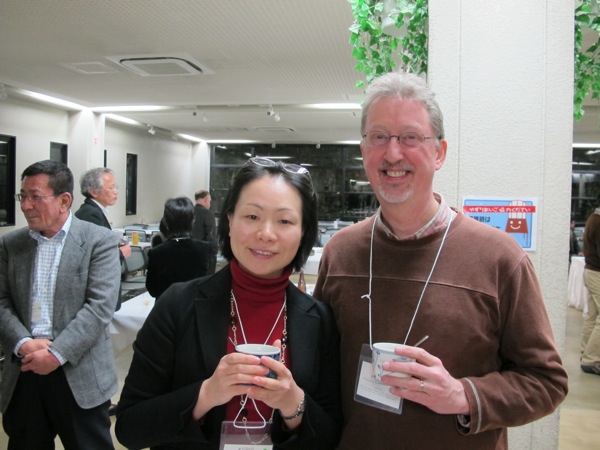
Attached are pictures of UMass folks participating in the International Conference on Phonetics and Phonology organized by the National Institute for Japanese Language and Linguistics and held at the University of Kyoto, 10-14 December 2011. It was very long, but also very stimulating, with many papers focusing on Rendaku, sokuon (geminates), and prosody, and as you can see with participation by a number of people from UMass.

Jk 3

Shigeto points

Mariko explaining

Shigeto amused

Shigeto with otake

Junko armin jk with shigeki kaji 2nd degree black belt karate


Mariko sugahara and jk

16 January 2012

Tanja Heizmann defends dissertation on January 18

Tanja Heizmann will defend her dissertation, "Acquisition of Exhaustivity in Clefts and Questions and the Quantifier Connection -- A Crosslinguistic Study of English and German" on Wednesday, January 18, at 3PM in Bartlett 206.

Congratulations Tanja!

Call for abstracts: Undergraduate Conference

The q Undergraduate Association for Linguistics at Michigan State (qUALMS) is pleased to announce the Great Lakes Expo for Experimental and Formal Undergraduate Linguistics (GLEEFUL). GLEEFUL will be held on April 21, 2012 in East Lansing, Michigan.

Keynote Speaker: Dr. David Pesetsky
Massachusetts Institute of Technology

GLEEFUL aims to bring together undergraduate linguists from across the continent to present high-quality research to their peers in order to gain experience and a greater appreciation for the many ways to study linguistics and language-related fields.

We invite 1 page abstracts (500 words) for 10 minute presentations or posters from any area of linguistics. Abstract submission and registration will all be done electronically through our website, available through https://sites.google.com/site/gleeful2012/.

Deadline for submission of abstract: January 22, 2012.
Abstracts will be reviewed, and participants will be notified starting on February 26, 2012.

For further information, you can send an email to gleeful.2012@gmail.com, or check out the GLEEFUL website.

05 January 2012

Call for Abstracts: Modality Workshop in Ottawa

Ana Arregui from Ottawa University writes:

We will be hosting a modality workshop on April 20-21.  We have extended the abstracts deadline to January 30.

Here is the link to the conference website:
http://modalityatottawau.blogspot.com/2011/10/call-for-papers.html

(Note: Angelika Kratzer is an invited speaker!)

Call for Papers: Societas Linguistica Europaea

The Workshop Convenors write:

We are happy to inform you that we are organizing a workshop on "Meaning and form of vagueness: a cross-linguistic perspective" at the 45th Annual Meeting of the Societas Linguistica Europaea (Stockholm, 29 August-1 September 2012, www.sle2012.eu).

The description of the workshop, research directions, and a non-exhaustive list
of possible topics are available on the workshop website:
https://sites.google.com/site/workshopvagueness2012

Abstracts should be submitted to the SLE by 15 January 2012 via the conference
site (http://www.sle2012.eu/), specifying that the abstract is intended as an
“Oral Presentation” in our workshop.

Abstracts should be anonymous and contain between 400 and 500 words (exclusive
of references). They should state research questions, approach, method, data
and (expected) results. Notification of acceptance will be given by 31 March
2012.

If you have any questions, please do not hesitate to contact us at
workshop.vagueness2012@gmail.com

Call for Applications: NSF Funded Joint Conference

In association with the Cognitive Science Society, the US National Science Foundation hopes to fund up to eight conference grants/research fellowships to US citizens who are enrolled as students at a US institution.  The funds will support students to both attend the 34th Annual Conference of the Cognitive Science Society (CogSci2012) and to participate in a collaborative research project with a sponsoring institution in Japan.  The award will provide funds for travel, accommodations, and registration fees for the conference and for a short stay (3 to 4 days) at a relevant Japanese institution immediately prior to or after the conference to work on the project.  The number of awards will be based on available funds and the scientific merit of the submitted proposals.

Confirmed collaborating hosts/institutions include:

Hiroshi Motoda, Osaka University.
Research areas: Artificial Intelligence, Machine Learning, Data Mining, Knowledge Discovery, Scientific Discovery, Expert Knowledge Acquisition
http://www.ar.sanken.osaka-u.ac.jp/~motoda/motopreg.html

Naomi Miyake, University of Tokyo.
Research areas: Learning sciences, Collaborative Problem Solving, Robotics for CSCL, Learning Process Analysis
http://coref.u-tokyo.ac.jp/en

Other potential host institutions in Japan include:

National Institute of Advanced Industrial Science and Technology
Center for Experimental Research in Social Sciences, Hokkaido University
http://lynx.let.hokudai.ac.jp/cerss/english/index.html

Advanced Telecommunications Research Institute at Kyoto/Osaka
Primate Research Institute, Kyoto University at Inuyama, Nagoya
http://www.pri.kyoto-u.ac.jp/index.html

The application process is as follows:

All eligible applicants who wish to apply should submit a one page proposal outlining the project on which they wish to work.  The deadline for this is February 1, 2012.  This outline may specify a collaborating institution, but need not.  Institutions not listed above will be considered if the applicant can provide the name of a suitable and willing academic collaborator at such an institution.  In addition to the proposal, applicants should provide indicative costs.

From the applicants, a subset will be identified by March 1 whose interests overlap sufficiently with those of a lab sponsor in Japan.

The student and lab sponsor will coordinate to plan a small research project that will include a visit to the lab before or after the conference in Sapporo.

With guidance from the sponsor, the student will submit a final proposal for review by the Selection Committee on or before May 1, 2012.

The Selection Committee will review and choose up to eight projects to support, based on student academic merits, potential impacts on students' education and research goals, financial need, and fundingavailability.  Awards will be announced on June 1, 2012.

Students will only be considered if they have submitted a paper to the CogSci2012 conference and if that paper is accepted for oral
presentation.

Interested students should submit their applications to: CogSci.2012.sapporo@gmail.com.

25 December 2011

Kingston at the International Conference on Phonetics and Phonology

John Kingston presented a talk, along with UMass alumnus Shigeto Kawahara, on "The Phonological Consequences of Geminate Phonetics," at the International Conference on Phonetics and Phonology on December 11 at NINJAL in Kyoto.

Other talks at the conference by UMass alumni are:

Shigeto Kawahara (Rutgers University)?
"Lyman's Law is active in loan and nonce words: Evidence from judgement studies"

Mariko Sugahara (Doshisha University)
"Variations in the shiki domain formation of Kinki Japanese compound words: A pilot study"

Junko Ito and Armin Mester (UC Santa Cruz, ICU/UC Santa Cruz, NINJAL)
"Non-prominent positions"

The full program link is:

http://www.ninjal.ac.jp/phonology/InternationalConference/icpp/program/

Tanja Heizmann defends her dissertation!

Tanja Heizmann will defend her dissertation,

Acquisition of Exhaustivity in Clefts & Questions; and the Quantifier Connection - A Cross-linguistic Study of English and German on Wednesday, January 18, 2012 at 3:00 in Bartlett 206

Last Call for abstracts to: Optionality in Syntax and Semantics

Workshop: Properties and Optionality in Syntax and Semantics
13-14 February 2012
Utrecht University, The Netherlands

http://www.hum.uu.nl/medewerkers/h.devries1/poss2012.htm

Submission deadline: 10 January 2012

Invited speakers:
Philippe de Groote (INRIA)
Thomas Ede Zimmermann (Frankfurt)

Description
Much research in linguistics over the last decades has involved various procedures of syntactic optionality, which work in parallel to intensional phenomena in semantics. Certain phenomena of optionality, e.g. of unspecified objects or by-phrases in passives, have been treated by assuming empty syntactic positions (Bach 1980, Landau 2010).
Other optionality phenomena, e.g. of verbal adjuncts, were traditionally treated in Montague Grammar using intensional properties, but are more standardly treated as involving modification in event semantics (Parsons 1990, Landman 2000). Even some cases of adjectival modification (e.g. skillful doctor, beautiful dancer) that were traditionally analyzed as involving properties have been argued to involve event modification (Larson 2002). Both theories of intensionality and event semantics take the modification process to be purely semantic and avoid any empty syntactic positions. 

The variety of optionality and modification phenomena, and their intricate relations with intensional properties, lead to some hard puzzles about syntax and semantics:
1. Should there be a unified grammatical framework for analyzing phenomena of optionality?
2. Is there still a role for intensional properties in accounting for optionality effects?
3. How precise and elegant are current hypotheses about optionality in natural language grammar?

The workshop will examine these questions from the perspectives of formal syntax and semantics, and the formal philosophy of intensional properties. 

Invited speakers:
Philippe de Groote (INRIA): TBA
Thomas Ede Zimmermann (Frankfurt): TBA
Contributed Talks:
- Chris Blom (Utrecht): ACG fragment for verbs with optional arguments
- Hanna de Vries (Utrecht): Group distributivity and property-denoting indefinites
- Marijana Marelj (Utrecht): Optionality and argument structure
- Reinhard Muskens (Tilburg) and Noor van Leusen (Nijmegen): Events, Time, Worlds, Roles, Linking, and Variable Management
- Yoad Winter (Utrecht): Property descriptions in locative PPs
- Joost Zwarts (Utrecht): The role of events in adjective modification

In addition, there will be a number of slots reserved for solicited papers.

Reimbursement: Depending of funding restrictions, presenters of selected talks may expect partial reimbursement of their trip and staying expenses. 

Procedure
We invite authors to submit an abstract (1 or 2 pages including references) for a 30-minute presentation (+10 minute discussion). Abstracts should be submitted via EasyChair: https://www.easychair.org/conferences/?conf=poss2012

Submission deadline: 10 January 2012

Notification:17 January 2012.

Call For Abstracts: ESSLLI in Opole 6-17 August 2012

First Call for Papers

ESSLLI 2012 STUDENT SESSION

Held duringThe 24th European Summer Schoolin Logic, Language and Information
Opole, Poland, August 6-17, 2012


Deadline for submissions: March 20, 2012http://loriweb.org/ESSLLI2012StuS/

ABOUT:
The Student Session of the 24th European Summer School in Logic, Language, and Information (ESSLLI) will take place in Opole, Poland on August 6-17, 2012. We invite submissions of original, unpublished work from students in any area at the intersection of Logic & Language, Language & Computation, or Logic & Computation. Submissions will be reviewed by several experts in the field, and accepted papers will be presented orally or as posters and will appear in the student session proceedings. This is an excellent opportunity to receive valuable feedback from expert readers and to present your work to a diverse audience.
ESSLLI 2012 will feature a wide range of foundational and advanced courses and workshops in all areas of Logic, Language, and Computation. Consult the main ESSLLI website (link below) for further information.

INSTRUCTIONS FOR AUTHORS:
Authors must be students, i.e., may not have received the Ph.D. degree before August 2012. All submissions must be in PDF format and be submitted to the conference EasyChair website. Submissions may be singly or jointly authored. No one may submit more than one singly and one jointly authored paper.
There are two types of papers. Long papers of up to 8 pages will be considered for both oral presentation and the poster session. Short papers of up to 4 pages will be considered as submissions for the poster session.

Submissions must be anonymous, without any identifying information, and must be must be received by March 20, 2012.

More detailed guidelines regarding submission can be found on the Student Session website: http://loriweb.org/ESSLLI2012StuS/

Links to previous years' proceedings are also available there.

Please direct inquiries about submission procedures or other matters relating to the Student Session to esslli2012stus@loriweb.org

For general inquiries about ESSLLI 2012, please consult the main ESSLLI 2012 page, http://esslli2012.pl/


Call for abstracts: LabPhon 13 in Stuttgart 27-29 July 2012

Deadline for abstract submission: 15 January 2012

Notification of acceptance: 31 March 2012

Abstracts are solicited for contributed papers for presentation as 20-minute oral contributions or as posters. Contributions relating to the conference themes are especially encouraged; there will also be sessions for non-thematic papers.The overall theme for the conference is “Phonological and phonetic computations: between grammar and neural activity.” Our goal is to bring together researchers from phonology, phonetics, and adjacent psycho- and neurosciences and to seek to advance these disciplines by encouraging the joint pursuit of interdisciplinary research questions.

Specific topics that address this theme are the following:Simulation as a research method in Laboratory Phonology.Temporal mechanisms in neural processing of sounds and prosodies.Rhythm and Temporal Structure.Rich memory for rich phonology.Non-thematic sessions (both oral and poster) will include contributions to other topics of interest to the LabPhon community.

For more information:

http://www.labphon13.labphon.org/callforpapers.html

Roeper in the United Kingdom

Tom Roeper gave one of the two public lectures at "The Image of the Child's Mind in Grammar," at "The Past and Future of Universal Grammar," at Durham University in Durham, UK on December 17th. Jill de Villiers was also  a speaker at this conference. For more information, go to http://www.dur.ac.uk/whatson/event/?eventno=11318

While overseas, Tom also gave a talk at University College London entitled "Internal Merge and Avoid Phase in Acquisition," and a talk at St Mary's College, "Building Nodes: Recursives and Possessives in AAE and acquisition."

North American Summer School in June in Austin

The fifth North American Summer School in Logic, Language, and Information,
NASSLLI  2012, will be hosted at the University of Texas at Austin, on June
18-22, 2012.

http://nasslli2012.com/

NASSLLI is a one-week summer school aimed at graduate students and advanced
undergraduates in Philosophy, Computer Science, Linguistics, Psychology and
related fields, especially students with interdisciplinary interests or whose
research crosses traditional boundaries between these subject areas. The summer
school is loosely modeled on the long-running ESSLLI series in Europe and will
consist of 5 sessions of 90 minute courses each day during the week of June
18-22, followed by a Turing Symposium on June 23 celebrating the first
centenary of Alan Turing's birth, and the 13th Texas Linguistics Society
conference on June 23, 24.

Courses

* Johan van Benthem (University of Amsterdam / Stanford University): Logical
Dynamics of Information and Interaction
* Craige Roberts (The Ohio State University): Questions in Discourse
* Noah Goodman (Stanford University): Stochastic Lambda Calculus and its
Applications in Semantics and Cognitive Science
* Mark Steedman (University of Edinburgh): Combinatory Categorial Grammar:
Theory and Practice
* Chris Potts (Stanford University): Extracting Social Meaning and Sentiment
* Catherine Legg (University of Waikato): Possible Worlds: A Course in
Metaphysics (for Computer Scientists and Linguists)
* Adam Lopez (Johns Hopkins University): Statistical Machine Translation
* Eric Pacuit (Stanford University): Social Choice Theory for Logicians
* Valeria de Paiva (Rearden Commerce) & Ulrik Buchholtz (Stanford University):
Introduction to Category Theory
* Adam Pease (Rearden Commerce): Ontology Development and Application with
Suggested Upper Merged Ontology (SUMO)
* Ede Zimmermann (University of Frankfurt): Intensionality
* Thomas Icard (Stanford University): Surface Reasoning
* Nina Gierasimczuk (University of Groningen): Belief Revision Meets Formal
Learning Theory
* Robin Cooper (Göteborg University) & Jonathan Ginzburg (University of Paris):
Type Theory with Records for Natural Language Semantics
* Jeroen Groenendijk (University of Amsterdam) & Floris Roelofsen (University
of Amsterdam): Inquisitive Semantics
* Shalom Lappin (King's College London): Alternative Paradigms for
Computational Semantics
* Tandy Warnow (University of Texas at Austin): Estimating Phylogenetic Trees
in Linguistics and Biology
* Hans Kamp (University of Stuttgart / University of Texas at Austin) & Mark
Sainsbury (University of Texas at Austin): Vagueness and Context
* Steve Wechsler (University of Texas at Austin) & Eric McCready (Osaka
University): Meaning as Use: Indexicality and Expressives

Special Presentations

* Pranav Anand (University of California at Santa Cruz)
* Nicholas Asher (IRIT, CNRS/Université Paul Sabatier)
* Martin Davis (Emeritus NYU)
* Robert King (University of Texas at Austin)
* Oleg Kiselyov (FNMOC)
* Kevin Knight (USC/Information Sciences Institute)
* Sarah Murray (Cornell University)
* Chung-chieh Shan (Cornell University)
* Bonnie Webber (University of Edinburgh)
* More to be announced...

Events

* Turing Symposium: June 23
* Texas Linguistics Society Conference: June 23, 24
* More to be announced...

Registration fees: academic discount rate $175; professional rate $400. Student
scholarships will be available for 50 students
(http://nasslli2012.com/scholarships; application deadline: February 29).
Scholarships include registration and may include a further subsidy for travel
and accommodation.

More information is available at:

http://nasslli2012.com/

12 December 2011

UMass at the International Conference on Phonetics and Phonology in Kyoto

The International Conference on Phonetics and Phonology is being held this week at NINJAL in Kyoto. John Kingston, with alumnus Shigeto Kawahara (Rutgers University), is giving an invited talk entitled "The phonological consequences of geminate phonetics."

Other talks at the conference by UMass alumni are:

Shigeto Kawahara (Rutgers University)?
"Lyman's Law is active in loan and nonce words: Evidence from judgement studies"

Mariko Sugahara (Doshisha University)
"Variations in the shiki domain formation of Kinki Japanese compound words: A pilot study"

Junko Ito and Armin Mester (UC Santa Cruz, ICU/UC Santa Cruz, NINJAL)
"Non-prominent positions"

The full program link is:

http://www.ninjal.ac.jp/phonology/InternationalConference/icpp/program/

Call for abstracts: Properties and Optionality in Syntax and Semantics

Workshop: Properties and Optionality in Syntax and Semantics
13-14 February 2012
Utrecht University, The Netherlands 
http://www.hum.uu.nl/medewerkers/h.devries1/poss2012.htm

Submission deadline: 10 January 2012

Invited speakers:
Philippe de Groote (INRIA)                            
Thomas Ede Zimmermann (Frankfurt)  

Description
Much research in linguistics over the last decades has involved various procedures of syntactic optionality, which work in parallel to intensional phenomena in semantics. Certain phenomena of optionality, e.g. of unspecified objects or by phrases in passives, have been treated by assuming empty syntactic positions (Bach 1980, Landau 2010). Other optionality phenomena, e.g. of verbal adjuncts, were traditionally treated in Montague Grammar using intensional properties, but are more standardly treated as involving modification in event semantics (Parsons 1990, Landman 2000). Even some cases of adjectival modification (e.g. skillful doctor, beautiful dancer) that were traditionally analyzed as involving properties have been argued to involve event modification (Larson 2002). Both theories of intensionality and event semantics take the modification process to be purely semantic and avoid any empty syntactic positions.

The variety of optionality and modification phenomena, and their intricate relations with intensional properties, lead to some hard puzzles about syntax and semantics:

1.      Should there be a unified grammatical framework for analyzing phenomena of optionality?
2.      Is there still a role for intensional properties in accounting for optionality effects?
3.      How precise and elegant are current hypotheses about optionality in natural language grammar?

The workshop will examine these questions from the perspectives of formal syntax and semantics, and the formal philosophy of intensional properties.

Invited speakers:
Philippe de Groote (INRIA): TBA
Thomas Ede Zimmermann (Frankfurt): TBA
Contributed Talks:
-         Chris Blom (Utrecht): ACG fragment for verbs with optional arguments
-         Hanna de Vries(Utrecht): Group distributivity and property-denoting indefinites
-         Marijana Marelj(Utrecht): Optionality and argument structure
-         Reinhard Muskens (Tilburg) and Noor van Leusen (Nijmegen): Events, Time, Worlds, Roles, Linking, and Variable Management
-         Yoad Winter (Utrecht): Property descriptions in locative PPs
-         Joost Zwarts (Utrecht): The role of events in adjective modification

In addition, there will be a number of slots reserved for solicited papers.

Reimbursement: Depending of funding restrictions, presenters of selected talks may expect partial reimbursement of their trip and staying expenses.

Procedure
We invite authors to submit an abstract (1 or 2 pages including references) for a 30-minute presentation (+10 minute discussion).
Abstracts should be submitted via EasyChair:https://www.easychair.org/conferences/?conf=poss2012

Submission deadline:10 January 2012 
Notification:17 January 2012.

Pater and Smith in Paris

On the 8th of December in Paris, Joe Pater and Brian Smith presented a paper to the "Phonologie du Français Contemporain" meeting , entitled "Le ‘e’ en français: élision, épenthèse, les deux, ni l’un ni l’autre?". If you are curious about the answer, you can find it here: 

http://people.umass.edu/pater/pater-smith-pfc.pdf

Selkirk and Cable at the 50th anniversary of MIT Linguistics

The MIT Linguistics department celebrated their 50th anniversary over the weekend with a series of talks and posters, including invited talks by Seth Cable on Endangered languages and Lisa Selkirk on Representations in Phonology. The poster session included a presentation by UMass alumna Gillian Gallagher "Learning the identity effect via reduplication," (co-authored with Peter Graff).

04 December 2011

Tom Roeper at Ling Club meeting on December 7

Jeremy Cahill writes:

Tom Roeper will be speaking on acquisition for Ling Club 5 PM on Dec. 7 in the Partee room. Everyone is invited  and there'll be pizza as always.

You can RSVP now or when I send out the reminder email. RSVP email: jccahill@student.umass.edu


Barbara Partee on the road

Barbara has had two recent trips. She gave a colloquium talk for the Linguistics Program at Princeton November 16, “The History of Formal Semantics: Influences from and to Linguistics and Philosophy”.  While there, she spent the next two days interviewing linguists and philosophers for her history project, and consulting with Stephanie Lewis about her archive of David Lewis’s correspondence.

Now she is in Wrocław for the conference Generative Linguistics in Poland (GLIP) 7, Dec 2-4, hosted by the Institute of English Studies of the University of Wrocław. She is giving the keynote talk: ''The History of Formal Semantics.'' She’s visiting with our former student Bożena Rozwadowska while she’s there.

Barbara and Volodja will be in Amherst until February 14, when they return to Moscow.


Call for papers: Comparative Germanic Syntax Workshop

The 27th Comparative Germanic Syntax Workshop will take place at Yale University from 31 May to 1 June, 2012. Angelika Kratzer is one of the invited speakers!

Here is the official notice:

Call for Papers:

CGSW has established a long tradition of bringing together researchers in Germanic syntax for fruitful and constructive interaction. As the name of the workshop suggests, the focus has been on the comparative syntax of the Germanic languages. In recent years, the range of work presented has been productively extended to include diachronic change and the interface between narrow syntax and other components of the grammar. CSGW27, which is being organized jointly by the Yale and UConn Linguistics Departments and held at Yale, will continue in this tradition, and we invite abstracts on these topics. In addition, this year’s workshop aims to expand both outward and inward: looking outward, we invite submissions that profitably compare the syntax of Germanic and non-Germanic languages. Looking inward, we encourage submissions on micro-syntactic variation in the dialects of American English, and we anticipate holding a special session on this topic.

Talks will be 30 minutes in length with 10 additional minutes for discussion.  For details on abstract submission via EasyChair, see the CGSW27 website at http://whitney.ling.yale.edu/cgsw27.

Invited Speakers

Marcel den Dikken (CUNY Graduate Center)
Caroline Heycock (University of Edinburgh)
Angelika Kratzer (University of Massachusetts, Amherst)

Submission deadline: 15 January 2012
Notification of acceptance: 15 March 2012

Organizers:

Jonathan Bobaljik, Gísli Rúnar Harðarson, Susi Wurmbrand (UConn)
Bob Frank, Mike Freedman, Tim Hunter, Sabina Matyiku, Dennis Storoshenko, Raffaella Zanuttini (Yale)

Masters program at the University of Amsterdam

The MSc Logic, offered by the the Institute for Logic, Language and
Computation (ILLC) at the University of Amsterdam, is a two-year
Master's programme providing intensive interdisciplinary research
training for excellent students with a first degree in Mathematics,
Computer Science, Philosophy, Linguistics, or a related discipline.

*Courses*: We offer a unique combination of over 40 courses in
Mathematical Logic, Theoretical Computer Science, Artificial
Intelligence, Philosophical Logic, Formal Semantics and Pragmatics,
Philosophy of Language, Computational Linguistics, Cognitive Science,
and Mathematical Economics. You will be guided by an academic mentor
to design your own personal programme of study out of this pool of
courses, supplemented with a number of small individual research
projects. The final semester is devoted to the writing of a Master's
thesis, which in the past has often lead to scholarly publications.

*Language*: All courses are taught in English. At any given time, the
programme hosts students from at least 25 different countries.

*Career opportunities*: Most of our graduates embark on an academic
career and continue with a PhD, often at top universities all over the
world. Other career opportunities include the software industry and
management consulting.

*Application*: The application deadlines for September 2012 entry are
1 April 2012 for students from European countries and 1 February 2012
for all others.

Please visit http://www.illc.uva.nl/MScLogic/ to find out more.

Summer Research at Harvard for Undergraduates

Margarita Zeitlin from Harvard Univeristy writes:

Each summer, the Laboratory for Developmental Studies at Harvard University
offers a limited number of internships for college undergraduates, under
the supervision of Dr. Susan Carey and Dr. Jesse Snedeker. Interns will
gain experience with current techniques for investigating conceptual and
language development in infants and children.

The internship will start on June 4, 2012 and go through August 10, 2012.
This is a full-time research position and interns are expected to be
available from 9am-5pm Monday through Friday. A stipend of $1500 may be
awarded for a full time commitment, but applicants are encouraged to apply
for funding from external sources.

Because of the nature of the internship, it is essential that interns be
mature, articulate, and comfortable with parents and children. They should
also be highly organized and reliable. Desirable background experience
would include the following: coursework in developmental or experimental
psychology or linguistics, basic computer skills and previous research
and/or experience with children.

For more information about this opportunity or to find out how to apply,
please visit our website:

https://software.rc.fas.harvard.edu/lds/research/carey/summer-internship
<https://software.rc.fas.harvard.edu/lds/research/carey/summer-internship>
The application deadline is March 9, 2012. We do have an early
deadline on February
10, 2012 for those who are applying for external funding.

UUSLAW at UConn

The UUSLAW acquisition workshop, was held at UConn this Saturday, December 3rd. There were several talks by members of the UMass community, including:

"The Collective-Distributive reading of 'each' and 'every' in Language Acquisition, by Rama Novogrodsky

"Language and the concept of like events," by Jill de Villiers

"Investigating events and propositions in child language," by Gustavo Freire

"Quantity judgments in Yudja (Tupi)" by Suzi Lima

"Syntax of possession: Accounting for optional and obligatory possessive marking in African American English acquisition," by Tracy Conner

You can see more about the workshop at their website:

http://homepages.uconn.edu/~lst08001/UUSLAW2011.html

Postdoc on Prosody

Proposition de post-doctorat à Aix-en-Provence (France), 
à partir de février 2012, pour une durée de 1 an renouvelable 1 fois.
ANR MINPROGEST Rôle de la théorie de l’esprit dans la construction du sens

L'objectif général du projet ANR MINDPROGEST est de déterminer, en français, quel rôle joue l'attribution des états mentaux (intention, croyance, connaissance) aux autres - encore appelée théorie de l'esprit (ToM) ou mindreading – dans la construction du sens.

Une approche multidisciplinaire (linguistique, psychologie, neurosciences et santé mentale) sera adoptée pour étudier la contribution des mécanismes linguistiques et cognitifs à la construction du sens.

La conversation étant le site fondamental de l'utilisation du langage, un défi majeur consistera à déterminer ce rôle de la ToM dans le contexte de l'interaction sociale chez des individus atteints de schizophrénie et des personnes sans pathologie. On connaît le rôle majeur que joue la prosodie dans la construction du sens et notamment dans l’expression et la reconnaissance des intentions (via sa fonction attitudinale). L’intérêt pour le sens, de plus en plus manifeste aujourd’hui dans les études en prosodie, se traduira par l’exploration plus spécifique de la dimension intonative de la prosodie. Dans ce projet, il s’agira donc d’étudier les contours intonatifs en tant qu’ils véhiculent des informations relatives à l’attribution et la reconnaissance d’états mentaux à l’autre en vue de construire le sens.

Mots-clés: prosodie, sens de l’intonation, contours intonatifs, pragmatique, théorie de l’esprit, schizophrénie.

Profil du/de la canditat(e) : Pour ce projet multidisciplinaire, le/la candidat(e) sera titulaire d’un doctorat en prosodie (de préférence sur la prosodie du français). La maîtrise (quasi) native du français est requise. Une bonne connaissance des approches phonologiques de l’intonation et de la problématique du sens de l’intonation ainsi que la maîtrise des méthodes expérimentales d’investigation de ces questions seront déterminantes.

Le dossier de candidature comprendra :
a) Un CV 
b) Une lettre de motivation décrivant les intérêts de recherche du/de la canditat(e) 
c) 2 lettres de recommandation et/ou le nom et les coordonnées de 2 personnes référentes

Financement : subvention ANR (Agence Nationale de la Recherche)
Salaire : selon les normes du CNRS

Contact : 
Maud Champagne-Lavau 
email: maud.champagne-lavau@lpl-aix.fr
Laboratoire Parole et Langage 
UMR 6057, CNRS 5 Av. Pasteur B.P. 80975 
13604 Aix-en-Provence, France Téléphone : (33) 04 88 78 57 07
Laboratoire Parole et Langage
http://www.lpl.univ-aix.fr/
http://lpl-aix.fr/person/bertrand
http://lpl-aix.fr/person/portes

Call for Papers: Roots of Pragmasemantics

Linguists, logicians, and philosophers are invited to join the 13th conference on the Roots of Pragmasemantics. The focus of this year's convention is on discourse particles. Discourse particles are situated at the semantics-pragmatics interface, they relate utterances to other utterances in the discourse but also to different kinds of background knowledge (shared or individual). Experimental as well as theoretical approaches to the problem are welcome. We especially invite submissions related to this topic, but welcome also contributions relevant to any of the more classical subjects of this workshop series. We particularly encourage the presentation of innovative ideas, even if they are still in need of later refinement.
We invite anonymous submission of abstracts of no longer than 500 words in PDF, to be sent tomarkus.egg@anglistik.hu-berlin.de
Relevant topics include, but are not limited to:
* Expressive and other non-truth-conditional aspects of discourse particles
* Discourse particles and management of the common ground and interlocutors’ backgrounds (Theory of Mind)
* Discourse particles in interaction with sentence types and speech acts
* Information structure of discourse particles
* Crosslinguistic studies of discourse particles


*Invited Speakers:
Peter Bosch (confirmed)
Peter Gärdenfors (confirmed)
further invited speakers to be confirmed

Deadline for submissions: January 15th 2012
Notification of acceptance: January 31st 2012
Workshop: February 23d-27th 2012.
Location: Szklarska Poręba, Poland

*Organizers:
Markus Egg (chair, program)
Reinhard Blutner (accommodation, finances)
Peter beim Graben (program, finances)
Henk Zeevat (program)
Ewa Rudnicka (local organization)
Maria Spychalska (local organization)


For further details check the webpage:
http://szklarska2012.hlotze.com/ (coming soon)

27 November 2011

Jesse Harris defends dissertation

Jesse Harris will defend his dissertation, "Processing Commitments" at 1PM in Dickinson 212 on Monday, November 28. All are welcome.

Congratulations Jesse!

Michael Clauss talks at the LARC/Acquisition Lab meeting

Michael Clauss will give "Modal morphology in Child Tamil," at the LARC/Acquisition Lab meeting on Monday, November 28, at 5:15 in the Partee Room (South College 301).

All are welcome!

Discussion of Wilson and Obdeyn (2009)

Joe Pater writes:

Brian Dillon and I have organized a group discussion of Wilson and Obdeyn's (2009) "Simplifying subsidiary theory: statistical evidence from Arabic, Muna, Shona, and Wargamay." 

The meeting will take place in the Partee room (South College 301) at 2:30 pm November 30th. I've put a copy of the difficult-to-find paper here:

http://people.umass.edu/hgr/WilsonObdeynSeptember2009.pdf

All are welcome!

Colin Wilson gives department colloquium

Colin Wilson, of Johns Hopkins, will give the following talk at the department colloquium on Friday, December 2 at 3:30 in Machmer E-37.

Bayesian inference for constraint-based phonology

Bayesian mathematics and associated algorithms provide a general solution to the problem of inferring structure from incomplete, ambiguous, and noisy data. In this talk, I apply these methods to the specific problem of learning constraint-based grammars of phonology, focusing in particular on the relative roles of the likelihood -- which depends on the language-specific sound pattern -- and the prior -- which embodies assumptions made by the learner independently of the data. Previous research has proposed a rich set of prior assumptions (e.g., that inputs are identical to outputs in early phonological learning, and that certain classes of constraints are biased to be higher-ranked), which are (approximately) enforced by an increasingly complex battery of learning mechanisms. I argue that the prior can be greatly simplified, perhaps even made completely unbiased, by embracing the learner's uncertainty about the inputs and weightings/rankings that underly the observable data. Formal analysis of an unbiased learner, together with simulations from an implementation that uses Gibbs sampling, suggest that a rich prior is not needed to ensure 'restrictiveness' or other empirically-motivated properties of phonological learning.

20 November 2011

Call for Papers: Conference on Language, Discourse and Cognition

*The 6th Conference on Language, Discourse, and Cognition (CLDC 2012)*

Date:     May 4th to 6th , 2012
Venue:   Tsai Lecture Hall on the main campus of National Taiwan University
Taipei, Taiwan

Website: http://homepage.ntu.edu.tw/~cldcntu/

The 6th Conference on Languages, Discourse, and Cognition (CLDC 2012) will be held from May 4th to 6th in 2012, hosted by Graduate Institute of Linguistics, Department of Psychology, Neurobiology and Cognitive Science Center at National Taiwan University, and Linguistic Society of Taiwan.

The CLDC, as an annual international conference, aims to provide a forum for researchers interested in language, discourse, and cognition to report new research findings, exchange innovative ideas and share their frameworks in these areas. Although CLDC was launched only five years ago, the topics relevant to language, discourse, and cognition themes as well as the interdisciplinary exchange stimulated over the last few years have given rise to a growing body of critical findings, making CLDC an important annual event in the fields of Cognitive Linguistics/Functional Linguistics in East Asia. We hope that the CLDC 2012 meeting will continue to attract a greater number of international researchers to participate in the dialog.

The CLDC 2012 will focus on research associated with Cognitive Linguistics /Functional Linguistics and interdisciplinary research. The meeting will be comprised of a general session with the theme of “COGNITIVE LINGUISTICS/ FUNCTIONAL LINGUISTICS AND INTERDISCIPLNARY STUDIES” and a special session with the theme of “EMOTION, LANGUAGE, and COGNITION.”

Summer Research Experience for Linguistics Undergraduates

Sheila Kennison from Oklahoma State University writes:

We are pleased to announce that we will be holding our summer research
experience for undergraduates again in summer 2012.  The goal of this
program is to provide 12 undergraduate students with an in-depth, hands-on
research experience focused on the biological basis of animal  and human
behavior. Students will be trained in the application of the scientific
method to develop hypotheses, design and conduct research studies involving
either animal or human subjects.  Students will also be trained in the
responsible conduct of research. Students will be mentored by full-time,
Ph.D.-level faculty members who are tenured/tenure-track faculty with strong
programs of research. Students selected for the program will be expected to
devote at least 40 hours a week for research; thus, it is not possible to be
enrolled in courses or other activities during the program.

Program dates: June 2, 2012-July 29, 2012

Application deadline: February 1, 2012

To be eligible, students must be a U.S. citizen or permanent resident who is
currently enrolled in an undergraduate program.  Each student will reside in
a campus dormitory (at no cost to the student) and receive $500 per week to
cover food and other living expenses.  Students will receive a $500 travel
stipend to pay for their travel to and from campus and a $500 additional
stipend, if students present research at an academic conference.

Information about how to submit an application is available at
http://psychology.okstate.edu/faculty/kennison/osunsfreu.htm.

We especially welcome applications from students from underrepresented
groups, including first generation college students and students from rural
areas.

PLC deadline delayed to Monday

The organizers of the Penn Linguistics Circle write:

It has been pointed out that the Call for Papers for this year's PLCcontained an error, in that it specified the deadline as Thursday, November 15 (a day/date combination that is not realized this year). To avoid penalizing anyone who might have been confused by this, as well as to allow extra time for the preparation of submissions, we have decided to extend the deadline until Monday, Nov. 21.

As a reminder, instructions for abstract submission can be found at
the PLC website: http://www.ling.upenn.edu/Events/PLC/plc36/

We are looking forward to your submissions.

Seth Cable invited to teach at 2013 LSA Summer Institute

Congratulations to Seth Cable, who has just received an invitation to teach an introductory semantics course at the 2013 LSA Summer Institute in Ann Arbor.

Congratulations Seth!

13 November 2011

Luiz Amaral and Andie Faber at Acquisition Lab/LARC today

Acquisition Lab / LARC meeting is today, Monday November 14 at 5:15 in the Partee Room

Luiz Amaral and Andie Faber will give the talk:

"A Unification-based Approach to Nominal Agreement in Adult Second
Language Grammars"

Everyone is Welcome!

Lisa Green elected to LSA Executive Committee

Lisa Green has been elected to the Executive Committee of the Linguistic Society of America. Her three-year term will begin this January.

Congratulations Lisa!

The UMass invasion of NLLT continues

UMass is taking "Natural Language and Linguistic Theory" by storm. Last week, WHISC reported two articles that have been accepted by that august journal authored by members of the linguistics department (faculty and students alike), and this week WHISC learns that two other UMass papers have been accepted. They are:

"Synchronic explanation," by Paul de Lacy and John Kingston (A critique of Blevins's Evolutionary Phonology and an argument for a synchronic phonological grammar).

and,

"Passivization, Reconstruction and Edge Phenomena: Connecting English and Japanese nominalizations," by Angeliek van Hout, Masaaki Kamiya and Thomas Roeper.

Congratulations!

Cable talks in the undergrad linguistics club meeting

Jeremy Cahill writes:

Seth Cable will be giving an informal presentation on the Tlingit language for the Ling Club on Tuesday, November 15th at 5:15 in the Partee Room (South College 301).

All interested undergrads are invited.

Ling Club contact email: jccahill@student.umass.edu.

UMass at the BU Language Acquisition Conference

Tom Roeper writes:

From BU, Bart Hollebrandse Angeliek van HOut,  and Kazuko Yatsushiro
were co-authors with 17 and 25 others, respectively, of two reports
from the COST project, run by Uli Sauerland, which was a European outgrowth
of the DELV project.  The papers dealt with co-ordinated experiments
on Tense and Quantification across all of those languages.  The DELV
figured prominently in a new COST project on Bililngualism and SLI presented
by Cornelia Hamann in the plenary lecture at BU as well.

Ana Perez presented a paper on Recursion developing a Canadian wing to
the UMass work on the project,  And Jill deVilliers and Tom Roeper
presented their recent work on Tense and Truth in the (fortunately) endless
saga of wh-movement in acquisition.

A video on East Sutherland Gaelic

Barbara Partee writes:

There is a wonderful video -- not new, but I just learned about it last
week, about Nancy Dorian's work on the dying language East Sutherland
Gaelic. The video itself is in Gaelic (including Nancy's), with English
subtitles. It's really interesting on many levels, can be fascinating for
students as well as for linguists. (It may make you cry, though.)
http://video.google.com/videoplay?docid=7647046783946085652

If you lose this message, you can easily find the video just by googling on
Nancy Dorian. (She was already famous for her first-of-its-kind book
Language Death.)

06 November 2011

Emily Elfner defends Dissertation on Tuesday

Emily Elfner will defend her dissertation: "Syntax-Prosody Interactions in Irish" on Tuesday, November 8th at 4PM in Bartlett 206.

All are welcome!

Peter Klecha speaks in SRG on Thursday.

Anisa Schardl writes:

This Thursday, Peter will be talking at SRG about imprecision and
modality.  It'll be at Barbara's, 50 Hobart Lane in Amherst, starting
at 6pm.  I'll bring dinner, you bring money or your own dinner.  If
you need me to pick up something special (e.g. vegan, lactose-free)
for you, email me and let me know.  This will be one of your last
chances to talk to Peter about his work before he leaves, so be there!

Paper by Peggy Speas and Jill deVilliers accepted to NLLT

WHISC has learned that Natural Language and Linguistic Theory has accepted "Direct Evidentials, Case, Tense and Aspect in Tibetan: Evidence for a General Theory of the Semantics of Evidentials," a paper co-authored by  Kalsang, Jay Garfield, Margaret Speas and Jill deVilliers.

Congratulations!

The Guru: before and after

Angelika Kratzer writes:

Here are two pictures of our Fall Semantics Guru, taken a few years apart in the same environment.


Roger now


Roger then

UMOP 38 is out

UMOP 38: Processing Linguistic Structure, edited by Jesse A. Harris and Margaret Grant is now available!

Here is how its advert blurb describes the volume:

This volume consists of a collection of working papers on sentence processing covering a wide range of topics, including pied-piping, ellipsis in adult sentence processing and acquisition, and processing effects associated with anticipating upcoming linguistic structure. Addressing numerous theoretical and experimental issues, papers in the volume may appeal to a wide audience interested in sentence processing.

Table of contents: http://www.people.umass.edu/harris/umop/UMOP38_toc.pdf

It can be purchased from the Graduate Linguistic Students' Association
http://glsa.hypermart.net/

Bhatt and Walkow in NLLT

"Locating Agreement in Grammar: An Argument from Agreement in Conjunctions" by Rajesh Bhatt and Martin Walkow has been accepted for publication by Natural Language and Linguistic Theory.

Congratulations!

30 October 2011

Henry Davis speaks in Semantics Seminar on Tuesday

Angelika writes:

You are cordially invited to a special lecture:

Quantification in Salish (and maybe Tsimshianic)
by
Henry Davis, University of British Columbia.

Time: Tuesday, November 1st at 2:30 PM.
Place: Bartlett 206.

EEG/ERP in the Phonetics Lab

John Kingston writes:

It's with great pleasure that I announce that we now have the capacity  
in the Phonetics Lab to collect EEG/ERP data. We have a 64-channel  
system from Electrical Geodesics Inc. (EGI), the same company that  
manufactured the 128-channel system in Lisa Sanders's lab. The  
engineer from EGI is here this week and is training a number of us in  
the basics of how the system works.

So that any interested member of the department can get trained and  
become at least self-sufficient in running experiments using this  
system, if not yet expert, Brian Dillon and I are organizing a  
training regime that will consist of two experiments, one looking at a  
P-side question, the other at an S-side question. Our idea is to  
design maximally simple experiments in each of these two areas, which  
nonetheless either replicate a well-established effect or look to see  
whether a novel manipulation has an effect. The experiments will be  
very simple, so that we can focus on training people in the use of the  
equipment and software.

If you are interested in taking part in the training, let me or Brian  
know soon. Once we have heard from all interested people, we'll  
schedule a brief meeting to set up a training schedule.

While experiments using this technology are not easy to do, you should  
not be deterred from getting trained by that fact, if you think that  
ms-resolution, real-time data on brain activity might provide answers  
to the questions you're working on. With 64 channels, we can also do  
rough localization of the activity.

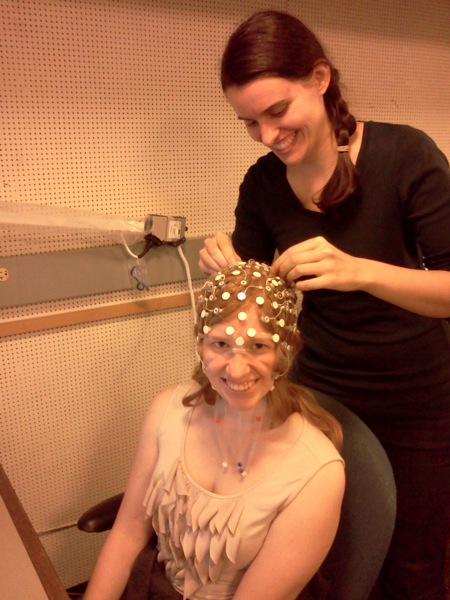
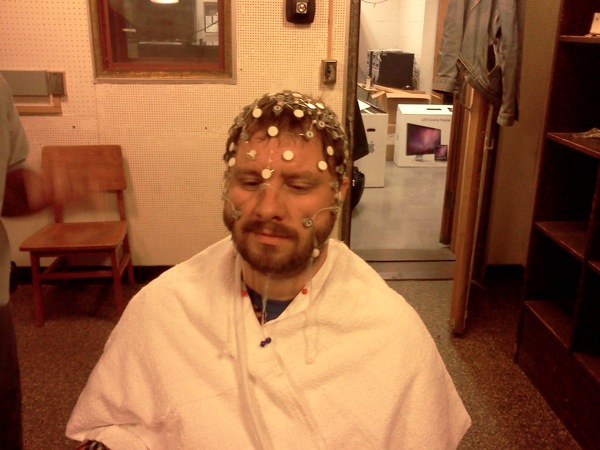
Here's what the fun you can have with EEG/ERP looks like!

Eerp3

Eerp2

Eerp1

Call for papers: Conference on Areal Linguistics

Graduate Conference on Areal Linguistics, Grammar and Contacts

Tartu, Estonia

4-6 May 2012

Call for papers: Deadline: 10.01.2012

We invite MA and PhD students, postdocs and young researchers in linguistics to submit abstracts related to the following themes:

- Contact-induced phonological, morphological, syntactic and lexical change

- Lexical and grammatical replication, shared grammaticalization

- Typological investigations and wider perspectives on linguistic areas

- Circum-Baltic languages in general

- Language contact and sociolinguistics

- Language contact and dialectal variation

- Globalization and its effect on minor(ity) languages

- Synchronic, diachronic and panchronic approaches to language contact and linguistic areas

Invited plenary speakers:

- Maria Koptjevskaja-Tamm, Stockholm University

- Axel Holvoet, University of Warsaw, Vilnius University

- Florian Siegl, University of Tartu

The working language of the conference is English. For further information, abstract submission and more, see http://arealling.ut.ee

23 October 2011

Acquisition Lab/LARC Meeting Tomorrow!

There will be an Acquisition Lab/LARC meeting on Monday October 24 at 5:15
in the Partee Room. There will be two presentations:

Rama Novogrodsky
"Acquisition of each one/one each"

Barbara Pearson
"Distributive and Collective Readings in the Elementary School
Mathematics Classroom"


Everyone welcome!

Maziar Toosarvandani speaks in syntax seminar on Wednesday

Maziar Toosarvandani (http://toosarva.scripts.mit.edu/) from MIT will give a presentation in Rajesh Bhatt's syntax seminar on Wednesday, October 26, in Herter 208 at 2:30. The talk will be on the role of nominalization in relative clause formation, with a focus on his work on Paiute. (see:[http://toosarva.scripts.mit.edu/manuscripts.html and http://toosarva.scripts.mit.edu/papers/wscla16-paper.pdf)

For more information about the course: https://sites.google.com/site/umasslx750f11/

Maria Polinsky gives department colloquium this Friday

Maria Polinsky from Harvard University will this week's colloquium on Friday October 28 at 3:30 PM in Machmer E-37.

Title: Explaining syntactic ergativity

Abstract:
This paper shows that ergative languages fall into two separate classes, PP-ergative and DP-ergative languages. In PP-ergative languages, the ergative is contained inside a PP which prevents it from undergoing A-bar movement. This accounts for the widespread phenomenon of syntactic ergativity. DP-ergative languages allow the extraction of the ergative. The paper  then presents and analyzes a cluster of properties associated with the two types. Under the principled division of ergative languages into the proposed two classes, the syntactic ramifications of ergativity are predictable and lead to a more uniform syntax.

Everyone is welcome to a post-colloquium dinner to be held at Alice Harris's house.

Call for Papers: Harvard East Asia Society Grad Student Conference

CALL FOR ABSTRACTS

15th Annual Harvard East Asia Society Graduate Student Conference
Harvard University, Cambridge, MA, USA
February 24 - February 26, 2012

The Harvard East Asia Society (HEAS) Graduate Student Conference invites graduate students from around the world, conducting research in all disciplines, to submit abstracts for our 2012 conference.

Over the past decade, East Asia has experienced unprecedented change, which has had an immense impact on every aspect of the region. As a result, scholars worldwide are exploring and engaging in meaningful discussion on every subject to do with East Asia, past and present.

The HEAS Graduate Student Conference is an annual event which provides an interdisciplinary forum for graduate students to exchange ideas and discuss current research on East Asia. The conference allows young scholars to present their research to both their peers and to eminent scholars in East Asian Studies. All panels will be moderated by Harvard University faculty. The conference will also allow participants to meet others in their field conducting similar research and to forge new professional relationships.

We welcome submissions from graduate students in all disciplines. Papers should be related to East or Inner Asia, including East Asian interactions with the wider world.

Eligibility and Application Guidelines:
1.  Applicants must be currently enrolled in a program of graduate study ("postgraduate" in British degree classification systems).
2.  Papers must be related to East or Inner Asia.
3.  Abstracts must be no longer than 250 words, submitted exactly as directed on the HEAS Individual Paper Application Form.
4.  Deadline for abstract submission:  NOVEMBER 18, 2011

Inquiries:
For general conference inquiries, please contact: heasconference@gmail.com<mailto:heasconference@gmail.com>
For abstract submission inquiries, please contact: heas.abstracts@gmail.com<mailto:heas.abstracts@gmail.com>
--

Undergraduate Linguistics Club forms! Meeting this Wednesday

Benjamin Herman writes:

The next Linguistics club meeting will be at 5pm, Wednesday November 2nd.

There is also an officers' meeting at 5pm, Wednesday October 26th, but  all club members are welcome to join.

PIZZA AS ALWAYS!!!

If you need any assistance regarding club matters, or are looking for a hook-up to any kind of Linguistics study group for your next exam, feel free to contact us:

President:          Jeremy Cahill            jccahill@student.umass.edu
Vice President:     Pratiksha Yalakkishettar pyalakki@student.umass.edu
Secretary:          Benjamin Herman          bsherman@student.umass.edu
Treasurer:          Nathan Banker            nbanker@student.umass.edu
Librarian:          Emily Westland           enicat@verizon.net
Webmaster:          Samuel Baldwin           sbaldwin@student.umass.edu

Call For Papers: Penn Linguistics Colloquium

The 36th Penn Linguistics Colloquium


Call for Papers


The 36th Annual Penn Linguistics Colloquium will take place March 23-25, 2012 at the University of Pennsylvania campus in Philadelphia.

Invited Speaker: Paul Kiparsky (topic and title TBA)
There will also be a special panel on Friday, March 23, which is about game theory and linguistics. More information will be posted closer to the conference.

Papers on any topic in linguistics and associated fields are welcome. Speakers will have 20 minutes for their presentations and 5 minutes for discussion and questions.

Posters: We are happy to announce that this year's PLC will feature a poster session with catered lunch.  Abstracts should indicate whether they are being submitted for consideration as a talk, poster, or both. (See instructions.)

Deadline: Abstracts are due Thursday, November 15, 2011. Notification of acceptance/rejection will be given by Wednesday, January 25, 2012.

Length: Please limit abstracts to one page, single-spaced. An additional page may be used for references and tables. Do not include your name or affiliation within the abstract.

Format: To facilitate the review process, please submit your abstract as a .pdf file.

Abstract Submission: To submit an abstract, you must follow these steps:

  1. To begin, click here to go to our abstract submission system and login.
  2. If you do not have an existing EasyChair account, click on "sign up for an account." You will be asked to fill out a simple form to create an account.
  3. Click "NewSubmission" at the top of the page.
  4. Enter author information in the provided fields. Tick the "Corresponding Author" box for all authors who wish to receive e-mail correspondences or notifications.
  5. Enter your title in the "Title" field.
  6. In the "Abstract" field, please enter a one sentence summary, or any comments you have, in order to assist the committee in assigning reviewers. Please also indicate here whether you would like your submission to be considered for a talk, poster, or both. By default, submissions will be considered for both modes of presentation. Do not paste your full abstract into this field.
  7. Please select the primary category of your abstract. Additional categories may be included in the keywords.
  8. Enter at least three keywords.
  9. Upload your abstract .pdf file in the "Paper" field. Only .pdf files will be accepted. Do not include your name or affiliation in the abstract/file name!
  10. Do not tick the "Abstract only" box, or your .pdf will not be uploaded.
  11. Click "Submit." You will be taken to a summary page of your submission - this is your confirmation that it has been saved. Abstracts will be reviewed anonymously.
  12. You may make any necessary updates by logging in and clicking on "My Submissions."


Proceedings: Conference proceedings will be published as a volume of the Penn Working Papers in Linguistics. Speakers will be invited to provide camera-ready copies of their papers after the Colloquium.

FOR MORE INFORMATION
Email plc36@ling.upenn.edu
Visit http://www.ling.upenn.edu/Events/PLC/plc36