13th Texas Linguistics Society (TLS) Conference
June 23-24, 2012
University of Texas at Austin
TLS is a graduate-student run conference in linguistics organized by the Texas Linguistics Society and the Department of Linguistics at the University of Texas at Austin. This year's TLS is co-located with the North American Summer School in Logic, Language, and Information and associated workshops and symposia.
http://uts.cc.utexas.edu/~tls/
TLS 13 will be structured around two para-sessions: (1) the semantics and pragmatics of questions and question-based models of discourse, and (2) signed languages and meaning. While we encourage submissions related to these themes, we are also interested in submissions on topics of general linguistic interest. Papers on language related topics from disciplines including anthropology, cognitive science, neuroscience, philosophy of language, and psychology will also be considered.
--- Keynote Speakers ---
Nicholas Asher (IRIT, CNRS/Université Paul Sabatier)
Erin Wilkinson (University of Manitoba)
--- Invited Talks ---
Kathryn Davidson (University of Connecticut)
Jeroen Groenendijk (University of Amsterdam)
Richard Meier (University of Texas at Austin)
Josep Quer (ICREA & Universitat de Barcelona)
Craige Roberts (The Ohio State University)
--- Submission Information ---
One page abstracts (plus references) should be submitted in PDF or DOC format through EasyChair at https://www.easychair.org/conferences/?conf=tls13. 11-12 point font, please. Authors whose abstracts are accepted are encouraged to submit a short paper (10-20 pages). These will be collected into an edited volume for publication.
--- Important Dates ---
* Abstract Submission Deadline: April 16, 2012
* Notification of Acceptance: May 7, 2012
* Pre-proceedings Paper Submission Deadline: June 10, 2012
* Final Draft Submission Deadline: August 31, 2012
18 March 2012
Call for Papers: Texas Linguistics Society Conference

UMass at WCCFL
The annual meeting of the West Coast Conference on Formal Linguistics is meeting April 13-15 at the University of California, Santa Cruz. There are several talks by people in the UMass community, including:
Wendell Kimper with Riikka Ylitalo will present "Variability and Trigger Competition in Finnish Disharmonic Loanwords."
Noah Constant will present a poster entitled "Topic Abstraction as the Source for Nested Alternatives."
Jesse Harris will present a poster entitled "On the Semantics of Domain Adjectives in English."
UMass at GLOW
The annual meeting of the Generative Linguists of the Old World is at Potsdam on March 28-30, and there are several members of the UMass community giving talks.
Brian Dillon, with co-authors Ewan Dunbar and William Idsardi, is presenting "Learning Phonetic Categories by Learning Allophony and vice versa."
Noah Constant is presenting "Topic Abstraction as the Source for Nested Alternatives: A conservative Semantics for Contrastive Topic."
Satoshi Tomioka is presenting "Focus matters in New-Hamblin semantics."
Bart Hollebrandse, with Petra Hendriks and Jacolien van Rij is presenting "Eye gaze patterns reveal subtle discourse effects on object pronoun resolution."
For a full schedule, see http://www.ling.uni-potsdam.de/~glow/program.html
Seth Cable at SULA
Seth Cable's paper "Distributive Numerals in Tlingit: Pluractionality and Distributivity" has been accepted to the seventh annual meeting of Semantics of Under-Represented Languages in the Americas (SULA), which will take place May 4-6 at Cornell University.
Congratulations Seth!
Roeper in Germany
Tom Roeper gave two talks in Germany a couple weeks ago. He presented joint work with Jill de Villiers at a conference on Recursion, Complexity and Typology at Konstanz. The title of their talk was "Avoid Phase: wh-infinitives and movement in acquisition." And he gave a paper titled "Internal Merge vs Topic Shift in Acquisition" at the ZAS conference on Discourse Cohesion in Berlin.
Congratulations Tom!
Definites Workshop at University of Düsseldorf in June
Workshop title: "Semantic and typological perspectives on definites", CRC991 #3
Conference date: June 01 -- 02, 2012
Location: Heinrich-Heine University Düsseldorf
The Cooperative Research Centre CRC 991 "The Structure of Representation in Language, Cognition and Science" of the University of Düsseldorf is pleased to announce a workshop on "Semantic and typological perspectives on definites", to be held on 01 - 02 June 2012 at the Heinrich-Heine University Düsseldorf.
The workshop will center on the following topics:
Definiteness and concept types: The view that definiteness is a means of marking a noun's use as a functional concept entails essential semantic aspects such as a classification of nouns into concept types, and shifts among these types. The idea that determination mirrors concept types calls for statistical and psycholinguistic evidence -- e.g., can the cognitive effort for ac-complishing a type shift be attested?
Article splits: It is common for languages with definite articles to exhibit marking asymmetries according to the conceptual noun type. The opposition of pragmatic uniqueness (most notably anaphorically used sortal nouns) and semantic uniqueness (most notably functional concepts such as size/mother/head of, and individual concepts such as proper names) has proven to be significant, in that the latter types tend to be marked only if the former are.
Likewise, pragmatic and semantic uniqueness are morphosyntactically distinguished by different article forms (typically, phonologically strong vs. weak). Case studies especially cover varieties of German and Frisian. The conditions for fusion of prepositions and definite articles in Standard German have been analysed as one instance.
Grammaticalisation of definiteness marking: Besides the familiar grammaticalisation path (demonstratives 'weaken' their function and develop into definite articles), in, e.g., some Uralic languages the function of possessor agreement suffixes is extended so as to mark uniqueness in non-possessive contexts.
Special uses of (non-)definite descriptions: definite descriptions without unique reference (e.g., German die meisten / die Hälfte von 'most/half of'), including configurational uses (take the lift / the bus), and 'bare definites' such as to school, in jail/hospital.
List of contributors:
Bert Le Bruyn (University of Utrecht), Anne Carlier (University of Charles-de-Gaulle - Lille 3), Maria Cieschinger (University of Osnabrück), Xuping Li (EHESS, Paris), Christopher Lucas (SOAS, London), Ulrike Mosel (University of Kiel), Brigitte Pakendorf (CNRS, Lyon 2), Frans Plank (University of Konstanz), Magdalena Kaufmann (prev. Schwager; University of Göttin-gen), Erhard Voeltz (University of Frankfurt/Main), Dorothea Brenner, Elizabeth Coppock, Adrian Czardybon, Doris Gerland, Christian Horn, Nico Kimm, Sebastian Löbner, Albert Ortmann, Robert D. van Valin, Jr (all Heinrich-Heine University Düsseldorf).
The workshop is organised by the member projects C01 and C02 of the Cooperative Research Centre CRC 991 "The Structure of Representation in Language, Cognition and Science" (http://www.sfb991.uni-duesseldorf.de/), sponsored by the German Research Foundation (DFG).
11 March 2012
Leonardo Llanos and Marcus Maia speak at LARC/Language Lab meeting
The following talks will be presented at the LARC / Language Lab meeting tomorrow, Monday March 12, at 5:20 in the Partee Room (South College 301).
"A Spanish oral learner corpus for L2 language research"
Leonardo Campillos Llanos
Universidad Autonoma de Madrid
"Processing of causative alternation structures by Karaja/Portuguese bilinguals"
Marcus Maia
Federal University of Rio de Janeiro
Everyone welcome!
Jim Cathey speaks at Linguistics Club
Jim Cathey will deliver a talk entitled "Object Marking in Finnish" at the Linguistics Club meeting on Friday, March 16 in the Partee Room (301 South College) at 3:30PM. If you plan on going, please let Ling Club President Jeremy Cahill know at jccahill@student.umass.edu
John Kingston and Shigeto Kawahara at NEST
Today, March 10, John Kingston and Shigeto Kawahara present "You got to be discriminating to get contrast" at the New England Sequencing and Timing (NEST) meeting, held at UMass. An abstract of their talk follows.
At NEST in 2007, we presented a study of Italian, Norwegian, Japanese and English speakers' categorization and discrimination of a silent interval that varied in duration (see also Kingston, Kawahara, Chambless, Mash, & Brenner-‐Alsop, 2009). This interval has flanked by vowels in the speech condition and by filtered square waves in the non-‐speech condition – in the speech condition, the silent interval was perceived as a voiceless stop consonant. The preceding vowel's or filtered square wave's duration was varied orthogonally from the silence's duration. Except when a consonant's and a preceding vowel's durations vary inversely in their native language (Italian and Norwegian listeners) and the stimuli were speech, listeners judged the silence to be longer when the preceding sound was longer. We described the general finding as a product of listeners' adding the durations of the two intervals together in all other conditions. These findings accord with those reported by Fowler (1992) but not those reported by Kluender, Diehl, & Wright (1988), whose listeners categorized the silent interval as longer when the preceding vowel or square wave was shorter. Fraisse (1963, 1984) and more recently Nakajima, Hoopen, Hilkhuysen, & Sasaki (1992) showed that so long as the duration ratio between successive intervals is close to 1 and doesn’t exceed 2, listeners judge the second interval as long after a long first interval, but once the ratio greatly exceeds 2, they judge the second as long after a short first interval. This observation may explain our earlier results because most of the duration ratios in our stimuli were in the 1-‐2 range.
At this NEST, we will report new results using more extreme ratios, up to 3, which show that listeners discriminate silences better when their durations vary inversely with the durations of the preceding vowels or non-‐speech sounds. Contrast still did not arise in categorization, even with the largest duration ratios. Kato, Tsuzaki, & Sagisaka (2003) report that listeners treat variation in the onset times of successive vowels but not their offset times as evidence of rate variation. Because manipulating the duration of the silence varied the onset time between successive vowels or square waves in our earlier stimuli, our listeners may have been covertly judging rate rather than the silence's duration relative to the preceding vowel's or square wave's. We may also report the results of an experiment examining this explanation of our earlier results.
Call for papers: Workshop on Semantics and Pragmatics of Dialogue
The 16th WORKSHOP ON THE SEMANTICS AND PRAGMATICS OF DIALOGUE
PARIS, SEPTEMBER 19-21, 2012
https://sites.google.com/site/semdial2012seinedial/
Invited Speakers:
Eve V. Clark (Stanford University)
Geert-Jan M. Kruijff (DFKI-Saarbrücken)
François Recanati (Institut Jean Nicod, École Normale Supérieure)
The SEMDIAL series of workshops brings together researchers working on the semantics and pragmatics of dialogue in fields such as artificial intelligence, computational linguistics, formal semantics/pragmatics, philosophy, psychology, and neuroscience (see past SemDials).
In 2012 the workshop will be hosted by Université Paris-Diderot (Paris 7). The Semdial workshops are always stimulating and fun, and Paris is of course one of the greatest cities to visit, especially in September. SeineDial will be immediately preceded by a workshop on "Dialogue and Contextualism" (a separate announcement on this will appear shortly) and will feature a special session on The Acquisition of Dialogue.
We invite papers on all topics related to the semantics and pragmatics of dialogues, including, but not limited to:
-- models of common ground/mutual belief in communication
-- modelling agents' information states and how they get updated
-- multi-agent models and turn-taking
-- goals, intentions and commitments in communication
-- semantic interpretation in dialogues
-- reference in dialogues
-- ellipsis resolution in dialogues
-- dialogue and discourse structure
-- interpretation of questions and answers
-- gesture in communication
-- intonational meaning in dialogue
-- humour in dialogue
-- natural language understanding and reasoning in spoken dialogue systems
-- multimodal dialogue systems
-- dialogue management in practical implementations
-- categorisation of dialogue moves or speech acts in corpora
-- designing and evaluating dialogue systems
-- contextual factors underlying child utterances in dialogue
-- repair in child/adult interaction
Important Dates:
-- May 1, 2012: Paper submissions due at 23:59 UTC-11
-- June 15, 2012: Author notification for full papers
-- June 30, 2012: Poster and demo submissions
-- July 10, 2012: Author notification for posters and demos
-- August 20, 2012: Camera-ready copies
--September 19-21, 2012: Workshop in Paris
Submission is via EasyChair at the following address:
https://www.easychair.org/conferences/?conf=semdial2012
It will be open for submissions no later than May 1, 2012.
Submitted papers should be in the following format.
- Anonymous PDF file
- 8 pages total (including data, tables, figures, and references)
- A4 paper size
- 11pt Times font
- 1 inch (2.5 cm) margins
- 2-column format
Include a one-paragraph abstract of the entire work (about 200 words).
We strongly recommend using the style files provided by ACL-HLT 2011:
http://www.naaclhlt2012.org/conference/conference.php
Peggy Speas speaks at WSCLSA 17
Peggy Speas was an invited speaker at this year's annual Workshop on Structure and Constituency of Languages of the Americas, which is being held at the University of Chicago this weekend, March 9-11. The title of her talk is "Topics in Navajo."
For more information, see: https://sites.google.com/site/wscla17/
Katz and Selkirk appears in Language
In the latest issue of Language (87.4), appears a paper by Lisa Selkirk and former student Jonah Katz, entitled "Contrastive focus vs. discourse-new: Evidence from phonetic prominence in English"
Congratulations Lisa and Jonah!
UMass Library fellowships in Digital Humanities
James Kelly, UMass library, sends the following notice:
The Department of Special Collections and University Archives
in the Libraries is accepting applications for fellowships in digital
humanities. Experiential Training in Historical Information Resources
(ETHIR) is an initiative designed to provide students with structured,
hands-on experience using and interpreting historical documentary resources.
Graduate students from any department enrolled at UMass Amherst are eligible
to apply. The deadline for applications is April 20, 2012. For more
information visit http://bit.ly/ethir_fellowship.
As part of an effort to integrate Special Collections more fully into the
learning and research mission of the university, the Libraries offer an
opportunity for select undergraduate and graduate students to work in the
Department and develop research ideas, while gaining first-hand experience
in historical and archival praxis. ETHIR fellows will take part in a range
of activities in the digital humanities tied to their research interests,
including preparing new and under-described collections for use by
researchers, creating finding aids that will be made available on the
Department's website, and curating exhibits, digital corpora, or other
interpretive materials.
Two fellows will be selected from the pool of applicants based upon a
three-page statement of purpose, curriculum vitae, letter of support, and
the ability to contribute to the work of Special Collections and University
Archives. Fellows will receive an honorarium of $500, plus hourly
compensation for 150 hours of work, and they may use their awards during
either the summer or the fall terms.
For more information, contact Rob Cox, head of Special Collections and
University Archives, at <mailto:rscox@library.umass.edu>
rscox@library.umass.edu, or (413) 545-6842.
Linguist List Fund Drive!
Barbara Partee writes:
It's Linguist List fund drive time! (See the nice succinct appeal
letter below.) I've had an interesting time introducing Russians to the
concept of user-funded non-profit Good Things, and by now Russia is making
a decent showing in the 'horse race' (aka Graduate School Challenge) to see
who gives the most to Linguist List. (It's the fourth-highest country in
Europe right now; last year I think it ended up second.) In the US we have
a well-established tradition of grass-roots philanthropy -- so I like to
see UMass do well in the "Grad School Challenge" too! (In a turnabout,
Volodja's contribution has credited UMass, and mine RGGU in Moscow.) And
don't forget that you can enter the competition among subfields at the same
time. The Linguist List folks do their best to make the fund drive
entertaining, but it's also really serious! Do donate -- every $5 helps!
If you want to see my letter urging all international Linguist List
readers to donate, it's here: http://linguistlist.org/issues/23/23-1048.html.
Rooting for UMass and for Linguist List.
The appeals letter:
Dear LINGUIST List Subscribers,
It's that time of year again! We'd like to let all of our subscribers know
that the LINGUIST List Fund Drive has begun!
What if 650 people each gave $100? Or 1300 people each gave $50--and gave
it TODAY? Could we possibly begin and end Fund Drive in a single day?
Sounds like a pipe dream, doesn't it? But logically it's possible. The
LINGUIST List website receives 150,000 page views per week. That's over 6
million views per year. If only 1/30 of our weekly visitors donated $50
today, we would reach our goal. That's one-THIRTIETH, note--not
one-third--of our weekly site visitors.
And that doesn't count the 27,000 people who subscribe to the email list
and perhaps never visit the site. If only 1/415 of the people reading this
message would donate $100 each, we could end Fund Drive today:
https://linguistlist.org/donation/donate/donate1.cfm
So what would we at LINGUIST do with our extra time--besides smile a lot?
Well, instead of spending two solid months begging for money, we would
finish some exciting new services 2 months sooner:
- We're almost ready to go live with a Summer School Register that we
hope will be very useful both to prospective students and to the institutions
running summer schools.
- We're about to unveil a conference registration system, called
EasyReg to pair with our highly successful abstracts review service EasyAbs.
- Thanks to Damir Cavar, we're almost ready to present a text-mining
tool that will allow you to search all LINGUIST issues, and perhaps all 150 of
the language-related email lists archived on our site.
- We're planning a Project's Registry where PIs can publicize new
projects and services
Donate now to ensure the ongoing quality and continuation of our services!
https://linguistlist.org/donation/donate/donate1.cfm
04 March 2012
Tom Ernst talks at SRG on Thursday
On Thursday, March 8th, Tom Ernst will be talking to the SRG about modification of state predicates. His talk will take place at his apartment in Northampton and starts at 6:30.
Summer Research Education for Undergraduates at Univ. of South Carolina
The Psychology Department at the University of South Carolina is pleased to announce that NSF has recommended funding for our Summer Research Education for Undergraduates program, Summer Research Experience in Brain and Cognitive Sciences (SREBCS). Each summer this program will provide ten undergraduate students the opportunity to engage in research seminars, laboratory exercises, and one-on-one laboratory projects in the exciting and fast growing field of brain and cognitive sciences. The SREBCS builds on the resounding success that our previous summer program experienced across its 17 years of funding. An innovative feature of the SREBCS is the inclusion of a weekly group laboratory that will provide students with a diverse set of hands-on experiences of the methods used in brain and cognitive sciences, such as EEG, MRI and fMRI. In addition, students will discuss implications of research presented by the faculty and engage in research projects within a faculty mentor’s laboratory.
The application deadline for this year’s program is March 28, 2012. The program description and application materials are posted on our website:
http://www.psych.sc.edu/srebcs/
We very much appreciate your encouraging interested and qualified students to apply. The SREBCS is committed to providing opportunities to under-represented groups within the Brain and Cognitive Sciences.
Kai von Fintel speaks at department colloquium on Friday
Kai von Fintel will present work with Sabine Iatridou at the department colloquium on March 9, 3:30 in Machmer E-37. Reception to follow in 3rd floor lounge. Dinner to be hosted by Angelika Kratzer. A title and abstract follow.
"Imperative Puzzles"
Work by Kai von Fintel and Sabine Iatridou
Abstract:
Imperatives, which are prototypically used to issue commands, can also be used to give permissions:
(1) A: May I open the window? B: Sure, go ahead, open it!
Further, imperatives can serve as quasi-conditional antecedents in "left-subordinating conjunctions":
(2) Study hard and you will pass the class.
(3) Ignore your homework and you will fail the class.
(4) Open the paper and you will find 5 mistakes on every page.
We show that these phenomena present severe challenges for all existing theories of imperatives. We lay out desiderata for a successful analysis and speculate on ways of getting there. Along the way we present data from English, German, and pretty much every language spoken on the Mediterranean Rim.
Rajesh Bhatt speaks at Linguistics Club meeting
Rajesh Bhatt will present a talk entitled "South Asia as a linguistic Area," to the Linguistics Club meeting on Tuesday, March 6 at 5:15 in the Partee Room (South College 301). If you plan on attending, let Ling Club president Jeremy Cahill know at jccahill@student.umass.edu
ICESL Workshop planned for April 6
Joe Pater writes:
We've decided to make last year's launch workshop an annual event, as an opportunity for people working on language across campus to find out about each other's research. There will be three talks, by Luiz Amaral (Languages, Literatures and Cultures), Jacquie Kurland (Communication Disorders) and David Smith (Computer Science). We encourage everyone else to present a poster - if you'd like to do so, please send us a title at this e-mail address asap, and by April 1st at the latest. The event will take place in the afternoon - exact time and place TBA. We apologize to those of you who will be observing Passover or Good Friday and cannot make it - this is the only date we could find. This event is sponsored by the Mellon Mutual Mentoring Initiative.
Help Build a Global Word Association Network
Chuck Clifton writes:
Over the past few weeks, we have been trying to set up a scientific study that is important for many researchers interested in words, word meaning, semantics, and cognitive science in general. It is a huge word association project, in which people are asked to participate in a small task that doesn't last longer than 5 minutes. Our goal is to build a global word association network that contains connections between about 40.000 words, the size of the lexicon of an average adult. Setting up such a network might learn us a lot about semantic memory, how it develops, and maybe also about how it can deteriorate (like in Alzheimer's disease). Most people enjoy doing the task, but we need thousands of participants to succeed. Up till today, we found about 40,000 participants willing to do the little task, but we need more subjects. That is why we address you. Would it be possible to forward this call for participation to graduate and undergraduate students who are fluent in English?
The task can be found on
http://www.smallworldofwords.com
If people would REALLY like to help us, they can forward the call to students, friends, family, etc. or distribute the call through facebook, twitter, etc. (In this way, we succeeded in building a word association network in Dutch over the past years. The network comprises about 13.000 words and was built using more than 4 million word associations, gathered from 100.000 native Dutch speakers. The problem is only: who cares about Dutch data. That is why we want to do the same in English.) Any suggestion about how to reach more participants is welcome (societies that we can e-mail, local communities who want to put this on their website, ...)
Of course the network will be freely available to all interested language researchers when it becomes substantial enough.
We thank you in advance.
The Third Language and Linguistics Mini-course series at Brown University
THE THIRD LANGUAGE & LINGUISTICS MINICOURSE SERIES
Cognitive Linguistic & Psychological Sciences at Brown University
A TWO MINICOURSE SERIES
MAY 21 - MAY 25, 2012
Macmillan 115
Monday-Friday; 10AM - 12AM
Dying Languages: What World Linguistic Diversity Means for Us
Anthony Woodbury, University of Texas at Austin
Monday-Friday; 2PM - 4PM
Language Structure, Learning, and Change: Research on Signed and Spoken Languages
Elissa Newport & Ted Suppala, University of Rochester
This event is free and open to the public
Travel to and visiting Brown: http://www.brown.edu/web/about/visit
A list of accommodations: http://www.brown.edu/web/about/accommodations
More information will be posted on a website in the near future.
UMass at the 26th Arabic Linguistics Symposium at Alephi University
John McCarthy gave a Keynote Address at the 26th Arabic Linguistics Symposium in New York last week. The title of his address was "Is Phonological Opacity Real? Evidence from Arabic."
At the same conference, Martin Walkow presented "Restrictions on Pronoun Combinations and Parallels between Subject Agreement and Cliticization in Classical Arabic."
UMass at Penn Linguistics Colloquium
The 36th Annual Penn Linguistics Colloquium, which will take place March 23rd-25th at the University of Pennsylvania, will host a number of papers from recent UMass graduates, including:
Martin Walkow will present "Choosing between Persons: Articulated Probes and the Ultra-Strong PCC"
Aynat Rubinstein will present "Figuring out what we 'ought' do do"
Cherlon Ussery will present "A Taxonomy of Agreement in Icelandic: Agree vs Multiple Agree, Syntactic vs Post-Syntactic"
Maria Biezma will present "Only one at least: refining the role of context in building alternatives."
Florian Schwarz, with co-authors Dimka Atanassov and John Trueswell will present "On the processing of 'might' "
The keynote address, entitled "Morpheme Order, Constituency, and Scope" will be delivered by Paul Kiparsky. There will also be an interdisciplinary panel session on Game Theory and Language. For a full schedule of events, see: <http://www.ling.upenn.edu/Events/PLC/plc36/program.html>.
The preregistration deadline for the conference is Wednesday, February
29th. To preregister, please visit the conference website at
<http://www.ling.upenn.edu/Events/PLC/plc36/> and follow the link to
the registration form. There is an additional $10 surcharge for
registrations made after the pre-registration deadline, so be sure to
register before then. All registration fees will be collected onsite.
For further information, please email plc36@ling.upenn.edu<mailto:plc36@ling.upenn.edu>
26 February 2012
Colin Phillips talks on Friday
Colin Phillips from the University of Maryland will speak at the department colloquium on Friday, March 2, in Machmer E-37 at 3:30. A title and abstract follow.
Electrophysiology and Language Architecture
In this talk I will discuss two recent lines of research in the cognitive neuroscience of language processing that started from independent puzzles, but that appear to be converging on a common solution. The first puzzle involves apparent discrepancies in the localization results obtained using fMRI and MEG measures of 'semantic' processing. The same tasks and materials yield conflicting localizations when measured using different tools. The second puzzle involves a recent series of studies that undermine received wisdom about the functional status of ERP components and, more interestingly, challenge the widespread view in linguistics and psycholinguistics that semantic composition is tightly coupled to the syntax of a sentence. The solution to both puzzles involves recognizing that the N400, a neural response component traditionally associated with compositional semantic interpretation, is more closely linked to lexical processes and to word-level expectations. This also provides an account of the split personality of the N400 - it is sometimes very 'smart', responding to fine details of the compositional semantic interpretation and pragmatic congruity of linguistic input, but at times it is surprisingly 'dumb', sensitive only to the lexical properties of a word and to associative relations among words. I show how it is possible to turn the dumb N400 into the smart N400. I show that rather than undermining widespread assumptions about language architecture, the electrophysiological evidence instead provides finer-grained evidence on how interpretations are computed on-line. The evidence is drawn from studies in English, Spanish, and Chinese.
Andrew Weir's paper to appear in "English Language and Linguistics"
The next issue of "English Language and Linguistics" will contain Andrew Weir's paper "Left-edge deletion in English and subject omission in diaries."
Congratulations Andrew!
Kamil Ud Deen gives talks on Monday and Tuesday
Kamil Ud Deen (Univeristy of Hawaii) will give two talks this week.
The first is on Monday, February 27, at 4:30 in Dickinson 209. The title is: "The acquisition of raising and passives: implications for linguistic theory."
The second is on Tuesday, February 28, at 4:30 in Herter 217. The title is "Binding in adult and child Thai."
You can learn more about Kamil Ud Deen at http://www2.hawaii.edu/~kamil/
Jeremy Hartman gives talks on Wednesday and Thursday
Jeremy Hartman (MIT) will give two talks this week.
The first is Wednesday, February 29, at 4:30 in Dickinson 209. The title is "Principle B and Phonologically Reduced Pronouns in Child English."
The second is Thursday, March 1, at 4:30 in Bartlett 206. The title is "Clausal Arguments, Experiencer Predicates, and Intervention."
You can learn more about Jeremy Hartman at http://web.mit.edu/hartmanj/www/
Call for Papers: Sinn and Bedeutung 17
Sinn und Bedeutung 17, held at the École normale supérieure in Paris, invites submissions devoted to natural language semantics, pragmatics, the syntax-semantics interface, psycholinguistic aspects of meaning, or philosophy of language.
Invited speakers:
- Daniel Büring (Universität Wien)
- Rick Nouwen (Universiteit Utrecht)
- Barbara Partee (University of Massachusetts, Amherst)
- Liina Pylkkänen (New York University)
Papers will be selected for 45 (35+10) minute oral presentations.
Abstracts should contain original research that, at the time of submission, has neither been published nor accepted for publication. One person can submit at most one abstract as sole author and one abstract as co-author. Abstracts should be anonymous, in the form of a PDF file; they must not exceed 2 pages including all data and references and have to be written in 12 pt with 2.5 cm (1 in) margins on all sides.
Please submit your abstracts via EasyChair: easychair.
Deadline for 2-page abstract submission: April 16
Notification of acceptance: June 4
Conference dates: September 8, 9, 10
Organizers: École normale supérieure, Paris
Contact us at: sub.paris2012@gmail.com
Conference webpage: here.

19 February 2012
Annie Gagliardi talks on Tuesday and Wednesday
Annie Gagliardi, from the University of Maryland, will give two talks on language acquisition. Tuesday's talk will be at 4:30, in Bartlett 219, and is entitled "Bayesian Inference as an Evaluation Metric: Putting Computational Models to Work in Language Acquisition."
Wednesday's talk will also be at 4:30 and is entitled "Unpacking the Black Box: The Inner Workings of the Language Acquisition Device." The talk will be in Herter 217.
For more information about Ms. Gagliardi, go to: http://ling.umd.edu/~acg/
Robyn Orfitelli gives talks on Thursday and Friday
Robyn Orfitelli, from UCLA, will give two talks on language acquisition. Each talk will take place at 4:30.
Her talk on Thursday is entitled "Competence and Performance in Children's Grammar of Null Subjects," and will take place in Dickinson 209.
The talk on Friday is entitled "Argument Intervention in the Acquisition of A-Movement," and will be in Machmer E-37.
The rooms have not yet been nailed down. When they are, the locations will appear here.
For more information about Ms. Orfitelli, go to: http://rorfitelli.bol.ucla.edu/
Paper by Barbara Pearson, Tracy Conner and Janice Jackson to appear in "Developmental Psychology"
"Removing Obstacles for African-American-English-Speaking Children through Greater Understanding of Language Difference" by Barbara Pearson, Tracy Conner and Janice Jackson will appear in a special section of "Developmental Psychology": Deficit of Difference? Interpreting Diverse Developmental Paths. The abstract of their paper follows:
Language difference among speakers of African-American English (AAE) has often been considered language deficit, based on a lack of understanding about the AAE variety. Following Labov (1972), Wolfram (1969), Rickford (1999), Green (2002, 2011) and others, we define AAE as a complex rule-governed linguistic system, and briefly discuss language structures that it shares with general American English (GAE) and others that are unique to AAE. We suggest ways in which mistaken ideas about the language variety add to children’s difficulties in learning the mainstream dialect and, in effect, deny them the benefits of their educational programs. We propose that a linguistically-informed approach that highlights correspondences between AAE and the mainstream dialect and trains students and teachers to understand language varieties at a metalinguistic level creates environments that support the academic achievement of AAE- speaking students. Finally, we present three program types that are recommended for helping students achieve the skills they need to be successful in multiple linguistic environments.
Angelika Kratzer's Modals and Conditionals now available
Angelika Kratzer's new book on modals and conditionals, which collects many of her classic papers on the subject along with a guide to how this work bears on recent developments, is now available from Oxford University Press. The blurb on the Oxford University Press's website describes her book as follows:
This book contains updated and substantially revised versions of Angelika Kratzer's classic papers on modals and conditionals, including 'What "must" and "can" must and can mean', 'Partition and Revision', 'The Notional Category of Modality', 'Conditionals', 'An Investigation of the Lumps of Thought', and 'Facts: Particulars or Information Units?'. The book's contents add up to some of the most important work on modals and conditionals in particular and on the semantics-syntax interface more generally. It will be of central interest to linguists and philosophers of language of all theoretical persuasions.
See: http://ukcatalogue.oup.com/product/9780199234691.do
Congratulations Angelika!
ECO5!
Anisa Schardl writes:
This year, UMass is hosting ECO5, a graduate student workshop on
syntax, on April 7th. I am emailing to solicit presenters for ECO5.
This could be you!
ECO5 is a place for grad students to present work in progress in a
relaxed atmosphere. It is especially good for first- and second-year
students. Good stuff to present might be: your current GP project,
your project for a term paper that may or may not turn into a GP
later, something you were working on as an undergrad/master's student
that you haven't let go of, something cool that you recently
discovered. No project is too small!
There are five schools involved in ECO5 and each school can send up to
three presenters. If you're interested in being one of these
presenters, email me and tell me a title for your presentation. Email
me!
Call for Papers: ESSLLI
The Organizers of ESSLLI 24 write:
The Student Session of the 24th European Summer School in Logic, Language, and Information (ESSLLI) will take place in Opole, Poland on August 6-17, 2012. We invite submissions of original, unpublished work from students in any area at the intersection of Logic & Language, Language & Computation, or Logic & Computation. Submissions will be reviewed by several experts in the field, and accepted papers will be presented orally or as posters and will appear in the student session proceedings. This is an excellent opportunity to receive valuable feedback from expert readers and to present your work to a diverse audience.
ESSLLI 2012 will feature a wide range of foundational and advanced courses and workshops in all areas of Logic, Language, and Computation. Consult the main ESSLLI website (link below) for further information.
SPRINGER PRIZES FOR BEST PAPER AND BEST POSTER
In 2012, Springer has again continued its generous support for the Student Session by offering € 1000 in prizes. These include a a € 500 for Best Paper and € 500 for Best Poster. The prizes are awarded best on the reviews of the submission as well as the oral presentation.
INSTRUCTIONS FOR AUTHORS:
Authors must be students, i.e., may not have received the Ph.D. degree before August 2012. All submissions must be in PDF format and be submitted to the conference EasyChair website. Submissions may be singly or jointly authored. No one may submit more than one singly and one jointly authored paper.
There are two types of papers. Long papers of up to 8 pages will be considered for both oral presentation and the poster session. Short papers of up to 4 pages will be considered as submissions for the poster session.
Submissions must be anonymous, without any identifying information, and must be must be received by March 20, 2012.
More detailed guidelines regarding submission can be found on the Student Session website: http://loriweb.org/ESSLLI2012StuS/
Links to previous years' proceedings are also available there.
Please direct inquiries about submission procedures or other matters relating to the Student Session to esslli2012stus@loriweb.org.
For general inquiries about ESSLLI 2012, please consult the main ESSLLI 2012 page, http://esslli2012.pl/.
12 February 2012
Gustavo Freire and Joel Walters speak at LARC/Acquisition Lab tomorrow
The LARC/Acquisition Lab will meet Monday, Feb 13, at 5:20 in the Partee Room (South College 301) for the following two presentations.
"Experimental Ideas on Event and Indirect Causatives"
Gustavo Freire
"Codeswitching as a possible diagnostic in SLI"
Joel Walters
Professor at Bar-Ilan University
Everyone Welcome!
David Smith speaks at Yale
David Smith, from the Computer Science department, will give a talk at the Friday lunch series at Yale University on February 17. A title and abstract follow.
Efficient Inference for Declarative Approaches to Language
Much recent work in natural language processing treats linguistic
analysis as an inference problem over graphs. This development opens
up useful connections between machine learning, graph theory, and
linguistics. In particular, we will see how linguists can
declaratively specify linguistic inference problems, in terms of hard
and soft constraints on grammatical structures. The first part of the
talk formulates syntactic parsing as a graphical model with the novel
ingredient of global constraints. Global constraints are propagated
by combinatorial optimization algorithms, which greatly improve on
collections of local constraints. The second part extends these
models for efficient learning of transformations between
non-isomorphic structures. These noisy (quasi-synchronous) mappings
have applications to adapting parsers across domains, projecting
parsers to new languages, learning features of the syntax-semantics
interface, and reranking passages for information retrieval.
Call for papers: Formal Approaches to Heritage Language
The Language Acquisition Research Center at UMass will host a conference on Formal Approaches to Heritage Language on April 21-22.
They are soliciting abstracts for presentations or posters on both theoretical and acquisition issues that connect Heritage to L1 or L2 research. Priority will be given to work that addresses specific theoretical domains, such as, but not limited to: aspect, binding, quantification, movement, agreement, case, tense, and mood.
Abstract deadline: February 29, 2012
For more information, contact: Luiz Amaral, Barbara Pearson or Tom Roeper
05 February 2012
Seth Cable interview in "Faculty Profiles"
A profile and interview with Seth Cable appears in the Humanities and Fine Arts "Faculty Profile" series. Take a look:
http://www.umass.edu/hfa/faculty/profiles/sethcable.html
Congratulations Seth!
Katya Pertsova presents Brown Bag lunch on Thursday
Joe Pater writes:
Katya Pertsova, a visitor this semester from UNC Linguistics, will be presenting a Brown Bag practice talk this Thursday February 9th at noon in Dickinson 214. Feel free to bring lunch if you'd like.
The talk is entitled "Logical complexity in morphological learning".
Visiting Assistant Professor position at University of Rochester
The Department of Linguistics at the University of Rochester invites applications for a one year non-tenure track appointment as a visiting assistant professor to begin July 1, 2012; possibility of renewal. We seek candidates with a proven record of research in formal pragmatics and semantics, a record of excellence in teaching, and strong evidence of interest in interdisciplinary work. Applicants must have a Ph.D. in hand before the appointment starts. Duties include teaching established courses in the undergraduate and graduate curriculum and working with graduate students in allied fields such as experimental psychology and computer science.
Excellence in teaching is required, and breadth of teaching interest is highly desirable. The Department of Linguistics is part of a larger, active interdisciplinary community consisting of faculty and students doing research in cognitive science, philosophy, computer science, neuroscience, and we seek candidates who are likely to further those connections. Salary is competitive and commensurate with experience.
Applicants should send a cover letter, a curriculum vitae, teaching evaluations if possible, and arrange to have three letters of recommendation sent to: Professor Joyce McDonough, c/o Carla Gottschalk (carla.gottschalk@.rochester.edu). Review of applications will begin on 1 March, 2012 and continue until the position is filled.
The University of Rochester, an Equal Opportunity Employer, has a commitment to diversity and encourages applications from candidates from groups underrepresented in higher education.
Application Deadline: 1-March-2012 (Open until filled)
Email Address for Applications: carla.gottschalk@.rochester.eduContact Information:Joyce McDonoughEmail: joyce.mcdonough@rochester.edu
Spring Colloq series announced
The Colloq Monsters (Claire Moore-Cantwell and Elizabeth Bogal-Allbritten) write:
We are pleased to announce the schedule of colloqs for the Spring semester:
March 2: Colin Phillips (University of Maryland)
March 9: Kai von Fintel (MIT)
March 30: Judith Tonhauser (Ohio State U.) --Semantics Guru
April 13: Hamida Demirdache (University of Nantes) --Syntax Guru
April 20 *4:00pm*: John Drury (Stony Brook) --ICESL colloq
April 27: Gaja Jarosz (Yale)
Newton International Fellowships now open
From their notice:
A new round of Newton International Fellowships - an initiative to fund research collaborations and improve links between UK and overseas researchers - has now opened. The Newton International Fellowships are funded by the British Academy and the Royal Society and aim to attract the most promising early-career post-doctoral researchers from overseas in the fields of the humanities, the natural, physical and social sciences. The Fellowships enable researchers to work for two years at a UK research institution with the aim of fostering long-term international collaborations.Newton Fellows will receive an allowance of £24,000 to cover subsistence and up to £8,000 to cover research expenses in each year of the Fellowship. A one-off relocation allowance of up to £2,000 is also available. In addition, Newton Fellows may be eligible for follow-up funding of up to £6,000 per annum for up to 10 years following completion of the Fellowship to support activities which will help build long term links with the UK. The scheme is open to post-doctoral (and equivalent) early-career researchers working outside the UK who do not hold UK citizenship.
Applications are to be made via the Royal Society’s online application system which is available at https://e-gap.royalsociety.org/
The closing date for applications is Monday 16 April 2012.
Further details are available from the Newton International Fellowships website: www.newtonfellowships.org
UMass Linguist spotted by the Hampshire Gazette's "style team"
The February 3rd issue of the local newspaper -- the Hampshire Gazette -- devoted a full page spread to first year graduate student Mike Clauss. The short, but informative interview, can be found by typing his name into the search box at http://www.gazettenet.com/
Unfortunately, the full page color photograph is not reproduced online.
University of Cambridge invites applications for PhD studentships in Linguistics
University of Cambridge, Faculty of Modern and Medieval Languages
Applications are invited for three PhD studentships covering the period 1 October 2012 to 30 September 2015, working under the general supervision of Professor Ian Roberts in the Faculty of Modern and Medieval Languages (although each student will in fact be assigned to a four-member PhD committee). This award has become available as a result of an ERC Advanced Grant “Rethinking Comparative Syntax” (see http://www.mml.cam.ac.uk/dtal/research/recos/). Successful applicants for these awards are expected to begin PhD study on 1 October 2012 and will receive a student stipend sufficient to meet the fees and maintenance requirements.
Qualification requirements
Candidates should hold or be in the process of obtaining a Master's degree (or equivalent) in Linguistics, with a specialisation in Syntax, and have attained or expect to obtain a mark of distinction. Excellent writing skills in English and knowledge of some language(s) other than English are desirable. Eligible candidates must submit an advanced proposal of research relevant to the “Rethinking Comparative Syntax” project, specifying how their research would contribute to the typological and theoretical goals of the project. Applicants are encouraged to look at the project website (http://www.mml.cam.ac.uk/dtal/research/recos/) to identify one or more areas of research to which they feel they would be able to contribute via their doctoral work. Applicants can be from the UK, EU or overseas.
Closing date 14 March 2012.
Application Procedure
Candidates will fall into two brackets:
1. You may already be applying/have applied for a PhD in the Department of Theoretical and Applied Linguistics, and have timed your application to meet funding deadlines such as that set for the AHRC (13 January 2012).
2. You may only be interested in applying for this studentship.
1. If you have already made an application for the PhD through the Board of Graduate Studies, please email Siobhán Carew (sw334@cam.ac.uk) and give her your Application Number. Please note that applicants who have already submitted a PhD application will need to write a 500-1000 word research proposal specifically for this application, along the lines outlined above and below. ALL supporting documents must be uploaded by 14 March 2012 at the very latest.
2. Applications from candidates who intend to apply only for this studentship should be made directly to the Faculty of Modern & Medieval Languages. Successful candidates will be asked to make a formal application through the Board of Graduate Studies. Applications should be made on the University graduate application form (GRADSAF), available at: http://www.admin.cam.ac.uk/offices/gradstud/prospec/pdf/gradsaf1213.pdf, and include the following supporting documents: two academic references transcripts or degree certificates English Language Score Report (if English is not your first language) 500-1000 word research proposal Completed applications should be emailed or posted to Ms Siobhán Carew, Faculty of Modern and Medieval Languages, Sidgwick Avenue, Cambridge CB3 9DA, tel: (01223) 335010, email: sw334@cam.ac.uk, by the closing date of 14 March 2012. Incomplete applications will not be considered.
In the Research Statement, candidates are required to outline their original research proposal and explain how it will fit the Project, “Rethinking Comparative Syntax”. Applicants should specify Professor Ian Roberts as supervisor on their application forms and are encouraged to contact Professor Roberts (igr20@cam.ac.uk) to discuss the ERC project, Cambridge College selection, and their applications.
The ERC project
The ERC Advanced Grant “Rethinking Comparative Syntax” endeavours to reconceptualise principles-and-parameters theory along new lines. The central idea is to organise parameters into hierarchies, which define the ways in which properties of individually variant categories may act in concert; this creates macroparametric effects from the combined action of many microparameters. The highest position in a hierarchy defines a macroparameter, a major typological property, lower positions define successively more local properties. Parameter- setting in language acquisition starts at the highest position as this is the simplest choice; acquirers will "move down the hierarchy" when confronted with primary linguistic data incompatible with a high setting. Hence the hierarchies simultaneously define learning paths and typological properties. The project aims to investigate five hierarchies: those determining word-order, null arguments, word structure, discourse-configurationality and case/agreement alignment. These five hierarchies, although not exhaustive, combine to give a typological footprint of many languages, as well as providing the basis for the study of the interaction of micro- and macroparametric interactions. In this way, the claim that formal comparative syntax has little to offer typological studies can be met. Also, a clear diagnostic is provided for showing that these hierarchies represent genuine syntactic variation, and not merely morphophonological variation as suggested by Berwick & Chomsky (2011). Last, a more purely theoretical component of the project aims to show that the nature of the hierarchies is determined, not directly UG, but by UG interacting with "third-factor" principles of simplicity and efficiency.
Johnson speaks at Yale
Kyle Johnson will present "Squashing Tangled Trees," at Yale's colloquium Monday, February 6.
29 January 2012
Kristine Yu speaks at University of Maryland
Kristine Yu will present "Morphosyntax-prosody mapping in Samoan," at the University of Maryland on February 3. An abstract follows.
Samoan is a Polynesian language with an ergative case marking system. While ergative and oblique case are marked segmentally, the absolutive case has been thought to be unmarked. I will present fieldwork data in Samoan supporting the hypothesis that absolutive case is marked by a lexical high tone, although this is not necessarily a one-to-one mapping, since high tones also mark other grammatical structures, as well as prosodic boundaries. I will discuss implications of this finding for prosodic typology and for the syntax-phonology interface.
Stefan Keine's paper on Switch Reference accepted to NLLT
Stefan Keine's paper "Deconstructing Switch-Reference," has just been accepted for publication in Natural Language and Linguistic Theory.
Congratulations Stefan!
Undergraduate Research Position in Speech Perception
Alexandra Jesse from Psychology writes:
We are currently looking for undergraduate research assistants to work in the Language, Intersensory Perception, and Speech (short: LIPS) lab in the Psychology Department. Positions are open starting this Spring semester. Ideal applicants are those who can commit to a longer time period.
The work within the LIPS lab falls within the area of Psycholinguistics. We examine how listeners recognize speech from hearing and seeing a speaker talk. In particular, we are interested in the time-course of recognizing words - both from listening and from lip-reading, how listeners adjust to a speaker's idiosyncratic pronunciations, and what happens to these processes when people get older. We use eye-tracking and other behavioral methods to address these questions, as well as EEG.
You can visit our website for more information:
http://lips.psych.umass.edu
Typical tasks of our research assistants are:
- help with finding stimuli for an experiments (e.g., selecting words, making nonwords)
- help with recording, annotating, and editing of speech materials for the experiments
- assist with recruitment, scheduling, and testing of participants
- attend & prepare for weekly lab meetings
- do administrative research-related tasks
The typical commitment of our research assistants during the school year is 9hrs/week, for 3 credits. You would be enrolled in Psych 398B, but this course can count as an elective towards your linguistics degree. Please contact me if you have any questions about how these credits can be applied to your degree in Linguistics.
So if you are interested in the position for the Spring, please contact me as soon as possible for more information and for an application form. Once you return the completed application form, we will then contact you to schedule for an interview. We will then also require a letter of recommendation. Enrollment has to be completed by Thursday, February 2nd.
Barbara Pearson presents at the LARC/Acquisition Lab Meeting on Monday
The first meeting of LARC and the Acquisition Lab this semester will be tomorrow, Monday January 30th, in the Partee Room (South College 301) at 5:15PM. Barbara Pearson will present her paper co-authored with UMass alumna Miren Hodgson "A Test of Chidren's Knowledge of A-Chains: Preschoolers learning Spanish verbs with 'se' ."
Deadline for Abstracts to GLEEFUL 2012 extended
The Deadline for submissions to the Great Lakes Expo for Experimental and Formal Undergraduate Linguistics (GLEEFUL) has been extended to February 5th (next Sunday). GLEEFUL will happen on April 21 at Michigan State University, and the keynote speaker is former UMass faculty, David Pesetsky.
More information is available at: https://sites.google.com/site/gleeful2012/
Call for Papers: Undergraduate Conference at University of Toronto
The University of Toronto is proud to host TULCon (Toronto Undergraduate Linguistics Conference) 2012! It will be held March 2-4, 2012.
Abstracts can still be submitted for consideration until February 10, 2012. If you are an undergraduate or a graduate student who has yet to begin a graduate program, please consider applying! We consider every abstract, as long as it's linguistics-related.
For more information, please see http://homes.chass.utoronto.ca/~slugs/?s=tulcon2012 or email tulcon2012@gmail.com.
Christopher Garry is awarded Commonwealth College grant
Christopher Garry, an undergraduate majoring in Computer Systems and Engineering, has been awarded a $1000 grant by the Commonwealth College to study "Larynx Displacement during Speech Utterances." John Kingston's description of Mr Garry's grant follows.
Chris Garry received a $1000 research grant from the Commonwealth College for building a system to record vertical movement of the larynx during speech. Movement is recording using a Casio EX-F1 camera that can capture up to 1200 frames per second, although just 300 fps is more than enough for recording the relatively slow movement of the larynx. The system Chris is building processes these images in Matlab to measure changes in the height of the larynx as the person speaks and synchronizes these measurements with an audio recording of their speech. The height of the larynx in the neck varies directly with the pitch of the speaker's voice -- larynx lowering appears to be the principal mechanism for lowering pitch -- and with their regulation of the volume of the oral cavity to control air pressure inside it -- larynx lowering is at least the second most important means of expanding the oral cavity and reducing pressure. Chris is a computer engineering major who came to the Phonetics Lab last spring with an interest in getting practical research experience. He will present the results of this project at the Undergraduate Research Conference later this spring.
Congratulations!
Michael Becker speaks at McGill
Michael Becker will present "Universal Grammar protects Initial Syllables" at McGill University on Monday, Jan. 30. An abstract of his talk follows.
In English, voicing alternations (e.g. knife ~ knives) impact mostly monosyllables, while polysyllables are rarely impacted. The opposite is true of French: most monosyllables that end in [al] keep their base faithful under affixation (e.g. bal ~ bal ‘ball(s)’), while most polysyllables tolerate a stem change (bokal ~ boko‘jar(s)’). In this talk, I examine the two types of languages, and show that the symmetry is only superficial. The French trend is accessible to the grammar and extends readily to novel words, whereas English speakers treat novel words the same regardless of size. In other words, English speakers fail to find the generalization (the surfeit of the stimulus, Becker et al. 2011).
Positional faithfulness, and in particular, initial syllable faithfulness explains this asymmetry: The [al] in bal is protected by initial syllable faithfulness and by general faithfulness, while the [al] in bokal is protected by general faithfulness only. English goes against the Universal bias, requiring monosyllables to be less faithful than polysyllables. But with general faithfulness highly ranked, the ranking of initial syllable faithfulness is irrelevant, and the speakers are blocked from forming the required generalization.
Having established the asymmetry in the novel word tasks, we press English speakers further and ask them to learn unfamiliar morphophonological alternations (e.g. miːp ~ miːb-ni). Unencumbered by the counter-typological nature of actual English, speakers revert to Universal Grammar, and exhibit the French pattern.
This line of investigation, which goes from real words to novel words and from novel words to novel alternations, allows us to trace the biases that humans use in the phonological organization of their lexicon, and allows us to expose behavior that roundly contradicts the ambient language, yet conforms to the trends we see in the world’s languages.
22 January 2012
Anne Pycha gives McGill colloquium
Anne Pycha was the colloquium speaker at McGill on Friday, January 20th. She delivered "Phonological signatures in words: Evidence from production and perception of diphthongs." The abstract of her talk follows.
Abstract
This talk wrestles with two big problems that face phonology. First, non‐local dependencies in phonology are not widely attested, despite the fact that they are common at other levels of linguistic analysis, such as syntax. Second, many phonological processes bear close resemblance to phonetic processes, suggesting that no real difference exists between abstract phonological structures and the physical events of articulation. In this talk, I pursue the hypothesis that phonologically contrastive processes exhibit acoustic “signatures” that are a) non‐local and b) absent from otherwise similar phonetic processes. Experiment 1 demonstrates that English speakers produce non‐local dependencies in order to maintain contrast between words such as bite vs. bide, but not in order to accomplish other tasks, such as changing speech rates or signaling phrasal positions. Experiments 2 & 3 demonstrate that English listeners can use these dependencies to perceptually distinguish between words like bite vs. bide, even in the absence of other cues. The upshot of these findings, which build on previous work that I have done in Hungarian, is that phonology does use non‐local dependencies, and these dependencies crucially distinguish it from phonetics. I analyze non‐locality in both languages as motivated by a need to target maximal segments, and I examine the implications of this analysis for cross‐linguistic typology.
The Psycho/Syntax Lab starts up on February 3
Brian Dillon and Rajesh Bhatt write:
The Psycho/Syntax lab meeting rides again for the Spring Semester! Like last semester, we'll be meeting biweekly throughout the semester to discuss the wide variety of syntactic projects going on around the department (theoretical, experimental, both). The tentative first date for the first meeting is Friday, February 3rd at 10AM, in the Partee room. We'll use this meeting to do some planning for the upcoming semester, including finding a regular time when everyone can meet; if you cannot make this first planning meeting, let us know what times you can meet during the semester.
In this first meeting we'll also get to hear about some interesting new work from Stefan, who will talk to us about some neat data on Hindi coreference restrictions that he's been working on. Anyone who has a project of any sort that they're interested in presenting at the lab meetings should get in touch with us (before we come looking for you...). The format is *strictly informal*, and so incomplete analyses, messy data, and ideas that aren't yet fully baked are very much welcome! In particular, projects that are just in their infancy, and which would benefit from group discussion, would make for very good discussion.
Becker and Lima teach at Evelin 2012
Michael Becker and Suzi Lima taught a couple of courses over Winter break at the Summer School in Formal Linguistics at UNICAMP in Brazil. Michael Becker taught "Morfofonologia computacional e experimental (Computational and Experimental Morphophonology," and Suzi Lima taught Tópicos em Semântica II (Topics in Semantics II): A distinção contável/massivo através das línguas: aspectos semânticos e experimentais (The count/mass distinction cross-linguistically: semantic and experimental aspects).
You can learn more about Evelin at http://evelin2012.wordpress.com/
Call for Papers: Formal Approaches to Heritage Language
Sponsored by the Language Acquisition Research Center (LARC) of the University of Massachusetts Amherst
“Heritage speakers” have been described by Polinsky and Kagan (2007) as people raised in a home where one language is spoken, but who subsequently switch to another dominant language. This conference aims to explore the formal properties of Heritage Speaker grammars and where they diverge from both native “baseline” and L2 speaker grammars. The program will also include a workshop on research techniques for heritage languages.
Invited speakers:
Ana Perez-Leroux, University of Toronto
Acrisio Pires, University of Michigan
Maria Polinsky, Harvard University
Abstracts for presentations or posters are solicited on both theoretical and acquisition issues that connect Heritage to L1 or L2 research.
Priority will be given to work that addresses specific theoretical domains, such as, but not limited to: aspect, binding, quantification, and movement and more specifically, agreement, case, tense, and mood.
Talks will be 20 minutes long, with 10 minutes for discussion. Abstracts should be one page, font size 12 pt., with one-inch margins. A second page may (optionally) be used for examples, tables or graphs, and references. In order to maintain anonymity during the review process, please do not include your name or otherwise identify yourself anywhere in your abstract.
Abstracts should be sent by email in pdf format to bpearson@research.umass.edu. Please use ‘abstract submission’ as subject heading. The body of the message should include the author’s name(s), title, and contact information.
For more information about the call or the conference, contact the organizers: Tom Roeper, Luiz Amaral, or Barbara Zurer Pearson ( roeper@linguist.umass.edu, amaral@spanport.umass.edu orbpearson@research.umass.edu )
Abstract deadline: February 29, 2012 (midnight EST)
Notification of acceptance: March 10, 2012
Workshop dates: April 20-21, 2012
Martin Walkow's paper accepted at Arabic Linguistics Symposium
Martin Walkow's paper: "Restrictions on Pronoun Combinations and a Parallelism between Subject Agreement and Cliticization in Classical Arabic" has been accepted for inclusion at the 26th Arabic Linguistics Symposium, March 1–3 in New York.
Congratulations Martin!
McCarthy a finalist for the Vice Provost for Graduate Education and Dean of the Graduate School
The search committee for the position of Vice Provost of Graduate Education and Dean of the Graduate School has announced that there are two finalists for the position, one of which is our own John McCarthy. See the announcement here.
Congratulations John!
The UMass contingent at ICPP in Kyoto
John Kingston writes:
Attached are pictures of UMass folks participating in the International Conference on Phonetics and Phonology organized by the National Institute for Japanese Language and Linguistics and held at the University of Kyoto, 10-14 December 2011. It was very long, but also very stimulating, with many papers focusing on Rendaku, sokuon (geminates), and prosody, and as you can see with participation by a number of people from UMass.


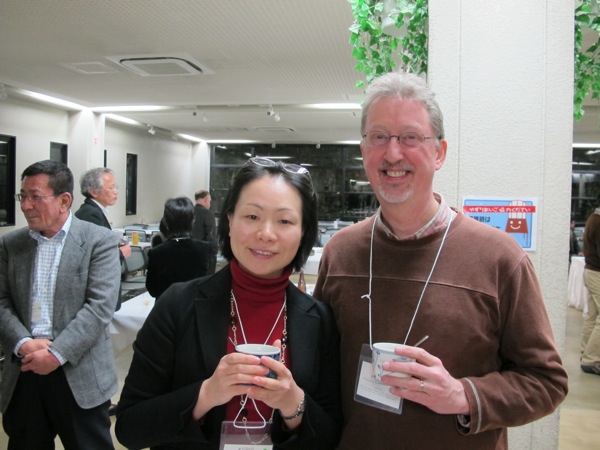
16 January 2012
Tanja Heizmann defends dissertation on January 18
Tanja Heizmann will defend her dissertation, "Acquisition of Exhaustivity in Clefts and Questions and the Quantifier Connection -- A Crosslinguistic Study of English and German" on Wednesday, January 18, at 3PM in Bartlett 206.
Congratulations Tanja!
Call for abstracts: Undergraduate Conference
The q Undergraduate Association for Linguistics at Michigan State (qUALMS) is pleased to announce the Great Lakes Expo for Experimental and Formal Undergraduate Linguistics (GLEEFUL). GLEEFUL will be held on April 21, 2012 in East Lansing, Michigan.
Keynote Speaker: Dr. David Pesetsky
Massachusetts Institute of Technology
GLEEFUL aims to bring together undergraduate linguists from across the continent to present high-quality research to their peers in order to gain experience and a greater appreciation for the many ways to study linguistics and language-related fields.
We invite 1 page abstracts (500 words) for 10 minute presentations or posters from any area of linguistics. Abstract submission and registration will all be done electronically through our website, available through https://sites.google.com/site/gleeful2012/.
Deadline for submission of abstract: January 22, 2012.
Abstracts will be reviewed, and participants will be notified starting on February 26, 2012.
For further information, you can send an email to gleeful.2012@gmail.com, or check out the GLEEFUL website.
05 January 2012
Call for Abstracts: Modality Workshop in Ottawa
Ana Arregui from Ottawa University writes:
We will be hosting a modality workshop on April 20-21. We have extended the abstracts deadline to January 30.
Here is the link to the conference website:
http://modalityatottawau.blogspot.com/2011/10/call-for-papers.html
(Note: Angelika Kratzer is an invited speaker!)
Call for Papers: Societas Linguistica Europaea
The Workshop Convenors write:
We are happy to inform you that we are organizing a workshop on "Meaning and form of vagueness: a cross-linguistic perspective" at the 45th Annual Meeting of the Societas Linguistica Europaea (Stockholm, 29 August-1 September 2012, www.sle2012.eu).
The description of the workshop, research directions, and a non-exhaustive list
of possible topics are available on the workshop website:
https://sites.google.com/site/workshopvagueness2012
Abstracts should be submitted to the SLE by 15 January 2012 via the conference
site (http://www.sle2012.eu/), specifying that the abstract is intended as an
“Oral Presentation” in our workshop.
Abstracts should be anonymous and contain between 400 and 500 words (exclusive
of references). They should state research questions, approach, method, data
and (expected) results. Notification of acceptance will be given by 31 March
2012.
If you have any questions, please do not hesitate to contact us at
workshop.vagueness2012@gmail.com
Call for Applications: NSF Funded Joint Conference
Confirmed collaborating hosts/institutions include:
Hiroshi Motoda, Osaka University.
Research areas: Artificial Intelligence, Machine Learning, Data Mining, Knowledge Discovery, Scientific Discovery, Expert Knowledge Acquisition
http://www.ar.sanken.osaka-u.ac.jp/~motoda/motopreg.html
Naomi Miyake, University of Tokyo.
Research areas: Learning sciences, Collaborative Problem Solving, Robotics for CSCL, Learning Process Analysis
http://coref.u-tokyo.ac.jp/en
Other potential host institutions in Japan include:
National Institute of Advanced Industrial Science and Technology
Center for Experimental Research in Social Sciences, Hokkaido University
http://lynx.let.hokudai.ac.jp/cerss/english/index.html
Advanced Telecommunications Research Institute at Kyoto/Osaka
Primate Research Institute, Kyoto University at Inuyama, Nagoya
http://www.pri.kyoto-u.ac.jp/index.html
The application process is as follows:
All eligible applicants who wish to apply should submit a one page proposal outlining the project on which they wish to work. The deadline for this is February 1, 2012. This outline may specify a collaborating institution, but need not. Institutions not listed above will be considered if the applicant can provide the name of a suitable and willing academic collaborator at such an institution. In addition to the proposal, applicants should provide indicative costs.
From the applicants, a subset will be identified by March 1 whose interests overlap sufficiently with those of a lab sponsor in Japan.
The student and lab sponsor will coordinate to plan a small research project that will include a visit to the lab before or after the conference in Sapporo.
With guidance from the sponsor, the student will submit a final proposal for review by the Selection Committee on or before May 1, 2012.
The Selection Committee will review and choose up to eight projects to support, based on student academic merits, potential impacts on students' education and research goals, financial need, and fundingavailability. Awards will be announced on June 1, 2012.
Students will only be considered if they have submitted a paper to the CogSci2012 conference and if that paper is accepted for oralpresentation.
Interested students should submit their applications to: CogSci.2012.sapporo@gmail.com.
25 December 2011
Kingston at the International Conference on Phonetics and Phonology
John Kingston presented a talk, along with UMass alumnus Shigeto Kawahara, on "The Phonological Consequences of Geminate Phonetics," at the International Conference on Phonetics and Phonology on December 11 at NINJAL in Kyoto.
Other talks at the conference by UMass alumni are:
Shigeto Kawahara (Rutgers University)?
"Lyman's Law is active in loan and nonce words: Evidence from judgement studies"
Mariko Sugahara (Doshisha University)
"Variations in the shiki domain formation of Kinki Japanese compound words: A pilot study"
Junko Ito and Armin Mester (UC Santa Cruz, ICU/UC Santa Cruz, NINJAL)
"Non-prominent positions"
The full program link is:
http://www.ninjal.ac.jp/phonology/InternationalConference/icpp/program/
Tanja Heizmann defends her dissertation!
Tanja Heizmann will defend her dissertation,
Acquisition of Exhaustivity in Clefts & Questions; and the Quantifier Connection - A Cross-linguistic Study of English and German on Wednesday, January 18, 2012 at 3:00 in Bartlett 206
Last Call for abstracts to: Optionality in Syntax and Semantics
Workshop: Properties and Optionality in Syntax and Semantics
13-14 February 2012
Utrecht University, The Netherlands
http://www.hum.uu.nl/medewerkers/h.devries1/poss2012.htm
Submission deadline: 10 January 2012
Invited speakers:
Philippe de Groote (INRIA)
Thomas Ede Zimmermann (Frankfurt)
Description
Much research in linguistics over the last decades has involved various procedures of syntactic optionality, which work in parallel to intensional phenomena in semantics. Certain phenomena of optionality, e.g. of unspecified objects or by-phrases in passives, have been treated by assuming empty syntactic positions (Bach 1980, Landau 2010).
Other optionality phenomena, e.g. of verbal adjuncts, were traditionally treated in Montague Grammar using intensional properties, but are more standardly treated as involving modification in event semantics (Parsons 1990, Landman 2000). Even some cases of adjectival modification (e.g. skillful doctor, beautiful dancer) that were traditionally analyzed as involving properties have been argued to involve event modification (Larson 2002). Both theories of intensionality and event semantics take the modification process to be purely semantic and avoid any empty syntactic positions.
The variety of optionality and modification phenomena, and their intricate relations with intensional properties, lead to some hard puzzles about syntax and semantics:
1. Should there be a unified grammatical framework for analyzing phenomena of optionality?
2. Is there still a role for intensional properties in accounting for optionality effects?
3. How precise and elegant are current hypotheses about optionality in natural language grammar?
The workshop will examine these questions from the perspectives of formal syntax and semantics, and the formal philosophy of intensional properties.
Invited speakers:
Philippe de Groote (INRIA): TBA
Thomas Ede Zimmermann (Frankfurt): TBA
Contributed Talks:
- Chris Blom (Utrecht): ACG fragment for verbs with optional arguments
- Hanna de Vries (Utrecht): Group distributivity and property-denoting indefinites
- Marijana Marelj (Utrecht): Optionality and argument structure
- Reinhard Muskens (Tilburg) and Noor van Leusen (Nijmegen): Events, Time, Worlds, Roles, Linking, and Variable Management
- Yoad Winter (Utrecht): Property descriptions in locative PPs
- Joost Zwarts (Utrecht): The role of events in adjective modification
In addition, there will be a number of slots reserved for solicited papers.
Reimbursement: Depending of funding restrictions, presenters of selected talks may expect partial reimbursement of their trip and staying expenses.
Procedure
We invite authors to submit an abstract (1 or 2 pages including references) for a 30-minute presentation (+10 minute discussion). Abstracts should be submitted via EasyChair: https://www.easychair.org/conferences/?conf=poss2012
Submission deadline: 10 January 2012
Notification:17 January 2012.
Call For Abstracts: ESSLLI in Opole 6-17 August 2012
First Call for Papers
ESSLLI 2012 STUDENT SESSION
Held duringThe 24th European Summer Schoolin Logic, Language and Information
Opole, Poland, August 6-17, 2012
Deadline for submissions: March 20, 2012http://loriweb.org/ESSLLI2012StuS/
ABOUT:
The Student Session of the 24th European Summer School in Logic, Language, and Information (ESSLLI) will take place in Opole, Poland on August 6-17, 2012. We invite submissions of original, unpublished work from students in any area at the intersection of Logic & Language, Language & Computation, or Logic & Computation. Submissions will be reviewed by several experts in the field, and accepted papers will be presented orally or as posters and will appear in the student session proceedings. This is an excellent opportunity to receive valuable feedback from expert readers and to present your work to a diverse audience.
ESSLLI 2012 will feature a wide range of foundational and advanced courses and workshops in all areas of Logic, Language, and Computation. Consult the main ESSLLI website (link below) for further information.
INSTRUCTIONS FOR AUTHORS:
Authors must be students, i.e., may not have received the Ph.D. degree before August 2012. All submissions must be in PDF format and be submitted to the conference EasyChair website. Submissions may be singly or jointly authored. No one may submit more than one singly and one jointly authored paper.
There are two types of papers. Long papers of up to 8 pages will be considered for both oral presentation and the poster session. Short papers of up to 4 pages will be considered as submissions for the poster session.
Submissions must be anonymous, without any identifying information, and must be must be received by March 20, 2012.
More detailed guidelines regarding submission can be found on the Student Session website: http://loriweb.org/ESSLLI2012StuS/
Links to previous years' proceedings are also available there.
Please direct inquiries about submission procedures or other matters relating to the Student Session to esslli2012stus@loriweb.org
For general inquiries about ESSLLI 2012, please consult the main ESSLLI 2012 page, http://esslli2012.pl/
Call for abstracts: LabPhon 13 in Stuttgart 27-29 July 2012
Deadline for abstract submission: 15 January 2012
Notification of acceptance: 31 March 2012
Abstracts are solicited for contributed papers for presentation as 20-minute oral contributions or as posters. Contributions relating to the conference themes are especially encouraged; there will also be sessions for non-thematic papers.The overall theme for the conference is “Phonological and phonetic computations: between grammar and neural activity.” Our goal is to bring together researchers from phonology, phonetics, and adjacent psycho- and neurosciences and to seek to advance these disciplines by encouraging the joint pursuit of interdisciplinary research questions.
Specific topics that address this theme are the following:Simulation as a research method in Laboratory Phonology.Temporal mechanisms in neural processing of sounds and prosodies.Rhythm and Temporal Structure.Rich memory for rich phonology.Non-thematic sessions (both oral and poster) will include contributions to other topics of interest to the LabPhon community.
For more information:
Roeper in the United Kingdom
Tom Roeper gave one of the two public lectures at "The Image of the Child's Mind in Grammar," at "The Past and Future of Universal Grammar," at Durham University in Durham, UK on December 17th. Jill de Villiers was also a speaker at this conference. For more information, go to http://www.dur.ac.uk/whatson/event/?eventno=11318
While overseas, Tom also gave a talk at University College London entitled "Internal Merge and Avoid Phase in Acquisition," and a talk at St Mary's College, "Building Nodes: Recursives and Possessives in AAE and acquisition."
North American Summer School in June in Austin
The fifth North American Summer School in Logic, Language, and Information,
NASSLLI 2012, will be hosted at the University of Texas at Austin, on June
18-22, 2012.
http://nasslli2012.com/
NASSLLI is a one-week summer school aimed at graduate students and advanced
undergraduates in Philosophy, Computer Science, Linguistics, Psychology and
related fields, especially students with interdisciplinary interests or whose
research crosses traditional boundaries between these subject areas. The summer
school is loosely modeled on the long-running ESSLLI series in Europe and will
consist of 5 sessions of 90 minute courses each day during the week of June
18-22, followed by a Turing Symposium on June 23 celebrating the first
centenary of Alan Turing's birth, and the 13th Texas Linguistics Society
conference on June 23, 24.
Courses
* Johan van Benthem (University of Amsterdam / Stanford University): Logical
Dynamics of Information and Interaction
* Craige Roberts (The Ohio State University): Questions in Discourse
* Noah Goodman (Stanford University): Stochastic Lambda Calculus and its
Applications in Semantics and Cognitive Science
* Mark Steedman (University of Edinburgh): Combinatory Categorial Grammar:
Theory and Practice
* Chris Potts (Stanford University): Extracting Social Meaning and Sentiment
* Catherine Legg (University of Waikato): Possible Worlds: A Course in
Metaphysics (for Computer Scientists and Linguists)
* Adam Lopez (Johns Hopkins University): Statistical Machine Translation
* Eric Pacuit (Stanford University): Social Choice Theory for Logicians
* Valeria de Paiva (Rearden Commerce) & Ulrik Buchholtz (Stanford University):
Introduction to Category Theory
* Adam Pease (Rearden Commerce): Ontology Development and Application with
Suggested Upper Merged Ontology (SUMO)
* Ede Zimmermann (University of Frankfurt): Intensionality
* Thomas Icard (Stanford University): Surface Reasoning
* Nina Gierasimczuk (University of Groningen): Belief Revision Meets Formal
Learning Theory
* Robin Cooper (Göteborg University) & Jonathan Ginzburg (University of Paris):
Type Theory with Records for Natural Language Semantics
* Jeroen Groenendijk (University of Amsterdam) & Floris Roelofsen (University
of Amsterdam): Inquisitive Semantics
* Shalom Lappin (King's College London): Alternative Paradigms for
Computational Semantics
* Tandy Warnow (University of Texas at Austin): Estimating Phylogenetic Trees
in Linguistics and Biology
* Hans Kamp (University of Stuttgart / University of Texas at Austin) & Mark
Sainsbury (University of Texas at Austin): Vagueness and Context
* Steve Wechsler (University of Texas at Austin) & Eric McCready (Osaka
University): Meaning as Use: Indexicality and Expressives
Special Presentations
* Pranav Anand (University of California at Santa Cruz)
* Nicholas Asher (IRIT, CNRS/Université Paul Sabatier)
* Martin Davis (Emeritus NYU)
* Robert King (University of Texas at Austin)
* Oleg Kiselyov (FNMOC)
* Kevin Knight (USC/Information Sciences Institute)
* Sarah Murray (Cornell University)
* Chung-chieh Shan (Cornell University)
* Bonnie Webber (University of Edinburgh)
* More to be announced...
Events
* Turing Symposium: June 23
* Texas Linguistics Society Conference: June 23, 24
* More to be announced...
Registration fees: academic discount rate $175; professional rate $400. Student
scholarships will be available for 50 students
(http://nasslli2012.com/scholarships; application deadline: February 29).
Scholarships include registration and may include a further subsidy for travel
and accommodation.
More information is available at:
http://nasslli2012.com/
12 December 2011
UMass at the International Conference on Phonetics and Phonology in Kyoto
The International Conference on Phonetics and Phonology is being held this week at NINJAL in Kyoto. John Kingston, with alumnus Shigeto Kawahara (Rutgers University), is giving an invited talk entitled "The phonological consequences of geminate phonetics."
Other talks at the conference by UMass alumni are:
Shigeto Kawahara (Rutgers University)?
"Lyman's Law is active in loan and nonce words: Evidence from judgement studies"
Mariko Sugahara (Doshisha University)
"Variations in the shiki domain formation of Kinki Japanese compound words: A pilot study"
Junko Ito and Armin Mester (UC Santa Cruz, ICU/UC Santa Cruz, NINJAL)
"Non-prominent positions"
The full program link is:
http://www.ninjal.ac.jp/phonology/InternationalConference/icpp/program/