23 February 2014

Nathaniel Smith speaks on Wednesday

Nathaniel Smith, a Research Associate at the University of Edinburgh School of Informatics, will give a talk at 12:00 on Wednesday, Feb. 26, in Tobin 521B. The title of his talk is ''Building a Bayesian bridge between the physics and the phenomenology of social interaction.’’ An abstract follows.

What is word meaning, and where does it live? Both naive intuition andscientific theories in fields such as discourse analysis and socio-and cognitive linguistics place word meanings, at least in part,outside the head: in important ways, they are properties of speechcommunities rather than individual speakers. Yet, from aneuroscientific perspective, we know that actual speakers andlisteners have no access to such consensus meanings: the physicalprocesses which generate word tokens in usage can only depend directlyon the idiosyncratic goals, history, and mental state of a singleindividual. It is not clear how these perspectives can be reconciled.This gulf is thrown into sharp perspective by current Bayesian modelsof language processing: models of learning have taken the formerperspective, and models of pragmatic inference and implicature havetaken the latter. As a result, these two families of models, thoughbuilt using the same mathematical framework and often by the samepeople, turn out to contain formally incompatible assumptions.

Here, I'll present the first Bayesian model which can simultaneouslylearn word meanings and perform pragmatic inference. In addition tocapturing standard phenomena in both of these literatures, it givesinsight into how the literal meaning of words like "some" can beacquired from observations of pragmatically strengthened uses, andprovides a theory of how novel, task-appropriate linguisticconventions arise and persist within a single dialogue, such as occursin the well-known phenomenon of lexical alignment. Over longer timescales such effects should accumulate to produce language change;however, unlike traditional iterated learning models, our simulatedagents do not converge on a sample from their prior, but instead showan emergent bias towards belief in more useful lexicons. Our modelalso makes the interesting prediction that different classes ofimplicature should be differentially likely to conventionalize overtime.  Finally, I'll argue that the mathematical "trick" needed toconvince word learning and pragmatics to work together in the samemodel is in fact capturing a real truth about the psychologicalmechanisms needed to support human culture, and, more speculatively,suggest that it may point the way towards a general mechanism forreconciling qualitative, externalist theories of social interactionwith quantitative, internalist models of low-level perception andaction, while preserving the key claims of both approaches.

Naomi Feldman gives department colloq on Friday

Naomi Feldman (University of Maryland) gives the department colloquium this Friday, February 28, in Machmer E-37 at 3:30. Her talk is entitled “Interactive learning of sounds and words.” An abstract follows:

Infants begin learning words during the same period as they learn phonetic categories, yet accounts of phonetic category acquisition typically ignore information about the words in which sounds appear.  This work uses computational and behavioral methods to test the hypothesis that infants’ developing knowledge of words provides useful information for learning about phonetic categories.  A first set of simulations examines the potential benefit of a developing lexicon that contains no semantic information.  A Bayesian model is constructed that learns to categorize speech sounds and words simultaneously, and this model outperforms a model that is solely focused on learning phonetic categories.  Artificial language learning experiments demonstrate that human learners can use word-level information to constrain phonetic learning, and that they are sensitive to this information at the same age when they are learning phonetic categories.  A second set of simulations examines the potential role of weak semantic knowledge in constraining sound and word learning.  The model is given weak semantic information about the situations in which words appear, and this situational semantic information is shown to be particularly beneficial for phonetic learning when the developing lexicon contains many similar-sounding words.  Together, these results point to a critical role for the developing lexicon in phonetic category acquisition and highlight the importance of considering how children integrate statistical information across multiple layers of linguistic structure.

Pater at Berkeley on Monday

Joe Pater will give the colloquium talk at University of California at Berkeley on Monday entitled “Structural Bias in Phonology.” An abstract of the talk follows.

Chomsky and Halle (1968) propose an Evaluation Procedure that prefers featurally simple rules and grammars, and Bach and Harms (1972) propose that this bias for structural simplicity can explain instances of historical change in terms of rule simplication in learning. In this talk, I discuss an alternative model of structural bias (Pater and Moreton 2012) cast in a Maximum Entropy framework (Goldwater and Johnson 2003, Hayes and Wilson 2008), which does not invoke an explicit simplicity metric. In the first part of this talk, I present this model, and the results of a phonotactic learning experiment that supports its predictions (Moreton et al. 2013). 

I also present the results of an ERP study (Moore-Cantwell et al. 2013) that provides insight into the nature of the phonotactic knowledge acquired in an experimental setting. After participants are trained on a small set of pattern-conforming words, we find that novel words that violate the pattern elicit a larger Late Positive Component (LPC) than the novel conforming items. LPCs have been observed in response to syntactic violations in language, and also violations of musical expectation. Finding an LPC rather than an N400 effect for the novel words is consistent with the view that participants in these experiments are forming an abstract generalization about the phonotactic pattern rather than directly judging the similarity of novel and trained words. It is also noteworthy that the response to a laboratory learned phonotactic constraint is similar to that for a naturally learned one (Domahs 2009).

In the last part of the talk, I present a model of how structural bias can impact phonological typology, which uses MaxEnt learning in the context of agent-based modeling. I present simulation results (Pater and Staubs 2013) that show the emergence of featural economy (Clements 2003) in systems produced by agent interaction. In these results the tendency towards simplicity is balanced by a tendency to maintain contrast between potentially homophonous words. No constraints or principles specifically demanding economy or contrast are required to obtain these results, suggesting that it is possible to maintain the standard view that phonological grammars evaluate individual representations, rather than entire systems.

Andries Coetzee: LSA Member Spotlight

UMass alumnus Andries Coetzee has been put under the LSA’s spotlight.

Bhatt at Konstanz

Rajesh Bhatt presented with Veneeta Dayal on polar questions in Hindi-Urdu at the Workshop on Non-Canonical Quesitons and Interface Issues, on the 18th of February the Kloster Hegne, Germany. The handout is here. UMass alumna Maria Biezma also gave a talk on “qué questions."

UMass at GLOW

The program for the 37th annual meeting of the Generative Linguists of the Old World has been published and includes the following two papers from UMass students.

Ethan Poole, “A Configurational Account of Finnish Case."

Yangsook Park, “Indexicals and the long-distance reflexive ‘cali’ in Korean"

Congratulations Yangsook and Ethan!

16 February 2014

Sokolowski gives Commonwealth College Alumni talk on Tuesday

UMass alumnus Peter Sokolowski will give a talk entitled “Dictionary as Data: What the Online Dictionary Tells us about English” on Tuesday, February 18, at 5:30 PM Events Hall-East, Commonwealth College. Mr. Sokolowski is Editor-at-large for Merriam-Webster.

Fava at Cognitive Colloquium on Wednesday

Alexandra Jesse writes:

This is just a reminder that Eswen Fava is giving a talk this week in our Brown Bag (Wednesday, Tobin 521B, 12-1:15). The title of the talk is "Examining how environment and experience influence speech processing during infancy".

The abstract is:
We will examine how speech and visual perception and processing are influenced by different types of experiences and environments. The bulk of the talk will discuss a series of neurophysiological studies that explore how infants process different types of complex auditory stimuli, including speech and music.  We will discuss what neural resources are used to process these stimuli and the role biological maturation and experience.  Finally, we will explore current data and future directions that employ longitudinal training paradigms that enable us to examine how specific types of experiences with speech influence visual perception and attention.

Kamiya speaks at LARC on Thursday

Magda Oiry writes:

Please join us for the presentation by Masaaki Kamiya (Hamilton College) at the LARC meeting on Thursday in the Partee room:
 
Investigations in the representation and acquisition of negative quantifiers in nominalizations

NB: new time, we will start promptly at 9:45.
 
Everyone welcome!

Rohena-Madrazo gives Hispanic Linguistics talk on Friday

We are pleased to announce the second of three talks in the Hispanic Linguistics Talk Series this year:

Marcos Rohena-Madrazo (Middlebury College)

Talk title: Diagnoses of a completed sound change: phonetic and phonological evidence for /ʃ/ in Buenos Aires Spanish

When: Friday, February 21st at 4pm

Where: 301 Herter Hall

See abstract below.

In this talk, I present a sociolinguistic analysis of the voicing variation of /ʃ/: [ʒ~ʃ] in Buenos Aires Spanish (BAS), which has been characterized as a sound change in progress from  /ʒ/ > [ʃ]. For example, in BAS the middle consonant in the words "allá" or "oyó" used to be generally pronounced with a voiced postalveolar fricative [ʒ], like the <s> in English "vision", but now many BAS speakers pronounce it with a voiceless postalveolar fricative [ʃ], like the <sh> in English "fishing". In order to determine for which speakers or social groups the devoicing change has reached completion, I implement a novel method that not only compares the percentage voicing levels of /ʒ/ to the inherent voicing variation of /s/, but also compares the phonologically conditioned affrication patterns of /ʒ/ to those of /s/. If the voicing levels of /ʒ/ are not significantly different from those of /s/ and the /ʒ/ no longer exhibits allophonic affrication tendencies, regardless of position, then one can conclude that the speaker's underlying postalveolar fricative is /ʃ/; they are a '’devoiced.'' The sociolinguistic results suggest that the younger, middle class speakers are ‘'devoicers"; however, other social groups also have "devoicers” and "non-robust voicers," which seems to indicate that the /ʒ/ devoicing change is still progressing and perhaps nearing conclusion.

Partee in Utrecht

Barbara Partee was in Utrecht Feb 13 -15 to participate in Lisa Bylinina’s Ph.D. dissertation defense on Feb 14 and to take part in a defense-day workshop that also included talks by Lisa, by her advisor Rick Nouwen, and by fellow committee member Louise McNally. Barbara’s talk was “On the history of the question, ‘Are meanings in the head?’ ”.

Psych EM on Tuesday

Brian Dillon writes:

Wondering and worrying where Psych EM was this semester? Never fret! Psych EM rides again in the Winter 2014 semester. We'll start up our semi-regular evening meetings this semester by meeting on Tuesday February 25th at 8pm in Packard's in Northampton (we'll be reserving a larger, private back room. That way we can have beer AND privacy).

John and I are going to lead discussion of a recent paper called 'Modeling accuracy as a function of response time with the generalized linear model' by Davidson & Martin. A copy of it can be obtained here.

Check it out if you can, and come join us at Packard's for a rousing discussion of the joint analysis of reaction time and accuracy data!

Tentative PRG Schedule

Coral Williams and Ivy Hauser write:

Here is the tentative meeting schedule for the rest of the semester.  Please note that we are NOT MEETING THIS COMING MONDAY, February 17.  Instead, we will meet the week after, on February 24. Stay tuned for  further information.

Meeting Schedule:
February 24 - Jeremy's WCCFL practice talk
March 3 - We will hear from Emiliana. Hosted at Ivy's house.
March 31 - Open House Aftermath, hosted at Claire's place
April 14 - Possibly reading? Hosted at Brian's
April 28 - Possibly reading? Hosted at Ivy's

Hosts and presenters: please let us know if you will be unable to host  or present on the day you are scheduled so we can make any necessary  arrangements. If anyone wants to volunteer to host a meeting, or has  anything they want to talk about at PRG, or has any comments or  concerns, we'd love to hear from you!

CUNY conference program available

The 27th annual CUNY conference on Human Sentence Processing, which will take place March 13-15 at Ohio State University, has recently published its schedule. UMass is well represented:

Brian Dillon, Josh Levy, Adrian Staub and Charles Clifton: Linear order effects in agreement: Evidence from English wh-questions

Jesse Harris and Katy Carlson: “The local contrast expectation in ‘let alone’ coordination"

Suzi Lima: “Language affects quantity judgments in bilingual Yudja speakers"

Amy Schafer, with Kitaek Kim and Theres Grüter: “Effects of morphological and prosodic focus cues on topic maintenance in Korean"

Michael Walsh Dickey, with Evelyn Milburn and Tessa Warren: “No lexical boost: verb-based information does not facilitate prediction over and above event-based knowledge in the visual world"

Jesse Harris: “Shifting viewpoints and discourse economy"

Florian Schwarz: “Soft and hard presupposition triggers are fast in online processing"

Jesse Harris and Katy Carlson: “Focus preferences for focus-sensitive particles (and why)"

Florian Schwarz, with Cory Bill, Jacopo Romoli and Stephen Crain: “Indirect scalar implicatures are neither scalar implicatures nor presuppositions (or both)"

Brian Dillon “Locality in filler-gap dependencies: Evidence from extraposition"

Glynis MacMillan and Iiia Kurenkov, with Wing Yee Chow, Shefali Shah, Ellen Lau and Colin Phillips: “Partial use of available information in early stages of verb prediction."

Brian Dillon, with Akira Omaki, Takuya Kubo, Manami Sato and Hiromu Sakai: “Anti-locality preference in the processing of Japanese reflexive binding."

Florian Schwarz, with Dan Grodner: “Pragmatic narrowing in reference resolution: Domain restriction and perspective taking"

Katy Carlson, with Michael Frazier: “Prosodic and syntactic effects in gapping interpretation"

10 February 2014

Brendan O'Connor on text analysis today

Brendan O'Connor, CMU, will give a talk today, February 10, at
4 PM in Computer Science Building 150 entitled “Statistical Text Analysis for Social Science.” An abstract follows.

What can text analysis tell us about society? Corpora of news, books, and social media encode human beliefs and culture. But it is impossible for a researcher to read all of today's rapidly growing text archives. My research develops statistical text analysis methods that measure social phenomena from textual content, especially in news and social media data. For example: How do changes to public opinion appear in microblogs? What topics get censored in the Chinese Internet? What character archetypes recur in movie plots? How do geography and ethnicity affect the diffusion of new language? In order to answer these questions effectively, we must apply and develop scientific methods in statistics, computation, and linguistics.

In this talk I will illustrate these methods in a project that
analyzes events in international politics. Political scientists are
interested in studying international relations through *event data*:
time series records of who did what to whom, as described in news
articles. To address this event extraction problem, we develop an
unsupervised Bayesian model of semantic event classes, which learns the verbs and textual descriptions that correspond to types of
diplomatic and military interactions between countries. The model
uses dynamic logistic normal priors to drive the learning of semantic
classes; but unlike a topic model, it leverages deeper linguistic
analysis of syntactic argument structure. Using a corpus of several
million news articles over 15 years, we quantitatively evaluate how
well its event types match ones defined by experts in previous work,
and how well its inferences about countries correspond to real-world
conflict. The method also supports exploratory analysis; for example,
of the recent history of Israeli-Palestinian relations.

Second Call: ESSLLI

Models in formal Semantics and Pragmatics Workshop held at ESSLLI 26, August 18-22, Tuebingen, Germany

Organizers: 
* Magdalena Kaufmann, University of Connecticut* Stefan Kaufmann, University of Connecticut

Invited Speakers:
* Michael Glanzberg, Northwestern University* Stanley Peters, Stanford University* Thomas Ede Zimmermann, Frankfurt University

Workshop Information:
Whatever happened to "model-theoretic" semantics?  Since Montague’s groundbreaking work and throughout much of its history, the field of formal semantics (and later pragmatics) was characterized by the use of models - abstract mathematical structures in which linguistic expressions are interpreted and which serve as the backdrop for stating generalizations about their semantic properties and relations.

Over the last couple of decades, however, the once-prominent status ofmodels has been eroding. In the research literature, explicitlydefined fragments and models were the norm in the early days (Partee1975, 1976; Dowty, 1979), but are now the exception rather than therule. In teaching, one of the most widely used textbooks, Heim andKratzer (1998), makes no mention of models, in stark contrast withearly standard works like Dowty, Wall and Peters (1981). Aside fromsuch signs of waning interest, there is a small but formidable body ofwork which actively questions the status of models and finds them tobe of limited use at best (Lepore 1983; Higginbotham 1988; Zimmermann 1999, 2011; Glanzberg, t.a.).
Such explicit reflections are rare, however. The overall decline ofmodels in the field is not driven by a general debate, let aloneconsensus. Nor is the turn away from models a turn towards somenon-model-theoretic alternative. What we do see instead is a tendencyto stay loosely within the model-theoretic framework, but to enrich itwith notions and tools whose formal properties remain largely implicit.

The goal of this workshop is to promote and generate discussion of thepast, present, and future of models in natural-language semantics andpragmatics, specifically the implications of their apparent demise forthe foundations and goals of the field. Topics for discussion include,but are in no way limited to the following:

* What are models, anyway?  Commitments about language, reality, and the nature of meaning that a model-theoretic approach to semantic analysis implies. The (special?) status of possible worlds and their relationship to extensional models.

* What are models good for? Linguistic phenomena or aspects of meaning in whose analysis a model-theoretic approach has been, or would be, crucial or at least beneficial. The (potential) use of models         in treating meaning as variable (e.g., in the analysis of uncertainty about language, or in cross-linguistic and diachronic comparative semantics).

* Where do models get in the way? Desiderata for semantic theory and limitations of the model-theoretic approach. Risks and side effects of specific methods associated with the model-theoretic approach (e.g., meaning postulates).

* Are we safe without models? Advantages and potential pitfalls of innovative uses of formal techniques or metalinguistic expressions, whose repercussions are underexplored (various kinds of states and events, partial functions, etc.)

* What are the alternatives? 

Workshop Format: 
The workshop is part of ESSLLI and open to all ESSLLI participants. It will consist of five 90-minute sessions held over five consecutive days in the second week of ESSLLI. The three invited talks are allotted one hour each, including discussion. On the first day, the workshop organizers will give a 30-minute introduction to thetopic. This leaves room for eight submitted papers of 30 minutes each,including discussion.

Submission Procedure:
Authors are invited to submit an abstract of up to three pages,including examples and/or references (single-spaced, at least 11 pt font, on US letter of A4 paper with margins at least 1in or 2.5cm on all sides, in .pdf, .txt, .doc or .odt format). Abstracts must be submitted by February 15, 2014, electronically at the following address: http://linguistlist.org/easyabs/Models_ESSLLI14

03 February 2014

First PRG meeting today!

Ivy Hauser writes:

The first meeting of PRG will take place at Amanda's apartment in Northampton on Monday (today) at 7pm.  We will spend the first half of the meeting working on planning for the semester and the second half Ivy will talk about recent work and some new ideas.  Dinner will be provided!  

de Villiers at LARC on Thursday

Magda Oiry writes:


Jill de Villiers will present work with Hristo Kyuchukov this coming Thursday in the LARC meeting - 9:30 in South College 301. The talk will be on addressing the rights of Roma children for a language assessment in their native language of Romani

Kratzer in Tel Aviv

Angelika Kratzer gives a talk entitled “Focus and Given:Two Technologies for Discourse Coherence,” at a Workshop on focus sensitive expressions at Bar Ilan University on February 4. UMass alumnus Mats Rooth also gives a talk. For the full schedule, go here.

Dillon in Compass

Brian Dillon’s paper  'Syntactic memory in the comprehension of reflexive dependencies: an overview" has been accepted for publication in Language and Linguistics Compass.

Congratulations Brian!

The Dictionary as Data

Peter Skoloski, editor at large at Merriam-Webster, will be giving a talk called "The Dictionary as Data" on campus at UMass on Tuesday, February 18, at 5:30. It's open to the public, and: "Food will be provided.” The talk is in Commonwealth Honors College Hall east. For more information, go here.

Jeff Moher at Cog Sci Brown Bag

Alexandra Jesse writes:

This is a reminder that Jeff Moher (Brown) is giving a talk this week in the Cognitive Psychology Brown Bag (Wednesday, Tobin 521B, 12-1:15). The title of the talk is "Distractor suppression in attention and action".

26 January 2014

SRG meets on Thursday

Jason Overfelt writes:

Please join us this Thursday at 6:30pm for our first meeting of the Syntax/Semantics Reading Group.  In addition to planning for this semester, Jason Overfelt will lead a discussion about the implications of some novel data on Extraposition from NP structures.  We will be meeting at Sakshi and Jyoti's place at 5 Fruit Street in Northampton. Please bring $5 for pizza or your own dinner.

Call for papers: Exploring the Interface

Exploring the Interfaces 3: Prosody and Constituent Structure

Abstract submission deadline: February 28, 2014

Notification of Acceptance: March 10, 2014

Conference: May 8-10, 2014

Exploring the Interfaces (ETI) 3 will take place at McGill University  from May 8-10, 2014. This workshop will be the last of three workshops  organized by the McGill Syntactic Interfaces Research Group (McSIRG)  as part of a multi-year grant to study linguistic interfaces.  Following ETI 1 (Word structure) and ETI 2 (Implicatures, alternatives  and the semantics/pragmatics interface), the topic of ETI 3 will be  'Prosody and Constituent Structure'.

In particular, ETI 3 will deal with issues surrounding prosodic and  phonological evidence for syntactic constituent structure, with a  focus on verb-initial languages.

Goals of the Workshop:

- To bring together researchers working on issues at the  syntax-phonology interface (e.g. syntactic constituency, prosodic  effects on word order) from the perspectives of syntax, prosody, and  phonology/phonetics

- To bring together researchers working on a variety of different  languages, with an emphasis on languages with default verb-initial  word order

- To encourage communication and discussion about methodologies that  can be used for the empirical study of prosody and thesyntax-phonology interface

Invited Speakers:
Judith Aissen (UC Santa Cruz)

Sasha Calhoun (Victoria University of Wellington)

Lauren Eby Clemens (Harvard)

Emily Elfner (McGill)

Jim McCloskey (UC Santa Cruz)

Norvin Richards (MIT)

Joey Sabbagh (UT Arlington)

Kristine Yu (University of Massachusetts Amherst)

Methods Tutorials:
In addition to the regular session, we will have two tutorials on  local technological tools for fieldwork, with special reference to  fieldwork on prosody:

- Tutorial 1: Automatic Acoustic Alignment in Underdocumented Languages

- Tutorial 2: LingSync: An Online Tool for Field Work

Call for Papers:
In addition to eight invited speakers, we are accepting abstracts for  a limited number of additional talks (30 minutes + 10 minutes  discussion) and posters. We particularly welcome papers which address  the following questions:

- What can prosodic and phonological evidence tell us about syntactic  constituent structure?

- To what extent do syntactic, phonological and prosodic evidence  agree with one another regarding constituent structure?

- What is the role of prosody in determining word order?

- Can prosodic and phonological evidence be used to help distinguish  between competing syntactic accounts of how word order is derived?

We welcome abstracts dealing with these topics in any language, but  would particularly welcome abstracts on verb-initial languages in  keeping with the theme of the conference.

Abstracts should be anonymous and no longer than 500 words (including  examples, but not counting title or references), and should be  submitted in PDF format on the following easychair site by February  28, 2014:
https://www.easychair.org/conferences/?conf=eti3

Please indicate on the form whether you would prefer an oral  presentation, a poster presentation, or whether either would be  acceptable. By default, we will first consider you for an oral  presentation. Additionally, we hope to have some funding available to  supplement travel costs for student presenters.

Questions may be directed to eti3.mcgill@gmail.com.

Sound Workshop schedule

Kristine Yu writes:

Here is the current sound workshop schedule for Spring semester, whichwill be kept up to date as the semester progresses. Future internalannouncements about the workshop will be sent to the ling-sound list here.

Call for Papers: Workshop on Aspect and Argument Structure

Workshop on Aspect and Argument Structure of Adverbs and Prepositions

TROMSØ, 12-13 JUNE 2014

Call Deadline: 15-Feb-2014

We invite submissions for 30 minute presentations (+10 of discussion) on any of these topics. If we get a high number of submissions, those that obtain a high score but cannot make it into the general session will be considered for a poster session. Abstracts should not be longer than two pages, including examples, tables, figures and references, and should be submitted to: waasaptwo@gmail.com 

Deadline for submission: 15 February 2014

Deadline for notification of acceptance: 11 April 2014 

Workshop: 12-13 June 2014, University of Tromsø 

In this workshop we would like to contribute to a better understanding of the nature of prepositions and adverbs and the limits between arguments and adjuncts by gathering researchers working on different aspects of argument structure and aspect of adverbs and prepositions.  The questions we are interested in include, but are not restricted to, the following: 

- Can inner and outer aspect primitives be reduced to the same prepositional-like elements? 

- The argument structure of PPs: What are the theta-roles             associated to Ps, and how is it different or similar to those of verbs?

- How rich is the internal structure of PPs and what correlations can be established between levels of complexity, argument structure and aspect?

- Is the internal structure of PPs similar, in terms of argument structure, to a split VP? - Can Ps define events by themselves?

- How do prepositions contribute to the definition of internal aspect in verbs and adjectives?

- What is the role of prepositions inside verbal periphrases?

- Choice of P and the semantic interpretation of the argument introduced by P 

- Adverbs and adverbial phrases as diagnostics for aspectual properties

- The internal structure of adverbs and the definition of their internal aspectual properties

- The position of adverbs and the interpretation of arguments

- NPs behaving as adverbs (Larson 1985) and adjuncts. What are the limits between arguments and adjuncts, and between nouns and adverbs, in terms or referentiality, modificability, etc.?

- What defines an adverb? What are the relevant subclasses of adverbs for grammar?

- Adverbs as arguments of verbs: Under which circumstances can an adverb be an argument of a verb?

- Adverbs as derived categories: Do adverbs inherit nominal or adjectival properties of their morphological bases?

- Vocatives in the limit between arguments and adjuncts, nouns and adverbs 

Keynote Speakers: 
Peter Svenonius (CASTL, Universitetet i Tromsø) M. Teresa Espinal (CLT, Universitat Autònoma de Barcelona) 

Call for papers: Manchester Phonology Meeting

SECOND CALL FOR PAPERS
Twenty-Second Manchester Phonology Meeting
29-31 MAY 2014

Deadline for abstracts: 10th February 2014

Special session: 'Epenthesis', featuring:* Iris Berent (Northeastern University)* Louis Goldstein (University of Southern California)* Nancy Hall (California State University, Long Beach)* Christian Uffmann (University of Duesseldorf)

Held at Hulme Hall, Manchester, England. Organised through a collaboration of phonologists at the University of Edinburgh, the University of Manchester, and elsewhere.
Conference website: http://www.lel.ed.ac.uk/mfm/22mfm.html

From the description of the conference:

We are pleased to announce the Twenty-Second Manchester Phonology Meeting (22mfm). The mfm is the UK's annual phonology conference, with an international set of organisers. It is held in late May every year in Manchester (central in the UK, and with excellent international transport connections). The meeting has become a key conference for phonologists from all over the world, where anyone who declares themselves to be interested in phonology can submit an abstract on anything phonological in any phonological framework. In an informal atmosphere, we discuss a broad range of topics, including the phonological description of languages, issues in phonological theory, aspects of phonological acquisition and implications of phonological change.

About Submissions:

* There is no obligatory conference theme for the 22mfm - abstracts can be submitted on anything phonological.

* We are using the Linguist List's EasyAbstracts system for abstract submission. Abstracts should be uploaded to the 22mfm's page on the EasyAbstracts site by 10th February 2014:- http://linguistlist.org/easyabs/22mfm

* Full papers will last around 25 minutes with around 5 minutes for questions, and there will be a high-profile poster session lasting one and a half hours. When you submit your abstract, you will be asked to indicate whether you would be prepared to present your work (i) either as a talk or a poster paper or (ii) only as a poster.

*See conference website for important additional details.

Workshop on Gradability and Quantity

The 'McGill/MIT Workshop on Gradability and Quantity in Language and  the Brain' is a two day workshop that brings together a group of  neuroscientists with an interest in language and a group of  experimental and formal linguists interested in the brain, in an  attempt to enhance the dialogue between the linguistic and the  neurophysiological cultures, and help to close the gap between these  two growing groups of researchers. The theme of the workshop is  centered on aspects of gradability and quantity as it pertains to the  cognitive domains of Number, Space, and Time.

The Workshop meets this Friday and Saturday (Jan. 31- Feb. 1) at MIT 32-141. The workshop is open and all are welcome to attend.  For more information about the schedule and talks, go here.

LARC

Magda Oiry writes:

Starting this semester, the Language Acquisition Research Center will be meeting every other Thursdays at 9:30.

Our first meeting was last Thursday, where Maria Turrero-Garcia from LLC Spanish linguistics presented her current experimental ideas to test wh-islands acquisition by L2 speakers of Spanish / L1 English.

Roeper at the Roeper High School

Tom Roeper writes:

 I just returned from Michigan where I spoke to the Roeper High School Linguistics club on "the Recursion controversy in Brazil and its social consequences" on Jan 15th.  The Piraha indian community would like the government   to build them a schoolhouse, but the local officials (not federal) refused saying "Why should we build the Piraha a school, they can't learn". The Roeper Amnesty  International Club is collecting letters from children in support of the PIraha children.  At the same time, a number of indian leaders of many tribes in the area have been killed, most recently on December 3rd.  Three outsiders disappeared, and the indians were blamed.  The local FUNAI (indian affairs office) was burned down.  Every kind of support for the indian groups is particularlyimportant now.  Anyone interested could speak to me.

Colloquium schedule change

Mike Clauss writes:

One addendum to the colloq schedule: Jason Merchant won't be coming on 3/14, but rather on 4/18. This will work better for those who will be going to the CUNY conference and are also interested in Merchant's talk.

19 January 2014

Lyn Frazier: LSA Fellow

At the 88th annual meeting of the Linguistic Society of America, Lyn Frazier was inducted into the class of LSA fellows, along with UMass alumnus Gennaro Chierchia. Lyn joins fellow faculty members Emmon Bach, Barbara Partee, Alice Harris, Angelika Kratzer, John McCarthy, Lisa Selkirk and Tom Roeper.

Erschler presents in the Syntax Workshop on Friday

David Erschler will give a practice talk "Relative clauses in Ossetic and the typology of correlatives” in the syntax workshop on Friday, January 24 at 2:30 in the Partee room.

Call for papers: Workshop on the Semantics of Referring Expressions

Workshop on the semantics of referring expressions
Olomouc
June 5, 2014

Deadline: February 10, 2014

This workshop forms part of the Olomouc Linguistics Colloquium 2014. For further information please consult this webpage.

Coordinators and discussants: Mojmír Dočekal (Masaryk University, Brno), Berit Gehrke (Université Paris Diderot)

The workshop aims to bring together linguists interested in the semantics and pragmatics of natural language, focusing on interpretative issues related to nominal complexes. The theme should not exclude papers on other subjects, but submissions traditionally related to this theme (indefinite/definite NPs, plurality/kind/mass denoting NPs and referential pronouns) are especially welcome.

Call for papers: Workshop on Quantifier Scope

Workshop on "Quantifier Scope: Syntactic, Semantic, and Experimental Approaches"

June 12-13, 2014

We invite 6 papers for 30 minutes (plus 10 minutes discussion) that address the topic of Quantifier Scope, either from a syntactic, a semantic, or an experimental approach, or any combination of the previous.

This workshop aims to foster discussion and collaboration among researchers working on quantifier scope, by trying to bring together work from a variety of languages, experimental paradigms, and theoretical perspectives.
Submission guidelines:
Abstracts (2 pages, 12pt font, including references and data) should be emailed to: u.etxeberria at iker.cnrs.fr

Please include title of the proposal, name of the author(s) and affiliation in the body of the email.

Abstract Submission Information:
Abstracts can be submitted from 01-Jan-2014 until 19-Jan-2014.

Deadline for submission: January 19, 2014
Notification of acceptance: March 14, 2014

Invited Speakers (in alphabetical order):
Benjamin Bruening (University of Delaware)
Anastasia Giannakidou (University of Chicago)
Jeffrey Lidz (University of Maryland)
Janina Rado (Goethe Universitat, Frankfurt am Main)
Gregory Scontras (Harvard University)
Benjamin Spector (CNRS, Institut Jean Nicod)
Georges Tsoulas (University of York)
Susi Wurmbrand (University of Connecticut)

Schedule for Cognitive Colloquium

Alexandra Jesse writes:

Below is a preliminary schedule for our Cognitive Colloquium for this semester. As always, we meet on Wednesdays in Tobin 521B at 12:00 noon. We won't meet every week, since due to our job searches, I have been asked to limit the number of talks. This may also mean that we have to meet occasionally in a different location - look out for room changes in my reminder emails. My apologies to all of you who had suggested someone (or volunteered) who couldn't be scheduled. I will try to consider these suggestions for the Fall.

Feb 5 - Jeff Moher
Feb 19 - Eswen Fawa
Feb 26 - Nathaniel Smith
March 5 - Sean Kang
March 19 - Spring break
March 26 - Katja Poellmann
April 2 - Evan Heit
April 9 - Ben Zobel
April 16 - Lisa Fiorenzo
April 30 - Monica Bennett

If you have suggestions for Fall speakers, please send them to me.

Partee at LSA

In WHISC’s last issue, we neglected to include the talk given by Barbara Partee in our entry about UMass’s presence at the Linguistics Society of  America’s meeting in Minneapolis. She was one of the presenters at the LSA’s 90th anniversary talks. Hers was entitled “Semantics and Pragmatics: then and Now.” The slides for her talk can be found here.

Call for papers: Logic, Grammar and Meaning

The Logic, Grammar and Meaning conference will take place at the University of East Anglia on June 7-9. Keynote speakers include Angelika Kratzer and UMass alumnus Gennaro Chierchia. 

The LGM conference brings together philosophers and linguists in order to investigate and promote fruitful interactions between logic and natural language. Our target audience consists of philosophers, logicians and linguists interested in the application of logic to natural language. We especially encourage  graduate students and young researches to join in. We support the Gendered Conference Campaign.

Submission deadline: March 20, 2014

Notification of decisions: April 10, 2014

For more information, and instructions on submitting abstracts, go here.

Call for papers: Canadian Linguistic Association

The Canadian Linguistic Association will hold its 2014 conference as part of the Congress of the Humanities and Social Sciences at Brock University, St. Catharines, ON, from Saturday May 24 to Monday May 26, 2014. Members are invited to submit abstracts representing all areas of linguistics. Only members in good standing for 2014 may submit an abstract for the main session. (To become a member, you must subscribe to the Canadian Journal of Linguistics via the University of Toronto Press Web site.)

PLEASE NOTE: We strongly encourage all members, especially senior faculty, to submit poster abstracts.

ABSTRACTS ARE TO BE SUBMITTED ELECTRONICALLY, in .pdf format, through EasyAbstracts, at http://linguistlist.org/confcustom/aclcla2014.

Deadline: Saturday, February 1, 2014

For more information, go here.

Spring Colloq calendar announced

The schedule of department colloq talks for Spring 2014 has been released:

2/7 - Ev Federenko (Mass. General Hospital Department of Psychiatry [ICESL talk]

2/28 - Naomi Feldman (Maryland)

3/14 - Jason Merchant (Chicago)

3/28 - Gereon Müller (Leipzig) [Syntax Guru]

4/25 - Veneeta Dayal (Rutgers)

Erschler's entry in Oxford Bibliographies appears

David Erschler’s entry on Northeast Caucasian Languages has appeared in Oxford University Press’s online bibliographies series. Find it here.

WW II Trivia winners announced

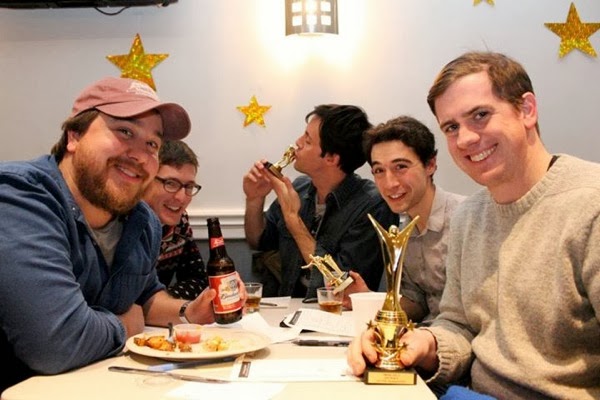
WHISC is proud to announce that local favorite “Oh! The Humanities” won three prizes at the World War II club trivia contest, including third place for the coveted “Worst Tiebreakers” trophy. Below is a picture of team members Erik Cheries (Psychology), Brian Dillon (Linguistics), Jeremy Hartman (Linguistics), Tom Maresca (Biology) and Brian McDermott (Journalism). (Picture courtesy of Northampton bureau chief Rajesh Bhatt.)

Trivia

Johnson in Rome

Kyle Johnson will make a (short) presentation with Diane Lillo-Martin and Andrew Nevins on the structure of language at the 2014 Science Festival in Rome on Saturday, January 25. The Festival this year is devoted to linguistics and language, and will include talks by many well-known linguists, including Noam Chomsky who will also be the subject of an “opera” which is described thusly:

A talk-opera by Emanuele Casale for instrumental ensemble, voice, electronics and images Conversations with Chomsky is a musical opera featuring characters who “interpret” themselves, without acting a part, on a virtual stage – the video screen. Various characters follow and interact with one another at the threshold between reality and evocation: the linguist and activist Noam Chomsky, an internationally renowned scholar and professor at the M.I.T.; legendary names such as those of Margaret Thatcher, Milton Friedman, Ronald Reagan and Salvador Allende; and university students. Far from being a work of political propaganda, Conversations with Chomsky seeks to combine themes related to activism within an audiovisual framework vaguely inspired by melodrama. The central theme is the current contrast between two impulses found within individuals and societies: collectivism and mutual aid on the one hand, and competition and individualism on the other.

Check out the full schedule here.

CoLang 2014

CoLang 2014, the 2014 Institute on Collaborative Language Research (formerly InField) will occur in June and July 2014, hosted by The University of Texas at Arlington, with Dr. Colleen Fitzgerald as Director. CoLang 2014 is funded by a National Science Foundation grant, BCS#263939 and by various units at UT Arlington. The theme of CoLang 2014 is Native American languages, but participants and instructors from countries all over the world are expected to attend.

CoLang offers an opportunity for undergraduate and graduate students, practicing linguists, and indigenous community members to develop and refine skills and approaches to language documentation and revitalization. The Institute is designed to provide an opportunity for a diverse range of participants to become trained in a wide range of skills in community-centered language documentation.

For more information, including the costs and how to enroll, go here.

13 January 2014

UMass at LSA

The 88th annual meeting of the Linguistic Society of America was held January 2-5 in Minneapolis, Minnesota.  UMass was well-represented, with the following presentations given by current UMass residents:

Yangsook Park
"Different Monsters for Person and Adverbial Indexicals in Korean"

Brian Smith
"Rhythmic conditioning of ‘-licious' in English"

Yelena Fainleib
"Lexical Distributions and Productive Generalizations of Stress in Modern Hebrew nouns"

Kristine Yu (with Sameer ud Dowla Khan)
"Intonational phonology in infant-directed speech"

Lisa Green (with introduction by Tom Roeper)
"Diversity in Linguistics"

and the following UMass alumni also presenting:

Emily Elfner (McGill)
"Prosodic boundary strength in verb-initial structures: Evidence from English and Irish"

Jill Beckman (University of Iowa)
"Speaking Rate effects on VOT in German Stops: Phonological Implications"

Tohru Noguchi (Ochanomizu University)
"Reflexive Verb Constructions in Japanese"

Kyle Rawlins (Johns Hopkins)
"iPython Lambda Notebook: a system for digital fragments in semantics"

Ana Arregui (with Maria Luisa Rivero and Andres Salanova, all from University of Ottawa)
"Aspect and tense in evidentials"

Janet Randall (with Lucas Graf, both at Northwestern University)
"Linguistics meets 'legalese': syntax, semantics and jury instruction reform"

Partee wins trivia prize at LSA meeting

Barbara Partee writes:

The LSA meeting in Minneapolis featured some events commemorating the 90th anniversary of the LSA, including two days of short talks contrasting the state of things in 1924 and 2014 in the different subfields, and of the LSA itself, and women in linguistics, and other related topics, all interesting. And there was a video compiled by Dennis Preston from materials sent in response to a year-long appeal (including a number of photos from the 1974 Linguistic Institute at UMass Amherst), which ended with a quiz: photos (many of them cryptic in one way or another) and clues about 10 linguists, and we were all invited to submit entries. There was also a “tie-breaker” photo with two guys in T-shirts, one with an undecipherable autograph, one with something written in some non-English language. It turned out that I won, to my great surprise. I guess I’m now a certified “old guy”, because I think you had to be. I was one of two to get 7 right, and I got the first three words on the t-shirt (I didn’t know the language, but it was something Scandinavian, and I deciphered “I have not ….” (turned out to be Icelandic, and to say ‘I have no idea what this T-shirt says’.) My prize: free registration for next year’s LSA, in San Francisco – so maybe I’ll go! 

From the WHISC editor:

You can see the LSA’s 90th anniversary video presentation here. There is a section that includes the artistic accomplishments of several notable linguists — be sure to check out Emmon Bach’s poem and Barbara’s photography, as well as the contest that Barbara describes above.

Workshop on Gradability and Quantity

MIT and McGill University will sponsor a Workshop on Gradability and Quantity in Language and Brain. The workshop is hosted by MIT on January 31 and February 1.  UMass alumni Irene Heim, Roger Schwarzschild and Bernhard Schwarz will be giving presentations, as will UMass syntax guru, Roumyana Pancheva. For a full schedule, go here.

Call for Applications: Summer School on Mathematical Philosophy for Women

Sponsored by the Munich Center for Mathematical Philosophy

The summer school is open to women with a keen interest in mathematical philosophy. Applicants should be female students of philosophy, or philosophically minded logicians, mathematicians, or scientists at an advanced undergraduate level, in a master program, or at an early PhD level. To apply for participation, please send a cover letter (including a statement of motivation) and your CV (ideally everything in one pdf file) to mathsummer2014@lrz.uni-muenchen.de. A separate letter of recommendation should be sent to the same address. Please indicate in your cover letter if you wish to present your own project. The deadline for applications is February 15, 2014. Decisions will be made by March 1, 2014. The participation fee is 200€. The language of all events will be English.

06 January 2014

Post Doc at ZAS in Berlin

The Center for General Linguistics (ZAS) in Berlin, Germany has an opening starting flexibly between April 1st, 2014 and September 1st, 2014 pending final approval of funding for one postdoctoral researcher.  The position is in the SSI project within the XPrag.de program (www.zas.gwz-berlin.de/xpragde.html).  The advertised position is limited to one year initially with a possibility of extension. The appointment would be made at the German government pay-scale for a postdoc (about 45.000 EUR/year before tax). 

The SSI project:

Scalar inferences have been shown to differ in strength. As an example, consider the contrast between the cardinal numerals "three" and the quantifier "some":  the scalar inference from "three" to "not four" is felt to be stronger than  that from "some" to "not all" in some cases.  Four diagnostics of strength corroborating this contrast are the following: 1) The stronger inference of the cardinal is more difficult to cancel, 2) easier to embed,  3) acquired earlier by children, and 4) accessed faster and more easily in online language processing. Several researchers have therefore claimed that cardinals like "three" must receive a fundamentally different analysis from other scalars.  However, disjunction also exhibits a  strength difference: "either A or B" is intuitively  felt to more strongly exclude the truth of both A and B than a bare disjunction "A or B" does.  Most proposals for cardinals cannot be extended to "either-or"  As far as we know, there has been no general discussion of strength of scalar inferences within pragmatic theory despite numerous individual observations.

The goal of this project is to develop a theory of the strength of scalar inferences that extends beyond cardinals.  Our empirical basis is a detailed investigation of the four diagnostic mentioned above for the pair of "or" and "either-or".  In addition to offline judgment tasks, we gather data from language acquisition and online language processing using self-paced reading, eye-tracking and mouse-tracking.  Furthermore we engage language comparisons between German and Japanese since in several respects our experimental tests are easier to apply in Japanese.  Within pragmatic theory, our goal is to develop a uniform theory of strength.  In particular, we test the hypotheses that obligatory activation of alternatives within the grammatical analysis of implicatures underlies at least the two core cases of scalar inference strength.

The XPrag.de program is a national priority program (SPP 1727) funded by the German Research Council DFG. The overall goal of XPrag.de is to develop a precise pragmatic theory that is informed by evidence using experimental methods.  Within the XPrag.de program additional possibilities for Postdoc career development such as training schools, funding for workshops and scientific exchanges are available.

Desirable skills include the following:

- broad general background in linguistics including syntax, Japanese and German linguistics
- advanced knowledge / own research in formal pragmatics and semantics
- familiarity with current research on implicatures
- experimental skills in language acquisition and processing
- experience with self-directed project work in experimental linguistics
- interest to contribute to broader research agendas of ZAS and XPrag.de

For further information regarding this position please contact
Uli Sauerland <uli@alum.mit.edu>.

Review of applications will start February 1st, 2014 and continue until the position is filled.

Applications should include the following information:
- cover letter indicated the desired starting date
- curriculum vitae 
- samples of prior published research
- names and email addresses of three people that can be contacted for recommendation letters
 (but please do not send letters at this point)

Please send your applications electronically to uli@alum.mit.edu. 

Applications can also be send by mail to the address below.

Uli Sauerland
Zentrum für Allgemeine Sprachwissenschaft
Schützenstr. 18
10117 Berlin
Germany

Pater in Southern California

Joe Pater will be giving a colloquium talk at UCLA Friday January 10th entitled "Structural bias in phonology". It presents joint work with Claire Moore-Cantwell, Elliott Moreton, Katya Pertsova, Lisa Sanders, Robert Staubs, and Ben Zobel – an abstract is available here:

http://blogs.umass.edu/pater/files/2014/01/pater-ucla-colloq-abstract-2014.pdf

Second Call: Conference on Formal Grammar

The 19th Conference on Formal Grammar

Tuebingen, Germany, August 16-17 2014

http://fg.phil.hhu.de/

Collocated with the European Summer School in Logic, Language and Information

Background

FG-2014 is the 19th conference on Formal Grammar, to be held in conjunction with the European Summer School in Logic, Language and Information, which takes place in 2014 in Tuebingen, Germany.

Previous Formal Grammar meetings were held in Barcelona (1995), Prague (1996), Aix-en-Provence (1997), Saarbruecken (1998), Utrecht (1999), Helsinki (2001), Trento (2002), Vienna (2003), Nancy (2004), Edinburgh (2005), Malaga (2006), Dublin (2007), Hamburg (2008), Bordeaux (2009), Copenhagen (2010), Ljubljana (2011), Opole (2012) and Duesseldorf (2013).

Aims and Scope

FG provides a forum for the presentation of new and original research on formal grammar, mathematical linguistics and the application of formal and mathematical methods to the study of natural language. Themes of interest include, but are not limited to,

* formal and computational phonology, morphology, syntax, semantics and pragmatics;

* model-theoretic and proof-theoretic methods in linguistics;

* logical aspects of linguistic structure;

* constraint-based and resource-sensitive approaches to grammar;

* learnability of formal grammar;

* integration of stochastic and symbolic models of grammar;

* foundational, methodological and architectural issues in grammar and linguistics;

* mathematical foundations of statistical approaches to linguistic analysis.
Previous conferences in this series have welcomed papers from a wide variety of frameworks.

Submission Details

We invite **electronic** submissions of original, 16-page papers (including references and possible technical appendices).  Authors are encouraged to use the Springer-Verlag LNCS style.

The submission deadline is **February 23 2014**. Papers must be submitted electronically at https://www.easychair.org/conferences/?conf=fg2014

Papers should report original work which was not presented in other conferences. However, simultaneous submission is allowed, provided that the authors indicate other conferences to which the work was submitted in a footnote. Note that accepted papers can only be presented in one of the venues.

Submissions will be reviewed anonymously by at least three reviewers. Accepted papers will be published as a volume in the Springer LNCS series, under the FoLLI subline, either separately or jointly with the papers from FG-2015, depending on the number of accepted papers.

Important Dates

* February 23, 2014: Deadline for paper submission

* April 20, 2014: Notification of acceptance

* June 1, 2014: Camera ready copies due

* August 16-17, 2014: Conference dates

30 December 2013

One year position at Boston University

Carol Neidle writes:

What we got for Christmas was approval to advertise for a  1-year replacement position (VISITING ASSISTANT PROFESSOR)  in SYNTAX for AY 2014-15. We'll advertise in the usual places,  but please help spread the word, especially to prospective  candidates who plan to attend the LSA meetings in January. Go here for details.

University of Rochester's linguistics and cognitive sciences program

Jeff Runner writes:

The department of Brain & Cognitive Sciences and the department of Linguistics at the University of Rochester invite applications from students interested in pursuing a joint PhD in Brain & Cognitive Sciences and Linguistics. The department of Linguistics (http://www.ling.rochester.edu/) combines strengths in formal linguistics--syntax, semantics, pragmatics, phonetics and phonology--with experimental and empirical methodologies. The department of Brain and Cognitive Sciences combines strengths in language research--language processing, language acquisition, brain and language--with vision, and neuroscience, which includes computational neuroscience, learning and plasticity. The language researchers in these departments--along with those in Computer Science--constitute Rochester's Center for Language Sciences. This year we are particularly interested in applicants who want to investigate the formal syntactic and semantic properties of language structure using experimental and empirical techniques. Students interested in the joint Brain & Cognitive Sciences/Linguistics PhD program should apply through the Brain & Cognitive Sciences department as soon as possible, and no later January 15, 2014. Please mention in your application your interest in pursuing the joint degree with Linguistics. For further information contact Jeff Runner (jeffrey.runner@rochester.edu).

Call for papers: SPE 7

The 7th Colloquium Semantics and Philosophy in Europe – SPE 7 – will be hosted by the Zentrum für Allgemeine Sprachwissenschaft (ZAS) in Berlin in cooperation with the Institut für Philosophie and the Institut für deutsche Sprache und Linguistik at Humboldt University Berlin

Place: Zentrum für Allgemeine Sprachwissenschaft, Berlin
Date: June 26-28 , 2014 (conference), June 25, 2014 (tutorials)
Web: www.zas.gwz-berlin.de/fileadmin/spe7

We invite submissions for the general session and the special sessions for 45 minute presentations (incl. discussion) or posters Please visit the SPE7 web pages for details.

The submission deadline is 1. February 2014. We expect to make notifications of acceptance in the beginning of March.

25 December 2013

Call for Papers: Models in formal Semantics and Pragmatics

                                     Workshop held at ESSLLI 26

                                 August 18-22, Tuebingen, Germany

Organizers: 

 * Magdalena Kaufmann, University of Connecticut

* Stefan Kaufmann, University of Connecticut

Invited Speakers:

* Michael Glanzberg, Northwestern University

* Stanley Peters, Stanford University

* Thomas Ede Zimmermann, Frankfurt University


Workshop Information:

 Whatever happened to "model-theoretic" semantics?  Since Montague’s groundbreaking work and throughout much of its history, the field of formal semantics (and later pragmatics) was characterized by the use of models - abstract mathematical structures in which linguistic expressions are interpreted and which serve as the backdrop for stating generalizations about their semantic properties and relations.

Over the last couple of decades, however, the once-prominent status of models has been eroding. In the research literature, explicitly defined fragments and models were the norm in the early days (Partee 1975, 1976; Dowty, 1979), but are now the exception rather than the rule. In teaching, one of the most widely used textbooks, Heim and Kratzer (1998), makes no mention of models, in stark contrast with early standard works like Dowty, Wall and Peters (1981). Aside from such signs of waning interest, there is a small but formidable body of work which actively questions the status of models and finds them to be of limited use at best (Lepore 1983; Higginbotham 1988; Zimmermann 1999, 2011; Glanzberg, t.a.).

Such explicit reflections are rare, however. The overall decline of models in the field is not driven by a general debate, let alone consensus. Nor is the turn away from models a turn towards some non-model-theoretic alternative. What we do see instead is a tendency to stay loosely within the model-theoretic framework, but to enrich it with notions and tools whose formal properties remain largely implicit. 

The goal of this workshop is to promote and generate discussion of the past, present, and future of models in natural-language semantics and pragmatics, specifically the implications of their apparent demise for the foundations and goals of the field. Topics for discussion include, but are in no way limited to the following:

* What are models, anyway?  Commitments about language, reality, and the nature of meaning that a model-theoretic approach to semantic analysis implies. The (special?) status of possible worlds and their relationship to extensional models.

 * What are models good for? Linguistic phenomena or aspects of meaning n whose analysis a model-theoretic approach has been, or would be, crucial or at least beneficial. The (potential) use of models in treating meaning as variable (e.g., in the analysis of uncertainty about language, or in cross-linguistic and diachronic comparative semantics).

* Where do models get in the way? Desiderata for semantic theory and limitations of the model-theoretic approach. Risks and side effects of specific methods associated with the model-theoretic approach (e.g., meaning postulates).

* Are we safe without models? Advantages and potential pitfalls of innovative uses of formal techniques or metalinguistic expressions, whose repercussions are underexplored (various kinds of states and events, partial functions, etc.)

* What are the alternatives? 

Workshop Format: 

The workshop is part of ESSLLI and open to all ESSLLI participants. It will consist of five 90-minute sessions held over five consecutive days in the second week of ESSLLI. The three invited talks are allotted one hour each, including discussion. On the first day, the workshop organizers will give a 30-minute introduction to the topic. This leaves room for eight submitted papers of 30 minutes each, including discussion.

Submission Procedure:

Authors are invited to submit an abstract of up to three pages, including examples and/or references (single-spaced, at least 11pt font, on US letter of A4 paper with margins at least 1in or 2.5cm on all sides, in .pdf, .txt, .doc or .odt format). Abstracts must be submitted by February 15, 2014, electronically at the following address:

                 http://linguistlist.org/easyabs/Models_ESSLLI14

Review:

 Abstracts will be reviewed by members of the program committee and, where appropriate, outside reviewers. Reviewing will be anonymous unless authors include self-identifying information in their abstracts. Decisions will be made by the program committee and announced to authors on April 15, 2014.

Important Dates:

* Feb 15, 2014: Submission deadline

* Apr 15, 2014: Notification of acceptance 

* Jun 15, 2014: End of ESSLLI early registration period

* Aug 18-22, 2014: Workshop

Contact Information:

* Magdalena Kaufmann

* Stefan Kaufmann

COLANG 2014 at UT, Arlington

Colleen M. Fitzgerald writes:

I am writing you to ask for your help and support for CoLang 2014: the Institute on Collaborative Language Research, taking place at The University of Texas at Arlington in June and July 2014. CoLang (previously known as InField) allows students and faculty to acquire or refine cutting edge skills in language documentation, revitalization and field linguistics, to network with established international experts in these areas, and to gain hands-on experience in working with endangered and underdescribed language communities through field methods offerings. An exciting development this year is our partnership with the Linguistic Society of America. Part of this co-sponsorship includes LSA scholarships to CoLang 2014, creating expanded opportunities for academic training in language documentation and field linguistics for faculty and students, including undergraduates.  

As we continue our planning and advertising for the upcoming summer, I'd like to ask your help in raising awareness of CoLang 2014 and in supporting the LSA and its commitment to endangered language documentation and revitalization.  I will be holding office hours at the LSA on January 3rd and 4th, where we will have fliers and posters for you to take home to your university.  I will be available to answer any questions that you or your faculty or students might have about attending CoLang.  The two-week session, from June 16-27, 2014 consists of workshops in aspects of language documentation and revitalization and it costs $1450, which covers registration, room and board.  Many attendees stay on for an additional four-weeks, which includes enrollment in a four-week field methods class, as well as the two weeks of workshops. Costs for the entire six-week session is $4300 (registration, room and board).  The field methods classes give participants a firsthand experience in working with speakers of an endangered language to document and analyze the language. With three to four field methods classes scheduled, CoLang 2014 will be able to serve a large number of interested participants. This year, for the first time, we plan to offer a Spanish-medium field methods class featuring a language of Mexico.

The CoLang website is up at here and we expect registration to open soon.  Online scholarship applications from the Linguistic Society of America and for CoLang 2014 internal scholarships will shortly be available; the due date for consideration for both is February 17, 2014.  Full scholarship information and updates as they occur are here.

We hope that you will join our many sponsors, including the National Science Foundation, the Linguistic Society of America, the Endangered Language Fund, and The University of Texas at Arlington, in making CoLang 2014 a significant step in the documentation of our vanishing linguistic heritage,  a valuable training ground for emerging linguists to acquire documentation, revitalization, and field linguistics skills, and a place where established linguists can expand their repertoire or retool for their next research projects.

Prosody Bootcamp in January

Kristine Yu writes:

You are cordially invited to a prosody bootcamp on **Friday, 1/17 -
Sunday, 1/19** right before the start of the Spring semester. (Note:
date change due to popular demand). This is a component of activities
this year for the Five Colleges Prosody Community Mellon Mutual
Mentoring grant. There will be plenary lectures, research talks, and tutorials, all geared towards stimulating collaborative research on
prosody. We welcome anyone interested in learning more about prosody.

While most of the speakers at the bootcamp are from the local Five
College community, I'm delighted to share that we will also be joined
by our regional colleagues from Boston: members of the BU-MIT-Simmons Prosody Lab and Mohinish Shukla (UMass Boston).

***IMPORTANT: For head-counting, food-ordering purposes, please send me a note if you are planning to come by JANUARY 6, 2014. *****

TENTATIVE SCHEDULE:

FRIDAY JAN 17 (Math Lounge, UMASS)

9:00-11:00 Lyn Frazier/Chuck Clifton plenary: prosody/sentence processing
11:00-11:30 Break
11:30-12:30 Research talks
12:30-1:30 Lunch
1:30-3:00 Research talks
3:00-3:30 Break
3:30-6:00 Tutorial 1: working with f0 and voice quality in the
speech signal; intro
to ToBI transcription (Kristine Yu)
6:30 on Dinner party somewhere off-campus


SATURDAY JAN 18 (Math Lounge, UMASS)

9:00-11:00 Lisa Selkirk/Angelika Kratzer plenary: prosody/information structure
11:00-11:30 Break
11:30-12:30 Research talks
12:30-1:30 Lunch
1:30-2:00 Research talks
2:00-3:00 John Kingston plenary: tone
3:00-3:30 Break
3:30-6:00 Tutorial 2: empirical methods for prosodic research
(Meghan Armstrong, Mara Breen)
6:30 on Informal dinner parties

SUNDAY JAN 19

Morning brunch in Northampton
Collaborative group discussions

Call for papers: CCLCC 2014

Computational, Cognitive, and Linguistic Approaches to the Analysis of Complex Words and Collocations (CCLCC 2014)

http://www.sfs.uni-tuebingen.de/~vhenrich/cclcc_2014/

Workshop organized as part of the European Summer School on Logic, Language and Information ESSLLI 2014 (http://www.esslli2014.info/), August 11-15 2014 (ESSLLI first week), Tübingen, Germany


Workshop Organizers:
--------------------

Erhard Hinrichs and Verena Henrich
esslli-workshop@sfs.uni-tuebingen.de


Workshop Purpose:
-----------------

The analysis of complex words, compounds, and collocations has received considerable attention in linguistics, cognitive science and computational linguistics. Research on these phenomena concerns theoretical, experimental, and applied aspects relevant to all three disciplines. This diverse and interdisciplinary perspective lends itself particularly well to an ESSLLI workshop on this topic.

The aim of the workshop is to stimulate a cross-disciplinary discussion that will be of mutual benefit to the three fields sketched above and that will provide a forum for junior and senior researchers alike.

Relevant topics for the workshop include, but are not limited to, the following issues:

- Cognitive and computational models for the interpretation of compounds and collocations
- Experimental and computational methods for the analysis of compounds and collocations
- Statistical models for the identification and classification of collocations
- Word formation, lexical semantics, and semantic compositionality
- Word formation at the interface of morphology and syntax


Submission Details:
-------------------

Authors are invited to submit an EXTENDED ABSTRACT for a 30-minute presentation (including discussion). Submissions should not exceed 3 pages, including figures, data, and references. The submissions will be reviewed anonymously by the workshop's program committee. The abstracts accepted for presentation will appear in the workshop web site and be published as part of the ESSLLI 2014 proceedings. In addition, we are considering the possibility of compiling a journal special issue from selected papers presented at the workshop.

Please upload your submission at EasyChair:
https://www.easychair.org/conferences/?conf=cclcc2014


Workshop Format:
----------------

The workshop is part of ESSLLI and is open to all ESSLLI participants. It will consist of five 90-minute sessions held over five consecutive days in the first week of ESSLLI. There will be 2-3 slots for paper presentation and discussion per session. On the first day the workshop organizer will give an introduction to the topic.

All workshop participants, including the authors, will be required to register for ESSLLI.


Important Dates:
----------------

- December 23: First Call for Papers
- January 11: Second Call for Papers
- February 11: Last Call for Papers
- March 8: *Deadline for Submissions*
- April 21: Notification of Acceptance
- August 11-15: Workshop

Frazier a Winner!

Lyn Frazier was announced as one of two winners for the iPad Mini Raffle put on by the UMass Amherst Community Campaign. Congratulations Lyn!

16 December 2013

Word?

http://xkcd.com/1301/

Deadline Extended for Language and Other Minds

The submission deadline for the Language and Other Minds workshop at Maryland, with invited talks Mandy Simons and Jason Stanley, has been extended to December 30.  A fuller description follows.


PHLING, a research group of students and faculty from the departments of linguistics and philosophy at the University of Maryland, invites student contributions to PHLINC 2: Language and Other Minds, our second biennial conference on topics at the intersection of linguistics, philosophy, and neighboring disciplines. The topic of Language and Other Minds is attitudes and attitude ascriptions, with a special emphasis on knowledge ascriptions and related phenomena such as presupposition, factivity, and evidentiality.

The use of language relates to an awareness of other minds in two important ways. First, communication depends fundamentally on a sensitivity to the intentions and beliefs of others in conversation. Presupposition and implicature are interesting special cases of this. Second, with verbs like "think" and "know", we can talk about mental states explicitly, in ways that create familiar semantic challenges. Acquiring a language therefore involves the development of competence in both areas, not a simple task.

In this conference, we invite discussion of both sorts of relations between language and other minds, from the perspectives of philosophy, linguistics and cognitive or developmental psychology. What understanding of knowledge, belief, desire and intention is expressed in the meanings of attitude verbs? In what ways does the use of such verbs rely on pragmatic enrichment? What is the correct understanding of knowledge in conversation, as expressed in presuppositions, evidentials, or epistemic modals? By what path do children become competent in these various areas? And what does this tell us about the linguistic representation of mental states, or semantic theories of attitude verbs?

The conference will feature talks by invited speakers Mandy Simons (Carnegie Mellon University) and Jason Stanley (Yale University), as well as a special discussion session on acquisition issues in this area, led by Shevaun Lewis (Johns Hopkins University).

Submissions are open to graduate student researchers only. Presenters will have 30 minutes to present their work, followed by 15 minutes for round-table discussion. Submissions to the conference may take one of two forms, depending on the author’s preferences:

Type 1: Abstract. Maximum of 1 page of text single-spaced, 12pt font, with an additional page for examples, figures, and references.

Type 2: Paper. Maximum 4000 words, double-spaced, 12pt font, suitable for a 30 minute presentation. Please include references.
All submissions will be considered by an interdisciplinary panel of reviewers. As a goal of the conference is to bring together researchers with a strong focus on interdisciplinary cognitive science, reviewers will be looking for evidence in abstract/paper submissions that the author(s) are able to communicate effectively to individuals outside of their primary field.

We will be accepting submissions until December *30th*, 2013, with final selections to be made by January 15th, 2014. Abstracts should be uploaded to EasyChair (abstracts, like papers, should be loaded as a separate document).

Call for papers: Semantics/Syntax Interface online Journal

Semantics-Syntax Interface seeks to provide a platform for the discussion of theoretical developments in syntax/semantics interface based on formal and experimental methods. Edited by young scholars, Semantics-Syntax Interface welcomes research articles, short contributions (squibs, replies) as well as review articles. The journal publishes studies mainly focused on (but not limited to) mood and modality, quantification, argument structure, tense, aspect, event structure, and negation. All submissions will undergo double-blind review.

Semantics-Syntax Interface is an open access journal, freely available to all online readers at http://semantics-syntax.ut.ac.ir/.

Guidelines for authors are available here.
For questions, contact semsynut.ac.ir.

Deadline for submissions to the inaugural issue is 28 February 2014.

Call for papers: SLA symposium in Madison

The SLA Graduate Student Organization at UW-Madison is organizing an annual SLA symposium which for next year will be held on April 11-12, 2014.  They are accepting abstracts;  the deadline is February 1, 2014. 
 
 For more information go here. 
 

Call for papers: NASSLLI at Maryland June 23-27

The North American Summer School for Logic, Language and Information (NASSLLI) welcomes paper submissions for presentation at its Student Session. Submissions may be in any of the fields related to the school (logic and language, logic and computation, or language and computation) and should represent original, unpublished work by individuals who will not yet have received their Ph.D. by the time of the conference.

The Student Session will co-occur with NASSLLI and provides students an excellent opportunity to present their work to experts in their field as well as to a broader, well-informed interdisciplinary audience. All submissions will be reviewed by at least three specialists who will provide commentary on the paper regardless of its acceptance status.

Submissions should be prepared for blind review (i.e., should not contain any information identifying the author) and should be uploaded as a .pdf file to the Student Session’s EasyChair site. Submissions should not exceed 10 pages and should be formatted standardly (11 or 12 point font, 1 inch margins).

No more than one-single authored and one co-authored paper should be submitted by an individual. (All co-authors should also be students.) Authors whose submissions have been accepted and who intend to present will be required to register for NASSLLI.


IMPORTANT DATES:
Submissions due: February 28, 2014 (by midnight)
Notifications: April 14, 2014

WEBSITES:
Submissions
NASSLLI 2014: http://www.nasslli2014.com/


08 December 2013

Heidi Buetow's defense on Friday at 3PM

The Final Oral Examination for the PhD for Heidi Buetow is scheduled for 3:00pm on Friday, December 13, 2013 in Bartlett 374. The title of Heidi's dissertation is "Disagreement and the Semantics of Predicates of Personal Taste".  The Chair of her Dissertation Committee is Phillip Bricker.

A copy of the dissertation is available in the Main Office.

All members of the UMass philosophical community are invited to attend the Oral Exam.

(WHISC has been informed that linguists are members of the philosophical community.)

Call for Papers: Graduate Student Workshop

The Department of Linguistics at Tel-Aviv University is proud to announce the 2nd graduate student workshop in memory of Professor Tanya Reinhart, which will take place on April 24th, 2014.

MA students and PhD students not having submitted their dissertation in linguistics by April 2014 are invited to submit abstracts of their research in all areas of theoretical and applied linguistics: semantics, syntax, phonology, pragmatics, language acquisition, computational linguistics, psycholinguistics and neurolinguistics.

Papers will be allotted 20 minutes for presentation plus 10 minutes for discussion.

Invited Speaker: Prof. Danny Fox (The Hebrew University of Jerusalem, MIT).

Length: 

Up to two single spaced A4 pages with 2.5 cm margins, typed in 12-point Times New Roman.

Format: 

Abstracts must be anonymous and in pdf format.

Submission: 

To submit your abstract, please send it to tau.linguistics.workshop@gmail.com  no later than February 1st. Please state your name and affiliation in the body of the message.

Important dates:

Deadline for submission: 1 February 2014 

Notification of acceptance: 1 March 2014

Workshop: 9:30 - 17:30, 24 April 2014


Website: http://taulinguisticsworkshop.wordpress.com/

UMass at the 19th annual Amsterdam Colloquium

The 19th Annual Amsterdam Colloquium will meet from December 18-20 at the University of Amsterdam. UMass will be well represented. Angelika Kratzer gave an invited talk, “Modality and the Semantics of Embedding,” and is one of four participants in the “SMART Cognitive Debate on the Future of Semantics.” Barbara Partee will give a speech in a special event honoring Jeroen Groenendijk, Martin Stokhof and Frank Veltman. In addition Elizabeth Bogal-Allbritten will give a talk entitled “Subsentential modal modification as reduced Transparent Free Relatives.” The wider UMass Diaspora is also well represented:

Bernhard Schwarz will give a talk entitled “At least and quantity implicature: choices and consequences"

Luis Alonso-Ovalle and Paula Menendez-Benito will give a talk entitled “Epistemic Indefinites and Evidential Constraints: Spanish Algún."

Robin Cooper will give a talk entitled “Update Conditions and intensionality in a type-theoretic approach to dialogue semantics."

Roger Schwarzschild will give a talk, with Daniel Altshuler, entitled "Correlating cessation with double access."

Johnson at CUNY

Kyle Johnson gave a talk at the linguistics department of the City University of New York on Thursday, December 5, entitled “How to give someone their innocence again."

Hot Chocolate Run

Elizabeth Bogal-Allbritten writes:

Here’s a picture taken this morning at the Hot Chocolate Run, where the ‘Linguists and Friends’ took part in both the 5K run (Ivy Hauser, Hannah Greene, Elizabeth Bogal-Allbritten, Kristine Yu) and 2 mile walk (Magda Oiry (and Marie!), Andrew Weir, Claire Moore-Cantwell, and Terri Yu). Not pictured in the post-hot chocolate photo are Magda and Marie.

Photo  8

02 December 2013

LARC on Wednesday

Magda Oiry writes:

We will meet for the last time of the semester on Wednesday at 12:15 in the Partee room.
 
Tom Roeper and Luiz Amaral will report on the conference on Recursion and every interesting things that came out of it.
 
Everyone welcome!

01 December 2013

Charles Yang virtually in LING 830

Tom Roeper writes:

Charles Yang will skype into our root infiinitives class and discuss those
issues and others he may be working on.

The class is 2:30 on December 2nd in Dickinson 210. Everyone is invited to attend!

SALT 24 deadline is tomorrow

The deadline for SALT 24 is Monday, December 2, 2013, 11:59pm EST.  SALT 24 will be hosted by the Linguistics Department of New York University on May 30 through June
1, 2014. The conference will be preceded by a series of tutorials on Formal Semantics Beyond Spoken Language, on May 29 (see notice below). The Call for Papers and submission information can be found here.

Tao Gong and Lan Shuai speak on Tuesday

The Department of Languages, Literatures, & Cultures presents
Dr. Tao Gong (The Hong Kong University) and Dr. Lan Shuai (Johns Hopkins University)  who will give a talk entitled "Simulating Vowel Chain Shifts" (Tao GONG) and "Language as an 'interface' -- evidence from tone perception and its lateralization" (Lan SHUAI). The talks are on Tuesday, December 3, 2013 in Herter Hall 210 from 4:00-6:00. Abstracts of the talks follow.

Simulating Vowel Chain Shifts.

Vowel chain shift, as a series of related sound changes leading to a rearrangement of the phonetic realizations, is a typical phonetic change in world languages, yet the explanation for it remains controversial; some scholars highlight the roles of self-organizing property of the vowel space, whereas others emphasize the necessity of phonetic contrast maintenance. In this talk, based primarily on Bart de Boer's self-organizing model and the empirical data of vowel chain shifts in Xumi language, I present an agent-based computer simulation to address this controversy and explain how the vowel chain shift in Upper Xumi occurs. The simulation results show that extended vowel chain shift cannot be solely explained by self-organization, the phonemic contrast maintenance mechanism is also necessary. Under these two factors, the vowel chain shift in Upper Xumi can be explained as the combined effect of the evolution of vowel system under noise conditions and the addition of the loan phoneme /ɔ/. This is the first simulation attempt to address the process of an extended vowel shift in relation to real-world data.

Langauge as an Interface — evidence from Tone Perception and its lateralization

In this talk, I report my ERP studies investigating the hemispheric specialization of tone perception. This line of research begins with the debate between the task-dependent (based on linguistic mechanisms) and cue-dependent (based on acoustically driven mechanisms) hypotheses, which predict opposite lateralization patterns. Since lexical tone is defined as the use of pitch variations to distinguish lexical meanings, it is natural to examine both the linguistic function and acoustic property of lexical tone, and my work shows that both aspects affect the lateralization in tone perception, in both early (~200 ms) and late (~400 ms) time windows. This work contributes to a more complete picture of tone lateralization, and supports a parallel processing of both linguistic and acoustic factors. It further indicates that language functions such as tone perception involve various concurrent cognitive functions, linguistic and non-linguistic, such as semantic memory or pitch perception, which is in accordance with the ‘mosaic theory’ stating that “language is regarded as a kind of ‘interface’ among a variety of more basic abilities” (Wang, 1978).

Barbara speaks on December 10

Seth Cable writes:

I wanted to let everyone know that, as part of the Semantics Proseminar, Barbara will be giving a special one-hour talk on December 10th at 2PM in the Partee room.

Titled "On the History (and a Bit of Post-History) of Montague's PTQ", this talk will assume some prior familiarity with the content of Montague's seminal paper "The Proper Treatment of Quantification in Ordinary English." That is, unlike some of Barbara's other popular talks on the history of formal semantics, this one will be targeted to 'S-siders' with some technical knowledge of Montague's work. Nevertheless, all are very welcome to attend!

If you'd like to attend Barbara's talk, could you please let me know by Friday? I'd like to get a head count, just in case we need to shift venues.

Call for papers: Afranaph Workshop

The Linguistics Department at Rutgers is hosting the Afranaph Project Development Workshop II (APDW2) which will take place on December 13-14 at the College Avenue Campus of Rutgers, New Brunswick. The full event program for APDW2 is available here.

APDW2 brings together researchers and consultants presenting their work on languages within the Afranaph Project, or joint work in connection with the Afranaph Sister Projects, or else proposals for new sister projects that will expand the scope of the Afranaph data resources. We invite anyone interested in African linguistics, theoretical linguistics, and the relationship between online empirical research collaborations and linguistic fieldwork, to attend our event (there is no registration fee). Inquiries may be directed to Ken Safir, Afranaph Project Director, safir@ruccs.rutgers.edu.

UMass at American Speech Language and Hearing Association meeting

Barbara Zurer Pearson writes:

UMass Linguistics was represented at the American Speech Language and Hearing Association Annual Meeting in Chicago, November 14-17.
Fourth-year graduate student Tracy Conner led a "Dialect Awareness Workshop: Enhancing Language Flexibility in African American English-Speaking Children & Their Teachers & Clinicians." Co-presenters for the hands-on activities of the two-hour workshop were myself, and Tamika LeRay, a 2009 participant in Professor Lisa Green's Summer Dialect Research Project, who is now a practicing speech-language therapist in the Boston Public Schools. The workshop was based on a paper by me, Tracy, and co-author Janice Jackson published earlier this year in Developmental Psychology (volume 49:1). [Janice was unable to join them because she had extensive brain surgery earlier in the fall. Fortunately, she is now on the mend.) ]

Tom Roeper and Ondene van Dulm, a colleague from the University of Canterbury in New Zealand, presented "Toward a Principled Approach to Child Language Remediation", showcasing materials based on the DELV-Norm Referenced test (Seymour, Roeper, & de Villiers, 2005) that Ondene and Frenette Southwood of Stellenbosch University in South Africa created.

LARC member Jill de Villiers of Smith College participated in three presentations of a still-unnamed computer-based assessment of vocabulary and syntax for monolingual and bilingual preschoolers being developed in conjunction with researchers at Temple University, University of Delaware, and Laureate Learning Systems. Like the DELV, the new assessment focuses on a more sophisticated notion of syntactic and lexical knowledge than most current tests that screen for language delay.

I also presented on the DELV-NR in Catherine Snow's class at the Harvard Graduate School of Education on Monday November 25.