27 October 2013
John Kingston at UPenn

Rajesh Bhatt at McGill
Rajesh will give a presentation at McGill University on Friday, November 1. He’ll present his work with Stefan Keine:
Two Roots in One Phase: An Environment for Semantically Contentful Head Movement
In this presentation we develop an argument that head movement may
have semantic effects and that it can hence not be a PF phenomenon.
The argument is based on novel facts regarding scope in infinitival
complementation structures in German. We show that every element
inside the infinitival clause must take scope over the matrix verb if
the embedded clause is a VP that remains in situ. If, by contrast, the
embedded clause is either a vP or a VP that undergoes movement, no
such wide scope is possible. We propose that wide scope of embedded
elements is the result of syntactic verb cluster formation: The
infinitival verb incorporates into the higher verb. To obtain the
observed scope facts, we suggest that the verb cluster is semantically
interpreted via Function Composition. Supplemented with standard
assumptions about the interpretation of movement, this account derives
the wide scope of material inside the embedded clause.
Call for paper: TripleA 1: cross-linguistic semantics
Date: June 11-13, 2014
Call deadline: January 7, 2014
Notification of acceptance: February 2014
Location: Tübingen, Germany
::: Meeting Description :::
The Universities of Tübingen and Potsdam are proud to announce TripleA 1, a workshop focusing on the cross-linguistic formal semantics of understudied languages from Africa, Asia, Australia and Oceania.
::: Invited Speakers :::
Miriam Butt (Universität Konstanz)
Manfred Krifka (ZAS/ Humboldt Universität zu Berlin)
Kilu von Prince (ZAS, Berlin)
Walter Bisang (Johannes-Gutenberg-
::: Call for Papers :::
We invite submissions for 30-minute talks plus 10 minutes for discussion. Submissions should present original formal semantic or pragmatic work on any interpretive aspect of the languages under discussion, ideally originating from own fieldwork. We particularly encourage Ph.D. students to apply.
Abstracts must be anonymous, in PDF format, 2 pages (A4 or letter), in a font size no less than 12pt, and with margins of 1 inch/2.5cm. Please submit abstracts via Easy Chair (see link below) no later than January 8, 2014.
::: Abstract submission link ::::
https://www.easychair.org/conferences/?conf=semanticsofaaa1
::: Organizing Committee :::
Sigrid Beck (Eberhard Karls Universität Tübingen)
Polina Berezovskaya (Eberhard Karls Universität Tübingen)
Vera Hohaus (Eberhard Karls Universität Tübingen)
Anna Howell (Eberhard Karls Universität Tübingen)
Pritty Patel-Grosz (Eberhard Karls Universität Tübingen)
Konstantin Sachs (Eberhard Karls Universität Tübingen)
Mira Grubic (Universität Potsdam)
Anne Mucha (Universität Potsdam)
Malte Zimmermann (Universität Potsdam)
::: Sponsors ::
This workshop is under the patronage of GLOW (Generative Linguistics in the Old World) and is funded by the cross-linguistic semantics projects C1 and A5 of the SFB 833 at Tübingen University and the SFB 632 at Potsdam University.
Barbara Partee at MIT
Barbara Partee writes:
I gave the linguistics colloquium at MIT on Friday Oct 25, “The Starring Role of Quantifiers in the History of Formal Semantics”. While in Cambridge Oct 23-25, I also did interviews for her history project with Joyce Friedman, Kai von Fintel, Irene Heim, and Hilary Putnam. On colloquium day besides meeting with a number of advanced PhD students, I enjoyed lunchtime conversation with the first-year students and wondered whether we have such a tradition -- if not it might be nice to think about it.
David Huber's seminar on Computational Modeling
Joe Pater writes:
David Huber of Cognitive Psychology will be offering a seminar "Computational Modeling in Cognition" Tuesday 4 - 6:30. He'll be using a text by Lewandowsky and Farrell that I've started reading myself, and can already highly recommend - from my perspective, it starts at exactly the right level of math, and does a great job of explaining the role of quantitative modeling in theory construction.
http://www.amazon.com/Computational-Modeling-Cognition-Principles-Practice/dp/1412970768
You might also want to check out this paper by Huber and Cowell, which offers a perspective on the connectionist/bayesian debate that you might find congenial:
Huber, D. E. & Cowell, R. A. (2010). Theory driven modeling or model driven theorizing? Comment on McClelland et al/Griffiths et al. Trends in Cognitive Sciences, 14(8), 343-344.http://people.umass.edu/dehuber/TICS_huber_cowell.pdf
Finally, this is a good opportunity to welcome David and Rosie to UMass - they are a great addition to our cognitive science community, and I'm sure many of you will look forward to meeting them if you haven't already at the Cognitive bag lunches or elsewhere.
Chronos 11 deadline for abstracts extended
Angelika Kratzer writes:
The deadline for abstracts for Chronos 11 has been extended:
http://linguistica.sns.it/Chronos11/dates.htm
The new deadline is 20 December 2013.
Again, of particular note is the variety of interesting workshops proposed:
http://linguistica.sns.it/Chronos11/conference_workshop.htm
Apple Tasting
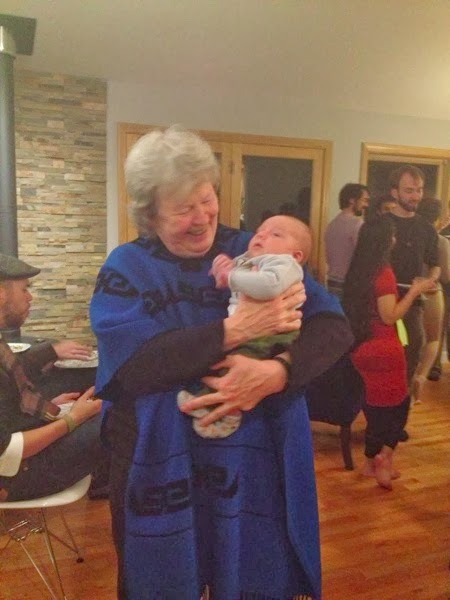
Saturday, October 26, was the annual department tasting party. This year, continuing the smashing success of last year’s party, the theme was apples and their products. In addition to such pomological achievements as the Golden Russet, the Fuji, the famed University of Minnesota Honeycrisp, and the sensational Winter Banana (all from UMass’s Cold Spring Orchard), there was a Bhatt-curated selection of hard ciders, fine cheeses, Rysling-shaken (Apple)Jack Rose cocktails, and apple-themed baked goods.
And there were characters.






21 October 2013
William Snyder speaks in Oiry/Johnson Seminar on Wednesday
William Snyder (UConn) will give a talk entitled "Evidence of parameter-setting in the acquisition of English particles and datives" in the seminar on Arguments and Acquisition that Magda Oiry and Kyle Johnson are conducting. His talk is on Wednesday, October 23, at 4PM in Dickinson 210. Everyone is welcome.
20 October 2013
Adam Albright gives colloq on Friday
Adam Albright (MIT) will give the department colloquium on Friday, October 25, in Machmer E-37 at 3:30. A title and abstract follow.
Modeling the acquisition of phonological alternations with learning biases
[joint work with Young Ah Do, Georgetown University]
What expectations do learners bring to the task of acquiring alternations? We provide evidence for three biases: (1) a bias against alternations, favoring uniform paradigms (McCarthy 1998); (2) a bias in favor of alternations that target broader classes of segments (Peperkamp et al. 2006); (3) a substantive bias against perceptually salient alternations (Steriade 2001).
Learners’ biases were probed using Artificial Grammar experiments, in which adult English speakers were taught singular~plural pairs in a “Martian language”, and were then asked to produce or rate plural forms. In the artificial language, obstruent-final stems exhibited either voicing alternations (dap~dabi) or continuancy alternations (brup~brufi), for both labial-final and coronal-final stems. By manipulating the frequency of labials vs. coronals, we were able to vary the amount of data concerning different segmental alternations. If learners are biased to expect non-alternation, then we expect fewer alternating responses for the rarer segment, and this is indeed what we observe: participants often produce non-alternating responses for the rarer segment, even though non-alternation was unattested in the training data.
By manipulating the relative proportion of voicing vs. continuancy alternations across the two places of articulation, we were able to pit frequency of segmental alternations (p~f > p~b) against feature-level frequency (voicing > continuancy). If learners expect alternations to target natural classes, rather than individual segments, then we expect subjects to prefer the alternation that is overall more frequent across both classes. In general, this is indeed what we find: subjects prefer to generalize the featurally more frequent alternation, even if it is less frequent for particular segment pairs. However, the effect of feature-level frequency differs significantly depending on the feature. Comparing across experiments, we find that subjects more readily extend voicing alternations across different places of articulation than continuancy alternations. We attribute this to a learning bias against certain featural alternations. Finally, we show how these relative preferences can be modeled using a regularized maximum entropy model of constraint weighting.
Phonology gurus arrive
Joe Pater writes:
In the first half of November we will have the great pleasure of having not only Elliott Moreton and Sharon Peperkamp visiting us as phonology gurus, but also Anne-Michelle Tessier in our midst as well. I'm writing now primarily to encourage people to get in touch with the three of them, whom I've cc'd, to set up meetings. Meeting with students is the primary function of a guru-ship, and Anne-Michelle has indicated that she'd also like to get (re-)acquainted with the current denizens of South College while she's here. Please visit their websites to find out about their research - I could never do justice to any one of them with a short blurb.
Peperkamp - 1st week of November - http://www.lscp.net/persons/peperkamp/
Moreton - 2nd week of November - http://www.unc.edu/~moreton/
Tessier - 1st 2 weeks of November - http://www.ualberta.ca/~annemich/
Sharon and Anne-Michelle will both be talking at Phonology 2013 November 9th and 10th (please register *today* if you haven't already), and Elliott will be giving a colloquium November 15th. There will also be further classes and PrG events that will be announced separately.
http://blogs.umass.edu/phonology-2013/
Acquisition Lab/LARC on Wednesday
Magda Oiry writes:
The acquisition lab / LARC meeting this Wednesday (Partee room 12:15 to 1:15) will be a "conference round-up" where we discuss ideas from the recent conferences we have been involved in: acquisition of quantification, Multiple grammars, Rio conference on recursion.
Everyone is welcome!
Call for Papers: Experiencers in Natural Language Semantics
Modeling experiencers in natural language semantics
January 13-16, 2014, Tezpur, Assam, India
Workshop hosted by the 5th Indian School on Logic and its Applications (ISLA 2014)
Webpage of the local organisation: http://www.tezu.ernet.in/isla2014/index.htm
Invited speakers
Eric McCready (Aoyama Gakuin University)
Brendan Gillon (Mc Gill)
Carla Umbach (Zentrum für Allgemeine Sprachwissenschaft)
Meeting description
There is a long-standing tradition of using logical and, more specifically, model-theoretic tools in the analysis of natural languages. Building on this tradition, our workshop aims at addressing one specific issue that has been the topic of discussion lately in the areas of formal semantics, applied logic, computational linguistics, and philosophy. The issue at stake is the notion of experiencer, across languages and across linguistic categories. For example, it is commonly assumed that in a sentence like "Deeti's performance astonished Raj", Raj occupies the role of the experiencer. One of the open questions currently under debate is whether this experiencer argument remains present in derived adjectives such as 'astonishing', as in "Deeti's performance was astonishing". Another open question is whether derived adjectives like 'astonishing' belong to the same semantic category as morpho-syntactically simple adjectives like 'nice' or 'great', which are commonly classified under the label of evaluative adjectives and have elicited a heated debate in semantics and in philosophy. Yet another question is the role of experiencers in other linguistic constructions such as, e.g., evidential markers (which do not exist in English but do e.g. In Japanese). In addressing these and other questions concerning experiencers, our workshop aims at reaching a better understanding of the nature of argument structure in natural language, which we take to be a key element in understanding the logical patterns that linguistic constructions give rise to, and in modeling the logic of natural language. Our interdisciplinary workshop will provide a platform for a fruitful exchange between those working in foundational areas in logic and those who are interested in the applications of logic to natural languages.
Call for Papers
We invite abstracts for 40-minute presentations (30 + 10) to be submitted by October 22 to both of the following addresses:
berit.gehrke@upf.edu
isidora.stojanovic@upf.edu
Please include your name, affiliation and the title of the abstract in the body of the e-mail. Abstracts should be anonymous and should not exceed 2 pages in length (A4 or letter-size), in 12 pt. font, with 1-inch/2,5-cm margins, including examples and references. The language of the submissions and the presentations will be English.
Important dates
October 22, 2013: Deadline for abstract submission
October 31, 2013: Notification of acceptance
January 5-17, 2014: ISLA 2014
January 13-16, 2014: Workshop dates
14 October 2013
Roberto Zavala Maldonado speaks on Friday
Roberto Zavala Maldonado, a linguist from CIESAS-Sureste, will give a talk entitled "Preferred Argument Structure in Chol (Mayan), an agentive language," at 3:30 on Friday, October 18 in Machmer E37. Professor Maldonado, an expert on Mayan and Mixe-Zoquean, languages will be here all week and is available for meetings. To make an appointment, get in touch with Rajesh Bhatt.
Rajesh Bhatt gives colloq talk at Michigan
Rajesh Bhatt presented joint work with Stefan Keine at a department colloquium at the University of Michigan on October 4. A talk and abstract follows.
An Argument for Semantically Contentful Head Movement
In this presentation we develop an argument that head movement may
have semantic effects and that it can hence not be a PF phenomenon.
The argument is based on novel facts regarding scope in infinitival
complementation structures in German. We show that every element
inside the infinitival clause must take scope over the matrix verb if
the embedded clause is a VP that remains in situ. If, by contrast, the
embedded clause is either a vP or a VP that undergoes movement, no
such wide scope is possible. We propose that wide scope of embedded
elements is the result of syntactic verb cluster formation: The
infinitival verb incorporates into the higher verb. To obtain the
observed scope facts, we suggest that the verb cluster is semantically
interpreted via Function Composition. Supplemented with standard
assumptions about the interpretation of movement, this account derives
the wide scope of material inside the embedded clause.
PhD position at Université Paris Diderot
PhD position at Université Paris Diderot: Verbal ellipsis in Portuguese and English
The Université Paris Diderot (Paris 7) is offering a fully funded three year PhD grant in linguistics on the topic of "Post-verbal ellipsis in Portuguese and English". Research is to be conducted at Paris Diderot, under the joint supervision of Philip Miller (Université Paris Diderot, Paris 7) and Sonia Cyrino (Unicamp, Universidade estadual de Campinas). The position is expected to open in January 2014, subject to final confirmation of funding, with a salary of at least 1400 euros per month. A detailed description of the project is included at the end of the document.
Qualifications
Candidates must have excellent command of Portuguese (Brazilian or European) and English. They must hold a master's degree in linguistics (or in a related field), and have research experience in one or more of the following specialties: syntax and semantics of Portuguese, syntax and semantics of English, ellipsis and anaphora, discourse pragmatics, corpus linguistics, psycholinguistics.
Application
Candidates should send a CV, a .pdf copy of their Master's thesis, a statement of interest, and the names of three references (with their contact information) to Philip Miller (philip.miller@univ-paris-diderot.fr) and Sonia Cyrino (cyrino@iel.unicamp.br) by October 27 2013.
NELS 44
This weekend, UConn, Storrs is hosting NELS 44, where the following members of the department will give posters.
Visiting professor Ilaria Frana will give a poster with UMass alumnus Kylito Rawlins entitled: `Mica' questions and bias.
Andrew Weir will give the poster "Fragment answers and the Question under Discussion."
Shayne Sloggett will give the poster "Case Licensing in processing: Evidence from German"
Alumna Junko Shimoyama will also give a talk with Alex Drummond entitled "QR as an agent of vehicle change: Evidence from Japanese and Hindi comparatives.
Bhatt/Keine get paper accepted to Linguistic Variation
Linguistic Variation has accepted for publication "Complete and Defective Agreement in Kutchi" by Rajesh Bhatt and Stefan Keine. Congratulations!
Japanese/Korean Linguistics 23
MIT is hosting the Twenty-Third meeting of the Japanese/Korean Linguistics conference. UMass alumna Junko Shimoyama is an invited speaker, and there are talks by alumni Chris Davis, Kiyomi Kusumoto, and Jennifer Smith. Go here for more information.
07 October 2013
Lap-Ching Keung on Wednesday
Lap-Ching Keung is giving a talk this week in our Brown Bag (Wednesday, Tobin 521B, 12-1:15). The title of his talk is "Effects of Discourse Status and Planning Difficulty on Acoustic Variation".
His abstract is:
Repeated words within a discourse tend to be acoustically reduced. This variation can be explained by a pragmatic selection rule (discourse status) or by speaker facilitation (planning difficulty). For this experiment, we ask whether these effects are part of the same cognitive system or different systems. Participants saw an array of four objects and described a sequence of two movements like, "The chiddle moved above the hamel. The *cammer moved above the neeken." The *target?s discourse status and planning difficulty were manipulated. Durations were longer for new vs. given and novel vs. familiar, which replicated findings from previous research. More importantly, at the target noun, there was a trend towards an interaction. Givenness had a greater effect on novel targets. Although not significant, onset latency patterned in the same way as target duration, showing a correlation between the two factors. These results together suggest that discourse status is partially mediated by planning difficulty, which further suggests that the two effects are operating from the same cognitive system.
Valentina Brunetto at LARC on Wednesday
Magda Oiry writes:
Valentina Brunetto a post-doc fellow from England and Italy will present
"Acquisition of near-reflexivity"
at the LARC meeting on Wednesday, October 9 at 12:15 in the Partee Room.
Everyone welcome!