In WHISC’s last issue, we neglected to include the talk given by Barbara Partee in our entry about UMass’s presence at the Linguistics Society of America’s meeting in Minneapolis. She was one of the presenters at the LSA’s 90th anniversary talks. Hers was entitled “Semantics and Pragmatics: then and Now.” The slides for her talk can be found here.
19 January 2014
Call for papers: Logic, Grammar and Meaning
The Logic, Grammar and Meaning conference will take place at the University of East Anglia on June 7-9. Keynote speakers include Angelika Kratzer and UMass alumnus Gennaro Chierchia.
The LGM conference brings together philosophers and linguists in order to investigate and promote fruitful interactions between logic and natural language. Our target audience consists of philosophers, logicians and linguists interested in the application of logic to natural language. We especially encourage graduate students and young researches to join in. We support the Gendered Conference Campaign.
Submission deadline: March 20, 2014
Notification of decisions: April 10, 2014
For more information, and instructions on submitting abstracts, go here.

Call for papers: Canadian Linguistic Association
The Canadian Linguistic Association will hold its 2014 conference as part of the Congress of the Humanities and Social Sciences at Brock University, St. Catharines, ON, from Saturday May 24 to Monday May 26, 2014. Members are invited to submit abstracts representing all areas of linguistics. Only members in good standing for 2014 may submit an abstract for the main session. (To become a member, you must subscribe to the Canadian Journal of Linguistics via the University of Toronto Press Web site.)
PLEASE NOTE: We strongly encourage all members, especially senior faculty, to submit poster abstracts.
ABSTRACTS ARE TO BE SUBMITTED ELECTRONICALLY, in .pdf format, through EasyAbstracts, at http://linguistlist.org/confcustom/aclcla2014.
Deadline: Saturday, February 1, 2014
For more information, go here.
Spring Colloq calendar announced
The schedule of department colloq talks for Spring 2014 has been released:
2/7 - Ev Federenko (Mass. General Hospital Department of Psychiatry [ICESL talk]
2/28 - Naomi Feldman (Maryland)
3/14 - Jason Merchant (Chicago)
3/28 - Gereon Müller (Leipzig) [Syntax Guru]
4/25 - Veneeta Dayal (Rutgers)
Erschler's entry in Oxford Bibliographies appears
David Erschler’s entry on Northeast Caucasian Languages has appeared in Oxford University Press’s online bibliographies series. Find it here.
WW II Trivia winners announced
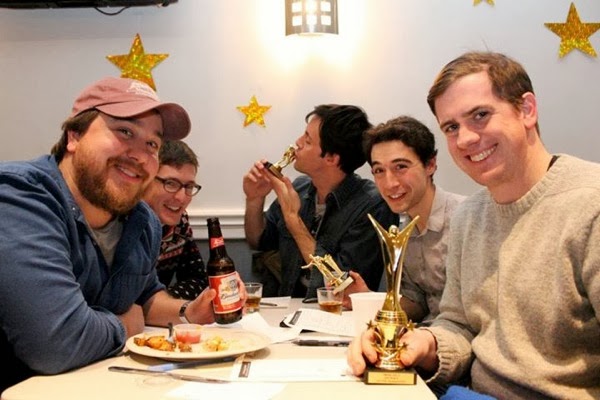
WHISC is proud to announce that local favorite “Oh! The Humanities” won three prizes at the World War II club trivia contest, including third place for the coveted “Worst Tiebreakers” trophy. Below is a picture of team members Erik Cheries (Psychology), Brian Dillon (Linguistics), Jeremy Hartman (Linguistics), Tom Maresca (Biology) and Brian McDermott (Journalism). (Picture courtesy of Northampton bureau chief Rajesh Bhatt.)
Johnson in Rome
Kyle Johnson will make a (short) presentation with Diane Lillo-Martin and Andrew Nevins on the structure of language at the 2014 Science Festival in Rome on Saturday, January 25. The Festival this year is devoted to linguistics and language, and will include talks by many well-known linguists, including Noam Chomsky who will also be the subject of an “opera” which is described thusly:
A talk-opera by Emanuele Casale for instrumental ensemble, voice, electronics and images Conversations with Chomsky is a musical opera featuring characters who “interpret” themselves, without acting a part, on a virtual stage – the video screen. Various characters follow and interact with one another at the threshold between reality and evocation: the linguist and activist Noam Chomsky, an internationally renowned scholar and professor at the M.I.T.; legendary names such as those of Margaret Thatcher, Milton Friedman, Ronald Reagan and Salvador Allende; and university students. Far from being a work of political propaganda, Conversations with Chomsky seeks to combine themes related to activism within an audiovisual framework vaguely inspired by melodrama. The central theme is the current contrast between two impulses found within individuals and societies: collectivism and mutual aid on the one hand, and competition and individualism on the other.
Check out the full schedule here.
CoLang 2014
CoLang 2014, the 2014 Institute on Collaborative Language Research (formerly InField) will occur in June and July 2014, hosted by The University of Texas at Arlington, with Dr. Colleen Fitzgerald as Director. CoLang 2014 is funded by a National Science Foundation grant, BCS#263939 and by various units at UT Arlington. The theme of CoLang 2014 is Native American languages, but participants and instructors from countries all over the world are expected to attend.
CoLang offers an opportunity for undergraduate and graduate students, practicing linguists, and indigenous community members to develop and refine skills and approaches to language documentation and revitalization. The Institute is designed to provide an opportunity for a diverse range of participants to become trained in a wide range of skills in community-centered language documentation.
For more information, including the costs and how to enroll, go here.
13 January 2014
UMass at LSA
The 88th annual meeting of the Linguistic Society of America was held January 2-5 in Minneapolis, Minnesota. UMass was well-represented, with the following presentations given by current UMass residents:
Yangsook Park
"Different Monsters for Person and Adverbial Indexicals in Korean"
Brian Smith
"Rhythmic conditioning of ‘-licious' in English"
Yelena Fainleib
"Lexical Distributions and Productive Generalizations of Stress in Modern Hebrew nouns"
Kristine Yu (with Sameer ud Dowla Khan)
"Intonational phonology in infant-directed speech"
Lisa Green (with introduction by Tom Roeper)
"Diversity in Linguistics"
and the following UMass alumni also presenting:
Emily Elfner (McGill)
"Prosodic boundary strength in verb-initial structures: Evidence from English and Irish"
Jill Beckman (University of Iowa)
"Speaking Rate effects on VOT in German Stops: Phonological Implications"
Tohru Noguchi (Ochanomizu University)
"Reflexive Verb Constructions in Japanese"
Kyle Rawlins (Johns Hopkins)
"iPython Lambda Notebook: a system for digital fragments in semantics"
Ana Arregui (with Maria Luisa Rivero and Andres Salanova, all from University of Ottawa)
"Aspect and tense in evidentials"
Janet Randall (with Lucas Graf, both at Northwestern University)
"Linguistics meets 'legalese': syntax, semantics and jury instruction reform"
Partee wins trivia prize at LSA meeting
Barbara Partee writes:
The LSA meeting in Minneapolis featured some events commemorating the 90th anniversary of the LSA, including two days of short talks contrasting the state of things in 1924 and 2014 in the different subfields, and of the LSA itself, and women in linguistics, and other related topics, all interesting. And there was a video compiled by Dennis Preston from materials sent in response to a year-long appeal (including a number of photos from the 1974 Linguistic Institute at UMass Amherst), which ended with a quiz: photos (many of them cryptic in one way or another) and clues about 10 linguists, and we were all invited to submit entries. There was also a “tie-breaker” photo with two guys in T-shirts, one with an undecipherable autograph, one with something written in some non-English language. It turned out that I won, to my great surprise. I guess I’m now a certified “old guy”, because I think you had to be. I was one of two to get 7 right, and I got the first three words on the t-shirt (I didn’t know the language, but it was something Scandinavian, and I deciphered “I have not ….” (turned out to be Icelandic, and to say ‘I have no idea what this T-shirt says’.) My prize: free registration for next year’s LSA, in San Francisco – so maybe I’ll go!
From the WHISC editor:
You can see the LSA’s 90th anniversary video presentation here. There is a section that includes the artistic accomplishments of several notable linguists — be sure to check out Emmon Bach’s poem and Barbara’s photography, as well as the contest that Barbara describes above.
Workshop on Gradability and Quantity
MIT and McGill University will sponsor a Workshop on Gradability and Quantity in Language and Brain. The workshop is hosted by MIT on January 31 and February 1. UMass alumni Irene Heim, Roger Schwarzschild and Bernhard Schwarz will be giving presentations, as will UMass syntax guru, Roumyana Pancheva. For a full schedule, go here.
Call for Applications: Summer School on Mathematical Philosophy for Women
Sponsored by the Munich Center for Mathematical Philosophy
The summer school is open to women with a keen interest in mathematical philosophy. Applicants should be female students of philosophy, or philosophically minded logicians, mathematicians, or scientists at an advanced undergraduate level, in a master program, or at an early PhD level. To apply for participation, please send a cover letter (including a statement of motivation) and your CV (ideally everything in one pdf file) to mathsummer2014@lrz.uni-muenchen.de. A separate letter of recommendation should be sent to the same address. Please indicate in your cover letter if you wish to present your own project. The deadline for applications is February 15, 2014. Decisions will be made by March 1, 2014. The participation fee is 200€. The language of all events will be English.
06 January 2014
Post Doc at ZAS in Berlin
The Center for General Linguistics (ZAS) in Berlin, Germany has an opening starting flexibly between April 1st, 2014 and September 1st, 2014 pending final approval of funding for one postdoctoral researcher. The position is in the SSI project within the XPrag.de program (www.zas.gwz-berlin.de/xpragde.html). The advertised position is limited to one year initially with a possibility of extension. The appointment would be made at the German government pay-scale for a postdoc (about 45.000 EUR/year before tax).
The SSI project:
Scalar inferences have been shown to differ in strength. As an example, consider the contrast between the cardinal numerals "three" and the quantifier "some": the scalar inference from "three" to "not four" is felt to be stronger than that from "some" to "not all" in some cases. Four diagnostics of strength corroborating this contrast are the following: 1) The stronger inference of the cardinal is more difficult to cancel, 2) easier to embed, 3) acquired earlier by children, and 4) accessed faster and more easily in online language processing. Several researchers have therefore claimed that cardinals like "three" must receive a fundamentally different analysis from other scalars. However, disjunction also exhibits a strength difference: "either A or B" is intuitively felt to more strongly exclude the truth of both A and B than a bare disjunction "A or B" does. Most proposals for cardinals cannot be extended to "either-or" As far as we know, there has been no general discussion of strength of scalar inferences within pragmatic theory despite numerous individual observations.
The goal of this project is to develop a theory of the strength of scalar inferences that extends beyond cardinals. Our empirical basis is a detailed investigation of the four diagnostic mentioned above for the pair of "or" and "either-or". In addition to offline judgment tasks, we gather data from language acquisition and online language processing using self-paced reading, eye-tracking and mouse-tracking. Furthermore we engage language comparisons between German and Japanese since in several respects our experimental tests are easier to apply in Japanese. Within pragmatic theory, our goal is to develop a uniform theory of strength. In particular, we test the hypotheses that obligatory activation of alternatives within the grammatical analysis of implicatures underlies at least the two core cases of scalar inference strength.
The XPrag.de program is a national priority program (SPP 1727) funded by the German Research Council DFG. The overall goal of XPrag.de is to develop a precise pragmatic theory that is informed by evidence using experimental methods. Within the XPrag.de program additional possibilities for Postdoc career development such as training schools, funding for workshops and scientific exchanges are available.
Desirable skills include the following:
- broad general background in linguistics including syntax, Japanese and German linguistics
- advanced knowledge / own research in formal pragmatics and semantics
- familiarity with current research on implicatures
- experimental skills in language acquisition and processing
- experience with self-directed project work in experimental linguistics
- interest to contribute to broader research agendas of ZAS and XPrag.de
For further information regarding this position please contact
Uli Sauerland <uli@alum.mit.edu>.
Review of applications will start February 1st, 2014 and continue until the position is filled.
Applications should include the following information:
- cover letter indicated the desired starting date
- curriculum vitae
- samples of prior published research
- names and email addresses of three people that can be contacted for recommendation letters
(but please do not send letters at this point)
Please send your applications electronically to uli@alum.mit.edu.
Applications can also be send by mail to the address below.
Uli Sauerland
Zentrum für Allgemeine Sprachwissenschaft
Schützenstr. 18
10117 Berlin
Germany
Pater in Southern California
Joe Pater will be giving a colloquium talk at UCLA Friday January 10th entitled "Structural bias in phonology". It presents joint work with Claire Moore-Cantwell, Elliott Moreton, Katya Pertsova, Lisa Sanders, Robert Staubs, and Ben Zobel – an abstract is available here:
http://blogs.umass.edu/pater/files/2014/01/pater-ucla-colloq-abstract-2014.pdf
Second Call: Conference on Formal Grammar
The 19th Conference on Formal Grammar
Tuebingen, Germany, August 16-17 2014
Collocated with the European Summer School in Logic, Language and Information
Background
FG-2014 is the 19th conference on Formal Grammar, to be held in conjunction with the European Summer School in Logic, Language and Information, which takes place in 2014 in Tuebingen, Germany.
Previous Formal Grammar meetings were held in Barcelona (1995), Prague (1996), Aix-en-Provence (1997), Saarbruecken (1998), Utrecht (1999), Helsinki (2001), Trento (2002), Vienna (2003), Nancy (2004), Edinburgh (2005), Malaga (2006), Dublin (2007), Hamburg (2008), Bordeaux (2009), Copenhagen (2010), Ljubljana (2011), Opole (2012) and Duesseldorf (2013).
Aims and Scope
FG provides a forum for the presentation of new and original research on formal grammar, mathematical linguistics and the application of formal and mathematical methods to the study of natural language. Themes of interest include, but are not limited to,
* formal and computational phonology, morphology, syntax, semantics and pragmatics;
* model-theoretic and proof-theoretic methods in linguistics;
* logical aspects of linguistic structure;
* constraint-based and resource-sensitive approaches to grammar;
* learnability of formal grammar;
* integration of stochastic and symbolic models of grammar;
* foundational, methodological and architectural issues in grammar and linguistics;
* mathematical foundations of statistical approaches to linguistic analysis.
Previous conferences in this series have welcomed papers from a wide variety of frameworks.
Submission Details
We invite **electronic** submissions of original, 16-page papers (including references and possible technical appendices). Authors are encouraged to use the Springer-Verlag LNCS style.
The submission deadline is **February 23 2014**. Papers must be submitted electronically at https://www.easychair.org/conferences/?conf=fg2014
Papers should report original work which was not presented in other conferences. However, simultaneous submission is allowed, provided that the authors indicate other conferences to which the work was submitted in a footnote. Note that accepted papers can only be presented in one of the venues.
Submissions will be reviewed anonymously by at least three reviewers. Accepted papers will be published as a volume in the Springer LNCS series, under the FoLLI subline, either separately or jointly with the papers from FG-2015, depending on the number of accepted papers.
Important Dates
* February 23, 2014: Deadline for paper submission
* April 20, 2014: Notification of acceptance
* June 1, 2014: Camera ready copies due
* August 16-17, 2014: Conference dates
30 December 2013
One year position at Boston University
Carol Neidle writes:
What we got for Christmas was approval to advertise for a 1-year replacement position (VISITING ASSISTANT PROFESSOR) in SYNTAX for AY 2014-15. We'll advertise in the usual places, but please help spread the word, especially to prospective candidates who plan to attend the LSA meetings in January. Go here for details.
University of Rochester's linguistics and cognitive sciences program
Jeff Runner writes:
The department of Brain & Cognitive Sciences and the department of Linguistics at the University of Rochester invite applications from students interested in pursuing a joint PhD in Brain & Cognitive Sciences and Linguistics. The department of Linguistics (http://www.ling.rochester.edu/) combines strengths in formal linguistics--syntax, semantics, pragmatics, phonetics and phonology--with experimental and empirical methodologies. The department of Brain and Cognitive Sciences combines strengths in language research--language processing, language acquisition, brain and language--with vision, and neuroscience, which includes computational neuroscience, learning and plasticity. The language researchers in these departments--along with those in Computer Science--constitute Rochester's Center for Language Sciences. This year we are particularly interested in applicants who want to investigate the formal syntactic and semantic properties of language structure using experimental and empirical techniques. Students interested in the joint Brain & Cognitive Sciences/Linguistics PhD program should apply through the Brain & Cognitive Sciences department as soon as possible, and no later January 15, 2014. Please mention in your application your interest in pursuing the joint degree with Linguistics. For further information contact Jeff Runner (jeffrey.runner@rochester.edu).
Call for papers: SPE 7
The 7th Colloquium Semantics and Philosophy in Europe – SPE 7 – will be hosted by the Zentrum für Allgemeine Sprachwissenschaft (ZAS) in Berlin in cooperation with the Institut für Philosophie and the Institut für deutsche Sprache und Linguistik at Humboldt University Berlin
Place: Zentrum für Allgemeine Sprachwissenschaft, Berlin
Date: June 26-28 , 2014 (conference), June 25, 2014 (tutorials)
Web: www.zas.gwz-berlin.de/fileadmin/spe7
We invite submissions for the general session and the special sessions for 45 minute presentations (incl. discussion) or posters Please visit the SPE7 web pages for details.
The submission deadline is 1. February 2014. We expect to make notifications of acceptance in the beginning of March.
25 December 2013
Call for Papers: Models in formal Semantics and Pragmatics
August 18-22, Tuebingen, Germany
Organizers:
* Magdalena Kaufmann, University of Connecticut
* Stefan Kaufmann, University of Connecticut
Invited Speakers:
* Michael Glanzberg, Northwestern University
* Stanley Peters, Stanford University
* Thomas Ede Zimmermann, Frankfurt University
Workshop Information:
Whatever happened to "model-theoretic" semantics? Since Montague’s groundbreaking work and throughout much of its history, the field of formal semantics (and later pragmatics) was characterized by the use of models - abstract mathematical structures in which linguistic expressions are interpreted and which serve as the backdrop for stating generalizations about their semantic properties and relations.
Over the last couple of decades, however, the once-prominent status of models has been eroding. In the research literature, explicitly defined fragments and models were the norm in the early days (Partee 1975, 1976; Dowty, 1979), but are now the exception rather than the rule. In teaching, one of the most widely used textbooks, Heim and Kratzer (1998), makes no mention of models, in stark contrast with early standard works like Dowty, Wall and Peters (1981). Aside from such signs of waning interest, there is a small but formidable body of work which actively questions the status of models and finds them to be of limited use at best (Lepore 1983; Higginbotham 1988; Zimmermann 1999, 2011; Glanzberg, t.a.).
Such explicit reflections are rare, however. The overall decline of models in the field is not driven by a general debate, let alone consensus. Nor is the turn away from models a turn towards some non-model-theoretic alternative. What we do see instead is a tendency to stay loosely within the model-theoretic framework, but to enrich it with notions and tools whose formal properties remain largely implicit.
The goal of this workshop is to promote and generate discussion of the past, present, and future of models in natural-language semantics and pragmatics, specifically the implications of their apparent demise for the foundations and goals of the field. Topics for discussion include, but are in no way limited to the following:
* What are models, anyway? Commitments about language, reality, and the nature of meaning that a model-theoretic approach to semantic analysis implies. The (special?) status of possible worlds and their relationship to extensional models.
* What are models good for? Linguistic phenomena or aspects of meaning n whose analysis a model-theoretic approach has been, or would be, crucial or at least beneficial. The (potential) use of models in treating meaning as variable (e.g., in the analysis of uncertainty about language, or in cross-linguistic and diachronic comparative semantics).
* Where do models get in the way? Desiderata for semantic theory and limitations of the model-theoretic approach. Risks and side effects of specific methods associated with the model-theoretic approach (e.g., meaning postulates).
* Are we safe without models? Advantages and potential pitfalls of innovative uses of formal techniques or metalinguistic expressions, whose repercussions are underexplored (various kinds of states and events, partial functions, etc.)
* What are the alternatives?
Workshop Format:
The workshop is part of ESSLLI and open to all ESSLLI participants. It will consist of five 90-minute sessions held over five consecutive days in the second week of ESSLLI. The three invited talks are allotted one hour each, including discussion. On the first day, the workshop organizers will give a 30-minute introduction to the topic. This leaves room for eight submitted papers of 30 minutes each, including discussion.
Submission Procedure:
Authors are invited to submit an abstract of up to three pages, including examples and/or references (single-spaced, at least 11pt font, on US letter of A4 paper with margins at least 1in or 2.5cm on all sides, in .pdf, .txt, .doc or .odt format). Abstracts must be submitted by February 15, 2014, electronically at the following address:
http://linguistlist.org/easyabs/Models_ESSLLI14
Review:
Abstracts will be reviewed by members of the program committee and, where appropriate, outside reviewers. Reviewing will be anonymous unless authors include self-identifying information in their abstracts. Decisions will be made by the program committee and announced to authors on April 15, 2014.
Important Dates:
* Feb 15, 2014: Submission deadline
* Apr 15, 2014: Notification of acceptance
* Jun 15, 2014: End of ESSLLI early registration period
* Aug 18-22, 2014: Workshop
Contact Information:
COLANG 2014 at UT, Arlington
Colleen M. Fitzgerald writes:
I am writing you to ask for your help and support for CoLang 2014: the Institute on Collaborative Language Research, taking place at The University of Texas at Arlington in June and July 2014. CoLang (previously known as InField) allows students and faculty to acquire or refine cutting edge skills in language documentation, revitalization and field linguistics, to network with established international experts in these areas, and to gain hands-on experience in working with endangered and underdescribed language communities through field methods offerings. An exciting development this year is our partnership with the Linguistic Society of America. Part of this co-sponsorship includes LSA scholarships to CoLang 2014, creating expanded opportunities for academic training in language documentation and field linguistics for faculty and students, including undergraduates.
As we continue our planning and advertising for the upcoming summer, I'd like to ask your help in raising awareness of CoLang 2014 and in supporting the LSA and its commitment to endangered language documentation and revitalization. I will be holding office hours at the LSA on January 3rd and 4th, where we will have fliers and posters for you to take home to your university. I will be available to answer any questions that you or your faculty or students might have about attending CoLang. The two-week session, from June 16-27, 2014 consists of workshops in aspects of language documentation and revitalization and it costs $1450, which covers registration, room and board. Many attendees stay on for an additional four-weeks, which includes enrollment in a four-week field methods class, as well as the two weeks of workshops. Costs for the entire six-week session is $4300 (registration, room and board). The field methods classes give participants a firsthand experience in working with speakers of an endangered language to document and analyze the language. With three to four field methods classes scheduled, CoLang 2014 will be able to serve a large number of interested participants. This year, for the first time, we plan to offer a Spanish-medium field methods class featuring a language of Mexico.
The CoLang website is up at here and we expect registration to open soon. Online scholarship applications from the Linguistic Society of America and for CoLang 2014 internal scholarships will shortly be available; the due date for consideration for both is February 17, 2014. Full scholarship information and updates as they occur are here.
We hope that you will join our many sponsors, including the National Science Foundation, the Linguistic Society of America, the Endangered Language Fund, and The University of Texas at Arlington, in making CoLang 2014 a significant step in the documentation of our vanishing linguistic heritage, a valuable training ground for emerging linguists to acquire documentation, revitalization, and field linguistics skills, and a place where established linguists can expand their repertoire or retool for their next research projects.
Subscribe to:
Posts (Atom)