10 April 2016

Call for papers: NELS

UMass is hosting the Forty Seventh annual meeting of the North East Linguistic Society in early October, 2016. Invited speakers are Klaus Abels, Cleo Condoravdi, Roumyana Pancheva and our own Gaja Jarosz. There are two special sessions: one on linearization of syntactic structures and one on grammatical illusions at the grammar-processing interface. Deadline for abstracts is the last minute of June 15.

For more information, go here.

Brian Smith goes to Santa Cruz

WHISC is happy to announce that Brian Smith has accepted a one-year position at the University of California at Santa Cruz. Congratulations Brian!

Call for papers: XI Workshop on Formal Linguistics

We are pleased to announce the XI Workshop on Formal Linguistics, to be held on November 9, 10 and 11, 2016, at Universidade Federal do Paraná (UFPR) in Curitiba, Brazil. The Workshop welcomes papers on any topic concerning formal accounts to meaning and structure with relevance to linguistic theory, and which explores either core aspects of grammar or some interface phenomena (syntax-semantic, syntax-prosody, morpho-syntax, morpho-phonology, semantics-pragmatics, lexical semantics, language acquisition, language change).

Invited Speakers

Susan Rothstein – Bar-Ilan University
Jenny Doetjes – University of Leiden
Virgina Hill – University of New Brunswick
Suzi Lima – Universidade Federal do Rio de Janeiro

http://sites.google.com/site/workshopformallinguistics/

CALL FOR PAPERS

We invite abstract submissions for the Workshop for 20-minute talks (plus 10 minutes for discussion) and/or posters (posters should measure approx. 3ft x 4ft or 90cm x 120cm) on any aspect of the topics of the Conference.

All abstracts should be written in English and anonymous, no more than two pages in length (including examples and references), font Times New Roman, in 12-point font, 8.5x11-inch page setup (= US Letter), with 1-inch margins. Submissions are limited to one individual and one joint abstract per author.
When you submit your abstract please indicate whether you would like it to be considered (i) for a talk only; (ii) for a talk or a poster; or (iii) for a poster only.

SUBMISSION DEADLINE: June 15th, 2016

NOTIFICATION OF ACCEPTANCE: by July

To submit an abstract, go to:
https://easychair.org/conferences/?conf=wfl2016

UMass at ECO 5

MIT is hosting the Graduate Student Workshop this Saturday, April 16, from 9:15 to dinner. UMass is represented by:

Deniz Ozyildiz who is giving the talk “Factivity alternates, at least in Turkish."

Nadine Balbach, Jeremy Hartman and Tom Roeper, who are giving the talk “Everyone but me — Children Acquiring the different notions of `but’ in Quantified Sentences."

Polina Berezovskaya will present the talk “Processing Ambiguous Degree Constructions Cross-Linguistically"

For more information, including a schedule and how to register, go here.

Stefan Keine goes to USC

Congratulations to Stefan Keine who has accepted an offer from the linguistics department at the University of Southern California!

Two Talks by Zsofia Zvolensky

Zsofia Zvolensky will be giving two talks this week. The first is Wednesday, April 20, at 4:30 in 216 Skinner Hall at Mount Holyoke College. The title of that talk is “Authors Creating Fictional Characters, Either Intentionally or Inadvertently.” The second talk is at UMass on Friday, April 22, at 3:30 in Bartlett 201. The title of that talk is “A Common Problem for Possible-Worlds Analyses of Deontic and Fictional Discourse."

Linguistics Scholarship winners

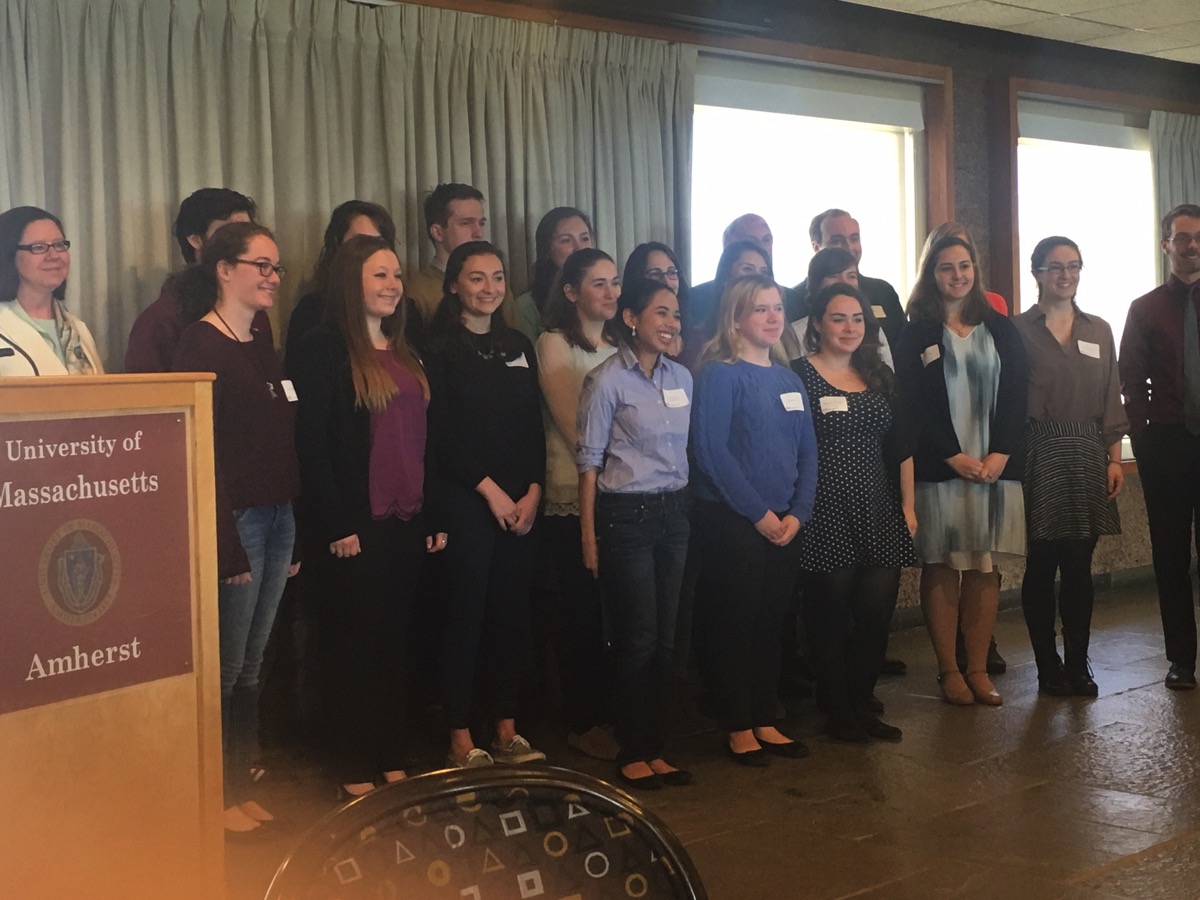
Linguistics majors Megan Shelb, Abigail Williams, Valerie Higgins and Joanna Nevins were awarded scholarships this year by the college of Humanities and Fine Arts. This Saturday, April 16, there was an awards brunch honoring these, and other, students. Below is a picture of all the honorees featuring Joanna and Megan at the far left of the first row. Congratulations!

IMG 0566

Call for papers: Situations, Information, and Semantic Content

Full Title: Situations, Information, and Semantic Content 

Date: 16-Dec-2016 - 18-Dec-2016 

Location: Munich, Bavaria, Germany Contact Person: Kristina

Web Site: http://www.situatedcontent2016.philosophie.uni-muenchen.de 

Call Deadline: 29-May-2016

Backgrounds, Aim, and Scope: 

The semantic content of natural language is multiply situated: Whether an utterance receives one interpretation or another depends on the discourse situation (in which the utterance takes place), on the target situation (which is described by the utterance), and on the interpreting agents' informational situation (which also contains the agents' background knowledge). Over the past decades, work on extralinguistic context-dependence has focused on discourse situations and target situations, and has paid less attention to the dependence of interpretation on the agents' informational situation. However, this kind of information-dependence plays a crucial role in the explanation of a number of semantic phenomena, including the behavior of epistemic/deontic modals and propositional attitude-sentences. Recent research in situated cognition has suggested an even more general scope of semantic information-dependence. The latter assumes that cognition (and therefore, all linguistic understanding) is fundamentally embedded in the situational context of the cognition. 
This workshop aims to bring together linguists, philosophers, logicians, and cognitive and computer scientists to discuss the information-dependence of the semantic content of natural language. It covers all aspects of the interaction between situations, information, and semantic content -- both theoretical and experimental --, including 

- agents' information and semantic content 

- the scope of information-dependence in natural language 

- analyses of semantic phenomena featuring information-dependence 

- experiments on semantic information-dependence 

- the impact of agents' information on attitude attributions - semantic aspects of situated cognition 

- situation theory and situation semantics 

- data semantics and dynamic/update semantics 

- (partial) information and situations 

- the formal analysis of (informational) situations 

- the formal analysis of background knowledge 

- partiality of information - type-theoretic approaches to information 

Invited Speakers: 

- Robin Cooper (University of Gothenburg) 

- Nikola Kompa (Osnabrück University) 

- Roussanka Loukanova (Stockholm University) 

- Friedrike Moltmann (CNRS Paris, New York University) 

- Floris Roelofsen (University of Amsterdam/ILLC) 

- Markus Werning (Ruhr University Bochum) 

- Thomas Ede Zimmermann (Goethe University of Frankfurt) 

- more speakers to be confirmed 

UMass at UUSLAW

The University of Connecticut is hosting the Conn-Umass-Smith Language Acquisition Workshop (UUSLAW) today, April 17, and UMass is represented by Nadine Balbach who is giving the talk “ `Everyone but me’ — Children Acquiring the Different Notions of but in Quantified Sentences” and by Tracy Conner who is giving the talk “Acquiring Ellipsis."

Bhatt at UPenn

Rajesh Bhatt is giving an invited colloquium talk on April 14 at the University of Pennsylvania. The title of his talk, which reports on joint work with Vincent Homer, is “PPIs and Movement in Hindi-Urdu.” An abstract follows.

Typically, Positive Polarity Items (PPIs), e.g. `would rather', cannot be interpreted in the scope of a clausemate negation (barring rescuing or shielding) (Baker 1970, van der Wouden 1997, Szabolcsi 2004 a.o.):

1a. John would rather leave.

1b. *John wouldn't rather leave.

The scope of most of them is uniquely determined by their surface position. But PPI indefinites are special: they can surface undernegation and yet yield a grammatical sentence under a wide scope interpretation:

2. John didn't understand something.ok: SOME > NEG;*NEG > SOME

Here we address the question of the mechanism through which a   PPI ofthe `some' type  takes wide scope out of an anti-licensingconfiguration. One possibility is (covert) movement, another is mechanisms that allow indefinites to take (island-violating) ultra-wide scope such as choice functions (Reinhart 1997). The relevant configurations that have motivated choice functions for other languages can be set up for Hindi-Urdu too.

We can therefore assume that a device that generates wide-scope for indefinites without movement is available in Hindi-Urdu too. We show that in Hindi-Urdu at least,  this device is unable to salvage PPIs in the relevant configuration. Only good old fashioned overt movement does the needful. If we think of overt movement in Hindi-Urdu as being the analogue of covert movement elsewhere, then the Hindi-Urdu facts are an argument that it is movement, albeit covert, that salvages PP Is in English too, not alternative scope-shifting devices. We explore whether the conclusion from Hindi-Urdu does in fact extend to English.

Dillon at Northwestern

Brian Dillon gave a colloquium talk at Northwestern University on Friday, April 8. A title and abstract follow.

Grammatical illusions in sentence processing: At the interface of performance and competence

One question of interest for psycholinguists is the question of how closely real-time sentence processing routines align with grammatical knowledge: does the competence grammar directly constrain sentence comprehension, or does it play a secondary role, 'cleaning up' the results of a comprehension process driven by heuristic processes (e.g. Lewis & Phillips, 2015; Patson & Ferreira, 2007; Townsend & Bever, 2001)? Much experimental work has provided evidence for the view that the human sentence processor is fairly directly constrained by grammatical knowledge even at the earliest stages of analysis, suggesting a very tight link between grammatical knowledge and the sentence processor. However, a puzzle for this view is the observation that there are many apparently simple grammatical constraints, such as subject-verb agreement, that comprehenders seem unable to accurately apply during comprehension (e.g. Wagers, Lau & Phillips, 2009). Such 'grammatical illusions' have been accounted for by appealing to independently motivated aspects of the parser, such as an interference-prone working memory architecture (Phillips, Lau & Wagers, 2011; see also Frazier, 2015).

Research on grammatical illusions has generated a wealth of psycholinguistic data that bears on when, and how, grammatical constraints guide the analysis of linguistic input. Overall the data reveal a pattern of 'selective fallibility': some linguistic dependencies fall prey to grammatical illusions quite readily, others do not (Phillips et al, 2011). This leads to an important theoretical question which is the focus of my talk: when, and why, do comprehenders violate grammatical constraints during sentence comprehension? In this talk, I will review some of the work in this area, and discuss processing models that have been proposed to account for these processor-grammar divergences. I will then discuss two case studies from our group at UMass Amherst on the processing of reflexive binding dependencies (work with Shayne Sloggett) and the licensing of negative polarity items in comprehension (work with Jon Ander Mendia and Ethan Poole) that provide new insight into the factors that create grammatical illusions in comprehension. These studies suggest that some grammatical illusions actually have grammatical bases, reflecting 'subgrammatical' linguistic constraints. This study suggests that grammaticality illusions are no mere performance errors; instead, they are regular and predictable behavior that provides a unique window into normal grammatical mechanisms and normal processing mechanisms alike.

03 April 2016

Kathryn Davidson gives department colloq

Kathryn Davidson (Harvard) will give the department colloquium on Friday, April 8 at 3:30 in ILC N400. A title and abstract of her talk follow.

Title:
Combining imagistic and discrete components in a single proposition: The case of sign language classifier predicates

Abstract:
Classifier predicates in sign languages (also known as "depicting verbs") have both discrete and imagistic components: they participate fully in the grammar as verbs and involve categorical handshapes that agree with the subject, but also have an obligatory "gestural" component that psycholinguistic experiments have shown are interpreted in an analog and iconic way. Understanding how to treat these verbs in a formal semantic system is therefore a challenge. In this talk I will draw parallels with work on quotation and attitude reports to introduce an analysis of classifier predicates involving the notion of an iconic "demonstration of events". I will also present corpus data from bimodal (sign/speech) bilingual blended utterances that sheds light on the syntax/semantics of classifier predicates. Finally, I will discuss extensions of this analysis of classifier predicates to formal semantic analyses of gesture.

Saskia Ottschofski speaks at LARC

Saskia Ottschofski (University of Tübingen) will give a talk presenting work she is carrying out while visiting the University of Maryland at LARC this week. Her talk is entitled “Can acquisitional data give insights into the semantics of pronouns and definites?” LARC meets in ILC N451 at 12:20 Wednesday, April 6.

UMass at GLOW

The 39th annual meeting of the Generative Linguistics in the Old World is being hosted by the University of Göttingen April 5-8. UMass is represented by:

Sakshi Bhatia, Leland Kusmer and Ekaterina Vostrikova who are presenting the paper “Indirect interaction of person and number"

Ethan Poole who is presenting the paper “The locality of dependent case."

Jeremy Pasquereau who is presenting the paper “Overt movement of comparative quantifiers in European French."

alumnus Keir Moulton, with Nino Grillo, who is presenting the paper “Clausal determiners and long distance AGREE in Italian."

Jon Ander Mendia who is presenting the paper “Conventionalizing at least some determiners."

Stefan Keine, Jon Ander Mendia and Ethan Poole who are presenting the paper “It’s tough to reconstruct"

You can learn more about GLOW here.

UMass at phoNE

NYU is hosting phoNE this Saturday, April 9. UMass is represented by Deniz Ozyildiz and Alexei Nazarov who are giving talks. A complete schedule follows.

Saturday, April 9

11:30-12      Luca Iacaponi (Rutgers): Non-stringent markednessrelations: evidence from Consonant Harmony

12-12:30      Chris Geissler (Yale): Explaining Vowel Harmony in Lhasa Tibetan

12:30-1:30   lunch

1:30-2           Deniz Ozyildiz (UMass)

2-2:30           James Whang (NYU)

2:30-2:50      break

2:50-3:20       Juliet Stanton (MIT): Trigger deletion in Gurindji

3:20-3:50       Gašper Beguš (Harvard) Unnatural phenomena and gradient phonotactics

3:50-4:10       break

4:10-4:40       Shu-hao Shih (Rutgers)

4:40-5:10       Alexei Nazarov (UMass)

5:10-5:30       break

5:30-6            Erin Olsen (MIT)

6                business meeting

The conference takes place on the first floor of the Linguistics Department, which is at 10 Washington Place in Manhattan.

LinguistList Fund Drive!

Barbara Partee writes:

The Linguist List fund drive for 2016 has begun.

http://funddrive.linguistlist.org/         

Linguist List has great value for everyone, but it's easy to take it for granted, like Wikipedia (which also needs support.) The second "Linguist of the Day" this year is Gary Holton (http://funddrive.linguistlist.org/linguists/) of the University of Alaska, one of whose main specializations is language documentation. He tells on his post there how crucial Linguist List has been in getting the linguistic community together to develop best practices for fieldwork, documentation, archiving, etc, often in cooperation with NSF and other entities. There's one good reason right there.     

Linguist List also revolutionized the whole business of job postings and job searches. We used to have to submit a job description to a print journal and/or the LSA Bulletin and/or some MLA publication, I forget what, with a tight deadlines followed by a long wait before the announcement appeared, and it was all very cumbersome and awkward.     

And of course the calls for papers for conferences etc -- now they reach linguists everywhere, getting rid of the unintentional but inevitable discrimination that resulted from the fact that conference organizers were dependent on the mailing lists they had, and those often didn't reach many independent scholars or scholars at small schools or scholars abroad. Now if you have access to internet you have access to all that information, thanks to the fact that Linguist List is the recognized clearing house that everyone will send their conference information to.   

And on an on -- Linguist List is probably of value to you in more ways than you've ever realized, especially if you're of a young enough generation that it has always been there, as far as you've been aware.     

They've been through a labor-intensive transition period the last couple of years, changing leadership as Helen Aristar-Dry and Anthony Aristar retired and Damir and Malgorzata Cavar took the helm, and the whole operation moved from Eastern Michigan University to the University of Indiana. They had to skip the fund drive the first year of the transition because they had no time or staff to mount one. They did have one last year and were moderately successful. But they really really need our help this year. All the funds that are raised go to supporting graduate students who help keep Linguist List running. The goal this year is $79,000, and they really need to reach it.     

As usual, there are various challenges. Right now, with things just starting up, UMass Amherst happens to be tied for third in the university challenge -- but that could change fast, since we're third at a total of $300 with just 2 donors. (http://funddrive.linguistlist.org/university/) But if lots of us would jump in quick with whatever gift we can afford, I hope we can at least stay in a good respectable top 10% or so.     

http://funddrive.linguistlist.org/donate/

Call for papers: DSALT

DSALT: Distributional Semantics and Linguistic Theory

ESSLLI 2016 Workshop

15-19 August 2016, Bolzano, Italy

* Two-page abstract submission deadline: April 7 2016 *

URL: http://esslli2016.unibz.it/?page_id=256

WORKSHOP DESCRIPTION

The DSALT workshop seeks to foster discussion at the intersection of distributional semantics and various subfields of theoretical linguistics, with the goal of boosting the impact of distributional semantics on linguistic research beyond lexical semantic phenomena, as well as broadening the empirical basis and theoretical tools used in linguistics. We welcome contributions regarding the theoretical interpretation  of distributional vector spaces and/or their application to theoretical morphology, syntax, semantics, discourse, dialogue, and any other subfield of linguistics. Potential topics of interest include, among others:

* distributional semantics and morphology: How do results in the distributional semantics-morphology interface impact theoretical accounts of morphology? Can distributional models account for inflectional morphology? Can they shed light on phenomena like productivity and regularity?

* distributional semantics and syntax: How can compositionality at the semantic level interact with syntactic structure? Can we go beyond the state of the art in accounting for the syntax-semantics interface when it interacts with lexical semantics? How can distributional accounts for gradable syntactic phenomena, e.g. selectional preferences or argument alternations, be integrated into theoretical linguistic accounts?

* distributional semantics and formal semantics: How can distributional representations be related to the traditional components of a semantics for natural languages, especially reference and truth? Can distributional models be integrated with discourse- or dialogue-oriented semantic theories like file change semantics or inquisitive semantics?

* distributional semantics and discourse: Distributional semantics has shown to be able to model some aspects of discourse coherence at a global level (Landauer and Dumais 1997, a.o.); can it also help with other discourse-related phenomena, such as the choice of discourse particles, nominal and verbal anaphora, or the form of referring expressions as discourse unfolds?

* distributional semantics and dialogue: Distributional semantics has traditionally been mostly static, in the sense that it creates a semantic representation for a word once and for all. Can it be made dynamic so it can help model, for example, phenomena related to Questions Under Discussion (QUDs) in dialogue? Can distributional representations help predict the relations between utterance units in dialogue?

* distributional semantics and pragmatics: Distributional semantics is based on the statistics of language use, and therefore should include information related to pragmatics of language. How do distributional models relate to such aspects of pragmatics as focus, pragmatic presupposition, or conversational implicature?

SUBMISSIONS

We solicit two-page (plus references) abstracts in at most 11pt font. No proceedings will be published, so workshop submissions may discuss published work (as well as unpublished work). The abstract submission deadline is April 7, 2016. Submissions are accepted by email at dsalt2016@gmail.com.

IMPORTANT DATES

Deadline for abstract submission: April 7 2016
Author notification: May 15 2016
Workshop dates: August 15-19 2016

Alice Harris on the road

Alice Harris is giving a talk entitled “Origins of Metathesis in Batsbi, Part II: Intransitive Verbs” at the Sixteenth Spring Workshop on Theory and Method in Linguistic Reconstruction, which meets in Ann Arbor April 1-3. And on April 4th, she’ll be giving a colloquium talk at the University of California Berkeley entitled “Affix Order, Multiple Exponence, and Morphological Reconstruction."

Vernon Valiquette at Luthier's Coop

“Vernon Valiquette” will be playing a short set of Iggy and the Stooges songs with the Electric Eyes from 4:30 - 5 at the Luthier’s Co-op, Easthampton on Saturday April 9th. They are closing a panel discussion that starts at 3 in which music scholars Chris O'Leary and Steve Waksman are speaking on Iggy Pop's music and his influences. This event is part of the  Easthampton Book Fair http://www.easthamptoncityarts.com/bookfest

27 March 2016

Raffaella Zanuttini gives Freeman Lecture

Raffaella Zanuttini (Yale University) will give the Freeman Lecture this year on Friday, April 1 in room S211 of the Integrative Learning Center at 3:30. Her talk, “Discovering Grammatical Diversity in American English” is based on the research carried out by the Yale Grammatical Diversity Project which she founded. You can learn more about the Project here.