Jeremy Hartman will give an Acquisition Rap at MIT on Saturday, April 30 at a conference in honor of Ken Wexler on the occasion of his retirement. Jeremy’s rap is “Building a corpus for root infinitives.” For more information about the event, and Jeremy’s rap, go here.
24 April 2016
Gaja, Brian and Kristine are featured at Data Science Tea
Data Science Tea - Linguistics Spotlight
What: tea, refreshments, presentations and conversations about topics in data science
Where: Computer Science Building Rooms 150, 151
When: 4-5:30pm Tuesday April 26
Who: You! Especially PhD & MS students, and faculty interested in data science.
Professor Kristine Yu - The learnability of tones from the speech signal
Many of the world's languages are tone languages, meaning that a change in pitch (how high or how low the voice is) causes a change in word meaning, e.g. in Mandarin, "ma" uttered with a rising pitch like in an English question (Did you go to class today?) means "hemp", but "ma" uttered with a falling pitch like in an English declarative (Yes!) means "to scold". This talk discusses initial steps in using machine learning to find out the best way to parametrize tones in an acoustic space, in order to set up the learning problem for studying how tone categories could be learned. I look forward to your comments and suggestions!
Professor Gaja Jarosz - Computational Models of Language Development: Nature vs. Nurture
Recent work on phonological learning has utilized computational modeling to investigate the role of universal biases in language development. In this talk I review the latest findings and controversies regarding the status of a particular language universal, Sonority Sequencing Principle, traditionally argued to constrain the sound structure of all human languages. I argue that explicit computational and statistical models of the language development process, when tested across languages (English, Mandarin, Korean, and Polish) allow us to disentangle the often correlated predictions of competing hypotheses, and suggest a crucial role for this universal principle in language learning.
Professor Brian Dillon - Serial vs. parallel structure-building in syntactic comprehension
In this talk I give a brief overview to theories of human syntactic comprehension. An important theoretical question in this area is whether the human sentence processor creates and maintains a single syntactic description of a sentence, or if instead it maintains multiple, parallel parses of the input. This question is of wide-ranging theoretical importance for theories of human syntactic processing, but the empirical data that distinguish serial from parallel parsing behavior are unclear at best (Gibson & Pearlmutter, 2000; Lewis, 2000). In this talk I reexamine this theoretical question, and present in progress work with Matt Wagers (Linguistics, UC Santa Cruz) that uses tools from mathematical psychology (Signal Detection Theory) to derive novel empirical predictions that distinguish serial vs. parallel processing, a first step on the road to reevaluating this old, but perptually important, theoretical question.

Graduating Seniors at LINGLE
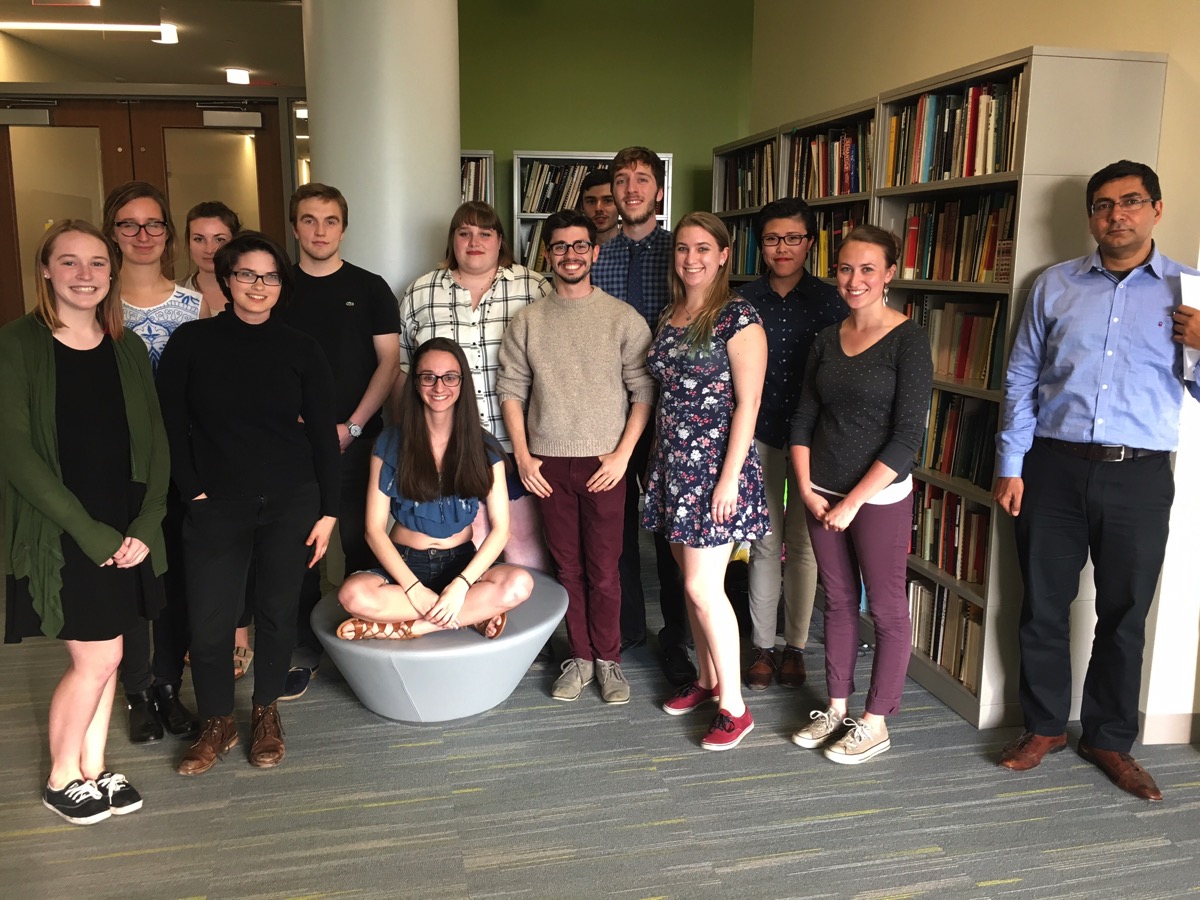
The Year End Lingle happened on Thursday, April 21, in the linguistics department and about half of the graduating seniors were able to show up to be fêted. They, and Rajesh Bhatt, are pictured below.
Congratulations to them, and to all our other graduating seniors!
UMass at WCCFL
The University of Utah is hosting the 34th meeting of the West Coast Conference on Formal Linguistics this weekend. UMass is represented by:
Ethan Poole, who is giving the talk “The locality of dependent Case,"
Alumna Amy Rose Deal, who is giving the talk “Syntactic Egativity as Case discrimination."
Alumna Karen Jesney, who with Brian Hsu, is presenting the paper “Loanword Adaptation in Quebec French: Evidence for Weighted Scalar Constraints"
Gaja gives a talk at 5 at 4
Gaja Jarosz is one of five incoming HFA faculty who are giving a short presentation at the “5 at 4” cocktail hour that the Dean of HFA is sponsoring on April 27. Gaja’s talk is entitled “ .” the event is at 4PM in The Hadley Room, Campus Center.
Mohawk
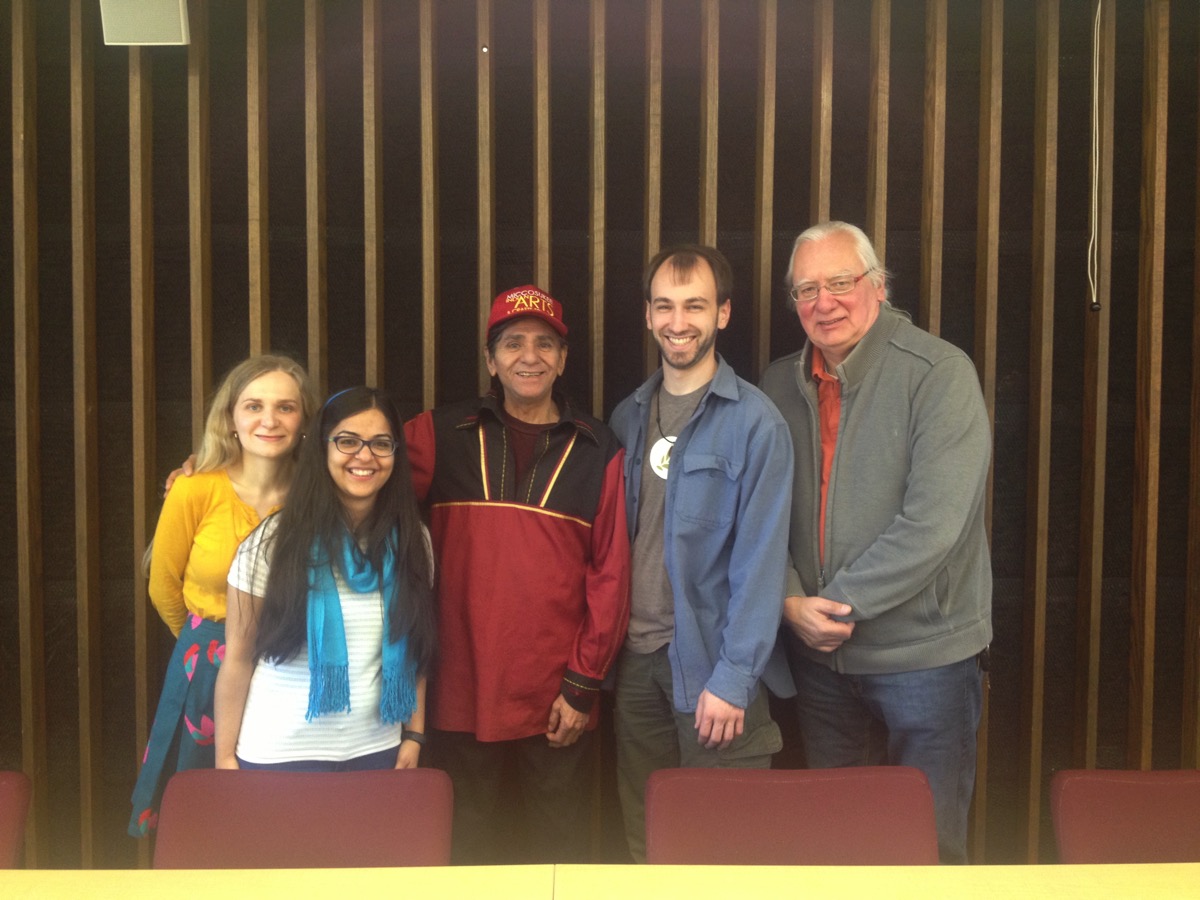
Mohawk speakers Phillip Deering and Francis Bootes meet with Katia Vostrikova, Sakshi Bhatia and Leland Kusmer on April 15th.
17 April 2016
Simon Kirby speaks on Friday
Joe Pater writes:
We will meet with Simon Kirby of the University of Edinburgh on April 22 10-11 am in Integrative Learning Center N400 to discuss his 2015 Cognition paper “Compression and communication in the cultural evolution of linguistic structure“. There will also be a prior meeting to prepare for that discussion on Wednesday April 20th from 11-12 in the same location. All are welcome to attend either one or both of these meetings. If you would like to meet with Simon at some other time during his visit, please e-mail Joe Pater.
As previously announced, his talk “The Evolution of Linguistic Structure: where learning, culture and biology meet” jointly sponsored by the Initiative in Cognitive Science and the 5 Colleges Cognitive Science Seminar on will take place at 3:30 in ILC N101. The abstract is below.
Abstract. Language is striking in its systematic structure at all levels of description. By exhibiting combinatoriality and compositionality, each utterance in a language does not stand alone, but rather exhibits a network of dependencies on the other utterances in that language. Where does this structure come from? Why is language systematic, and where else might we expect to find this kind of systematicity in nature? In this talk, I will propose a simple hypothesis that systematic structure is the inevitable result of a suite of behaviours being transmitted by iterated learning. Iterated learning is a mechanism of cultural evolution in which behaviours persist by being learned through observation of that behaviour in another individual who acquired it in the same way. I will survey a wide range of lab studies of iterated learning, in which the cultural evolution of sets of behaviours is experimentally recreated. These studies include everything from artificial language learning tasks and sign language experiments, to more abstract behaviours like sequence learning, and have recently even been extended to other species. I will conclude by suggesting that these cultural evolution experiments provide clear predictions about where we should expect to see structure in behaviour, and what form that structure might take.
Liliana Sanchez speaks on Friday
Luiz Amaral writes:
Liliana Sanchez (Rutgers) will give a talk on Friday, April 22 at 2:30 in Herter 301. Please join us.
"Modularity and variability at the interfaces: Quechua, Shipibo and Spanish pronominal systems in contact"
"The study of bilingualism and second language acquisition from a generative perspective has been characterized in the last decades by approaches that have ranged from strong empirical support for the autonomy of syntax and the availability of universal language acquisition (Flynn 1987, Liceras 2010, Schwartz & Sprouse 1996, White 1989, 2003) to approaches that focus on variability at the interfaces between language components (Montrul 2010, Sorace 2000, 2005, 2009). These have become increasingly acknowledged as crucially involved in the development of the grammatical representation of adult and child sequential bilinguals (Pladevall 2010, Serratrice, Sorace & Paoli 2004, Sorace & Serratrice 2009).In this talk, I will focus on some of the major findings and contributions that the study of adult bilingualism in Spanish and agglutinative languages such as Quechua and Shipibo have brought to the understanding of modularity and variability at the interfaces.Quechua is a nominative-accusative language with no gender marking. It is an agreement-based null subject language that also allows null definite objects (Cerrón-Palomino 1988, Sánchez 2010). Shipibo is an ergative language with no gender marking. It is a mixed null subject language with obligatory first and second person overt pronouns and pragmatically conditioned third person null subjects and null objects (Camacho and Elías 2010).Bilingualism in Quechua and Spanish and bilingualism in Shipibo and Spanish have resulted in partially divergent Spanish pronominal patterns. I will discuss evidence of variability in the pronominal system of Spanish among Quechua and Shipibo speakers due to crosslinguistic influence at the interfaces of syntax and morphology and syntax and pragmatics. The evidence presented includes: a) the feature specification of direct object clitics (Camacho, Sánchez, and Paredes, 1995; Kalt 2012b; Sánchez 2003, Mayer and Sánchez in prep), b) the emergence of secondary topic interpretations for clitic doubling expressions (Sánchez 2003, Mayer 2010, Mayer and Sánchez in prep), and c) the interpretation of overt first person subjects in Shipibo Spanish (Sanchez, Camacho and Elías 2010)."
Kingston on the road
John Kingston gave a talk last Wednesday, April 13, at the Workshop on (Morpho)-phonological Processing at Oxford University. His talk presents work with Amanda Rysling, Adrian Staub, Andrew Cohen and Jeffrey Starn; the title is “When do words influence perception? Converging evidence that Ganong effect is early and variable”
And last Friday, April 15th, he presented the paper “Misperception, coarticulation, and sound change,” work with Amanda Rysling, Alexandra Jesse, and Robert Moura, at the Worshop on Articulatory Control at the Laboratories de Phonetique et Phonologie, Paris 3.
Zsofia Zvolenszky gives two talks this week
Ned Markosian writes:
I am writing to remind you of not one but two talks next week by the amazing Hungarian philosopher, Zsofia Zvolenszky. The one on Wednesday (please note: next Wednesday is a Monday schedule here at UMass) is at Mount Holyoke College, and the one on Friday is right here in Bartlett Hall. Details below.
Zsofia Zvolenszky
Authors Creating Fictional Characters, Either Intentionally or Inadvertently
Wednesday, April 20, at 4:30 pm
216 Skinner Hall
Mount Holyoke College
Zsofia Zvolenszky
A Common Problem for Possible-Worlds Analyses of Deontic and Fictional Discourse
Friday, April 22, at 3:30 pm
201 Bartlett Hall
UMass
Year End Lingle on Thursday
The year end Lingle (Linguistics Majors Mingle) will happen in the UMass Linguistics Department lobby on Thursday, April 21 at 6PM. Come celebrate the end of the year and say farewell to our graduating seniors!
Call for volunteers to work at Speech Prosody 8
CONFERENCE: Speech Prosody 8
WHEN: May 31 to June 3, 2016
WHERE: Boston University
CONFERENCE WEBSITE: http://sites.bu.edu/speechprosody2016/WHO?
Volunteers should be students (any level) who are interested inattending the conference at no cost.
VOLUNTEER JOB DESCRIPTION:
By volunteering for two 4-5 hour shifts, your registration will be waived for the conference (the banquet fee is separate if interested). Volunteer jobs include registering conference goers, overseeing poster sessions, and helping with technical support.
*PLEASE CONTACT JILL THORSON IF INTERESTED AT: J.THORSON@NEU.EDU
UMass at CLS
The Chicago Linguistic Society will host its 52nd annual meeting Thursday April 21 to Saturday, April 23, 2016. UMass will be well represented:
Luis Alonso-Ovalle has a paper "Spanish siquiera in the even landscape"
David Erschler has a paper "Sluicing beyond wh-questions: Exploring and explaining cross- linguistic variation"
Thuy Bui has a paper "Number agreement in languages with two hierarchies"
Jon Ander Mendia has a paper "Conventionalizing at least some determiners"
The full program is here.
Extended Deadline: Cognitive Structures: Linguistic, Philosophical and Psychological Perspectives
Full Title: Cognitive Structures: Linguistic, Philosophical and Psychological Perspectives
Short Title: Cognitive Structures
Date: September 15–17, 2016
Location: Heinrich-Heine-University Düsseldorf, Germany.
Meeting Email: cognitive-structures@phil.hhu.de
Web Site: http://cognitive-structures.phil.hhu.de
Field(s): General and Computational Linguistics, Philosophy, Psychology, Cognitive Science
Extended Deadline: May 1, 2016
Meeting Description
The DFG Collaborative Research Centre 991: The Structure of Representations in Language, Cognition, and Science (Düsseldorf, Germany) invites abstracts for its biannual conference that aims to cover a broad range of research on language and cognition.
We are especially interested in theoretical, empirical and experimental work exploring the nature of mental representations that support natural language production/understanding, other manifestations of cognition as well as general reasoning about the world. One fundamental question raised in this general topic area is whether the requisite knowledge structures can be adequately modeled by means of a uniform representational format, and if so, what exactly is its nature.
Topics addressed may include, but are not limited to, the following:
* frames, which have had a strong impact on the exploration of knowledge representations in artificial intelligence, psychology and linguistics: e.g., formal theories of frames (including their modeling by means of DAGs, AVMs), frame semantics and constructions, frame induction, linking frame semantics to truth conditional semantics
*concepts and categorization: formation/acquisition of concepts, concept types and shifts, grounding of concepts, prototypes, concept empiricism, conceptual spaces and similarity of concepts, statistical concepts;
*experimental investigation of mental representation;
*semantic interpretation and mental representation: the syntax/semantics interface, compositionality, lexical semantic decomposition, (dynamic) representation of aspect and tense, temporal sequencing in discourse.
Submissions are welcome from any area within cognitive science, including linguistics, computer science, philosophy, psychology, artificial intelligence and neuroscience. Accepted participants will be allotted 25 minutes to present and 10 minutes to answer questions. Accepted participants will be invited to submit their papers for the conference proceedings.
Invited Speakers
Lawrence Barsalou (University of Glasgow)
Verity Brown (University of St Andrews)
UMass alumnus Robin Cooper (Gothenburg University)
Igor Douven (CNRS and Paris-Sorbonne University)
Adele Goldberg (Princeton University)
Manfred Krifka (Humboldt University and ZAS Berlin)
UMass alumnus Marcin Morzycki (Michigan State University)
Francois Recanati (Institut Jean Nicod, Paris)
Guidelines for Submission
Abstracts must be anonymous, in PDF format, maximally 800 words, excluding bibliographical references. Data should be incorporated into the main text of the abstract, not on a separate page.
All abstracts will be reviewed anonymously by at least two reviewers. Abstracts should not include the authors’ names, and authors are asked to avoid self-references.
Use the EasyChair platform for the submission of abstracts: https://easychair.org/conferences/?conf=cost16
Submission Contact cognitive-structures@phil.hhu.de
Important datesExtended Deadline: May 1, 2016Notification of acceptance: May 30, 2016 Conference: September 15–17, 2016
EGG 2016 at Lagodekhi
The Eastern Generative Grammar summer has just announced that this year’s meeting will take place in Lagodekhi in Georgia. For developments, monitor this page.
10 April 2016
Kingston on the road
John Kingston will give a talk on Wednesday, April 13, at the Workshop on (Morpho)-phonological Processing at Oxford University. His talk presents work with Amanda Rysling, Adrian Staub, Andrew Cohen and Jeffrey Starn; the title is “When do words influence perception? Converging evidence that Ganong effect is early and variable”
And on Friday, April 15th, he will be presenting the paper “Misperception, coarticulation, and sound change,” work with Amanda Rysling, Alexandra Jesse, and Robert Moura, at the Worshop on Articulatory Control at the Laboratories de Phonetique et Phonologie, Paris 3.
David Pesetsky gives department colloquium
David Pesetsky (MIT) will give the department colloquium on Friday, April 15, at 3:30 in ILC N400. The title of his talk is “Exfoliation: towards a derivational theory of clause size.” An abstract follows.
We too easily become used to facts about language that should strike us as strange. One of these is the menagerie of clause-types and clause-sizes in the world's languages categorized with ill- understood labels such as finite, non-finite, full, reduced, defective, and worse. For almost a half-century, the standard approach to these distinctions has treated them as a consequence of lexical choice — a legacy of arguments by Kiparsky & Kiparsky (1970) and Bresnan (1972), who showed (1) that verbs that select a clausal complement select for the complementizer and finiteness of that complement, and (2) that finiteness and complementizer choice have semantic implications. In an early-1970s model of grammar in which selection and semantic interpretation were properties of Deep Structure, these discoveries directly entailed the lexicalist view of clause type that is still the standard view today. So compelling was this argument at the time, that its 1960s predecessor (Rosenbaum 1967) was all but forgotten — the idea that distinctions are derivationally derived as the by-product of derivational processes such as Raising. As a consequence, it has gone unnoticed that in a modern model of grammar, where structure is built by Merge (and both selection and semantic interpretation are interspersed with syntactic operations), the arguments against the derivational theory no longer go through.
In this talk, I present a series of arguments for a modernized return to a derivational theory. I argue that a reduced clause is the response to specific situation: a clause-external probe that has located a goal such as the subject in the upper phase of its CP-complement, when that goal does not occupy the edge of its CP. Since anti-locality prevents that goal from moving to the clausal edge (Erlewine 2015 and predecessors), a last-resort operation called Exfoliation deletes outer layers of the clause until the goal occupies the edge without movement. If the goal was a subject occupying a low enough position, the result is an infinitive. If the goal occupied a higher position, the result is a finite clause missing its complementizer. My starting point is the paradigm in (a)-(d). Because a standard approach assumes that every infinitive is born infinitival, the contrast between (a) and (b) is usually treated as a puzzle of case theory: why does moving the subject in (b) eliminate its case problem visible in (a)? The derivational approach invites an entirely different question: why should the embedded clause in (a) be infinitival in the first place? Since no probe targets the embedded subject in (a), Exfoliation should not have taken place, and the clause should have remained finite (I assure you that Mary is the best candidate). Only in (b), where an Ā-probe has targeted the embedded subject, is Exfoliation justified, hence the possibility of an infinitive. Example (c) also shows Exfoliation, deleting only the complementizer because the subject is higher than in (b), and (d) is impossible because no Exfoliation took place — thus explaining the that-trace effect as part of the same paradigm.
a. *I assure you Mary to be the best candidate.
b. Mary, who I assure you __ to be the best candidate. (Kayne 1983)
c. Mary, who I assure you __ is the best candidate.
d. *Mary, who I assure you that __ is the best candidate.
Similar effects with A-movement arise in the behavior of English wager-class predicates and raising in Lusaamia (Carstens & Diercks 2014), as well as with other Ā-phenomena such as anti- Agreement (Baier 2015). Finally, I provide an independent argument for the last-resort nature of Exfoliation from Zulu Hyper-Raising, based on a simplified version of a proposal by Halpert (2015).
Tracking the Human Mind in Attitude and Speech Reports
Angelika Kratzer writes:
You (and your friends, students, colleagues) are all invited to a symposium on:
Tracking the Human Mind in Attitude and Speech Reports
Saturday, April 16 10:00 AM - 1:00 PM
Integrative Learning Center, N 400
Please spread the word! Catered reception starting at 1:00 PM. This might or might not be a substitute for lunch.
9:30
Coffee, settling down
10:00 - 10:55
Kate Davidson, Linguistics Department, Harvard University
Our cat went "meow" and my dog was like "feed me!": iconic attitude reports in spoken and sign languages.
Hadas Kotek, Linguistics Department, McGill University Chair & last question or comment.
11:05 - 12:00
Jonathan Phillips, Moral Cognition Lab, Psychology Department, Harvard University
Factive Theory of Mind
Angelika Kratzer, Department of Linguistics, UMass AmherstChair & last question or comment.
12:10 - 1:05
Shevaun Lewis, Language & Cognition Lab, Cognitive Science Department, Johns Hopkins University
The Role of Pragmatics in Language Development and Processing
Amy Rose Deal, Linguistics Department, UC BerkeleyChair & last question or comment.
The Symposium is offered and organized by members of the 2015/2016 SIAS (Some Institutes for Advanced Study) Summer Institute. Financial support for the symposium comes from Research and Professional Development Funds provided by UMass Amherst, which are gratefully acknowledged. More information about the 2015/2016 SIAS Summer Institute:
Call for papers: NELS
UMass is hosting the Forty Seventh annual meeting of the North East Linguistic Society in early October, 2016. Invited speakers are Klaus Abels, Cleo Condoravdi, Roumyana Pancheva and our own Gaja Jarosz. There are two special sessions: one on linearization of syntactic structures and one on grammatical illusions at the grammar-processing interface. Deadline for abstracts is the last minute of June 15.
For more information, go here.
Brian Smith goes to Santa Cruz
WHISC is happy to announce that Brian Smith has accepted a one-year position at the University of California at Santa Cruz. Congratulations Brian!
Subscribe to:
Posts (Atom)