Katy Waldman, Slate’s “words correspondent” riffs on ellipsis.
15 May 2016
Graduate Commencement
Presley Pizzo, Claire Moore-Cantwell and Brian Smith took delivery of their well-earned PhD diplomas at the Graduate Commencement on Friday, May 6th.
Congratulations!


Johnson in California
Kyle Johnson gives a talk at the University of California-Santa Cruz on Friday, May 20, entitled “Building a Trace."
UMass at WAFL 12
Central Connecticut College is hosting the 12th Workshop on Altaic Formal Linguistics this weekend, May 13-15. UMass is represented by:
Deniz Özyildiz, who is giving the poster “*Say what? A Turkish word order restriction explained by prosody."
and
alumnus Satoshi Tomioka, who is giving the invited talk “Purposeful Questions: A New Embedding Strategy."
For more information, go here.
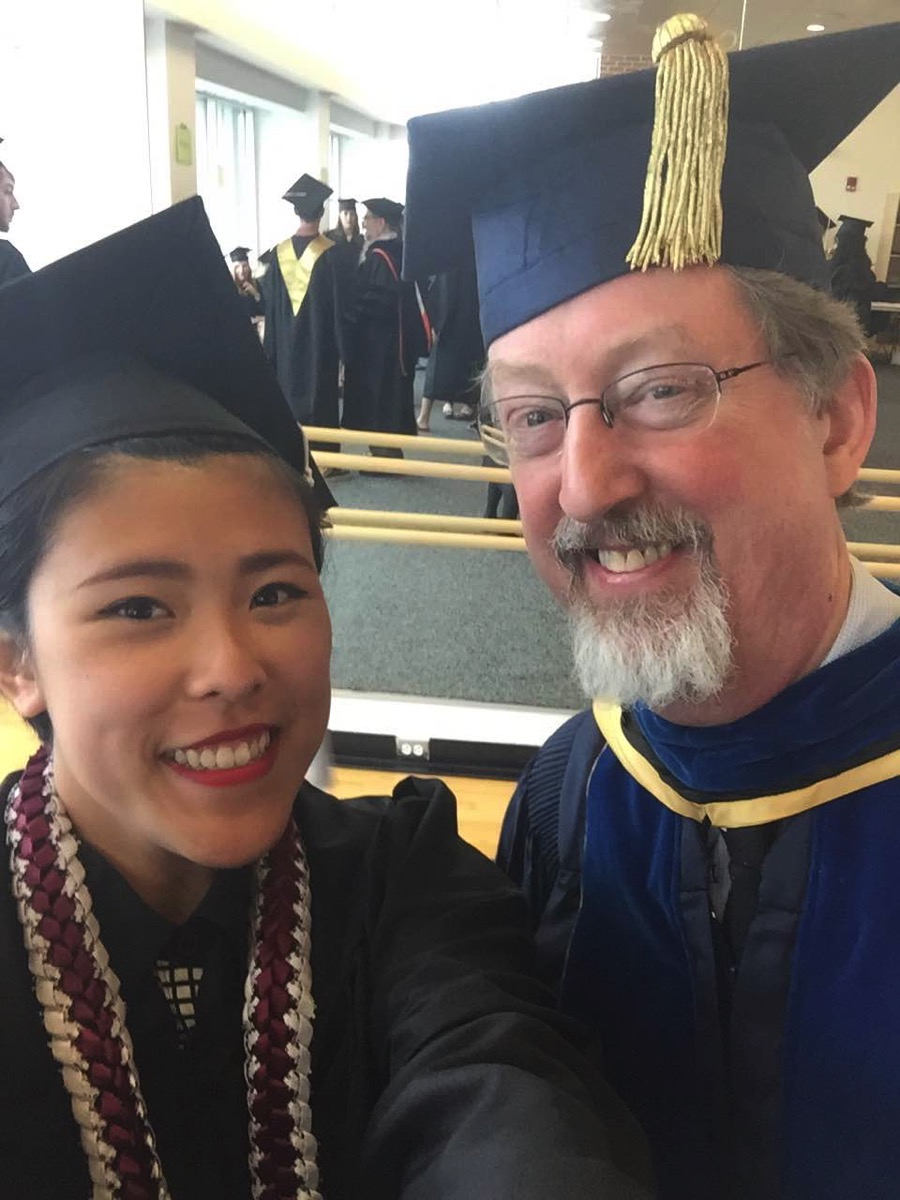
Linguists at HFA Senior Recognition Ceremony
Some pictures of freshly graduated linguists at the Humanities and Fine Arts Senior Recognition Ceremony last Saturday, May 7.
Congratulations!


08 May 2016
Call for papers: BCGL
BCGL 9: Phase Theory
Brussels, December 13-14, 2016.
BCGL 9 will be followed by CRISSP 10, a one-day workshop celebrating the 10th anniversary of the research institute CRISSP featuring invited presentations by Luigi Rizzi, Alec Marantz, and Angelika Kratzer, among others.
BCGL 9: description
Throughout the history of generative grammar, there have been various ways of implementing locality effects, for example through Transformational Cycles (Chomsky 1965; Kayne 1969) or Barriers (Chomsky 1986). Phase Theory (Uriagereka 1999; Chomsky 2000, 2001) constitutes the most recent development in this line of thinking. It is often argued that there exist discrete structural domains in natural language that exhibit a degree of syntactic, semantic, and phonological independence from their surrounding linguistic environment. Phase Theory offers a tool for understanding such domains. However, since the inception of phases, there have been many different proposals about the specific formalization of this concept, along with much debate about the extent to which phases can be evidenced empirically (and indeed whether phases exist at all). The aim of this workshop is to discuss the empirical validity and theoretical specifics of Phase Theory. The questions and issues this workshop aims to address, include, but are not limited to the following:
- What are the empirical diagnostics for phases and how reliable are these? Common diagnostics for phases are:
- (related to the narrow syntax) successive-cyclic movement (islands), agreement, binding conditions, quantifier scope, and parasitic gaps (Fox 1998; Nissenbaum 1998; Legate 2003);
- (related to the PF-interface) ellipsis (Holmberg 1999, 2001; Gengel 2007, 2008), and prosodic rule application (Sato 2009);
- (related to the LF-interface) idiomatic expressions (Svenonius 2005; Harwood & Temmerman 2015; Kim 2015).
- What is the definition of a phase? Do phases correspond to sub-numerations (Chomsky 2000, 2001), spell-out domains and/or workspaces (Uriagereka 1999)? Or do they need to be defined in terms of e.g. Prolific Domains (Grohmann 2003), Layered Derivations (Zwart 2009), or Cyclic Linearization (Fox & Pesetsky 2003, 2005)? Related questions are: What is the timing of spell-out and what exactly is spelled out (Chomsky 2000, 2001; Fox & Pesetsky 2003, 2005; Richards 2011; Bošković 2014)?
- What does the inventory of phases look like: CP, vP, DP, PP, …? Is the size of a phase fixed? Are phases rigid and absolute or context-sensitive (cf. Bošković (2013, 2014), Wurmbrand (2013) and Harwood (2015) for dynamic phases, Den Dikken (2007) for phase extension, and Gallego (2010) for phase sliding)?
- To what extent do phases at one interface (necessarily) coincide with phases at another interface (Marušič 2005; d’Alessandro & Scheer 2015)?
Abstract guidelines
Abstracts should be anonymous, and submissions are limited to 2 per author, at least one of which must be co-authored. They must not exceed two pages, including data, references and diagrams. The font should be at least 11-point, with one-inch margins. They should be submitted as pdf-documents through EasyChair: https://easychair.org/conferences/?conf=bcgl9
Important dates
First call for papers: May 3, 2016.
Second call for papers: August 1, 2016.
Abstract submission deadline: September 1, 2016.
Notification of acceptance: October 1, 2016.
Conference location
CRISSP – KU Leuven Brussels Campus
Warmoesberg 26
1000 Brussels
Belgium
Conference organizers
Jeroen van Craenenbroeck
Will Harwood
Dany Jaspers
Cora Pots
Koen Roelandt
Jolijn Sonnaert
Tanja Temmerman
Guido Vanden Wyngaerd
Websites
Kratzer at UPenn
Angelika Kratzer gave a colloquium talk entitled “Evidential Moods” to UPenn’s linguistics department on Thursday, May 5.
Rethinking Comparative Syntax
The University of Cambridge hosted the conference “Rethinking Comparative Syntax” this last week. UMass was represented by David Erschler, who gave the talk “Typology of Sluicing in wh- and non-wh-questions.” For more information, go here.
UMass at FASL
Cornell University is hosting the Twenty Fifth annual meeting of Formal Approaches to Slavic Linguistics on May 13-15. Gaja Jarosz and alumnus Michael Becker are giving plenary talks. Gaja’s is entitled “Sonority sequencing in Polish: Defying the sttimulus?” and Michael’s is entitled “Inconspicuous unfaithfulness in Slovenian.” For more information, go here.
Call for papers: Workshop on Complex Predicates
Workshop on Complex Predicates in Iranian Languages
University of Tehran,
Tehran, IRAN,
10-11 September 2016
https://sites.google.com/site/cprut2016/
Deadline for abstract submission: May 20, 2016
Guidelines are available on https://sites.google.com/site/cprut2016/call
Topics of interest include but are not limited to:
- emergence of complex predicates
-complex predicates as light verb constructions
-idioms as complex predicates
-argument structure of complex predicates
-event structure of complex predicates
-active/non-active distinction and argument alternation
-phonological properties of complex predicates
Keynote speakers:
Mohammad Dabir-Moghaddam (Professor, Allameh Tabataba'i University)
Simin Karimi (Professor, University of Arizona)
Pollet Samvelian (Professor, Université Sorbonne Nouvelle & CNRS)
01 May 2016
UMass at SULA
UC, Santa Cruz is hosting the ninth meeting of Semantics of Under-Represented Languages in the Americas on May 6-8. UMass is represented by:
Alumna Amy Rose Deal, who is giving the talk “Legacy Documentation: What can we learn?"
Seth Cable, who is giving the talk “Negation and negative antonyms in Tlingit."
Alumna Suzi Lima, who is giving the talk “On the interpretation of object denoting nouns in Yudja"
For more information, go here.
Two Summer Schools
International Summer School on Language Documentation and Description/
Netherlands
http://www.hum.leiden.edu/summerschool/
The Leiden University Centre for Linguistics (LUCL) is proud to host the sixth 3L International Summer School on Language Documentation and Description this summer from Monday 11 July up to and including Friday 22 July 2016. The 3L Summer School is part of the annual Leiden Summer School in Languages and Linguistics. The 3L Summer School offers 2-week courses dealing with various aspects of language documentation and description for future and novice field linguists. Courses cover both practical and typological issues, including practical training in fieldwork methods, fieldwork on sign languages, recording techniques, software for documentation, language description, grammar writing, the analysis of tone, and how to make a lexicon.Minimum Education Level: BA
LOT Summer School in Utrecht
Dates: 04-Jul-2016 - 15-Jul-2016
The LOT Summer School 2016 will be hosted by Utrecht University. Minimum Education Level: BA. Special Qualifications: Master Sudents should be enrolled in a Research Master programme and have had at least two semesters of training.
Tuition: 200 EURRegistration: 15-Apr-2016 to 31-May-2016
24 April 2016
Bruna Pereira at LARC
Bruna Pereira, visiting scholar at MIT, will present her work on agreement in Brazilian Portuguese in LARC this Wednesday, April 27, at 12:20 in ILC N451. The title and abstract of her talk follow.
The DP-internal plural marking in Brazilian Portuguese
In contrast to standard BP, which has all the elements of the DP marked for plural, non-standard BP (1a, b) leaves most of them unmarked. In view of these facts, this paper investigates the syntactic conditions that determine the DP-internal distribution of the plural morpheme in non-standard BP. In order to do that, I assume that the position of the cardinal numeral divides the DP into two domains: the items in its left are marked with the plural morpheme (1a, b), whereas the items in its right are not (1c).
(1) a. Os (dois) outro balde vermelho
The-PL two other bucket red
‘The other two red buckets’.
b. Os outros (dois) balde vermelho
The-PL other-PL
two bucket red
c. *O outro (dois) baldes vermelhos
The other two bucket-PL red-PL
Overall, this paper is organized in three parts. Section 1 presents: firstly, current proposals (Costa; Figueiredo Silva, 2006) on a presumed ‘singleton’ morpheme, which does not account for the facts above mentioned; secondly, the theoretical basis (Chomsky, 2001; Pesetsky; Torrego, 2007) for assuming a new proposal; and thirdly cross-linguistic data for illustrating that, in several languages, the numeral works as a boundary dividing the DP with regards to the distribution of number features (Danon, 2011; Norris, 2014). Section 2 tests, with BP data, the explanation power of this analysis. Finally, section 3 describes structures with wh-determiners (Nunes, 2007; Pereira 2014, 2016) and indefinite articles in the dialect spoken in Minas Gerais that give support for the analysis carried out.
Therefore, as opposed to current proposals, the analysis assumed here shows that the DP-internal plural marking is not only dependent on syntax but also consistent with the DP-internal hierarchy. Above all, it reveals the underlying reason why some constituents of the DP must, may or cannot be marked for plural in non-standard BP.
UMass at Undergraduate Research Conference
The 22nd annual Annual Undergraduate Research Conference took place last Friday, April 22, in the Lincoln Campus Center. The Linguistics Department was represented by:
Ashley Lee, who gave the talk: “Gender Assignment in German Loan Nouns from English."
Stephanie Rich presented the poster “Why not Both? Incremental Processing of Syntactic and Semantic Ambiguities."
Anthony Yacovone presented the talk “Investigating the role of predictability during syntactic resolutions."
Congratulations!
mini-conference on Thursday
The Second Year students present their work at a Mini-Conference this Thursday, April 28 starting at 9:30 in ILC N400. A schedule follows.
9:30 Petr Kusily: Embedded under Past: Novel data and puzzles for Present and Future in Japanese, Russian and English
10:00 Rodica Ivan: Binding within PPs
10:30 Deniz özyildiz: Factivity Defteated
11:00 Break (with refreshments)
11:30 Georgia Simon: Getting Specific about Underspecification
12:00 Thuy Bui: The Vietnamese Perfect
Jeremy raps
Jeremy Hartman will give an Acquisition Rap at MIT on Saturday, April 30 at a conference in honor of Ken Wexler on the occasion of his retirement. Jeremy’s rap is “Building a corpus for root infinitives.” For more information about the event, and Jeremy’s rap, go here.
Gaja, Brian and Kristine are featured at Data Science Tea
Data Science Tea - Linguistics Spotlight
What: tea, refreshments, presentations and conversations about topics in data science
Where: Computer Science Building Rooms 150, 151
When: 4-5:30pm Tuesday April 26
Who: You! Especially PhD & MS students, and faculty interested in data science.
Professor Kristine Yu - The learnability of tones from the speech signal
Many of the world's languages are tone languages, meaning that a change in pitch (how high or how low the voice is) causes a change in word meaning, e.g. in Mandarin, "ma" uttered with a rising pitch like in an English question (Did you go to class today?) means "hemp", but "ma" uttered with a falling pitch like in an English declarative (Yes!) means "to scold". This talk discusses initial steps in using machine learning to find out the best way to parametrize tones in an acoustic space, in order to set up the learning problem for studying how tone categories could be learned. I look forward to your comments and suggestions!
Professor Gaja Jarosz - Computational Models of Language Development: Nature vs. Nurture
Recent work on phonological learning has utilized computational modeling to investigate the role of universal biases in language development. In this talk I review the latest findings and controversies regarding the status of a particular language universal, Sonority Sequencing Principle, traditionally argued to constrain the sound structure of all human languages. I argue that explicit computational and statistical models of the language development process, when tested across languages (English, Mandarin, Korean, and Polish) allow us to disentangle the often correlated predictions of competing hypotheses, and suggest a crucial role for this universal principle in language learning.
Professor Brian Dillon - Serial vs. parallel structure-building in syntactic comprehension
In this talk I give a brief overview to theories of human syntactic comprehension. An important theoretical question in this area is whether the human sentence processor creates and maintains a single syntactic description of a sentence, or if instead it maintains multiple, parallel parses of the input. This question is of wide-ranging theoretical importance for theories of human syntactic processing, but the empirical data that distinguish serial from parallel parsing behavior are unclear at best (Gibson & Pearlmutter, 2000; Lewis, 2000). In this talk I reexamine this theoretical question, and present in progress work with Matt Wagers (Linguistics, UC Santa Cruz) that uses tools from mathematical psychology (Signal Detection Theory) to derive novel empirical predictions that distinguish serial vs. parallel processing, a first step on the road to reevaluating this old, but perptually important, theoretical question.
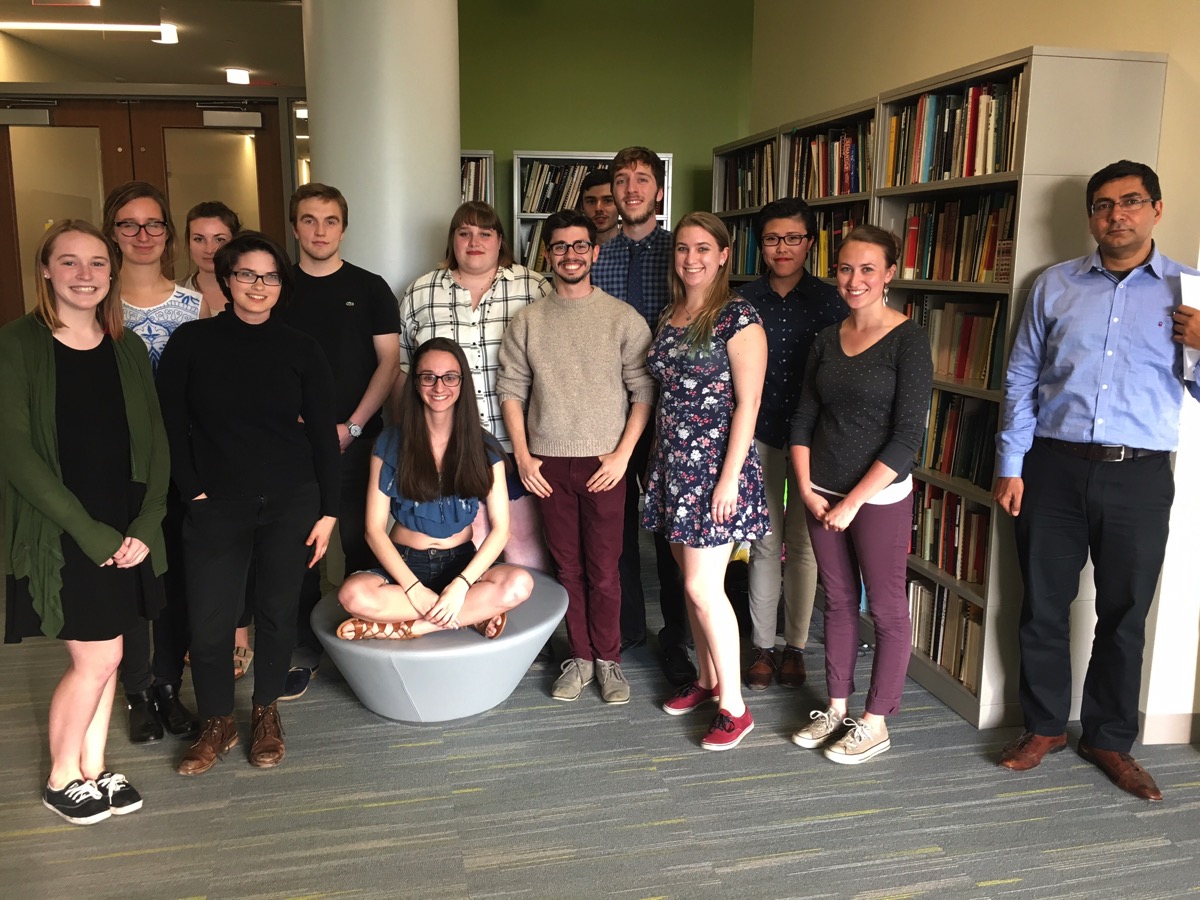
Graduating Seniors at LINGLE
The Year End Lingle happened on Thursday, April 21, in the linguistics department and about half of the graduating seniors were able to show up to be fêted. They, and Rajesh Bhatt, are pictured below.
Congratulations to them, and to all our other graduating seniors!
UMass at WCCFL
The University of Utah is hosting the 34th meeting of the West Coast Conference on Formal Linguistics this weekend. UMass is represented by:
Ethan Poole, who is giving the talk “The locality of dependent Case,"
Alumna Amy Rose Deal, who is giving the talk “Syntactic Egativity as Case discrimination."
Alumna Karen Jesney, who with Brian Hsu, is presenting the paper “Loanword Adaptation in Quebec French: Evidence for Weighted Scalar Constraints"
Subscribe to:
Posts (Atom)