UMass linguistics and classics major Jack Duff will be a summer inter at Harvard University’s Center for Hellenic Studies in Washington D.C. this summer. You can learn more here. Congratulations Jack!
22 May 2016
Call for papers: CGSW
The 31st edition of the Comparative Germanic Syntax Workshop will be a historic one as this will be the first CGSW to be held in Africa.
Stellenbosch University in South Africa’s beautiful Western Cape Province will be hosting this meeting, which will take place on 2-3 December 2016.
Invited Speakers
Roland Hinterhölzl (Venice)
Jason Merchant (Chicago)
Tarald Taraldsen (Tromsø)
Call for papers
We invite abstracts for thirty-minute talks (followed by ten minutes of discussion) on any aspect of comparative Germanic syntax, including diachronic syntax. Given the location of the conference, we are also very interested in research focusing on lesser studied Germanic varieties, particularly those that have developed and/or been used in contact situations, including “extraterritorial” varieties of continental Germanic. Papers focusing on formal aspects of “non-standard” varieties and on phenomena like code-switching are also very welcome, as are papers considering how aspects of the structure of non-Germanic languages spoken in southern Africa (may) have impacted on the structure of Germanic languages spoken in this part of the world.
Abstract Guidelines
Abstracts should not exceed two pages, with 2.5cm margins on all sides and a font size of 12pt. This includes data, references and diagrams.
Each author may submit no more than one single-authored and one co-authored abstract, or two co-authored ones.
Abstracts must be anonymous and prospective presenters should submit their abstract in pdf to:
http://conferences.sun.ac.za/index.php/cgsw31/cgsw31/about/submissions#onlineSubmissions
The deadline for submission is 31 May 2016.
Notification of acceptance by 1 July 2016.
Further information
Please feel free to visit the conference website at the following address:
http://conferences.sun.ac.za/cgsw31.
Here, you will (in due course) find information regarding CGSW31 itself, a pre-CGSW31 workshop involving international researchers (see below), visa applications, travel, and accommodation.
For local (Stellenbosch-related) information, please contact Erin Pretorius: erink@sun.ac.za
For directly CGSW-related information, please contact Theresa Biberauer: mtb23@cam.ac.uk
Additional workshop
This year, CGSW will be accompanied by a pre-workshop taught by Theresa Biberauer, Mara Frascarelli, Roland Hinterhölzl and Ian Roberts.
We look forward to receiving your abstracts! And then to welcoming you in Stellenbosch at a wonderful time of year!

UMass at Manchester Phonology meeting
The University of Manchester is hosting the the Twenty-Fourth Manchester Phonology Meeting May 26-28th. UMass is represented by
alumna Nancy Hall who is giving the talk “A phonetic study of closed syllable shortening in Palestinian Arabic."
Coral Hughto who is giving the talk “Typological prediction of an interactive learning model"
Leland Kusmer and Ivy Hauser who are giving the talk “Wrong side reduplication in Koasat"
For more information, go here.
Summer Writing Camps
The Office ofProfessional Development and the Writing Center are pleased to offer aSummer Writing Series to help graduate students set goals and stay ontrack in a quiet and supportive environment. Optionally, writingconsultants will be available to meet with writers to discuss any typeof writing.
This Summer Writing Series will take place on Tuesdays (through July26th) from 9am - 1pm in the Writing Center (Du Bois Library lowerlevel). Coffee and snacks will be provided. Come late or leave early;come one week or attend them all.
Series pre-registration (once) is required:
http://goo.gl/forms/Lhshl1sk8SKfSlW22
A limited number of consultations are available for advance registration here.
Additional consultations are available for on-site sign-ups on afirst-come, first-served basis.
Summer School in Göttingen
Summer School on Complex Clauses/Germany
Host Institution:University of Göttingen, Germany
Coordinating Institution:University of Göttingen, Germany
https://www.uni-goettingen.de/de/535725.html
Dates:8-Aug-2016 to 12-Aug-2016
Location:Göttingen , Germany
Focus:Linguistics in Göttingen (LinG) proudly announces a five-day summer school on Complex Clauses, held in Göttingen. During this summer school, four tutorials (1,5 hour per day each) will be held, featuring well-known teachers. In addition, there will be a poster session, where students can present and discuss their work, as well as evening lectures.
Minimum Education Level:BA
Additional Qualifications:The school is intended for 20 graduate students, PhD students or postdocs, working on, or interested in, the topic.
Full Summer School Description:
Four courses (1,5 hours/day for 5 days):
Courses:
Jaklin Kornfilt (Syracuse University): Complex Clauses in some head-final languages (with particular attention to Turkish and Turkic)
UMass alumnus Keir Moulton (Simon Fraser University): Ingredient of Embedding
Hans-Martin Gärtner (Hungarian Academy of Sciences): Issues in Special and Minor Sentence Type
Magdalena and Stefan Kaufmann (UConn): Current topics in the semantics and pragmatics of conditionals
Evening lectures:
Beáta Gyuris (Hungarian Academy of Sciences): The semantics and pragmatics of embedded interrogatives in Hungarian
Uwe Junghans and Hagen Pitsch (University of Göttingen): Complex sentence structures in Slavic
Tuition:100 (EUR)
Tuition Explanation:Tuition includes coffee breaks and free lunch on all 5 days.
Registration Dates:1-Apr-2016 to 23-May-2016
Contact person information:Edgar Onea
Email:edgar.onea@zentr.uni-goettingen.de
Apply by mail:julia.steinmetz@zentr.uni-goettingen.de
----------------
Apply by email:julia.steinmetz@zentr.uni-goettingen.de
Registration Instructions:Interested? Send an email to julia.steinmetz@zentr.uni-goettingen.de by May 23 with a short description of your research interests and a short motivation why you would want to attend the school. Together this should be no more than 500 words. Please consult the website https://www.uni-goettingen.de/de/535725.html on accommodation information and financial aid. Notification of acceptance by the June, 1 the latest.
Roeper at University of Toronto
Tom Roeper will be giving a talk entitled “Recursion and Interfaces” at a workshop on Complexity in Learnability and Development that the University of Toronto is hosting this Wednesday, May 25. Tom’s paper reports on his work with Petra Schulz. The Workshop is organized by UMass alumna Ana-Teresa Pérez-Leroux, who will also be giving talks at the workshop. For more information, go here.
15 May 2016
Graduate Commencement
Presley Pizzo, Claire Moore-Cantwell and Brian Smith took delivery of their well-earned PhD diplomas at the Graduate Commencement on Friday, May 6th.
Congratulations!

Johnson in California
Kyle Johnson gives a talk at the University of California-Santa Cruz on Friday, May 20, entitled “Building a Trace."
UMass at WAFL 12
Central Connecticut College is hosting the 12th Workshop on Altaic Formal Linguistics this weekend, May 13-15. UMass is represented by:
Deniz Özyildiz, who is giving the poster “*Say what? A Turkish word order restriction explained by prosody."
and
alumnus Satoshi Tomioka, who is giving the invited talk “Purposeful Questions: A New Embedding Strategy."
For more information, go here.
Linguists at HFA Senior Recognition Ceremony
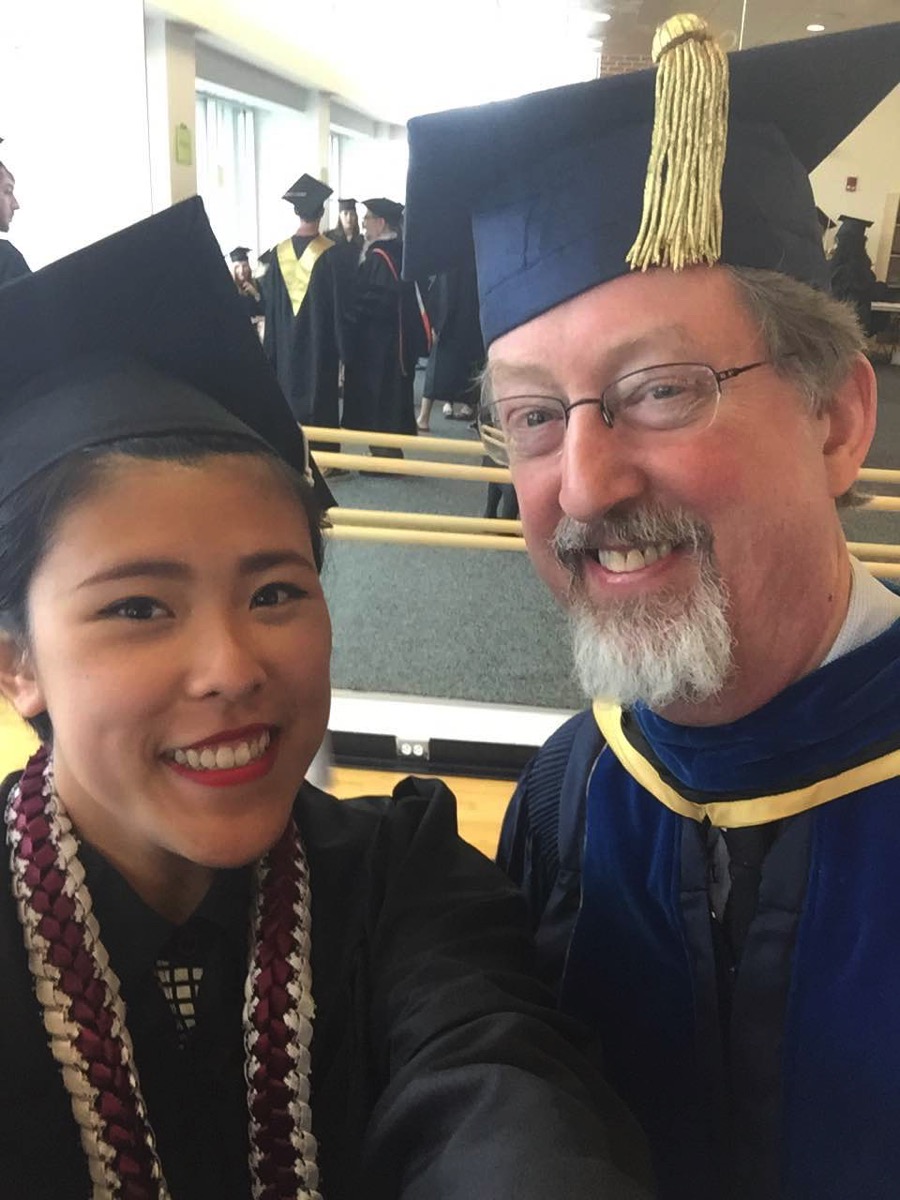
Some pictures of freshly graduated linguists at the Humanities and Fine Arts Senior Recognition Ceremony last Saturday, May 7.
Congratulations!


08 May 2016
Call for papers: BCGL
BCGL 9: Phase Theory
Brussels, December 13-14, 2016.
BCGL 9 will be followed by CRISSP 10, a one-day workshop celebrating the 10th anniversary of the research institute CRISSP featuring invited presentations by Luigi Rizzi, Alec Marantz, and Angelika Kratzer, among others.
BCGL 9: description
Throughout the history of generative grammar, there have been various ways of implementing locality effects, for example through Transformational Cycles (Chomsky 1965; Kayne 1969) or Barriers (Chomsky 1986). Phase Theory (Uriagereka 1999; Chomsky 2000, 2001) constitutes the most recent development in this line of thinking. It is often argued that there exist discrete structural domains in natural language that exhibit a degree of syntactic, semantic, and phonological independence from their surrounding linguistic environment. Phase Theory offers a tool for understanding such domains. However, since the inception of phases, there have been many different proposals about the specific formalization of this concept, along with much debate about the extent to which phases can be evidenced empirically (and indeed whether phases exist at all). The aim of this workshop is to discuss the empirical validity and theoretical specifics of Phase Theory. The questions and issues this workshop aims to address, include, but are not limited to the following:
- What are the empirical diagnostics for phases and how reliable are these? Common diagnostics for phases are:
- (related to the narrow syntax) successive-cyclic movement (islands), agreement, binding conditions, quantifier scope, and parasitic gaps (Fox 1998; Nissenbaum 1998; Legate 2003);
- (related to the PF-interface) ellipsis (Holmberg 1999, 2001; Gengel 2007, 2008), and prosodic rule application (Sato 2009);
- (related to the LF-interface) idiomatic expressions (Svenonius 2005; Harwood & Temmerman 2015; Kim 2015).
- What is the definition of a phase? Do phases correspond to sub-numerations (Chomsky 2000, 2001), spell-out domains and/or workspaces (Uriagereka 1999)? Or do they need to be defined in terms of e.g. Prolific Domains (Grohmann 2003), Layered Derivations (Zwart 2009), or Cyclic Linearization (Fox & Pesetsky 2003, 2005)? Related questions are: What is the timing of spell-out and what exactly is spelled out (Chomsky 2000, 2001; Fox & Pesetsky 2003, 2005; Richards 2011; Bošković 2014)?
- What does the inventory of phases look like: CP, vP, DP, PP, …? Is the size of a phase fixed? Are phases rigid and absolute or context-sensitive (cf. Bošković (2013, 2014), Wurmbrand (2013) and Harwood (2015) for dynamic phases, Den Dikken (2007) for phase extension, and Gallego (2010) for phase sliding)?
- To what extent do phases at one interface (necessarily) coincide with phases at another interface (Marušič 2005; d’Alessandro & Scheer 2015)?
Abstract guidelines
Abstracts should be anonymous, and submissions are limited to 2 per author, at least one of which must be co-authored. They must not exceed two pages, including data, references and diagrams. The font should be at least 11-point, with one-inch margins. They should be submitted as pdf-documents through EasyChair: https://easychair.org/conferences/?conf=bcgl9
Important dates
First call for papers: May 3, 2016.
Second call for papers: August 1, 2016.
Abstract submission deadline: September 1, 2016.
Notification of acceptance: October 1, 2016.
Conference location
CRISSP – KU Leuven Brussels Campus
Warmoesberg 26
1000 Brussels
Belgium
Conference organizers
Jeroen van Craenenbroeck
Will Harwood
Dany Jaspers
Cora Pots
Koen Roelandt
Jolijn Sonnaert
Tanja Temmerman
Guido Vanden Wyngaerd
Websites
Kratzer at UPenn
Angelika Kratzer gave a colloquium talk entitled “Evidential Moods” to UPenn’s linguistics department on Thursday, May 5.
Rethinking Comparative Syntax
The University of Cambridge hosted the conference “Rethinking Comparative Syntax” this last week. UMass was represented by David Erschler, who gave the talk “Typology of Sluicing in wh- and non-wh-questions.” For more information, go here.
UMass at FASL
Cornell University is hosting the Twenty Fifth annual meeting of Formal Approaches to Slavic Linguistics on May 13-15. Gaja Jarosz and alumnus Michael Becker are giving plenary talks. Gaja’s is entitled “Sonority sequencing in Polish: Defying the sttimulus?” and Michael’s is entitled “Inconspicuous unfaithfulness in Slovenian.” For more information, go here.
Call for papers: Workshop on Complex Predicates
Workshop on Complex Predicates in Iranian Languages
University of Tehran,
Tehran, IRAN,
10-11 September 2016
https://sites.google.com/site/cprut2016/
Deadline for abstract submission: May 20, 2016
Guidelines are available on https://sites.google.com/site/cprut2016/call
Topics of interest include but are not limited to:
- emergence of complex predicates
-complex predicates as light verb constructions
-idioms as complex predicates
-argument structure of complex predicates
-event structure of complex predicates
-active/non-active distinction and argument alternation
-phonological properties of complex predicates
Keynote speakers:
Mohammad Dabir-Moghaddam (Professor, Allameh Tabataba'i University)
Simin Karimi (Professor, University of Arizona)
Pollet Samvelian (Professor, Université Sorbonne Nouvelle & CNRS)
01 May 2016
UMass at SULA
UC, Santa Cruz is hosting the ninth meeting of Semantics of Under-Represented Languages in the Americas on May 6-8. UMass is represented by:
Alumna Amy Rose Deal, who is giving the talk “Legacy Documentation: What can we learn?"
Seth Cable, who is giving the talk “Negation and negative antonyms in Tlingit."
Alumna Suzi Lima, who is giving the talk “On the interpretation of object denoting nouns in Yudja"
For more information, go here.
Two Summer Schools
International Summer School on Language Documentation and Description/
Netherlands
http://www.hum.leiden.edu/summerschool/
The Leiden University Centre for Linguistics (LUCL) is proud to host the sixth 3L International Summer School on Language Documentation and Description this summer from Monday 11 July up to and including Friday 22 July 2016. The 3L Summer School is part of the annual Leiden Summer School in Languages and Linguistics. The 3L Summer School offers 2-week courses dealing with various aspects of language documentation and description for future and novice field linguists. Courses cover both practical and typological issues, including practical training in fieldwork methods, fieldwork on sign languages, recording techniques, software for documentation, language description, grammar writing, the analysis of tone, and how to make a lexicon.Minimum Education Level: BA
LOT Summer School in Utrecht
Dates: 04-Jul-2016 - 15-Jul-2016
The LOT Summer School 2016 will be hosted by Utrecht University. Minimum Education Level: BA. Special Qualifications: Master Sudents should be enrolled in a Research Master programme and have had at least two semesters of training.
Tuition: 200 EURRegistration: 15-Apr-2016 to 31-May-2016
24 April 2016
Bruna Pereira at LARC
Bruna Pereira, visiting scholar at MIT, will present her work on agreement in Brazilian Portuguese in LARC this Wednesday, April 27, at 12:20 in ILC N451. The title and abstract of her talk follow.
The DP-internal plural marking in Brazilian Portuguese
In contrast to standard BP, which has all the elements of the DP marked for plural, non-standard BP (1a, b) leaves most of them unmarked. In view of these facts, this paper investigates the syntactic conditions that determine the DP-internal distribution of the plural morpheme in non-standard BP. In order to do that, I assume that the position of the cardinal numeral divides the DP into two domains: the items in its left are marked with the plural morpheme (1a, b), whereas the items in its right are not (1c).
(1) a. Os (dois) outro balde vermelho
The-PL two other bucket red
‘The other two red buckets’.
b. Os outros (dois) balde vermelho
The-PL other-PL
two bucket red
c. *O outro (dois) baldes vermelhos
The other two bucket-PL red-PL
Overall, this paper is organized in three parts. Section 1 presents: firstly, current proposals (Costa; Figueiredo Silva, 2006) on a presumed ‘singleton’ morpheme, which does not account for the facts above mentioned; secondly, the theoretical basis (Chomsky, 2001; Pesetsky; Torrego, 2007) for assuming a new proposal; and thirdly cross-linguistic data for illustrating that, in several languages, the numeral works as a boundary dividing the DP with regards to the distribution of number features (Danon, 2011; Norris, 2014). Section 2 tests, with BP data, the explanation power of this analysis. Finally, section 3 describes structures with wh-determiners (Nunes, 2007; Pereira 2014, 2016) and indefinite articles in the dialect spoken in Minas Gerais that give support for the analysis carried out.
Therefore, as opposed to current proposals, the analysis assumed here shows that the DP-internal plural marking is not only dependent on syntax but also consistent with the DP-internal hierarchy. Above all, it reveals the underlying reason why some constituents of the DP must, may or cannot be marked for plural in non-standard BP.
Subscribe to:
Posts (Atom)