20 November 2011

Summer Research Experience for Linguistics Undergraduates

Sheila Kennison from Oklahoma State University writes:

We are pleased to announce that we will be holding our summer research
experience for undergraduates again in summer 2012.  The goal of this
program is to provide 12 undergraduate students with an in-depth, hands-on
research experience focused on the biological basis of animal  and human
behavior. Students will be trained in the application of the scientific
method to develop hypotheses, design and conduct research studies involving
either animal or human subjects.  Students will also be trained in the
responsible conduct of research. Students will be mentored by full-time,
Ph.D.-level faculty members who are tenured/tenure-track faculty with strong
programs of research. Students selected for the program will be expected to
devote at least 40 hours a week for research; thus, it is not possible to be
enrolled in courses or other activities during the program.

Program dates: June 2, 2012-July 29, 2012

Application deadline: February 1, 2012

To be eligible, students must be a U.S. citizen or permanent resident who is
currently enrolled in an undergraduate program.  Each student will reside in
a campus dormitory (at no cost to the student) and receive $500 per week to
cover food and other living expenses.  Students will receive a $500 travel
stipend to pay for their travel to and from campus and a $500 additional
stipend, if students present research at an academic conference.

Information about how to submit an application is available at
http://psychology.okstate.edu/faculty/kennison/osunsfreu.htm.

We especially welcome applications from students from underrepresented
groups, including first generation college students and students from rural
areas.

PLC deadline delayed to Monday

The organizers of the Penn Linguistics Circle write:

It has been pointed out that the Call for Papers for this year's PLCcontained an error, in that it specified the deadline as Thursday, November 15 (a day/date combination that is not realized this year). To avoid penalizing anyone who might have been confused by this, as well as to allow extra time for the preparation of submissions, we have decided to extend the deadline until Monday, Nov. 21.

As a reminder, instructions for abstract submission can be found at
the PLC website: http://www.ling.upenn.edu/Events/PLC/plc36/

We are looking forward to your submissions.

Seth Cable invited to teach at 2013 LSA Summer Institute

Congratulations to Seth Cable, who has just received an invitation to teach an introductory semantics course at the 2013 LSA Summer Institute in Ann Arbor.

Congratulations Seth!

13 November 2011

Luiz Amaral and Andie Faber at Acquisition Lab/LARC today

Acquisition Lab / LARC meeting is today, Monday November 14 at 5:15 in the Partee Room

Luiz Amaral and Andie Faber will give the talk:

"A Unification-based Approach to Nominal Agreement in Adult Second
Language Grammars"

Everyone is Welcome!

Lisa Green elected to LSA Executive Committee

Lisa Green has been elected to the Executive Committee of the Linguistic Society of America. Her three-year term will begin this January.

Congratulations Lisa!

The UMass invasion of NLLT continues

UMass is taking "Natural Language and Linguistic Theory" by storm. Last week, WHISC reported two articles that have been accepted by that august journal authored by members of the linguistics department (faculty and students alike), and this week WHISC learns that two other UMass papers have been accepted. They are:

"Synchronic explanation," by Paul de Lacy and John Kingston (A critique of Blevins's Evolutionary Phonology and an argument for a synchronic phonological grammar).

and,

"Passivization, Reconstruction and Edge Phenomena: Connecting English and Japanese nominalizations," by Angeliek van Hout, Masaaki Kamiya and Thomas Roeper.

Congratulations!

Cable talks in the undergrad linguistics club meeting

Jeremy Cahill writes:

Seth Cable will be giving an informal presentation on the Tlingit language for the Ling Club on Tuesday, November 15th at 5:15 in the Partee Room (South College 301).

All interested undergrads are invited.

Ling Club contact email: jccahill@student.umass.edu.

UMass at the BU Language Acquisition Conference

Tom Roeper writes:

From BU, Bart Hollebrandse Angeliek van HOut,  and Kazuko Yatsushiro
were co-authors with 17 and 25 others, respectively, of two reports
from the COST project, run by Uli Sauerland, which was a European outgrowth
of the DELV project.  The papers dealt with co-ordinated experiments
on Tense and Quantification across all of those languages.  The DELV
figured prominently in a new COST project on Bililngualism and SLI presented
by Cornelia Hamann in the plenary lecture at BU as well.

Ana Perez presented a paper on Recursion developing a Canadian wing to
the UMass work on the project,  And Jill deVilliers and Tom Roeper
presented their recent work on Tense and Truth in the (fortunately) endless
saga of wh-movement in acquisition.

A video on East Sutherland Gaelic

Barbara Partee writes:

There is a wonderful video -- not new, but I just learned about it last
week, about Nancy Dorian's work on the dying language East Sutherland
Gaelic. The video itself is in Gaelic (including Nancy's), with English
subtitles. It's really interesting on many levels, can be fascinating for
students as well as for linguists. (It may make you cry, though.)
http://video.google.com/videoplay?docid=7647046783946085652

If you lose this message, you can easily find the video just by googling on
Nancy Dorian. (She was already famous for her first-of-its-kind book
Language Death.)

06 November 2011

Emily Elfner defends Dissertation on Tuesday

Emily Elfner will defend her dissertation: "Syntax-Prosody Interactions in Irish" on Tuesday, November 8th at 4PM in Bartlett 206.

All are welcome!

Peter Klecha speaks in SRG on Thursday.

Anisa Schardl writes:

This Thursday, Peter will be talking at SRG about imprecision and
modality.  It'll be at Barbara's, 50 Hobart Lane in Amherst, starting
at 6pm.  I'll bring dinner, you bring money or your own dinner.  If
you need me to pick up something special (e.g. vegan, lactose-free)
for you, email me and let me know.  This will be one of your last
chances to talk to Peter about his work before he leaves, so be there!

Paper by Peggy Speas and Jill deVilliers accepted to NLLT

WHISC has learned that Natural Language and Linguistic Theory has accepted "Direct Evidentials, Case, Tense and Aspect in Tibetan: Evidence for a General Theory of the Semantics of Evidentials," a paper co-authored by  Kalsang, Jay Garfield, Margaret Speas and Jill deVilliers.

Congratulations!

The Guru: before and after

Angelika Kratzer writes:

Here are two pictures of our Fall Semantics Guru, taken a few years apart in the same environment.


Roger now


Roger then

UMOP 38 is out

UMOP 38: Processing Linguistic Structure, edited by Jesse A. Harris and Margaret Grant is now available!

Here is how its advert blurb describes the volume:

This volume consists of a collection of working papers on sentence processing covering a wide range of topics, including pied-piping, ellipsis in adult sentence processing and acquisition, and processing effects associated with anticipating upcoming linguistic structure. Addressing numerous theoretical and experimental issues, papers in the volume may appeal to a wide audience interested in sentence processing.

Table of contents: http://www.people.umass.edu/harris/umop/UMOP38_toc.pdf

It can be purchased from the Graduate Linguistic Students' Association
http://glsa.hypermart.net/

Bhatt and Walkow in NLLT

"Locating Agreement in Grammar: An Argument from Agreement in Conjunctions" by Rajesh Bhatt and Martin Walkow has been accepted for publication by Natural Language and Linguistic Theory.

Congratulations!

30 October 2011

Henry Davis speaks in Semantics Seminar on Tuesday

Angelika writes:

You are cordially invited to a special lecture:

Quantification in Salish (and maybe Tsimshianic)
by
Henry Davis, University of British Columbia.

Time: Tuesday, November 1st at 2:30 PM.
Place: Bartlett 206.

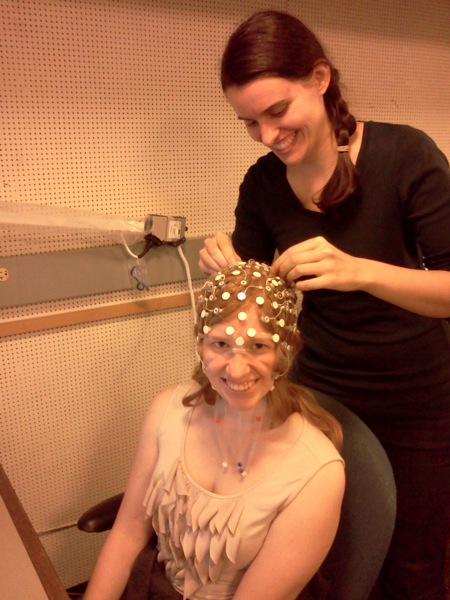
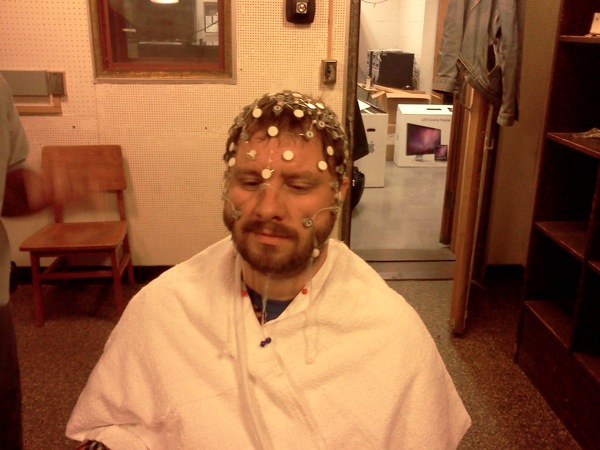
EEG/ERP in the Phonetics Lab

John Kingston writes:

It's with great pleasure that I announce that we now have the capacity  
in the Phonetics Lab to collect EEG/ERP data. We have a 64-channel  
system from Electrical Geodesics Inc. (EGI), the same company that  
manufactured the 128-channel system in Lisa Sanders's lab. The  
engineer from EGI is here this week and is training a number of us in  
the basics of how the system works.

So that any interested member of the department can get trained and  
become at least self-sufficient in running experiments using this  
system, if not yet expert, Brian Dillon and I are organizing a  
training regime that will consist of two experiments, one looking at a  
P-side question, the other at an S-side question. Our idea is to  
design maximally simple experiments in each of these two areas, which  
nonetheless either replicate a well-established effect or look to see  
whether a novel manipulation has an effect. The experiments will be  
very simple, so that we can focus on training people in the use of the  
equipment and software.

If you are interested in taking part in the training, let me or Brian  
know soon. Once we have heard from all interested people, we'll  
schedule a brief meeting to set up a training schedule.

While experiments using this technology are not easy to do, you should  
not be deterred from getting trained by that fact, if you think that  
ms-resolution, real-time data on brain activity might provide answers  
to the questions you're working on. With 64 channels, we can also do  
rough localization of the activity.

Here's what the fun you can have with EEG/ERP looks like!

Eerp3

Eerp2

Eerp1

Call for papers: Conference on Areal Linguistics

Graduate Conference on Areal Linguistics, Grammar and Contacts

Tartu, Estonia

4-6 May 2012

Call for papers: Deadline: 10.01.2012

We invite MA and PhD students, postdocs and young researchers in linguistics to submit abstracts related to the following themes:

- Contact-induced phonological, morphological, syntactic and lexical change

- Lexical and grammatical replication, shared grammaticalization

- Typological investigations and wider perspectives on linguistic areas

- Circum-Baltic languages in general

- Language contact and sociolinguistics

- Language contact and dialectal variation

- Globalization and its effect on minor(ity) languages

- Synchronic, diachronic and panchronic approaches to language contact and linguistic areas

Invited plenary speakers:

- Maria Koptjevskaja-Tamm, Stockholm University

- Axel Holvoet, University of Warsaw, Vilnius University

- Florian Siegl, University of Tartu

The working language of the conference is English. For further information, abstract submission and more, see http://arealling.ut.ee

23 October 2011

Acquisition Lab/LARC Meeting Tomorrow!

There will be an Acquisition Lab/LARC meeting on Monday October 24 at 5:15
in the Partee Room. There will be two presentations:

Rama Novogrodsky
"Acquisition of each one/one each"

Barbara Pearson
"Distributive and Collective Readings in the Elementary School
Mathematics Classroom"


Everyone welcome!

Maziar Toosarvandani speaks in syntax seminar on Wednesday

Maziar Toosarvandani (http://toosarva.scripts.mit.edu/) from MIT will give a presentation in Rajesh Bhatt's syntax seminar on Wednesday, October 26, in Herter 208 at 2:30. The talk will be on the role of nominalization in relative clause formation, with a focus on his work on Paiute. (see:[http://toosarva.scripts.mit.edu/manuscripts.html and http://toosarva.scripts.mit.edu/papers/wscla16-paper.pdf)

For more information about the course: https://sites.google.com/site/umasslx750f11/

Maria Polinsky gives department colloquium this Friday

Maria Polinsky from Harvard University will this week's colloquium on Friday October 28 at 3:30 PM in Machmer E-37.

Title: Explaining syntactic ergativity

Abstract:
This paper shows that ergative languages fall into two separate classes, PP-ergative and DP-ergative languages. In PP-ergative languages, the ergative is contained inside a PP which prevents it from undergoing A-bar movement. This accounts for the widespread phenomenon of syntactic ergativity. DP-ergative languages allow the extraction of the ergative. The paper  then presents and analyzes a cluster of properties associated with the two types. Under the principled division of ergative languages into the proposed two classes, the syntactic ramifications of ergativity are predictable and lead to a more uniform syntax.

Everyone is welcome to a post-colloquium dinner to be held at Alice Harris's house.

Call for Papers: Harvard East Asia Society Grad Student Conference

CALL FOR ABSTRACTS

15th Annual Harvard East Asia Society Graduate Student Conference
Harvard University, Cambridge, MA, USA
February 24 - February 26, 2012

The Harvard East Asia Society (HEAS) Graduate Student Conference invites graduate students from around the world, conducting research in all disciplines, to submit abstracts for our 2012 conference.

Over the past decade, East Asia has experienced unprecedented change, which has had an immense impact on every aspect of the region. As a result, scholars worldwide are exploring and engaging in meaningful discussion on every subject to do with East Asia, past and present.

The HEAS Graduate Student Conference is an annual event which provides an interdisciplinary forum for graduate students to exchange ideas and discuss current research on East Asia. The conference allows young scholars to present their research to both their peers and to eminent scholars in East Asian Studies. All panels will be moderated by Harvard University faculty. The conference will also allow participants to meet others in their field conducting similar research and to forge new professional relationships.

We welcome submissions from graduate students in all disciplines. Papers should be related to East or Inner Asia, including East Asian interactions with the wider world.

Eligibility and Application Guidelines:
1.  Applicants must be currently enrolled in a program of graduate study ("postgraduate" in British degree classification systems).
2.  Papers must be related to East or Inner Asia.
3.  Abstracts must be no longer than 250 words, submitted exactly as directed on the HEAS Individual Paper Application Form.
4.  Deadline for abstract submission:  NOVEMBER 18, 2011

Inquiries:
For general conference inquiries, please contact: heasconference@gmail.com<mailto:heasconference@gmail.com>
For abstract submission inquiries, please contact: heas.abstracts@gmail.com<mailto:heas.abstracts@gmail.com>
--

Undergraduate Linguistics Club forms! Meeting this Wednesday

Benjamin Herman writes:

The next Linguistics club meeting will be at 5pm, Wednesday November 2nd.

There is also an officers' meeting at 5pm, Wednesday October 26th, but  all club members are welcome to join.

PIZZA AS ALWAYS!!!

If you need any assistance regarding club matters, or are looking for a hook-up to any kind of Linguistics study group for your next exam, feel free to contact us:

President:          Jeremy Cahill            jccahill@student.umass.edu
Vice President:     Pratiksha Yalakkishettar pyalakki@student.umass.edu
Secretary:          Benjamin Herman          bsherman@student.umass.edu
Treasurer:          Nathan Banker            nbanker@student.umass.edu
Librarian:          Emily Westland           enicat@verizon.net
Webmaster:          Samuel Baldwin           sbaldwin@student.umass.edu

Call For Papers: Penn Linguistics Colloquium

The 36th Penn Linguistics Colloquium


Call for Papers


The 36th Annual Penn Linguistics Colloquium will take place March 23-25, 2012 at the University of Pennsylvania campus in Philadelphia.

Invited Speaker: Paul Kiparsky (topic and title TBA)
There will also be a special panel on Friday, March 23, which is about game theory and linguistics. More information will be posted closer to the conference.

Papers on any topic in linguistics and associated fields are welcome. Speakers will have 20 minutes for their presentations and 5 minutes for discussion and questions.

Posters: We are happy to announce that this year's PLC will feature a poster session with catered lunch.  Abstracts should indicate whether they are being submitted for consideration as a talk, poster, or both. (See instructions.)

Deadline: Abstracts are due Thursday, November 15, 2011. Notification of acceptance/rejection will be given by Wednesday, January 25, 2012.

Length: Please limit abstracts to one page, single-spaced. An additional page may be used for references and tables. Do not include your name or affiliation within the abstract.

Format: To facilitate the review process, please submit your abstract as a .pdf file.

Abstract Submission: To submit an abstract, you must follow these steps:

  1. To begin, click here to go to our abstract submission system and login.
  2. If you do not have an existing EasyChair account, click on "sign up for an account." You will be asked to fill out a simple form to create an account.
  3. Click "NewSubmission" at the top of the page.
  4. Enter author information in the provided fields. Tick the "Corresponding Author" box for all authors who wish to receive e-mail correspondences or notifications.
  5. Enter your title in the "Title" field.
  6. In the "Abstract" field, please enter a one sentence summary, or any comments you have, in order to assist the committee in assigning reviewers. Please also indicate here whether you would like your submission to be considered for a talk, poster, or both. By default, submissions will be considered for both modes of presentation. Do not paste your full abstract into this field.
  7. Please select the primary category of your abstract. Additional categories may be included in the keywords.
  8. Enter at least three keywords.
  9. Upload your abstract .pdf file in the "Paper" field. Only .pdf files will be accepted. Do not include your name or affiliation in the abstract/file name!
  10. Do not tick the "Abstract only" box, or your .pdf will not be uploaded.
  11. Click "Submit." You will be taken to a summary page of your submission - this is your confirmation that it has been saved. Abstracts will be reviewed anonymously.
  12. You may make any necessary updates by logging in and clicking on "My Submissions."


Proceedings: Conference proceedings will be published as a volume of the Penn Working Papers in Linguistics. Speakers will be invited to provide camera-ready copies of their papers after the Colloquium.

FOR MORE INFORMATION
Email plc36@ling.upenn.edu
Visit http://www.ling.upenn.edu/Events/PLC/plc36


16 October 2011

Semantics guru speaks in semantics seminar on Tuesday

Roger Schwarzschild, our resident guru, will give a talk entitled "Nouns as eventuality predicates and the mass/count distinction" in Angelika Kratzer's seminar this Tuesday, October 18th, at 2:30pm in Bartlett 206.

All are welcome!

Seth Cable awarded LSA's "Early Career Award"

The Linguistic Society of America gives, every year, its Early Career Award to "a new scholar who has made an outstanding contribution to the field of Linguistics." This year, our own Seth Cable has won this coveted award. WHISC has not determined whether Dr. Cable plans on being present at the gala awards ceremony at this year's LSA meeting in Portland, Oregon this January to receive the award.

We at WHISC join Sally Thomason, Chair of the Awards Committee, who offers "congratulations on the super-impressive record of scholarship and teaching that earned you this award!"

Roger Schwarzschild gives department colloq on Friday

Roger Schwarzschild of Rutgers University will present the department colloquium this Friday at 3:30 in Machmer E-37.  A title and abstract follow.

Quantifier Domain Adverbials, Semantic Change and the Comparative

The sentence “Jack is more anxious than Jill” is a comparative.  We know that because of the presence of “more” as well as the presence of “than”.   Across the world’s languages, there are expressions of the comparative that lack a morpheme comparable to “more”  (comparative marker) and there are some that lack a morpheme comparable to “than” (standard marker).   From this perspective, the comparative seems to be redundantly marked in the English example. 

Where is the meaning of the comparative localized, in the more-word?  in the than-word?  in both? Is there a dependency between the grammar of the than-word in a given language and its use of a more-word (Stassen 1985)?

What is the process by which languages acquire a more-word over time?

In this talk, I will be looking at expressions of the comparative in Modern Hebrew.  I’ll propose an analysis that makes use of Quantifier Domain Adverbialization.  In this analysis, both the more-word and the than-word are meaningful. The phrase headed by the than-word can function as a Quantifier-Domain Adverbial whereby it comments on the domain of the degree quantifier more. I’ll address the questions raised above through the lens of the proposed analysis.

NELS 42 schedule published; registration deadline soon!

NELS 42 is being hosted by the University of Toronto this year on the weekend of November 11-13. The theme of the conference is: "The role of Typology and Linguistic Universals in Linguistic Theory." In addition to plenary talks by former UMass faculty David Pesetsky and Lisa Matthewson, other UMass notables presenting include:

Claire Moore-Cantwell "Over- and under-generalization in Learning derivational morphology."

Michael Becker (with Clemens and Nevins) "A richer model is not always more accurate: The case of French and Portuguese plurals."

Maria Gouskova and Michael Becker "Russian 'yer' alternations are governed by the grammar."

Gillian Gallagher "Speaker knowledge of laryngeal phonotactics in Cochabamba Quechua."

Stefan Keine "Long-distance agreement and movement: Evidence from Hindi"

Keir Moulton "What covaries in backward variable binding."

The deadline for early bird registration is this Tuesday: October 18. It looks like a smashing conference (NB: the party is to be held in the Bata Shoe Museum). More information at: NELS 42

LSA Fellows include yet more of UMass

In the October 9th issue of WHISC, it was reported that two UMass faculty (Lisa Selkirk and Angelika Kratzer) and one UMass alumnus (Irene Heim) were inducted into the list of Linguistic Society of America Fellows. Word has since reached WHISC that two other UMass faculty members -- John McCarthy and Alice Harris -- have joined those august ranks this year. Emmon Bach and Barbara Partee were among the inaugural Fellows in 2006 and, with the addition of Professors McCarthy, Harris, Selkirk and Kratzer UMass now has more LSA Fellows than any other University east (or west) of California.

Bhatt at Berkeley

Rajesh Bhatt presented an invited talk at UC, Berkeley on October 10. A title, and abstract, follow.

Amounts versus Cardinalities

Semantic treatments of differentials in comparatives treat measure
phrases (`one pound' in `Jules is one pound heavier than Jim') and
numerals (`one' in `Jules has one more book than Jim') alike. This
seems justified based on the syntax of English but an examination of a
wider variety of languages reveals a peculiar restriction. In Hebrew,
Hindi-Urdu, or German, one cannot say `one more book'; instead the
form `one book more' must be used. I'll explore the consequences of
this peculiar restriction for the semantics of comparatives and the
distinctions between cardinalities and amounts.

RESEARCH and TEACHING POSITIONS for 2011-2012 in Paris

The LabEx EFL is a 10 year project funded by the French Ministry of Higher
Education and Research and relies on a cluster of 13 research teams from 5 Parisian Universities (Sorbonne Nouvelle University, Paris Diderot University, Paris Descartes University, Paris 13 University and INALCO ), in partnership with CNRS, INRIA, EPHE,  and IRD.

The project’s aim is to promote interdisciplinary innovative research between different fields of theoretical and applied linguistics, with a special focus on empirical
foundations and experimental methods.

For the academic year 2011-2012, we are offering the following positions :

-    International chair of quantitative and experimental linguistics (invited professorship)
-    9 Postdoctoral positions in the following fields: prosody, experimental syntax, experimental semantics, text data mining, language typology, history of  computational linguistics
-    2 Engineers in the following fields: language resources, psycholinguistics
-    1 three year PhD stipend  in experimental semantics (laboratory linguistique formelle, University Paris Diderot)
-    2 Research assistants in psycholinguistics (laboratory psychologie de la perception, University Paris Descartes)

Application deadline November 10th 2011

http:// www.labex-efl.org

Another call will be issued for positions to be filled in 2012.


Jacqueline Vaissière
Professeur, coordinateur EFL, Université Sorbonne Nouvelle Paris3 (Sorbonne Paris Cité), Institut Universitaire de France

Laboratoire Phonétique et Phonologie, LPP (CNRS/Paris3)

19 rue des Bernardins
75005 Paris

tel: 06 15 93 94 71 (01 43 26 57 17: gestionnaire du laboratoire)

Pages du laboratoire: http://lpp.univ-paris3.fr
Pages personnelles: 
http://www.personnels.univ-paris3.fr/users/vaissier/pub/ARTICLES/index.htm

WCCFL 30 call for papers

The Thirtieth meeting of the West Coast Conference on Formal Linguistics will be held on April 13-15 at the University of California, Santa Cruz. Abstract submissions are now being taken, the deadline is October 31. For more information, go to: WCCFL 30 @ UC Santa Cruz - Call for Papers

The InterContinental for NELS

The NELS  42 organizers write:

For those of you who are attending NELS42, we would like to announce a
special hotel offer: if you book with the InterContinental hotel for Friday
11 November and Saturday 12 November, you will receive a $40 rebate on your
conference registration fee.

Together with our special reduced hotel rate ($175/night; for comparison,
regular rates start at $229), this is a great opportunity to spend a weekend
in a luxury hotel without breaking the bank! The InterContinental is located
close to campus in Toronto's Yorkville neighbourhood, the city's premier
district for fine shopping and dining.

Act fast -- this offer is available in a limited quantity for a limited time
(expires October 21).

Hotel details:
- 220 Bloor Street West, Toronto, ON M5S 1T8
http://toronto.intercontinental.com/
- Phone: (416) 960-5200, Fax: (416) 960-8269
- Refer to "NELS - University of Toronto" when booking

As the number of registration rebates is limited, please email Will Oxford
(will.oxford@utoronto.ca) before you book to confirm that a rebate is still
available for you.

Frazier at UCLA

Lyn Frazier gave an invited colloquium talk at UCLA on October 7th, entitled "Processing ellipsis: Explorations at the edge of grammar."

SALT 22: Call for Papers

Semantics and Linguistics Theory 22 will be held at the University of Chicago, May 18-20, 2012. We invite submission of abstracts for 30 minute oral presentations (with 10 minute discussion periods) or posters on any topic in natural language semantics.

The abstract submission deadline is January 3, 2012, 11:59pm CST.  We expect to make notifications of acceptance in late February. 

Abstracts must not exceed two pages in letter-size or A4 paper, including examples and references, with 1 inch margins on all sides and 12 point font size. The abstract should have a clear title but should not identify the author(s). The abstract must be submitted electronically in PDF format. Submissions are limited to 1 individual and 1 joint abstract per author, or 2 joint abstracts per author.

We are using EasyChair for the submission and the review process; the url for abstract submission is: 

https://www.easychair.org/conferences/?conf=salt22

For detailed instructions about EasyChair and the submission process, please visit the conference website:

http://salt22.uchicago.edu

When you submit your abstract, you will be asked to indicate whether you would like it to be considered for a talk, a poster or both. 

Please direct inquiries to salt22chicago@gmail.com.

Roeper in Bucharest

Tom Roeper writes:

I gave an invited lecture last week on the topic "An Interface Question: does SLI
involve Pragmatic Excess" at the final meeting of the EU-sponsored CLAD
(Cross-linguistic Language Diagnosis) where a number of theoretical and
applied linguists have been developing evaluation materials for language
problems in LIthuanian, Romanian, Italian, German and other languages.
This project grew out of the European COST project which grew out of our own
DELV project.

Cable's paper accepted to the Amsterdam Colloquium

Seth Cable's paper, "Between Tense and Adverbs: Temporal Remoteness in Kikuyu," has been accepted to the 18th annual Amsterdam Colloquium, held on December 19-21 at the University of Amsterdam. For more information, go to Amsterdam Colloquium 2011: Homepage.

Congratulations Seth!

Jason Overfelt speaks at SRG

Jason Overfelt gave a presentation at the S Reading Group meeting last Thursday, October 13th. A title and abstract follow.

Title: Right Roof Economy


Description:  In this paper I offer new evidence from the licensing of
null-operator structures in various adjunct clauses as well as scope
shifting effects to support the existence of unbounded,
successive-cyclic rightward movement.  The current state of the
analysis provided suggests that the Right Roof Constraint (Ross 1967,
Soames and Perlmutter 1977, McCloskey 1999 i.a.), commonly thought to
limit rightward movement to strictly local applications, can be
reduced to syntactic and interface economy conditions.  This in turn
supports a model of grammar in which linearization is determined by
independent principles responsible for mapping syntactic structure to
PF.

Bhatt at Stanford

Rajesh Bhatt presented joint work with Trupti Nisar, of SNDT Women's University, Mumbai, at Stanford on October 7th. A title and abstract follow.

Shadows of Ergativity: Variable Agreement in Kutchi


Kutchi, a western Indo-Aryan language, presents a typologically unusual split ergative system which manifests ergativity at the wrong end of Silverstein's scale (1st Person is Ergative, everything else seems Nominative). Ergativity is manifested in the 1st Person in Kutchi via object agreement and hence this split is not a surface morphological split of the kind analyzed by Deo & Sharma (2006). Handling non-morphological person based splits is challenging: can the abstract case licensed by a head depend upon the person features of the DP receiving the case? We show that the Kutchi system makes sense once we extend our understanding of ergativity to cover the impoverished agreement found with 2/3 subjects in Perfective Transitive environments in Kutchi - object agreement can then be seen as a limiting case of impoverished subject agreement. We also discuss the typological oddness of Kutchi in the context of the proper location of Silverstein's Generalization (nominal versus verbal), and possible diachronic motivations.

UMass at NECPhon

The Fifth meeting of the Northeast Computational Phonology Workshop met on October 15 at Yale and included talks by Kristine Yu (The Learnability of Tones from the Speech Signal) and Robert Staubs (Learning-Based Biases in Quantity-Insensitive Stress). You can learn more at NECPHON 2011.

09 October 2011

Montrul speaks on Friday, gives workshop on Saturday

Silvina Montrul, of the University of Illinois at Urbana-Champaign, will present two programs October 14-15, a guest lecture on Friday and an informal workshop on Saturday. Her visit is co-sponsored by LARC (Language Acquisition Research Center) with The Center for Latin America, Latino, and Caribbean Studies (CLACLS).

All are invited to attend.

Here is the information

Date  Friday, October 14, 2011

Title   “Attrition or Incomplete Acquisition in Heritage Language Speakers?"

Time  3pm to 5 pm

Location  Herter Hall 301

Complete abstract (and poster) at http://www.umass.edu/spanport/

______________________________________________________

Date:  Saturday, October 15, 2011

Title: Workshop on trends and future directions in bilingual acquisition

Herter Hall 301

10 am to 3 pm

Description of visit:

Montrul's talk on Friday will address the question in the title with data from Spanish, Hindi, and Romanian.  Complete abstract at http://www.umass.edu/spanport/.

Montrul is Professor and Chair in the Department of Spanish, Italian, and Portuguese and is also in the Department of Linguistics.  She is the author of four books on linguistic theory and the acquisition of Spanish, with an emphasis on bilingual and heritage language speakers. She also directs the University Language Academy for Children and the Second Language Acquisition and Bilingualism Lab (SLAB)

Short abstract:  What language-internal and language-external factors contribute to the vulnerability of particular grammatical areas in the weaker language of a bilingual?  What do different heritage languages have in common at the structural level? What are their differences?  Montrul investigates the linguistic competence of heritage speakers in an aspect of the syntax-semantics-pragmatics interface by focusing on knowledge of the morphology for differential object marking (DOM) in these three languages. Experimental evidence points to attrition in Spanish, but incomplete acquisition in Hindi and Romanian. She considers how language internal and language external factors contribute to the degree of intergenerational attrition of the DOM marker in these three languages..


The programs are open to the public.  All are invited to attend. For more information, contact Luiz Amaral (amaral@spanport.umass.edu), Tom Roeper (roeper@linguist.umass.edu) or Barbara Pearson (bpearson@research.umass.edu)

Roger Schwarzschild, semantics guru, arrives this week

Angelika Kratzer writes:

It gives me great pleasure to announce the arrival on October 11 of  our Fall Semantics Guru:

ROGER SCHWARZSCHILD, RUTGERS UNIVERSITY 

http://www.rci.rutgers.edu/~tapuz/

Roger will be delivering the colloquium on October 21. It will be about comparatives. He has also agreed to give a more explorative and specialized talk in my seminar on October 18: that talk will be on nouns as eventuality predicates and the mass/count distinction. I will announce the room for the seminar session in a later message: for now, mark your calendar - everyone is most welcome. 

The main function of a guru is to enlighten us individually. Roger will be using my office, and I am setting up a schedule for him. Please e-mail me for an appointment with him with your availabilities. Roger has worked on a wide range of topics, including plurals, givenness and focus, comparatives, and measure phrases.  He is easy to talk to and you can try out any topic on him.

Lisa Selkirk, Angelika Kratzer and Irene Heim elected Fellows of the LSA

Word has reached WHISC that Lisa Selkirk, Angelika Kratzer and UMass alumnus Irene Heim have been elected fellows of the Linguistic Society of America. A high-placed informant has leaked this portion of a message, reportedly from LSA's Executive Director, Alyson Reed:

On behalf of the LSA Executive Committee, it is my distinct pleasure to
inform you of your nomination and election as a Fellow of the Linguistic
Society of America. The induction ceremony for the 2012 class of Fellows
will take place on Friday, January 6, 2012 at the LSA Annual Meeting in
Portland.

Congratulations Lisa, Angelika and Irene!

New prosody e-mail list

Kristine Yu writes:

I have started a new e-mail list for people interested in prosody for
announcements about meetings, conferences, etc.

You can subscribe at the link at the bottom of the webpage of the
departmental e-mail lists.

http://www.umass.edu/linguist/news/mailer.php

NELS 42 registration open

NELS 24 organizer Will Oxford writes:

We are pleased to announce that online registration for NELS 42 is now open and the preliminary program has been posted on our website:
http://linguistics.utoronto.ca/nels42

Discounted early-bird registration rates are available until October 18. 
Special hotel rates are available until October 11; please visit our website
for details.

For those of you who are presenting, we ask that you check the posted
program to ensure that your information is correct.

We look forward to seeing you in Toronto!

02 October 2011

LARC/Acquisition Lab meeting on Monday

LARC/Acquisition Lab will meet on Monday, October 3, in the Partee Room (South College 301) at 5:15. Tracy Conner will present:

The Acquisition of Possessive Marking in African American English: Testing
for Obligatory Genitive 's with N' Ellipsis*

All are welcome!

Generative Linguists of the Old World: Call for papers

The 35th annual GLOW conference will take place March 28-30, 2012 in Potsdam, Germany. The topic of the colloquium is "Context in grammar: a frequent visitor or a regular inhabitant?". Abstracts are invited for 45 minute talks with an additional 15 minutes for discussion, as well as for two poster sessions. The submission deadline is Tuesday, November 15.

In addition to the colloquium, there will also be four thematic workshops happening on Tuesday, March 27 and Saturday, March 31 that are described in separate postings of WHISC.

The abstract deadline is November 15, 23:59 CET. All abstracts (including abstracts for the workshops) must be submitted through EasyChair. Notifications of acceptance/rejection will be sent out on January 20.

For more information, go to: GLOW 35 @ Potsdam

GLOW Workshop on Empty Categories

Empty categories in syntax: are there any?

Organizers: Gisbert Fanselow and Gereon Müller

Keynote speaker: to be announced. 

Abstract deadline: November 15. 

Description: Obviously, there are morphemes that are devoid of semantic content, so that the postulation of morphemes (or words and phrases) that lack a phonological interpretation can be considered a natural move. Indeed, most grammatical models employ elements that are unpronounced. They may already exist in the lexicon, or be created by grammatical processes such as deletion in syntactic movement chains or in contexts of ellipsis. Grammatical models must be explicit about the licensing condition for such unpronounced material.

There is a more restrictive concept of empty elements: he introduction of empty categories into syntactic representations in the Government-and-Binding framework was once considered a major milestone in the development of grammatical theory. Empty categories in this sense are not just syntactic elements that lack a phonological matrix, rather, they have special properties (as compared to pronounced material) that are subject to specific conditions such as the Empty Category Principle of Chomsky (1981). Their postulation promised, e.g., an elegant approach to the locality of movement or crossover phenomena, identifying connections between seemingly unrelated areas such as A-movement, the binding of reflexives, and scopal properties of quantifiers. Extrasyntactic motivation was argued to exist in the form of morphophonological evidence (recall the discussion of wanna contraction) or psycholinguistic results (e.g., the issue of the reactivation of an antecedent at the site of the trace, Nicol 1993). The postulation of empty categories and the modelling of their syntactic properties figured prominently in argumentations for the idea that UG constitutes an abstract formal competence unrelated to other cognitive capacities in a principled way. The discovery of such invisible (inaudible) elements seemed to put linguistics on par with disciplines such as the physics of elementary particles. The inventory of empty categories was quite differentiated: the traces of A- and A-bar movement, head movement traces, PRO, pro, empty expletives, empty operators. 

Thirty years later, empty categories in this narrow sense have lost most of their importance in syntactic theory. The shift from a representational to a derivational approach in syntax eliminated the need for a device for encoding transformational history such as traces, and attempts to formulate a satisfactory model for properties specific to empty categories have failed (cf., e.g., Hornstein 1995 for the ECP), which is not surprising on the background of a minimalist approach to grammar. 

The purpose of our workshop is an evaluation of empty categories, both in the narrow and the broad sense, as part of the syntactic toolbox, answering questions such as

  • What are the substantial differences between approaches working with and without empty categories? To what extent are these differences merely due to overall changes in the grammatical architecture (e.g., derivation vs. representation?)
  • how can the phenomena previously captured by models of empty categories (such as common locality aspects for different sorts of descriptive phenomena) explained without them?
  • can empty categories be eliminated completely from grammatical theories? What consequences does this have for the abstractness of linguistic representations?

We invite abstracts for 45 + 15 minutes talks. Abstracts are to be submitted via EasyChair. Please consult the abstract guidelines before submitting.

GLOW Workshop on Prosody

Production and perception of prosodically-encoded information structure

Organizers: Frank Kügler and Sabine Zerbian

Keynote speaker: to be announced. 

Deadline: November 15. 

Description: In many (though not in all) languages, information-structural context, e.g. focus, influences the prosodic form of an utterance. Information structure may be prosodically encoded by different acoustic parameters, such as the commonly found increase in intensity, duration and fundamental frequency for focus, but also by differences in pitch register scaling of tones or phrasing. The prosodic encoding of information structure may be based on universal aspects of pitch (Gussenhoven 2004) or driven by communication-oriented processes as a deviation from a neutral register/voice (Kügler 2011). Many studies have investigated the prosodic encoding of information structure in a variety of languages, as e.g. presented at last year's GLOW workshop on the phonological marking of focus and topic. 

The workshop wants to continue this research by turning to the perceptual relevance of the prosodic encoding of information structure. It is therefore interested in the combination of production and perception studies. It aims at dealing with the questions whether listeners perceive prosodic differences related to information structure and how they decode this information at the interface of phonetics, phonology and semantics/pragmatics. E.g. studies by Wu and Xu (2010) have shown that listeners can reliably point out the "prominent" element in a sentence in a language that marks focus prosodically. Swerts et al. (2002) have shown that Dutch listeners are able to reconstruct previous discourse on the basis of prosodic information. Common experimental tasks used to elicit perception and interpretation data include prominence ratings, context matching, and appropriate judgments. 

Particular emphasis will be on work that addresses these issues in lesser studied languages and varieties (including contact varieties and learner varieties) in order to gain insight into the existing variation concerning not only production but also perception of prosodically-encoded information structure and therefore reach at a better understanding of the phenomenon as such. 

Core issues are:

  • Which prosodic cues to information structure do we find in the languages of the world? Are certain cues more prevalent in one type of language than in another?
  • Are prosodic cues to information structure found in production studies perceived and parsed to such an extent that they influence the interpretation of the meaning of a sentence?
  • Are gradual changes in prosodic cues to information structure perceived categorically?
  • If information structure is encoded by means of different prosodic cues such as F0, duration, intensity or phrasing, do listeners make use of all the cues, or which cues are most important in the perception and interpretation of information structure?
  • If in speech production evidence for speaker-specific strategies to prosodically mark information structure is found, how do listeners deal with speaker variation?
  • Does information structure have a direct or indirect effect on the phonetic realization of the intonation contour and/or phrasing? Are there further case studies that provide evidence for a communication-oriented approach in the phonetic encoding of information structure?
  • What are important methodological issues in the study of perception and interpretation of prosodically-encoded information structure?

We invite abstracts for 30 + 15 minute talks. Abstracts are to be submitted via EasyChair. Please consult the abstract guidelines before submitting.

GLOW Workshop on Real Time Processing

The timing of grammar: experimental and theoretical considerations

Organizers: Harald Clahsen and Claudia Felser. 

Keynote speaker: Patrick Sturt (University of Edinburgh). 

Deadline: November 15. 

Description: This workshop examines the real-time application of grammatical constraints during language processing, and how these interact with other types of constraints such as selectional restrictions, discourse-pragmatic biases, or cognitive resource limitations. Our focus will be on constraints which help determine the interpretation of overt or covert anaphoric elements. 

Theoretical linguists have identified a set of grammatical principles or constraints --such as the principles of binding theory, or island constraints-- which are thought to restrict the search for an antecedent for pronouns, or for silent copies of moved constituents. These constraints are known to interact with other types of constraints during language comprehension and production, however, and have also been shown to be violable. The apparent violability of grammatical constraints is often attributed (by linguists) to ''processing factors'' without necessarily being explicit about what exactly these may be. Using timecourse-sensitive experimental methods allows us to gain a better understanding of how grammatical and non-grammatical constraints interact during moment-by-moment language processing, and to examine at what point during processing grammatical constraints are applied, or potentially overridden by other types of constraints. 

The workshop will provide a forum for discussing the timing of grammatical constraints from both experimental and theoretical perspectives. Abstracts are invited which may examine any type of anaphoric (or cataphoric) dependency, including movement dependencies. We also welcome contributions that investigate the timecourse of language processing in children, nonnative speakers, or language-impaired populations. 

We invite abstracts for 45 + 15 minute talks. Abstracts are to be submitted via EasyChair. Please consult the abstract guidelines before submitting.

GLOW Workshop on Focus

GLOW-Workshop "Association with focus", Potsdam, March 31, 2012

Keynote speaker: David Beaver

Important dates:
Workshop date: March 31, 2012 (Please note the change of date!)
Date of the GLOW colloquium: March 28-30, 2012
Deadline: November 15

Description:

Research on focus has always been linked to research on focus-sensitive elements. One central area of research is concerned with the nature of this sensitivity. Is it semantic, and therefore encoded into the lexical meaning of these elements (Rooth 1985, Jacobs 1983)? Or is it pragmatic (Rooth 1992, 1996, von Fintel 1994)? Or are there different kinds of focus-sensitivity, as proposed in Beaver and Clark (2008)? In the case of pragmatic association with focus, must the particles rely on focus, or can they also associate with alternatives provided by other elements such as e.g. contrastive topics (Krifka 1999)? What role does accenting on the focus-sensitive elements themselves play in interpretation?

The second area of research concerns the meaning contribution of focus-sensitive elements. What meanings, across languages, do focus-sensitive elements contribute? In most cases, the contributed meaning components are non-truth-conditional. What is the nature of these meaning components? If e.g. the prejacent of only and the additive component of also are both presupposed (as suggested e.g. in König 1991), why do the presuppositions said to be triggered by also/even differ from those said to be triggered by only: uttering a sentence with also is not permissible unless its presupposition is already in the Common Ground (the presupposition cannot be accommodated), whereas the presupposition of only is easily, and most often, accommodated; see. e.g. the classification of projective meanings by Tonhauser et al. 2011)? A third area of research concerns the function of these particles in discourse. It has been suggested that the function of some focus-sensitive particles lies in discourse structuring, e.g. by marking an utterance as unexpected, unlikely, or surprising (e.g. Karttunen and Peters 1979 for even, Zeevat 2009 and Beaver and Clark 2008 for only). But whose surprise is marked by these particles? That of the hearer, or that of the speaker? And what does this mean for a more fine-grained model of the Common Ground that keeps track of speaker/hearer commitments?

Questions to be discussed include, but are not limited to, the following:

* What is the inventory of focus-sensitive elements in different languages? In what sense do they function as discourse particles (Thurmair 1989)?
* What is the nature of their association with alternatives? Is there evidence for different classes, as suggested by Beaver and Clark (2008), or evidence for a unified account? Are there cross-linguistic similarities with respect to the class that corresponding elements belong to?
* Do such expressions associate exclusively with focus, or rather with alternatives in general (including alternatives generated by contrastive topics, Krifka 1999)?
* What is the nature of their meaning components? What can we learn about presuppositions / conventional / conversational implicatures by looking at association with focus?
* For those focus-sensitive elements that are said to have a scalar meaning component, what is the nature of these scales?
* What is the discourse function of focus-sensitive elements, and what can we learn from them for a model of the Common Ground?

We invite abstracts for 30 + 10 minutes talks. Abstracts are to be submitted via EasyChair (https://www.easychair.org/account/signin.cgi?conf=glow35). Please consult the abstract guidelines (http://www.ling.uni-potsdam.de/~glow/submit.html) before submitting.

For more information, please visit http://www.ling.uni-potsdam.de/~glow/

25 September 2011

SRG events this week: Andrew on Thursday, Gennaro on Saturday

Anisa Schardl writes:

SRG is having a busy week this week!  On Thursday, Andrew will be talking
about modality in English double object constructions, at Rajesh's house,
starting around 6:30pm.  There will be dinner.

Then, on Saturday, Gennaro Chierchia will be visiting us at Barbara's house
at 10am.  Topics of discussion are TBD, but we believe there will be coffee
and bagels.

Food at SRG: We determined last week that we like to have dinner-type food
at SRG.  However, since SRG has no budget, we ask that SRG attendees who
intend to eat please bring a small amount of money to pay back the food
buyers.  BYO dinner is also perfectly acceptable.  Thanks!

Special Lecture in Semantics Seminar on Tuesday

Tuesday, September 27, 2011
Spanish "algunos" and dependent plurality
2:30 p.m., Herter 209
Special invited lecture for LINGUIST 720 Semantics seminar. Everyone is welcome.

Ling Club Interest Meeting: This Thursday

Jeremy Cahill writes:

The first Ling Club meeting is going to be Thursday, 9/29, at 6 in the
linguistics lounge. There'll be pizza.

It won't be particularly long -- we don't have any programming yet,
we're just going to be talking about club ideas, organizational stuff,
and all that. We can talk about better times and sexier spots for
meetings, but only if you show up to this one.

Email me at jccahill@student.umass.edu about pizza preferences and any
topics you want brought up in the meeting. You obviously don't need to
RSVP, but if you do, I'll have a better idea of how much pizza to get
and we won't run out.

To get to the linguistics lounge after hours:

Come in Entrance A (the one on the right if you're looking at South
College from the library) and head upstairs. Turn right at the top of
the stairs. You should already have your animal sacrifice prepared at
this point for safe passage. Take the next set of stairs to the third
floor and go down the hallway. The lounge is at the end, most of the
time.

Some doors might be locked; I'm told they sometimes respond to sweet
nothings whispered into their doorknobs.

If you can't get in, don't know where to go, or find yourself in a
field of poppies instead of the linguistics lounge, my phone number's
857 201 9473. You could also shout really loudly to nobody in
particular. Throwing rocks at windows is discouraged.

LARC/Acquisition Lab Meeting tomorrow!

The next LARC/Acquisition Lab Meeting is Monday Sept 26, in the Partee Room at 5:15.  The presentations are:

"A new approach to preschool language assessment"
Jill deVilliers

"An overview of the LARC-UFRJ-UFRR (Brazil) collaboration in two
projects with native Brazilian languages"
Luiz Amaral


There is a potluck afterwards at Tom Roeper (and Laura Holland's) house
149 High ST Amherst--- bring something if you'd like--but we will
have plenty of food--

All are welcome!

(rides should be available--it is about a 15 minute walk--directions
at the meeting)

Chierchia talks at the department colloq on Friday

On Friday, September 30, at 3:30 in Machmer E-37, Gennaro Chierchia (Harvard University) will present:

Title: Some parameters of epistemic and free choice indefinites

Abstract: In this talk I explore a quadrant of the system of polarity sensitive
items, namely the existential one, that includes items like Italian 'uno
qualunque' and 'un qualche', German 'irgendein', Spanish 'algun', Rumanian
'vreun'. The attempt is to identify the generative matrix at the basis of
typological generalizations on the behavior of such items. The concept of
'implicature' and a characterization of the ways in which implicatures may get
'grammaticized' through an alternatives based semantics play a key role in this
attempt.

Join us at Barbara's house (50 Hobart Ln.) for dinner afterwards.

PHLING at University of Maryland

PHLING, a graduate student research group in philosophy and linguistics at the University of Maryland, College Park, is hosting its first interdisciplinary research symposium, PHLINC (Philosophy & Linguistics Colloquium) on //events//. 

We hope to bring together young researchers working on events in philosophy, linguistics and psychology. We aim to relate the discussion of events in these fields, bringing into conversation the work in ontology, logic, semantics, and perception. We will also have two invited speakers: Achille Varzi, of Columbia University, and Paul Pietroski, of the University of Maryland.

Submissions are open to graduate student researchers only. 10 students will have 30 minutes to present their work, followed by 15 minutes for round-table discussion. The symposium will take place over the weekend of the 31st of March and the 1st of April, in College Park MD. Each day, we will reserve some time for closing discussion.

We are accepting two varieties of submissions for consideration to participate in the symposium, depending on the author's preferences:

TYPE 1 - Abstract - maximum 1 page of text single-spaced, 12pt font, with 1 additional page for examples, figures, and references.

TYPE 2 - Paper - maximum 4000 words, double-spaced, 12pt font, suitable for a 30 minute presentation. Please include references.

All abstracts/paper submissions will be considered by an interdisciplinary audience. Ideally, the composition of speakers will reflect in equal parts contributions from Linguistics, Philosophy, and Psychology. As the goal of the symposium is to bring together researchers with a strong focus on interdisciplinary cognitive science, reviewers will be looking for evidence in abstract/paper submissions that the author(s) are able to communicate effectively to individuals outside of their primary field.

We will be accepting abstract/paper submissions until January 7th, 2012, and final selections will be made by February 4th, 2012. Abstracts/papers should be sent to phling@umd.edu, with "Events - Abstract" or "Events - Paper" as well as your name in the title of the email.

Note that as this is a graduate student symposium, we will make special efforts to help with accommodations in College Park or Washington, D.C., and transportation to the university. Details will be provided closer to the date on our website,http://phling.umd.edu/symposia.html

Richard Schmierer is Ambassador to Oman

Peggy Speas writes:

Oh the places you might go - Belated kudos to alumnus Richard Schmierer, who
we recently learned was appointed US Ambassador to Oman in 2009.  After
receiving his Ph.D. in Linguistics at UMass in 1977, Dr. Schmierer embarked
on a career in the foreign service, which has taken him to Germany, Saudi
Arabia, Iraq, Washington DC and now Oman.  In addition to being a diplomat,
he has taught at the School of Foreign Service at Georgetown University and
is the author of the 2007 book *Iraq:  Policy and Perceptions.*  Next time
someone asks what one can DO with a degree in Linguistics, point them to Dr.
Schmierer's Wikipedia page!

18 September 2011

Acquisition Lab/LARC Meeting on Monday

Everyone Welcome!

September 19, 2011

Monday 5: 15

Partee Room


Gustavo Freire [University of Sao Paolo]

"Perception and Causative Verbs and their Acquisition"

UMAFLAB meets this Thursday

Seth Cable writes:

The first full meeting of UMAFLAB (UMass Funny Languages Breakfast)  
will take place *Thursday*, September 22 at 9AM in *Bartlett 11* (note  
day and room change).

At this meeting, Elizabeth Bogal-Allbritten will present some of the  
results of fieldwork this summer, examining modals in Navajo.

As noted above, the day and location of our meetings have changed. In  
order to accommodate everyone's schedule, our meetings will take place  
*Thursday* mornings at 9AM. Unfortunately, this means we won't be able  
to meet in the Partee room, since the McCarthy-Pater grant group meets  
there at that time. However, Brian Dillon has very generously offered  
up his lab meeting room, which is in Bartlett 11.

At today's organizational meeting, we put together the following  
schedule of meetings for the remainder of the term:

Thursday 9/22 (9AM, Bartlett 11):
Elizabeth Bogal-Allbritten (Navajo Modals)

Thursday 10/6 (9AM, Bartlett 11):
Rex Wallace (A puzzle concerning Etruscan)

Thursday 10/20 (9AM, Bartlett 11):
Suzi Lima (Projects on Yudja and Kawaiwete)

Thursday 11/3 (9AM, Bartlett 11):
Jérémy Pasquereau (Projects on languages of Caucasus)

Thursday 11/17 (9AM, Bartlett 11):
Seth Cable (Tlingit Distributive Numerals or Multiple Tenses in Kikuyu)
[note: I'm happy to drop my slot if another student would like to  
present]

Thursday 12/1 (9AM, Bartlett 11):
Emiliana Cruz (Projects on Chatino language)

Thursday 12/15:
Possible extra date, if we'd like to do it.

If you'd like to get on the e-mail list for future meetings, please  
just drop me an e-mail letting me know.

Psycho/Syntax Lab meetings

Brian Dillon writes:

This is just a quick note to announce that the Psycho/Syntax lab meetings for the semester have been scheduled, and that anyone who is interested in attending any or all of the meetings is more than welcome to come! Meetings are at 9am in 11 Barlett (space permitting). The schedule for Fall 2011 is:

9/29: Jason Overfelt (Tigrinya wh-in-situ, visual world eye-tracking)

10/13: Meg Grant (Extraction from comparatives)

10/27: Shayne Sloggett (German case attraction)

11/10: Magda Oiry (French wh-in-situ)

12/8: Rajesh Bhatt / Brian Dillon (Hindi agreement, Mechanical Turk for judgment studies)

The list can also be found at the XLUM blog: http://blogs.umass.edu/XLUM. Reminders will be sent to the "linguist-experimental" list, so if you'd like to continue getting more messages like this one, sign up for that list here: http://www.umass.edu/linguist/news/mailer.php.


Robots start talking in Australia!

http://discovermagazine.com/2011/sep/16-robots-invent-their-own-language

NSF East Asia and Pacific Summer Institutes

Brian Dillon writes:

The NSF's East Asia and Pacific Summer Institutes for US graduate students program (EAPSI; http://www.nsfsi.org) is now accepting applications for their 2012 institute. The grants from this program support graduate students who want to go perform research in East Asia (construed very broadly, it includes Australia and New Zealand), and provides funding, travel and host arrangements, and good beginning experience with grant-writing for the NSF. Compared to other NSF programs there is a pretty high rate of success. I got a grant through this program to go to China for a summer to do research and it was definitely among the most useful things I did to advance my doctoral research. For linguists who want to work on East Asian/Pacific/Australian languages, it's usually fairly straightforward to put together a statement saying why Asia/the Pacific would be a good place to do research. I'd be happy to talk to people who are interested in pursuing one of these about how to put together an application.

The official call is copied below.

NATIONAL SCIENCE FOUNDATION EAST ASIA AND PACIFIC SUMMER INSTITUTES FOR U.S. GRADUATE STUDENTS - 2012 APPLICATION NOW OPEN

The National Science Foundation (NSF) East Asia and Pacific Summer Institutes for U.S. Graduate Students (EAPSI) is a flagship international fellowship program for developing the next generation of globally  engaged U.S. scientists and engineers knowledgeable about the Asian and Pacific regions. The Summer Institutes are hosted by foreign counterparts committed to increasing opportunities for young U.S. researchers to work in research facilities and with host mentors abroad. Fellows are supported to participate in eight-week research experiences at host laboratories in Australia, China, Japan (10 weeks), Korea, New Zealand, Singapore and Taiwan from June to August. The program provides a $5,000 summer stipend, round-trip airfare to the host location, living expenses abroad, and an introduction to the society, culture, language, and research environment of the host location.

The 2012 application is now open and will close at 5:00 pm proposer’s local time on November 9, 2011. Application instructions are available online at www.nsfsi.org. For further information concerning benefits, eligibility, and tips on applying, applicants are encouraged to visitwww.nsf.gov/eapsi or www.nsfsi.org.

NSF recognizes the importance of enabling U.S. researchers and educators to advance their work through international collaborations and the value of ensuring that future generations of U.S. scientists and engineers gain professional experience beyond this nation's borders early in their careers. The program is intended for U.S. graduate students pursuing studies in fields supported by the National Science Foundation. Women, minorities, and persons with disabilities are strongly encouraged to apply for the EAPSI. Applicants must be enrolled in a research-oriented master's or PhD program and be U.S. citizens or U.S. permanent residents by the application deadline date. Students in combined bachelor/master degree programs must have matriculated from the undergraduate degree program by the application deadline date. 

The first Summer Institutes began in Japan in 1990, and to date over 2,400 U.S. graduate students have participated in the program.

Should you have any questions, please contact the EAPSI Help Desk by email at eapsi@nsfsi.orgor by phone at 1-866-501-2922.

Postdoc in Semantics and Pragmatics at University of Amsterdam

We are seeking a highly motivated Postdoctoral Research fellow to work in the project "Indefinites and beyond: Evolutionary pragmatics and typological semantics" at the ILLC-Department of Philosophy, University of Amsterdam

For information on the project please visit the website at http://staff.science.uva.nl/~maloni/Indefinites/

Qualifications: The candidate must have a PhD in linguistics or philosophy or a related area
Starting date: Preferably 1 January  2012, but extensible to 1 March  2012
Total duration: 6-8 months
Closing date for applications:  1 November 2011

The gross monthly salary will be between €3195 and 4374 [‘Onderzoeker 3’; salary scale 11] in the case of a full-time position (38 hours/week). Depending on experience and date of completion of the PhD an appointment as ‘Onderzoeker 4’ (salary scale 10) may be necessary. Secondary benefits at Dutch universities are attractive and include holiday pay and an end of year bonus.

Interested candidates are encouraged to get in touch at their earliest convenience with Maria Aloni  (m.d.aloni@uva.nl)

Please include the following documents in your application: CV, list of publications, names and contact details of two personal references

Our Worst Building is better than MIT's Worst Building

In the widely touted CNBC lists of worsts, UMass ranks better than MIT.

http://www.cnbc.com/id/44231749/?slide=8
http://www.cnbc.com/id/44231749/?slide=9

(Thanks to David Pesetsky and Angelika Kratzer for bringing this contest to WHISC's attention.)

Festschrift for Jorge Hankamer

Nick LaCara writes:

After nearly two years in the making, I am pleased to inform WHISC about a working papers/festschrift volume for which I was one of the editors. The volume is entitled Morphology at Santa Cruz: Papers in Honor of Jorge Hankamer (or MASC, for short). MASC grew out of the morphology seminar that Jorge Hankamer organized and taught in the fall of 2009 at UCSC which itself developed from the department's long-running morphology reading group. Many of the papers in the volume are revised versions of those originally written for that seminar. In addition to these, several others were solicited from UCSC alums and associates. A number of the papers, though not all them, are written in or about Distributed Morphology, and they focus on languages from Arabic and Bulgarian to Icelandic and Luiseño.

The volume has been published by the Linguistics Research Center at UCSC through the University of California's eScholarship website. It is available in its entirety and it's absolutely free: http://escholarship.org/uc/lrc_masc

Complexity Workshop

Fritz Newmeyer writes:

We are organizing a conference in Seattle next March on a topic that will be of interest to many of you. It's on 'Formal Linguistics and the Measurement of Grammatical Complexity'. Here's the url:

http://depts.washington.edu/lingconf/index.php

The basic idea is to probe whether 'formal linguistics' (broadly defined) has anything to contribute to the topic of relative overall complexity of languages.

11 September 2011

First Meeting of Acquisition Lab/LARC this Monday

Tom Roeper writes:

The First Meeting of  Acquisition Lab/LARC  (Language Acquisition Resource Center) will be at 5:15 this Monday, September 12, in the Partee Room (301 South College). Everyone is Welcome!!

On this week's agenda:

1. Organization: introductions, future meetings, experimental plans

2.  Magda Oiry: "Exploring the pragmatics of long-distance questions"

If you are interested in language acquisition, this is an excellent way to
learn about ongoing work at UMass and Smith, present your own ideas, and get feedback for planned projects.

SRG starts up

Anisa Schardl writes:

SRG (the Syntax/Semantics Reading Group) had a brief planning meeting on Friday.  This is how it went:

We would like SRG to continue to exist.  The plan is that most of the time, S-side members of the department will offer informal, low-key presentations of the work they've been doing in the past year or so, and the group will be there to provide feedback and ideas.  This way, S-siders will be more in touch with each other's work.  SRG will continue to be a place where people can give practice talks, we will continue to invite S-side colloq speakers and gurus to talk to us, and if anyone actually wants to read something to discuss, we can do that too.  If you want to present or you have an idea of what to read, email me (Anisa).

We're sticking with Thursday evenings, every two weeks or so, and we'll be alternating between Northampton and Amherst locations.

The first real meeting will be this coming Thursday, September 15th, at Barbara's house (50 Hobart Lane in Amherst.)  It will be at 6pm, and we'll order some dinner in so we don't starve.  Stefan will be presenting his work on long-distance agreement in Hindi.

The next few scheduled meetings are as follows, locations TBA:

Sept 29 -- Andrew W.
Oct 27 -- Jason

... plus hopefully some presentations by gurus and colloq speakers during that time.

As far as the SRG traditions of cocktails and other fancy edibles, we hope that this will emerge organically.  If someone wants to provide a fancy edible, we will be happy to consume it.

SRG has a Google calendar!  You can access it in any of the following ways:


Roger Levy speaks Friday, September 16

Joe Pater writes:

The Institute for Computational and Experimental Study of Language (suggested pronunciation: ['aisəl]) welcomes Roger Levy of the University of California, San Diego, who will present on "Probabilistic Knowledge and Uncertain Input in Rational Human Sentence Comprehension" on at 3:30, Friday September 16th in Machmer E-37. A reception will follow in South College.

Roger will be available for meetings on Friday morning from 9-12. Graduate students and post-docs are especially encouraged to meet with him. To sign up for a meeting, please indicate your available times here:

http://www.doodle.com/hqzwkrnacz4k79az

An abstract of Professor Levy's talk follows:

Considering the adversity of the conditions under which linguistic communication takes place in everyday life — ambiguity of the signal, environmental competition for our attention, speaker error, our limited memory, and so forth — it is perhaps remarkable that we are as successful at it as we are. Perhaps the leading explanation of this success is that (a) the linguistic signal is redundant, (b) diverse information sources are generally available that can help us obtain infer something close to the intended message when comprehending an utterance, and (c) we use these diverse information sources very quickly and to the fullest extent possible. This explanation suggests a theory of language comprehension as a rational, evidential process. In this talk, I describe recent research on how we can use the tools of computational linguistics to formalize and implement such a theory, and to apply it to a variety of problems in human sentence comprehension, subsuming both classic cases of garden-path disambiguation and syntactic processing difficulty patterns in the absence of structural ambiguity. In addition, I address a number of phenomena that remain clear puzzles for the rational approach, due to an apparent failure to use information available in a sentence appropriately in global or incremental inferences about the correct interpretation of a sentence. I argue that the apparent puzzle posed by these phenomena for models of rational sentence comprehension may derive from the failure of existing models to appropriately account for the environmental and cognitive constraints — in this case, the inherent uncertainty of perceptual input, and humans’ ability to compensate for it — under which comprehension takes place. I present a new probabilistic model of language comprehension under uncertain input and show that this model leads to solutions to the above puzzles. I also present behavioral data in support of novel predictions made by the model. More generally, I suggest that appropriately accounting for envir
onmental and cognitive constraints in probabilistic models can lead to a more nuanced and ultimately more satisfactory picture of key aspects of language processing and of human cognition.

UMass Morphologists at the LSA Institute

A workshop, "The Challenges of Complex Morphology to Morphological Theory"
was organized at this summer's Linguistic Institute in Boulder by Alice
Harris, Farrell Ackerman, and Gabriela Caballero.  Presentations included
Robert Staubs' "Operational Exponence: Process Morphology in Harmonic
Serialism", Minta Elsman's "Multiple Plural Exponence in Maay: An Optimality
Theoretic Account", and Alice Harris's "Exponent Adjacency in Multiple
Exponence."

UMass at GALA

Tom Roeper writes:

GALA in Thessalonika, Greece, Sept 6-8th had a good representation from
UMass. Papers or Posters were presented by UMass alumn Bart Hollebrandse, Miren Hodgson as well as Barbara Pearson, Chloe Gu and Tom Roeper. In addition UMass visitors Angeliek van Hout, Petra Schulz, Ruth Lopes, Rama Novogrodski made presentations.