Reminder and Grants Info
ESSLLI 2012 STUDENT SESSION
Held during
The 24th European Summer School
in Logic, Language and Information
Opole, Poland, August 6-17, 2012
EXTENDED DEADLINE: APRIL 30, 2012
http://loriweb.org/ESSLLI2012StuS/
This is a reminder of the final, extended deadline for submission to the ESSLLI 2012 Student Session and a notification that the ESSLLI 2012 OC are offering grants in form of waived fees to selected students. Preferences will be given to students actively participating in the Student Session.
The deadline for submitting to the ESSLLI 2012 StuS is **APRIL 30**
For more information of grant application, instructions for authors and important dates, please refer to the Student Session website: http://loriweb.org/ESSLLI2012StuS/
28 April 2012
2012 ESSLLI student grants extended to Monday

Mini-conference on Thursday, May 3
The second year students will give short presentations of their generals papers in the annual mini-conference, this Thursday (May 3). It will be held in 22 Arnold House, from 1-4, with refreshments served.
Cable gets HFA Project funds award
Seth Cable has been awarded monies to support his work over the summer on Tlingit from the Humanities and Fine Arts Project funds.
Congratulations Seth!
Linguistics Majors present at the Undergraduate Research Conference
On Friday, April 27, there were three presentations at the Massachusetts' Undergraduate Research Conference by UMass linguists. They were:
Katherine Devane Brown, Learning to understand foreign-accented speech, 11:35-12:20, Room 911
Kayly Tillman, Perception of Intrusive /r/ in Bostonian English, 11:35-12:20, Room 911
Chris Garry, An Algorithm for Tracking Vertical Larynx Movement, 3:30-4:15 in the Auditorium, Board 38A
For more information, go to:
http://honorsapp.honors.umass.edu/aspnet_resources/conference/2012ucdprogram.pdf
Congratulations!
22 April 2012
Ayesha Kidwai gives talk on Wednesday
Ayesha Kidwai, Professor at Jawaharlal Nehru University in New Delhi, India, will give a talk entitled "Extraposition, Scrambling and Wh-construal in Hindi and Bangla Finite Complements" on Wednesday, April 25, at 2:30 in Herter 204 (abstract follows).
Professor Kidwai has worked on scrambling, binding, topic and focus, intonation, and information structure in a number of languages, with a focus on Hindi-Urdu and Meiteilon. She is the author of the OUP book `XP-Adjunction in Universal Grammar: Scrambling and Binding in Hindi-Urdu'. Most recently she translated `In Freedom's Shade', a memoir by Anis Kidwai that documents the first twenty years of independent India.
Abstract:
In this talk, I will revisit the familiar question of finite clause extraposition and argue that the Hindi and Bangla facts from rightward and leftward scrambling, WH-construal and bound anaphora in embedded clauses suggest that the non-canonical rightward positioning of finite complements is effected by a generalised, and revised, version of TH/EX (Chomsky 1999/2001). I will argue that while this 'displacement' is driven by interface conditions holding primarily at the PHON interface, it also serves to facilitate the observance of SEM interface conditions. Along the way to this analysis, I will propose that the distribution of expletive pronominals that frequently occur in construction with such finite clauses is fundamentally unrelated to the extraposition operation per se, and that the differences between Hindi and Bangla reduce to a single lexical item -- the nature of the embedded C0.
Gaja Jarosz speaks on Friday, April 27
Gaja Jarosz, from Yale University, will give the department colloquium talk this Friday, April 27, at 3:30PM in Machmer E-37. You can learn more about Professor Jarosz at http://pantheon.yale.edu/~gjs42/.
The title and abstract for her talk are:
Learning Hidden Structure in OT and HG
Computational models of learning with violable constraints have led to significant progress in understanding how learners acquire the complex system of knowledge that is phonology; however, a number of significant challenges remain. This talk addresses one of the major outstanding problems, learning in the face of hidden structure, and examines the challenges this problem poses for successful and efficient learning. The particular kind of hidden structure I focus on in this talk is structural ambiguity, which includes any kind of latent structure assigned when parsing a phonological string, such as metrical feet, (sub)syllabic constituents, and autosegmental representations. I examine Robust Interpretive Parsing (Tesar and Smolensky 1998), a well-known approach to structural ambiguity in OT, and show that its extension to probabilistic constraint-based grammars as first described by Boersma (2003) is problematic. The problem occurs because the proposed formulation fails to take advantage of the rich information contained in the learner's stochastic grammar. I propose two modifications to the learning algorithm, one trivial and another more involved, and show that both lead to improvements in the success rates of Stochastic OT and noisy HG learners. I then examine another important aspect of these algorithms' performance: their efficiency. The results of this second evaluation are complex but indicate an efficiency advantage for the proposed modifications as well. I discuss the implications for the relative merits of OT and HG as well as for the evaluation of computational models of phonological learning more generally.
Workshop on memory and long-distance dependencies
On Wednesday, May 16th, ICESL is sponsoring a one-day workshop hosted by Brian Dillon and Lyn Frazier, with the goal of discussing issues at the interface of memory retrieval and the construction of long-distance dependencies, and in particular, if and how structural notions like c-command are used during the online comprehension of binding dependencies. Invited speakers include Brian McElree (NYU), Colin Phillips (UMD), and Jeff Runner (U of R). For more information, please visit the workshop website:
http://people.umass.edu/bwdillon/workshop.html
If you plan on attending, please let Brian know so that we can have an accurate head-count.
Cable awarded Jacobs Research Funds
Seth Cable has been awarded a Jacobs Research Fund grant for his fieldwork on Tlingit this summer.
Congratulations Seth!
Entering class of Graduate Program announced
WHISC is pleased to welcome the following individuals, who will join the graduate program in the Fall of 2012.
Hsin-Lun Huang has a BA from National Taiwan University and is completing an MA at National Chengchi University. He is interested in classifiers, resultatives, long-distance binding, and other topics in syntax and has worked primarily on his native language, Mandarin.
Jon Ander Mendia some of us already know. He comes to us from the University of the Basque Country (in Spain), where he earned his BA and MA. He is interested in semantics, especially topics involving quantification.
Ethan Poole s completing his BA at the University of Minnesota, Twin Cities. Ethan has been awarded an NSF Fellowship, and he serves as web master for the LSA. He is interested in syntax, having worked on various topics in Mainland Scandinavian languages.
Amanda Rysling was admitted last year but deferred so that she could accept a Fulbright Fellowship to study and do research in Poland. She completed her BA at NYU. She is interested in morphology-phonology interface, exceptionality and its roots, and syllable structure.
Megan Somerday comes to us from the University of North Carolina, Chapel Hill. Having done a second major in math, she worked for a while in a statistics firm. She is interested in OT phonology, acquisition, and AAVE.
Rajesh Bhatt gives colloquium at the University of Connecticut
Rajesh Bhatt will give the colloquium at the University of Connecticut on Friday, April 27. The title of his talk is "Differential Phrases and a Semantics for Comparatives."
Call for papers: (In)definites and weak reference
(IN) DEFINITES AND WEAK REFERENCE
We are pleased to announce the conference (In)Definites and Weak Reference, which will be held at Universidade Federal de Santa Catarina – UFSC - in Florianopolis (Brazil), on August 20-21, 2012.
The conference is part of the activities of the CAPES-COFECUB Cooperation Project.
Invited Speakers:
Greg Carlson (University of Rochester)
Claire Beyssade (CNRS – IJN Paris)
Carmen Dobrovie-Sorin (CNRS – Paris 7)
Important Dates:
Abstract Submission: May 15
Notification of acceptance/rejection: June 15
Program: June 20
Information about the conference: http://www.barenominals.ufsc.br/
Conference on Formal Approaches to Heritage Language
Over this weekend, the Language Acquisition Research Center hosted a conference on formal approaches to Heritage Language, with invited lectures by Acrísio Pires, Ana Perez-Leroux and Maria Polinsky. More information can be found at:
Lisa Green speaks at Stony Brook
Lisa Green will give a talk at Stony Brook on Thursday, April 26 as part of the Language Diversity Lecture series. The title of her talk is: "African American English Through the Years: From Hot Topics and Debates to Linguistic Research."
Call for Papers: Workshop on Locality and Directionality at the Morphosyntax-Phonology Interface
Stanford University is hosting a workshop on Locality and Directionality at the Morphosyntax-Phonlogy Interface on October 12-14, 2012. Talks are 45 minutes long, and there is a poster session as well. The two page abstracts are due on June 1.
More information can be found at:
15 April 2012
John McCarthy to be Dean and Vice-Provost
Congratulations to John McCarthy, who has been appointed Dean of the Graduate School and Vice-Provost for Graduate Education, effective this September.
Even as he takes on these new administrative responsibilities, John will remain engaged in graduate teaching, advising, and research in the Linguistics Department, and he will teach a seminar every year. As happened with Michael Becker this year, the department will also receive funds annually to hire a visiting faculty member in phonology.
John Drury (Stony Brook) gives a talk on April 20th
Lisa Sanders writes:
John Drury (http://www.linguistics.stonybrook.edu/faculty/john.drury) will be visiting from Stony Brook University on April 20th. He'll be giving an ICESL colloquium on Friday, April 20th at 3:30 pm in Tobin 423. If you are interested in meeting with him before the talk (12-3), email Lisa Sanders (lsanders@psych.umass.edu) to set the time and place. If you are interested in meeting with him after the talk, join us for the reception in the Partee room.
The title of his talk is "On the etiology of some of the usual suspects in language ERP research: LANs, N400s, and P600s (but especially LANs).
An abstract can be found here:
http://www.umass.edu/linguist/icesl/events/john-drury-april-20-2012.
UMass at the Modality Workshop in Ottawa
This Friday and Saturday, April 20-21, Ottawa University will sponsor a conference on Modality (Modality@OttawaU).
Angelika Kratzer, and former UMass faculty Lisa Matthewson, are invited speakers.
Angelika Kratzer's talk is entitled "Modals as building blocks for attitude ascriptions"
Lisa Mattewson's talk (co-authored with UMass alumnus Hotze Rullman) is entitled "Epistemic modality with a past temporal perspective."
Many UMass graduates are on the program:
Aynat Rubinstein, is presenting "Developing a methodology for modality-type annotations on a large scale," a paper co-authored with Dan Simonson, Joo Chung, Hillary Harner, Graham Katz and Paul Portner.
Ilaria Frana is presenting "Adnominal conditions and modal NPs"
Luis Alonso Ovalle and Junko Shimoyama are presenting "Modality in the nominal domain: exploring Japanese wh-ka indeterminates."
Luis Alonso Ovalle and Paula Menéndez-Benito are presenting "Indifference and Modality: the case of Spanish 'uno cualquier' "
Aynat Rubinstein is presenting "Straddling the line between attitude verbs and necessity modals"
Ana Arregui is presenting "Variation in imperfectives," a paper co-authored with María Luisa Rivero and Andrés Salanova.
Barbara at Cafe ZaVtra (Moscow)
Barbara Partee writes:
On Thursday April 19 I'll give a talk in Russian for a general audience at the Cafe ZaVtra in Moscow, on formal semantics as the offspring of linguistics and philosophy. (Formal’naja semantic oak porozhdenie lingvistiki i filosofii.) There will be a live video broadcast over the website of the hosting organization, polit.ru. The website with both the announcement of the talk and the link for the streaming video is here: http://polit.ru/article/2012/03/28/anons_partee/ . The talk starts at 7pm Moscow time (11am Amherst time); the talk will be followed by an hour of questions and answers – doing that in Russian is the part I’m most nervous about, so I’m doing a couple of rehearsals of that part. And Volodja and other colleagues will be there to help when I can’t find the words I’m searching for or absolutely can’t understand some question.
By the way, both Google translate and Facebook were tremendously useful as I worked on my first draft. Google translate has to be used with caution – you can’t just turn it loose. It wanted to translate ‘validity’ with a term relating to the expiration date on medicines and warranties; and when I gave it David Lewis’s famous sentence, “Semantics without the treatment of truth conditions is not semantics”, it wanted to translate ‘treatment’ in the sense of medical treatment, as if we needed to cure semantics of the ailment of truth conditions. (Like.) But with care and some iterations between the two languages and a few tricks, it can really help. And bilingual friends on Facebook helped at many crucial points as I worked. This weekend I’ll revise the talk and make the slides, then a couple of rehearsals and I’ll be as ready as I’ll ever be. Volodja is helping in many ways, including discussing this stuff in Russian with me at dinner every day. (I must confess that up until now, the great majority of my discussions of semantics with colleagues and students have been in English, and I’ve had to do a lot of homework for this talk! But although I’m a little bit nervous, I’m really looking forward to it!)
Anne Pycha gives colloquium at Stony Brook
Anne Pycha will give the colloquium talk at Stony Brook on April 20. The title of her talk is "Phonological signatures in words: Evidence from production and perception of diphthongs." An abstract follows.
This talk wrestles with two problems that face phonology. First, non-local dependencies in phonology are not widely attested, despite the fact that they are common at other levels of linguistic analysis, such as syntax. Second, many phonological processes bear close resemblance to phonetic processes, suggesting that no real difference exists between abstract phonological structures and the physical events of articulation. In this talk, I pursue the hypothesis that phonologically contrastive processes exhibit acoustic “signatures” that are a) non-local and b) absent from otherwise similar phonetic processes. Experiment 1 demonstrates that English speakers produce non-local dependencies in order to maintain contrast between words such as bite vs. bide, but not in order to accomplish other tasks, such as changing speech rates or signaling phrasal positions. Experiments 2 & 3 demonstrate that English listeners can use these dependencies to perceptually distinguish between words like bite vs. bide, even in the absence of other cues. The upshot of these findings, which build on previous work that I have done in Hungarian, is that phonology does use non-local dependencies, and these dependencies crucially distinguish it from phonetics. I analyze non-locality in both languages as motivated by a need to target maximal segments, and I examine the implications of this analysis for cross-linguistic typology.
Career Services advisor speaks at Undergraduate Club
Jeremy Cahill writes:
A Career Services advisor will be speaking about internships and job search resources at Linguistics Club on Tuesday, April 17th, at 5:15
PM in the Partee room.
All undergrads are invited and pizza will be provided.
Internship + Job Search Workshop w/ Career Services
Tuesday, April 17 at 5:15 PM
301 South College (across from DuBois Library)
UMass at Chicago Linguistics Society
The 48th annual meeting of the Chicago Linguistics Society meets Thursday (April 19) through Saturday (April 21) at the University of Chicago.
UMass graduate student Elizabeth Bogal-Allbritten will present "Slightly coerced: Processing evidence for adjectival coercion by minimizers."
UMass alumnus Kai von Fintel is an invited speaker: he will present "What's an Imperative"
UMass alumnus John Alderete will present "Learning phonotactics without rules: A connectionist model OCP-Place in Arabic," a paper co-authored with Stefan Frisch.
UMass alumnus Elliott Moreton will present "Is phonological learning special?," a paper co-authored with Katya Pertsova
Cable at Harvard
Seth Cable is giving a colloquium talk at Harvard University on Friday, April 20. The title of his talk is "Beyond the Past, Present and Future: Towards a Semantics of 'Graded Tense' in Gikuyu."
Last Call for papers for Workshop on Information, Discourse Structure and Levels of Meaning: tomorrow!
Call for papers for the workshop on Information, Discourse Structure
and Levels of Meaning (IDL 12)
25-26 October 2012 in Barcelona
More info: http://blogs.uab.cat/idl12/
Deadline for abstracts submissions: 16-Apr-2012
Information and discourse structure, and the analysis of different levels of meaning (conventional and conversational implicatures, presuppositions, etc.) have been two of the most fruitful areas of research in the semantics-pragmatics interface in the last decade. This workshop aims to study the interactions between these two areas. Thus, the questions that this workshop will address go in two
directions.
1. How does information and discourse structure affect the different
levels of meaning? Can we obtain a better understanding of, for
instance, conversational implicatures or presuppositions, once the
topic-focus structure is taken into account?
2. How do the dimensions of meaning affect the information structure
of discourse? Can we obtain a better understanding of concepts such as
topic, focus, contrastive topic, background or QUD, once the
properties of the different levels of meaning are taken into account?
Invited speakers:
Daniel Büring (Universität Wien)
Bart Geurts (Radboud University Nijmegen)
Craige Roberts (Ohio State University)
Gregory Ward (Northwestern University)
We invite contributions for 30′ oral presentations.
Abstracts should conform to the following guidelines:
-Abstracts must be submitted electronically via Easychair:
https://www.easychair.org/account/signin.cgi?conf=idl12
-Abstracts should be anonymous.
-Abstracts should not exceed two pages, including examples and references.
-Submissions are restricted to one single-authored or one co-authored
abstract at most.
-The conference language is English: abstracts and talks will be in English.
-Page format: A4, 2.5 cm margins on all sides, at least 12 pt Times
New Roman font, single line spacing.
-File format: .pdf
-File name: surname.pdf
Call for papers: Texas Linguistics Conference
13th Texas Linguistics Society (TLS) Conference
June 23-24, 2012
University of Texas at Austin
TLS is a graduate-student run conference in linguistics organized by the Texas Linguistics Society and the Department of Linguistics at the University of Texas at Austin. This year's TLS is co-located with the North American Summer School in Logic, Language, and Information and associated workshops and symposia.
http://uts.cc.utexas.edu/~tls/
TLS 13 will be structured around two para-sessions: (1) the semantics and pragmatics of questions and question-based models of discourse, and (2) signed languages and meaning. While we encourage submissions related to these themes, we are also interested in submissions on topics of general linguistic interest. Papers on language related topics from disciplines including anthropology, cognitive science, neuroscience, philosophy of language, and psychology will also be considered.
--- Keynote Speakers ---
Nicholas Asher (IRIT, CNRS/Université Paul Sabatier)
Erin Wilkinson (University of Manitoba)
--- Invited Talks ---
Kathryn Davidson (University of Connecticut)
Jeroen Groenendijk (University of Amsterdam)
Katrin Erk (University of Texas at Austin)
Richard Meier (University of Texas at Austin)
Josep Quer (ICREA, Universitat Pompeu Fabra)
Craige Roberts (The Ohio State University)
--- Submission Information ---
One page abstracts (plus references) should be submitted in PDF or DOC format in 11-12 point font through EasyChair at https://www.easychair.org/conferences/?conf=tls13
Authors whose abstracts are accepted are encouraged to submit a short paper (10-20 pages). These will be collected into an edited volume for publication.
--- Important Dates ---
* Abstract Submission Deadline: May 5, 2012
* Notification of Acceptance: May 12, 2012
* Pre-proceedings Paper Submission Deadline: June 10, 2012
* Final Draft Submission Deadline: August 31, 2012
08 April 2012
Luiz Amaral speaks in the LARC/Acquisition Lab
Tomorrow, April 9, at 5:20 PM in the Partee Room (301 South College), Luiz Amaral will give a talk entitled "Experimental ideas to test recursion and verb morphology in Wapichana," at the LARC/Acquisition Lab meeting.
All are welcome!
Syntax Guru, Hamida Demirdache, takes up residence
Hamida Demirdache, director of the Laboratoire de Linguistique de Nante and professor of linguistics at University of Nantes, will be taking up her guru duties on Monday, April 9th, until Thursday, April 26th. Professor Demirdache has done extensive work on resumptive pronouns and, in recent years, has worked on the syntax and semantics of questions and on the first language acquisition of constituent questions. She is also known for her work on tense, and its interaction with modals and aspect.
You can find her hanging out in the guru office (aka Barbara Partee's office), on the third floor of South College. If you'd like to make an appointment with her, she can be emailed at hamida.demirdache@univ-nantes.fr
Hamida is wonderful to talk to. Take advantage of her guruness early and often!
Yangsook Park speaks at PsychoSyntax meeting on Friday
Brian Dillon writes:
The PsychoSyntax meetings ride again for a final time this semester on 4/13. Yangsook will be talking to us about "Embedded Topic in Korean". The meeting time is the usual time / place: 10am in the Partee room.
See you there!
Alice Harris speaks at Undergraduate Ling Club
Jeremy Cahill writes:
Prof. Alice Harris will be speaking on Georgian on April 11. All undergrads are invited and pizza will be provided.
Alice Harris (UMass Amherst)
"Georgian Language Case-Marking Systems"
Wednesday, April 11 at 5:15 PM
301 South College (across from DuBois Library)
RSVP, please: jccahill@student.umass.edu
Hamida Demirdache speaks at department colloq
The syntax guru, Hamida Demirdache, will be speaking at the department colloquium this Friday, April 13, at 3:30 in Machmer E-37.
The title of her talk is "Crossover and reconstruction resumptive puzzles. Wholesale VERY late merger."
Final Call for Papers: ESSLLI 2012
Final Call for Papers
ESSLLI 2012 STUDENT SESSION
Held during
The 24th European Summer School
in Logic, Language and Information
Opole, Poland, August 6-17, 2012
EXTENDED DEADLINE: APRIL 30, 2012
http://loriweb.org/ESSLLI2012StuS/
ABOUT:
The Student Session of the 24th European Summer School in Logic, Language, and Information (ESSLLI) will take place in Opole, Poland on August 6-17, 2012. We invite submissions of original, unpublished work from students in any area at the intersection of Logic & Language, Language & Computation, or Logic & Computation.
Submissions will be reviewed by several experts in the field, and accepted papers will be presented orally or as posters and will appear in the student session proceedings. This is an excellent opportunity to receive valuable feedback from expert readers and to present your work to a diverse audience.
ESSLLI 2012 will feature a wide range of foundational and advanced courses and workshops in all areas of Logic, Language, and Computation. Consult the main ESSLLI website (link below) for further information.
SPRINGER PRIZES FOR BEST PAPER AND BEST POSTER
In 2012, Springer has again continued its generous support for the Student Session by offering € 1000 in prizes. These include a a € 500 for Best Paper and € 500 for Best Poster. The prizes are awarded best on the reviews of the submission as well as the oral presentation.
INSTRUCTIONS FOR AUTHORS:
Authors must be students, i.e., may not have received the Ph.D. degree before August 2012. All submissions must be in PDF format and be submitted to the conference EasyChair website. Submissions may be singly or jointly authored. No one may submit more than one singly and one jointly authored paper.
There are two types of papers. Long papers of up to 8 pages will be considered for both oral presentation and the poster session. Short papers of up to 4 pages will be considered as submissions for the poster session.
We strive for posters getting the longest possible exposure during ESSLLI 2012.
Submissions must be anonymous, without any identifying information ready for blind peer review, and must be must be received by April 30, 2012.
More detailed guidelines regarding submission can be found on the Student Session website:http://loriweb.org/ESSLLI2012StuS/
Links to previous years' proceedings are also available there.
IMPORTANT DATES:
Submission of papers: April 30
Notification deadline: June 10 (in time to make early registration for ESSLLI with reduced fee)
Submission of camera-ready papers: July 1
Conference dates: August 6-17
PROCEEDINGS
All accepted papers will be available in online proceedings.
A Springer volume in the LNCS series with the best papers of 2008-2009 have been published, and a similar volume for 2010-2011 is in preparation. We aspire to a forthcoming volume for 2012-2013.
FURTHER INFORMATION:
Please direct inquiries about submission procedures or other matters relating to the Student Session to esslli2012stus@loriweb.org.
For general inquiries about ESSLLI 2012, please consult the main ESSLLI 2012 page,http://esslli2012.pl/.
Call for papers: Mass/Count
First call for papers
International Multidisciplinary Colloquium:
Mass/Count in Linguistics, Philosophy and Cognitive Science
December 20-21, 2012
ENS-Paris, France
The aim of this colloquium is to provide a platform of exchange between linguists, philosophers and psychologists, working the different aspects of the mass/count distinction. Such a resolutely interdisciplinary approach is indeed necessary to fully apprehend the new questions that are presently arising in connection to the mass/count distinction. This multidisciplinary conference aspires to move this scientific debate forward, and contribute to the evolution of current methodology.
A more detailed description of the scientific scope of this colloquium is available at: http://mass-count.sciencesconf.org/
Topics of particular interest include, but are not limited to:
- Alternative approaches to standard extensional mereology
- Analysis of the (quasi-)classifier role on nouns in constructions like “the town of Paris”
- The mass/count distinction in connection to non-sortal nouns like “the kind” of “the type”, etc.
- Plurality and individuation of reference
- Syntactic mapping
- Experimental psychology and assessment of theoretical analyses
SUBMISSION DETAILS
We invite submissions of anonymous two-page abstracts including references, for a 30-minute talk.
All submissions must be made exclusively electronically via the website:
http://mass-count.sciencesconf.org/
The heading “Submission” appears only after having registered on the SciencesConf website.
Important: for authors affiliated to a French institution, during the submission procedure, under the heading “Affiliation”, the authors will necessarily have to provide the EPST code of their laboratory (e.g. for the CNRS and the university, it will be of the form UMRxxxx, EAxxxx, etc.).
INVITED SPEAKERS:
• David Barner (UCSD)
• Almerindo Ojeda (UCDavis)
• Beyon-Uk Yi (Toronto University)
• Anne Zribi-Herts (Paris 8 University)
IMPORTANT DATES
Deadline for submissions: June 29, 2012
Notification: September 3, 2012
Conference: Paris, December 20-21, 2012
01 April 2012
Fernanda Mendes at LARC/Acquisition Lab meeting
On Monday, April 2, in the Partee Room (South College 301) Fernanda Mendes will present "Inalienable Possession: Possessor's' Plurality Effects and Determiner Status." The meeting begins at 5:20PM. Everyone is welcome!
Semantics guru, Judith Tonhauser, speaks at SRG
Judith Tonhauser will be speaking at the Semantics Reading Group on Thursday, April 5. She will present research concerning the temporal interpretation of noun phrases. Hannah hosts the reading group at Barbara and Volodja's place. For more information, contact Anisa Schardl.
ECO 5 at UMass on Saturday, April 7
Anisa Schardl writes:
ECO5 is coming to UMass!
UMass is delighted to host ECO5, a graduate student workshop on
syntax. All are welcome to attend! Here are the essential details:
Time: Saturday, April 7th, 10:00am -- 5:00pm
Location: Herter Hall, room 301 (also known as the French Lounge)
Afterparty: 7:00pm dinner party at the home of the incomparable Rajesh Bhatt
If you attend ECO5, you will probably hear talks from the following people:
Lauren Eby (Harvard)
Yuki Ito (Maryland)
Jungmin Kang (UConn)
Nick LaCara (UMass)
Carolina Peterson (Maryland)
Jose Riqueros Morante (UConn)
Peter Smith (UConn)
Edwin Tsai (Harvard)
Andrew Weir (UMass)
...and possibly others!
Getting there is easy! Herter Hall may be found on the following map:
http://goo.gl/DArui
There are metered parking spots along Presidents Dr. and there are
parking lots along Swift Way (Mass Ave.) Since it is the weekend, you
don't need to pay the meters or have the correct parking permits. If
you are coming by PVTA bus, the UMass/Haigis Mall stop is right in
front of Herter.
We'll start with a breakfast of bagels and coffee at 10, with talks
starting at 10:30. At noon, we'll have a pizza lunch courtesy of
UMass and then resume talks during the afternoon. Then on to
Northampton for the afterparty!
The afterparty will feature dinner, home-cooked by grad students! In
the tradition of UMass colloq dinners, we hope that guests will bring
drinks. If you feel so inclined, bring a beverage to share.
We are excited to be hosting ECO5 and we hope to see you there!
For more information about the program, see: http://people.umass.edu/aschardl/eco5.html
2nd Annual ICESL Workshop on Friday, April 6
The second annual workshop sponsored by the Institute for Computational and Experimental Study of Language will take place this Friday, April 6. The speakers include Luiz Amaral (Languages, Literature and Cultures), Jacquie Kurland (Communication Disorders) and David Smith (Computer Science). For more information, see
/http://www.umass.edu/linguist/icesl/events/2nd-annual-icesl-workshop-april-6th/
Andrew McKenzie goes to Kansas
Andrew McKenzie has accepted a tenure track position in the Linguistics Department at the University of Kansas. He will start his duties there in the Fall 2012.
Congratulations Andrew!
UMass at CUNY
The 25th Annual meeting of the CUNY Conference on Human Sentence Processing was held March 14 through 16 at the CUNY Graduate Center. UMass showed up in force.
Lyn Frazier, an invited speaker, delivered a paper, entitled "Two Interpretive Systems for Natural Language," an abstract of which follows.
The desiderata for a theory of language interpretation include at least the following: explaining how humans compute the meaning of novel sentences, including implausible ones; characterizing the incrementality of interpretation; accounting for how interpretation processes relate to conscious awareness; explaining the existence and nature of widespread context effects, characterizing the complexity profile of interpretation (e.g., why DE contexts are more complex than non-DE contexts) and accounting for semantic illusions. The field of psycholinguistics is making successful forays into various aspects of interpretation, e.g., semantic ‘coercion,’ compositionality, scalar meanings, focus and the role of alternatives, implicatures, presupposition, counterfactual contexts, and the rapid impact of various types of stereotypical knowledge, to give only a few examples. I will argue that we also need to recognize the existence of two distinct systems for pairing form and meaning. One is the familiar type-based system that operates whether a sentence has an interpretation that describes a plausible real world situation or an implausible one. The other is token-based and involves the interpretation of repaired utterances, producing plausible meanings only; it depends on details of particular utterances as well as an implicit knowledge of the performance systems. Understanding the ‘performance pairing’ of form and meaning removes the need for the grammar to explain certain puzzling linguistic facts, and it helps to explain certain semantic illusions.
Alumnus Florian Schwarz presented, with Sonja Tiemann, "Presuppositions and projection in processing."
The poster session had many presentations by current and former UMass denizens. Posters from present members of the UMass linguistics community were:
"Ungrammatical interpretations of reflexive anaphors: Online or offline interfence? -- Brian Dillon
"PRO beats gap, revisited: Eyetracking evidence" -- Dan Petty, Mara Breen and Adrian Staub
"Eye-tracking Evidence for Implicit Prosodic Phrasing of Unambiguous Sentence" -- Mara Breen, Alexander Pollatsek and Adrian Staub
"Quantity judgments in Yudja (Tupi)" -- Suzi Lima
"Memory for words in sentences: The influence of word frequency and fixation time" -- Angela M. Pazzaglia, Adrian Staub, Caren Rotello and William Shattuck
"Stress matters revisited: a boundary change experiment" -- Mara Breen and Chuck Clifton
"Syntactic Probability Influences Duration" -- Claire Moore-Cantwell
And from the large diaspora of UMass alumni were the following:
"On the processing of epistemic modals" -- Dimka Atanassov, Florian Schwarz and John Trueswell
"Neurolinguistic evidence for independent contributions of verb-specific and event-related knowledge to predictive processing" -- Michael Walsh Dickey and Tessa Warren
"Question structure and ellipsis" -- Christina Tim, Timothy Dozat and Jeff Runner
"Domain Restriction and Discourse Structure: Evidence from Processing" -- Florian Schwarz
"Quantifier Scope Ambiguity and the Timing of Algorithmic Processing" -- Veena Dwivedi
"Brain responses to negation: an fMRI study with Japanese negative polarity items" -- Masako Hirotani, Angela Friederici, Hiroki Tanabe, Koji Shimada, Mika Yamazaki-Murase and Norihiro Sadato
"The Collective Bias? Using eye movements to examine collective vs. distributive interpretations of plural sets" -- Christine Boylan, Dimka Atanassov, Florian Schwarz and John Trueswell
Notable quote from the conference:
"Which conference is Janet's city really, really great to hold in? -- Chuck Clifton
Seth Cable's book reviewed in Language
An excellent, if short, review of Seth Cable's book, "The Grammar of Q," by Sandy Chung has appeared in the latest issue of Language. In it, Professor Chung reports "There is much to admire in the theoretical reach and empirical depth of this book. Cable shows an impressive command of the literature on WH-movement, pied-piping, and the syntax and semantics of questions. He is willing to engage very broad theoretical issues (e.g. the nature of WH-effects in English multiple WH-questions). The claim that the syntax of constituent questions is transparently reflected by Tlingit, not English, is thought provoking. Overall, the book does indeed, as Cable hoped, 'offer yet another object lesson in the importance of endangered and understudied languages in the development of linguistic theory.'
Pearson and Roeper at the AAAL
WHISC has learned that Barbara Pearson and Tom Roeper presented their paper "Two Children found Four Caterpillars: Distributively and/or Collectively?" at the American Association for Applied Linguistics Conference which met in Boston last weekend.
For information, go to:
CGSW program out
The 27th annual Comparative Germanic Syntax Workshop, which will take place May 31 to June 1 at Yale, has just published its program. In addition to former syntax gurus Caroline Heycock and Klaus Abels, who will be presenting "Hierarchy and order in verb clusters," our own Angelika Kratzer is among the invited speakers.
For more information, go to: http://whitney.ling.yale.edu/cgsw27/CGSW_27/Home.html
Bhatt and Keine at FASAL
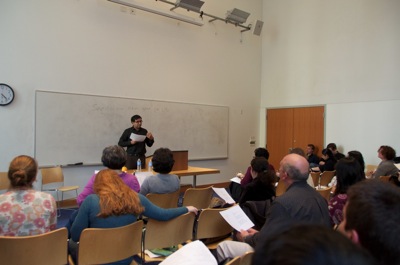
The second meeting of "Formal Approaches to South Asian Languages" (FASAL), a conference that started at UMass, met at MIT March 17-18. Rajesh Bhatt was one of the invited speakers, and he delivered a paper entitled "Complex Predicates, Agreement, and Case Licensing. Stefan Keine was also on the program, his talk was "Linearity-based reference restrictions in Hindi." A schedule, and more information about the conference, can be found at http://fasal.mit.edu/.
Rajesh and Stefan dominate the photos posted from the conference, no doubt because of their movie-star photogenicness. Here are two representative examples.

25 March 2012
Magda Oiry gives two talks this week
Magda Oiry will give the following two talks this week.
"Input and Universals in Developing Grammars" at 4:30 tomorrow, Monday March 28, in Dickinson 209
"Acquisition of long-distance questions at the syntax-semantics interface" at 4:30 on Wednesday March 30, in Herter 217.
Judith Tonhauser, semantics Guru, takes up residence
Seth Cable writes:
Judith Tonhauser (http://www.ling.ohio-state.edu/~judith/) will be visiting us as our semantic guru from March 29th (next Thursday) to April 7th (the following Saturday).
Judith's has done pioneering work investigating cross-linguistic semantic variation through both fieldwork and experimental methods, including the application of experimental methods to understudied indigenous languages. Her semantic interests cross-cut a variety of domains, including tense, modality, evidentials, focus and presupposition. She is also a highly experienced fieldworker, and has worked 'in the field' on Yucatec Mayan and Paraguayan Guarani since 2001.
Needless to say, we're very fortunate to have Judith visiting with us, and we should all make the absolute most of this opportunity.
Over the next few days, I'd like to draw up a preliminary schedule of meetings with Judith between both students and faculty. Whenever you can, please let me know on what days/times you'd like to meet with Judith.
As always, students are highly encouraged to meet with the guru. Please do not feel in any way hesitant to discuss your work, and please do not worry about whether or not your work relates to the guru's interests. It does. Even if you think your work is more 'syntactic' than 'semantic', or is more about 'processing' than about 'semantics' - or whatever - I guarantee that you will have a fruitful and enjoyable time talking with Judith about it.
So, whenever you're able to draw yourself away from this fantastic weather, just let me know what days and times would work best for you!
Anne Pycha goes to the University of Wisconsin
Anne Pycha has accepted a position of assistant professor in the department of linguistics at the University of Wisconsin, Milwaukee, starting in Fall 2012.
Congratulations Anne!
Judith Tonhauser gives department colloq on Friday
Judith Tonhauser, semantics guru, will give the department colloquium Friday, March 30, at 3:30 in Machmer E-37. The title of her talk is "Cross-linguistic semantics: The view from research on presuppositions and other projective contents."
UMass at Penn Linguistics Colloquium
Martin Walkow presented his paper "Choosing between Persons: Articulated Probes and the Ultra-Strong PCC" at the Thirty Six annual meeting of the Pennsylvania Linguistics Colloquium at UPenn this weekend. There were also a raft of UMass alumni at the conference, including:
Aynat Rubinstein who presented "Figuring out what we 'ought' to do"
Cherlon Ussery who presented "A Taxonomy of Agreement in Icelandic: Agree vs. Multiple Agree, Syntactic vs. Post-Syntactic"
Maria Biezma who presented "Only one at least: Refining the role of Context in Building Alternatives."
and
Florian Schwarz, along with Dimka Atanassov and John Trueswell who presented "On the Processing of 'might' "
Elizabeth Bogal-Allbritten goes to SULA and CLS
Elizabeth Bogal-Allbritten will give papers at the upcoming SULA and CLS conferences. At the Semantics of Under-Represented Languages in the Americas conference, held May 4-6 at Cornell, she will present "Conjectural questions in Navajo: the case of daats'i." And at the Chicago Linguistics Society meeting on April 19-21 she will present "Slightly Coerced: Processing evidence for adjectival coercion by minimizers."
Congratulations Elizabeth!
Barbara and Volodja on the road
Barbara Partee writes:
Volodja and I have been in Israel since March 16. I gave a talk, "Cardinal and proportional readings of quantifiers: MANY, MNOGO,
MNOGIE" at a small Slavic Linguistics Workshop at Bar-Ilan University,
organized by Susan Rothstein. We've had discussions and/or visits with
Susan, Fred Landman, Hana Filip, Nirit Kadmon, Yael Greenberg, and several other Israeli linguists. The trip has included visits to family and friends of Volodja's, and visits to several interesting sites that show off Israel's wonderful combination of archaeological and natural history, including good spring birdwatching. Returning to Moscow March 26.
Chris Davis takes up position at the University of the Ryukyus
Chris Davis writes:
I wanted to report that I have a permanent position (starting at Assistant Professor level) at the University of the Ryukyus, Faculty of Law and Letters, starting next month.
http://www.ll.u-ryukyu.ac.jp/
The position involves three components: English language, Linguistics, and fieldwork on Ryukyuan Languages. I will be using the position to continue the fieldwork on Southern Ryukyuan languages that I began last year as a JSPS postdoc.
Congratulations Chris!
Register for Formal Approaches to Heritage Language
Luiz Amaral writes:
As you may know, LARC is organizing a conference on Formal Approaches to Heritage Language on April 21st and 22nd at the Campus Center.
The program is now available online at:
http://www.umass.edu/larc/events/FAHL.html
There will be 30-minute talks, a poster session, and three keynote talks:
Ana Perez-Leroux (University of Toronto)
Acrisio Pires (University of Michigan)
Maria Polinsky (Harvard University)
Non-presenters are welcome to attend, and registration is free until March 31st. To register, please visit:
http://heritage-workshop.eventbrite.com/
UMass at SALT
The program for the 22nd annual meeting of Semantics and Linguistic Theory is now available, and it features presentations from two members of the UMass community. These are:
Noah Constant will present his paper "Witnessable Quantifiers License Type-e Meaning: Evidence from CT, Equatives and Supplements"
Aynat Rubinstein will present a poster, co-authored with Paul Portner and Graham Katz: "Ordering Combination for Modal Comparison"
For more information, see http://lucian.uchicago.edu/blogs/salt22/
18 March 2012
Bhatt at GIST
Rajesh Bhatt's coauthor, former syntax guru Roumi Pancheva, will be presenting their paper at GIST, Generative Initiatives in Syntactic Theory, held March 22-23 at the University of Gent. The title and abstract of their talk follows.
Two Superlative Puzzles
We discuss two cases where superlatives interact with relative clauses with puzzling consequences. The first case concerns the distribution of relative readings of superlatives inside relative clauses (e.g., “the boy who Mary likes the most”). We demonstrate that the facts require that the head be interpreted inside the relative clause. The second case concerns the licensing of subject infinitival relatives by superlatives (“the first man to walk on the moon”). Here too we suggest that the head is interpreted inside the infinitival clause but the superlative is external.
Schueler (2005) observes that relative clauses with relative readings of superlatives are non- intersective. Thus, “John is the boy who runs the fastest” does not entail that John is the fastest person; that could be Sally, with John being the fastest only among the boys. Schueler’s account utilizes the head external analysis of relative clauses with an additional mechanism where the comparison class of the superlative is restricted by the external head of the relative clause. This mechanism ensures that the comparison class is only composed of boys, delivering the desired result. However, we show that the problem identified by Schueler also arises in cases where the relative reading of the superlative is dependent on an element other than the relative pronoun (e.g., “John is the boy who MARY likes the most”), yet his treatment doesn’t generalize to these cases. Adopting an analysis where the head is interpreted internal to the relative clause allows for a uniform treatment of all cases of relative readings of superlatives inside relative clauses.
Bhatt (2006) offers arguments that the licensing of non-modal subject infinitival relatives by superlatives requires reconstruction of the superlative to a relative-clause internal position. Inspired by the discussion in Sharvit (2010), concerning the cross-linguistic distribution of such relatives and their temporal interpretation, we reanalyze these cases as infinitival complements of the superlative operator: [the [first [man to walk on the moon]]], i.e., the superlative does not originate inside the infinitival clause but the head does. One of the arguments in support of the first point, namely the clause-internal origin of the superlative, is that relative readings which should be available go missing (compare “MARY likes the tallest man”, which permits a relative reading where of all the relevant people who like men, the man who Mary likes is the tallest vs. “MARY likes the tallest man to walk on the moon”, which lacks such a reading). We derive this result from the fact that the infinitival clause provides the comparison class. Whenever the comparison class is explicitly given, as in “Mary likes the tallest man of the three”, relative readings are absent. Concerning the second point, namely the origin of the head, we show that the temporal dependence between the head and the infinitival clause, is naturally accommodated if the head is interpreted inside the infinitival clause.
To conclude, superlatives provide two different arguments for the head-internal interpretation of relative clauses.
UMass at the 34th DGfS Meeting
Lyn Frazier was a plenary speaker at the 34th DGfS Meeting at Frankfurt University on March 9th. The title of her talk was "Processing Ellipsis: Explorations at the Edge of Grammar." (An abstract follows.) Former student Maribel Romero was another plenary speaker, her talk was titled "From Form to Meaning."
In addition, Anisa Schardl gave a talk entitled "Finnish - hAn and the QUD" and former students Maria Beizma and Kyle Rawlins gave a talk entitled "Or What?"
For more information, see http://dgfs.uni-frankfurt.de/dgfs/dgfs_de.html
Processing Ellipsis: Explorations at the Edge of Grammar
It will be suggested that stringent grammatical conditions on ellipsis should be maintained, requiring syntactic matching of antecedent and elided constituent in the case of Verb Phrase Ellipsis, certain morphological features aside, (Sag, 1977 a.o.), and requiring movement of the ‘answer’ to a Focus projection with ellipsis of the TP in the case of fragment answers to questions (Merchant, 2004). However, speakers at times erroneously produce utterances that violate these stringent conditions, e.g., producing a syntactic blend of an antecedent from one utterance and an elided constituent appropriate for a closely related (competitor) utterance. These ungrammatical utterances can be repaired under the same conditions as garden-path misanalyses, namely, when few repair operations are needed and there is lots of evidence for those operations. The acceptability of such utterances depends on the difficulty of the repair and on whether the input sounds like a familiar form, possibly an error, that might be produced by normal sentence production mechanisms. Evidence supporting this account suggests that, in addition to the general form-meaning pairing characterized by the grammar, there is also a performance-based pairing of forms and meanings that is token-based, rather than type-based; this performance pairing results from implicit knowledge of the performance systems as well as grammar. The performance pairing of form and meaning is not tied to ellipsis per se, and thus its existence has implications not only for our understanding of ellipsis but more generally including, for example, the interpretation of quantifiers. The account suggests that certain problematic examples do not require us to complicate our grammatical theory but instead are appropriately explained in the realm of systematic language performance.
The Roeper Linguistics Club
Tom Roeper writes:
I had the unique pleasure of talking to the Roeper linguistics Club over skype---they are a group of bright high school kids at the Roeper School. If anyone would like to share some interesting linguistic work with high school kids----I could arrange another session. It is fun.
Noah Constant receives Mellon
Congratulations to Noah Constant who has received a Mellon/ACLS Dissertation fellowship for the 2012-13 academic year!
Call for Papers: Texas Linguistics Society Conference
13th Texas Linguistics Society (TLS) Conference
June 23-24, 2012
University of Texas at Austin
TLS is a graduate-student run conference in linguistics organized by the Texas Linguistics Society and the Department of Linguistics at the University of Texas at Austin. This year's TLS is co-located with the North American Summer School in Logic, Language, and Information and associated workshops and symposia.
http://uts.cc.utexas.edu/~tls/
TLS 13 will be structured around two para-sessions: (1) the semantics and pragmatics of questions and question-based models of discourse, and (2) signed languages and meaning. While we encourage submissions related to these themes, we are also interested in submissions on topics of general linguistic interest. Papers on language related topics from disciplines including anthropology, cognitive science, neuroscience, philosophy of language, and psychology will also be considered.
--- Keynote Speakers ---
Nicholas Asher (IRIT, CNRS/Université Paul Sabatier)
Erin Wilkinson (University of Manitoba)
--- Invited Talks ---
Kathryn Davidson (University of Connecticut)
Jeroen Groenendijk (University of Amsterdam)
Richard Meier (University of Texas at Austin)
Josep Quer (ICREA & Universitat de Barcelona)
Craige Roberts (The Ohio State University)
--- Submission Information ---
One page abstracts (plus references) should be submitted in PDF or DOC format through EasyChair at https://www.easychair.org/conferences/?conf=tls13. 11-12 point font, please. Authors whose abstracts are accepted are encouraged to submit a short paper (10-20 pages). These will be collected into an edited volume for publication.
--- Important Dates ---
* Abstract Submission Deadline: April 16, 2012
* Notification of Acceptance: May 7, 2012
* Pre-proceedings Paper Submission Deadline: June 10, 2012
* Final Draft Submission Deadline: August 31, 2012
UMass at WCCFL
The annual meeting of the West Coast Conference on Formal Linguistics is meeting April 13-15 at the University of California, Santa Cruz. There are several talks by people in the UMass community, including:
Wendell Kimper with Riikka Ylitalo will present "Variability and Trigger Competition in Finnish Disharmonic Loanwords."
Noah Constant will present a poster entitled "Topic Abstraction as the Source for Nested Alternatives."
Jesse Harris will present a poster entitled "On the Semantics of Domain Adjectives in English."
UMass at GLOW
The annual meeting of the Generative Linguists of the Old World is at Potsdam on March 28-30, and there are several members of the UMass community giving talks.
Brian Dillon, with co-authors Ewan Dunbar and William Idsardi, is presenting "Learning Phonetic Categories by Learning Allophony and vice versa."
Noah Constant is presenting "Topic Abstraction as the Source for Nested Alternatives: A conservative Semantics for Contrastive Topic."
Satoshi Tomioka is presenting "Focus matters in New-Hamblin semantics."
Bart Hollebrandse, with Petra Hendriks and Jacolien van Rij is presenting "Eye gaze patterns reveal subtle discourse effects on object pronoun resolution."
For a full schedule, see http://www.ling.uni-potsdam.de/~glow/program.html
Seth Cable at SULA
Seth Cable's paper "Distributive Numerals in Tlingit: Pluractionality and Distributivity" has been accepted to the seventh annual meeting of Semantics of Under-Represented Languages in the Americas (SULA), which will take place May 4-6 at Cornell University.
Congratulations Seth!
Roeper in Germany
Tom Roeper gave two talks in Germany a couple weeks ago. He presented joint work with Jill de Villiers at a conference on Recursion, Complexity and Typology at Konstanz. The title of their talk was "Avoid Phase: wh-infinitives and movement in acquisition." And he gave a paper titled "Internal Merge vs Topic Shift in Acquisition" at the ZAS conference on Discourse Cohesion in Berlin.
Congratulations Tom!
Definites Workshop at University of Düsseldorf in June
Workshop title: "Semantic and typological perspectives on definites", CRC991 #3
Conference date: June 01 -- 02, 2012
Location: Heinrich-Heine University Düsseldorf
The Cooperative Research Centre CRC 991 "The Structure of Representation in Language, Cognition and Science" of the University of Düsseldorf is pleased to announce a workshop on "Semantic and typological perspectives on definites", to be held on 01 - 02 June 2012 at the Heinrich-Heine University Düsseldorf.
The workshop will center on the following topics:
Definiteness and concept types: The view that definiteness is a means of marking a noun's use as a functional concept entails essential semantic aspects such as a classification of nouns into concept types, and shifts among these types. The idea that determination mirrors concept types calls for statistical and psycholinguistic evidence -- e.g., can the cognitive effort for ac-complishing a type shift be attested?
Article splits: It is common for languages with definite articles to exhibit marking asymmetries according to the conceptual noun type. The opposition of pragmatic uniqueness (most notably anaphorically used sortal nouns) and semantic uniqueness (most notably functional concepts such as size/mother/head of, and individual concepts such as proper names) has proven to be significant, in that the latter types tend to be marked only if the former are.
Likewise, pragmatic and semantic uniqueness are morphosyntactically distinguished by different article forms (typically, phonologically strong vs. weak). Case studies especially cover varieties of German and Frisian. The conditions for fusion of prepositions and definite articles in Standard German have been analysed as one instance.
Grammaticalisation of definiteness marking: Besides the familiar grammaticalisation path (demonstratives 'weaken' their function and develop into definite articles), in, e.g., some Uralic languages the function of possessor agreement suffixes is extended so as to mark uniqueness in non-possessive contexts.
Special uses of (non-)definite descriptions: definite descriptions without unique reference (e.g., German die meisten / die Hälfte von 'most/half of'), including configurational uses (take the lift / the bus), and 'bare definites' such as to school, in jail/hospital.
List of contributors:
Bert Le Bruyn (University of Utrecht), Anne Carlier (University of Charles-de-Gaulle - Lille 3), Maria Cieschinger (University of Osnabrück), Xuping Li (EHESS, Paris), Christopher Lucas (SOAS, London), Ulrike Mosel (University of Kiel), Brigitte Pakendorf (CNRS, Lyon 2), Frans Plank (University of Konstanz), Magdalena Kaufmann (prev. Schwager; University of Göttin-gen), Erhard Voeltz (University of Frankfurt/Main), Dorothea Brenner, Elizabeth Coppock, Adrian Czardybon, Doris Gerland, Christian Horn, Nico Kimm, Sebastian Löbner, Albert Ortmann, Robert D. van Valin, Jr (all Heinrich-Heine University Düsseldorf).
The workshop is organised by the member projects C01 and C02 of the Cooperative Research Centre CRC 991 "The Structure of Representation in Language, Cognition and Science" (http://www.sfb991.uni-duesseldorf.de/), sponsored by the German Research Foundation (DFG).
11 March 2012
Leonardo Llanos and Marcus Maia speak at LARC/Language Lab meeting
The following talks will be presented at the LARC / Language Lab meeting tomorrow, Monday March 12, at 5:20 in the Partee Room (South College 301).
"A Spanish oral learner corpus for L2 language research"
Leonardo Campillos Llanos
Universidad Autonoma de Madrid
"Processing of causative alternation structures by Karaja/Portuguese bilinguals"
Marcus Maia
Federal University of Rio de Janeiro
Everyone welcome!
Jim Cathey speaks at Linguistics Club
Jim Cathey will deliver a talk entitled "Object Marking in Finnish" at the Linguistics Club meeting on Friday, March 16 in the Partee Room (301 South College) at 3:30PM. If you plan on going, please let Ling Club President Jeremy Cahill know at jccahill@student.umass.edu
John Kingston and Shigeto Kawahara at NEST
Today, March 10, John Kingston and Shigeto Kawahara present "You got to be discriminating to get contrast" at the New England Sequencing and Timing (NEST) meeting, held at UMass. An abstract of their talk follows.
At NEST in 2007, we presented a study of Italian, Norwegian, Japanese and English speakers' categorization and discrimination of a silent interval that varied in duration (see also Kingston, Kawahara, Chambless, Mash, & Brenner-‐Alsop, 2009). This interval has flanked by vowels in the speech condition and by filtered square waves in the non-‐speech condition – in the speech condition, the silent interval was perceived as a voiceless stop consonant. The preceding vowel's or filtered square wave's duration was varied orthogonally from the silence's duration. Except when a consonant's and a preceding vowel's durations vary inversely in their native language (Italian and Norwegian listeners) and the stimuli were speech, listeners judged the silence to be longer when the preceding sound was longer. We described the general finding as a product of listeners' adding the durations of the two intervals together in all other conditions. These findings accord with those reported by Fowler (1992) but not those reported by Kluender, Diehl, & Wright (1988), whose listeners categorized the silent interval as longer when the preceding vowel or square wave was shorter. Fraisse (1963, 1984) and more recently Nakajima, Hoopen, Hilkhuysen, & Sasaki (1992) showed that so long as the duration ratio between successive intervals is close to 1 and doesn’t exceed 2, listeners judge the second interval as long after a long first interval, but once the ratio greatly exceeds 2, they judge the second as long after a short first interval. This observation may explain our earlier results because most of the duration ratios in our stimuli were in the 1-‐2 range.
At this NEST, we will report new results using more extreme ratios, up to 3, which show that listeners discriminate silences better when their durations vary inversely with the durations of the preceding vowels or non-‐speech sounds. Contrast still did not arise in categorization, even with the largest duration ratios. Kato, Tsuzaki, & Sagisaka (2003) report that listeners treat variation in the onset times of successive vowels but not their offset times as evidence of rate variation. Because manipulating the duration of the silence varied the onset time between successive vowels or square waves in our earlier stimuli, our listeners may have been covertly judging rate rather than the silence's duration relative to the preceding vowel's or square wave's. We may also report the results of an experiment examining this explanation of our earlier results.
Call for papers: Workshop on Semantics and Pragmatics of Dialogue
The 16th WORKSHOP ON THE SEMANTICS AND PRAGMATICS OF DIALOGUE
PARIS, SEPTEMBER 19-21, 2012
https://sites.google.com/site/semdial2012seinedial/
Invited Speakers:
Eve V. Clark (Stanford University)
Geert-Jan M. Kruijff (DFKI-Saarbrücken)
François Recanati (Institut Jean Nicod, École Normale Supérieure)
The SEMDIAL series of workshops brings together researchers working on the semantics and pragmatics of dialogue in fields such as artificial intelligence, computational linguistics, formal semantics/pragmatics, philosophy, psychology, and neuroscience (see past SemDials).
In 2012 the workshop will be hosted by Université Paris-Diderot (Paris 7). The Semdial workshops are always stimulating and fun, and Paris is of course one of the greatest cities to visit, especially in September. SeineDial will be immediately preceded by a workshop on "Dialogue and Contextualism" (a separate announcement on this will appear shortly) and will feature a special session on The Acquisition of Dialogue.
We invite papers on all topics related to the semantics and pragmatics of dialogues, including, but not limited to:
-- models of common ground/mutual belief in communication
-- modelling agents' information states and how they get updated
-- multi-agent models and turn-taking
-- goals, intentions and commitments in communication
-- semantic interpretation in dialogues
-- reference in dialogues
-- ellipsis resolution in dialogues
-- dialogue and discourse structure
-- interpretation of questions and answers
-- gesture in communication
-- intonational meaning in dialogue
-- humour in dialogue
-- natural language understanding and reasoning in spoken dialogue systems
-- multimodal dialogue systems
-- dialogue management in practical implementations
-- categorisation of dialogue moves or speech acts in corpora
-- designing and evaluating dialogue systems
-- contextual factors underlying child utterances in dialogue
-- repair in child/adult interaction
Important Dates:
-- May 1, 2012: Paper submissions due at 23:59 UTC-11
-- June 15, 2012: Author notification for full papers
-- June 30, 2012: Poster and demo submissions
-- July 10, 2012: Author notification for posters and demos
-- August 20, 2012: Camera-ready copies
--September 19-21, 2012: Workshop in Paris
Submission is via EasyChair at the following address:
https://www.easychair.org/conferences/?conf=semdial2012
It will be open for submissions no later than May 1, 2012.
Submitted papers should be in the following format.
- Anonymous PDF file
- 8 pages total (including data, tables, figures, and references)
- A4 paper size
- 11pt Times font
- 1 inch (2.5 cm) margins
- 2-column format
Include a one-paragraph abstract of the entire work (about 200 words).
We strongly recommend using the style files provided by ACL-HLT 2011:
http://www.naaclhlt2012.org/conference/conference.php
Peggy Speas speaks at WSCLSA 17
Peggy Speas was an invited speaker at this year's annual Workshop on Structure and Constituency of Languages of the Americas, which is being held at the University of Chicago this weekend, March 9-11. The title of her talk is "Topics in Navajo."
For more information, see: https://sites.google.com/site/wscla17/
Katz and Selkirk appears in Language
In the latest issue of Language (87.4), appears a paper by Lisa Selkirk and former student Jonah Katz, entitled "Contrastive focus vs. discourse-new: Evidence from phonetic prominence in English"
Congratulations Lisa and Jonah!
UMass Library fellowships in Digital Humanities
James Kelly, UMass library, sends the following notice:
The Department of Special Collections and University Archives
in the Libraries is accepting applications for fellowships in digital
humanities. Experiential Training in Historical Information Resources
(ETHIR) is an initiative designed to provide students with structured,
hands-on experience using and interpreting historical documentary resources.
Graduate students from any department enrolled at UMass Amherst are eligible
to apply. The deadline for applications is April 20, 2012. For more
information visit http://bit.ly/ethir_fellowship.
As part of an effort to integrate Special Collections more fully into the
learning and research mission of the university, the Libraries offer an
opportunity for select undergraduate and graduate students to work in the
Department and develop research ideas, while gaining first-hand experience
in historical and archival praxis. ETHIR fellows will take part in a range
of activities in the digital humanities tied to their research interests,
including preparing new and under-described collections for use by
researchers, creating finding aids that will be made available on the
Department's website, and curating exhibits, digital corpora, or other
interpretive materials.
Two fellows will be selected from the pool of applicants based upon a
three-page statement of purpose, curriculum vitae, letter of support, and
the ability to contribute to the work of Special Collections and University
Archives. Fellows will receive an honorarium of $500, plus hourly
compensation for 150 hours of work, and they may use their awards during
either the summer or the fall terms.
For more information, contact Rob Cox, head of Special Collections and
University Archives, at <mailto:rscox@library.umass.edu>
rscox@library.umass.edu, or (413) 545-6842.
Linguist List Fund Drive!
Barbara Partee writes:
It's Linguist List fund drive time! (See the nice succinct appeal
letter below.) I've had an interesting time introducing Russians to the
concept of user-funded non-profit Good Things, and by now Russia is making
a decent showing in the 'horse race' (aka Graduate School Challenge) to see
who gives the most to Linguist List. (It's the fourth-highest country in
Europe right now; last year I think it ended up second.) In the US we have
a well-established tradition of grass-roots philanthropy -- so I like to
see UMass do well in the "Grad School Challenge" too! (In a turnabout,
Volodja's contribution has credited UMass, and mine RGGU in Moscow.) And
don't forget that you can enter the competition among subfields at the same
time. The Linguist List folks do their best to make the fund drive
entertaining, but it's also really serious! Do donate -- every $5 helps!
If you want to see my letter urging all international Linguist List
readers to donate, it's here: http://linguistlist.org/issues/23/23-1048.html.
Rooting for UMass and for Linguist List.
The appeals letter:
Dear LINGUIST List Subscribers,
It's that time of year again! We'd like to let all of our subscribers know
that the LINGUIST List Fund Drive has begun!
What if 650 people each gave $100? Or 1300 people each gave $50--and gave
it TODAY? Could we possibly begin and end Fund Drive in a single day?
Sounds like a pipe dream, doesn't it? But logically it's possible. The
LINGUIST List website receives 150,000 page views per week. That's over 6
million views per year. If only 1/30 of our weekly visitors donated $50
today, we would reach our goal. That's one-THIRTIETH, note--not
one-third--of our weekly site visitors.
And that doesn't count the 27,000 people who subscribe to the email list
and perhaps never visit the site. If only 1/415 of the people reading this
message would donate $100 each, we could end Fund Drive today:
https://linguistlist.org/donation/donate/donate1.cfm
So what would we at LINGUIST do with our extra time--besides smile a lot?
Well, instead of spending two solid months begging for money, we would
finish some exciting new services 2 months sooner:
- We're almost ready to go live with a Summer School Register that we
hope will be very useful both to prospective students and to the institutions
running summer schools.
- We're about to unveil a conference registration system, called
EasyReg to pair with our highly successful abstracts review service EasyAbs.
- Thanks to Damir Cavar, we're almost ready to present a text-mining
tool that will allow you to search all LINGUIST issues, and perhaps all 150 of
the language-related email lists archived on our site.
- We're planning a Project's Registry where PIs can publicize new
projects and services
Donate now to ensure the ongoing quality and continuation of our services!
https://linguistlist.org/donation/donate/donate1.cfm
04 March 2012
Tom Ernst talks at SRG on Thursday
On Thursday, March 8th, Tom Ernst will be talking to the SRG about modification of state predicates. His talk will take place at his apartment in Northampton and starts at 6:30.
Summer Research Education for Undergraduates at Univ. of South Carolina
The Psychology Department at the University of South Carolina is pleased to announce that NSF has recommended funding for our Summer Research Education for Undergraduates program, Summer Research Experience in Brain and Cognitive Sciences (SREBCS). Each summer this program will provide ten undergraduate students the opportunity to engage in research seminars, laboratory exercises, and one-on-one laboratory projects in the exciting and fast growing field of brain and cognitive sciences. The SREBCS builds on the resounding success that our previous summer program experienced across its 17 years of funding. An innovative feature of the SREBCS is the inclusion of a weekly group laboratory that will provide students with a diverse set of hands-on experiences of the methods used in brain and cognitive sciences, such as EEG, MRI and fMRI. In addition, students will discuss implications of research presented by the faculty and engage in research projects within a faculty mentor’s laboratory.
The application deadline for this year’s program is March 28, 2012. The program description and application materials are posted on our website:
http://www.psych.sc.edu/srebcs/
We very much appreciate your encouraging interested and qualified students to apply. The SREBCS is committed to providing opportunities to under-represented groups within the Brain and Cognitive Sciences.
Kai von Fintel speaks at department colloquium on Friday
Kai von Fintel will present work with Sabine Iatridou at the department colloquium on March 9, 3:30 in Machmer E-37. Reception to follow in 3rd floor lounge. Dinner to be hosted by Angelika Kratzer. A title and abstract follow.
"Imperative Puzzles"
Work by Kai von Fintel and Sabine Iatridou
Abstract:
Imperatives, which are prototypically used to issue commands, can also be used to give permissions:
(1) A: May I open the window? B: Sure, go ahead, open it!
Further, imperatives can serve as quasi-conditional antecedents in "left-subordinating conjunctions":
(2) Study hard and you will pass the class.
(3) Ignore your homework and you will fail the class.
(4) Open the paper and you will find 5 mistakes on every page.
We show that these phenomena present severe challenges for all existing theories of imperatives. We lay out desiderata for a successful analysis and speculate on ways of getting there. Along the way we present data from English, German, and pretty much every language spoken on the Mediterranean Rim.
Rajesh Bhatt speaks at Linguistics Club meeting
Rajesh Bhatt will present a talk entitled "South Asia as a linguistic Area," to the Linguistics Club meeting on Tuesday, March 6 at 5:15 in the Partee Room (South College 301). If you plan on attending, let Ling Club president Jeremy Cahill know at jccahill@student.umass.edu
ICESL Workshop planned for April 6
Joe Pater writes:
We've decided to make last year's launch workshop an annual event, as an opportunity for people working on language across campus to find out about each other's research. There will be three talks, by Luiz Amaral (Languages, Literatures and Cultures), Jacquie Kurland (Communication Disorders) and David Smith (Computer Science). We encourage everyone else to present a poster - if you'd like to do so, please send us a title at this e-mail address asap, and by April 1st at the latest. The event will take place in the afternoon - exact time and place TBA. We apologize to those of you who will be observing Passover or Good Friday and cannot make it - this is the only date we could find. This event is sponsored by the Mellon Mutual Mentoring Initiative.
Help Build a Global Word Association Network
Chuck Clifton writes:
Over the past few weeks, we have been trying to set up a scientific study that is important for many researchers interested in words, word meaning, semantics, and cognitive science in general. It is a huge word association project, in which people are asked to participate in a small task that doesn't last longer than 5 minutes. Our goal is to build a global word association network that contains connections between about 40.000 words, the size of the lexicon of an average adult. Setting up such a network might learn us a lot about semantic memory, how it develops, and maybe also about how it can deteriorate (like in Alzheimer's disease). Most people enjoy doing the task, but we need thousands of participants to succeed. Up till today, we found about 40,000 participants willing to do the little task, but we need more subjects. That is why we address you. Would it be possible to forward this call for participation to graduate and undergraduate students who are fluent in English?
The task can be found on
http://www.smallworldofwords.com
If people would REALLY like to help us, they can forward the call to students, friends, family, etc. or distribute the call through facebook, twitter, etc. (In this way, we succeeded in building a word association network in Dutch over the past years. The network comprises about 13.000 words and was built using more than 4 million word associations, gathered from 100.000 native Dutch speakers. The problem is only: who cares about Dutch data. That is why we want to do the same in English.) Any suggestion about how to reach more participants is welcome (societies that we can e-mail, local communities who want to put this on their website, ...)
Of course the network will be freely available to all interested language researchers when it becomes substantial enough.
We thank you in advance.
The Third Language and Linguistics Mini-course series at Brown University
THE THIRD LANGUAGE & LINGUISTICS MINICOURSE SERIES
Cognitive Linguistic & Psychological Sciences at Brown University
A TWO MINICOURSE SERIES
MAY 21 - MAY 25, 2012
Macmillan 115
Monday-Friday; 10AM - 12AM
Dying Languages: What World Linguistic Diversity Means for Us
Anthony Woodbury, University of Texas at Austin
Monday-Friday; 2PM - 4PM
Language Structure, Learning, and Change: Research on Signed and Spoken Languages
Elissa Newport & Ted Suppala, University of Rochester
This event is free and open to the public
Travel to and visiting Brown: http://www.brown.edu/web/about/visit
A list of accommodations: http://www.brown.edu/web/about/accommodations
More information will be posted on a website in the near future.
UMass at the 26th Arabic Linguistics Symposium at Alephi University
John McCarthy gave a Keynote Address at the 26th Arabic Linguistics Symposium in New York last week. The title of his address was "Is Phonological Opacity Real? Evidence from Arabic."
At the same conference, Martin Walkow presented "Restrictions on Pronoun Combinations and Parallels between Subject Agreement and Cliticization in Classical Arabic."
UMass at Penn Linguistics Colloquium
The 36th Annual Penn Linguistics Colloquium, which will take place March 23rd-25th at the University of Pennsylvania, will host a number of papers from recent UMass graduates, including:
Martin Walkow will present "Choosing between Persons: Articulated Probes and the Ultra-Strong PCC"
Aynat Rubinstein will present "Figuring out what we 'ought' do do"
Cherlon Ussery will present "A Taxonomy of Agreement in Icelandic: Agree vs Multiple Agree, Syntactic vs Post-Syntactic"
Maria Biezma will present "Only one at least: refining the role of context in building alternatives."
Florian Schwarz, with co-authors Dimka Atanassov and John Trueswell will present "On the processing of 'might' "
The keynote address, entitled "Morpheme Order, Constituency, and Scope" will be delivered by Paul Kiparsky. There will also be an interdisciplinary panel session on Game Theory and Language. For a full schedule of events, see: <http://www.ling.upenn.edu/Events/PLC/plc36/program.html>.
The preregistration deadline for the conference is Wednesday, February
29th. To preregister, please visit the conference website at
<http://www.ling.upenn.edu/Events/PLC/plc36/> and follow the link to
the registration form. There is an additional $10 surcharge for
registrations made after the pre-registration deadline, so be sure to
register before then. All registration fees will be collected onsite.
For further information, please email plc36@ling.upenn.edu<mailto:plc36@ling.upenn.edu>
26 February 2012
Colin Phillips talks on Friday
Colin Phillips from the University of Maryland will speak at the department colloquium on Friday, March 2, in Machmer E-37 at 3:30. A title and abstract follow.
Electrophysiology and Language Architecture
In this talk I will discuss two recent lines of research in the cognitive neuroscience of language processing that started from independent puzzles, but that appear to be converging on a common solution. The first puzzle involves apparent discrepancies in the localization results obtained using fMRI and MEG measures of 'semantic' processing. The same tasks and materials yield conflicting localizations when measured using different tools. The second puzzle involves a recent series of studies that undermine received wisdom about the functional status of ERP components and, more interestingly, challenge the widespread view in linguistics and psycholinguistics that semantic composition is tightly coupled to the syntax of a sentence. The solution to both puzzles involves recognizing that the N400, a neural response component traditionally associated with compositional semantic interpretation, is more closely linked to lexical processes and to word-level expectations. This also provides an account of the split personality of the N400 - it is sometimes very 'smart', responding to fine details of the compositional semantic interpretation and pragmatic congruity of linguistic input, but at times it is surprisingly 'dumb', sensitive only to the lexical properties of a word and to associative relations among words. I show how it is possible to turn the dumb N400 into the smart N400. I show that rather than undermining widespread assumptions about language architecture, the electrophysiological evidence instead provides finer-grained evidence on how interpretations are computed on-line. The evidence is drawn from studies in English, Spanish, and Chinese.
Andrew Weir's paper to appear in "English Language and Linguistics"
The next issue of "English Language and Linguistics" will contain Andrew Weir's paper "Left-edge deletion in English and subject omission in diaries."
Congratulations Andrew!
Kamil Ud Deen gives talks on Monday and Tuesday
Kamil Ud Deen (Univeristy of Hawaii) will give two talks this week.
The first is on Monday, February 27, at 4:30 in Dickinson 209. The title is: "The acquisition of raising and passives: implications for linguistic theory."
The second is on Tuesday, February 28, at 4:30 in Herter 217. The title is "Binding in adult and child Thai."
You can learn more about Kamil Ud Deen at http://www2.hawaii.edu/~kamil/
Jeremy Hartman gives talks on Wednesday and Thursday
Jeremy Hartman (MIT) will give two talks this week.
The first is Wednesday, February 29, at 4:30 in Dickinson 209. The title is "Principle B and Phonologically Reduced Pronouns in Child English."
The second is Thursday, March 1, at 4:30 in Bartlett 206. The title is "Clausal Arguments, Experiencer Predicates, and Intervention."
You can learn more about Jeremy Hartman at http://web.mit.edu/hartmanj/www/
Call for Papers: Sinn and Bedeutung 17
Sinn und Bedeutung 17, held at the École normale supérieure in Paris, invites submissions devoted to natural language semantics, pragmatics, the syntax-semantics interface, psycholinguistic aspects of meaning, or philosophy of language.
Invited speakers:
- Daniel Büring (Universität Wien)
- Rick Nouwen (Universiteit Utrecht)
- Barbara Partee (University of Massachusetts, Amherst)
- Liina Pylkkänen (New York University)
Papers will be selected for 45 (35+10) minute oral presentations.
Abstracts should contain original research that, at the time of submission, has neither been published nor accepted for publication. One person can submit at most one abstract as sole author and one abstract as co-author. Abstracts should be anonymous, in the form of a PDF file; they must not exceed 2 pages including all data and references and have to be written in 12 pt with 2.5 cm (1 in) margins on all sides.
Please submit your abstracts via EasyChair: easychair.
Deadline for 2-page abstract submission: April 16
Notification of acceptance: June 4
Conference dates: September 8, 9, 10
Organizers: École normale supérieure, Paris
Contact us at: sub.paris2012@gmail.com
Conference webpage: here.

19 February 2012
Annie Gagliardi talks on Tuesday and Wednesday
Annie Gagliardi, from the University of Maryland, will give two talks on language acquisition. Tuesday's talk will be at 4:30, in Bartlett 219, and is entitled "Bayesian Inference as an Evaluation Metric: Putting Computational Models to Work in Language Acquisition."
Wednesday's talk will also be at 4:30 and is entitled "Unpacking the Black Box: The Inner Workings of the Language Acquisition Device." The talk will be in Herter 217.
For more information about Ms. Gagliardi, go to: http://ling.umd.edu/~acg/
Robyn Orfitelli gives talks on Thursday and Friday
Robyn Orfitelli, from UCLA, will give two talks on language acquisition. Each talk will take place at 4:30.
Her talk on Thursday is entitled "Competence and Performance in Children's Grammar of Null Subjects," and will take place in Dickinson 209.
The talk on Friday is entitled "Argument Intervention in the Acquisition of A-Movement," and will be in Machmer E-37.
The rooms have not yet been nailed down. When they are, the locations will appear here.
For more information about Ms. Orfitelli, go to: http://rorfitelli.bol.ucla.edu/
Paper by Barbara Pearson, Tracy Conner and Janice Jackson to appear in "Developmental Psychology"
"Removing Obstacles for African-American-English-Speaking Children through Greater Understanding of Language Difference" by Barbara Pearson, Tracy Conner and Janice Jackson will appear in a special section of "Developmental Psychology": Deficit of Difference? Interpreting Diverse Developmental Paths. The abstract of their paper follows:
Language difference among speakers of African-American English (AAE) has often been considered language deficit, based on a lack of understanding about the AAE variety. Following Labov (1972), Wolfram (1969), Rickford (1999), Green (2002, 2011) and others, we define AAE as a complex rule-governed linguistic system, and briefly discuss language structures that it shares with general American English (GAE) and others that are unique to AAE. We suggest ways in which mistaken ideas about the language variety add to children’s difficulties in learning the mainstream dialect and, in effect, deny them the benefits of their educational programs. We propose that a linguistically-informed approach that highlights correspondences between AAE and the mainstream dialect and trains students and teachers to understand language varieties at a metalinguistic level creates environments that support the academic achievement of AAE- speaking students. Finally, we present three program types that are recommended for helping students achieve the skills they need to be successful in multiple linguistic environments.
Angelika Kratzer's Modals and Conditionals now available
Angelika Kratzer's new book on modals and conditionals, which collects many of her classic papers on the subject along with a guide to how this work bears on recent developments, is now available from Oxford University Press. The blurb on the Oxford University Press's website describes her book as follows:
This book contains updated and substantially revised versions of Angelika Kratzer's classic papers on modals and conditionals, including 'What "must" and "can" must and can mean', 'Partition and Revision', 'The Notional Category of Modality', 'Conditionals', 'An Investigation of the Lumps of Thought', and 'Facts: Particulars or Information Units?'. The book's contents add up to some of the most important work on modals and conditionals in particular and on the semantics-syntax interface more generally. It will be of central interest to linguists and philosophers of language of all theoretical persuasions.
See: http://ukcatalogue.oup.com/product/9780199234691.do
Congratulations Angelika!
ECO5!
Anisa Schardl writes:
This year, UMass is hosting ECO5, a graduate student workshop on
syntax, on April 7th. I am emailing to solicit presenters for ECO5.
This could be you!
ECO5 is a place for grad students to present work in progress in a
relaxed atmosphere. It is especially good for first- and second-year
students. Good stuff to present might be: your current GP project,
your project for a term paper that may or may not turn into a GP
later, something you were working on as an undergrad/master's student
that you haven't let go of, something cool that you recently
discovered. No project is too small!
There are five schools involved in ECO5 and each school can send up to
three presenters. If you're interested in being one of these
presenters, email me and tell me a title for your presentation. Email
me!
Call for Papers: ESSLLI
The Organizers of ESSLLI 24 write:
The Student Session of the 24th European Summer School in Logic, Language, and Information (ESSLLI) will take place in Opole, Poland on August 6-17, 2012. We invite submissions of original, unpublished work from students in any area at the intersection of Logic & Language, Language & Computation, or Logic & Computation. Submissions will be reviewed by several experts in the field, and accepted papers will be presented orally or as posters and will appear in the student session proceedings. This is an excellent opportunity to receive valuable feedback from expert readers and to present your work to a diverse audience.
ESSLLI 2012 will feature a wide range of foundational and advanced courses and workshops in all areas of Logic, Language, and Computation. Consult the main ESSLLI website (link below) for further information.
SPRINGER PRIZES FOR BEST PAPER AND BEST POSTER
In 2012, Springer has again continued its generous support for the Student Session by offering € 1000 in prizes. These include a a € 500 for Best Paper and € 500 for Best Poster. The prizes are awarded best on the reviews of the submission as well as the oral presentation.
INSTRUCTIONS FOR AUTHORS:
Authors must be students, i.e., may not have received the Ph.D. degree before August 2012. All submissions must be in PDF format and be submitted to the conference EasyChair website. Submissions may be singly or jointly authored. No one may submit more than one singly and one jointly authored paper.
There are two types of papers. Long papers of up to 8 pages will be considered for both oral presentation and the poster session. Short papers of up to 4 pages will be considered as submissions for the poster session.
Submissions must be anonymous, without any identifying information, and must be must be received by March 20, 2012.
More detailed guidelines regarding submission can be found on the Student Session website: http://loriweb.org/ESSLLI2012StuS/
Links to previous years' proceedings are also available there.
Please direct inquiries about submission procedures or other matters relating to the Student Session to esslli2012stus@loriweb.org.
For general inquiries about ESSLLI 2012, please consult the main ESSLLI 2012 page, http://esslli2012.pl/.
12 February 2012
Gustavo Freire and Joel Walters speak at LARC/Acquisition Lab tomorrow
The LARC/Acquisition Lab will meet Monday, Feb 13, at 5:20 in the Partee Room (South College 301) for the following two presentations.
"Experimental Ideas on Event and Indirect Causatives"
Gustavo Freire
"Codeswitching as a possible diagnostic in SLI"
Joel Walters
Professor at Bar-Ilan University
Everyone Welcome!
David Smith speaks at Yale
David Smith, from the Computer Science department, will give a talk at the Friday lunch series at Yale University on February 17. A title and abstract follow.
Efficient Inference for Declarative Approaches to Language
Much recent work in natural language processing treats linguistic
analysis as an inference problem over graphs. This development opens
up useful connections between machine learning, graph theory, and
linguistics. In particular, we will see how linguists can
declaratively specify linguistic inference problems, in terms of hard
and soft constraints on grammatical structures. The first part of the
talk formulates syntactic parsing as a graphical model with the novel
ingredient of global constraints. Global constraints are propagated
by combinatorial optimization algorithms, which greatly improve on
collections of local constraints. The second part extends these
models for efficient learning of transformations between
non-isomorphic structures. These noisy (quasi-synchronous) mappings
have applications to adapting parsers across domains, projecting
parsers to new languages, learning features of the syntax-semantics
interface, and reranking passages for information retrieval.
Call for papers: Formal Approaches to Heritage Language
The Language Acquisition Research Center at UMass will host a conference on Formal Approaches to Heritage Language on April 21-22.
They are soliciting abstracts for presentations or posters on both theoretical and acquisition issues that connect Heritage to L1 or L2 research. Priority will be given to work that addresses specific theoretical domains, such as, but not limited to: aspect, binding, quantification, movement, agreement, case, tense, and mood.
Abstract deadline: February 29, 2012
For more information, contact: Luiz Amaral, Barbara Pearson or Tom Roeper
05 February 2012
Seth Cable interview in "Faculty Profiles"
A profile and interview with Seth Cable appears in the Humanities and Fine Arts "Faculty Profile" series. Take a look:
http://www.umass.edu/hfa/faculty/profiles/sethcable.html
Congratulations Seth!
Katya Pertsova presents Brown Bag lunch on Thursday
Joe Pater writes:
Katya Pertsova, a visitor this semester from UNC Linguistics, will be presenting a Brown Bag practice talk this Thursday February 9th at noon in Dickinson 214. Feel free to bring lunch if you'd like.
The talk is entitled "Logical complexity in morphological learning".