02 September 2012

Andrew's Summer Vacation

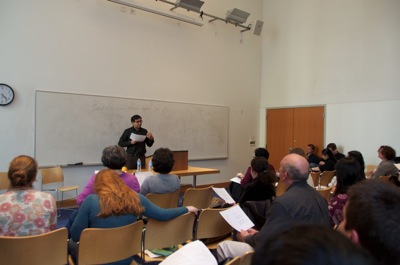
Fourth year graduate student Andrew Weir gave the following two presentations this summer. 

"Negation in Scots: two dinnas " at the Forum for Research on the Languages of Scotland and Ulster, University of Aberdeen, July 19.

"Some, speaker knowledge, and subkinds" at the Student Session of the European Summer School in Logic, Language and Information, University Opole, Poland, August 15.

Congratulations Andrew!

Call for papers: Workshop on Aspect across Languages

SUBMISSION DEADLINE: 20-Sep-2012


WORKSHOP DESCRIPTION:

The level of complexity and importance of aspectual systems in languages, compounded by the diversity of approaches to representing aspect, make aspect an extremely interesting topic for discussion. In this workshop, we would like to engage in this discussion from a cross-linguistic perspective. Although many authors have thoroughly addressed and investigated issues surrounding aspect, there still remains a lack of uniformity in regard to the theoretical notion of aspect (Beavers, 2008, in press; Borer, 2005; Comrie, 1976; de Swart, 1998; Dowty, 1979; Filip, 2008; Klein, 1994; Krifka, 1998; Vendler, 1967, amongst others). Aspect can roughly be delimited as describing the speaker's perspective on the internal organisation of an action, event or state, which not only covers temporal perspectives, but might also include characteristics such as progressive, habitual, repetition, momentary, bounded, perfective etc. (Bybee, Perkins, & Pagliuca, 1994; Dahl, 1985; Smith, 1997; Talmy, 2000; Verkuyl, 1993).

Topics of interest in this workshop include but are not limited to:

- definitions and classifications of aspectual notions;
- diachronic perspectives on aspect;
- aspectual coding in specific languages, i.e. single-language treatments of aspect;
- comparisons of aspect across different languages.

The workshop is held as part of the Annual Conference of the Australian Linguistic Society (https://sites.google.com/site/als2012uwa/home).


CALL FOR PAPERS:

We invite abstracts of up to 500 words. Please submit your abstract at

<https://bookings.arts.uwa.edu.au/ocs/index.php/linguistics/linguistics2012/schedConf/cfp>

Papers will be of 30 minutes duration, consisting of a 20 minute lecture-style presentation followed by 10 minutes for questions/responses.

Abstracts should be submitted online and will be reviewed by at least two reviewers drawn from the Program Committee. Please ensure that your abstract meets the specific guidelines (cf. website).

Note that only ALS members are eligible to present at an ALS conference. Non-members presenting papers must take up membership by the beginning of the conference.

We particularly invite contributions that focus on the premise that aspectual categories reflect conceptual structures and which make these structures explicit. In addition, we welcome analytical and comparative studies of aspect across languages as well as discussions and presentations that help to clarify the current knowledge base of aspect terminology. Authors with problematic and non-standard examples as well as with work in progress are encouraged to contribute.

Call for papers: SALT

Semantics and Linguistics Theory 23 will be held at UC Santa Cruz, May
3-5, 2013. We invite submission of abstracts for 30 minute oral
presentations (with 10 minute discussion periods) or posters on any
topic in natural language semantics.

Abstracts must not exceed 3 pages (please note the new page limit) in
letter-size paper, including examples and references, with 1 inch
margins on all sides and 12 point font size. The abstract should have
a clear title but should not identify the author(s). The abstract must
be submitted electronically in PDF format. Submissions are limited to
1 individual and 1 joint abstract per author, or 2 joint abstracts per
author.

SALT does not accept papers that by the time of submission have
appeared or have been accepted for publication in a peer-reviewed
journal. Preference will be given to presentations not duplicated at
other major conferences (including LSA, NELS, WCCFL).

Details about the submission process will be posted soon on the SALT 23 webpage:

http://babel.ucsc.edu/salt/

Please direct any inquiries to:

salt23ucsc@gmail.com

Important Dates:
-- Submission deadline: December 2, 2012, 11:59pm PST
-- Notification of acceptance: Early February 2013
-- Conference date: May 3 - May 5, 2013

Seth Cable goes to NELS

Congratulations to Seth Cable, whose paper "Distance Distributivity and Pluractionality in Tlingit (and Beyond)" was accepted to this year's NELS, which will be held at CUNY on October 19-21.

Speas in Leiden

Peggy Speas was a keynote speaker at "The Nature of Evidentiality," a conference held in Leiden on June 14-16. An abstract of her talk, "Evidential Situations," follows.

What is “evidence”?  In many formal analyses of evidentials, the denotation of a modal or illocutionary operator simply includes a stipulation that the speaker has “direct evidence,” “indirect evidence,” etc. This is a problem, since “evidence” has no denotation independent of what it is evidence for.  I argue that an explanatory theory of evidentials must be a relational one. I will draw on the insights of Nikolaeva (1999), Chung (2007) or Lee(2008), who have analyzed evidentials in terms of temporal or spatial relations, as well as others such as deHaan (1999) who have drawn attention to the fact that evidentials involve overlap or non-overlap with the speaker’s perceptual field. However, I will argue that evidentials denote relations between situations, not times or locations. 

Tibetan distinguishes three different types of evidence, ego, direct and indirect.  However, within each category there are multiple sub-types. For example, there are three different direct evidential morphemes, (‘dug, shag and song), which are often, but not always, interchangeable.

(1) a.

kha sang khong ‘khrom la slebs ‘dug

yesterday he market (LOC) arrived  ‘DUG

‘Yesterday he arrived at the market’ (and the speaker witnessed the event’)

  b.

kha sang khong ‘khrom la slebs shag

yesterday he market (LOC) arrived  SHAG

‘Yesterday he arrived at the market’ (and the speaker witnessed the event’)

  c.

kha sang khong ‘khrom la slebs song

yesterday he market (LOC) arrived  SONG

‘Yesterday he arrived at the market’ (and the speaker witnessed the event’)


In this talk I will focus on the distinction between ’dug and shag . It is fairly well established that song incorporates past tense, while ‘dug and shag are unmarked for tense. (Agfa 1993, Tournadre and Dorje 2003 and Garrett 2001) Although shag is the most frequent evidential in spoken Tibetan, it has not been extensively studied.  Documented differences between ’dug and shag do not reveal any obvious pattern. However, a pattern emerges within a theory that treats direct evidentials as denoting a relation of inclusion between the situation being reported and the situation in which the speaker came to know this information. I will argue that ‘dug and shag differ only in the direction of this inclusion relation. This analysis receives surprising support from the behavior of direct evidentials in the antecedent of conditionals, questions and negation. I further argue that apparently idiosyncratic uses of ’dug and shag are extensions of the relevant inclusion relations to epistemic domains.

It would be premature to draw conclusions from Tibetan about the general typology of evidentials, but I conclude by sketching out a typology based on the assumption that evidentials are necessarily relational. 

23 May 2012

Kathryn Pruitt's defense on Friday

Kathryn Pruitt will defend her dissertation on Friday, May 25, at 1:00PM in Machmer E-37. Her dissertation is entitled: Stress in Harmonic Serialism.

The (re-)birth of structurally biased phonology

Alumnus Elliott Moreton, now of UNC Chapel Hill, and Joe Pater have written a pair of papers launching what they call "structurally biased phonology". A further UMass connection is that they cite Professor Emeritus Emmon Bach as one of the original progenitors of this approach to phonological theory. From Pater and Moreton (to appear):

"Structurally biased phonology is a program of research that aims to understand the role of structural complexity in phonological learning and typology...Although a form of structurally biased phonology was originally proposed in Bach and Harms (1972), it seems not to have been subsequently much pursued. We seek to better understand: (1) what effects structure has on learning and typology, (2) whether and how the learning effects are causally connected with the typological ones, (3) what properties a learner must have to account for them, and (4) whether and how these effects are connected to other domains in and out of linguistics." 

Moreton, Elliott and Joe Pater. To appear. Structure and substance in artificial-phonology learning. In Language and Linguistic Compass. http://www.unc.edu/~moreton/Papers/MoretonPater.Draft.4.1.pdf

Pater, Joe and Elliott Moreton. To appear. Structurally biased phonology: Complexity in learning and typology. In a special issue of the EFL Journal on phonology, edited by K.G. Vijayakrishnan (The Journal of the English and Foreign Languages University, Hyderabad). http://blogs.umass.edu/pater/files/2012/05/pater-moreton-2012.pdf

Brian Smith goes to Manchester

Brian Smith will be going to the 20th annual meeting of the Manchester Phonology Meeting to present "Ineffability and UR constraints in Optimality Theory". He will be joined by several UMass alums: Jill Beckman, Elliott Moreton and Jen Smith.

http://people.umass.edu/bwsmith/
http://www.lel.ed.ac.uk/mfm/20mfm-prog.pdf

20 May 2012

WHISC goes on holiday

WHISC has discovered summer, and will be doing something about it. See you in the Fall!

13 May 2012

ICESL sponsored workshop on c-command on Wednesday

On Wednesday, May 16th, from 9 to 5:30 in Herter 301, there will be a series of talks at a workshop entitled:

Where is c-command? Relational structure in parsing long-distance dependencies. 

Speakers include Matt Wagers, Dan Parker, Maria Sol Lago, Colin Phillips, Dave Kush, Shevaun Lewis, Wing Yee Chow, Brian McElree, and UMass alumnus Jeff Runner and UMass student Jason Overfelt.

More information can be found at: http://people.umass.edu/bwdillon/workshop.html

Suzi Lima gets NSF dissertation award

Suzi Lima has been awarded an NSF Dissertation Grant. It will fund her next two field trips to the Xingu Indigenous Territory (Mato Grosso, Brazil).

Below is  a short abstract that summarizes her main proposal:

The Grammar of Counting and Measuring: a view from Tupi languages

This proposal aims to investigate the processes of counting and measuring in two under-studied Tupi languages spoken in Brazil, Yudja (Juruna family) and Kawaiwete (Tupi Guarani family). Three major aspects of the grammar of counting and measuring will be investigated: (i) the semantic and syntactic properties of numeral constructions, and their compatibility with notional count and notional mass nouns; (ii) the semantics of the measure constructions, their interaction with numerals and their syntactic status, and finally (iii) the semantics of nominal quantifiers. Preliminary research shows that Yudja and Kawaiwete are number neutral languages that do not obviously fit into the widely accepted linguistic typologies of the count/mass distinction proposed so far, in particular by Chierchia 1998a and Chierchia 1998b). Therefore, these languages raise new and important theoretical questions in the field of semantics.

Congratulations Suzi!

Andrew Weir gets a University Fellowship

Andrew Weir has been awarded a University Fellowship for the 2012-13 academic year.

Congratulations Andrew!

07 May 2012

Keir Moulton gives talk on Friday

UMass Alumnus Keir Moulton (UCLA) will give a talk on Friday, May 11, at 2:30 in Machmer E37. A title and abstract follow.

Covariation and Causers in Backward Variable Binding

Backward variable binding (BVB) as in (1) has inspired either deviations from surface syntax (Belletti and Rizzi 1988, Pesetsky 1995) or appeals to notions like logophoricity (e.g. Bouchard 1995).

(1) Heri new-found fame will make everyi actress rich.

I report that: (i) the distribution of BVB is distinct from backward bound reflexives and reciprocals, and not subject to constraints imposed by exempt or ‘logophoric’ reflexives; (ii) Backward bound variables are found in ’containing phrases’ that are situation-denoting (i.e. causers, Pesetsky 1995); (iii) the containing phrase falls in the scope of the binding quantifier and locality conditions on QR limit BVB. These ingredients lend themselves ideally to a D-type analysis (Heim 1990, Elbourne 2005). The semantics of causers supplies a situation variable for resolving the D-pronoun—one that co-varies with respect to the binding quantifier (hence the sensitivity to QR). We then show why these D-type pronouns in causer arguments do not exhibit crossover violations (2a), while D-type pronouns otherwise do (2b) (Büring, 2004).

(2) D-type in a causer:
      a. Heri mother made every knight who courted a ladyi nervous.

      D-type in an agent:
      b. *Heri mother visited every knight who courted a ladyi.

The mere existence of D-type BVB as in (2a) corroborates the analysis of (1) and, incidentally, speaks against recent accounts of BVB in causatives by Larson (Larson and Cheung 2009).

Angelika Kratzer selected as Radcliffe Institute Fellow

Angelika Kratzer has been selected as a fellow of The Radcliffe Institute for Advanced Study at Harvard University for the 2012-13 Academic year.  The Radcliffe Institute is "dedicated to creating and sharing transformative ideas across the arts, humanities, sciences, and social sciences." The Fellowship program brings together fifty artists and scholars every year.  An excerpt from the bulletin announcing Angelika's selection is below.

Congratulations Angelika!

The Radcliffe Institute for Advanced Study at Harvard University has selected Angelika Kratzer to be a Radcliffe Institute fellow for the 2012–2013 academic year. Angelika Kratzer is among the 51 women and men who will pursue independent projects in the arts, humanities, sciences, and social sciences within the rich, multidisciplinary community.

After a highly competitive peer-review process, Angelika Kratzer is among only 5 percent of applicants who were accepted to create a diverse incoming class that ranges from A to V: including anthropologists, chemical engineers, linguists, literature professors, molecular biologists, musicologists, and visual artists.

“As an alumna of the Institute’s Fellowship Program, it is a special pleasure for me to welcome these distinguished individuals to a year of exploration, innovation, and creation,” said Lizabeth Cohen, dean of the Radcliffe Institute for Advanced Study. “We expect that each fellow will enjoy a year of profound growth and great productivity.”

Angelika Kratzer is a professor of linguistics at the University of Massachusetts at Amherst. She has been a guest professor in many places around the world and is a fellow of the Linguistic Society of America. With Irene Heim from MIT, she is co-founder and co-editor of Natural Language Semantics, a journal that, for the last twenty years, has been a major force in bringing together results from theoretical linguistics with fieldwork-based research on underdescribed languages.

Angelika Kratzer’s area of specialization is semantics, an interdisciplinary field located at the intersection of linguistics, cognitive psychology, logic, and philosophy. Her research is about how natural languages are constructed so as to make it possible for humans to systematically assemble complex meanings from small and simple pieces. Humans talk about mere possibilities: what might have been, ought to be, could be, or should be. Human notions of what is possible, inevitable, likely, or desirable are highly systematic,and this is why they have attracted the attention of mathematicians, logicians and philosophers for more than two thousand years. As a Radcliffe fellow, Angelika Kratzer will write a book showing how talk about possibilities is the result of an intricate interaction between the human language faculty and general cognitive abilities, some of which we share with other species.

The Radcliffe Institute, which is Harvard’s institute for advanced study, has awarded nearly 600 fellowships since its founding in 1999. The complete list of 2012–2013 fellows is online: www.radcliffe.harvard.edu.

Graduate Commencement on Friday, May 11

Commencement for our Master's and PhD students will take place at the Mullins Center at 9AM this Friday, May 11.  WHISC has learned that the following linguists will be presented with their degrees at this ceremony.

Abril Navarro
Mike Key
Emily Elfner
Karen Jesney
Aaron Schien
Martin Walkow

For more information about Commencement:  http://www.umass.edu/commencement/graduate-ceremony

Congratulations to them, and to the rest of our graduating students this year.

Kingston on the Road

John Kingston will be taking his show on the road through May and June, with talks and classes at Nijmegen, Paris and San Pablo, Oaxaca. Here, in his own words, is a description of his itinerary.

9-11 May 2012. Relations in Relativity: New Perspectives on Language and Thought. Max Planck Institute for Psycholinguistics, Nijmegen. Invited talk or a side in a conversation with Emmanuel Dupoux on whether linguistic knowledge affects speech perception early or late -- I argue that the effects are late. I'll also be participating in master classes for graduate students and a panel discussion. Details can be found at: http://www.mpi.nl/events/relations-in-relativity

13 May-13 June 2012. International chair, Empirical Foundations of Linguistics. I'll be giving a weekly seminar on the relationship between speech perception and sound perception and collaborating with colleagues Jacqueline Vaissiere, Cecile Fougeron, Pierre Halle, Barbara Kuhnert, Annie Rialland, Rachid Ridouane and others at the Laboratoire de Phonétique et de Phonologie. For more info:

http://www.labex-efl.org/?q=fr/node/1
http://www.labex-efl.org/?q=fr/node/125

15-24 June 2012. Taller de tonos para linguistas hablantes de lenguas de Mesoamerica. (trans: Workshop on tone for native-speaker linguists of Mesoamerican languages). Together with Emiliana Cruz from Anthropology and a number of other colleagues from the US and Mexico, I will be lecturing on the phonetics, phonology, and historical development of tone in morning sessions and advising small groups focused on particular languages in the afternoon sessions. For more info: http://tallerdetonos.blogspot.com/

Bon Voyage, John!

Borschev and Partee give talk at Moscow State University

Vladimir Borschev and Barbara Partee gave a talk “Genitive of measure, types, sorts, and semantic shifts” at Moscow State University on April 28 in the 169th meeting of Vladimir Uspensky’s seminar series on Applications of Mathematical Methods in Linguistics. (The talk relates to two of their recent papers, a 2011 one in Russian in a festschrift for Yury Apresjan and a 2012 one in the Journal of Semantics, both downloadable from Barbara’s website.)

Undergraduate Commencement

Commencement for UMass undergraduates is this Friday, May 11, at the McGuirk Alumni Stadium, starting at 4:00 PM.  There is a separate ceremony for graduates of School of Humanities and Fine Arts that takes place on Saturday, May 12, at 1PM in the Recreation Center.

(For more information: http://www.umass.edu/commencement/)

Say congratulations to our graduating seniors:

Kelly Jo Fuller
James ParsonsDatherine Rose DeVane Brown
Gavin Galloway
Marissa Malone
Chelsea McGovern
Heather Pastushok
Rebecca Shaughnessy
Madolyn Chiu
Renee Lessard
Amanda Lewis
Karin Eichelman
Sheila Rotkiewicz
Nathan Banker
Laura Catanach
Taylor Cohen
Rhiannon Courtney
Epiphany Holmstock
Carol Huben
Glynis Anna Jones MacMillan
Mikaela Ortstein-Otero
Kayly Tillman
Yurleni Velez
Yiliang Xie
David Rome

Linguistics Club selects officers

Amanthis Miller writes:

The Undergraduate Linguistics Club is happy to say that we've survived our first year as an RSO! Thanks to all the student and faculty that have come to meetings and made our club great! We will be returning again for Fall 2012 for more linguistic antics and adventures, with another all-star officer line-up:

President:       Jeremy Cahill   (jccahill@student.umass.edu)
Vice President:  Amanthis Miller (amanthis@student.umass.edu)
Treasurer:       [Tentatively: Pratiksha Yalakkishettar]
Secretary:       Benjamin Herman (bsherman@student.umass.edu)
Librarian:       Emily Westland  (enicat@verizon.net)
Web Master:      Samuel Baldwin  (sbaldwin@student.umass.edu)

Hope to see everyone next semester, good luck on finals, and happy almost summer!

Linguistics 401 Summer Playlist

Rajesh Bhatt writes:

In the last class of the semester before the summer, I asked the wonderful students of the Spring 2012 Linguist 401 [Introduction to Syntax] class for listening suggestions for the summer. This is what came in with the finals.

List BA
Midnight City - M83
Shuffle - Bombay Bicycle Club
Dancing Behind My Eyelids - Mum

List DM
The next time around - Little Joy
Attaboy - Yo Yo Ma & Stuart Duncan
Love is all - The Tallest Man on Earth
Ziggy Stardust - Seu Jorge
The Breeze - Dr. Dog
40 Day Dream - Edward Sharpe
Sam Huff's Flying Raging Machine - Lettuce
Jackie wants a black eye - Dr. Dog
Dancefloors - My Morning Jacket
Slippin' and Slidin' - Justin Townes Earle
A La Longue - Noir Desir
Magic Marker - Monsters of Folk
Oliver James - Fleet Foxes

List FC
Guy who got a headache and accidentally saves the world - The Flaming Lips
Spitting Blood - WU LYF
In her drawer - RX Bandits
Randy described Eternity - Built to Spill
Building Steam with a Grain of Salt - DJ Shadow
A More Perfect Union - Titus Andronicus
Award Tour - A Tribe Called Quest
A Tender History In Rust - Do Make Say Think
Black History Month - Death From Above 1979
Cross the Breeze - Sonic Youth

List GURH
Stand and Deliver - Adam Ant
Sound and Vision - David Bowie
Blame it on Cain - Elvis Costello
You're the voice - John Farnham
We are Golden - Mika
Birdhouse in your soul - They Might Be Giants
Bicycle - Pink Floyd
That'll be the day - Buddy Holly
Psycho Killer - Talking Heads
Mr. Blue Sky - Electric Light Orchestra
Running up that hill - Kate Bush
Marty Groves - Fairport Convention
Sorrow - David Bowie

List MS
Turn to Stone - Electric Light Orchestra
Super Rad - The Aquabats!
Tamacun - Rodrigo y Gabriela
Take the long way home - Supertramp
Opera Singer - Cake
Cousins - Vampire Weekend
Ballroom Blitz - Sweet
Me and Julio down by the schoolyard - Paul Simon
Dead Leaves and the Dirty Ground - The White Stripes
Somewhere in the Between - Streetlight Manifesto

Roeper appointed to commission of the German Ministry for Education and Science

Tom Roeper has been appointed to an evaluation commission of the German Ministry for Education and Science as part of their Initiative in the Humanities to promote longterm research in the Humanities.

Congratulations Tom!

28 April 2012

Kamiya talks at LARC/Acquisition Lab on Monday

On Monday  April 30, 2012 at 5:20 in the Partee Room (South College 301), Masaaki Kamiya (Hamilton College) will give the following talk.

"Semantic/Pragmatic notion of contrastiveness and learnability issues in
Japanese-speaking children"

Everyone is welcome!

2012 ESSLLI student grants extended to Monday

Reminder and Grants Info 
ESSLLI 2012 STUDENT SESSION

Held during
The 24th European Summer School
in Logic, Language and Information

Opole, Poland, August 6-17, 2012

EXTENDED DEADLINE: APRIL 30, 2012
http://loriweb.org/ESSLLI2012StuS/

This is a reminder of the final, extended deadline for submission to the ESSLLI 2012 Student Session and a notification that the ESSLLI 2012 OC are offering grants in form of waived fees to selected students. Preferences will be given to students actively participating in the Student Session.

The deadline for submitting to the ESSLLI 2012 StuS is **APRIL 30**

For more information of grant application, instructions for authors and important dates, please refer to the Student Session website: http://loriweb.org/ESSLLI2012StuS/

Mini-conference on Thursday, May 3

The second year students will give short presentations of their generals papers in the annual mini-conference, this Thursday (May 3). It will be held in 22 Arnold House, from 1-4, with refreshments served.

Cable gets HFA Project funds award

Seth Cable has been awarded monies to support his work over the summer on Tlingit from the Humanities and Fine Arts Project funds.

Congratulations Seth!

Linguistics Majors present at the Undergraduate Research Conference

On Friday, April 27, there were three presentations at the Massachusetts' Undergraduate Research Conference by UMass linguists. They were:

Katherine Devane Brown, Learning to understand foreign-accented speech, 11:35-12:20, Room 911

Kayly Tillman, Perception of Intrusive /r/ in Bostonian English, 11:35-12:20, Room 911

Chris Garry, An Algorithm for Tracking Vertical Larynx Movement, 3:30-4:15 in the Auditorium, Board 38A

For more information, go to:

http://honorsapp.honors.umass.edu/aspnet_resources/conference/2012ucdprogram.pdf

Congratulations!

22 April 2012

Ayesha Kidwai gives talk on Wednesday

Ayesha Kidwai, Professor at Jawaharlal Nehru University in New Delhi, India, will give a talk entitled "Extraposition, Scrambling and Wh-construal in Hindi and Bangla Finite Complements" on Wednesday, April 25, at 2:30 in Herter 204 (abstract follows).

Professor Kidwai  has worked on scrambling, binding, topic and focus, intonation, and information structure in a number of languages, with a focus on Hindi-Urdu and Meiteilon. She is the author of the OUP book `XP-Adjunction in Universal Grammar: Scrambling and Binding in Hindi-Urdu'. Most recently she translated `In Freedom's Shade', a memoir by Anis Kidwai that documents the first twenty years of independent India.

Abstract:

In this talk, I will revisit the familiar question of finite clause extraposition and argue that the Hindi and Bangla facts from rightward and leftward scrambling, WH-construal  and bound anaphora in embedded clauses suggest that the non-canonical rightward positioning of finite complements is effected by a generalised, and revised, version of TH/EX (Chomsky 1999/2001). I will argue that while this 'displacement' is driven by interface conditions holding primarily at the PHON interface, it also serves to facilitate the observance of SEM interface conditions. Along the way to this analysis, I will propose that the distribution of expletive pronominals that frequently occur in construction with such finite clauses is fundamentally unrelated to the extraposition operation per se, and that the differences between Hindi and Bangla reduce to a single lexical item -- the nature of the embedded C0.

Gaja Jarosz speaks on Friday, April 27

Gaja Jarosz, from Yale University, will give the department colloquium talk this Friday, April 27, at 3:30PM in Machmer E-37. You can learn more about Professor Jarosz at http://pantheon.yale.edu/~gjs42/.

The title and abstract for her talk are:

Learning Hidden Structure in OT and HG

Computational models of learning with violable constraints have led to significant progress in understanding how learners acquire the complex system of knowledge that is phonology; however, a number of significant challenges remain. This talk addresses one of the major outstanding problems, learning in the face of hidden structure, and examines the challenges this problem poses for successful and efficient learning. The particular kind of hidden structure I focus on in this talk is structural ambiguity, which includes any kind of latent structure assigned when parsing a phonological string, such as metrical feet, (sub)syllabic constituents, and autosegmental representations. I examine Robust Interpretive Parsing (Tesar and Smolensky 1998), a well-known approach to structural ambiguity in OT, and show that its extension to probabilistic constraint-based grammars as first described by Boersma (2003) is problematic. The problem occurs because the proposed formulation fails to take advantage of the rich information contained in the learner's stochastic grammar. I propose two modifications to the learning algorithm, one trivial and another more involved, and show that both lead to improvements in the success rates of Stochastic OT and noisy HG learners. I then examine another important aspect of these algorithms' performance: their efficiency. The results of this second evaluation are complex but indicate an efficiency advantage for the proposed modifications as well. I discuss the implications for the relative merits of OT and HG as well as for the evaluation of computational models of phonological learning more generally.

Workshop on memory and long-distance dependencies

On Wednesday, May 16th, ICESL is sponsoring a one-day workshop hosted by Brian Dillon and Lyn Frazier, with the goal of discussing issues at the interface of memory retrieval and the construction of long-distance dependencies, and in particular, if and how structural notions like c-command are used during the online comprehension of binding dependencies. Invited speakers include Brian McElree (NYU), Colin Phillips (UMD), and Jeff Runner (U of R). For more information, please visit the workshop website:

http://people.umass.edu/bwdillon/workshop.html

If you plan on attending, please let Brian know so that we can have an accurate head-count.

Cable awarded Jacobs Research Funds

Seth Cable has been awarded a Jacobs Research Fund grant for his fieldwork on Tlingit this summer.

Congratulations Seth!

Entering class of Graduate Program announced

WHISC is pleased to welcome the following individuals, who will join the graduate program in the Fall of 2012.

Hsin-Lun Huang has a BA from National Taiwan University and is completing an MA at National Chengchi University. He is interested in classifiers, resultatives, long-distance binding, and other topics in syntax and has worked primarily on his native language, Mandarin.

Jon Ander Mendia some of us already know. He comes to us from the University of the Basque Country (in Spain), where he earned his BA and MA. He is interested in semantics, especially topics involving quantification.

Ethan Poole s completing his BA at the University of Minnesota, Twin Cities. Ethan has been awarded an NSF Fellowship, and he serves as web master for the LSA. He is interested in syntax, having worked on various topics in Mainland Scandinavian languages.

Amanda Rysling was admitted last year but deferred so that she could accept a Fulbright Fellowship to study and do research in Poland. She completed her BA at NYU. She is interested in morphology-phonology interface, exceptionality and its roots, and syllable structure.

Megan Somerday comes to us from the University of North Carolina, Chapel Hill. Having done a second major in math, she worked for a while in a statistics firm. She is interested in OT phonology, acquisition, and AAVE.

Rajesh Bhatt gives colloquium at the University of Connecticut

Rajesh Bhatt will give the colloquium at the University of Connecticut on Friday, April 27. The title of his talk is "Differential Phrases and a Semantics for Comparatives."

Call for papers: (In)definites and weak reference

(IN) DEFINITES AND WEAK REFERENCE

We are pleased to announce the conference (In)Definites and Weak Reference, which will be held at Universidade Federal de Santa Catarina – UFSC - in Florianopolis (Brazil), on August 20-21, 2012.
The conference is part of the activities of the CAPES-COFECUB Cooperation Project.

Invited Speakers:
Greg Carlson (University of Rochester)
Claire Beyssade (CNRS – IJN Paris)
Carmen Dobrovie-Sorin (CNRS – Paris 7)

Important Dates:
Abstract Submission: May 15
Notification of acceptance/rejection: June 15
Program: June 20

Information about the conference: http://www.barenominals.ufsc.br/

Conference on Formal Approaches to Heritage Language

Over this weekend, the Language Acquisition Research Center hosted a conference on formal approaches to Heritage Language, with invited lectures by Acrísio Pires, Ana Perez-Leroux and Maria Polinsky. More information can be found at: 

http://www.umass.edu/larc/events/FAHL.html

Lisa Green speaks at Stony Brook

Lisa Green will give a talk at Stony Brook on Thursday, April 26 as part of the Language Diversity Lecture series. The title of her talk is: "African American English Through the Years: From Hot Topics and Debates to Linguistic Research."

Call for Papers: Workshop on Locality and Directionality at the Morphosyntax-Phonology Interface

Stanford University is hosting a workshop on Locality and Directionality at the Morphosyntax-Phonlogy Interface on October 12-14, 2012. Talks are 45 minutes long, and there is a poster session as well. The two page abstracts are due on June 1.

More information can be found at:

http://www.stanford.edu/~gribanov/CrISP_workshop.html

15 April 2012

John McCarthy to be Dean and Vice-Provost

Congratulations to John McCarthy, who has been appointed Dean of the Graduate School and Vice-Provost for Graduate Education, effective this September.

Even as he takes on these new administrative responsibilities, John will remain engaged in graduate teaching, advising, and research in the Linguistics Department, and he will teach a seminar every year. As happened with Michael Becker this year, the department will also receive funds annually to hire a visiting faculty member in phonology.

John Drury (Stony Brook) gives a talk on April 20th

Lisa Sanders writes:

John Drury (http://www.linguistics.stonybrook.edu/faculty/john.drury) will be visiting from Stony Brook University on April 20th. He'll be giving an ICESL colloquium on Friday, April 20th at 3:30 pm in Tobin 423. If you are interested in meeting with him before the talk (12-3), email Lisa Sanders (lsanders@psych.umass.edu) to set the time and place. If you are interested in meeting with him after the talk, join us for the reception in the Partee room.

The title of his talk is "On the etiology of some of the usual suspects in language ERP research: LANs, N400s, and P600s (but especially LANs).

An abstract can be found here:

http://www.umass.edu/linguist/icesl/events/john-drury-april-20-2012.

UMass at the Modality Workshop in Ottawa

This Friday and Saturday, April 20-21, Ottawa University will sponsor a conference on Modality (Modality@OttawaU).

Angelika Kratzer, and former UMass faculty Lisa Matthewson, are invited speakers.

Angelika Kratzer's talk is entitled "Modals as building blocks for attitude ascriptions"

Lisa Mattewson's talk (co-authored with UMass alumnus Hotze Rullman) is entitled "Epistemic modality with a past temporal perspective."

Many UMass graduates are on the program:

Aynat Rubinstein, is presenting "Developing a methodology for modality-type annotations on a large scale," a paper co-authored with Dan Simonson, Joo Chung, Hillary Harner, Graham Katz and Paul Portner.

Ilaria Frana is presenting "Adnominal conditions and modal NPs"

Luis Alonso Ovalle and Junko Shimoyama are presenting "Modality in the nominal domain: exploring Japanese wh-ka indeterminates."

Luis Alonso Ovalle and Paula Menéndez-Benito are presenting "Indifference and Modality: the case of Spanish 'uno cualquier' "

Aynat Rubinstein is presenting "Straddling the line between attitude verbs and necessity modals"

Ana Arregui is presenting "Variation in imperfectives," a paper co-authored with María Luisa Rivero and Andrés Salanova.

Barbara at Cafe ZaVtra (Moscow)

Barbara Partee writes:

On Thursday April 19 I'll give a talk in Russian for a general audience at the Cafe ZaVtra in Moscow, on formal semantics as the offspring of linguistics and philosophy. (Formal’naja semantic oak porozhdenie lingvistiki i filosofii.) There will be a live video broadcast over the website of the hosting organization, polit.ru. The website with both the announcement of the talk and the link for the streaming video is here:  http://polit.ru/article/2012/03/28/anons_partee/ . The talk starts at 7pm Moscow time (11am Amherst time); the talk will be followed by an hour of questions and answers – doing that in Russian is the part I’m most nervous about, so I’m doing a couple of rehearsals of that part. And Volodja and other colleagues will be there to help when I can’t find the words I’m searching for or absolutely can’t understand some question.

By the way, both Google translate and Facebook were tremendously useful as I worked on my first draft. Google translate has to be used with caution – you can’t just turn it loose. It wanted to translate ‘validity’ with a term relating to the expiration date on medicines and warranties; and when I gave it David Lewis’s famous sentence, “Semantics without the treatment of truth conditions is not semantics”, it wanted to translate ‘treatment’ in the sense of medical treatment, as if we needed to cure semantics of the ailment of truth conditions. (Like.) But with care and some iterations between the two languages and a few tricks, it can really help. And bilingual friends on Facebook helped at many crucial points as I worked. This weekend I’ll revise the talk and make the slides, then a couple of rehearsals and I’ll be as ready as I’ll ever be. Volodja is helping in many ways, including discussing this stuff in Russian with me at dinner every day. (I must confess that up until now, the great majority of my discussions of semantics with colleagues and students have been in English, and I’ve had to do a lot of homework for this talk! But although I’m a little bit nervous, I’m really looking forward to it!)

Anne Pycha gives colloquium at Stony Brook

Anne Pycha will give the colloquium talk at Stony Brook on April 20. The title of her talk is "Phonological signatures in words: Evidence from production and perception of diphthongs." An abstract follows.

This talk wrestles with two problems that face phonology. First, non-local dependencies in phonology are not widely attested, despite the fact that they are common at other levels of linguistic analysis, such as syntax. Second, many phonological processes bear close resemblance to phonetic processes, suggesting that no real difference exists between abstract phonological structures and the physical events of articulation. In this talk, I pursue the hypothesis that phonologically contrastive processes exhibit acoustic “signatures” that are a) non-local and b) absent from otherwise similar phonetic processes. Experiment 1 demonstrates that English speakers produce non-local dependencies in order to maintain contrast between words such as bite vs. bide, but not in order to accomplish other tasks, such as changing speech rates or signaling phrasal positions. Experiments 2 & 3 demonstrate that English listeners can use these dependencies to perceptually distinguish between words like bite vs. bide, even in the absence of other cues. The upshot of these findings, which build on previous work that I have done in Hungarian, is that phonology does use non-local dependencies, and these dependencies crucially distinguish it from phonetics. I analyze non-locality in both languages as motivated by a need to target maximal segments, and I examine the implications of this analysis for cross-linguistic typology.

Career Services advisor speaks at Undergraduate Club

Jeremy Cahill writes:

A Career Services advisor will be speaking about internships and job search resources at Linguistics Club on Tuesday, April 17th, at 5:15 
PM in the Partee room.

All undergrads are invited and pizza will be provided.

Internship + Job Search Workshop w/ Career Services
Tuesday, April 17 at 5:15 PM
301 South College (across from DuBois Library)

UMass at Chicago Linguistics Society

The 48th annual meeting of the Chicago Linguistics Society meets Thursday (April 19) through Saturday (April 21) at the University of Chicago.

UMass graduate student Elizabeth Bogal-Allbritten will present "Slightly coerced: Processing evidence for adjectival coercion by minimizers."

UMass alumnus Kai von Fintel is an invited speaker: he will present "What's an Imperative"

UMass alumnus John Alderete will present "Learning phonotactics without rules: A connectionist model OCP-Place in Arabic," a paper co-authored with Stefan Frisch.

UMass alumnus Elliott Moreton will present "Is phonological learning special?," a paper co-authored with Katya Pertsova

Cable at Harvard

Seth Cable is giving a colloquium talk at Harvard University on Friday, April 20. The title of his talk is "Beyond the Past, Present and Future: Towards a Semantics of 'Graded Tense' in Gikuyu."

Last Call for papers for Workshop on Information, Discourse Structure and Levels of Meaning: tomorrow!

Call for papers for the workshop on Information, Discourse Structure
and Levels of Meaning (IDL 12)
25-26 October 2012  in Barcelona

More info: http://blogs.uab.cat/idl12/
Deadline for abstracts submissions: 16-Apr-2012

Information and discourse structure, and the analysis of different levels of meaning (conventional and conversational implicatures, presuppositions, etc.) have been two of the most fruitful areas of research in the semantics-pragmatics interface in the last decade. This workshop aims to study the interactions between these two areas. Thus, the questions that this workshop will address go in two
directions.

1. How does information and discourse structure affect the different
levels of meaning? Can we obtain a better understanding of, for
instance, conversational implicatures or presuppositions, once the
topic-focus structure is taken into account?

2. How do the dimensions of meaning affect the information structure
of discourse? Can we obtain a better understanding of concepts such as
topic, focus, contrastive topic, background or QUD, once the
properties of the different levels of meaning are taken into account?

Invited speakers:
Daniel Büring (Universität Wien)
Bart Geurts (Radboud University Nijmegen)
Craige Roberts (Ohio State University)
Gregory Ward (Northwestern University)

We invite contributions for 30′ oral presentations.
Abstracts should conform to the following guidelines:

-Abstracts must be submitted electronically via Easychair:
https://www.easychair.org/account/signin.cgi?conf=idl12
-Abstracts should be anonymous.
-Abstracts should not exceed two pages, including examples and references.
-Submissions are restricted to one single-authored or one co-authored
abstract at most.
-The conference language is English: abstracts and talks will be in English.
-Page format: A4, 2.5 cm margins on all sides, at least 12 pt Times
New Roman font, single line spacing.
-File format: .pdf
-File name: surname.pdf

Call for papers: Texas Linguistics Conference

13th Texas Linguistics Society (TLS) Conference
June 23-24, 2012
University of Texas at Austin

TLS is a graduate-student run conference in linguistics organized by the Texas Linguistics Society and the Department of Linguistics at the University of Texas at Austin. This year's TLS is co-located with the North American Summer School in Logic, Language, and Information and associated workshops and symposia.

http://uts.cc.utexas.edu/~tls/

TLS 13 will be structured around two para-sessions: (1) the semantics and pragmatics of questions and question-based models of discourse, and (2) signed languages and meaning. While we encourage submissions related to these themes, we are also interested in submissions on topics of general linguistic interest. Papers on language related topics from disciplines including anthropology, cognitive science, neuroscience, philosophy of language, and psychology will also be considered.

--- Keynote Speakers ---

Nicholas Asher (IRIT, CNRS/Université Paul Sabatier)
Erin Wilkinson (University of Manitoba)

--- Invited Talks ---

Kathryn Davidson (University of Connecticut)
Jeroen Groenendijk (University of Amsterdam)
Katrin Erk (University of Texas at Austin)
Richard Meier (University of Texas at Austin)
Josep Quer (ICREA, Universitat Pompeu Fabra)
Craige Roberts (The Ohio State University)

--- Submission Information ---

One page abstracts (plus references) should be submitted in PDF or DOC format in 11-12 point font through EasyChair at https://www.easychair.org/conferences/?conf=tls13

Authors whose abstracts are accepted are encouraged to submit a short paper (10-20 pages). These will be collected into an edited volume for publication.

--- Important Dates ---

* Abstract Submission Deadline: May 5, 2012
* Notification of Acceptance: May 12, 2012
* Pre-proceedings Paper Submission Deadline: June 10, 2012
* Final Draft Submission Deadline: August 31, 2012

08 April 2012

Luiz Amaral speaks in the LARC/Acquisition Lab

Tomorrow, April 9, at 5:20 PM in the Partee Room (301 South College), Luiz Amaral will give a talk entitled "Experimental ideas to test recursion and verb morphology in Wapichana," at the LARC/Acquisition Lab meeting.

All are welcome!

Syntax Guru, Hamida Demirdache, takes up residence

Hamida Demirdache, director of the Laboratoire de Linguistique de Nante and professor of linguistics at University of Nantes, will be taking up her guru duties on Monday, April 9th, until Thursday, April 26th. Professor Demirdache has done extensive work on resumptive pronouns and, in recent years, has worked on the syntax and semantics of questions and on the first language acquisition of constituent questions. She is also known for her work on tense, and its interaction with modals and aspect.

You can find her hanging out in the guru office (aka Barbara Partee's office), on the third floor of South College. If you'd like to make an appointment with her, she can be emailed at hamida.demirdache@univ-nantes.fr

Hamida is wonderful to talk to. Take advantage of her guruness early and often!

Yangsook Park speaks at PsychoSyntax meeting on Friday

Brian Dillon writes:

The PsychoSyntax meetings ride again for a final time this semester on 4/13. Yangsook will be talking to us about "Embedded Topic in Korean". The meeting time is the usual time / place: 10am in the Partee room.

See you there!

Alice Harris speaks at Undergraduate Ling Club

Jeremy Cahill writes:

Prof. Alice Harris will be speaking on Georgian on April 11. All undergrads are invited and pizza will be provided.

Alice Harris (UMass Amherst)
"Georgian Language Case-Marking Systems"
Wednesday, April 11 at 5:15 PM
301 South College (across from DuBois Library)

RSVP, please: jccahill@student.umass.edu

Hamida Demirdache speaks at department colloq

The syntax guru, Hamida Demirdache, will be speaking at the department colloquium this Friday, April 13, at 3:30 in Machmer E-37.

The title of her talk is "Crossover and reconstruction resumptive puzzles. Wholesale VERY late merger."

Final Call for Papers: ESSLLI 2012

Final Call for Papers
ESSLLI 2012 STUDENT SESSION

Held during
The 24th European Summer School
in Logic, Language and Information

Opole, Poland, August 6-17, 2012

EXTENDED DEADLINE: APRIL 30, 2012
http://loriweb.org/ESSLLI2012StuS/

ABOUT:

The Student Session of the 24th European Summer School in Logic, Language, and Information (ESSLLI) will take place in Opole, Poland on August 6-17, 2012. We invite submissions of original, unpublished work from students in any area at the intersection of Logic & Language, Language & Computation, or Logic & Computation. 

Submissions will be reviewed by several experts in the field, and accepted papers will be presented orally or as posters and will appear in the student session proceedings. This is an excellent opportunity to receive valuable feedback from expert readers and to present your work to a diverse audience.

ESSLLI 2012 will feature a wide range of foundational and advanced courses and workshops in all areas of Logic, Language, and Computation. Consult the main ESSLLI website (link below) for further information.

SPRINGER PRIZES FOR BEST PAPER AND BEST POSTER

In 2012, Springer has again continued its generous support for the Student Session by offering € 1000 in prizes. These include a a € 500 for Best Paper and € 500 for Best Poster. The prizes are awarded best on the reviews of the submission as well as the oral presentation.

INSTRUCTIONS FOR AUTHORS:

Authors must be students, i.e., may not have received the Ph.D. degree before August 2012. All submissions must be in PDF format and be submitted to the conference EasyChair website. Submissions may be singly or jointly authored. No one may submit more than one singly and one jointly authored paper.

There are two types of papers. Long papers of up to 8 pages will be considered for both oral presentation and the poster session. Short papers of up to 4 pages will be considered as submissions for the poster session.
We strive for posters getting the longest possible exposure during ESSLLI 2012.

Submissions must be anonymous, without any identifying information ready for blind peer review, and must be must be received by April 30, 2012.

More detailed guidelines regarding submission can be found on the Student Session website:http://loriweb.org/ESSLLI2012StuS/
Links to previous years' proceedings are also available there.

IMPORTANT DATES:
Submission of papers: April 30
Notification deadline: June 10 (in time to make early registration for ESSLLI with reduced fee)
Submission of camera-ready papers: July 1
Conference dates: August 6-17

PROCEEDINGS
All accepted papers will be available in online proceedings.
A Springer volume in the LNCS series with the best papers of 2008-2009 have been published, and a similar volume for 2010-2011 is in preparation. We aspire to a forthcoming volume for 2012-2013.

FURTHER INFORMATION:
Please direct inquiries about submission procedures or other matters relating to the Student Session to esslli2012stus@loriweb.org.

For general inquiries about ESSLLI 2012, please consult the main ESSLLI 2012 page,http://esslli2012.pl/.

Call for papers: Mass/Count

First call for papers
International Multidisciplinary Colloquium:
Mass/Count in Linguistics, Philosophy and Cognitive Science

December 20-21, 2012
ENS-Paris, France

The aim of this colloquium is to provide a platform of exchange between linguists, philosophers and psychologists, working the different aspects of the mass/count distinction. Such a resolutely interdisciplinary approach is indeed necessary to fully apprehend the new questions that are presently arising in connection to the mass/count distinction. This multidisciplinary conference aspires to move this scientific debate forward, and contribute to the evolution of current methodology.

A more detailed description of the scientific scope of this colloquium is available at: http://mass-count.sciencesconf.org/

Topics of particular interest include, but are not limited to:

-       Alternative approaches to standard extensional mereology
-      Analysis of the (quasi-)classifier role on nouns in constructions like “the town of Paris”
-      The mass/count distinction in connection to non-sortal nouns like “the kind” of “the type”, etc.
-       Plurality and individuation of reference
-       Syntactic mapping
-       Experimental psychology and assessment of theoretical analyses

SUBMISSION DETAILS

We invite submissions of anonymous two-page abstracts including references, for a 30-minute talk.

All submissions must be made exclusively electronically via the website:
http://mass-count.sciencesconf.org/
The heading “Submission” appears only after having registered on the SciencesConf website.
Important: for authors affiliated to a French institution, during the submission procedure, under the heading “Affiliation”, the authors will necessarily have to provide the EPST code of their laboratory (e.g. for the CNRS and the university, it will be of the form UMRxxxx, EAxxxx, etc.).

INVITED SPEAKERS:
• David Barner (UCSD)
• Almerindo Ojeda (UCDavis)
• Beyon-Uk Yi (Toronto University)
• Anne Zribi-Herts (Paris 8 University)

IMPORTANT DATES

Deadline for submissions: June 29, 2012

Notification: September 3, 2012
Conference: Paris, December 20-21, 2012

01 April 2012

Fernanda Mendes at LARC/Acquisition Lab meeting

On Monday, April 2, in the Partee Room (South College 301) Fernanda Mendes will present "Inalienable Possession: Possessor's' Plurality Effects and Determiner Status." The meeting begins at 5:20PM. Everyone is welcome!

Semantics guru, Judith Tonhauser, speaks at SRG

Judith Tonhauser will be speaking at the Semantics Reading Group on Thursday, April 5. She will present research concerning the temporal interpretation of noun phrases. Hannah hosts the reading group at Barbara and Volodja's place. For more information, contact Anisa Schardl.

ECO 5 at UMass on Saturday, April 7

Anisa Schardl writes:

ECO5 is coming to UMass!

UMass is delighted to host ECO5, a graduate student workshop on
syntax.  All are welcome to attend!  Here are the essential details:

Time: Saturday, April 7th, 10:00am -- 5:00pm
Location: Herter Hall, room 301 (also known as the French Lounge)
Afterparty: 7:00pm dinner party at the home of the incomparable Rajesh Bhatt

If you attend ECO5, you will probably hear talks from the following people:
Lauren Eby (Harvard)
Yuki Ito (Maryland)
Jungmin Kang (UConn)
Nick LaCara (UMass)
Carolina Peterson (Maryland)
Jose Riqueros Morante (UConn)
Peter Smith (UConn)
Edwin Tsai (Harvard)
Andrew Weir (UMass)
...and possibly others!

Getting there is easy!  Herter Hall may be found on the following map:
http://goo.gl/DArui
There are metered parking spots along Presidents Dr. and there are
parking lots along Swift Way (Mass Ave.)  Since it is the weekend, you
don't need to pay the meters or have the correct parking permits.  If
you are coming by PVTA bus, the UMass/Haigis Mall stop is right in
front of Herter.

We'll start with a breakfast of bagels and coffee at 10, with talks
starting at 10:30.  At noon, we'll have a pizza lunch courtesy of
UMass and then resume talks during the afternoon.  Then on to
Northampton for the afterparty!

The afterparty will feature dinner, home-cooked by grad students!  In
the tradition of UMass colloq dinners, we hope that guests will bring
drinks.  If you feel so inclined, bring a beverage to share.

We are excited to be hosting ECO5 and we hope to see you there!

For more information about the program, see: http://people.umass.edu/aschardl/eco5.html

2nd Annual ICESL Workshop on Friday, April 6

The second annual workshop sponsored by the Institute for Computational and Experimental Study of Language will take place this Friday, April 6. The speakers include Luiz Amaral (Languages, Literature and Cultures), Jacquie Kurland (Communication Disorders) and David Smith (Computer Science). For more information, see

/http://www.umass.edu/linguist/icesl/events/2nd-annual-icesl-workshop-april-6th/

Andrew McKenzie goes to Kansas

Andrew McKenzie has accepted a tenure track position in the Linguistics Department at the University of Kansas. He will start his duties there in the Fall 2012.

Congratulations Andrew!

UMass at CUNY

The 25th Annual meeting of the CUNY Conference on Human Sentence Processing was held March 14 through 16 at the CUNY Graduate Center. UMass showed up in force.

Lyn Frazier, an invited speaker, delivered a paper, entitled "Two Interpretive Systems for Natural Language," an abstract of which follows.

The desiderata for a theory of language interpretation include at least the following: explaining how humans compute the meaning of novel sentences, including implausible ones; characterizing the incrementality of interpretation; accounting for how interpretation processes relate to conscious awareness; explaining the existence and nature of widespread context effects, characterizing the complexity profile of interpretation (e.g., why DE contexts are more complex than non-DE contexts) and accounting for semantic illusions. The field of psycholinguistics is making successful forays into various aspects of interpretation, e.g., semantic ‘coercion,’ compositionality, scalar meanings, focus and the role of alternatives, implicatures, presupposition, counterfactual contexts, and the rapid impact of various types of stereotypical knowledge, to give only a few examples. I will argue that we also need to recognize the existence of two distinct systems for pairing form and meaning. One is the familiar type-based system that operates whether a sentence has an interpretation that describes a plausible real world situation or an implausible one. The other is token-based and involves the interpretation of repaired utterances, producing plausible meanings only; it depends on details of particular utterances as well as an implicit knowledge of the performance systems. Understanding the ‘performance pairing’ of form and meaning removes the need for the grammar to explain certain puzzling linguistic facts, and it helps to explain certain semantic illusions.

Alumnus Florian Schwarz presented, with Sonja Tiemann, "Presuppositions and projection in processing."

The poster session had many presentations by current and former UMass denizens. Posters from present members of the UMass linguistics community were:

"Ungrammatical interpretations of reflexive anaphors: Online or offline interfence? -- Brian Dillon

"PRO beats gap, revisited: Eyetracking evidence" -- Dan Petty, Mara Breen and Adrian Staub

"Eye-tracking Evidence for Implicit Prosodic Phrasing of Unambiguous Sentence" -- Mara Breen, Alexander Pollatsek and Adrian Staub

"Quantity judgments in Yudja (Tupi)" -- Suzi Lima

"Memory for words in sentences: The influence of word frequency and fixation time" -- Angela M. Pazzaglia, Adrian Staub, Caren Rotello and William Shattuck

"Stress matters revisited: a boundary change experiment" -- Mara Breen and Chuck Clifton

"Syntactic Probability Influences Duration" -- Claire Moore-Cantwell

And from the large diaspora of UMass alumni were the following:

"On the processing of epistemic modals" -- Dimka Atanassov, Florian Schwarz and John Trueswell

"Neurolinguistic evidence for independent contributions of verb-specific and event-related knowledge to predictive processing" -- Michael Walsh Dickey and Tessa Warren

"Question structure and ellipsis" -- Christina Tim, Timothy Dozat and Jeff Runner

"Domain Restriction and Discourse Structure: Evidence from Processing" -- Florian Schwarz

"Quantifier Scope Ambiguity and the Timing of Algorithmic Processing" -- Veena Dwivedi

"Brain responses to negation: an fMRI study with Japanese negative polarity items" -- Masako Hirotani, Angela Friederici, Hiroki Tanabe, Koji Shimada, Mika Yamazaki-Murase and Norihiro Sadato

"The Collective Bias? Using eye movements to examine collective vs. distributive interpretations of plural sets" -- Christine Boylan, Dimka Atanassov, Florian Schwarz and John Trueswell

Notable quote from the conference:

"Which conference is Janet's city really, really great to hold in? -- Chuck Clifton

Seth Cable's book reviewed in Language

An excellent, if short, review of Seth Cable's book, "The Grammar of Q," by Sandy Chung has appeared in the latest issue of Language.  In it, Professor Chung reports "There is much to admire in the theoretical reach and empirical depth of this book. Cable shows an impressive command of the literature on WH-movement, pied-piping, and the syntax and semantics of questions. He is willing to engage very broad theoretical issues (e.g. the nature of WH-effects in English multiple WH-questions). The claim that the syntax of constituent questions is transparently reflected by Tlingit, not English, is thought provoking. Overall, the book does indeed, as Cable hoped, 'offer yet another object lesson in the importance of endangered and understudied languages in the development of linguistic theory.'

Pearson and Roeper at the AAAL

WHISC has learned that Barbara Pearson and Tom Roeper presented their paper "Two Children found Four Caterpillars: Distributively and/or Collectively?" at the American Association for Applied Linguistics Conference which met in Boston last weekend.

For information, go to:

http://aaal.org/displaycommon.cfm?an=1&subarticlenbr=64

CGSW program out

The 27th annual Comparative Germanic Syntax Workshop, which will take place May 31 to June 1 at Yale, has just published its program. In addition to former syntax gurus Caroline Heycock and Klaus Abels, who will be presenting "Hierarchy and order in verb clusters," our own Angelika Kratzer is among the invited speakers.

For more information, go to: http://whitney.ling.yale.edu/cgsw27/CGSW_27/Home.html

Bhatt and Keine at FASAL

The second meeting of "Formal Approaches to South Asian Languages" (FASAL), a conference that started at UMass, met at MIT March 17-18. Rajesh Bhatt was one of the invited speakers, and he delivered a paper entitled "Complex Predicates, Agreement, and Case Licensing. Stefan Keine was also on the program, his talk was "Linearity-based reference restrictions in Hindi." A schedule, and more information about the conference, can be found at http://fasal.mit.edu/.

Rajesh and Stefan dominate the photos posted from the conference, no doubt because of their movie-star photogenicness. Here are two representative examples.


DSC 0429DSC 0811

25 March 2012

Magda Oiry gives two talks this week

Magda Oiry will give the following two talks this week.

"Input and Universals in Developing Grammars" at 4:30 tomorrow, Monday March 28, in Dickinson 209

"Acquisition of long-distance questions at the syntax-semantics interface" at 4:30 on Wednesday March 30, in Herter 217.

Judith Tonhauser, semantics Guru, takes up residence

Seth Cable writes:

Judith Tonhauser (http://www.ling.ohio-state.edu/~judith/) will be visiting us as our semantic guru from March 29th (next Thursday) to April 7th (the following Saturday).

Judith's has done pioneering work investigating cross-linguistic semantic variation through both fieldwork and experimental methods, including the application of experimental methods to understudied indigenous languages. Her semantic interests cross-cut a variety of domains, including tense, modality, evidentials, focus and presupposition. She is also a highly experienced fieldworker, and has worked 'in the field' on Yucatec Mayan and Paraguayan Guarani since 2001.

Needless to say, we're very fortunate to have Judith visiting with us, and we should all make the absolute most of this opportunity.

Over the next few days, I'd like to draw up a preliminary schedule of meetings with Judith between both students and faculty. Whenever you can, please let me know on what days/times you'd like to meet with Judith.

As always, students are highly encouraged to meet with the guru. Please do not feel in any way hesitant to discuss your work, and please do not worry about whether or not your work relates to the guru's interests. It does. Even if you think your work is more 'syntactic' than 'semantic', or is more about 'processing' than about 'semantics' - or whatever - I guarantee that you will have a fruitful and enjoyable time talking with Judith about it.

So, whenever you're able to draw yourself away from this fantastic weather, just let me know what days and times would work best for you!

Anne Pycha goes to the University of Wisconsin

Anne Pycha has accepted a position of assistant professor in the department of linguistics at the University of Wisconsin, Milwaukee, starting in Fall 2012.

Congratulations Anne!

Judith Tonhauser gives department colloq on Friday

Judith Tonhauser, semantics guru, will give the department colloquium Friday, March 30, at 3:30 in Machmer E-37. The title of her talk is "Cross-linguistic semantics: The view from research on presuppositions and other projective contents."

UMass at Penn Linguistics Colloquium

Martin Walkow presented his paper "Choosing between Persons: Articulated Probes and the Ultra-Strong PCC" at the Thirty Six annual meeting of the Pennsylvania Linguistics Colloquium at UPenn this weekend. There were also a raft of UMass alumni at the conference, including:

Aynat Rubinstein who presented "Figuring out what we 'ought' to do"

Cherlon Ussery who presented "A Taxonomy of Agreement in Icelandic: Agree vs. Multiple Agree, Syntactic vs. Post-Syntactic"

Maria Biezma who presented "Only one at least: Refining the role of Context in Building Alternatives."

and

Florian Schwarz, along with Dimka Atanassov and John Trueswell who presented "On the Processing of 'might' "

Elizabeth Bogal-Allbritten goes to SULA and CLS

Elizabeth Bogal-Allbritten will give papers at the upcoming SULA and CLS conferences. At the Semantics of Under-Represented Languages in the Americas conference, held May 4-6 at Cornell, she will present "Conjectural questions in Navajo: the case of daats'i." And at the Chicago Linguistics Society meeting on April 19-21 she will present "Slightly Coerced: Processing evidence for adjectival coercion by minimizers."

Congratulations Elizabeth!

Barbara and Volodja on the road

Barbara Partee writes:

Volodja and I have been in Israel since March 16. I gave a talk, "Cardinal and proportional readings of quantifiers: MANY, MNOGO,
MNOGIE" at a small Slavic Linguistics Workshop at Bar-Ilan University,
organized by Susan Rothstein. We've had discussions and/or visits with
Susan, Fred Landman, Hana Filip, Nirit Kadmon, Yael Greenberg, and several other Israeli linguists. The trip has included visits to family and friends of Volodja's, and visits to several interesting sites that show off Israel's wonderful combination of archaeological and natural history, including good spring birdwatching. Returning to Moscow March 26.

Chris Davis takes up position at the University of the Ryukyus

Chris Davis writes:

I wanted to report that I have a permanent position (starting at Assistant Professor level) at the University of the Ryukyus, Faculty of Law and Letters, starting next month. 

http://www.ll.u-ryukyu.ac.jp/

The position involves three components: English language, Linguistics, and fieldwork on Ryukyuan Languages. I will be using the position to continue the fieldwork on Southern Ryukyuan languages that I began last year as a JSPS postdoc.

Congratulations Chris!

Register for Formal Approaches to Heritage Language

Luiz Amaral writes:

As you may know, LARC is organizing a conference on Formal Approaches to Heritage Language on April 21st and 22nd at the Campus Center.

The program is now available online at:

http://www.umass.edu/larc/events/FAHL.html

There will be 30-minute talks, a poster session, and three keynote talks:

Ana Perez-Leroux (University of Toronto)
Acrisio Pires (University of Michigan)
Maria Polinsky (Harvard University)

Non-presenters are welcome to attend, and registration is free until March 31st. To register, please visit:

http://heritage-workshop.eventbrite.com/

UMass at SALT

The program for the 22nd annual meeting of Semantics and Linguistic Theory is now available, and it features presentations from two members of the UMass community. These are:

Noah Constant will present his paper "Witnessable Quantifiers License Type-e Meaning: Evidence from CT, Equatives and Supplements"

Aynat Rubinstein will present a poster, co-authored with Paul Portner and Graham Katz: "Ordering Combination for Modal Comparison"

For more information, see http://lucian.uchicago.edu/blogs/salt22/

18 March 2012

Bhatt at GIST

Rajesh Bhatt's coauthor, former syntax guru Roumi Pancheva, will be presenting their paper at GIST, Generative Initiatives in Syntactic Theory, held March 22-23 at the University of Gent.  The title and abstract of their talk follows.

Two Superlative Puzzles

We discuss two cases where superlatives interact with relative clauses with puzzling consequences. The first case concerns the distribution of relative readings of superlatives inside relative clauses (e.g., “the boy who Mary likes the most”). We demonstrate that the facts require that the head be interpreted inside the relative clause. The second case concerns the licensing of subject infinitival relatives by superlatives (“the first man to walk on the moon”). Here too we suggest that the head is interpreted inside the infinitival clause but the superlative is external.

Schueler (2005) observes that relative clauses with relative readings of superlatives are non- intersective. Thus, “John is the boy who runs the fastest” does not entail that John is the fastest person; that could be Sally, with John being the fastest only among the boys. Schueler’s account utilizes the head external analysis of relative clauses with an additional mechanism where the comparison class of the superlative is restricted by the external head of the relative clause. This mechanism ensures that the comparison class is only composed of boys, delivering the desired result. However, we show that the problem identified by Schueler also arises in cases where the relative reading of the superlative is dependent on an element other than the relative pronoun (e.g., “John is the boy who MARY likes the most”), yet his treatment doesn’t generalize to these cases. Adopting an analysis where the head is interpreted internal to the relative clause allows for a uniform treatment of all cases of relative readings of superlatives inside relative clauses.

Bhatt (2006) offers arguments that the licensing of non-modal subject infinitival relatives by superlatives requires reconstruction of the superlative to a relative-clause internal position. Inspired by the discussion in Sharvit (2010), concerning the cross-linguistic distribution of such relatives and their temporal interpretation, we reanalyze these cases as infinitival complements of the superlative operator: [the [first [man to walk on the moon]]], i.e., the superlative does not originate inside the infinitival clause but the head does. One of the arguments in support of the first point, namely the clause-internal origin of the superlative, is that relative readings which should be available go missing (compare “MARY likes the tallest man”, which permits a relative reading where of all the relevant people who like men, the man who Mary likes is the tallest vs. “MARY likes the tallest man to walk on the moon”, which lacks such a reading). We derive this result from the fact that the infinitival clause provides the comparison class. Whenever the comparison class is explicitly given, as in “Mary likes the tallest man of the three”, relative readings are absent. Concerning the second point, namely the origin of the head, we show that the temporal dependence between the head and the infinitival clause, is naturally accommodated if the head is interpreted inside the infinitival clause.

To conclude, superlatives provide two different arguments for the head-internal interpretation of relative clauses.

UMass at the 34th DGfS Meeting

Lyn Frazier was a plenary speaker at the 34th DGfS Meeting at Frankfurt University on March 9th. The title of her talk was "Processing Ellipsis: Explorations at the Edge of Grammar." (An abstract follows.) Former student Maribel Romero was another plenary speaker, her talk was titled "From Form to Meaning."

In addition, Anisa Schardl gave a talk entitled "Finnish - hAn and the QUD" and former students Maria Beizma and Kyle Rawlins gave a talk entitled "Or What?"

For more information, see http://dgfs.uni-frankfurt.de/dgfs/dgfs_de.html

Processing Ellipsis: Explorations at the Edge of Grammar

It will be suggested that stringent grammatical conditions on ellipsis should be maintained, requiring syntactic matching of antecedent and elided constituent in the case of Verb Phrase Ellipsis, certain morphological features aside, (Sag, 1977 a.o.), and requiring movement of the ‘answer’ to a Focus projection with ellipsis of the TP in the case of fragment answers to questions (Merchant, 2004). However, speakers at times erroneously produce utterances that violate these stringent conditions, e.g., producing a syntactic blend of an antecedent from one utterance and an elided constituent appropriate for a closely related (competitor) utterance. These ungrammatical utterances can be repaired under the same conditions as garden-path misanalyses, namely, when few repair operations are needed and there is lots of evidence for those operations. The acceptability of such utterances depends on the difficulty of the repair and on whether the input sounds like a familiar form, possibly an error, that might be produced by normal sentence production mechanisms. Evidence supporting this account suggests that, in addition to the general form-meaning pairing characterized by the grammar, there is also a performance-based pairing of forms and meanings that is token-based, rather than type-based; this performance pairing results from implicit knowledge of the performance systems as well as grammar. The performance pairing of form and meaning is not tied to ellipsis per se, and thus its existence has implications not only for our understanding of ellipsis but more generally including, for example, the interpretation of quantifiers. The account suggests that certain problematic examples do not require us to complicate our grammatical theory but instead are appropriately explained in the realm of systematic language performance.

The Roeper Linguistics Club

Tom Roeper writes:

I had the unique pleasure of talking to the Roeper linguistics Club over skype---they are a group of bright high school kids at the Roeper School.  If anyone would like to share some interesting linguistic work with high school kids----I could arrange another session. It is fun.

Noah Constant receives Mellon

Congratulations to Noah Constant who has received a Mellon/ACLS Dissertation fellowship for the 2012-13 academic year!

Call for Papers: Texas Linguistics Society Conference

13th Texas Linguistics Society (TLS) Conference
June 23-24, 2012
University of Texas at Austin

TLS is a graduate-student run conference in linguistics organized by the Texas Linguistics Society and the Department of Linguistics at the University of Texas at Austin. This year's TLS is co-located with the North American Summer School in Logic, Language, and Information and associated workshops and symposia.

http://uts.cc.utexas.edu/~tls/

TLS 13 will be structured around two para-sessions: (1) the semantics and pragmatics of questions and question-based models of discourse, and (2) signed languages and meaning. While we encourage submissions related to these themes, we are also interested in submissions on topics of general linguistic interest. Papers on language related topics from disciplines including anthropology, cognitive science, neuroscience, philosophy of language, and psychology will also be considered.

--- Keynote Speakers ---

Nicholas Asher (IRIT, CNRS/Université Paul Sabatier)
Erin Wilkinson (University of Manitoba)

--- Invited Talks ---

Kathryn Davidson (University of Connecticut)
Jeroen Groenendijk (University of Amsterdam)
Richard Meier (University of Texas at Austin)
Josep Quer (ICREA & Universitat de Barcelona)
Craige Roberts (The Ohio State University)

--- Submission Information ---

One page abstracts (plus references) should be submitted in PDF or DOC format through EasyChair at https://www.easychair.org/conferences/?conf=tls13.  11-12 point font, please.  Authors whose abstracts are accepted are encouraged to submit a short paper (10-20 pages). These will be collected into an edited volume for publication.

--- Important Dates ---

* Abstract Submission Deadline: April 16, 2012
* Notification of Acceptance: May 7, 2012
* Pre-proceedings Paper Submission Deadline: June 10, 2012
* Final Draft Submission Deadline: August 31, 2012

UMass at WCCFL

The annual meeting of the West Coast Conference on Formal Linguistics is meeting April 13-15 at the University of California, Santa Cruz. There are several talks by people in the UMass community, including:

Wendell Kimper with Riikka Ylitalo will present "Variability and Trigger Competition in Finnish Disharmonic Loanwords."

Noah Constant will present a poster entitled "Topic Abstraction as the Source for Nested Alternatives."

Jesse Harris will present a poster entitled "On the Semantics of Domain Adjectives in English."

UMass at GLOW

The annual meeting of the Generative Linguists of the Old World is at Potsdam on March 28-30, and there are several members of the UMass community giving talks.

Brian Dillon, with co-authors Ewan Dunbar and William Idsardi, is presenting "Learning Phonetic Categories by Learning Allophony and vice versa."

Noah Constant is presenting "Topic Abstraction as the Source for Nested Alternatives: A conservative Semantics for Contrastive Topic."

Satoshi Tomioka is presenting "Focus matters in New-Hamblin semantics."

Bart Hollebrandse, with Petra Hendriks and Jacolien van Rij is presenting "Eye gaze patterns reveal subtle discourse effects on object pronoun resolution."

For a full schedule, see http://www.ling.uni-potsdam.de/~glow/program.html

Seth Cable at SULA

Seth Cable's paper "Distributive Numerals in Tlingit: Pluractionality and Distributivity" has been accepted to the seventh annual meeting of Semantics of Under-Represented Languages in the Americas (SULA), which will take place May 4-6 at Cornell University.

Congratulations Seth!

Roeper in Germany

Tom Roeper gave two talks in Germany a couple weeks ago. He presented joint work with Jill de Villiers at a conference on Recursion, Complexity and Typology at Konstanz. The title of their talk was "Avoid Phase: wh-infinitives and movement in acquisition." And he gave a paper titled "Internal Merge vs Topic Shift in Acquisition" at the ZAS conference on Discourse Cohesion in Berlin.

Congratulations Tom!

Definites Workshop at University of Düsseldorf in June

Workshop title: "Semantic and typological perspectives on definites", CRC991 #3
Conference date: June 01 -- 02, 2012
Location: Heinrich-Heine University Düsseldorf


The Cooperative Research Centre CRC 991 "The Structure of Representation in Language, Cognition and Science" of the University of Düsseldorf is pleased to announce a workshop on "Semantic and typological perspectives on definites", to be held on 01 - 02 June 2012 at the Heinrich-Heine University Düsseldorf.

The workshop will center on the following topics:

Definiteness and concept types: The view that definiteness is a means of marking a noun's use as a functional concept entails essential semantic aspects such as a classification of nouns into concept types, and shifts among these types. The idea that determination mirrors concept types calls for statistical and psycholinguistic evidence -- e.g., can the cognitive effort for ac-complishing a type shift be attested?

Article splits: It is common for languages with definite articles to exhibit marking asymmetries according to the conceptual noun type. The opposition of pragmatic uniqueness (most notably anaphorically used sortal nouns) and semantic uniqueness (most notably functional concepts such as size/mother/head of, and individual concepts such as proper names) has proven to be significant, in that the latter types tend to be marked only if the former are.

Likewise, pragmatic and semantic uniqueness are morphosyntactically distinguished by different article forms (typically, phonologically strong vs. weak). Case studies especially cover varieties of German and Frisian. The conditions for fusion of prepositions and definite articles in Standard German have been analysed as one instance.

Grammaticalisation of definiteness marking: Besides the familiar grammaticalisation path (demonstratives 'weaken' their function and develop into definite articles), in, e.g., some Uralic languages the function of possessor agreement suffixes is extended so as to mark uniqueness in non-possessive contexts.

Special uses of (non-)definite descriptions: definite descriptions without unique reference (e.g., German die meisten / die Hälfte von 'most/half of'), including configurational uses (take the lift / the bus), and 'bare definites' such as to school, in jail/hospital.

List of contributors:
Bert Le Bruyn (University of Utrecht), Anne Carlier (University of Charles-de-Gaulle - Lille 3), Maria Cieschinger (University of Osnabrück), Xuping Li (EHESS, Paris), Christopher Lucas (SOAS, London), Ulrike Mosel (University of Kiel), Brigitte Pakendorf (CNRS, Lyon 2), Frans Plank (University of Konstanz), Magdalena Kaufmann (prev. Schwager; University of Göttin-gen), Erhard Voeltz (University of Frankfurt/Main), Dorothea Brenner, Elizabeth Coppock, Adrian Czardybon, Doris Gerland, Christian Horn, Nico Kimm, Sebastian Löbner, Albert Ortmann, Robert D. van Valin, Jr (all Heinrich-Heine University Düsseldorf).

The workshop is organised by the member projects C01 and C02 of the Cooperative Research Centre CRC 991 "The Structure of Representation in Language, Cognition and Science" (http://www.sfb991.uni-duesseldorf.de/), sponsored by the German Research Foundation (DFG).

11 March 2012

Leonardo Llanos and Marcus Maia speak at LARC/Language Lab meeting

The following talks will be presented at the LARC / Language Lab meeting tomorrow, Monday March 12, at 5:20 in the Partee Room (South College 301).

"A Spanish oral learner corpus  for L2 language research"
Leonardo Campillos Llanos
Universidad Autonoma de Madrid

"Processing of causative alternation structures by Karaja/Portuguese bilinguals"
Marcus Maia
Federal University of Rio de Janeiro

Everyone welcome!

Jim Cathey speaks at Linguistics Club

Jim Cathey will deliver a talk entitled "Object Marking in Finnish" at the Linguistics Club meeting on Friday, March 16 in the Partee Room (301 South College) at 3:30PM. If you plan on going, please let Ling Club President Jeremy Cahill know at jccahill@student.umass.edu

John Kingston and Shigeto Kawahara at NEST

Today, March 10, John Kingston and Shigeto Kawahara present "You got to be discriminating to get contrast" at the New England Sequencing and Timing (NEST) meeting, held at UMass. An abstract of their talk follows.

At NEST in 2007, we presented a study of Italian, Norwegian, Japanese and English speakers' categorization and discrimination of a silent interval that varied in duration (see also Kingston, Kawahara, Chambless, Mash, & Brenner-­‐Alsop, 2009). This interval has flanked by vowels in the speech condition and by filtered square waves in the non-­‐speech condition – in the speech condition, the silent interval was perceived as a voiceless stop consonant. The preceding vowel's or filtered square wave's duration was varied orthogonally from the silence's duration. Except when a consonant's and a preceding vowel's durations vary inversely in their native language (Italian and Norwegian listeners) and the stimuli were speech, listeners judged the silence to be longer when the preceding sound was longer. We described the general finding as a product of listeners' adding the durations of the two intervals together in all other conditions. These findings accord with those reported by Fowler (1992) but not those reported by Kluender, Diehl, & Wright (1988), whose listeners categorized the silent interval as longer when the preceding vowel or square wave was shorter. Fraisse (1963, 1984) and more recently Nakajima, Hoopen, Hilkhuysen, & Sasaki (1992) showed that so long as the duration ratio between successive intervals is close to 1 and doesn’t exceed 2, listeners judge the second interval as long after a long first interval, but once the ratio greatly exceeds 2, they judge the second as long after a short first interval. This observation may explain our earlier results because most of the duration ratios in our stimuli were in the 1-­‐2 range.

At this NEST, we will report new results using more extreme ratios, up to 3, which show that listeners discriminate silences better when their durations vary inversely with the durations of the preceding vowels or non-­‐speech sounds. Contrast still did not arise in categorization, even with the largest duration ratios. Kato, Tsuzaki, & Sagisaka (2003) report that listeners treat variation in the onset times of successive vowels but not their offset times as evidence of rate variation. Because manipulating the duration of the silence varied the onset time between successive vowels or square waves in our earlier stimuli, our listeners may have been covertly judging rate rather than the silence's duration relative to the preceding vowel's or square wave's. We may also report the results of an experiment examining this explanation of our earlier results.

Call for papers: Workshop on Semantics and Pragmatics of Dialogue

The 16th WORKSHOP ON THE SEMANTICS AND PRAGMATICS OF DIALOGUE
PARIS, SEPTEMBER 19-21, 2012
https://sites.google.com/site/semdial2012seinedial/

Invited Speakers:
Eve V. Clark (Stanford University)
Geert-Jan M. Kruijff (DFKI-Saarbrücken)
François Recanati (Institut Jean Nicod, École Normale Supérieure)

The SEMDIAL series of workshops brings together researchers working on the semantics and pragmatics of dialogue in fields such as artificial intelligence, computational linguistics, formal semantics/pragmatics, philosophy, psychology, and neuroscience (see past SemDials).
In 2012 the workshop will be hosted by Université Paris-Diderot (Paris 7). The Semdial workshops are always stimulating and fun, and Paris is of course one of the greatest cities to visit, especially in September. SeineDial will be immediately preceded by a workshop on "Dialogue and Contextualism" (a separate announcement on this will appear shortly) and will feature a special session on The Acquisition of Dialogue.

We invite papers on all topics related to the semantics and pragmatics of dialogues, including, but not limited to:

-- models of common ground/mutual belief in communication
-- modelling agents' information states and how they get updated
-- multi-agent models and turn-taking
-- goals, intentions and commitments in communication
-- semantic interpretation in dialogues
-- reference in dialogues
-- ellipsis resolution in dialogues
-- dialogue and discourse structure
-- interpretation of questions and answers
-- gesture in communication
-- intonational meaning in dialogue
-- humour in dialogue
-- natural language understanding and reasoning in spoken dialogue systems
-- multimodal dialogue systems
-- dialogue management in practical implementations
-- categorisation of dialogue moves or speech acts in corpora
-- designing and evaluating dialogue systems
-- contextual factors underlying child utterances in dialogue
-- repair in child/adult interaction

Important Dates:
-- May 1, 2012: Paper submissions due at 23:59 UTC-11

-- June 15, 2012: Author notification for full papers

-- June 30, 2012: Poster and demo submissions

-- July 10, 2012: Author notification for posters and demos

-- August 20, 2012: Camera-ready copies

--September 19-21, 2012: Workshop in Paris

Submission is via EasyChair at the following address:

https://www.easychair.org/conferences/?conf=semdial2012

It will be open for submissions no later than May 1, 2012.
Submitted papers should be in the following format.
- Anonymous PDF file
- 8 pages total (including data, tables, figures, and references)
- A4 paper size
- 11pt Times font
- 1 inch (2.5 cm) margins
- 2-column format
Include a one-paragraph abstract of the entire work (about 200 words).

We strongly recommend using the style files provided by ACL-HLT 2011:
http://www.naaclhlt2012.org/conference/conference.php