The registration for The 25th European Summer School in Logic, Language and Information (ESSLLI 2013) is now open. ESSLLI 2013 will be held in Düsseldorf, Germany, August 5-16, 2013.
In order to register, go to esslli2013.de/registration.
The European Summer School in Logic, Language and Information (ESSLLI) is organized every year by the Association for Logic, Language and Information (FoLLI) in different sites around Europe. Under the auspices of FoLLI (the Association for Logic, Language, and Information), ESSLLI brings together logicians, linguists, computer scientists, and philosophers to study language, logic, and information, and their interconnections. The school hosts approximately 50 courses at both introductory and advanced levels, and brings together around 500 participants from all over the world. Along with the courses, ESSLLI hosts workshops and invited lectures, providing opportunities for in-depth discussion of current research.
Anyone who has been to Düsseldorf will recall places like Königsallee, the Altstadt (Old Town), MedienHafen or the Rhine embankment promenade. For good reason – these places are to Düsseldorf what the Eiffel Tower is to Paris. The state capital of North Rhine-Westphalia has even more to offer. Recent years have seen the development of a thriving young alternative scene in Düsseldorf. Up-and-coming quarters such as Flingern, Bilk and Derendorf are becoming red-hot forges of original art, culture, fashion and music.
For more information on ESSLLI and on Düsseldorf, please check our website at esslli2013.de. We are very proud to be hosting the 25th ESSLLI in Düsseldorf and we look forward to seeing you there!
The ESSLLI 2013 Organization Committee
15 April 2013
ESSLI 2013 open for registration

Dillon in JEAL
Our own Brian is the Dillon in Xiang, Dillon, Wagers, Liu and Guo "Processing covert dependencies: an SAT study on Mandarin wh-in-situ questions" which has just been accepted for publication in the Journal of East Asian Linguistics.
Congratulations, Brian.
Call for Abstracts: TBilisi Symposium on Language, Logic and Computation
***********************************************************************
3rd Call for Papers
THE TENTH INTERNATIONAL TBILISI SYMPOSIUM ON
LANGUAGE, LOGIC AND COMPUTATION
23-27 September 2013
Gudauri, Georgia
http://www.illc.uva.nl/Tbilisi/Tbilisi2013
***********************************************************************
CALL FOR PAPERS
The Tenth International Tbilisi Symposium on Language, Logic and Computation will be held on 23-27 September 2013 in Gudauri, Georgia. The Programme Committee invites submissions for contributions on all aspects of language, logic and computation. Work of an interdisciplinary nature is particularly welcome. Areas of interest
include, but are not limited to:
* Algorithmic game theory
* Computational social choice
* Constructive, modal and algebraic logic
* Formal models of multiagent systems
* Historical linguistics, history of logic
* Information retrieval, query answer systems
* Language evolution and learnability
* Linguistic typology and semantic universals
* Logic, games, and formal pragmatics
* Logics for artificial intelligence
* Natural language syntax, semantics, and pragmatics
Authors can submit an abstract of four pages (including references) at
the EasyChair conference system here:
http://www.easychair.org/conferences/?conf=tbillc2013
PROGRAMME
The programme will include the following invited lectures, tutorials
and workshops.
Tutorials:
Logic: Rosalie Iemhoff (Utrecht University)
Language: Daniel Altshuler (University of Duesseldorf)
Computation: Samson Abramsky (University of Oxford)
Invited Lectures:
Balder ten Cate (University of California at Santa Cruz)
Agata Ciabattoni (Vienna University of Technology)
Thomas Colcombet (University of Paris)
Galit Sassoon (University of Jerusalem)
Alexandra Silva (Radboud University Nijmegen)
Sergei Tatevosov (Moscow State University )
Workshops:
Workshop on Algebraic Proof Theory
Invited speakers:
Matthias Baaz (Vienna University of Technology)
Alessio Guglielmi (University of Bath)
Kazushige Terui (University of Kyoto)
Organisers:
Agata Ciabattoni and Rosalie Iemhoff
More information:
http://www.illc.uva.nl/Tbilisi/Tbilisi2013/Workshops/
Workshop on Aspect
Invited speakers:
Roumyana Pancheva (University of Southern California)
Hans Kamp (Stuttgart University/University of Texas at Austin)
Corien Bary (Radboud University Nijmegen)
Organisers:
Daniel Altshuler, Daniel Hole and Sergei Tatevosov
More information:
http://www.illc.uva.nl/Tbilisi/Tbilisi2013/Workshops/
Programme Committee:
Lev Beklemishev (Steklov Mathematical Institute, Moscow)
Nick Bezhanishvili (Chair, Utrecht University)
Dion Coumans (Radboud University Nijmegen)
Frans Groen (University of Amsterdam)
Wiebe van der Hoek (University of Liverpool)
Daniel Hole (University of Stuttgart)
Clemens Kupke (University of Oxford)
Sebastian Loebner (University of Duesseldorff)
Larry Moss (Indiana University)
Prakash Panangaden (McGill University)
Floris Roelofsen (University of Amsterdam)
Susan Rothstein (Bar-Ilan University)
Luca Spada (University of Salerno)
PUBLICATION INFORMATION
Post-proceedings of the symposium will be published in the LNCS series of Springer.
IMPORTANT DATES
Submission deadline: May 1, 2013
Notification: July 1, 2013
Final abstracts due: August 1, 2013
Registration deadline: September 1, 2013
Symposium: September 23-27, 2013
Programme and submission details can be found at:
http://www.illc.uva.nl/Tbilisi/Tbilisi2013/
07 April 2013
Eric Bakovic, phonology guru, occupies South College this week
Eric Bakovic, from UC, San Diego, will embody the phonology guru position this week. He is giving a series of colloquiums described in the message from Joe Pater below.
Joe Pater writes:
Below is an abstract for Eric Bakovic's mini-course "Defining phonological interactions with string set intersection". The first class will be during John McCarthy's seminar time, and the first two classes will be in the seminar room down the hall from his office. The third class will be in the colloq room and time.
3:30 - 5:00 Monday April 8th, 528 Goodell
3:30 - 5:00 Wednesday April 10th, 528 Goodell
3:30 - 5:00 Friday April 12th, Machmer E-37
The manner in which rules/constraints potentially interact is predictable from their form. We'll start by defining a formal typology of the set of pairwise rule interactions that the rule-based serialism framework of SPE predicts. The full typology consists of 16 pairwise rule interaction types described by the intersections between the sets of strings described by the structural descriptions and structural changes of two rules. We will distinguish the familiar feeding and counterfeeding (= feeding-type) and bleeding and counterbleeding (= bleeding-type) interactions. A formal distinction between ‘on-focus’ and ‘on-environment’ feeding-type interactions arises from this exercise, but not between bleeding-type interactions, providing insight into the difference between on-focus and on-environment counterfeeding interactions from the perspective of ‘classic’ OT. We will then explore the rest of the typology, noting crucial differences between deletion/insertion rules and feature-changing rules; we will also discuss ways in which the formalism can be used to describe more than just pairwise rule interactions. Then we will extend the formalism to constraints and the ways in which they interact in OT and related frameworks.
PsychoSyntax tomorrow at 2:30!
Brian Dillon writes:
Potsdam at SRG on Thursday
Jason Overfelt writes:
Please join us this Thursday, April 11th, for a meeting of the Syntax/Semantics Reading Group. The current syntax guru, Eric Potsdam, has agreed to talk to us about "The processing of Russian numerical constructions". An abstract for the talk can be found below. We will be meeting at 6:30p at Rajesh's house at 11 Myrtle in Northampton. Please bring $5 for pizza or your dinner.
Abstract:
Natural language has numerous ways to encode anaphoric dependencies, including filler-gap (movement) constructions, antecedent-anaphor relations, control, variable binding, and coreference. Such relations can be created in the syntax (e.g. movement constructions), in the semantics (e.g. variable binding), or in the discourse (e.g. coreference). Reuland 2011, building on Reinhart 1983 and others, proposes the following hierarchy in the economy of the encoding of anaphoric dependencies.
(1) syntax < semantics < discourseThe hierarchy translates into processing preferences; the processing of dependencies farther to the left should be easier than the processing of those to the right. A specific prediction is that syntactic dependencies require less processing effort than discourse-derived dependencies (Koornneef 2008). In other words, movement is, perhaps surprisingly, less burdensome for processing than pronominalization. To test this prediction, this paper investigates two constructions from Russian which have not been previously fully analyzed. They minimally differ on the surface but we show that they involve distinct kinds of anaphoric dependencies. An experimental study confirms that the syntactic dependency requires less effort than the discourse dependency.
In the Russian examples in (2), a nominal can be fronted out of a numerical expression, stranding a modifying numeral. When the stranded numeral is a so-called paucal number (1.5, 2, 3, 4, and the expression ‘both’), the fronted nominal can appear in a form that matches in number with the numeral, (2a), or in a non-matching plural form, (2b).
(2) a. A’ movement dependency: matching morphology
Sobor-a v gorodke bylo tri sobor-a
cathedral-paucal in town was three.paucal
b. pronominal coreference dependency: non-matching morphology
Sobor-ov v gorodke bylo tri pro
cathedral-pl in town was three.paucal
‘As for cathedrals, there were three in that town.’
We argue that the construction with matching between the fronted element and the numeral (2a) involves A'-movement of the fronted element but (2b) without matching involves co-indexation between the fronted element and a null pronoun, as shown. Evidence comes from island sensitivity, number connectivity, binding reconstruction, parasitic gaps, word order, and resumption with a pronoun or epithet.
The hierarchy in (1) predicts that (2a) should be processed more easily than (2b). We test this prediction in a reading time experiment. The results show a strong effect of the number difference (p=0.0085), with a statistically significant slowdown in reading time in the region after the numeral in the non-matching case (discourse dependency) compared to the matching case (syntactic dependency). The result supports Reuland’s hierarchy in (1).
We reject an alternative explanation of the data in which the reading time slow down is due to a simple morphological mismatch, which has been noted by several studies (e.g Fanselow & Frisch 2006, Molinaro et al. 2011). We also reject an alternative in which the slow down is due to the agreeing paucal form providing fewer structural or lexical expectations, which are also known to facilitate processing (Vasishth 2003, Yoshida 2006, Lau et al. 2006, and others).
In conclusion, our analysis of a syntactic minimal pair in Russian forms the basis of a processing study comparing a syntactic dependency to a discourse dependency. Our experimental investigation of the two constructions shows that syntactic dependencies are processed more quickly than discourse dependencies, providing novel support for the hierarchy in (1). From a processing perspective, movement is less burdensome than pronominalization.
Ernst at Rutgers
Tom Ernst will give a talk on April 12 at the Rutgers SURGE (Semantics Research Group) entitled "Modification of Stative Predicates."
Final Call for papers: CSSIP 2013
CSSP (Colloque de Syntaxe et Sêmantique à Paris) 2013 invites submissions for 30-minute presentations (plus 10-minute discussions). Abstracts should be at most 2 pages in length (including examples and references) written in French or English. The same person may submit at most one abstract as a sole author and one as a co-author. Preference will be given to presentations that are not duplicated at other major conferences.
Abstracts will be refereed anonymously by an international selection committee. This page outlines the selection process.
Abstracts should be submitted through the Easychair system, at the following address:
https://www.easychair.org/conferences/?conf=cssp2013
Important dates
Submission deadline: April 15, 2013
Notification of acceptance: June 10, 2013
Program: July 05, 2013
Conference: September 26-28, 2013
Call for Papers: MoL 13
The 13th Meeting on the Mathematics of Language (MoL 13)
August 9, 2013
Sofia, Bulgaria
Third Call for Papers
=====================
MoL 13 is the 13th Meeting on the Mathematics of Language. MoL meetings are organized biennially by SIGMOL, the ACL Special Interest Group on Mathematics of Language. This year, MoL will be collocated with the 51st Annual Meeting of the Association for Computational Linguistics (ACL).
Important Dates
---------------
* Paper submission deadline: April 26, 2013
* Notification of acceptance: May 24, 2013
* Camera-ready copy deadline: June 7, 2013
* Conference: August 9, 2013 (after ACL 2013)
Description
-----------
MoL is devoted to the study of mathematical structures and methods that are of importance to the description of language. Contributions to all areas of this field are welcome. Specific topics within the scope of the conference include, but are not limited to the following:
* generative capacity, computational complexity, and learnability of grammar formalisms
* formal analysis of linguistic theories and frameworks
* model-theoretic and proof-theoretic methods in linguistics
* mathematical foundations of statistical and stochastic approaches to language analysis
* formal models of language use and language change
This year we are actively seeking contributions addressing the theoretical underpinnings of the main tasks and methods of natural language processing, such as speech analysis, parsing, POS tagging, named entity recognition, natural language understanding, and machine translation.
Submissions
-----------
We invite the submission of papers on substantial, original, completed, and unpublished research. Each submission will be reviewed by at least three members of the program committee.
The paper submission deadline is April 26, 2013. Submission is electronic:
https://www.softconf.com/acl2013/MOL2013/
Submitted papers should follow the two-column format of the ACL 2013 proceedings without exceeding eight (8) pages of content plus two (2) extra pages for references. We require conformance with the official ACL 2013 style guidelines including the policy on anonymous submissions, and the use of the ACL 2013 LaTeX or Microsoft Word style files. The only accepted submission format is PDF. Detailed information on all of these aspects can be found in the ACL 2013 Call for Papers at the following URL:
http://acl2013.org/site/call.html
Authors of accepted submissions are to produce a final version of the paper; this version will be published in the proceedings of the conference and distributed by the ACL. Final versions should take into account reviewers' comments.
Accepted papers must be presented at the conference in order to appear in the proceedings. At least one author must register for the conference and present the paper. Please do not submit a paper if you do not plan to attend the conference.
Papers that have been or will be submitted to other meetings or publications must indicate this at submission time. We will not accept papers that have been or will be published elsewhere. The contact author of an accepted paper that has also been submitted elsewhere will need to promptly inform the program co-chairs whether he or she intends the accepted paper to appear in MoL 13. An accepted paper that is submitted to be included in MoL 13 must be withdrawn from other conferences.
Call for papers: 19th Amsterdam Colloquium
--------------------------------------------
19th Amsterdam Colloquium
18-20 December 2013
--------------------------------------------
INVITED SPEAKERS
Regular Program
• Paul Egre (CNRS, Paris)
• Kit Fine (New York University)
• Anna Szabolcsi (New York University)
• Yoad Winter (Utrecht University)
Workshop: Scaling up - Quantitative data in formal semantics and pragmatics
• Adrian Brasoveanu (UC Santa Cruz)
• Noah Goodman (Stanford University) (TBC)
Workshop: More on modals - New empirical and theoretical prospectives
• Valentine Hacquard (University of Maryland)
• Angelika Kratzer (University of Massachusetts at Amherst)
Session on semantics and pragmatics of dialogue (jointly organised with DialDam, http://www.illc.uva.nl/semdial/dialdam/)
• Matthew Stone (Rutgers University)
E.W. Beth Foundation Lecture
• John Horty (University of Maryland)
Abstracts are due September 1, 2013. For submission details:
http://www.illc.uva.nl/AC/AC2013/
Organizing Committee 19th Amsterdam Colloquium
ILLC / Department of Philosophy, University of Amsterdam
Science Park 904, 1098 XH Amsterdam, The Netherlands
tel: +31 20 5254537, fax: +31 20 5255206, mailto: m.d.aloni@uva.nl
Note that our own Angelika Kratzer is an invited speaker for the workshop on modals
01 April 2013
Alex at PRG on Thursday
Claire Moore-Cantwell writes:
The PRG will meet again this Thursday, the 4th, 6:30 at Packards, when Alex will present his work on Dutch schwa alternations.

Phonetics Lab meeting on Tuesday
This Tuesday, April 2, from 4 to 5:30, there will be a Phonetics Lab meeting in the usual place.
RUMMIT on Saturday
The Rutger-UMass-MIT phonology workshop is this Saturday, April 6, from noon to 5 in Machmer E-37. You can find a schedule here.http://blogs.umass.edu/linguist/conferences-and-workshops/rummit-april-6th-2013/
31 March 2013
Julien Musolino gives department colloq on Friday
Julien Musolino will give the department colloquium on Friday, April 5, at 3:30 in Machmer E-37. The title and abstract of his talk follow.
Genes, language, and the nature of scientific explanations: the case of Williams Syndrome
Over the past 20 years or so, Williams Syndrome (WS) has received considerable attention from scholars interested in the structure and development of the human mind. The main reason is that this rare genetic disorder represents a natural experiment which suggests a potential dissociation between language and other aspects of cognition. WS has thus been cited as evidence supporting the kind of modular view of mental architecture advocated most famously by Jerry Fodor (1983) and Noam Chomsky (1965, 1986, 1995) (Anders, 1998; Bickerton, 1997; Piatelli-Palmarini, 2001; Pinker 1994). Recently, however, the status of linguistic knowledge in individuals with WS --- as well as its broader implications --- has become a hotly debated topic and has led to the emergence of strongly conflicting empirical claims and theoretical accounts (e.g., Karmiloff-Smith, 1997, 1998; Karmiloff and Karmiloff-Smith, 2001; Clahsen and Almazan, 1998; Pinker, 1999; Tager-Flusberg, pleas-Skerer, Faja, and Joseph, 2003; Mervis and Becerra, 2007; Brok 2007). In order to shed some light on these important issues, I will present the results of a set of interrelated experiments designed to assess knowledge of core syntactic and semantic principles in individuals with WS. Overall, these results support the conclusion that grammatical knowledge in WS is governed by the same abstract principles that characterize typically developing and mature systems, and thus that knowledge of grammar is not impaired in WS (Tager-Flusberg, pleas-Skerer, Faja, and Joseph, 2003; Brock, 2007; Thomas, in press). Broader implications of this conclusion for competing accounts of language development in WS, as well as for the relevance of WS to the study of cognitive architecture and development will be discussed.
UUSLAW on Saturday, April 6
The UConn, UMass, Smith Language Acquisition Workshop (UUSLAW) is this Saturday, April 6, and Smith College. There are papers by Jon Nelson, Luiz Amaral, Mike Clauss, Rama Novogrodsky, Tom Roeper and Seth Cable. Julien Musolino is the invited speaker. You can get the full schedule, as well as the location, here.
Christianson at Cognitive Psychology brown bag on Wednesday
Cognitive psych brown bag, Wednesday, 4/3, 12-1:15, Tobin 521B
Kiel Christianson
University of Illinois at Urbana-Champaign
College of Education
Title: Said fast, read fast: Perceptual simulation during silent reading
Abstract:
Skilled readers often experience "hearing" a voice inside their heads when they read. This "inner speech" is characteristic of skilled reading, and appears to be derived from the phonological representations generated during the grapheme-to-phoneme conversion process. Readers also seem to create an implicit metrical structure during silent reading. Recent research demonstrates that higher-level features are also generated under certain circumstances, perhaps approximating a more veridical representation of oral speech. This phenomenon has been termed "perceptual simulation." For example, direct quotations described as being said quickly are read faster than those described as being said slowly (Stites, Luke, & Christianson, 2013; Yao & Scheepers, 2011). In this talk, I will describe this perceptual simulation effect, demonstrate its occurrence with a wider variety of texts and "speaker" characteristics, and consider the connection between perceptual simulation and reading comprehension.
Tom Griffiths speaks on April 5th
Joe Pater writes:
Tom Griffiths of UC Berkeley will be visiting on Friday, April 5th, an event jointly sponsored by ICESL and the Institute for Computational Social Science. He will be giving a talk from 12:30 - 2 on "Identifying human inductive biases", details below.
From 2:30 - 3:15 on that same day, we will hold a meeting with Griffiths in Dickinson 206 in which we discuss a paper of his:
Hsu, A., & Griffiths, T. L. (2009). Differential use of implicit negative evidence in generative and discriminative language learning. Advances in Neural Information Processing Systems 22. http://cocosci.berkeley.edu/tom/papers/gendisclang.pdf
Identifying human inductive biases
Friday, April 5, 2013 • 12:30PM–2PM • Lunch provided
Campus Center, Room 917
Abstract: People are remarkably good at acquiring complex knowledge from limited data, as is required in learning causal relationships, categories, or aspects of language. Successfully solving inductive problems of this kind requires having good "inductive biases" - constraints that guide inductive inference. Viewed abstractly, understanding human learning requires identifying these inductive biases and exploring their origins. I will argue that probabilistic models of cognition provide a framework that can facilitate this project, giving a transparent characterization of the inductive biases of ideal learners. I will outline how probabilistic models are traditionally used to solve this problem, and then present a new approach that uses Markov chain Monte Carlo algorithms as the basis for an experimental method that magnifies the effects of inductive biases. This approach provides some surprising insights into how information changes through cultural transmission (relevant to understanding processes like language evolution) and shows how ideas from computer science and statistics can lead to new empirical paradigms for cognitive science research.
Partee and Borschev in Amherst in early April
Barbara Partee writes:
On April 6 I will be in New York at the first annual planning meeting of the new publication Annual Reviews of Linguistics, of which Mark Liberman and I are the founding co-editors. Volodja and I will be in Amherst from then through April 14, and after that not back in Amherst until late August. Appointments welcome.
About the Annual Reviews: see http://www.annualreviews.org/ ; Linguistics doesn’t have its own page yet, but there’s a description on Language Log here: http://languagelog.ldc.upenn.edu/nll/?p=4374.
UMass at GLOW
The 36th annual meeting of the Generative Linguists of the Old World (GLOW) meets this week in Lund. Stefan Keine and Rajesh Bhatt are presenting their paper "Verb Clusters and the Semantics of Head Movement," and Stefan Keine is also presenting is paper "Long-distance Agreement, Improper Movement and the Locality of Agree." Moreover, Jason Overfelt has a paper "Unbounded Successive-Cyclic Rightward Movement," and UMass alumna Cherlon Ussery presents her paper "Agreement vs Concord in Icelandic." This year's syntax guru also presents a paper with Maria Polinsky: "Anaphoric dependencies in real time: The processing of Russian numerical constructions."
Second Call for paper: ESSLLI
Discourse Coherence, Information Structure, and Implicatures
Workshop at ESSLLI 2013
Heinrich Heine University
Düsseldorf, Germany
5-9 August 2013
Organisers: Anton Benz & Katja Jasinskaja (ZAS, Berlin)
This workshop provides a platform for discussion of new research on the interaction of of discourse coherence, information structure, and implicatures. It thereby focusses the interface of three areas of linguistics and philosophy: (a) the structure and the semantics of discourse, the way meanings of sentences contribute to a coherent text or dialogue; (b) information structure, the way the informational status (topic vs. focus, given vs. new, etc.) of sentence constituents is reflected by the structure of the sentence; and (c) implicatures, pragmatic inferences driven by the assumption of the speaker’s rationality and cooperativity that enrich the literal meaning of a sentence. Each of these areas has a long history of research and it is widely agreed that the areas are closely interdependent. However, the exact ways in which they interact are the subject of a lot of on-going research and vivid debate.
The last decade has seen a growing interest in pragmatic phenomena, and the development of new logical and game theoretic frameworks. A trend that is particularly pronounced in recent years is the development of unified approaches, i.e. the attempt to explain pragmatic phenomena which had hitherto been treated as separate problems in a uniform framework with uniform principles. There have to be mentioned the attempts at integrating conversational implicatures in semantics (Chierchia, 2004), the explanation of information structure, presuppositions, and conventional implicatures from questions under discussion (Simons et al., 2011), the continued refinement and further application of discourse theories like segmented discourse representation theory (Asher and Lascarides, 2003), the rise of game theoretic pragmatics (Benz et al., 2006), and recent developments in bidirectional Optimality Theory (Benz and Mattausch, 2011). In addition to these theoretical approaches, there developed a substantial literature on experimental studies. It is getting increasingly clear that rhetorical structure, information structure and implicatures are closely interdependent.
Original papers are solicited in subjects including, but not limited to the following:
- Bidirectional optimality theory
- Experimental pragmatics
- Game theoretic pragmatics
- Question under discussion theories
- (Segmented) discourse representation theory
- Semantic approaches to information structure and implicatures
Invited Speakers:
Jacques Jayez (ENS de Lyon)
Craige Roberts (Ohio State University)
Submission:
Abstracts should be strictly anonymous and should not exceed 2 single-column pages including literature.
Abstracts must be submitted electronically in PDF format via Easychair at
https://www.easychair.org/conferences/?tba.
The number of submissions is limited to 1 individual and 1 joint abstract or 2 joint abstracts per author. Abstracts will be evaluated through peer reviewing. The deadline for the submission of abstracts is June 15, 2011. Authors will be notified by 22 May 2013.
We plan to publish a selection of papers as a special issue of a journal.
Important Dates:
Deadline for submissions: 15 April 2013
Notification of acceptance: 22 May 2013
Conference: 5-9 August 2013
Oiry in Paris
Magda Oiry writes:
I was in Paris 7 Diderot last week (March 21) during Spring Break to present my work on French acquisition. I had very good interactions with people from different backgrounds.
Meg Grant, a very recent graduate, was there too, as that's the place where she is doing her Post-doc. She seems to be enjoying her time in Paris very much. She's bilingual so we spoke mostly in French!
Workshop on prosody in sentence processing in May
Lyn Frazier writes:
In May, there will be a workshop on explicit and implicit prosody in sentence processing. It will take place on campus on May 30-31. The list of confirmed speakers includes: Janet Fodor, Fernanda Ferreira, Ted Gibson, Mike Tanenhaus, Mara Breen, Barbara Hemforth, Sun-Ah Jun, Caroline Fery, Lisa Selkirk, Kristine Yu, Ev Fedorenko, and Duane Watson. A few others potential speakers have been contacted but I do not as yet have definite commitments from them.
Everyone interested is welcome to attend the workshop. So feel free to circulate this notice to interested individuals.
Call for papers: ICL
International Conference on Linguistics (ICL): Petra I
19-21 November, 2013, Petra – Ma’an – Jordan
Organized by: Al- Hussein Bin Talal University (Ma’an – Jordan)
Call for papers
Call Deadline: 21-July-2013
Keynote Speakers:
Hamida Demirdache (University of Nantes – France)
Abbas Benmamoun (University of Illinois Urbana-Champagne, USA)
Basil Hatim (AUS - United Arab Emirates)
We invite abstract submissions for oral presentations or posters devoted to English, French and Arabic languages. We aim to bring together researchers working on these or related languages from various theoretical approaches and to provide an open forum in order to explore current linguistic issues and linguistic methodologies. The major research areas that the conference seeks to cover include the following:
- Phonology
- Morphology
- Syntax
- Semantics
- Pragmatics
- Language variation
- Language acquisition
- Text Linguistics
- Psycholinguistics
We encourage contributions explicitly addressing interdisciplinary issues— e.g. syntax-semantics, semantics-pragmatics, morpho-syntax, phonology-syntax/semantics and theoretical-psycholinguistics.
Scientific Committee: Ur Shlonsky, Hagit Borer, Alain Rouveret, Usama Soltan, Orin Percus, Nicolas Guilliot, Ali Tifriti, Basil Hatim, Hamida Demirdache, Edit Doron, Ali Idrissi, Martin Salzmann, Sabrina Bendjaballah, Lina Choueiri, Alain Kihm, Jean Lowenstamm, Elabbas Benmamoun, Jean Pierre Angoujard. Chris Reintges, Hamid Ouali, Laurie Tuller, Bilal Al-Adaileh, Olivier Crouzet, Anwar Abu-Swalem.
Organizing Committee: Mohammed Nawafleh (vice president), Ghalib Al-Shawish, Naser Athamneh, Anwar Abu-Swalem, Nouman Malkawi, Renad Abaddi, Mamdouh Ayed Alenazy, Ahmad Al-Saidat, Bilal Al- adaileh, Shehada Suleiman, Bilal Abu Rakhyah, Hmoud Al-Rahawi, Mansour Al-kfaween and Khaled Masa’feh.
Venue: Archeology Faculty of Al-Hussein Bin Talal University, Petra.
Abstract Submission Guidelines:
· Only electronic submissions are considered.
· All abstracts must be in (MS Word) and (Pdf) format and be no more than one page in length. Examples and references can be given on a second page.
· The main body of the text of the abstract should be followed by three to five keywords.
· The subject line of the email message to which the two copies of the abstract are attached should contain: Surname. ICL abstract. The body of the message should contain the following information: title of the abstract, full name, affiliation, contact telephone number, and the email address (if different from the address in the email header).
· Selected papers will be published in a special issue of AHU Journal.
Languages of the conference for both Oral Presentations (30 (20+10) minute) and Posters are: English, Arabic and French.
Important Dates:
· Deadline for abstract submission: 21- July-2013.
· Notification of acceptance: 20- August- 2013.
· Conference dates: 19-21 November, 2013.
Abstracts for oral presentation must be sent to: ical.petra1@gmail.com
Abstracts for posters submission must be sent to: iclposters@gmail.com
For any enquiries, please email:
- malkawi1@gmail.com
- renad_a@yahoo.com
- mamdouh_ahu@yahoo.co.uk
Conference Registration fees:
- Early registration: 100$ (covering transportation from airport to Petra hotels (230km)).
- Late registration: 130$.
- Participants from Jordan: 50 $
Partee involved in review of Linguistics in Israel March 8-25
Barbara Partee writes:
Volodja and I were in Israel March 8-25, where I was a member of a committee appointed to do evaluation reviews of the four Linguistics Programs or Departments in Israel: at the University of Tel Aviv, Bar Ilan University, Hebrew University of Jerusalem, and Ben Gurion University of the Negev; plus a summary review of the state of linguistics in Israel. Our work involved reading big self-evaluation reports in advance, two-day visits to each university, and several days for planning our questions for the visits and working on drafts of our reports. We were based in Tel Aviv the whole time; Obama’s visit disrupted plans to be based in Jerusalem the second week. It was strenuous but worthwhile; and we did manage to visit with Volodja’s stepdaughter’s family in Givat Shmuel; and Volodja visited old friends in Haifa and outside of Jerusalem. All of our reports should be in final form by July.
Study Linguistics in St Petersburg this summer
John Bailyn writes:
I hope everyone there is doing well. Please let your advanced Linguistics UG students and graduate students know about the exciting opportunity to study at the *NY-St. Petersburg Institute of Linguistics, Cognition and Culture* (NYI-XI), which will be held this summer for the 11th year* in St. Petersburg, Russia.* The dates are *July 15-August 2, 2013. * (With participation from your faculty again, as usual - Rajesh will be back for the 2nd year).
NYI's lineup of Linguistics and Cognitive Psychology faculty for summer 2013 include:
*John F. Bailyn* (Stony Brook)
*Rajesh Bhatt *(UMass, Amherst)
*Janet Dean Fodor* (CUNY Graduate Center)
*Jerry Fodor* (Rutgers University)
*Caroline Heycock* (University of Edinburgh)
*Sabine Iatridou* (MIT)
*Jaye Padgett* (UC Santa Cruz)
*Roumyana Pancheva* (USC)
*Sergei Tatevosov* (Moscow State University)
All seminars are in English and no Russian language knowledge is required.
(There are also 8 faculty in Cultural and Media studies, see website for details)
There are two ways US-based students can participate:
i) Through *Stony Brook's 4-week Study Abroad Program, students can earn 3-9 transferable credits. * Russian language and culture courses are offered in addition to Linguistics, Cognitive and Cultural Studies Courses at NYI, a cultural program, optional trip to Moscow and other program highlights. 4-week Study Abroad Program dates are *July 6-August 4, 2013.*
For more information, visit:
http://www.stonybrook.edu/studyabroad/shorts_russia.html
The current application deadline is March 29, 2013, though we anticipate it will be extended to April 15, 2013.
ii) Through NYI's "*Direct Linguistics Participation Program*", US
Linguistics students may attend the 3-week NY Institute program without paying US tuition, taking 4 Linguistics/Cognitive Studies seminars of their choice. Russian language courses, cultural program and excursions are not available. This option does not provide any transferable credits, but students receive a Certificate of Completion form NYI. *Direct Participation Program dates are July 12-August 4, 2013. *
*Students interested in NYI's Direct Participation Program should contact me, Prof John Bailyn directly* at john.bailyn@stonybrook.edu for details.
ESSLLI is open for registration
Registration for ESSLLI 2013 is open!
The registration system is located at esslli2013.de/register. In order to register, please create an account and log in. Using your account, you will be able to register and to access your registration data at any time after your registration is complete.
23 March 2013
Roeper and Nakato-Miyashita in LARC/Acquisition Lab on Monday
Magda Oiry writes:
PsychoSyntax meets tomorrow
Brian Dillon writes:
Psychosyntax will be meeting this Monday, 3/25, at 3pm in the Partee room. This week Stefan Keine will be presenting joint work with Rajesh on 'Verb clusters and the semantics of head movement.' You can find an abstract here.
Christina Tortora gives a talk Thursday on clitics
Christina Tortora (CUNY) will be visiting UMass on Thursday, March 28. She will give a talk entitled "Clausal Domains and Clitic Placement Generalizations in Romance," on that day in Dickinson 206 at 4PM. You can find an abstract of her talk here.
All are welcome!
The Syntax Guru arrives
Eric Potsdam (University of Florida) is installed on Tuesday as this year's syntax guru. Eric has worked on wh-constructions, ellipsis, imperatives and subjunctives in English and is perhaps best known for his work with Masha Polinsky on Backwards Control. He is an expert on Austronesian languages, especially Malagasy. He will give the department colloquium on Friday, and will be in residence until April 12. You'll find him in Barbara Partee's office. To learn more about his research go here.
He's here for only a short three weeks, so bring him your syntax problems early and often!
Teres Maria Xiques Garcia at SRG this Wednesday
Jason Overfelt writes:
Please join us on Wednesday, March 27th at 6:30p for another meeting of SRG. This week we will be hearing from Teresa Maria Xiques Garcia. The talk is titled 'The hodiernal perfect and the position-definite reading: towards a unified account'. It's at Barbara and Voldja's place at 50 Hobart Lane.
Eric Potsdam gives department colloquium
Eric Potsdam (University of Florida) will give the department colloquium on March 29 at 3:30 in Machmer E 37. A title and abstract follow.
Malagasy Phrasal Comparatives
Few question the existence of clausal comparatives—comparatives in which the constituent following ‘than’ shows clausal syntax, which may have been reduced by ellipsis (Bresnan 1973 and others). What remains unresolved is whether all comparatives must be analyzed in this way. At stake is the analysis of phrasal comparatives, such as the Malagasy (Austronesian, Madagascar) comparative in (1).
(1) lava noho ilay zaza Rabe
tall than that child Rabe
‘Rabe is taller than that child’
This talk contrasts a direct analysis of Malagasy comparatives with a number of extant reduced clauses analyses (Lechner 2004, Pancheva 2006, Merchant 2009). Evidence from a wide range of phenomena—binding theory, scope, case, NPIs, islands, gapping, and Malagasy-specific syntactic restrictions, among others—argues for a direct analysis for Malagasy. Although direct analyses have been proposed for other languages, such as English, Chinese, and Japanese, they have been questioned in most cases. Thus the number of clear cases is still quite small (i.e. Hindi (Bhatt & Takahashi 2011)). This result has implications for the syntax-semantics interface and issues of cross-linguistic variation.
PRG Bonanza this week
Claire Moore-Cantwell writes:
We'll meet twice this coming week: once *Thursday night at 6:30 at Packards*, where we'll be hearing from Amanda, Shayne, and Jeremy on
Phonotactic Satiation, and again *Friday morning at 9 at the North
Hadley Sugar Shack* where we'll be discussing plans for next year's
Sound Seminar and the Phonology conference in the fall.
Registration for the LSA Institute now open
The LSA Institute is being held this summer (June 24-July 19) at the University of Michigan at Ann Arbor, and the focus is on "Universality and Variability." They have just opened registration here. For more information about the Institute, its workshops, classes and speakers, go here.
Speas in Italy and France
Peggy Speas is giving a talk at the University of Venice on March 25, and at the conference "How do we know what happens" at the Ecole Normale Superieure in Paris on April 4-5. (You can see more about the conference here.)
Five PostBaccs at University of Maryland
The Dept of Linguistics at the U of Maryland, is looking to fill up to five full-time positions for post-baccalaureate researchers. Starting date for all positions is Summer/Fall 2013. Salary is competitive, with benefits included. The positions would be ideal for individuals with a BA degree who are interested in gaining significant research experience in a very active lab as preparation for a research career. Applicants must be US or Canadian citizens or permanent residents, and should have completed a BA or BS degree by the time of appointment. The ability to interact comfortably with a wide variety of people (and machines) is a distinct advantage. Applicants may request to be considered for all five positions.
The positions are open until filled, but for best consideration, applications should be received by April 5th. Details at http://ling.umd.edu/baggett/jobs/
Positions #1-#2: Baggett Research Fellowships
Baggett Fellowships are full-time positions. Fellows can pursue research in linguistics, cognitive (neuro-)science of language, language acquisition, or computational modeling. 1-2 positions are available for 2013-2014. Positions are for one year and are not renewable. Contact person: Dr Andrea Zukowski (address below). For further details, including the faculty mentor list:
http://www.ling.umd.edu/baggett
Position #3: Research Assistant in Psycholinguistics/Cognitive Neuroscience
This person will be involved in all aspects of studies of language comprehension using behavioral and neuroscientific techniques, including electrophysiological brain recordings (training provided). The person will also contribute to Maryland's IGERT training program in Language Science, (languagescience.umd.edu). Previous experience in (psycho-)linguistics preferred. 1 year initial appointment, possibility of extension. Contact Dr. Colin Phillips (address below). Application requirements same as for Baggett Fellowships.
Position #4: Research Assistant in Psycholinguistics/Cognitive Neuroscience
This person will have the opportunity to be involved in a variety of projects examining language comprehension with behavioral and neurophysiological recording methods including ERP, MEG, and fMRI (training provided). Previous experience in linguistics and/or language processing is preferred; reasonable comfort with basic programming and statistics is a significant plus. 1 year initial appointment with possibility of extension. Contact person: Dr. Ellen Lau (address below). Application requirements same as for Baggett Fellowships.
Position #5: MEG Laboratory Manager
This person will play a leading role in the operation of a magnetoencephalography (MEG) facility that is managed jointly by the Dept. of Linguistics and the Maryland Neuroimaging Center, and serves researchers from many departments, for studies on language, vision, memory, reading, audition, and kinesiology. The person will be trained as an expert user of the facility, will help to guide and train other users, will coordinate and enhance resources for the experimental paradigms in use in the lab, and will manage the smooth daily operation of the lab. The person will also have opportunities to participate in and/or lead research projects, and participate in a range of other intellectual activities in language and cognitive neuroscience. Previous laboratory experience is preferred, and the ability to interact comfortably with a wide variety of people and technologies is strongly preferred. Prior experience with MEG or other electrophysiological techniques is NOT required. The position is for a one year initial appointment, with the possibility of extension beyond that time. For more information contact lab co-directors Dr. Ellen Lau (Linguistics; address below). Application requirements are the same as for the Baggett Fellowships.
Applicants may request to be considered for all five positions, or any subset. Applicants for any of these positions should submit a cover letter outlining relevant background and interests, including potential faculty mentors (multiple mentors are possible), a current CV, and names and contact information for 3 potential referees. Reference letters are not needed as part of the initial application. Applicants should also send a writing sample. All application materials should be submitted electronically to the following recipients:
Positions #1-#2 - Andrea Zukowski (zukowski at umd.edu). Put 'Baggett Fellowship' in the subject line.
Position #3 - Colin Phillips (colin at umd.edu). Put 'Research Assistantship' in the subject line.
Position #4 - Ellen Lau (ellenlau at umd.edu). Put 'Research Assistantship' in the subject line.
Position #5 - Ellen Lau (ellenlau at umd.edu). Put 'MEG Lab Manager' in the subject line.
The Dept of Linguistics has shared facilities for testing of infants, children and adults, 2 eye-tracking labs, an ERP lab and a whole-head MEG facility. The department is part of a vibrant language science community that numbers 200 faculty, researchers, and graduate students across 10 departments, and is affiliated with the Neuroscience and Cognitive Science Program and the new Maryland Neuroimaging Center.
Best Consideration for Applications: 5-Apr-2013
Call for Papers: JeNom 5
JeNom 5: Eventualities beyond verbs
The 5th workshop on nominalizations
Les 5èmes Journées d'étude sur les nominalisations
June 20-21, 2013
Webpage: http://parles.upf.edu/llocs/glif/pub/jenom5/
Call for papers:
JeNom 5 aims at bringing together researchers who are concerned with the argument structure and the temporal/aspectual properties of noun phrases and other nominal constituents in various languages and frameworks. The JeNom Workshops originated in France (which explains its French acronym: Journées d'études sur les Nominalisations); the most recent edition was held in Stuttgart, JeNom3 at the University of Paris 8. This year's JeNom will be held at Universitat Pompeu Fabra, Barcelona, with the support of the CNRS lab UMR 7023 Structures Formelles du Langage & Université de Paris 8.
We invite submissions on any aspect of the study of nominal expressions (morphology, syntax, semantics, and/or interfaces) in various languages and theoretical frameworks.
This year's meeting aims at broadening the topic and at moving beyond the morphology, syntax and semantics of nominalizations of eventive verbs. The overarching topic concerns the representation of eventualities beyond the verbal domain. Topics include, but are not limited to the following:
The role of the noun in light verb constructions
Cognate object constructions
Nominal compounds
Noun incorporation
Deverbal nouns and adjectives, particularly nominalizations derived from stative verbs
Deadjectival and denominal verbs
Events/states in participles and/or adjectives
The nature of the morphology that derives nouns from verbs and adjectives, and adjectives from verbs and nouns
Hybrid categories
Non-derived event nouns (e.g. trip)
Individuation of events in nominals
Each talk will receive 30 minutes for presentation and 10 minutes for discussion. Abstracts should not exceed 2 pages in length (A4 or letter-size), in 12 pt. font, with 1-inch/2,5-cm margins, including examples and references. The language of the submissions and the presentations will be English.
Please submit your abstract here.
Invited speakers:
Paolo Acquaviva (University College Dublin)
Fabienne Martin (University of Stuttgart)
Andrew McIntyre (Humboldt University Berlin)
Important dates:
Deadline for abstract submission: March 30, 2013
Notification of acceptance: April 30, 2013
Workshop dates: June 20-21, 2013
Contact e-mail address: jenom5barcelona@gmail.com
Second Call for Papers: SPE 6
*SEMANTICS AND PHILOSOPHY IN EUROPE 6 (SPE6)*
It is our pleasure to announce the 6th Semantics and Philosophy in
Europe Colloquium (SPE6), which this year will take place in St
Petersburg during the White Nights.
Place: Bobrinsky Palace, Faculty of Liberal Arts and Sciences (Smolny
College), St. Petersburg State University, St Petersburg, Russia
Time: June 10-14, 2013
*INVITED SPEAKERS*
*GENERAL SESSION*
Barbara Partee (University of Massachusetts, Amherst / Moscow University)
Kjell Johan Saebø (University of Oslo)
*SPECIAL SESSIONS*
[1] The Interface between Linguistic Semantics and Philosophy of Mind
Berit Brogaard (University of Missouri, Saint Louis)
Frances Egan (Rutgers University)
Scott Soames (University of Southern California)
Tutorial:
Robert Matthews (Rutgers University)
Friederike Moltmann (IHPST (Paris1/ENS/CNRS), Paris)
[2] The Status of Semantics in the History of Generative Grammar
John Collins (University of East Anglia)
Wolfram Hinzen (Durham/Barcelona)
Robert May / Adam Sennett (UC Davis)
Howard Lasnik (University of Maryland)
[3] Empirical Methods in the Investigation of Semantics
Erica Cosentino (Calabria/Bochum)
Tatiana Chernigovskaya (St Petersburg State University / NRC
Kurchatov Institute , Moskow)
Natalia Slioussar (Utrecht/ St Petersburg State University)
Markus Werning (Bochum)
*Abstract Submission Details:*
Please send an anonymous two-page long abstract with to: slioussar@gmail.com
In the subject field of the e-mail, please mention SPE6 abstract .In the body of the e-mail please specify whether the submission is for the general session or one of the special sessions and mention title and your name, affiliation, and e-mail address.
*Abstract Submission Deadline:* March 22, 2013
*Notification of Acceptance:* April 5, 2013
*Organizing Committee of SPE6:*
Berit Brogaard, Tatiana Chernigovskaya, Wolfram Hinzen, Robert
Matthews, Robert May, Friederike Moltmann, Natalia Slioussar, Markus Werning, Ede Zimmermann
Here is the Conference Website
Agreement in Verse
Agreement in Verse
Do you know
that the key to my heart
and the cupboards is missing?
I heard you
and she have a spare.
All is well; I will wait
for the locksmith
is busy. Which keys
does his specialty
store make these
days? ‘Cause whichever
is best are the ones
I request.
But they must be alike:
where each one is the same as
all others,
and all are the same
as each one. For the way
to men’s hearts
is their stomachs and via
the locked kitchen cabinets.
- Joshua Levy
Linguistics Summer School in St. Petersburg
John Bailyn writes:
I hope everyone there is doing well. Please let your advanced Linguistics UG students and graduate students know about the exciting opportunity to study at the NY-St. Petersburg Institute of Linguistics, Cognition and Culture (NYI-XI), which will be held this summer for the 11th year in St. Petersburg, Russia. The dates are July 15-August 2, 2013. (With participation from your faculty again, as usual - Rajesh will be back for the 2nd year).
NYI's lineup of Linguistics and Cognitive Psychology faculty for summer 2013 include:
John F. Bailyn (Stony Brook)
Rajesh Bhatt (UMass, Amherst)
Janet Dean Fodor (CUNY Graduate Center)
Jerry Fodor (Rutgers University)
Caroline Heycock (University of Edinburgh)
Sabine Iatridou (MIT)
Jaye Padgett (UC Santa Cruz)
Roumyana Pancheva (USC)
Sergei Tatevosov (Moscow State University)
All seminars are in English and no Russian language knowledge is required.
(There are also 8 faculty in Cultural and Media studies, see website for details)
There are two ways US-based students can participate:
i) Through Stony Brook's 4-week Study Abroad Program, students can earn 3-9 transferable credits. Russian language and culture courses are offered in addition to Linguistics, Cognitive and Cultural Studies Courses at NYI, a cultural program, optional trip to Moscow and other program highlights. 4-week Study Abroad Program dates are July 6-August 4, 2013.
For more information, visit: http://www.stonybrook.edu/studyabroad/shorts_russia.html The current application deadline is March 29, 2013, though we anticipate it will be extended to April 15, 2013.
ii) Through NYI's "Direct Linguistics Participation Program", US Linguistics students may attend the 3-week NY Institute program without paying US tuition, taking 4 Linguistics/Cognitive Studies seminars of their choice. Russian language courses, cultural program and excursions are not available. This option does not provide any transferable credits, but students receive a Certificate of Completion form NYI. Direct Participation Program dates are July 12-August 4, 2013.
Students interested in NYI's Direct Participation Program should contact Prof John Bailyn directly at john.bailyn@stonybrook.edu for details.
Johnson in Hong Kong
Kyle Johnson gave a talk on Friday, March 22 ("The Antecedence Conditions on Ellipsis Aren't Proprietary") at the Workshop on the Syntax of Ellipsis sponsored by the TT Ng Chinese Language Research Centre at the Chinese University of Hong Kong. More information is here.
UMass at Potsdam
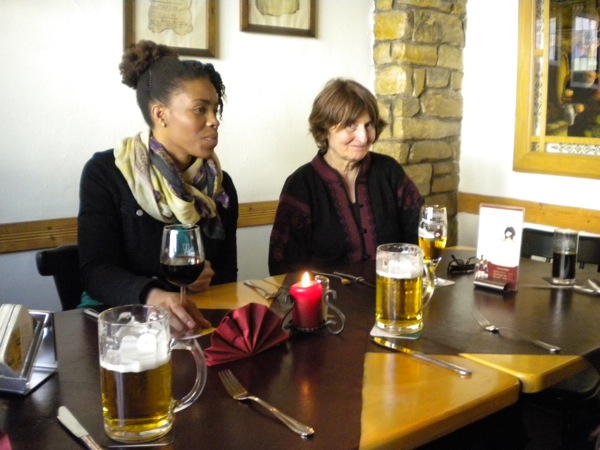
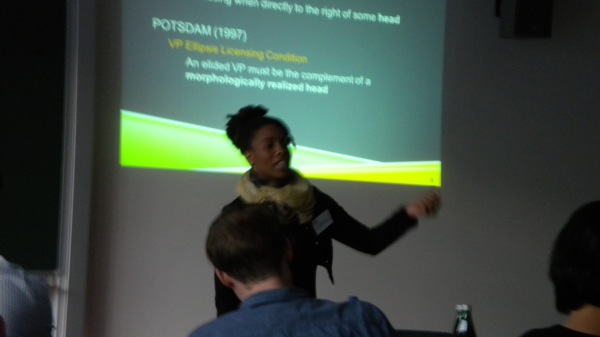
The 35th annual meeting of the German Society of Linguistics was held in Potsdam March 12-15, and UMass was well represented. Tom Roeper gave a talk entitled "What should a theory of interfaces tell us about the acquisition path for discourse coherence?" UMass alumnus Jeff Runner gave a talk entitled "Syntactic Structure, information structure, and lexical effects on null and overt subject conprehension in Spanish." Tracy Conner gave her talk "Overt functional heads license ellipsis: a unified account of VP-ellipsis and ellipsis in possessive DPs." Nick LaCara gave his talk " Inversion, deletion, and focus in as-parentheticals." UMass alumnus Florian Schwarz gave a talk entitled "Weak definites and Kinds of Events." Ellen Woolford gave her talk "A hybrid approach to agreement typology: MP+OT." And, finally, UMass alumnus Winfried Lechner gave a talk entitled "Notes on the Duke of York." Nick has sent the following photos as proof.

10 March 2013
LARC/Acquisition Lab meeting tomorrow
Magda Oiry writes:
Please join us on Monday, March 11 in the Partee Room (South College, room 301) at 12:10 for two presentations:
Andie Faber: "Experimental considerations for Gender Constraints in L2 Acquisition"
Michael Clauss: "Implicit clauses and (apparent) partial movement in child English"
UMass in "Linguistic Derivations and Filtering"
Hans Broekhuis and Ralf Vogel's "Linguistic Derivations and Filtering" has appeared in the Advances in Optimality Theory series by Equinox Press. UMass alumna Jane Grimshaw's paper "Last resorts: A typology of 'do'-Support" appears in this volume along with a paper by John McCarthy and Kathryn Pruitt ("Sources of Phonological Structure") and another by Ellen Woolford ("Aspect splits and parasitic marking").
Congratulations Ellen, Kathryn, John and Jane!
UMass at FASAL
The third meeting of Formal Approaches to South Asian Languages (FASAL) is meeting this weekend at the University of Southern California in Los Angeles. Rajesh Bhatt, along with co-authors K.V. Subbarao and Vanlal Hmar, is presenting a paper entitled "A-bar Movement and Ergativity in Hmar." And Stefan Keine is presenting his paper "Long-Distance Agreement, Improper Movement and the Locality of Agree."
Professorship in Pragmatics at University of Konstanz
The Department of Linguistics in the Faculties of Humanities at the University of Konstanz invites applications for a Junior Professorship in Pragmatics (Salary Scale W 1) with expertise in formal pragmatics and/or experimental pragmatics, to be filled by the winter semester 2013/2014.
The selected candidate is expected to carry out research in pragmatics and teach courses both at the undergraduate (BA, Lehramt) and graduate level (MA, Ph.D.). Cooperation with existing and planned research proposals at the department is expected.
Recent doctoral graduates of outstanding quality may apply. We are interested in candidates who have an excellent international publication record, as shown for example by an outstanding dissertation, publications in established linguistic journals, conference papers and awards, and who exhibit strong skills in the classroom. For further information please contact Prof. Maribel Romero Sangüesa at: maribel.romero@uni-konstanz.de or by phone +49(0)7531/88–2728.
The University of Konstanz is an equal opportunity employer and tries to increase the number of women in research and teaching.
The University of Konstanz encourages disabled people to apply. They will be given preference if appropriately qualified.
The University of Konstanz has been certified as a family-friendly institution by the Hertie Foundation and ist committed to further the compatibility of work and family life.
The University of Konstanz offers a „Dual Career Program“. Information can be obtained from: http://www.uni-konstanz.de/dcc.
Applications including a CV, a list of publications, a record of teaching experience, photocopies of academic degree certificates as well as a completed submission form (see pdf-link below) and reference to Job Offer No. 2013/045 must reach the head of the Faculty of Humanities at the University of Konstanz at the latest by April 5th, 2013.
The application documents will be electronically processed and not returned.
For further information, please contact via e-mail: Geist.Sektion@uni-konstanz.de.
Application form: http://rz157.wwwdns.rz.uni-konstanz.de/files/pdf/uploads/Bewerberbogen2013045.PDF
Call for Papers: Sinn und Bedeutung
Sinn und Bedeutung 18,
11-13 September 2013, University of the Basque Country in Vitoria-Gasteiz
2nd Call for papers:
We invite abstract submissions for 45 (35+10) minute oral presentations or posters devoted to natural language semantics, pragmatics, the syntax-semantics interface, psycholinguistic studies related to meaning, and the philosophy of language. Abstracts should contain original research that, at the time of submission, has neither been published nor accepted for publication. One person can submit at most one abstract as sole author and one abstract as co-author (or two co-authored abstracts). Abstracts must be submitted electronically in PDF format. Submissions should be anonymous and not reveal the identity of the author(s) in any form (e.g., references, file name or properties of the abstract). Abstracts must not exceed two pages in letter-size or A4 paper, including examples and references, with 2.5 cm (or 1 inch) margins on all sides and 12-point font size. When you submit your abstract, you will be asked to indicate whether you would like it to be considered for a talk, a poster or both.
Abstracts should be submitted via EasyChair, using the following link:
https://www.easychair.org/conferences/?conf=sub18
Invited Speakers:
David Barner (University of California, San Diego)
Gennaro Chierchia (Harvard University)
Luisa Martí (University of Kent)
Maribel Romero (Universität Konstanz)
Important dates:
Submission deadline: April 15, 11:59 PM, CET
Notification of Acceptance: June 10
Conference dates: September 11-13
Contact: sub18.basquecountry@gmail.com
Webpage: https://sites.google.com/site/sub18bc
Call for Papers: ILLS 5
09 March 2013
PsychoSyntax meeting
Brian Dillon writes:
We'll be meeting again this Monday, 3/11, at 3pm in the Partee Room, like usual! This week, Shayne and I will present Mauner and Koenig's (2000) article, "Linguistic vs. Conceptual Sources of Implicit Agents in
Sentence Comprehension" (You may find the paper here:).
After discussing the findings in that paper, Shayne will present some pilot data he's collected and thoughts on follow-up experiments... it'd be great if you could come and give feedback on the topic!
03 March 2013
Laura Benua passes
We have learned recently that Laura Benua died of a heart attack on February 21. Laura received her PhD from UMass in 1997 with an influential dissertation on Phonology and Morphology. She had a position at the University of Maryland for a number of years, but left that job in order to devote herself to teaching in New York City public school system. She was a lovely person and a dear friend to many of us. For those who knew her, this is a devastating loss.
There is a service for her today at Nyack, New York, where her home is. A memorial page has been established here, and you can read more about Laura's linguistic career on Eric Bakovic's blog, here.
Paula Menendez-Benito gives department colloq on Monday
Paula Menedez-Benito (University of Goettingen) will give the department colloquium tomorrow, Monday, March 4th at 4:00PM in Machmer W-27. The title of her talk is "Epistemic Indefinites," and an abstract follows.
Epistemic Indefinites: The Case of Spanish
(joint work with Luis Alonso-Ovalle (McGill))
Across languages, we find epistemic indefinites, existential determiners that signal ignorance on the part of the speaker (see Haspelmath (1997)). Over the last fifteen years, a substantial body of work on the semantics of epistemic indefinites has appeared (see references in Alonso-Ovalle and Mene ́ndez-Benito (to appear)). Taken together, these studies outline a research program that aims to provide an explanatory semantic typology of epistemic indefinites by determining across which parameters epistemic indefinites can vary, how these parameters interact, and why. The work presented in this talk contributes to this enterprise by analyzing the epistemic effect of Spanish "algu ́n," and investigating the interaction of this effect with number morphology.
In its singular form, Spanish algu ́n conveys speaker’s ignorance. By using "alga ́n" in (1a), the speaker signals that she does not know which student María married. Hence, it would be odd for her to add a namely continuation that explicitly identifies the student in question, as in (1b). Surprisingly, the plural version of "algu ́n," "algunos," does not trigger an ignorance effect, as shown by (2). This talk provides an account of the contrast between (1) and (2). We will argue (i) that the epistemic effect of "algún" comes about because this item imposes an anti-singleton constraint on its domain of quantification, and (ii) that the interaction of this constraint with plural morphology blocks the epistemic effect. The talk also reports on work in progress that extends this account to the complex determiner "algu ́n que otto," which conveys an ‘I don’t know how many’ effect (witness (3)). The picture that emerges from this investigation is that epistemic effects triggered by indefinites are linked to properties of the domain of quantification, such as the size of the domain, its internal structure, and the type of entities quantified over.
(1) a. María se casó con algún estudiante.
María married with ALGUN student
(Maria married some student or other.)
b. María se casó con algún estudiante # en concreto con Juan.
María married with ALGUN student namely Juan
(Maria married some student or other, namely John.)
(2) María vive con algunos estudiantes, en concreto con Pedro y con Juan.
María lives with ALGUNOS student, namely Pedro and Juan
(Maria lives with some student, namely Pedro and Juan.)
(3) María vive con algún que otro estudiante.
María lives with ALGUN QUE OTRO student
(Maria lives with students --- I don't know how many.)
Acquisition Lab/LARC meeting tomorrow
Magda Oiry writes:
This coming Monday, we will meet for a new acquisition lab / LARC meeting in the Partee Room at 12:05 to hear two presentations:
Andie Faber: "Experimental considerations for Gender Constraints in L2 Acquisition"
and
Rama Novogrodsky, Seth Cable and Tom Roeper: "Acquisition of Each/every and Event Separation"
Paula Menendez-Benito gives talk on Tuesday
Paula Menendez-Benito will give a semantics talk on Tuesday, March 5, at 4:00PM in Machmer W-27. A title and abstract follow.
On Choosing Randomly
(joint work with Luis Alonso-Ovalle (McGill))
Many languages have indefinites that trigger modal inferences in the absence of an overt modal. Some of these items signal speaker’s ignorance. Others indicate that an agent made a random choice. While the former type has received a lot of attention in recent years (see Alonso-Ovalle and Mene ́ndez-Benito (to appear) for references), random choice indefinites are comparatively less studied (but see Choi (2007); Choi and Romero (2008); Alonso-Ovalle and Mene ́ndez-Benito (2011)). This talk paves the way towards a better understanding of random choice indefinites by analyzing the interpretation and distribution of Spanish "uno cualquiera."
The sentence in (1) illustrates the random choice reading of "uno cualquiera": (1) can be understood as saying that Juan took a card and that his choice was indiscriminate. This reading has a restricted distribution. Cases like (1), where "uno cualquiera" is in object position, are ambiguous between the random choice reading and an evaluative reading that conveys that Juan took an unremarkable card (and is compatible with him having chosen the card carefully.) In subject position, only the evaluative reading is available: (2) can only mean that an unremarkable student spoke.
(1) Juan cogio ́ una carta cualquiera.
John took a card CUALQUIERA.
(2) Hablo ́ un estudiante cualquiera.
Spoke a student CUALQUIERA
We argue that "uno cualquiera" introduces a modal component that is anchored to the event described by the sentence. This component derives the random choice reading of sentences like (1) (roughly, that the agent’s decision is compatible with any of a number of actions under consideration), and blocks the random choice reading of (2) by deriving a contradiction. Our proposal is in line with some recent work on verbal modality where modal domains are projected from small particulars (events or individuals), rather than from whole worlds (see Hacquard (2006, 2009); Kratzer (2012)).
Nazarov at PRG on Thursday
This Thursday, March 7, Alex Nazarov will be presenting a paper to PRG, which meets at Packards in Northampton at 6:30.
Nick LaCara at SRG on Thursday
Jason Overfelt writes:
LaTeX for Linguistics Workshop on Wednesday
Jeremy Cahill of the Linguistic Club writes:
Linguistics Club invites you to join us next Wednesday for an interactive LaTeX workshop!
WHEN: Wednesday, March 6, 5:30 - 7:30 PM
WHERE: Machmer W-15
Presenters Felix Lehmann, Steffen Hildebrandt, and Ilia Kurenkov will cover LaTeX basics as well as tools for linguistic typesetting. To get the most out of the workshop, make sure to bring a laptop (no installation required -- just internet access). Check out the attached flyer to see a bit of LaTeX in action.
{ What is LaTeX? A (free) document preparation system widely used by professional linguists, mathematicians, and others with unusual typesetting needs or who just want their documents to be of very high quality. }
Space is limited!
Sign up here: http://bit.ly/UMassLaTeX
or RSVP at: jccahill@student.umass.edu
Call for Papers: Tbilisi Symposium on Language, Logic and Compuatation
THE TENTH INTERNATIONAL TBILISI SYMPOSIUM ON
LANGUAGE, LOGIC AND COMPUTATION
23-27 September 2013
Gudauri, Georgia
http://www.illc.uva.nl/Tbilisi/Tbilisi2013
***********************************************************************
CALL FOR PAPERS
The Tenth International Tbilisi Symposium on Language, Logic and
Computation will be held on 23-27 September 2013 in Gudauri,
Georgia. The Programme Committee invites submissions for contributions
on all aspects of language, logic and computation. Work of an
interdisciplinary nature is particularly welcome. Areas of interest
include, but are not limited to:
* Algorithmic game theory
* Computational social choice
* Constructive, modal and algebraic logic
* Formal models of multiagent systems
* Historical linguistics, history of logic
* Information retrieval, query answer systems
* Language evolution and learnability
* Linguistic typology and semantic universals
* Logic, games, and formal pragmatics
* Logics for artificial intelligence
* Natural language syntax, semantics, and pragmatics
Authors can submit an abstract of four pages (including references) at
the EasyChair conference system here:
http://www.easychair.org/conferences/?conf=tbillc2013
PROGRAMME
The programme will include the following invited lectures and
tutorials.
Tutorials:
Logic: Rosalie Iemhoff (Utrecht)
Language: Daniel Altshuler (Duesseldorf)
Computation: Samson Abramsky (Oxford)
Invited Lectures:
Balder ten Cate (Santa Cruz)
Agata Ciabattoni (Vienna)
Thomas Colcombet (Paris)
Galit Sassoon (Jerusalem)
Alexandra Silva (Nijmegen)
Sergei Tatevosov (Moscow)
WORKSHOPS
There will also be a workshop on Algebraic Proof Theory organized by
A. Ciabattoni and R. Iemhoff and a workshop on Aspect organized by
D. Altshuler, D. Hole and S. Tatevosov. More information can be found
on the TbiLLC website.
PUBLICATION INFORMATION
Post-proceedings of the symposium will be published in the LNCS series
of Springer.
IMPORTANT DATES
Submission deadline: May 1, 2013
Notification: July 1, 2013
Final abstracts due: August 1, 2013
Registration deadline: September 1, 2013
Symposium: September 23-27, 2013
Programme and submission details can be found at:
http://www.illc.uva.nl/Tbilisi/Tbilisi2013/
24 February 2013
LARC meeting tomorrow
Phonetics Lab meeting on Tuesday
John Kingston writes:
The next Phonetics Lab meeting will be held Tuesday, 4-5:30, 26 February 2013. The usual sustenance and refreshment will be provided, spiced with all the gory details of on-going experiments. It's also time to put your best face forward, as we'll be taking head shots to post on the lab's new website.
Vincent Homer gives colloq on Friday
On Friday, March 1, Vincent Homer (École normale supérieure) will give a colloquium entitled "Polarity and Grammar." The talk is at 3:30 in Machmer E-37. An abstract follows.
The licensing of polarity items is an old and difficult problem. It is hard to find the exact conditions that govern the distribution of those elements (e.g. some, any), not simply due to the intrinsic complexity of the patterns, but also because it is not even clear whether one should look for conditions couched in syntactic or semantic terms.
The discovery, due to the seminal work of Fauconnier (1975) and Ladusaw (1979), that downward-monotonicity is a characteristic property of the set of expressions whose presence can make an NPI acceptable (e.g. any in (1)), was a breakthrough which could have decisively tipped the scales in favor of a semantic approach.
(1) John didn’t understand anything.
That is, it could have become universally accepted that an NPI is only acceptable in a sentence S if it is in a position within S in which downward inferences are supported. But in fact, a vast majority of researchers who work on the topic view licensing essentially as a syntactic relation between a polarity item and an operator equipped with a certain negative feature, and do not take the monotonicity of the environment of the NPI as a direct factor. There is at least one good reason that supports their move: adding a negative expression to (1) does not lead to anti-licensing (2), as might be expected on strictly semantic grounds, given the monotonicity reversal; the acceptability of (2) is expected on the other hand if all that any requires is a structural relation with at least one appropriate operator above it:
(2) It is impossible that John didn’t understand anything.
In this talk, I propose a general account of licensing, both for NPIs and PPIs, which goes against the grain of the dominant syntactic approaches, as it maintains that polarity items are directly sensitive to the monotonicity of their environment. The theory, which relies on a few simple principles, also accounts for a number of unnoticed facts, and sheds new light on the dedicated mechanisms which evaluate the acceptability of polarity items, and on their interaction with other interpretative processes.
Aleksei in Amherst Choral Society
Alex writes:
Colleagues! I will be performing with the Amherst College Choral Society (and Symphony Orchestra) for the last time this upcoming March 2 at 8:00 PM. The concert will take place at Buckley concert hall on the Amherst College campus (tickets will presumably be $15, or $5 (for five college students)). We will be singing the magnificent Lord Nelson Mass (Missa in angustiis) by Joseph Haydn; the program will also feature the Tragic Overture by Johannes Brahms. Come and support good choral singing, and enjoy the beautiful music!
Vincent Homer gives talk on Thursday
On Thursday, February 28, Vincent Homer from the École normale supérieure-Paris will give a talk at 4:00 in Machmer W-27. His talk is entitled "Escape!" and an abstract follows:
Escape!
Modal verbs have intriguing scopal properties, which have received relatively little attention in the semantic literature. Compare can and must (both interpreted deontically):
(1) John can’t jog.
(2) John mustn’t jog.
If we are right to treat can as having existential force and must as having universal force, there is a puzzle: can takes obligatory narrow scope in (1), while in the exact same frame, must takes obligatory wide scope (2). This talk has one main goal: show that the contrast is due to a movement–I label it escape–which only certain modals can undergo. In the case at hand, it is must that moves because it is unacceptable in a negative environment, while can doesn’t move, because it has no reason to do so. I will study escape in detail, (i) because it has properties that set it apart from other known displacements, viz it is motivated by polarity and it is a last resort, and also (ii) because of the original light it sheds on modals and on the interplay of syntax and semantics in the mechanism of polarity item licensing.
UMass in NLLT
The most recent issue of Natural Language and Linguistic Theory contains the article "Passivization, reconstruction and edge phenomena: connecting English and Japanese Nominalizations," by Angeliek van Hout, Masaaki Kamiya and Tom Roeper.
Postdoc on discourse particles in Stuttgart
Post Doc, full time, 12 months
Location: University of Stuttgart, Germany
Email: cornelia.ebert AT ling.uni-stuttgart.de
We invite applications for one post-doc position in theoretical linguistics (semantics/pragmatics) at the University of Stuttgart, Germany, available from May 1st. The position is for 1 year. Salary is according to the German TV-L E13 scale.
The candidate will contribute to the project C4 of the Sonderforschungsbereich (collaborative research center) 732,
(http://www.uni-stuttgart.de/linguistik/sfb732/), 'Incremental Specification in Context'. The project investigates discourse particles and their interpretation in context.
Desired qualifications:
- Ph.D. in Linguistics or a closely related field
- Specialization in/interest in formal semantics and pragmatics
We offer the opportunity to work on cutting-edge research projects in a dynamic and international research team with up-to-date infrastructure and resources. English is the working language; nevertheless, an ability to speak, or willingness to learn, German is appreciated.
Please send inquiries and applications to Cornelia Ebert by March 15, 2013 (see contact information below). Applications should be in PDF format and include a CV, a list of publications and the names of two references.
The University of Stuttgart is committed to increasing the proportion of women in research and teaching. Qualified women are encouraged to apply. According to German law, disabled candidates with equal qualification will be given preference.
Application email: cornelia.ebert AT ling.uni-stuttgart.de
Contact information
Dr. Cornelia Ebert
Department of Linguistics/Germanic Studies
http://www.uni-stuttgart.de/ilg
cornelia.ebert AT ling.uni-stuttgart.de
UMass in Language and Linguistics Compass
The latest issue of Language and Linguistics Compass has a couple articles by current and former members of the UMass linguistics community:
"Two Views on Epistemic Indefinites" by Louis Alonso-Ovalle and Paula Menendez-Benito
and
"Pied-Piping: Comparing Two Recent Approaches" by Seth Cable
Check them out: http://onlinelibrary.wiley.com/journal/10.1111/(ISSN)1749-818X







Call for papers: Phonetics and Phonology in Iberia
The link below will take you to the second call for papers of PaPI 2013. The conference website can also be found at http://ww3.fl.ul.pt/laboratoriofonetica/papi2013/ .
17 February 2013
Floris Roelofsen gives presentation on Thursday
Floris Roelofsen will present "An inquisitive perspective on meaning: the case of disjunction" on Thursday, February 21 at 4:00 in Machmer W-27. An abstract follows.
A primary function of language is to allow for the exchange of information through a process of raising and resolving issues. To model this process, it is useful to have a notion of meaning that captures both informative and inquisitive content. This talk presents such a notion of meaning, and illustrates its advantages with respect to the classical, purely informational notion, focusing on the case of disjunction. The first part of the talk shows how the two main existing views on disjunction can be reconciled adopting an inquisitive perspective on meaning. The second part of the talk presents a uniform analysis of disjunctive questions and assertions in English, paying special attention to differences in form (e.g. declarative vs interrogative) and intonation (e.g. final rise vs final fall).
Floris Roelofsen gives colloquium on Friday, Feb. 22
Foris Roelofsen will present "Polarity Particles," in the department colloquium on Friday, February 22, at 3:30 in Machmer E-37. An abstract follows.
Polarity particles—words like yes and no—play a basic role in communication, and yet, their interpretation and distribution gives rise to a number of intriguing puzzles. This talk seeks to deepen our understanding of polarity particle systems cross-linguistically, revealing both their common core and the ways in which they vary from language to language. This investigation also has wider implications for linguistic theory, since polarity particles offer a valuable window onto the semantics of polar questions and assertions, which both license polarity particle responses. The common semantic core of polar questions and assertions is captured within the framework of inquisitive semantics. Subsequently, the account is extended to capture more involved patterns in the distribution of polarity particles, in particular in response to negative questions and assertions. The main predictions of the account concerning English are corroborated experimentally, and the cross-linguistic predictions are substantiated by data from German, French, Romanian, and Hungarian.
P Reading Group meets on Tuesday
Claire Moore-Cantwell writes:
We will meet Tuesday night to have a discussion about constraint induction. Everyone who works on constraint induction, come prepared to talk a little bit about what you do; all others come with questions/discussion points if you've got them.
Location: Kristine's place.
Time: 8pm on Tuesday 19 February
Suzi Lima at Harvard
This Tuesday, February 19th, Suzi Lima will present a talk in the Language and Cognition Group entitled "Individuation and Counting in Yudja Tupi."
Lisa Sanders talks on Friday
Lisa Sanders will be presenting a talk on ERP measures of phonological learning in an artificial language on Friday, Feb. 22, at 9:30 in Tobin 423.
All are welcome!
Newton International Fellowships Announced
New Round of Newton International Fellowships Announced
A new round of Newton International Fellowships - an initiative to fund research collaborations and improve links between UK and overseas researchers - has now opened. The Newton International Fellowships are funded by the British Academy and the Royal Society and aim to attract the most promising early-career post-doctoral researchers from overseas in the fields of the humanities, the natural, physical and social sciences.
The Fellowships enable researchers to work for two years at a UK research institution with the aim of fostering long-term international collaborations. Newton Fellows will receive an allowance of £24,000 to cover subsistence and up to £8,000 to cover research expenses in each year of the Fellowship. A one-off relocation allowance of up to £2,000 is also available. In addition, Newton Fellows may be eligible for follow-up funding of up to £6,000 per annum for up to 10 years following completion of the Fellowship to support activities which will help build long-term links with the UK. The scheme is open to post-doctoral (and equivalent) early-career researchers working outside the UK who do not hold UK citizenship.
Applications are to be made via the Royal Society’s online application system which is available at https://e-gap.royalsociety.org/
The closing date for applications is Wednesday 10 April 2013. Further details are available from the Newton International Fellowships website: www.newtonfellowships.org
The British Academy
10-11 Carlton House Terrace, London SW1Y 5AH
020 7969 5200 britac.ac.uk
Cable's papers virtually appear
Seth Cable's paper "Reflexives, Reciprocals and Contrast," has appeared in the electronic version of Journal of Semantics. And his paper "Beyond the Past, Present and Future: Towards the semantics of 'graded tense' in Gikuyu" has appeared in the electronic version of Natural Language Semantics.
WCCFL
The West Coast Conference in Formal Linguistics met in Tempe Arizona last weekend. UMass was well-represented. The following present and past students gave papers: