21 April 2014

Roeper on the road

Tom Roeper writes:

Last week I gave a talk on "Minimal Rules and Unlabelled Nodes in Multi-lingualism: How rules apply across grammars” at a small workshop on Multilingualism at the Netherlands Institute for Advanced Study in Wassenaar organized by Liliane Haegeman and Michel deGraff.

Then this week I was invited to give a plenary keynote lecture at the 10th anniversary of the Experimental Methods in Acquisition Research (EMLAR) conference in Utrecht on "There are No methods, only Theories".

Each of these conferences revealed the burgeoning vitality of empirical research in acquisition---and impressive attention to what the details of bilingualism can reveal, and new projects throughout Europe are being developed, particularly in Norway, England, Greece, Belgium, and China.

13 April 2014

Hartman at LARC

Magda Oiry writes:

Jeremy Hartman will present his work on Root infinitives at LARC on Thursday 9:45 in the Partee room. All are welcome!

PRG tomorrow: Speed Presentations

Ivy Hauser and Coral Hughto write:

PRG is scheduled to meet this Monday 4/14 at Brian's place in Northampton. Instead of the usual presentation we will be trying something a little different, a "lightning paper discussion."  The idea is that everyone comes with a paper in mind they have recently read to give a quick 5 minute synopsis of over dinner.  It should be something you have already read for class, your research, etc. (no extra work required) and of course no handout or prepared speech is necessary.  The goal is to share the important points of several papers in the time of a single meeting.  I think ideally fairly current papers would be nice to discuss but anything goes.

Jason Merchant gives department colloquium

Jason Merchant (University of Chicago) will give the department colloquium on Friday, April 18, at 3:30 in Machmer E-37. The title of his talk is (the cryptic) “More than one phrasal comparative(*s)."

Field School Program in Peru

Piero Fioralisso, Coordinator of Special Programs of the Pontificia Universidad Católica del Perú, writes:

I am writing to you to announce the launch of the Field School Program in Peru 2014. This program, created and developed by PUCP, provides students with the opportunity to carry out practical work in research projects which are directed by some of our most prestigious faculty members and during its ten years of existence the Field School program has received more than 300 students.

We would like you to know that this season the program is offering courses that we believe may be of interest to you:

-Linguistic Summer Field School

-Spanish Language and Peruvian Studies Program

You will find our complete Field School Program offer in the following links:

-Field School Program Brochure
-Spanish Language Brochure
-Website: http://fieldschool.pucp.edu.pe/

Call for papers: Fall Meeting on Formal Linguistics

The 3rd Fall Meeting on Formal Linguistics : Language(s) and Cognition  will be organized by the UMR "Structures Formelles du Langage" Université Paris 8 / CNRS in Paris.

9-10 October 2014

invited speakers

David Barner (University of California, San Diego)

Ricardo Bermúdez-Otero (University of Manchester)

Jenny Doetjes (Leiden)

Maria Polinsky (Harvard)

Call for Papers Deadline 16 June 2014

Submissions are invited for 30 minute-papers (plus discussion) on all domains of linguistic theory.

Abstracts are invited from all areas (phonology, morphology, syntax, semantics) of formal linguistics (e.g., generative grammar or related frameworks). Topics may include syntax-semantics interface, syntax-morphology interface and others. Abstracts on language acquisition, psycholinguistics and neurolinguistics are also particularly welcome in a perspective that relates them to theories of grammar.
We strongly encourage contributions exploring formal approaches to language diversity and typological works (including but not limited to sign languages, creoles, under-represented languages and comparative studies).

Abstract Submission Presentations may be in French or in English. Abstracts should be anonymous and must not exceed 2 pages (A4) (including data and references) with a 2,54 cm (1 inch) margin on all four sides using Times New Roman 12 pt.

Abstracts must be submitted online using the link below. We will accept electronic submissions only (.pdf files). EasyChair link : https://www.easychair.org/conferences/?conf=ralfe2014

Calendar Deadline for submission : June 16th, 2014

Notification of acceptance : July 13th, 2014 

Conference dates : October 9th-10th 2014

Research Assistant/Lab Manager position at Georgetown University

We are seeking a full-time Research Assistant/Lab Manager in the Brain and Language Lab at Georgetown University (http://brainlang.georgetown.edu) . The successful candidate will have the opportunity to be involved in a variety of projects, using a range of behavioral, neurological, electrophysiologial (ERPs), neuroimaging (fMRI), and biological (genetic, endocrine) approaches. S/he will have primary or shared responsibility for various aspects of research and laboratory management, including most of the following (depending on abilities and experience): creating experimental stimuli; designing experiments; running experiments on various subject groups; performing statistical analyses; writing papers; helping manage the lab's computers and server; managing undergraduate assistants; and working with the laboratory director and other lab members in preparing and managing grants and IRB protocols. The successful candidate will work closely with Dr. Ullman and with other Research Assistants, PhD students, and postdocs in the lab, as well as with our collaborators at Georgetown and at other institutions in the US and in other countries (e.g., Canada, UK, Spain, Portugal, Norway, Germany, Australia, Brazil, Indonesia, Iran, Turkey, Israel).  
 
Minimum requirements for the position include a Bachelor's degree (a Master's degree is a plus), with a significant amount of course-work or research experience in at least two and ideally three of the following: cognitive psychology, neuroscience, linguistics, computer science, and statistics. The following are highly desirable: at least some experience with Windows, Linux, E-Prime, programming, and statistics. A strong math aptitude is a plus. The candidate must be extremely responsible, reliable, energetic, hard-working, organized, and efficient, and be able to work with a diverse group of people.
 
To allow for sufficient time to learn new skills and to be productive, candidates must be available to work for at least two years, and ideally for three. The successful candidate will be trained in a variety of the methods and approaches used in the lab, including (depending on the focus of his/her work, and ongoing lab projects) statistics, experimental design, and neuroimaging methods. The successful candidate will ideally start as soon as possible (e.g., April 2014), but no later than June 1st 2014. 
 
Interested candidates should email Jarrett Lovelett (at brainlangadmin@georgetown.edu) their CV (which should include a summary of coursework and grades), and have 3 recommenders email him their recommendations directly. Salary will be commensurate with experience and qualifications. The position, which includes health benefits, is contingent upon funding. Georgetown University is an Affirmative Action/Equal Opportunity employer. 

SALT 24 program announced

The program for SALT 24, which is taking place at the end of May at NYU, has been announced. Congratulations to Elizabeth Bogal-Allbritten, whose paper “Interpreting DP-modifying modal adverbs” and Suzi Lima, whose paper “All notional mass nouns are count nouns in Yudja,” are on the program. Yangsook Park is also presenting the poster “Indexicals and the long-distance reflexive `caki’ in Korean.” In addition, the following UMass alumni have posters:

Maria Biezma: “The grammar of discourse: the case of `then.’"

Aynat Rubinstein (with Elena Herburger) “Is ‘more possible’ more possible in German?"

and alumnus Florian Schwarz will be giving the paper “Presuppositions are fast, whether hard or soft — Evidence from the visual world paradigm."

Report from "Sound Systems of Mexico and Central America," at Yale on May 27

John Kingston writes:

Emiliana Cruz, our colleague in Anthropology, Etna Pascacio, a visitor from Mexico to the department since January, Jeremy Pasquereau, and I just returned from a very stimulating workshop "Sound Systems of Mexico and Central America" organized by Ryan Bennett at Yale (http://pantheon.yale.edu/~rtb27/ssmca.html). Emiliana spoke about the 15 tones in the Chatino of San Juan Quiahije (the 15th only just discovered the day before her talk!), Etna gave a poster about her analysis of the synchrony and diachrony of alveolar fricatives and affricates in Matlazinca, and I gave the second of a two-part talk describing and explaining the development of vowel register distinctions and nasal grades in the Chatino of San Miguel Panixtlahuaca -- the first part was given by Tony Woodbury of the University of Texas, Austin. The meeting was also a chance to hear talks from various instructors and participants at the Talleres de Tonos organized by Emiliana in Oaxaca the last two summers. The purpose of the Talleres is to train native speakers of Otomanguean languages in the linguistic analysis of their languages. The third Taller will be held this June 17-27.

06 April 2014

Jonathan Rosa on the Language/Word gap

Meghan Armstrong writes:


The UMass Hispanic Linguistics program has invited Jonathan Rosa  (Anthropology) to lead a discussion on the language gap/word gap that  has been receiving substantial attention in the media.

We invite you to join us for this discussion:

Power, Perspective, and Linguistic “Problems:: Rethinking the  "Language/Word Gap"

4/8 @ 5:45 -- 217 Herter Hall

For more info: http://umasshispling.wordpress.com/

NSF Graduate Student Fellowships

Congratulations to Ivy Hauser and Leland Kusmer who have been awarded graduate student fellowships by the National Science Foundation. There were only 10 of these fellowships awarded to students at UMass. For more information about the program and awardees, go here.

UUSLAW

The annual UConn, Umass, Smith Language Acquisition Workshop took place at UConn yesterday (Saturday, April 5). UMass was represented by:

Valentina Brunetto “English speaking children’s acquisition of number words"

Michael Clauss “Ambiguity between questions and relative clauses for children and adults"

Jon Nelson “Recursive PP interpretation revisited: L1 and L2 differences in English and Spanish"

Lecturer in Phonology at Harvard

Lecturer on Linguistics

Harvard University

Faculty of Arts and Sciences


The Department of Linguistics seeks applications for a full-time lecturer in phonology. The appointment is expected to begin on 7/1/2014.  The lecturer will be responsible for teaching phonology at any level (undergraduate, beginning graduate, and advanced graduate).  The position is for one-year.  

Basic Qualifications:  Doctorate in Linguistics or related discipline ordinarily required by the time the appointment begins.

Additional Qualifications:  Demonstrated excellence in teaching is desired. 

Special Instructions:  Please submit the following materials through the ARIeS portal (http://academicpositions.harvard.edu), no later than April 30, 2014:

Required Documents

1. Curriculum Vitae

2. Cover Letter

3. Statement of Teaching Philosophy

4. Statement of Research

5. Publication

6. Course Evaluations

7. Names and contact information of two references (two letters of recommendation are required, and the application is only complete when both letters have been submitted)

Harvard is an Equal Opportunity/Affirmative Action employer. Applications from women and minorities are strongly encouraged.

Contact Information:  Cheryl Murphy, Harvard University, Boylston Hall, Rm. 305, Harvard Yard, Cambridge, MA  02138 

Contact Email:  clmurphy@fas.harvard.edu

Doctoral Research Fellowship in Oslo

One fully paid Doctoral Research Fellowship (3 years) within formal semantics and/or syntax is available in the Department of Literature, Area Studies and European Languages (ILOS) at the University of Oslo (UiO).ILOS seeks to recruit PhD candidates with excellent research qualifications who will work with the research group SynSem. The doctoral research fellowship is open to topics in formal semantics, theoretical syntax or the syntax-semantics interface. Only projects that involve modern European languages (Germanic, Romance and Slavic languages) being taught at ILOS will come into consideration. The project may be anchored within one language, but theoretical contrastive studies of several languages may also come into consideration. The successful candidate must participate in the research training program organized by the Faculty of Humanities (cf. regulations and supplementary provisions for the faculty’s researcher education) and must engage in the designated research activities on a full-time basis.

The purpose of the PhD Research Fellowship is research training leading to the successful completion of a doctoral dissertation (monograph or article-based) to be defended at a public defense for the doctoral degree. The person appointed will be affiliated with the Faculty's organized research training. The academic work must result in a doctoral thesis that will be defended at the Faculty with a view to obtaining the degree of PhD. The successful candidate is expected to join the existing research milieu or network and contribute to its development. go here for more details.

30 March 2014

Luiz Amaral at LARC

Magda Oiry writes:

Luiz Amaral will be presenting at the LARC meeting this Thursday (April 3) at 9:45 AM in the Partee room. His talk is: "Experimental ideas to test recursive relative clauses.”  (This talk has been rescheduled from last week.)

Everyone welcome!

Maribel Romero

Alumna Maribel Romero (Konstanz University) will be visiting the department this week. She is giving a talk on biased questions in the semantics seminar on Wednesday, April 2. The seminar meets from 2:30 to 5:15 in the Partee room.

Maribel has worked on a variety of topics in semantics, syntax/semantic, computational semantics, and pragmatics including ellipsis, reconstruction, questions, temporal interpretation, concealed questions, negation, the scope of quantifiers, superlatives, and focus. You can get a more complete picture of her range from her website here. She’ll be available for meetings this coming week, which you can arrange through Angelika Kratzer.

post-bac positions at University of Maryland

Colin Phillips from the University of Maryland writes:

The Dept of Linguistics at the U of Maryland, is looking to fill up to four full-time positions for post-baccalaureate researchers. Starting date for all positions is Summer/Fall 2014. Salary is competitive, with benefits included. The positions would be ideal for individuals with a BA degree who are interested in gaining significant research experience in a very active lab as preparation for a research career. Applicants must be US or Canadian citizens or permanent residents, and should have completed a BA or BS degree by the time of appointment. The ability to interact comfortably with a wide variety of people (and machines) is a distinct advantage. Applicants may request to be considered for all four positions or any subset. The positions are two Baggett Fellowships, one Research Assistant/Lab Manager, and one MEG Lab Manager.

The positions are open until filled, but for best consideration, applications should be received by  April 7th, 2014.

Details about all four positions may be found here:
http://ling.umd.edu/baggett/jobs/

Woolford at Georgetown

Ellen Woolford gave an invited talk at Georgetown University last Friday, March 21, entitled “No Object Agreement without Subject Agreement."

Vladimir Borschev at Moscow State University

Vladimir Borschev is giving an invited lecture “On the integration of formal and lexical semantics” at Moscow State University in a seminar led by V.A. Uspensky, M.R. Pentus and P Arkadiev  on the applications of mathematical methods in linguistics. His talk is on Saturday, April 12.

UMass at GLOW

The 37th meeting of the Generative Linguistics of the Old World meets April 2-4th in Brussels. UMass is represented by Yangsook Park and Ethan Poole. Ethan Poole will give a talk entitled “A configurational account of Finnish case.” and Yangsook Park will give a talk entitled “Indexicals and the long-distance reflexive `caki’ in Korean.” For a complete schedule, go here.

Linguistics/Philosophy blog

Seth Cable writes:

I'm writing to let you know that Alejandro Pérez Carballo and I have just set up a blog site where linguists and philosophers can share events / classes / etc. that will be of mutual interest: http://blogs.umass.edu/lingphil/

Our hope is that this will become a resource to members of our campus (and the broader Five College community) who are interested in Logic, Language, Cognition, and related areas. 

There's not much up there right now, but that's where you all come in! If you could, please let me know if you know of any additional upcoming events / talks / seminar presentations that would be of interest to and open to philosophers and philosophy students. Anything you want to share with the philosophers, I can post up there for us!

I should mention that we already plan to have linguistics course offerings up there soon. In addition, Alejandro is working on a Calendar of Events folks can subscribe to, as well as a mailing list that announces any updates to the site. Please, if you have any additional thoughts or suggestions, they would be greatly appreciated!

Harris in Konstanz

Alice Harris is an invited speaker at a conference on the Diachronic Typology of Differential Argument Marking held at the University of Konstanz held next weekend, April 5-6. Her talk is “On the Origins of Biabsolutive Constructions in Nakh-Daghestanian Languages.” A complete program can be found here.

Lecturer position at Rice

The Department of Linguistics at Rice University, located in Houston, Texas, is now accepting applications for a lecturer position in laboratory phonetics and phonology. The successful applicant will be asked to teach courses in both of these areas, an introductory linguistics course, and may teach additional courses in his or her subject area. S/he will also advise undergraduate and graduate students, and participate in departmental activities. This is a one year appointment and the course load is four courses for the year. Deadline for receipt of applications is May 1, 2014. PhD is required by time of appointment; position start date is July 1, 2014.

We especially welcome applications from researchers who share the department’s interest in approaching language from a usage-based perspective with solid empirical grounding in primary data, especially approaches of a cognitive, social-interactional, and/or functional nature. See also our department website.

Application materials include: cover letter, CV, teaching statement, sample of written work, and names and contact information for three references. Past teaching evaluations and/or information about course topics the applicant could teach are also welcome but not required at this time.

Rice University is committed to affirmative action and equal opportunity in education and employment. Rice does not discriminate on the basis of race, color, religion, sex, sexual orientation, national or ethnic origin, age, disability or veteran status. Rice University is an Equal Opportunity/Affirmative Action Employer.

Application Deadline:  (Open until filled)

Mailing Address for Applications:       

Search Committee Rita Riley

Department of Linguistics MS 23

Rice University

Houston, TX 77005 USA

Contact Information:        Rita Riley        Email: rriley@rice.edu

UMass at Slavic Semantics Workshop

Vladimir Borschev and Barbara Partee will be presenting invited papers at the Slavic Semantics Workshop at Bar Ilan University March 31 and April 1. Vladimir’s paper is entitled “Ontology and integration of formal and lexical semantics,” and Barbara’s is “Montague’s unfinished work: a report from the archives."

23 March 2014

Amy Rose Deal in Bhatt's seminar tomorrow

Amy Rose Deal (UC, Santa Cruz) will give a talk entitled “Cyclicity and connectivity in Nez Perce relative clauses,” in Rajesh Bhatt’s seminar tomorrow, Monday, March 24. Her talk is in the Partee room at 4:00.

The abstract:

This talk centers on two aspects of movement in relative clauses, focusing on evidence from Nez Perce. 

First, I argue that relativization involves _cyclic_ A’ movement, even in monoclausal relatives. Rather than moving directly to Spec,CP, the relative element moves there via an intermediate position in an A’ outer specifier of the TP immediately subjacent to relative C. Cyclicity of this type suggests that the TP sister of relative C constitutes a phase – a result whose implications extend to an ill-understood corner of the English that-trace effect.

Second, I argue that Nez Perce relativization provides new evidence for an ambiguity thesis for relative clauses, according to which some but not all relatives are derived by a head-raising analysis. The argument comes from connectivity and anticonnectivity in morphological case. These new data complement the range of standard arguments for head-raising, which draw primarily on connectivity effects at the syntax-semantics interface.

(You can get a preview of her talk here.)

Open House

The department is hosting prospective students this week, and there are a variety of events scheduled around their visit, including a tour of the new building on Friday afternoon. In addition:

The P Reading Group will meet at Amanda and Shayne’s place at 7PM on Thursday, March 27. Ivy will be presenting a paper.

The S Reading Group will meet at the same time at Mike and Jeremy’s place, where Yangsook will present a paper.

The S and P groups will convene afterwards at the Foundry (24 Main Street, Northampton) at around 8:30 to debrief. 

Gereon Müller: syntax guru

This year’s syntax guru, Gereon Müller, arrives on Monday, March 22, for his four week residence in the department. Professor Müller is professor linguistics and coordinator of the linguistics department at the University of Leipzig. He has done important work on rule interaction, making fundamental contributions to our understanding of what a syntactic derivation is. He is an expert on all things movement: how to treat the A/A’ distinction, island effects, interactions with anaphora, etc., etc. He has also done extensive work on inflectional morphology, including several papers on syncretism. You can get a more complete picture of his work here.

Gereon will be floating in the department. This coming week, he will be housed in Seth’s office from Monday to Thursday, and in Kyle’s office on Friday. Make appointments by writing: gereon.mueller@uni-leipzig.de.

Katja Poellmann talks at Brown Bag on Wednesday

Alexandra Jesse writes:

This is a reminder that Katja Poellmann (Northeastern University) is giving a talk this week in the Cognitive Psychology Brown Bag (Wednesday, Tobin 521B, 12-1:15). The title of the talk is "The many ways listeners adapt to reductions in casual speech".

The abstract is:

Three eye-tracking experiments tested whether native listeners recognized reduced Dutch words better after having heard the same reduced words, or different reduced words of the same reduction type and whether familiarization with one reduction type helps listeners to deal with another reduction type. In the exposure phase, Group 1 was exposed to /b/-reductions (e.g., manaan instead of banaan, 'banana') and Group 2 was exposed to full-vowel deletions (e.g., p'raat instead of paraat, 'ready'), while a control group did not hear any reductions. In the test phase, all three groups heard the same speaker producing reduced-/b/ and deleted-vowel words that were either repeated (Experiments 1 & 2) or new (Experiment 3). Word-specific learning effects were found for vowel-deletions, but not for /b/-reductions. Generalization of learning to new words of the same reduction type occurred only if the exposure words showed a phonologically consistent reduction pattern (/b/-reductions). In contrast, generalization of learning to words of another reduction type occurred only if the exposure words showed a phonologically inconsistent reduction pattern (the vowel deletions; learning about them generalized to recognition of the /b/-reductions). In order to deal with reductions, listeners thus use various means. They store reduced variants (e.g., for the inconsistent vowel-deleted words) and they abstract over incoming information to build up and apply mapping rules (e.g., for the consistent /b/-reductions). Experience with inconsistent pronunciations leads to greater perceptual flexibility in dealing with other forms of reduction uttered by the same speaker than experience with consistent pronunciations.

Luis talks in LARC on Thursday

Magda Oiry writes:

Luiz Amaral will be presenting in the LARC meeting this Thursday at 9:45 in the Partee room a talk entitled "Experimental ideas to test recursive relative clauses."

Everyone welcome!

Harris in Ann Arbor

Alice Harris gave an invited paper, entitled “On the Origins of Biabsolutive Constructions in Avar, Batsbi, and Nakh-Daghestanian,” at the Fifteenth Spring Workshop on Theory and Method in Linguistic Reconstruction, which took place March 14-16 at the University of Michigan. 

Gereon Müller gives department colloquium

Syntax guru, Gereon Müller will present “Buffers in Syntactic Derivations,” at the department colloquium this Friday in Machmer E-37. Because of Open House events, the time of Gereon’s talk is later than the usual colloquium time. His talk starts at 4:30.

An abstract for Gereon’s talk:

Phase-based minimalist syntax can be characterized as a localderivational approach to grammar: Syntactic structures are generatedbottom-up, by alternating operations like Merge, Move, and Agree, andthe accessible window of a derivation is quite small throughout -- itis standardly assumed to be confined to the minimal phase (PIC,Chomsky (2001)). In such an approach, all long-distance dependenciesmust be modelled locally. Thus, unbounded wh-movement is assumed to becomposed of a series of smaller movement steps to intermediate phaseedges, and similar local analyses postulating a decomposition ofseemingly non-local syntactic operations into sequences of smallersteps have been given for other non-local phenomena, likelong-distance reflexivization, non-local case assignment, andlong-distance agreement.

Against this background, I will discuss three movement-relatedphenomena that have so far proven recalcitrant from alocal-derivational, phase-based perspective: improper movement,remnant movement, and resumptive movement. The empirical evidence willmostly come from German. In all three cases, the dilemma is that itseems that information from a syntactic domain A must be used in asyntactic domain B even though it should not be accessible in B --either because A is not present yet (the look-ahead problem), orbecause A is too deeply embedded (a kind of backtracking problem).

First, what is arguably the simplest and most elegant approach toimproper movement (viz., the Williams Cycle; Williams (1974; 2003),Sternefeld (1992), Grewendorf (2003; 2004), Abels (2008), Neeleman &van de Koot (2010), Bader (2011), Keine (2014)) presupposes that inorder to determine whether a given long-distance movement operation islegitimate or not, information about landing sites in the embeddedclause is available (backtracking). Second, it seems that in order todistinguish legitimate and illegitimate cases of remnant movement(involving Freezing, Anti-Freezing, and what has been called theMueller-Takano Generalization; see Mueller (1993; 1998), Takano(1994), Kitahara (1994), Koizumi (1995), Sauerland (1999), Pesetsky(2012)), decisions must be made early in the derivation that depend oninformation which is not available yet (look-ahead). Third, withresumption, the problem is again that at crucial stages of thederivation (viz., when an island can -- or, indeed, must -- becrossed; Sells(1984), Pesetsky (1998), Boeckx (2003), McCloskey(2005)), the relevant information (about whether or not there is aresumptive pronoun in the base position) does not seem to be availableanymore (backtracking).

My goal in this talk is to present a unified analysis of these threephenomena (this implies treating the remnant movement problem as abacktracking rather than a look-ahead problem) that makes crucial useof buffers which temporarily store minimal aspects of the derivationalhistory on a moved item. The locus of this storage is themovement-related feature of the moved item (e.g., [wh]), moreprecisely, its value, which is viewed as a first-in-first-out listthat constantly changes throughout the derivation but must qualify aslegitimate (essentially: respect the functional sequence of heads,f-seq) in criterial positions.

UMass at FASAL 4

The fourth annual meeting of Formal Approaches to South Asian Languages happens this weekend (March 29-30) at Rutgers University. UMass is represented there by:

Rajesh Bhatt and Vincent Homer, who give the paper “The Interpretation of Infinitival negation in Hindi-Urdu."

and

Sakshi Bhatia, who will be giving the paper “Multiple Focus in Hindi-Urdu."

and

Stefan Keine and Rajesh Bhatt, who will be postering: “Auxiliary Deletion and the analysis of T in Hindi-Urdu."

Poole at PLC

Congratulations to Ethan Poole, who will be presenting “A configurational account of Finnish case” at the Penn Linguistics Circle meeting on Saturday, March 29. For a schedule of talks at PLC, go here.

Final Call: ESSLLI 2014 Student Session

Held during the 26th European Summer School in Logic, Language and Information

Tübingen, Germany, August 11-22, 2014

*Deadline for submissions: April 1st, 2014*

https://www.easychair.org/conferences/?conf=essllistus2014

*ABOUT:*The Student Session of the 26th European Summer School in Logic, Language, and Information (ESSLLI) will take place in Tübingen, Germany on August 11-22, 2014. We invite submissions of original, unpublished work from students in any area at the intersection of Logic & Language, Language & Computation, or Logic & Computation. Submissions will be reviewed by several experts in the field, and accepted papers will be presented orally or as posters and will appear in the student session proceedings by Springer. This is an excellent opportunity to receive valuable feedback from expert readers and to present your work to a diverse audience.

*SEPARATE POSTER SESSION:*Note that there are two separate kinds of submissions, one for the oral presentations and one for the posters. This means that papers can be directly submitted as posters. Reviewing and ranking will be done separately. We particularly encourage submissions for posters, as they offer an excellent opportunity to present research in progress.

*SUBMISSION GUIDELINES:*All authors must be students, and submissions may be singly or jointly authored. Submissions should not be longer than 8 pages for an oral presentation and 4 pages for a poster presentation (including examples and references). Submissions must be anonymous, without any identifying information. More detailed guidelines regarding submission can be found on the Student Session website: http://www.kr.tuwien.ac.at/drm/dehaan/stus2014/.

*FURTHER INFORMATION:*Please direct inquiries about submission procedures or other matters relating to the Student Session to dehaan@kr.tuwien.ac.at. 

ESSLLI 2014 will feature a wide range of foundational and advanced courses and workshops in all areas of Logic, Language, and Computation. For further information, including registration information and course listings, and for general inquiries about ESSLLI 2014, please consult the main ESSLLI 2014 page: http://www.esslli2014.info/.

Proceedings of Meeting on Phonology

The Proceedings of the 2013 Meeting on Phonology, edited by John Kingston,  Claire Moore-Cantwell, Joe Pater and Robert Staubs, have just been published by the Linguistic Society of America:

http://journals.linguisticsociety.org/proceedings/index.php/amphonology/

The proceedings include papers by current UMass PhD students Claire Moore-Cantwell and Robert Staubs, and alumni Gillian Gallagher (BA), Elliott Moreton, Jennifer Smith, and Anne-Michelle Tessier. The papers were developed from presentations at Phonology 2013, held at UMass in November. The next Annual Meeting on Phonology will be held at MIT September 19-21, and the fall 2015 edition will be hosted by the University of British Columbia and Simon Fraser University in Vancouver.

Syntax position at University of Illinois

The Department of Linguistics at the University of Illinois at Urbana-Champaign seeks applications for a one-year Visiting Assistant Professor position in syntax. The appointment will be a full-time, nine-month position.  Renewal of position is possible and contingent on availability of funding, strong enrollments, and strong performance reviews.  The target start date of appointment is August 16, 2014. Salary is commensurate with experience.

Qualifications include a Ph.D. in Linguistics (or a closely related field) with specialization in syntax, in hand by the date of appointment; an active research agenda including publications in syntax; teaching experience and evidence of teaching excellence. Additional expertise in semantics or the syntax-semantics interface is preferred; background in other areas such as historical linguistics, experimental methodology, or non-Western languages is a plus.

Teaching duties include graduate and undergraduate courses in syntax, survey courses in linguistics, and additional courses according to the qualifications and interests of the successful candidate.

To apply, create your candidate profile through the University of Illinois application login page at https://jobs.illinois.edu and upload your application materials: application letter, CV, up to three sample publications, teaching evaluations or other evidence of excellence in teaching, and names and contact information (or Interfolio ID) for three professional references. Referees (or Interfolio) will be contacted by the department after submission of the application.

Only electronic applications submitted through https://jobs.illinois.edu will be accepted.

To ensure full consideration, all required applicant materials must be received no later than April 11, 2014. For further information, contact slcl-hr@listserv.illinois.edu

Volume in memory of A.E. Kibrik

There will be a memorial event on Wednesday, March 26, at Moscow State University celebrating the 75th birthday of the late A. E. Kibrik. The program will include presentations of a new book “Language. Constants. Variables. To the Memory of Aleksandr Evgen’evich Kibrik,” which includes articles by Vladimir Borschev and Alice Harris.

UMass at DfGS

Tom Roeper writes:

At the DFGS March 5-7th Leah Bauke organized a session on Roots and Labels, where alumnus Dan Seely spoke. Hagit Borer, and Leah Bauke and I gave a talk on morhpology and Labeling.

The following Monday March 10th I gave a talk in the Relative Clauses project of Frankfurt University on the acquisition engine, Labeling, and recursion.

Early Registration: GLOW

Guido Vanden Wyngaerd writes:

With this message, we would like to remind you that the early registration deadline for GLOW 37 is coming up soon. 

If you don’t register online before March 25th, 2014, 12pm (MET), you will only be able to register on site and at a higher rate.

You can use the following link to register for GLOW 37: http://www.glow37.org/registration

When registering for the conference you can also still sign up for the GLOW Spring School, which takes place on April 7-11 (http://www.glow37.org/spring-school).

If you have any questions or comments regarding the conference, the workshops or the spring school, don’t hesitate to contact us at glowbrussels@gmail.com.

Call for Papers -- The Pragmatics of Grammar: negation and polarity

The pragmatics of grammar: negation and polarity

May 19-20, 2015

Université de Caen

Keynote speaker : Laurence R. Horn (Yale). Negative inversion(s).

Confirmed participants :

Jack Hoeksema (Groningen) on neg-raising and polarity,

Olga Kellert (Berlin) on negation in exclamations and interrogations,

Patrick Duffley (Laval)

Pierre Larrivée (Caen) on polarity in factive contexts.

Confirmed interest : Anastasia Giannakidou (Chicago), Michael Israel (Maryland).

Chierchia’s latest book (2013) argues that the interpretation of grammar is structured by logic-based processes following investigation of negative polarity. A number of behaviours of negation and polarity have however been suggested to relate to pragmatic mechanisms.

- The bulk of negative polarity uses are found in contexts with a semantic value successively defined as affective, downward-entailing or antiveridical. Since Linebarger (1987), it has been observed that contexts outside these do license NPI when pragmatically charged ("She persisted long after she had any hope of succeeding"). Expressive indexes have been proposed to characterise licensing factives (Giannakidou 2006). Unexpected licensing cases have been related to by assertoric inertia where it is the illocutionary point of the utterance that accounts for the use of NPIs (Horn in preparation).

- The licensing of NPIs has been envisaged as subject to surface order constraints such that infelicity would result from precedence of the NPI to its licensor ("* Anyone didn’t come"). However, it is not clear that such constraints are universal (languages with sentence final negatives being a case in point), and that all NPIs are equally subject to it (Larrivée 2007).

Regarding negation itself, an increasing number of analyses underline the importance of what the negative is responding to, converging to illustrate the role of Information Structure for a variety of linguistic phenomena.

- Initially thought to support syntactic analyses, intervention effects, where negation makes wh questions infelicitous ( "?* When didn’t she respond?"), are increasingly seen as relating to pragmatic factors (Spector 1996, Abrusán 2008, Tomioka 2009). In particular, felicity of negative questions seems to improve significantly when the underlying proposition is a Question Under Discussion, as suggested by acceptable "When did she respond and when didn’t she respond?".

- Information Structure also seems to be involved in negative fragment answers and corrections (Vicente 2010), as it is for most elliptical structures. It thus may be that fragmentary negative sequences could be interpreted with the support of contextual pragmatic information rather than syntactic reconstruction mechanisms.

- The metalinguistic and descriptive uses of negatives have considerable impact on the acceptable discursive follow-ups (Ducrot 1972, Horn 2001), but to what extent does the relation to antecedent discourse help delineate these two categories? While claims that these categories relate to different informational patterns are occasionally made, more systematic documentation is still awaited.

- Negative dependencies have been extensively studied (Biberauer & Roberts 2011, Haegeman & Lohndal 2011, Zeijlstra 2004 i.a.), and unexpectedly, prosodic (Tubau et al 2013) and syntactic (Déprez 2000) triggers do not categorically yield negative concord or double negation interpretations. Puskas (2012) among others has suggested that double negation may be correlated to information partition in a way that negative concord is not. Again, such a correlation is awaiting empirical confirmation.

This international conference invites new presentations that resolve outstanding issues concerning negation and polarity, in relation to pragmatics. Proposals are invited, spelling out the research problem and background, the notions and criteria, the method and data used, the key findings and their relevance in advancing the understanding of the pragmatics/grammar interface. The 500-word anonymous abstract is to be sent in .doc format to the workshop organizer (Pierre.Larrivee@Unicaen.fr) by November 1st 2014, along with a file providing the title of the paper, the identity, affiliation and addresses of the author(s), and an indication of whether a poster presentation could be considered. A notification will be sent at the beginning of January 2015, and  the draft versions of papers will be expected before the conference, for distribution among participants..

16 March 2014

Call for abstracts: Sinn und Bedeutung 2014

The 19th annual meeting of Sinn und Bedeutung will be held at the Georg August University at Göttingen from September 15 to 17, 2014.

From 1871 to 1873, Göttingen was the home of Gottlob Frege who first formulated the hypothesis that the content of natural language sentences is computed in a compositional manner. Proving the success of his vision, Sinn und Bedeutung 19 offers a platform for current research in natural language semantics, pragmatics, the syntax-semantics interface, psycholinguistic studies of meaning, and the philosophy of language.

The invited speakers are

Ashwini Deo (Yale)
Sabine Iatridou (MIT)
Sophia Malamud (Brandeis)
T. Ede Zimmermann (Frankfurt/M.)

Special session: Formal Theories of Meaning Change

Over the past years, there has been a rising interest in the connection between formal theories of semantics/pragmatics and language change. Certain phenomena such as the emergence of functional morphemes and words can be best investigated and understood in terms of semantic theories that allow for an explicit treatment of semantic composition. Another trend in meaning change is the change from situation-dependent meanings to situation-independent meanings, for instance when verbs of possession turn into future markers. Again, this trend can be put to test concisely in intensional semantics, where possible worlds are a visible parameter. The special session aims to intensify exchange between synchronic and diachronic investigations of meaning, and to explore new and fruitful connections.

The deadline for submitting abstracts is April 15, 2014. Please view the call for papers for details.

Barbara and Vladimir in Moscow

Vladimir Borschev and Barbara Partee will be presenting papers at the Formal Approaches to Russian Linguistics Workshop at Moscow State University on Thursday, March 20. This workshop is part of the larger conference, “The Russian language: Historical Destiny and the Present.” Vladimir will present a talk entitled “On the integration of formal and lexical semantics,” and Barbara will present a talk entitled “On the bleaching of `lexical verbs’ in Russian negated existential sentences."

NY-St. Petersburg Institute of Linguistics

John Bailyn writes:

Please tell your advanced Linguistics UG students and graduate students about the incredible opportunity to study with some of the world's leading linguists while gaining invaluable overseas experience at the NY-St. Petersburg Institute of Linguistics, Cognition and Culture (NYI-2014), which will be held this summer for the 12th year in St. Petersburg, Russia. The NYI dates are July 14-August 1, 2014.  

NYI's lineup of Linguistics and Cognitive Psychology faculty for summer 2014:

John F. Bailyn (Stony Brook University)

Thomas G. Bever (University of Arizona)

Jonathan Bobaljik (University of Connecticut)

James Hurford (University of Edinburgh)

Sabine Iatridou (Massachusetts Institute of Technology)

Evie Malaia (University of Texas)

Philippe Schlenker (NYU & Institute Jean Nicod, Paris)

Irina Sekerina (CUNY Graduate Center)

Sergei Tatevosov (Moscow State University)

Susi Wurmbrand (University of Connecticut)


***All seminars are in English***  

This year's Linguistics/Cognitive Studies program features seminars in:

• Generative Syntax

• Formal Semantics

• Experimental Cognitive Psychology

• The Semantics of Focus

• Evolution of Language

• Information Theory in Linguistic Analyses

• Morphological Theory

• Sign Language Semantics

• Language Universals

(There are also 8 faculty in Cultural and Media studies, see website for details)

• There are two ways US/Canada-based students can participate:

i)  Through Stony Brook's 4-week Study Abroad Program, students can earn 3-9 transferable credits.  Russian language and culture courses are provided, in addition to Linguistics, Cognitive and Cultural Studies Courses at NYI, a cultural program, optional trip to Moscow and other program highlights.  4-week Study Abroad Program dates are July 5-August 3, 2014.  For more information:  http://www.stonybrook.edu/studyabroad/shorts_russia.html  

The application deadline is April 1, 2014

ii)  Through NYI's "Direct Linguistics Participation Program", US Linguistics students may attend the 3-week NY Institute program without paying US tuition, taking 4-5 Linguistics/Cognitive Studies seminars of their choice.   This option does not provide any transferable credits, but students receive a Certificate of Completion from NYI.  Direct Participation Program dates are July 11-August 3, 2014. 

The application deadline is April 10, 2014

Students interested in NYI's Direct Participation Program should contact NYI program Coordinator Alecia Barbour directly at alecia.barbour@stonybrook.edu for details. 

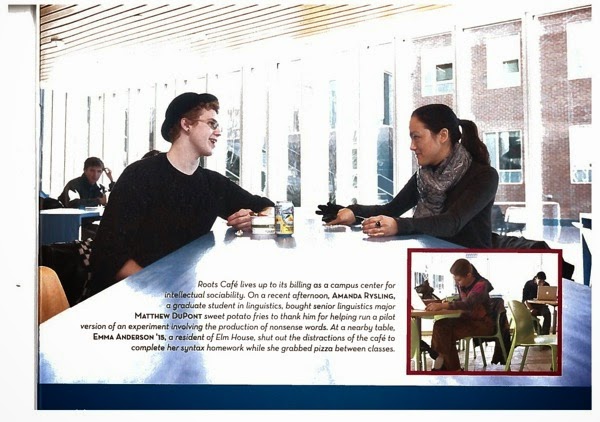
Sightings

In a recent UMass Magazine; linguists!


Amanda matt

Barbara at Moscow State University

Barbara Partee will be giving the invited talk in the seminar “Applications of mathematical methods in linguistics,” led by V.A. Uspensky, M.R. Pentus and P. Arkadiev this Saturday, March 22. Her talk is entitled “The Starring Role of Quantifiers in the History of Formal Semantics."

NASSLLI 2014

The 6th North American Summer School in Logic, Language and Information (NASSLLI 2014), a bi-annual summer school loosely modeled on the long-running ESSLLI series in Europe, will be held at the University of Maryland, College Park, June 23 - 27, 2014. In addition, we will run three intensive introductory courses ("bootcamps") on Saturday and Sunday, June 21-22. Additional events will be held during the weekend following the summer school, June 28-29.

The summer school will consist of 18 courses, scheduled in five parallel sessions throughout the week. Courses will meet for 90 minutes on each of five days. The instructors are prominent researchers who volunteer their time and energy to present work in their disciplines. NASSLLI courses are aimed at graduate students and advanced undergraduates in any of the fields represented at the summer school, but will also be of interest to post-docs and researchers in those fields. Courses are designed with an interdisciplinary audience in mind, by instructors who enjoy addressing students and colleagues from a wide range of disciplines.

For the full program of courses, see http://www.nasslli2014.com/program.

Registration

We are working to keep the registration fee low for NASSLLI participants. The expected registration fee is $175.00 for students and academics, $50.00 for UMD affiliates and $400 professional rate. The exact costs and online registration will be available on the NASSLLI website in mid-March.

Location

NASSLL is located on the campus of the University of Maryland, College Park. The University of Maryland is located in the Washington D.C. metropolitan area, and is accessible by Metro from downtown Washington DC.  

Accommodation

All NASSLLI participants are responsible for securing their own accommodations during their stay in College Park. However, NASSLLI participants may request accommodation in the South Campus Residence Hall on the University of Maryland, College Park campus.  There are also a number of hotels located in College Park within walking distance of the campus. Details on both dorm and hotel accommodations will be available on the NASSLLI website around mid-March.

11 March 2014

Bhatia and Poole at SRG

Jason Overfelt writes:


Join us for a double-header at SRG on Thursday, March13. We will hear the following 20(10) practice talks while enjoying  pizza at Jyoti and Sakshi's place.

Sakshi Bhatia: Focus Particles in Hindi-Urdu

Ethan Poole: A configurational account of Finnish case

Information for future meetings can be found at the following link.

09 March 2014

Jeff Moher talks this Wednesday

Alexandra Jesse writes:

This is a reminder that Jeff Moher (Brown) is giving a talk this week in the Cognitive Psychology Brown Bag (Wednesday, Tobin 521B, 12-1:15).

The title of the talk is "Distractor suppression in attention and action".

The abstract is:

Human behavior is frequently interrupted by distractions, from billboards to noisy neighbors to email notifications.   I will present work that addresses how and when distractor suppression mechanisms improve task performance by minimizing interference from task-irrelevant objects. Using a variety of methodologies including eye tracking, 3D reach tracking, and electroencephalography, we have found evidence for multiple distinct distractor suppression mechanisms that may be implemented through both implicit learning and explicit cueing. In some cases, even interference from perceptually salient distractors can be mitigated.  Together, these data highlight the critical role that distractor interference and distractor suppression play in both attention and goal-directed action. 

Meghan Armstrong at LARC on Thursday

Magda Oiry writes:

Meghan Armstrong will be presenting at LARC this coming Thursday. The title of her talk is:

"Child comprehension of epistemic meaning throughout the grammar: lexical and prosodic considerations"

We will meet at 9:45 in room 301 on Thursday, March 13.

Everyone welcome!

Philip Deering talks on Thursday

The Anthropology Department is hosting a talk by Philip Deering on "Indigenous Language and Education”  this Thursday 3/13 at 2:30 in Commonwealth College Events Hall, Rm. 160E next to the Roots Cafe.

Call for Papers: BUCLD

THE 39th ANNUAL BOSTON UNIVERSITY CONFERENCE ON LANGUAGE DEVELOPMENT
 
NOVEMBER 7-9, 2014
 
Keynote Speaker: Richard Aslin, University of Rochester
“From sounds to words to grammatical categories: The role of distributional learning”

Plenary Speaker: Katherine Demuth, Macquarie University
“Prosodic effects on the emergence of grammatical morphemes: Evidence from perception and production”
 
Submissions of abstracts for 20-minute talks will be accepted beginning April 1 at:
http://www.bu.edu/bucld/abstracts/abstract-submission/

DEADLINE.  All submissions must be received by 8:00 PM EST, May 15, 2014.

Submissions that present research on any topic in the fields of first and second language acquisition from any theoretical perspectives will be fully considered, including: Artificial Languages, Bilingualism, Cognition & Language, Creoles & Pidgins, Dialects, Discourse and Narrative, Gesture, Hearing Impairment and Deafness, Input & Interaction, Language Disorders, Linguistic Theory, Neurolinguistics, Pragmatics, Pre-linguistic Development, Reading and Literacy, Signed Languages, Sociolinguistics, and Speech Perception & Production.

A suggested format and style for abstracts is available at:
http://www.bu.edu/bucld/abstracts/abstract-format/
 
FURTHER INFORMATION
 
General conference information is available at:
http://www.bu.edu/bucld

Workshop on the Sound Systems of Mexico and Central America

Yale University will be hosting a workshop on sound systems of Mexico and Central America April 4-6. The workshop brings together an international group of linguists to discuss the phonetics and phonology of languages indigenous to Central America. UMass anthropologist Emiliana Cruz and linguist John Kingston are among those who are on the roster of participants. Registration is free and open to the public. For more information, go here.

Call for papers: Workshop on Indefinites and Discourse Structure"

The Workshop on “Indefinites in Discourse Structure”, is part of the workshop series 'Referential Expressions in Discourse’ (RED) and the follow up of the Workshops “Indefinites and Beyond” (Göttingen, 2011) and “Indefinites in Discourse” (Cologne, 2013).

Invited Speakers:
Hans Kamp (Stuttgart / Austin)

Anastasia Giannakidou (Chicago)

Organizers:
Klaus von Heusinger (Cologne)

Edgar Onea (Göttingen)

Call for Papers:
The workshop invites contribution to different kinds of indefinites and their semantic and pragmatic effects on discourse structure. Abstracts are invited for 20 minute talks (plus 10 minutes for discussion) on topics dealing with the semantics and pragmatics of indefinite, definite noun and demonstrative NPs with respect to discourse structure, discourse development and context.

Workshop Format:
On the first day will be a regular conference with talks, while the second day will have a different format. We plan to organise discussion groups around 2 or 3 dedicated topics identified on the first day.

Abstract Submission Guidelines:
Please send your abstracts electronically (pdf, ps, rtf) to red-2014@uni-koeln.de. Abstracts should be no more than two pages; examples should be part of the text. Please do not include your name or affiliation on the abstract. The number of abstracts per author is limited to one singly-authored and one co-authored abstract.

Please insert the following information in the accompanying email:

Paper title

Name(s) of author(s)

Affiliation(s) of author(s)

Email address to which the notification of acceptance should be mailed

Abstract submission deadline: April, 15, 2014.

Notification of acceptance: May 1, 2014.

UMass at WCCFL

The 32nd annual West Coast Conference on Formal Linguistics meets this weekend at the University of Southern California, in Los Angeles. UMass is in force:

Alumna Gillian Gallagher (NYU) has a paper “The effect of locality on two phonotactic restrictions in Cochabamba Quechua"

Jeremy Pasquereau has an alternate paper “Phonological degrees of labiality: evidence from Karata"

Vincent Homer has a poster, with Carlo Geraci (CNRS) “Decomposing Negative Modals into their Syntactic Atoms."

Jason Overfelt has a poster The Subclausal Locality of Extraposition from NP."

Rajesh Bhatt and Stefan Keine have a talk “Verb Clusters and the Semantics of Head Movement."

Vincent Homer also has a paper “Anatomy of `ne que’."

NACB: peek preview

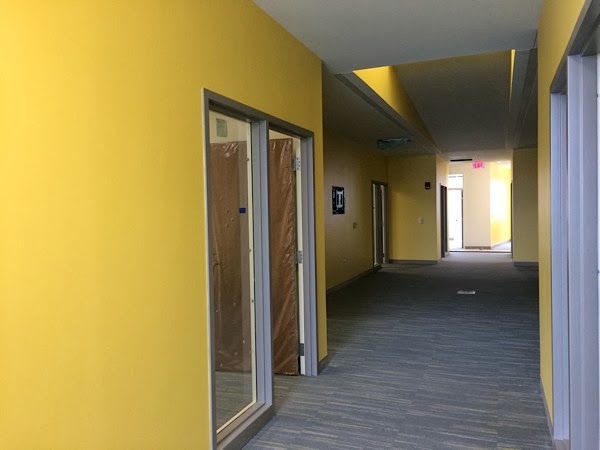
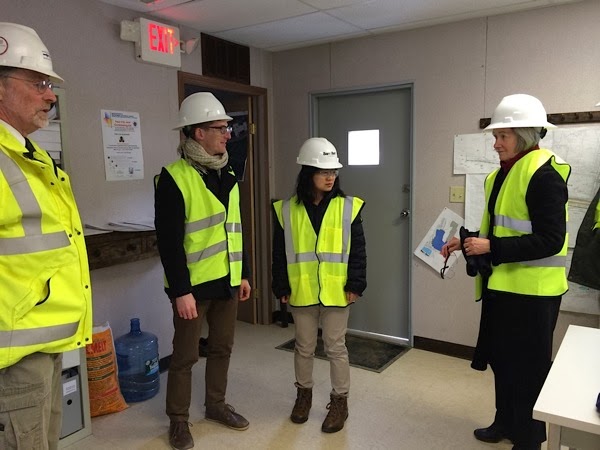
Several members of the department got a tour of the department’s new quarters in the New Academic Classroom Building. A few shots have been leaked to WHISC.

Building1

Build5

Build2

Build4

Build3

02 March 2014

Meg Grant in Bhatt's seminar

Meg Grant will give a talk entitled `Subset Comparatives’ in Bhatt's degree seminar tomorrow, Monday March 3, in the Partee Room at 2:30.

Cruz at PRG tomorrow

Ivy Hauser and Coral Williams write:

PRG will be meeting this Monday, March 3 at 7p at Ivy's place. We will be hearing from Emiliana Cruz over dinner. Parking is available along Fruit St. Everyone is welcome!

SRG tomorrow: Overfelt, Bhatt and Keine

Stefan Keine writes:

Here is a quick update on the SRG meeting this Monday, March 3. At 7pm we will have food and drinks (see below) and Jason will present his WCCFL poster to us. At 7:45 Rajesh and I will give our practice talk. It is supposed to take no more than 20 minutes plus questions so the overall meeting should not end too late.

Regarding foods and drink, we will have Hungry Ghost pizza and Rajesh will provide wine. There will be vegetarian pizzas and in addition I am planning on getting one gluten-free pizza from Joe's. If you plan to attend SRG and have dietary restrictions that I have not taken into account, please let me know asap.

Sean Kang at Brown Bag

Alexandra Jesse writes:

This is just a reminder that Sean Kang is giving a talk this week in our Brown Bag (Wednesday, Tobin 521B, 12-1:15). The title of the talk is "Applying Cognitive Science Principles to Promote Durable and Efficient Learning".

The abstract is:

Do tests only measure learning, or can they also promote learning? Should students review/practise the material they are trying to learn soon after they encounter the material or should they wait a while? During practice, should items of the same type/topic be grouped together or should they be interspersed among items of other types/topics? How we learn best may not correspond to how we think we learn best. I will talk about how basic research in cognitive psychology has yielded (nonobvious) principles about human learning and memory that have practical implications for instruction.

Margreet van Koert at LARC

Magda Oiry writes:

Please join us to hear Margreet van Koert, a graduate student visiting from the Netherlands, on

The Quantificational Asymmetry: A Comparative Look.


This LARC meeting will be happening Thursday, March 6,  at 9:45 in the Partee room.

Everyone welcome!

Pilar Chamorro gives Hispanic Linguistics Talk on Friday

Meghan Armstrong writes:

We invite you to join us for the next event in our Hispanic Linguistics Talk Series.

Pilar Chamorro, University of Georgia
On the Plurality of Western Iberian Romance Periphrastic Pasts
Friday, March 7 @ 3pm
301 Herter Hall

Linguistics Outreach Fund

Lisa Selkirk writes:

The Linguistics Outreach Fund (LOF) provides small grants to support research on understudied and/or endangered languages that contributes to a theoretically informed description or analysis of the language, and is carried out under the mentorship of faculty in the Linguistics Department at UMass Amherst. To be eligible for LOF grants, you must be:

(i) a recent or current undergraduate, M.A. or Ph.D. student, either at UMass or elsewhere, who is a native speaker of an understudied language or dialect or member of an understudied language community OR

(ii) a graduate student in the Linguistics Ph.D. program at UMass who intends to carry out original field research on an understudied language or dialect in the community where the language or dialect is spoken.?

If you are interested, you should continue reading the full LOF.

Students and faculty are urged to think about the availability of funding through the Linguistics Outreach Fund in connection with relevant research plans for coming years.

Interested students and faculty who would like to apply in Spring 2014 for funding for a project to be carried out in the next half year or so should contact me. The March 15 deadline for applications mentioned in the document will be extended to April 15 this year, to facilitate planning for an application.

Extended Submission Deadline: Models in formal Semantics and Pragmatics

New Submission Deadline: March 08, 2014

Models in formal Semantics and Pragmatics

Workshop held at ESSLLI 26
August 18-22, Tuebingen, Germany

http://homepages.uconn.edu/~stk12004/Models_ESSLLI2014/

Organizers:

* Magdalena Kaufmann, University of Connecticut
* Stefan Kaufmann, University of Connecticut


Invited Speakers:

* Michael Glanzberg, Northwestern University
* Stanley Peters, Stanford University
* Thomas Ede Zimmermann, Frankfurt University


Workshop Information:

Whatever happened to "model-theoretic" semantics? Since Montague's
groundbreaking work and throughout much of its history, the field of
formal semantics (and later pragmatics) was characterized by the use
of models - abstract mathematical structures in which linguistic
expressions are interpreted and which serve as the backdrop for
stating generalizations about their semantic properties and relations.

Over the last couple of decades, however, the once-prominent status of
models has been eroding. In the research literature, explicitly
defined fragments and models were the norm in the early days (Partee
1975, 1976; Dowty, 1979), but are now the exception rather than the
rule. In teaching, one of the most widely used textbooks, Heim and
Kratzer (1998), makes no mention of models, in stark contrast with
early standard works like Dowty, Wall and Peters (1981). Aside from
such signs of waning interest, there is a small but formidable body of
work which actively questions the status of models and finds them to
be of limited use at best (Lepore 1983; Higginbotham 1988; Zimmermann
1999, 2011; Glanzberg, t.a.).

Such explicit reflections are rare, however. The overall decline of
models in the field is not driven by a general debate, let alone
consensus. Nor is the turn away from models a turn towards some
non-model-theoretic alternative. What we do see instead is a tendency
to stay loosely within the model-theoretic framework, but to enrich it
with notions and tools whose formal properties remain largely implicit.

The goal of this workshop is to promote and generate discussion of the
past, present, and future of models in natural-language semantics and
pragmatics, specifically the implications of their apparent demise for
the foundations and goals of the field. Topics for discussion include,
but are in no way limited to the following:

* What are models, anyway? Commitments about language, reality, and
the nature of meaning that a model-theoretic approach to semantic
analysis implies. The (special?) status of possible worlds and their
relationship to extensional models.

* What are models good for? Linguistic phenomena or aspects of meaning
in whose analysis a model-theoretic approach has been, or would be,
crucial or at least beneficial. The (potential) use of models in
treating meaning as variable (e.g., in the analysis of uncertainty
about language, or in cross-linguistic and diachronic comparative
semantics).

* Where do models get in the way? Desiderata for semantic theory and
limitations of the model-theoretic approach. Risks and side effects
of specific methods associated with the model-theoretic approach
(e.g., meaning postulates).

* Are we safe without models? Advantages and potential pitfalls of
innovative uses of formal techniques or metalinguistic expressions,
whose repercussions are underexplored (various kinds
of states and events, partial functions, etc.)

* What are the alternatives?

Workshop Format:

The workshop is part of ESSLLI and open to all ESSLLI participants. It
will consist of five 90-minute sessions held over five consecutive
days in the second week of ESSLLI. The three invited talks are
allotted one hour each, including discussion. On the first day, the
workshop organizers will give a 30-minute introduction to the
topic. This leaves room for eight submitted papers of 30 minutes each,
including discussion.

Submission Procedure:

Authors are invited to submit an abstract of up to three pages,
including examples and/or references (single-spaced, at least 11pt
font, on US letter of A4 paper with margins at least 1in or 2.5cm on
all sides, in .pdf, .txt, .doc or .odt format). Abstracts must be
submitted by February 15, 2014, electronically at the following
address:

http://linguistlist.org/easyabs/Models_ESSLLI14

Authors who are unable to comply with these requirements are welcome
to contact the organizers.

Call for symposia: BUCLD 39

THE 39th ANNUAL BOSTON UNIVERSITY CONFERENCE ON LANGUAGE DEVELOPMENT

NOVEMBER 7-9

Keynote Speaker: Richard Aslin, University of Rochester
Plenary Speaker: Katherine Demuth, Macquarie University

CALL FOR SYMPOSIUM PROPOSALS
We are soliciting proposals for 90-minute symposia for the Boston University Conference on Language Development on any topic likely to be of broad interest to the conference attendees. The symposium format is open, but has frequently included 2-3 speakers presenting research from differing angles on a common theme.  We anticipate including two such symposia in the schedule, one being the Saturday lunchtime symposium, the other closing the conference on Sunday.  
 Proposals should include a list of the participants and a specification of the format, and should name at least one organizer who will be able to work with the BUCLD organizing committee in setting up the symposium.  Submissions can be sent by email to langconf@bu.edu with "Symposium proposal" indicated in the subject line.  Please limit symposium proposals to 1000 words or fewer.

DEADLINE: April 15, 201

Decisions on symposia will be made by June.

NOTE: Submissions of abstracts for 20-minute talks and poster presentations are not being solicited at this time. The deadline for those will be 8:00 PM EST, May 15, 2014.

General conference information is available at: http://www.bu.edu/bucld

UMass at SALT 24

The schedule for the annual Semantics and Linguistic Theory conference has been released, and UMass is well represented. The conference will take place at NYU on May 30-April 1, and is preceded by a conference on “Formal Semantics Beyond Spoken Language.” The following UMass papers are on the schedule.

“Interpreting DP-modifying modal adverbs,” by Elizabeth Bogal-Allbritten.

“All notional mass nouns are count nouns in Yudja” by Suzi Lima.

“Presuppositions are fast, whether hard or soft — evidence from the visual world paradigm,” by alumnus Florian Schwarz.

And UMass posters include:

“The Grammar of discourse: the case of ‘then’,” by alumna Maria Biezma.

“Indexicals and the long-distance reflexive ‘caki,” by Yangsook Park

“Is `more possible’ more possible in German?,” by alumna Aynat Rubinstein and Elena Herburger.

with poster alternate:

“Extreme modality,” by Paul Portner and alumna Aynat Rubinstein

Second Call: ESSLLI 2014 Student Session

*2nd Call for Papers*
*ESSLLI 2014 STUDENT SESSION*

Held during the 26th European Summer School in Logic, Language and Information

Tübingen, Germany, August 11-22, 2014

*Deadline for submissions: April 1st, 2014*
https://www.easychair.org/conferences/?conf=essllistus2014


*ABOUT:*
The Student Session of the 26th European Summer School in Logic, Language, and Information (ESSLLI) will take place in Tübingen, Germany on August 11-22, 2014. We invite submissions of original, unpublished work from students in any area at the intersection of Logic & Language, Language & Computation, or Logic & Computation. Submissions will be reviewed by several experts in the field, and accepted papers will be presented orally or as posters and will appear in the student session proceedings by Springer. This is an excellent opportunity to receive valuable feedback from expert readers and to present your work to a diverse audience.


*SEPARATE POSTER SESSION:*
Note that there are two separate kinds of submissions, one for the oral presentations and one for the posters. This means that papers can be directly submitted as posters. Reviewing and ranking will be done separately. We particularly encourage submissions for posters, as they offer an excellent opportunity to present research in progress.


*SUBMISSION GUIDELINES:*
All authors must be students, and submissions may be singly or jointly authored. Submissions should not be longer than 8 pages for an oral presentation and 4 pages for a poster presentation (including examples and references). Submissions must be anonymous, without any identifying information. More detailed guidelines regarding submission can be found on the Student Session website: http://www.kr.tuwien.ac.at/drm/dehaan/stus2014/.


*FURTHER INFORMATION:*
Please direct inquiries about submission procedures or other matters relating to the Student Session to dehaan@kr.tuwien.ac.at.

ESSLLI 2014 will feature a wide range of foundational and advanced courses and workshops in all areas of Logic, Language, and Computation. For further information, including registration information and course listings, and for general inquiries about ESSLLI 2014, please consult the main ESSLLI 2014 page: http://www.esslli2014.info/.

Preregistration available for Penn Linguistics Conference

The 38th Annual Penn Linguistics Conference will take place March 28-30, 2014 at the University of Pennsylvania campus in Philadelphia. Our keynote speaker this year is Professor John Ohala.

Pre-registration for the 38th Penn Linguistics Conference is now open and accessible from the PLC 38 website.

A lower pre-registration fee will apply for those who register by Saturday, March 1: $45 for students and $55 for faculty and others. The registration fee increases by $10 after the pre-registration period.

A preliminary program has also been posted on the website. For other detailed information about the conference, please refer to our website.

UMass at the Second East Asian Psycholinguistics Colloquium

The Second annual East Asian Psycholinguistics Colloquium takes place at the University of Chicago on March 8. The invited speakers include UMass alumna Amy Schafer and UMass faculty Brian Dillon. Dillon’s paper is “Locality and ant-locality effects in the comprehension of long distance anaphors” and Schafer’s is “Prosody and information structure in discourse processing: Evidence from Korean, English, and Japanese/Korean learners of English.” For a full program, go here.

Barbara Partee in Palo Alto

Barbara made a trip from Moscow to Palo Alto for an all-day meeting on Saturday February 22 of the Editorial Board of the new journal Annual Review of Linguistics, of which she and Mark Liberman are the inaugural editors, to plan the invitations for articles for Volume 2. Articles for Volume 1 are still being written; Volume 1 is expected to appear in February 2015. 

NASSLLI 2014 Student Session deadline extended

The deadline for submitting papers to the 2014 North American Summer School for Logic, Language and Information has been extended to March 14. Here’s the new call:

CALL FOR PAPERS
NASSLLI 2014 STUDENT SESSION

June 23-27, 2014
University of Maryland, College Park

The North American Summer School for Logic, Language and Information (NASSLLI) welcomes paper submissions for presentation at its Student Session. Submissions may be in any of the fields related to the school (logic and language, logic and computation, or language and computation) and should represent original, unpublished work by individuals who will not yet have received their Ph.D. by the time of the conference.

The Student Session will co-occur with NASSLLI and provides students an excellent opportunity to present their work to experts in their field as well as to a broader, well-informed interdisciplinary audience. All submissions will be reviewed by at least three specialists who will provide commentary on the paper regardless of its acceptance status. Select accepted papers will also be considered for inclusion in a potential volume of the conference’s proceedings.

Submissions should be prepared for blind review (i.e., should not contain any information identifying the author) and should be uploaded as a .pdf file to the Student Session’s EasyChair site. Submissions should not exceed 10 pages and should be formatted standardly (11 or 12 point font, 1 inch margins).

No more than one-single authored and one co-authored paper should be submitted by an
individual. (All co-authors should also be students.) Authors whose submissions have been
accepted and who intend to present will be required to register for NASSLLI.


IMPORTANT DATES:
Submissions due: March 14, 2014 (by midnight)
Notifications: April 21, 2014

WEBSITES:
Submissions: https://www.easychair.org/conferences/?conf=stusnasslli14
NASSLLI 2014: http://www.nasslli2014.com/

24 February 2014

Pasquereau at PRG tonight

Coral Williams and Ivy Hauser write:

PRG will be meeting tonight, February 24, at 7:00 pm in Brian Smith’s residence. According to Brian: "Parking is easiest on Fort Hill Terrace, but it's competitive". We will be hearing Jeremy Pasquereau give a practice talk for WCCFL, and there  will be more delicious Thai food!

As a reminder, the next meeting of PRG will be next Monday, March 3,  where we will hear from Emiliana at Ivy's place. Please let Ivy or me know about any questions, comments,  or concerns.

23 February 2014

Clauss at LARC

Michael Clauss will be giving a talk entitled “Ambiguity between questions and relative clauses for children and adults” at LARC this Thursday at 9:45 in the Partee room.

Emiliana Cruz talks tomorrow

Emiliana Cruz in Anthropology is giving a talk tomorrow (Monday, February 24) entitled: "Training Indigenous People to Study their Languages”  at 3:30pm in Machmer W-24.

Nathaniel Smith speaks on Wednesday

Nathaniel Smith, a Research Associate at the University of Edinburgh School of Informatics, will give a talk at 12:00 on Wednesday, Feb. 26, in Tobin 521B. The title of his talk is ''Building a Bayesian bridge between the physics and the phenomenology of social interaction.’’ An abstract follows.

What is word meaning, and where does it live? Both naive intuition andscientific theories in fields such as discourse analysis and socio-and cognitive linguistics place word meanings, at least in part,outside the head: in important ways, they are properties of speechcommunities rather than individual speakers. Yet, from aneuroscientific perspective, we know that actual speakers andlisteners have no access to such consensus meanings: the physicalprocesses which generate word tokens in usage can only depend directlyon the idiosyncratic goals, history, and mental state of a singleindividual. It is not clear how these perspectives can be reconciled.This gulf is thrown into sharp perspective by current Bayesian modelsof language processing: models of learning have taken the formerperspective, and models of pragmatic inference and implicature havetaken the latter. As a result, these two families of models, thoughbuilt using the same mathematical framework and often by the samepeople, turn out to contain formally incompatible assumptions.

Here, I'll present the first Bayesian model which can simultaneouslylearn word meanings and perform pragmatic inference. In addition tocapturing standard phenomena in both of these literatures, it givesinsight into how the literal meaning of words like "some" can beacquired from observations of pragmatically strengthened uses, andprovides a theory of how novel, task-appropriate linguisticconventions arise and persist within a single dialogue, such as occursin the well-known phenomenon of lexical alignment. Over longer timescales such effects should accumulate to produce language change;however, unlike traditional iterated learning models, our simulatedagents do not converge on a sample from their prior, but instead showan emergent bias towards belief in more useful lexicons. Our modelalso makes the interesting prediction that different classes ofimplicature should be differentially likely to conventionalize overtime.  Finally, I'll argue that the mathematical "trick" needed toconvince word learning and pragmatics to work together in the samemodel is in fact capturing a real truth about the psychologicalmechanisms needed to support human culture, and, more speculatively,suggest that it may point the way towards a general mechanism forreconciling qualitative, externalist theories of social interactionwith quantitative, internalist models of low-level perception andaction, while preserving the key claims of both approaches.

Naomi Feldman gives department colloq on Friday

Naomi Feldman (University of Maryland) gives the department colloquium this Friday, February 28, in Machmer E-37 at 3:30. Her talk is entitled “Interactive learning of sounds and words.” An abstract follows:

Infants begin learning words during the same period as they learn phonetic categories, yet accounts of phonetic category acquisition typically ignore information about the words in which sounds appear.  This work uses computational and behavioral methods to test the hypothesis that infants’ developing knowledge of words provides useful information for learning about phonetic categories.  A first set of simulations examines the potential benefit of a developing lexicon that contains no semantic information.  A Bayesian model is constructed that learns to categorize speech sounds and words simultaneously, and this model outperforms a model that is solely focused on learning phonetic categories.  Artificial language learning experiments demonstrate that human learners can use word-level information to constrain phonetic learning, and that they are sensitive to this information at the same age when they are learning phonetic categories.  A second set of simulations examines the potential role of weak semantic knowledge in constraining sound and word learning.  The model is given weak semantic information about the situations in which words appear, and this situational semantic information is shown to be particularly beneficial for phonetic learning when the developing lexicon contains many similar-sounding words.  Together, these results point to a critical role for the developing lexicon in phonetic category acquisition and highlight the importance of considering how children integrate statistical information across multiple layers of linguistic structure.

Pater at Berkeley on Monday

Joe Pater will give the colloquium talk at University of California at Berkeley on Monday entitled “Structural Bias in Phonology.” An abstract of the talk follows.

Chomsky and Halle (1968) propose an Evaluation Procedure that prefers featurally simple rules and grammars, and Bach and Harms (1972) propose that this bias for structural simplicity can explain instances of historical change in terms of rule simplication in learning. In this talk, I discuss an alternative model of structural bias (Pater and Moreton 2012) cast in a Maximum Entropy framework (Goldwater and Johnson 2003, Hayes and Wilson 2008), which does not invoke an explicit simplicity metric. In the first part of this talk, I present this model, and the results of a phonotactic learning experiment that supports its predictions (Moreton et al. 2013). 

I also present the results of an ERP study (Moore-Cantwell et al. 2013) that provides insight into the nature of the phonotactic knowledge acquired in an experimental setting. After participants are trained on a small set of pattern-conforming words, we find that novel words that violate the pattern elicit a larger Late Positive Component (LPC) than the novel conforming items. LPCs have been observed in response to syntactic violations in language, and also violations of musical expectation. Finding an LPC rather than an N400 effect for the novel words is consistent with the view that participants in these experiments are forming an abstract generalization about the phonotactic pattern rather than directly judging the similarity of novel and trained words. It is also noteworthy that the response to a laboratory learned phonotactic constraint is similar to that for a naturally learned one (Domahs 2009).

In the last part of the talk, I present a model of how structural bias can impact phonological typology, which uses MaxEnt learning in the context of agent-based modeling. I present simulation results (Pater and Staubs 2013) that show the emergence of featural economy (Clements 2003) in systems produced by agent interaction. In these results the tendency towards simplicity is balanced by a tendency to maintain contrast between potentially homophonous words. No constraints or principles specifically demanding economy or contrast are required to obtain these results, suggesting that it is possible to maintain the standard view that phonological grammars evaluate individual representations, rather than entire systems.

Andries Coetzee: LSA Member Spotlight

UMass alumnus Andries Coetzee has been put under the LSA’s spotlight.

Bhatt at Konstanz

Rajesh Bhatt presented with Veneeta Dayal on polar questions in Hindi-Urdu at the Workshop on Non-Canonical Quesitons and Interface Issues, on the 18th of February the Kloster Hegne, Germany. The handout is here. UMass alumna Maria Biezma also gave a talk on “qué questions."

UMass at GLOW

The program for the 37th annual meeting of the Generative Linguists of the Old World has been published and includes the following two papers from UMass students.

Ethan Poole, “A Configurational Account of Finnish Case."

Yangsook Park, “Indexicals and the long-distance reflexive ‘cali’ in Korean"

Congratulations Yangsook and Ethan!

16 February 2014

Sokolowski gives Commonwealth College Alumni talk on Tuesday

UMass alumnus Peter Sokolowski will give a talk entitled “Dictionary as Data: What the Online Dictionary Tells us about English” on Tuesday, February 18, at 5:30 PM Events Hall-East, Commonwealth College. Mr. Sokolowski is Editor-at-large for Merriam-Webster.

Fava at Cognitive Colloquium on Wednesday

Alexandra Jesse writes:

This is just a reminder that Eswen Fava is giving a talk this week in our Brown Bag (Wednesday, Tobin 521B, 12-1:15). The title of the talk is "Examining how environment and experience influence speech processing during infancy".

The abstract is:
We will examine how speech and visual perception and processing are influenced by different types of experiences and environments. The bulk of the talk will discuss a series of neurophysiological studies that explore how infants process different types of complex auditory stimuli, including speech and music.  We will discuss what neural resources are used to process these stimuli and the role biological maturation and experience.  Finally, we will explore current data and future directions that employ longitudinal training paradigms that enable us to examine how specific types of experiences with speech influence visual perception and attention.

Kamiya speaks at LARC on Thursday

Magda Oiry writes:

Please join us for the presentation by Masaaki Kamiya (Hamilton College) at the LARC meeting on Thursday in the Partee room:
 
Investigations in the representation and acquisition of negative quantifiers in nominalizations

NBnew time, we will start promptly at 9:45.
 
Everyone welcome!

Rohena-Madrazo gives Hispanic Linguistics talk on Friday

We are pleased to announce the second of three talks in the Hispanic Linguistics Talk Series this year:

Marcos Rohena-Madrazo (Middlebury College)

Talk title: Diagnoses of a completed sound change: phonetic and phonological evidence for /ʃ/ in Buenos Aires Spanish

When: Friday, February 21st at 4pm

Where: 301 Herter Hall

See abstract below.

In this talk, I present a sociolinguistic analysis of the voicing variation of /ʃ/: [ʒ~ʃ] in Buenos Aires Spanish (BAS), which has been characterized as a sound change in progress from  /ʒ/ > [ʃ]. For example, in BAS the middle consonant in the words "allá" or "oyó" used to be generally pronounced with a voiced postalveolar fricative [ʒ], like the <s> in English "vision", but now many BAS speakers pronounce it with a voiceless postalveolar fricative [ʃ], like the <sh> in English "fishing". In order to determine for which speakers or social groups the devoicing change has reached completion, I implement a novel method that not only compares the percentage voicing levels of /ʒ/ to the inherent voicing variation of /s/, but also compares the phonologically conditioned affrication patterns of /ʒ/ to those of /s/. If the voicing levels of /ʒ/ are not significantly different from those of /s/ and the /ʒ/ no longer exhibits allophonic affrication tendencies, regardless of position, then one can conclude that the speaker's underlying postalveolar fricative is /ʃ/; they are a '’devoiced.'' The sociolinguistic results suggest that the younger, middle class speakers are ‘'devoicers"; however, other social groups also have "devoicers” and "non-robust voicers," which seems to indicate that the /ʒ/ devoicing change is still progressing and perhaps nearing conclusion.

Partee in Utrecht

Barbara Partee was in Utrecht Feb 13 -15 to participate in Lisa Bylinina’s Ph.D. dissertation defense on Feb 14 and to take part in a defense-day workshop that also included talks by Lisa, by her advisor Rick Nouwen, and by fellow committee member Louise McNally. Barbara’s talk was “On the history of the question, ‘Are meanings in the head?’ ”.

Psych EM on Tuesday

Brian Dillon writes:

Wondering and worrying where Psych EM was this semester? Never fret! Psych EM rides again in the Winter 2014 semester. We'll start up our semi-regular evening meetings this semester by meeting on Tuesday February 25th at 8pm in Packard's in Northampton (we'll be reserving a larger, private back room. That way we can have beer AND privacy).

John and I are going to lead discussion of a recent paper called 'Modeling accuracy as a function of response time with the generalized linear model' by Davidson & Martin. A copy of it can be obtained here.

Check it out if you can, and come join us at Packard's for a rousing discussion of the joint analysis of reaction time and accuracy data!

Tentative PRG Schedule

Coral Williams and Ivy Hauser write:

Here is the tentative meeting schedule for the rest of the semester.  Please note that we are NOT MEETING THIS COMING MONDAY, February 17.  Instead, we will meet the week after, on February 24. Stay tuned for  further information.

Meeting Schedule:
February 24 - Jeremy's WCCFL practice talk
March 3 - We will hear from Emiliana. Hosted at Ivy's house.
March 31 - Open House Aftermath, hosted at Claire's place
April 14 - Possibly reading? Hosted at Brian's
April 28 - Possibly reading? Hosted at Ivy's

Hosts and presenters: please let us know if you will be unable to host  or present on the day you are scheduled so we can make any necessary  arrangements. If anyone wants to volunteer to host a meeting, or has  anything they want to talk about at PRG, or has any comments or  concerns, we'd love to hear from you!

CUNY conference program available

The 27th annual CUNY conference on Human Sentence Processing, which will take place March 13-15 at Ohio State University, has recently published its schedule. UMass is well represented:

Brian Dillon, Josh Levy, Adrian Staub and Charles Clifton: Linear order effects in agreement: Evidence from English wh-questions

Jesse Harris and Katy Carlson: “The local contrast expectation in ‘let alone’ coordination"

Suzi Lima: “Language affects quantity judgments in bilingual Yudja speakers"

Amy Schafer, with Kitaek Kim and Theres Grüter: “Effects of morphological and prosodic focus cues on topic maintenance in Korean"

Michael Walsh Dickey, with Evelyn Milburn and Tessa Warren: “No lexical boost: verb-based information does not facilitate prediction over and above event-based knowledge in the visual world"

Jesse Harris: “Shifting viewpoints and discourse economy"

Florian Schwarz: “Soft and hard presupposition triggers are fast in online processing"

Jesse Harris and Katy Carlson: “Focus preferences for focus-sensitive particles (and why)"

Florian Schwarz, with Cory Bill, Jacopo Romoli and Stephen Crain: “Indirect scalar implicatures are neither scalar implicatures nor presuppositions (or both)"

Brian Dillon “Locality in filler-gap dependencies: Evidence from extraposition"

Glynis MacMillan and Iiia Kurenkov, with Wing Yee Chow, Shefali Shah, Ellen Lau and Colin Phillips: “Partial use of available information in early stages of verb prediction."

Brian Dillon, with Akira Omaki, Takuya Kubo, Manami Sato and Hiromu Sakai: “Anti-locality preference in the processing of Japanese reflexive binding."

Florian Schwarz, with Dan Grodner: “Pragmatic narrowing in reference resolution: Domain restriction and perspective taking"

Katy Carlson, with Michael Frazier: “Prosodic and syntactic effects in gapping interpretation"

10 February 2014

Brendan O'Connor on text analysis today

Brendan O'Connor, CMU, will give a talk today, February 10, at
4 PM in Computer Science Building 150 entitled “Statistical Text Analysis for Social Science.” An abstract follows.

What can text analysis tell us about society? Corpora of news, books, and social media encode human beliefs and culture. But it is impossible for a researcher to read all of today's rapidly growing text archives. My research develops statistical text analysis methods that measure social phenomena from textual content, especially in news and social media data. For example: How do changes to public opinion appear in microblogs? What topics get censored in the Chinese Internet? What character archetypes recur in movie plots? How do geography and ethnicity affect the diffusion of new language? In order to answer these questions effectively, we must apply and develop scientific methods in statistics, computation, and linguistics.

In this talk I will illustrate these methods in a project that
analyzes events in international politics. Political scientists are
interested in studying international relations through *event data*:
time series records of who did what to whom, as described in news
articles. To address this event extraction problem, we develop an
unsupervised Bayesian model of semantic event classes, which learns the verbs and textual descriptions that correspond to types of
diplomatic and military interactions between countries. The model
uses dynamic logistic normal priors to drive the learning of semantic
classes; but unlike a topic model, it leverages deeper linguistic
analysis of syntactic argument structure. Using a corpus of several
million news articles over 15 years, we quantitatively evaluate how
well its event types match ones defined by experts in previous work,
and how well its inferences about countries correspond to real-world
conflict. The method also supports exploratory analysis; for example,
of the recent history of Israeli-Palestinian relations.

Second Call: ESSLLI

Models in formal Semantics and Pragmatics Workshop held at ESSLLI 26, August 18-22, Tuebingen, Germany

Organizers: 
* Magdalena Kaufmann, University of Connecticut* Stefan Kaufmann, University of Connecticut

Invited Speakers:
* Michael Glanzberg, Northwestern University* Stanley Peters, Stanford University* Thomas Ede Zimmermann, Frankfurt University

Workshop Information:
Whatever happened to "model-theoretic" semantics?  Since Montague’s groundbreaking work and throughout much of its history, the field of formal semantics (and later pragmatics) was characterized by the use of models - abstract mathematical structures in which linguistic expressions are interpreted and which serve as the backdrop for stating generalizations about their semantic properties and relations.

Over the last couple of decades, however, the once-prominent status ofmodels has been eroding. In the research literature, explicitlydefined fragments and models were the norm in the early days (Partee1975, 1976; Dowty, 1979), but are now the exception rather than therule. In teaching, one of the most widely used textbooks, Heim andKratzer (1998), makes no mention of models, in stark contrast withearly standard works like Dowty, Wall and Peters (1981). Aside fromsuch signs of waning interest, there is a small but formidable body ofwork which actively questions the status of models and finds them tobe of limited use at best (Lepore 1983; Higginbotham 1988; Zimmermann 1999, 2011; Glanzberg, t.a.).
Such explicit reflections are rare, however. The overall decline ofmodels in the field is not driven by a general debate, let aloneconsensus. Nor is the turn away from models a turn towards somenon-model-theoretic alternative. What we do see instead is a tendencyto stay loosely within the model-theoretic framework, but to enrich itwith notions and tools whose formal properties remain largely implicit.

The goal of this workshop is to promote and generate discussion of thepast, present, and future of models in natural-language semantics andpragmatics, specifically the implications of their apparent demise forthe foundations and goals of the field. Topics for discussion include,but are in no way limited to the following:

* What are models, anyway?  Commitments about language, reality, and the nature of meaning that a model-theoretic approach to semantic analysis implies. The (special?) status of possible worlds and their relationship to extensional models.

* What are models good for? Linguistic phenomena or aspects of meaning in whose analysis a model-theoretic approach has been, or would be, crucial or at least beneficial. The (potential) use of models         in treating meaning as variable (e.g., in the analysis of uncertainty about language, or in cross-linguistic and diachronic comparative semantics).

* Where do models get in the way? Desiderata for semantic theory and limitations of the model-theoretic approach. Risks and side effects of specific methods associated with the model-theoretic approach (e.g., meaning postulates).

* Are we safe without models? Advantages and potential pitfalls of innovative uses of formal techniques or metalinguistic expressions, whose repercussions are underexplored (various kinds of states and events, partial functions, etc.)

* What are the alternatives? 

Workshop Format: 
The workshop is part of ESSLLI and open to all ESSLLI participants. It will consist of five 90-minute sessions held over five consecutive days in the second week of ESSLLI. The three invited talks are allotted one hour each, including discussion. On the first day, the workshop organizers will give a 30-minute introduction to thetopic. This leaves room for eight submitted papers of 30 minutes each,including discussion.

Submission Procedure:
Authors are invited to submit an abstract of up to three pages,including examples and/or references (single-spaced, at least 11 pt font, on US letter of A4 paper with margins at least 1in or 2.5cm on all sides, in .pdf, .txt, .doc or .odt format). Abstracts must be submitted by February 15, 2014, electronically at the following address: http://linguistlist.org/easyabs/Models_ESSLLI14

03 February 2014

First PRG meeting today!

Ivy Hauser writes:

The first meeting of PRG will take place at Amanda's apartment in Northampton on Monday (today) at 7pm.  We will spend the first half of the meeting working on planning for the semester and the second half Ivy will talk about recent work and some new ideas.  Dinner will be provided!