07 September 2014

Call for papers: WSCLA

We the WSCLA planning committee are pleased to announce that the University of Arizona will host the Workshop on the Structure and Constituency of the Languages of the Americas this spring, from January 23-25, 2015.

This conference is a unique event that brings together linguists working with any of the indigenous languages of North, Central and South America. This will be the first time it is hosted at the University of Arizona (and high time too!) and also the 20th anniversary of this wonderful conference.

Abstracts are invited for papers in any area of formal linguistics (including phonetics, phonology, morphology, syntax, semantics, and pragmatics) within any theoretical framework. We welcome papers that address diachronic, sociolinguistic, or applied topics from a formal perspective, and we are especially interested in papers seeking to correlate the interests of formal linguists and the concerns of indigenous communities.

Abstracts should be submitted to the EasyChair website at this link:
https://easychair.org/conferences/?conf=wscla2015

Abstract submission guidelines:

Please submit your abstract for a paper in .pdf format at  https://easychair.org/conferences/?conf=wscla2015, following the requirements listed below, before midnight PST on October 10, 2014.

Abstracts should be anonymous. Author name(s) should not appear in the abstract or file name. Abstracts should not exceed 2 pages in length including references and examples (minimum 12 pt font size, 1 inch margins). Submissions are limited to two abstracts per author, including at most one single-authored abstract. (In other words, you may contribute to two co-authored abstracts, or one co-authored abstract plus one single-authored abstract.)

Please write to wscla2015@gmail.com with any questions.

BU Language Acquisition Conference program

The program for the 39th Annual Boston University Conference on Language Development has been released. The conference meets from November 7-9. The  keynote speaker is Richard Aslin (University of Rochester) who will deliver the talk “From sounds to words to grammatical categories: The role of distributional learning,” The Plenary Speaker is Katherine Demuth (Macquarie University) whose talk is “Prosodic effects on the emergence of grammatical morphemes: Evidence from perception and production.” Our own Barbara Pearson has, with Joan Maling, organized the poster symposium “Linguistics for Everyone: Engaging a broader public for the scientific study of language acquisition.”

Pre-registration starts on September 1 and closes on October 28. For more information about registering, go here.

The UMass linguistic community is represented by the following posters:

A. Aravind and Jill de Villiers: “Implicit alternatives insufficient for children’s SIs with some"

Valentina Brunetto and Tom Roeper: “Are rare constructions late in acquisition? The case of near-reflexivity"

Alumna Suzi Lima, with P. Li and J. Snedeker: “Acquiring the denotation of object-denoting nouns in a language without partitives."

Jill de Vliiers, with A. Pace, P. Yust, A Iglesias, M. Wilson, K Hirsh-Pasek, R. Golinkoff, A Takehesu Tabori, K. Strother-Garcia, K Ridge: “Examining the Validity of a Compuater-based Language Assessment for Preschool Children."

Alumna Anne-Michelle Tessier, with S. Shittu: “Perceptual attrition of lexical tone among L1 Yoruba-speaking children in Canada."

Michael Clauss: “The Syntax and Semantics of Free Relative Clauses in Child English."

Alumni Angeliek Van Hout and Bart Hallebrandse, with C Lindenbergh: “The acquisition of sentence ellipsis in Dutch preschoolers."

Alumnus Terue Nakato: “Gender Information of Possessive Pronouns: How does it work in Child English?"

Alumna Ana Teresa Pérez-Leroux, with A. Catilla-Earls, T Peterson, D. Massam and S. Behar: “Children’s acquisition of complex modification."

Alumna Angeliek Van Hout, with I Strangmann, and A. Slomp: “Context and the acquisition of Dutch eh-questions: The effect of topicality and thematic roles."

Barbara Pearson: “Linguistic and pragmatic ambiguity in quantified expressions: Implications for mathematics teaching and test of monolingual and bilingual students."

The complete schedule can be found here.

31 August 2014

Town Meeting this Friday

The Town meeting will happen on Friday, September 5, in the main lobby of the department. (The “main lobby” is that area outside Michelle and Tom’s offices, immediately beyond the front door to the department.) The Town Meeting is the occasion upon which all the new members of the department meet the established members of the department. It is also a time at which much of the human infrastructure of the department is revealed (e.g., who is graduate program director? what is a graduate program director? what is a guru?). And finally, it is where photographs or linguists are produced for the department website and directory. We’ll start taking individual photos at 2:30. Since many of the old photos were lost in the move, you should come to this even if you had a photo in South College. The town meeting will start at 3:15, with the group photo happening directly afterwards.

Lyn Frazier honored at Faculty Convocation

Lyn Frazier, along with seven other UMass faculty, will receive the award for Outstanding Accomplishments in Research and Creative Activity at the Tenth Annual Faculty Convocation on Friday, September 12. Join us in congratulating Lyn on this high honor.

Kratzer gives Sweet Lecture

Angelika Kratzer gives the Henry Sweet lecture at the 2014 annual meeting of the Linguistics Association of Great Britain on September 1.  Her lecture, “The semantics of embedding and the syntax of the left periphery,” is the plenary talk at a workshop on the syntax and semantics of embedding that includes talks by Enoch Aboh, Adriana Bellettii, Martina Faller and Daniel Rothschild. For more information, go here.

Call for papers: Grasping Ellipsis

The University of Campinas in Sao Paulo Brazil will be hosting a workshop “Grasping Ellipsis: its syntax, semantics, acquisition and processing” on May 4-5 2015. They are accepting abstracts for 30 minute talks until November 2. For more information, go here.

Alex Drummond

Alex Drummond will be a visiting professor in syntax for the 2014-15 academic year. He has worked on the Binding Theory, Quantifier Raising, issues in anaphora and ellipsis, Preposition Stranding and on general issues of the design of syntactic derivations. You can find out more about his work here.

He’ll be teaching a seminar in the Spring. This term, his office is in the CSAAL area of the department: N472.

Drummond

Sang-Im Lee-Kim

One of the visiting phonology faculty this academic year is Sang-Im Lee-Kim, who has just completed a dissertation (“Contrast Neutralization and Enhancement in Phoneme Inventories: Evidence from Sibilant Place Contrast and Typology”) at NYU. You can find out more about her research (and name) here. Her office is N434.

Shapeimage 1

Robert Staub

The inaugural dissertation defense in the Seminar Hub (N400 of the new department) took place on July 25, and featured Robert Staub who successfully defended his dissertation, “Computational Modeling of Learning Biases in Stress Typology.” Robert will be visiting faculty in the department for the 2014-15 academic year, teaching a proseminar in Phonology (LING 730) in the Fall and LING 402 in the Spring. You’ll find him in room N454 of the department.

Holyoke1

Semantics position at Toronto

The Department of Linguistics, University of Toronto (St. George Campus), invites applications for a full-time tenure-stream position in the area of Semantics. The appointment will be at the rank of Assistant Professor, and will begin on July 1, 2015.

Qualifications include a proven record of research in formal semantics. The ideal candidate will have experience in fieldwork on an understudied language as well as a secondary strength in syntax. Applicants must have completed the Ph.D. by the start date or shortly thereafter and have a demonstrated record of excellence in teaching and research.

Duties include teaching and supervision at the undergraduate and graduate levels, maintaining an active research agenda, and participating in the academic life of the department.

Salary will be commensurate with qualifications and experience.

All qualified candidates are invited to apply online by clicking on the link below. Applications should include a cover letter of no more than 2 single-spaced pages, a curriculum vitae, a research statement, evidence of teaching ability (including a statement of teaching philosophy), a writing sample, and the names and email addresses of three referees. Please combine your application into one or two files. If you have questions about this position, please contact lingdept@CHASS.UTORONTO.CA.

All application materials should be submitted online and received by October 24, 2014.

Submission guidelines can be found at: http://uoft.me/how-to-apply. We recommend combining attached documents into one or two files in PDF/MS Word format.

Applicants should also arrange to have three letters of reference, preferably as signed PDF documents on letterhead, sent directly to Professor Keren Rice at the address lingdept@CHASS.UTORONTO.CA with the subject line: "Semantics – (your full name)" by the job deadline date.

More information on the University of Toronto (http://www.utoronto.ca) and the Department of Linguistics (http://linguistics.utoronto.ca) can be found on their respective websites. Linguistics course descriptions are available at www.artsandscience.utoronto.ca/ofr/calendar/crs_lin.htm.

All qualified candidates are encouraged to apply; however, Canadians and permanent residents will be given priority.

McCarthy/Pater NSF

Joe Pater writes:

John McCarthy and I are very pleased to be able to announce that the NSF has awarded a grant of $305,613 to support a project entitled “Computing constraint-based derivations: Phonological opacity and hidden structure learning”, starting September 1, 2014, and lasting for 3 years. John and I will direct the grant, and the other senior personnel will be Robert Staubs (UMass) and Mark Johnson (Macquarie). The grant will support a graduate student RA, and also includes a Research Experience for Undergraduates component that will involve two undergraduates every semester. This coming semester, Presley Pizzo will be an RA on the grant, and Amanda Doucette and Stephanie Rich will  participate in the REU program. All are welcome to participate in grant activities, including our weekly meetings which will take place at 10 am Thursdays this semester. We will announce grant meetings on the ling-phonology mailing list (https://list.umass.edu/mailman/listinfo/ling-phonology). Students interested in future RA-ships or the REU program are especially encouraged to attend grant meetings, and also to talk with John or me.

The project plans include the creation of a publicly accessible database on instances of phonological opacity, development of accounts of opacity in Harmonic Serialism and comparison with other approaches, implementation of computational tools for working with derivational versions of OT and Harmonic Grammar ("OT-Help 3"), and research on the learning of hidden structure in a Maximum Entropy framework, including learning of derivations (the goals of the project will undoubtedly evolve as we pursue this collaborative work).

UMass at AMLaP XX

The 2014 Architectures and Mechanisms for Language Processing conference will be hosted by the University of Edinburgh from Wednesday, September 3, through Saturday, September 6. UMass students, faculty and alumni are well-represented. Chuck Clifton will be chairing a panel discussion entitled "The Past, Present and Future of Psycholinguistics,” and the following papers are on the schedule:

"Ambiguity advantages in attachment and pronominal reference: Evidence from eye movements during reading” by Margaret Grant, Brian Dillon and Shayne Sloggett

"Adjective sprouting in much-less ellipsis” by alumni Katy Carlson and Jesse Harris.

"SNAP judgments: Small N acceptability paradigm (SNAP) for linguistic judgments” by Jeremy Hartman, with Kyle Mahowald, Peter Graff and Edward Gibson.

24 August 2014

Department Potluck Picnic

The annual beginning-of-the-year potluck picnic/party will happen at Barbara and Voldja’s place  (50 Hobart Lane in Amherst) on Saturday, September 6. It starts at 3:30 and continues into the evening. WHISC has been informed that casual dress is acceptable. Sporting events include badminton and croquet (casual dress is acceptable for these activities as well). Feel free to bring equipment for more strenuous activities. 

Bring things to eat and drink. There will be a charcoal grill provided, and it’ll be hot by 4:30 or so. International foods are encouraged, as are adventuresome dishes.

Also bring friends, family, children, colleagues, hangers-on, partners, companions and Philosophers. But no dogs please.

Here is a message from Barbara regarding Hobart Lane’s notorious parking issues:

There is no parking permitted on most of Hobart Lane. Parking is possible in our driveway, and parking is possible in the daylight hours on the opposite side of the street between our house and where Hobart Lane turns into a dirt road, but for safety, put a note under your windshield wiper that tells the police your name and that you are now at 50 Hobart Lane and asking them please to let us know if there is a problem. (The parking restrictions help us combat the problems of large beer parties in the neighboring apartment complexes on Hobart Lane, so we like to stay friends with the police! We'll let them know about the party, but they won't be able to grant a total parking waiver for a September Saturday. They usually agree to come and let us know when cars need to be moved, rather than just towing them away.)

Masashi Hashimoto defends

Masashi Hashimoto will defend his dissertation, “Experiencing in Japanese: The Experiencer Restriction Across Clausal Types,” on Friday, August 29, in the Seminar Hub (N400).

Mellon Post-Doc at McGill

A world-renowned university located in the cosmopolitan metropolis of Montreal, Canada, McGill University has earned an international reputation for scholarly achievement and scientific discovery. Founded in 1821, McGill has 21 faculties and professional schools, which offer more than 300 programs from the undergraduate to the doctoral level. McGill attracts renowned professors and researchers from around the world and top students from more than 150 countries, creating one of the most dynamic and diverse educational environments in North America.

Three Mellon Postdoctoral Fellowships will be awarded for the academic year 2015-2016 to promising young scholars. The stipend for each fellow is $52,000 CAD (plus benefits), in addition to a research allowance of $8,500. The Fellowship is renewable once. Each fellow will teach an undergraduate course in both fall and winter terms and may be asked to give a public presentation on his or her research. Fellows will be provided with office space and are expected to be on campus making use of McGill’s resources, particularly during the academic year.

Eligibility:

Scholars who received their PhD after June 2012 or who will have completed all PhD degree requirements by June 1, 2015 are eligible to apply. While research projects must be based in the humanities, interdisciplinary applications are especially welcome. Fellowships are open to scholars of any nationality. Applicants who do not have the PhD in hand at the time of application must include a letter from their Department Chair specifying the date of the dissertation defense. Successful applicants who do not complete all requirements for their PhD by June 1, 2015, will have their offer of award withdrawn.

To Apply:

All applicants must be in contact with a full-time faculty member in the Faculty of Arts in advance to identify an appropriate supervisor for his or her work (see http://www.mcgill.ca/arts/departments). The deadline to contact a proposed supervisor is Friday, October 24, 2014. Since each supervisor can only endorse one Mellon fellowship application, an application can only proceed once endorsement from a proposed supervisor has been obtained. Applicants will be notified of this decision by the proposed supervisor by Friday, October 31, 2014.

There is no application form. The application should include:

  1. 1)  A one-page statement of interest from the applicant detailing the proposed research project

  2. 2)  A full curriculum vitae

  3. 3)  An official copy of university graduate transcripts

  4. 4)  A copy of the doctoral diploma, or a letter from the Department Chair specifying the defense date

  5. 5)  Two letters of recommendation, one of which must speak to competence in teaching

  6. 6)  A writing sample, not to exceed 20 pages (extract from the dissertation, published work, or draft of a work in progress)

  7. 7)  A letter of support from the proposed supervisor in the Faculty of Arts at McGill, to be forwarded directly to the address below by the proposed supervisor

Applications must be received by Monday, November 17, 2014.
For more information contact:
adr.arts@mcgill.ca or 514-398-4400, ext. 094822

Applications should be submitted electronically to adr.arts@mcgill.ca. Electronic letters of recommendation should be attached as PDF documents only and sent directly by the referees.

Submission by mail is also possible. The completed application should be sent to:

Professor Jim Engle-Warnick Associate Dean, Research and Graduate Studies Faculty of Arts
McGill University
853 Sherbrooke St. W.
Montreal, QC H3A 0G5 CANADA

Kratzer and Krifka: SIAS Summer Institute

Angelika Kratzer writes:

I have good news to share: Manfred Krifka and I have just heard that the eight directors of SIAS (Some Institutes for Advanced Studies, comprising the Princeton, Radcliffe, Stanford, Berlin, Stockholm, Hebrew University institutes, as well as NIAS and the National Humanities Center) have chosen our joint proposal for a SIAS Summer Institute at their last meeting in June. Our proposal is entitled: “The Investigation of Linguistic Meaning: in the Armchair, in the Field, and in the Lab.” Typically two proposals are chosen every two years. We heard that this time, the selection was particularly difficult because only one proposal could be chosen for budgetary reasons. We are very happy that it was ours. We are particularly proud that our proposal convinced eight top scholars from very different fields (Humanities, Social Sciences, Natural Sciences). 
 
A SIAS Summer Institute is, in fact, a two year mentoring program for 20 post-doctoral fellows (no more than 5 years from PhD) from Europe and the US. They will be brought together in two two-week summer institutes directed by us. We can invite up to four outside experts. For the Berlin segment of the Institute, we can also also rely on the resources of the Berlin School of Mind and Brain and the ZAS (Center for General Linguistics). The program is jointly funded by the Andrew Mellon Foundation and the Alexander von Humboldt Foundation. The funds (around $200,000) will be administered by the Berlin Wissenschaftskolleg and the National Center for the Humanities, which will also host the two Summer Institutes. The funds from the Alexander von Humboldt Foundation have already been secured, and we can thus begin to recruit fellows and plan for the 2015 Summer Institute. The Mellon Foundation is expected to commit funding for the second phase of the program and the 2016 Summer Institute by the end of the year.  
 
 
This grant will not consume resources from UMass, nor will it bring funds. It will, however, add to our reputation as a center for interdisciplinary research and innovation. It affirms our vision of linguistics as a bridge builder between the Humanities, the Social Sciences, and the Natural Sciences. It fits perfectly with our department’s efforts (currently spearheaded by Joe) towards a Cognitive Science Institute. It will contribute to international collaboration and tightly connect us to research on linguistic meaning in Europe. Personally, I am also interested in exploiting some of the expertise with collective interdisciplinary research for my undergraduate teaching. 

Mellon Post-Doc at Stanford

Stanford University invites applications for postdoctoral fellowships in the Andrew W. Mellon Fellowship of Scholars in the Humanities, a unique opportunity for the best recent Ph.D. recipients in the humanities to develop as scholars and teachers. Up to four fellowships will be awarded for a two-year term (with the possibility of renewal for a third year). Fellows will teach two courses per year in one of Stanford’s humanities departments, and are expected to participate in the intellectual life of the program, which includes regular meetings with other fellows and faculty to share work in progress and discuss topics of mutual interest. It is expected that Fellows will be in residence during the term of their appointment. Fellows will also be affiliated with the Stanford Humanities Center and will have the opportunity to be active in its intellectual life.

Eligible fields for the 2014 competition (for fellowships beginning autumn 2015):

Classics, Linguistics, and Philosophy

Candidates for this year’s competition must have received their Ph.D. between January 1, 2012 and June 30, 2015. Fellowships will begin on September 1, 2015.

The stipend for 2014-15 is $66,000, and compensation will include additional support for computer assistance, research, and relocation expenses, depending on the needs of individual fellows.

Deadline: Applications must be submitted by November 17, 2014. To
apply, complete the online application process at the website below.

You will be asked to submit electronically the following material:

- Cover letter (circa one page) describing your research and teaching interests to an interdisciplinary search committee
- Curriculum vitae
- Dissertation abstract (up to three pages). Linguistics applicants may submit a research statement (up to three pages) as part of, or in lieu of, a dissertation abstract.
- A sample of written work (article length, no longer than 40 pages)
- A separate description of teaching experience and interests (up to three pages) Note: Courses will be offered through standing Stanford departments; applicants should familiarize themselves with recent course offerings and department curricula.
- Three confidential letters of recommendation (or the applicant’s active graduate school dossier)

Faxed or emailed application materials cannot be considered.

Stanford Ph.D.s and employees are not eligible for consideration.

Only complete applications submitted through the online system will be considered. All applications will be acknowledged. Finalists may be interviewed. For more information, please visit the website below or contact us at the email below.

Application Deadline: 17-Nov-2014
US Web Address for Applications: http://mellonfellows.stanford.edu/apply/
Contact Information:
Robert Barrick
Email: mellonfellows@stanford.edu

Partee in Inaugural issue of Semantics-Syntax Interface

Angelika Kratzer writes:

The inaugural issue of Semantics-Syntax Interface has gone online. It includes an editorial by editor Negin Ilkhanipour and a new article by Barbara Partee: A Brief History of the Syntax-Semantics Interface in Western Formal Linguistics.

The next issue will be a special issue on "Past Tense". If you think you might be interested in contributing to this issue (The deadline is mid September).

Emmonfest

On June 20 and 21, there was an Emmonfest at the Goethe Universität Frankfurt. In addition to talks by several of Emmon’s students and friends, congratulations, well-wishes and tributes were delivered. A schedule, and pictures!, can be found here.

Roeper in Leipzig

Tom Roeper gave the talk “Unlabelled Nodes in Acquisition and Morphology,” to the linguistics department at the University of Leipzig on July 4. He was also a participant on the symposium on the Acquisition of Adversitives at the International Association for the Study of Child Language in Amsterdam July 14-18.

Helen Majewski defends

Congratulations to Helen Majewski who defended her dissertation, “Interpreting Reciprocals: A Processing Approach,” last Wednesday, August 20.

Recursion: Complexity in Cognition

WHISC is pleased to announce the publication by Springer of “Recursion: Complexity in Cognition,” edited by Tom Roeper and Peggy Speas. It collects some of the papers delivered to the recursion conference hosted by UMass in 2009, including papers by UMass alumni Eva Juarros and Bart Hollebrandse, as well as Tom Roeper and Jill deVilliers.

Brian Smith defended

On August 4, Brian Smith successfully defended his dissertation, “Phonologically conditioned allomoprhy and UR constraints.” Brian will be taking a one-year position at UCLA’s linguistics department. Congratulations, Brian!

Team Kratzer inaugural winner of the Beaver Cup

At the Sixth North American Summer School in Logic, Language and Information, which was held at the University of Maryland June 21-27, our own Angelika Kratzer captained the pictured team to win the Semantic Valueball tournament. (WHISC is told that Valueball approaches volleyball in the limit, originally defined by Carnap (1947) as the extension of Unsinnball.) Team Kratzer beat out Team Veltman, Team Hacquard and Team Williams to win the Beaver Cup, donated by David Beaver and designed by Alexander Williams.  (That is beaver fur (from Castor canadensis, not David) clothing the trophy.)

BeaverCupCeremony HoistedHigh NASSLLI

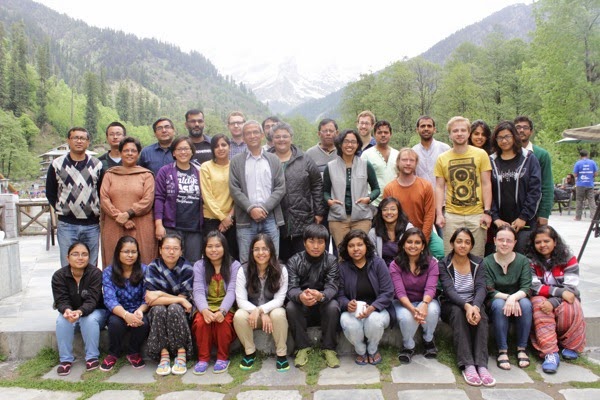
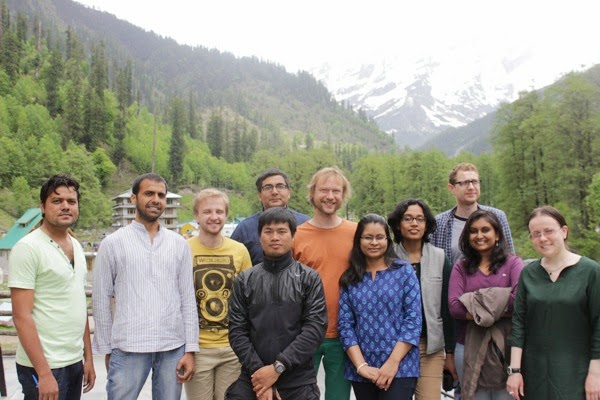
UMass at Linguistics Summer School in the Indian Mountains 8

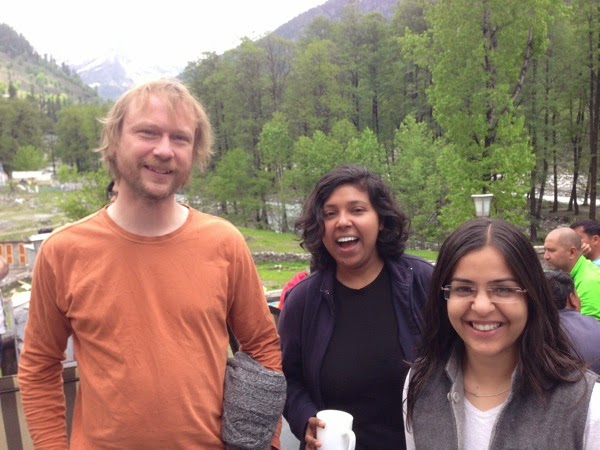
From May 25 to June 6, Rajesh Bhatt, Sakshi Bhatia, Michael Clauss, Jyoti Iyer and Stefan Keine attended the Linguistics Summer School in the Indian Mountains (LISSIM) in Solang, Himachal Pradesh, India. WHISC was fortunate enough to have embedded a reporter in the school, and what follows is a dispatch from our reporter, along with her (or his) photographs.

The 8th edition of LISSIM was organized in Solang, where we woke up to the sight of snow covered peaks and rested to the sound of the gurgling river flowing nearby. In some ways it was very much like the Pioneer valley, but at a higher elevation (2560m, 8400ft.) and with snow in midsummer.

The two week long school had courses by four visiting faculty: former UMass syntax guru Klaus Abels (UCL), who taught a course on sluicing; Rajesh Bhatt, who taught a course on agreement (along with Stefan Keine); Veneeta Dayal (Rutgers), who taught a course on the semantics of questions, and Joachim Sabels (the UCL in Belgium) who taught a course on the typology of wh-questions.

A usual day at the school had us in classes from 9 am to 5 pm (with enticing food served during the breaks). As the end goal of each of these courses was to equip the students with the best possible tools to be able to take a stab at the nature of these phenomena in the various languages spoken by them, the students and faculty would reconvene later in the evening to this effect. With all participants living at the venue itself, this meant that work went on till late in the night and early in the morning, with both faculty and students found to be deep in discussion at all hours. The presence of faculty on-site throughout the school also gave the students multiple opportunities to discuss their ongoing research with them. The location with its breathtaking views was inspiring; the isolated location meant that there were few distractions other than the natural beauty to take us away from our work.

The workshops, for which the students worked in language groups and where the students presented their findings and first analyses of the facts in their languages, enabled all present to have a comparative view of the topics taught in the courses. The languages represented include: Hindi-Urdu, Punjabi, Magahi, Angika, Bangla, Meiteilon, Telugu, Kannada, Nepali, Indian Sign Language, Polish, Russian, and German.

From our large UMass contingent, Jyoti Iyer and Sakshi Bhatia represented the Hindi-Urdu and Punjabi groups for the workshop presentations on Ellipsis and Rhetorical questions in Hindi-Urdu, and Addressee Agreement in Punjabi; and Mike Klaus had the unique honour of representing three language groups at different points in the school! (Follow up with him for further details).  Stefan Keine and Rajesh Bhatt made a presentation on the crosslinguistic distribution of the scope-marking construction. 

All in all it was a demanding and intensive school which introduced participants to various exciting issues in Syntax and Semantics and laid the basic groundwork for them to carry on further research.  The participants are very grateful to Tanmoy Bhattacharya (Delhi University) and Ayesha Kidwai (JNU) for making this happen.

IMG 2903

IMG 2505

IMG 2448IMG 2502


DSC 1477

10414645 10152249938143406 1200632187893601198 n

IMG 2923

IMG 2514

IMG 3210

07 June 2014

Call for papers: NELS 45

The 45th annual meeting of the North East Linguistic Society will be hosted by MIT from October 31 to November 2. Among the invited speakers is alumnus Roger Schwarzschild. The deadline for abstracts is July 1. In addition to the general session, there is  a special session on The Phonological Consequences of Morphological Structure. For more information, go here.

WHISC goes on Holiday II

It broke 80 degrees Fahrenheit this weekend in the WHISC offices, signaling the official beginning of the summer holiday. WHISC will return at the end of August.

31 May 2014

Tone Workshop this week

The Tone Workshop will be this Monday and Tuesday in the Life Sciences Laboratories N610. The program follows.

MONDAY, JUNE 2

9:30-10:30    Breakfast + coffee

10:30-11:30   Mark Liberman: Tone without pitch

11:30-12:30   Jianjing Kuang: The covariation between pitch and phonation: the case of creaky voice in Mandarin tones

12:30-1:00    Discussion

1:00-2:00     Lunch (served)

2:00-3:00     John Kingston: Tone in Chinantec

3:00-4:00     Christian DiCanio: Moraic alignment of Mixtec tone: exploring complex timing relations in Oto-Manguean tonal systems

4:00-5:00     Discussion

Workshop dinner at Kristine Yu’s house.


TUESDAY, JUNE 3

9:30-10  Breakfast + coffee

10-11    Bert Remijsen: Further evidence for contrastive alignment in falling contours

11-12    Kristine Yu on Bole; Scott Myers reaction from African perspective

12-12:30 Discussion

12:30-2  Lunch (served)

2-3      James Kirby: Tonogenesis in Khmer

3-4      Yi Xu: Toward parametric representation of tone: Articulatorydynamics and computational modeling

4-5      Discussion

Emmonfest in June!

Joyce McDonough, Gert Webelhuth and Jim Blevins have organized an Emmonfest at the Goethe Universität in Frankfurt am Main for Emmon Bach. It’ll take place on June 20 and 21.

Cognitive Science Initiative meetings

Joe Pater writes:

Following the success of our "Grad student mixer", we've decided to go with a relatively informal organization for the Cognitive Science Initiative, at least for the summer (that is, we won't try to form an official steering committee yet). 

We'll have two meetings at which all interested faculty and graduate students will be welcome. We'll discuss the activities of our proto-Institute for the upcoming academic year (creation of new website, workshop(s), launch of scholars program...).

Here are the times for your calendar - like the mixer, the meetings will be at the Amherst Brewing Company. We'll likely have a full group roundtable starting shortly after 3, and try to leave some time for smaller group discussions afterwards.

Meeting 1: June 11th 3-5
Meeting 2: July 16th 3-5 

Faculty interested in getting on the mailing list should fill out this google form

And graduate students should use this one.

23 May 2014

WHISC's holiday postponed

WHISC mistook last week’s warm snap for summer. We have returned to wait for proper beach weather.

Partee: Doctor of Humane Letters

Although the University of Chicago hasn’t  announced it yet, we’ve been given permission to share on WHISC the news that Barbara Partee will be awarded the honorary degree of Doctor of Humane Letters by the University of Chicago at their commencement ceremony on June 14. 

Congratulations Barbara!

Call for papers extended: InToSpan 2014

UMass is hosting the First Symposium on Intonation and Tone in the Spanish-Speaking world October 11-12. John Kingston is one of the invited speakers. Abstracts for oral presentations and posters are being accepted until June 7. For more information about the conference, go here. For information about submitting abstracts, go here.

Call for Abstracts: Phonology 2014

MIT will host Phonology 2014 on September 19-21, and is accepting abstracts for papers until June 5. Abstracts should be anonymous and no more than 2 single-spaced pages in 12 point font. Abstracts can be submitted here.

UMass alumna Gillian Gallagher (NYU) is one of three invited speakers.

For more information, go here.

Staubs defends dissertation on July 30

Robert Staubs will defend his dissertation, “Computational Modeling of Learning Biases in Stress Typology” on Wednesday, July 30, from 2-4PM in Machmer E33. Congratulations Robert!

One year position at College of William and Mary

Application deadline: June 6, 2014
Start Date: August 10, 2014
 
The Department of Psychology and the Linguistics Program invite applications for a one year, non-tenure-track position that will beginAugust 10, 2014. We seek an individual with expertise in PSYCHOLINGUISTICS who will hold a joint position in the Department of Psychology and the Linguistics Program. The successful candidate will be expected to be an effective teacher, and a Ph.D. is required at the time the candidate begins the appointment.  The successful candidate will teach Psycholinguistics and Language Acquisition, which are cross-listed between the Linguistics Program and Psychology. Teaching responsibilities also include the Linguistic Program's introduction to linguistics courses as well as topics courses in the candidate's area of expertise. Non-tenure-eligible faculty are required to teach a 3-3 course load during the academic year (three courses per semester).
 
Candidate must apply online at https://jobs.wm.edu. Submit a curriculum vitae, a cover letter including a statement of research and teaching interests, and teaching evaluations, if possible.  You will be prompted to submit online the names and email addresses of three references who will be contacted by us with instructions on how to submit a letter of reference.
 
For full consideration, submit application materials by the review date, June 6, 2014.  Applications received after the review date will be considered if needed.
 
The College of William & Mary values diversity and invites applications from underrepresented groups who will enrich the research, teaching and service missions of the university. The College is an Equal Opportunity/Affirmative Action employer and conducts background checks on applicants for employment.

Hashimoto defends dissertation on August 29

Masashi Hashimoto will defend his dissertation, “Experiencing in Japanese: The Experience Restriction Across Clausal Types,” on Friday, August 29, at 3PM in Machmer E-33. Congratulations Masashi!

Call for papers: Acoustical Society of America

The deadline for submission of abstracts for the fall 2014 meeting of the Acoustical Society of America is Monday, 23 June 2014.

The meeting will be held in Indianapolis, Indiana, 27-31 October 2014, at the Indianapolis Marriott Hotel. Please refer to the call for papers for information and instructions for submitting abstracts and making hotel reservations. Full details can be found on the Indianapolis meeting website

The call for papers describes the special sessions that are being organized by the ASA Technical Committees as well as other events such as a tutorial lecture on musical acoustics, a short course on electroacoustic transducers, hot topics papers, a gallery of acoustics, and an undergraduate student research exposition. Technical tours are being planned to the Center for the Performing Arts, Indiana University School of Medicine, and the 3M Acoustics Facilities. The tutorial lecture will also be preceded by a tour of the Hilbert Circle Theatre. Social events will include two socials, the Women in Acoustics Luncheon, the Society Luncheon and Lecture, and the Jam Session.

Student events will be organized by the Student Council including the Student Orientation, Student Meet and Greet, and the Student Reception. An International Student Challenge Problem in Acoustic Signal Processing is also offered.  First and second place awards of USD$500 and USD$250 will be made and the winners will be invited (but not obligated) to present a poster at the Indianapolis meeting.

Limited travel support to attend the meeting will be available to the winning entrants. Full details are described at acousticalsociety.org.

Accompanying persons are welcome at the meeting and a program of activities will be organized.

Student Transportation Subsidies and Young Investigator Travel Grants are offered as well as Best Paper Awards for Students and Early Career Acousticians. See Meeting Information for details about applying for these subsidies and awards.

A new meeting feature, the ASA Resume Help Desk, will be organized for this meeting.  The desk will be staffed by ASA members who are experienced in hiring and who will be available to look at your CV, cover letter, and research and teaching statements to provide suggestions.

We hope that you will consider presenting a paper or attending the meeting to participate in the exchange of ideas and the latest research developments in acoustics and to meet with your colleagues.

Visiting Phonologists next year

Joe Pater writes:

On behalf of the phonetics and phonology faculty, I'm very happy to be able to announce that we will be joined next year by Sang-Im Lee-Kim, currently finishing her PhD at NYU, and Robert Staubs, currently finishing his PhD in our own department.
 
 
Robert will be teaching the graduate pro-seminar in the fall, and Sang-Im will be teaching the graduate seminar in the spring. Preliminary descriptions of the seminars are included below. They will also be leading the sound seminar and teaching undergraduate classes. 
 
Staubs, Ling 730 Fall: Frequency in Phonological Typology. 
Traditional generative models of phonological typology touch only indirectly on questions of frequency, focusing instead on differences between possible and impossible languages. In this seminar we will examine a variety of approaches to answering the question of why some phonological patterns are more common than others.

We will discuss two principal ways of incorporating phonetic biases into the frequencies of phonological typology. The first is phonetically-driven phonology (e.g. in Hayes et al. 2004), which adds phonetic effects into more typical generative models. The second is Blevins’ (2004) Evolutionary Phonology, which instead seeks to explain phonological typology as originating only from phonetic effects paired with general principles of analogy.

In addition to phonetic concerns, we will look at models which seek to explain typological frequencies based on generative models themselves. Our main departure will be representations in Optimality Theory-like grammars. We will first discuss approaches such as Coetzee (2002) and Riggle (2010/in prep.) based on counting the number of rankings describing a pattern, then compare this approach to one based in formal learnability as discussed e.g. by Moreton & Pater (2012).

Finally, we will consider learning-based approaches which are comparatively divorced from grammatical theory, in particular the work of Kirby and colleagues on iterated learning and the emergence of structure across generations of language learning. We will ask what this work, typically focused on non-phonological domains, has to say about “emergence" in a phonological context.
 
Lee-Kim, Ling 751 Spring: Data-oriented approaches to phonological patterns
This graduate seminar investigates how evidence from articulation and acoustics can provide insights into phonological patterns. Focusing on the importance of empirical evidence, we will review articles that employ ultrasound imaging and other articulatory methods as well as various acoustic techniques in order to examine the phonetic bases of phonological phenomena. In addition, the contribution of morphological structure to both phonetic data and phonological patterns will be introduced to probe the interaction between various linguistic factors that are responsible for the emerging phonological patterns.

Specific topics to be addressed include phonological representation of schwa (Davidson 2005; Gick & Wilson 2006), transparent vowels (Gick, Pulleyblank, Fiona & Mutaka 2006; Benus & Gafos2007;Allen,Pulleyblank &Ajíbóyè2013),consonantharmony(Walker, Byrd & Mpiranya 2008; Zellou 2013) and sonority (Parker 2008; Proctor & Walker 2012). In the remainder of the seminar, we will proceed to discuss the interaction between phonology and other modules in grammar. Specifically, topics regarding the morphology-phonology interface will be discussed based on evidence from both acoustics and articulation (Cho 2001; Warner, Jongman, Sereno & Kemps 2004; Sugahara & Turk 2009; Lee-Kim, Davidson & Hwang 2013).

While familiarizing students with the current experimental methodology that can be used to effectively address phonological questions, the seminar ultimately aims to help students develop their own research questions and determine viable methodologies to test their hypotheses.

Annual Fall Picnic: September 6

Barbara Partee writes:

Linguists and friends -- the annual Fall Potluck Picnic to welcome new students, faculty, visitors to the department, including undergraduates (please spread the word to them), and including linguists in or visiting other departments -- will be held on the afternoon and evening of Saturday, September 6, rain or shine, at 50 Hobart Lane in Amherst (Barbara and Volodja's house). Please mark your calendars. A fuller announcement will come around in mid to late August. 

Schedule of Tone Workshop at UMass in June

An tentative schedule for the tone workshop at UMass on June 2-3 has become available. 

MONDAY, JUNE 2

9:30-10  Breakfast + coffee

10-11     Mark Liberman: Tone without pitch

11-12     Jianjing Kuang: The covariation between pitch and phonation:the case of creaky voice in Mandarin tones

12-12:30 Discussion

12:30-2   Lunch (served)

2-3        John Kingston (Something on Oto-Mangeuan)

3-4        Christian DiCanio (Something on Oto-Mangeuan)

4-5        Discussion

Workshop dinner

TUESDAY, JUNE 3

9:30-10  Breakfast + coffee

10-11     Bert Remijsen (University of Edinburgh): Further evidencefor contrastive alignment in falling contours

11-12     TBD

12-12:30 Discussion

12:30-2   Lunch (served)

2-3        James Kirby (University of Edinburgh): TBA

3-4        Yi Xu (University College London): Toward parametricrepresentation of tone: Articulatory dynamics and computationalmodeling

4-5        Discussion

NASSLI registration

The 6th North American Summer School in Logic, Language and Information (NASSLLI 2014), a bi-annual summer school loosely modeled on the long-running ESSLLI series in Europe, will be held at the University of Maryland, College Park, June 23 - 27, 2014. In addition, we will run three intensive introductory courses ("bootcamps") on Saturday and Sunday, June 21-22. Additional events will be held during the weekend following the summer school, June 28-29.
 

The summer school will consist of 18 courses, scheduled in five parallel sessions throughout the week. Courses will meet for 90 minutes on each of five days. The instructors are prominent researchers who volunteer their time and energy to present work in their disciplines. NASSLLI courses are aimed at graduate students and advanced undergraduates in any of the fields represented at the summer school, but will also be of interest to post-docs and researchers in those fields. Courses are designed with an interdisciplinary audience in mind, by instructors who enjoy addressing students and colleagues from a wide range of disciplines.

For the full program of courses, see http://www.nasslli2014.com/program.

Registration
 
We are working to keep the registration fee low for NASSLLI participants. The registration fee is $195.00 for students and academics (and $70 for local participants).


Location
 
NASSLL is located on the campus of the University of Maryland, College Park. The University of Maryland is located in the Washington D.C. metropolitan area, and is accessible by Metro from downtown Washington DC.  
 
Accommodation
 
All NASSLLI participants are responsible for securing their own accommodations during their stay in College Park. However, NASSLLI participants may request accommodation in the South Campus Residence Hall on the University of Maryland, College Park campus.  There are also a number of hotels located in College Park within walking distance of the campus.

New Department Housewarming: September 27th

John Kingston writes:

This summer, the Linguistics Department will with great joy move into a new building, one called the Integrated Learning Center for the time-being. The department will at last have space for all our faculty, all our graduate students, a considerable number of visitors, and all the laboratories, on the fourth floor of the new building. We will inaugurate our occupation of this new space on 27 September 2014 with a variety of festivities, and perhaps the annual Freeman lecture. So please plan to join us that day to make a joyful noise in celebration of the move and all the opportunities it creates for us.

More details will be forthcoming as they are firmed up.

Graduate Program in nominal modification at Goethe University

Goethe University Frankfurt, Germany, offers full funding for 12 graduate students who aim for a PhD in the domain of nominal modification. These 12 PhD positions will be part of the newly approved graduate program "Nominal Modification", funded by the Deutsche Forschungsgemeinschaft (DFG), designated director Prof. Dr. Caroline Fery.

The particpating disciplines are: Semantics, Syntax, Phonology, Phonetics, Psycholinguistics, Language Acquisition, English Linguistics, Romance linguistics, Historical Linguistics, and Typology.

For further information, go here.
Deadline for applications: June 30, 2014

New Journal: Semantics-Syntax Interface

There's a new international journal starting up, Semantics-Syntax Interface, published in Iran. The editor is Negin Ilkhanipour; the first call for papers went out last August on Linguist List: here.

By invitation, Barbara Partee has the first article in the first issue, which is just about to appear. Partee, Barbara H. 2014. A brief history of the syntax-semantics interface in Western formal linguistics. Semantics-Syntax Interface 1.1:1-20.  (A preprint is on her website.)

UMass at Speech Prosody 7

Trinity College in Dublin is hosting the seventh Speech Prosody conference this week (May 20-23). UMass is represented by Kristine Yu, who will be presenting “Intonational phonology in Bengali and English infant-direct speech,” joint work with Sameer Ud Dowla Khan and Megha Sundara, and by Meghan Armstrong, who presents “The acquisition of multimodal cues to disbelief,” joint work with Nuria Esteve-Gilbert and Pilar Prieto.

UMass at Exploring the Interfaces 3

On May 8-10, McGill University hosted Exploring the Interfaces, a conference devoted to the stuff between syntax, semantics, phonology and morphology.  Invited speakers included UMass alumna Emily Elfner (who also co-organized the conference) and UMass faculty Kristine Yu. Emily’s talk was entitled “Syntax-prosody mismatches in Irish and English verb-initial structures," and Kristine’s talk was entitled “Tonal marking of absolutive case in Samoan.” Lisa Selkirk also presented a talk, with Seunghun Lee (CCSU) entitled “Structural restrictions on H tone spread in Xitsonga.”  And UMass alumna Molly Diesing, with Draga Zec, gave the paper “Getting in the first word: Prosody and predicate-initial sentences in Serbian.” WHISC has also learned that UMass students Jeremy Pasquereau and Leland Kusmer were also present. For a full schedule, go here.

14 May 2014

WHISC goes to the beach

This will be the last posting of WHISC for the season. We’ll return, tanned and thin, in the Fall.

Call for Papers: BUCLD 39 DEADLINE TOMORROW!

THE 39th ANNUAL BOSTON UNIVERSITY CONFERENCE ON LANGUAGE DEVELOPMENT
 
NOVEMBER 7-9, 2014
 
Keynote Speaker: Richard Aslin, University of Rochester
“From sounds to words to grammatical categories: The role of distributional learning”

Plenary Speaker: Katherine Demuth, Macquarie University
“Prosodic effects on the emergence of grammatical morphemes: Evidence from perception and production”

Submissions of abstracts for 20-minute are now being accepted at:
http://www.bu.edu/bucld/abstracts/abstract-submission/

DEADLINE.  All submissions must be received by 8:00 PM EST, May 15, 2014.

Submissions that present research on any topic in the fields of first and second language acquisition from any theoretical perspectives will be fully considered, including: Artificial Languages, Bilingualism, Cognition & Language, Creoles & Pidgins, Dialects, Discourse and Narrative, Gesture, Hearing Impairment and Deafness, Input & Interaction, Language Disorders, Linguistic Theory, Neurolinguistics, Pragmatics, Pre-linguistic Development, Reading and Literacy, Signed Languages, Sociolinguistics, and Speech Perception & Production.

A suggested format and style for abstracts is available at:
http://www.bu.edu/bucld/abstracts/abstract-format/

 FURTHER INFORMATION
 
General conference information is available at:
http://www.bu.edu/bucld

Weir goes to Ghent

Andrew Weir writes:

As of this June I will be taking up a post-doctoral position at Ghent University, working with Liliane Haegeman and the Generative Initiatives in Syntactic Theory project, in the "Layers of structure and the cartography” project. I'll be researching left-dislocation structures in Scottish English and beyond, with an eye on how these integrate into cartographic models of the left periphery, as well as how left-dislocation structures mesh with Haegeman's recent 'intervention' proposals for the availability of A'-movement in adverbial clauses.

Congratulations Andrew!

Workshop on computational skills on May 19

Presley Pizzo writes:

There will be a workshop on computational skills on May 19th in the Partee Room starting at 11, ending probably sometime around 2. We'll have a break for lunch provided by the department, so please let me know soon if you plan to come so we can get enough food.

The theme is "answers to questions you didn't know to ask."

We'll cover:
- how to avoid bugs

- tools and tricks to save you time

- what to do if your code is too slow

- comparison of programming languages and styles

We won't cover:
- an intro to any particular language

- any particular computational linguistics techniques

Programming experience is not required but would give you a concrete sense of how the advice applies.

Frazier at MIT

Lyn Frazier gives a talk this Friday in Ted Gibson's lab at MIT entitled: "Syntactic restoration:  When errors are more acceptable than grammatically licit forms and interpretations."

Lima goes to Rio

Suzi Lima writes:

I have very good news to share: I got a permanent job position at Federal University in Rio de Janeiro (Universidade Federal do Rio de Janeiro - UFRJ). I was hired as a psycholinguist and I will keep doing experimental semantics and pragmatics.

Congratulations Suzi!

UMass at LabEx-EFL

Lyn Frazier and Joe Pater are giving courses as International Chairs in the LabEx-EFL project in Paris. Lyn’s is on “Processing at the Syntax-Discourse Interface,” and Joe’s is on “Complexité structurelle dans l’apprentissage de la phonologie.” For more information, go here.

UMass at SULA

The Eighth annual meeting of Semantics of Under-Represented Languages in the Americas meets this coming weekend at the University of British Columbia. UMass is well-represented, with invited talks by Elizabeth Bogal-Allbritten (“The Decomposition of Belief and Desire”) and Seth Cable (“The Tlingit Decessive and the Nature of Discontinuous Past") as well as alumnus Andrew McKenzie (University of Kansas: “On the Emergence of Discourse-Functions in With-Reference and Topic Dislocation"). In addition, alumna Amy Rose Deal (USCS) is giving a talk entitled “Mass and count in Nez Perce.”  Commenters include our own Angelika Kratzer and alumnus Keir Moulton (Simon Fraser). For more information, go here.

Harris in the Basque Country

Alice Harris is giving a seminar “Approaches to Historical Morphology and Syntax” at the University of the Basque Country. Her seminar is part of a series of research seminars on Non-Indo-European linguistics. 

Cable in Alaska

Seth Cable will be conducting NSF-supported fieldwork on Tlingit from June 19 to July 3, along with UBC PhD student James Crippen.

Kratzer at NASSLLI 2014

Angelika Kratzer is teaching a course on modality at NASSLLI from June 21-29 at the University of Maryland. For a full schedule of courses, go here.

04 May 2014

Weir defends

Andrew Weir will defend his dissertation, "Fragments and Clausal Ellipsis," on Tuesday, May 6 in Machmer W23 at 2:30. Come cheer him on!

Reception for class of 2014

The Linguistics Department in conjunction with the Philosophy Department will be holding a reception in honor of the graduating class of 2014 on Wednesday, May 7. It’ll be in room 160 of the Commonwealth Honors college, right next to Roots Cafe from 12 to 2. All are welcome, but drop Tom Maxfield (maxfield@linguist.umass.edu) a note letting him know if you plan on attending so that enough refreshments are ordered.

Call for papers: Pronouns in Embedded Contexts

Pronouns in Embedded Contexts at the Syntax-Semantics Interface

Location: University of Tuebingen; Tuebingen, Germany Date: 7-9 November 2014

Call Deadline: July 20th 2014

Meeting Description:

Embedded environments (e.g. clausal complements of attitude predicates) provide a window into the nature of pronouns: pronouns in such environments not only exhibit classic distinctions, such as that between bound and referential pronouns; they also participate in a broader range of phenomena, e.g. a distinction between de se and de re readings may emerge if they refer to the attitude holder. This workshop aims at investigating pronouns in such environments in order to shed new light on interactions between (i.) their syntactic properties (e.g. personal vs. clitic vs. null vs. demonstrative pronouns) and (ii.) their semantic properties (e.g. ‘de se’ pronouns vs. syntactically bound ‘de re’ pronouns vs. accidentally coreferring ‘de re’ pronouns). The goal of this workshop is to bring together recent advances on the behavior of pronouns in embedded contexts and how it bears on the correct analysis of pronominal elements.

Invited Speakers:

Angelika Kratzer (UMass Amherst)

Hazel Pearson (ZAS Berlin)

Orin Percus (Université de Nantes)

Philippe Schlenker (Institut Jean-Nicod, CNRS; New York University) Yael Sharvit (UCLA)

Commentators for invited talks:

Sigrid Beck (University of Tübingen) Regine Eckardt (University of Göttingen) Natasha Korotkova (UCLA)

Thomas Weskott (University of Göttingen) Igor Yanovich (University of Tübingen)

The workshop will be accompanied by a special discussion session led by the main organisers. In the current syntactic and semantic literature, it is a controversial question whether a unified treatment can be given for certain subsets of words that fall into the traditional category ‘pronoun’ (e.g. the subset of personal pronouns). The aim of this special session is to engage in a general discussion on possible research directions that emerge from investigating the behavior of pronouns in embedded contexts.

Special Session: On the (Non-)Uniformity of Pronouns Patrick Grosz & Pritty Patel Grosz (University of Tübingen) Sarah Zobel (University of Tübingen)

commentary: Cornelia Ebert (University of Stuttgart)

Pronouns in Embedded Contexts at the Syntax-Semantics InterfaceLocation: University of Tuebingen; Tuebingen, Germany Date: 7-9 November 2014Call Deadline: July 20th 2014Meeting Description:Embedded environments (e.g. clausal complements of attitude predicates) provide a window into the nature of pronouns: pronouns in such environments not only exhibit classic distinctions, such as that between bound and referential pronouns; they also participate in a broader range of phenomena, e.g. a distinction between de se and de re readings may emerge if they refer to the attitude holder. This workshop aims at investigating pronouns in such environments in order to shed new light on interactions between (i.) their syntactic properties (e.g. personal vs. clitic vs. null vs. demonstrative pronouns) and (ii.) their semantic properties (e.g. ‘de se’ pronouns vs. syntactically bound ‘de re’ pronouns vs. accidentally coreferring ‘de re’ pronouns). The goal of this workshop is to bring together recent advances on the behavior of pronouns in embedded contexts and how it bears on the correct analysis of pronominal elements.Invited Speakers:Angelika Kratzer (UMass Amherst)Hazel Pearson (ZAS Berlin)Orin Percus (Université de Nantes)Philippe Schlenker (Institut Jean-Nicod, CNRS; New York University) Yael Sharvit (UCLA)Commentators for invited talks:Sigrid Beck (University of Tübingen) Regine Eckardt (University of Göttingen) Natasha Korotkova (UCLA)Thomas Weskott (University of Göttingen) Igor Yanovich (University of Tübingen)The workshop will be accompanied by a special discussion session led by the main organisers. In the current syntactic and semantic literature, it is a controversial question whether a unified treatment can be given for certain subsets of words that fall into the traditional category ‘pronoun’ (e.g. the subset of personal pronouns). The aim of this special session is to engage in a general discussion on possible research directions that emerge from investigating the behavior of pronouns in embedded contexts.Special Session: On the (Non-)Uniformity of Pronouns Patrick Grosz & Pritty Patel Grosz (University of Tübingen) Sarah Zobel (University of Tübingen)commentary: Cornelia Ebert (University of Stuttgart)

TA/TO Training Session on Monday, May 12

Peggy Speas writes:

There will be a Linguistics TA/TO training session held on Monday May 12, from 1 to 3 pm in Herter 601. Everyone is welcome - We'll be talking about all levels/types of TAs and TOs, and it's always helpful to have experienced TA/TOs there to help out. 

27 April 2014

Caroline Heycock speaks tomorrow

Caroline Heycock (University of Edinburgh, and inaugural syntax guru) will speak in Rajesh Bhatt’s seminar tomorrow (Monday, April 28) in the Partee room at 4PM. The title of her talk is “What copular clauses might tell us about agreement (and vice versa).” An abstract follows. 

In Andrea Moro's influential 1997 book on copular clauses, the
agreement found in English specificational copular clauses was
contrasted with that in their Italian counterparts:

1. a.  The culprit *am/is me.
   b.  Il colpevole sono/*è io
        the culprit    am/*is I

Moro attributes this difference to the pro-drop status of Italian, but
den Dikken (1998) already showed that this explanation would not
extend to what appears to be a similar pattern in Dutch and German.
In more recent work (den Dikken 2013) it is argued that obligatory
agreement with the second DP in Dutch in number, but not person,
follows from—among other premisses—the predicate inversion analysis of
specificational copular clauses, given the assumption that predicates
do not have phi-features.

In this talk I will present current work, most of it done in
collaboration with Jutta Hartmann (Tübingen), in which we have begun
to explore the agreement possibilities of these sentences in a number
of different Germanic languages. I will discuss some of the variation
that we have found within Dutch, German, and Faroese, some of which we
attribute to the possibility of an agreement probe in C that is
independent of the probe in T. I will also present evidence that the
agreement facts actually do not support an predicate inversion
analysis—but that at least under one analysis they do support the
involvement of inversion.

PRG tomorrow evening

Ivy Hauser and Carol Hughto write:

The last PRG meeting of the semester will take place this coming Monday, 4/28 at 7p.  We plan to have an informal gathering at Amanda's house and we can discuss last week of class p-side related things (final projects, what happened at RUMMIT, etc.).  We will of course have dinner.  As always, everyone is welcome!

Deniz Ozyildiz at WAFL 10

Graduate student Deniz Ozyildiz has a poster at the Workshop on Altaic Formal Linguistics, which meets this weekend (May 2-4) at MIT. His poster is entitled “Turkish possessives are not exceptional.” For more information, go here.

Ricki Cohen in the digital Humanities

Linguistics major Ricki Cohen was featured at a showcase of student work on the digital humanities last Thursday, April 23, in Herer Hall. Ms Cohen’s program that analyzes proverbs and generates potentially new ones was one of four projects that were presented.

Pearson at Broader Impacts Summit

Barbara Pearson presented a poster at the Broader Impacts Infrastructure Summit April 16-18 in Arlington, VA. You can learn more here.

Tonal Spaces

Kristine Yu writes:

I'm pleased to announce a workshop on tonal spaces on June 2-3 at UMASS, sponsored by the Mellon Foundation Mutual Mentoring Grant for building a prosody community. We'll have the following invited speakers (with some preliminary talk titles given below):

Christian DiCanio, Haskins Laboratories/University at Buffalo (SUNY)
James Kirby, University of Edinburgh
John Kingston, University of Massachusetts
Jianjing Kuang, University of Pennsylvania
Mark Liberman, University of Pennsylvania: Tone without pitch
Bert Remijsen, University of Edinburgh: Further evidence for contrastive alignment in falling contours
Yi Xu, University College London: Articulatory dynamics of tone production and articulatory- and learning-based computational modelling

Registration open for ESSLLI 2014

The registration for the 26th European Summer School in Logic, Language and Information (ESSLLI 2014) is now open. ESSLLI 2014 will be held in Tübingen, Germany, August 11-22, 2014.

In order to register, go to http://www.esslli2014.info/registration/registration.

The European Summer School in Logic, Language and Information (ESSLLI) is organized every year by the Association for Logic, Language and Information (FoLLI) in different sites around Europe. Under the auspices of FoLLI (the Association for Logic, Language, and Information), ESSLLI brings together logicians, linguists, computer scientists, and philosophers to study language, logic, and information, and their interconnections. The school hosts approximately 50 courses at both introductory and advanced levels, and brings together around 500 participants from all over the world. Along with the courses, ESSLLI hosts workshops and invited lectures, providing opportunities for in-depth discussion of current research.

The ESSLLI Organizing Committee is pleased to be able to offer a limited number of waivers of participation fees and student travel grants to highly motivated and talented students. Preferences will be given to students who actively participate in the Student Session. See more details at: http://esslli2014.info/registration/grant-information

21 April 2014

Lyn Frazier gets Distinguished Graduate Mentor Award

The Graduate School made available this year two new awards, one for graduate faculty and another for graduate staff. It is with great pleasure that WHISC announces that our own Lyn Frazier, along with Eric Decker of Food Science and Erin Baker of Mechanical and Industrial Engineering, are inaugural winners of the Distinguished Graduate Mentor Award. Congratulations Lyn!

Oiry and Hartman at LARC

For the final meeting of the semester, Magda Oiry and Jeremy Hartman will present their ongoing work on the acquisition of factives. Thursday, April 24, at 9:45 in the Partee room.

Veneeta Dayal gives department colloq on Friday

Veneeta Dayal will present “What Polar kayaa tells us about Speech Acts” in the department colloquium this Friday, April 25, at 3:30 in Machmer E-37. An abstract of her talk follows.

I first present the findings of Bhatt and Dayal (2014) about a wh expression kyaa that optionally occurs with polar and alternative questions, but not wh questions:

1a.  (kyaa) tum cai piyoge

        What  you  tea will-drink     

        “Will you drink tea?”

b.   (kyaa) tum cai piyoge         yaa cofii

       What  you  tea will-drink   or   coffee     

       “Will you drink  TEA or COFFEE?”

c.  *kyaa kaun cai piyegaa

      What who tea will-drink     

       “Who will drink tea?’

Polar kyaa is analyzed as a Speech Act operator QUEST in ForceP, rather than a Y/N question operator.  While this is fairly unremarkable for matrix questions, embedded contexts present a more nuanced picture.  The empirical generalization is that polar kyaa can occur in those embedded contexts in which the embedded question is discourse-active, in the sense of Dayal and Grimshaw (2009).  The second part of the talk draws out the theoretical implications of this generalization, focusing on current approaches to polar questions and embedded speech acts, such as Farkas and Roelofsen (2012), Krifka (2009, 2014), among others.

PSYCH EM on Wednesday

The long-postponed PSYCH EM meeting will take place this Wednesday, April 23, at Brian Dillon’s home at 8PM. 

2014 entering class announced

Please welcome the new members of the graduate program, who will be arriving this Fall.

Thuy Bui, who is from Viet Nam and is currently a student at the University of Minnesota at Minneapolis. She is interested in working on Vietnamese syntax and has worked on adverbs and yes/no questions.

Rodica Ivan, who is from Romania and has studied at the University of Bucharest, as well as in Venice. She is interested in relativization strategies in Romanian, complementizers, and language acquisition, as well as many other topics.

Petr Kusliy, who is from Russia and studied philosophy at the Russian State University and the Institute of Philosophy. He has studied with Barbara in Moscow. He is interested in the semantics of attitude reports and the semantics of tense.

Deniz Ozyildiz, who is from Turkey but studied at Nanterre University in France and at UCLA; he is currently in the cognitive science program at the École normale supérieure in Paris. He is interested in syntax, semantics, and fieldwork, and has worked on tensed verbs in Turkish and on shifting indexicals.

Georgia Simon, who is an American student at Rutgers. She is interested in prosody and pragmatics, and has experience doing research using experimental methods.

RUMMIT on Saturday

The annual RUMMIT meeting is this Saturday at MIT. RUMMIT brings sound scientists from the northeast together to share ongoing research. WHISC has heard that UMass phonologist Robert Staubs will be presenting. As more details become available, they’ll be posted here.

Barbara Partee at Harvard on Monday, April 28

Barbara Partee gives the IX annual Joshua and Verona Whatmough Guest lecture at Harvard University on Monday, April 28, in 113 Sever Hall from 4-6PM. The title of her lecture is “The History of Formal Semantics: Changing Notions of Semantic Competence.”  For more information, go here.

Roeper on the road

Tom Roeper writes:

Last week I gave a talk on "Minimal Rules and Unlabelled Nodes in Multi-lingualism: How rules apply across grammars” at a small workshop on Multilingualism at the Netherlands Institute for Advanced Study in Wassenaar organized by Liliane Haegeman and Michel deGraff.

Then this week I was invited to give a plenary keynote lecture at the 10th anniversary of the Experimental Methods in Acquisition Research (EMLAR) conference in Utrecht on "There are No methods, only Theories".

Each of these conferences revealed the burgeoning vitality of empirical research in acquisition---and impressive attention to what the details of bilingualism can reveal, and new projects throughout Europe are being developed, particularly in Norway, England, Greece, Belgium, and China.

13 April 2014

Hartman at LARC

Magda Oiry writes:

Jeremy Hartman will present his work on Root infinitives at LARC on Thursday 9:45 in the Partee room. All are welcome!

PRG tomorrow: Speed Presentations

Ivy Hauser and Coral Hughto write:

PRG is scheduled to meet this Monday 4/14 at Brian's place in Northampton. Instead of the usual presentation we will be trying something a little different, a "lightning paper discussion."  The idea is that everyone comes with a paper in mind they have recently read to give a quick 5 minute synopsis of over dinner.  It should be something you have already read for class, your research, etc. (no extra work required) and of course no handout or prepared speech is necessary.  The goal is to share the important points of several papers in the time of a single meeting.  I think ideally fairly current papers would be nice to discuss but anything goes.

Jason Merchant gives department colloquium

Jason Merchant (University of Chicago) will give the department colloquium on Friday, April 18, at 3:30 in Machmer E-37. The title of his talk is (the cryptic) “More than one phrasal comparative(*s)."

Field School Program in Peru

Piero Fioralisso, Coordinator of Special Programs of the Pontificia Universidad Católica del Perú, writes:

I am writing to you to announce the launch of the Field School Program in Peru 2014. This program, created and developed by PUCP, provides students with the opportunity to carry out practical work in research projects which are directed by some of our most prestigious faculty members and during its ten years of existence the Field School program has received more than 300 students.

We would like you to know that this season the program is offering courses that we believe may be of interest to you:

-Linguistic Summer Field School

-Spanish Language and Peruvian Studies Program

You will find our complete Field School Program offer in the following links:

-Field School Program Brochure
-Spanish Language Brochure
-Website: http://fieldschool.pucp.edu.pe/

Call for papers: Fall Meeting on Formal Linguistics

The 3rd Fall Meeting on Formal Linguistics : Language(s) and Cognition  will be organized by the UMR "Structures Formelles du Langage" Université Paris 8 / CNRS in Paris.

9-10 October 2014

invited speakers

David Barner (University of California, San Diego)

Ricardo Bermúdez-Otero (University of Manchester)

Jenny Doetjes (Leiden)

Maria Polinsky (Harvard)

Call for Papers Deadline 16 June 2014

Submissions are invited for 30 minute-papers (plus discussion) on all domains of linguistic theory.

Abstracts are invited from all areas (phonology, morphology, syntax, semantics) of formal linguistics (e.g., generative grammar or related frameworks). Topics may include syntax-semantics interface, syntax-morphology interface and others. Abstracts on language acquisition, psycholinguistics and neurolinguistics are also particularly welcome in a perspective that relates them to theories of grammar.
We strongly encourage contributions exploring formal approaches to language diversity and typological works (including but not limited to sign languages, creoles, under-represented languages and comparative studies).

Abstract Submission Presentations may be in French or in English. Abstracts should be anonymous and must not exceed 2 pages (A4) (including data and references) with a 2,54 cm (1 inch) margin on all four sides using Times New Roman 12 pt.

Abstracts must be submitted online using the link below. We will accept electronic submissions only (.pdf files). EasyChair link : https://www.easychair.org/conferences/?conf=ralfe2014

Calendar Deadline for submission : June 16th, 2014

Notification of acceptance : July 13th, 2014 

Conference dates : October 9th-10th 2014

Research Assistant/Lab Manager position at Georgetown University

We are seeking a full-time Research Assistant/Lab Manager in the Brain and Language Lab at Georgetown University (http://brainlang.georgetown.edu) . The successful candidate will have the opportunity to be involved in a variety of projects, using a range of behavioral, neurological, electrophysiologial (ERPs), neuroimaging (fMRI), and biological (genetic, endocrine) approaches. S/he will have primary or shared responsibility for various aspects of research and laboratory management, including most of the following (depending on abilities and experience): creating experimental stimuli; designing experiments; running experiments on various subject groups; performing statistical analyses; writing papers; helping manage the lab's computers and server; managing undergraduate assistants; and working with the laboratory director and other lab members in preparing and managing grants and IRB protocols. The successful candidate will work closely with Dr. Ullman and with other Research Assistants, PhD students, and postdocs in the lab, as well as with our collaborators at Georgetown and at other institutions in the US and in other countries (e.g., Canada, UK, Spain, Portugal, Norway, Germany, Australia, Brazil, Indonesia, Iran, Turkey, Israel).  
 
Minimum requirements for the position include a Bachelor's degree (a Master's degree is a plus), with a significant amount of course-work or research experience in at least two and ideally three of the following: cognitive psychology, neuroscience, linguistics, computer science, and statistics. The following are highly desirable: at least some experience with Windows, Linux, E-Prime, programming, and statistics. A strong math aptitude is a plus. The candidate must be extremely responsible, reliable, energetic, hard-working, organized, and efficient, and be able to work with a diverse group of people.
 
To allow for sufficient time to learn new skills and to be productive, candidates must be available to work for at least two years, and ideally for three. The successful candidate will be trained in a variety of the methods and approaches used in the lab, including (depending on the focus of his/her work, and ongoing lab projects) statistics, experimental design, and neuroimaging methods. The successful candidate will ideally start as soon as possible (e.g., April 2014), but no later than June 1st 2014. 
 
Interested candidates should email Jarrett Lovelett (at brainlangadmin@georgetown.edu) their CV (which should include a summary of coursework and grades), and have 3 recommenders email him their recommendations directly. Salary will be commensurate with experience and qualifications. The position, which includes health benefits, is contingent upon funding. Georgetown University is an Affirmative Action/Equal Opportunity employer. 

SALT 24 program announced

The program for SALT 24, which is taking place at the end of May at NYU, has been announced. Congratulations to Elizabeth Bogal-Allbritten, whose paper “Interpreting DP-modifying modal adverbs” and Suzi Lima, whose paper “All notional mass nouns are count nouns in Yudja,” are on the program. Yangsook Park is also presenting the poster “Indexicals and the long-distance reflexive `caki’ in Korean.” In addition, the following UMass alumni have posters:

Maria Biezma: “The grammar of discourse: the case of `then.’"

Aynat Rubinstein (with Elena Herburger) “Is ‘more possible’ more possible in German?"

and alumnus Florian Schwarz will be giving the paper “Presuppositions are fast, whether hard or soft — Evidence from the visual world paradigm."

Report from "Sound Systems of Mexico and Central America," at Yale on May 27

John Kingston writes:

Emiliana Cruz, our colleague in Anthropology, Etna Pascacio, a visitor from Mexico to the department since January, Jeremy Pasquereau, and I just returned from a very stimulating workshop "Sound Systems of Mexico and Central America" organized by Ryan Bennett at Yale (http://pantheon.yale.edu/~rtb27/ssmca.html). Emiliana spoke about the 15 tones in the Chatino of San Juan Quiahije (the 15th only just discovered the day before her talk!), Etna gave a poster about her analysis of the synchrony and diachrony of alveolar fricatives and affricates in Matlazinca, and I gave the second of a two-part talk describing and explaining the development of vowel register distinctions and nasal grades in the Chatino of San Miguel Panixtlahuaca -- the first part was given by Tony Woodbury of the University of Texas, Austin. The meeting was also a chance to hear talks from various instructors and participants at the Talleres de Tonos organized by Emiliana in Oaxaca the last two summers. The purpose of the Talleres is to train native speakers of Otomanguean languages in the linguistic analysis of their languages. The third Taller will be held this June 17-27.

06 April 2014

Jonathan Rosa on the Language/Word gap

Meghan Armstrong writes:


The UMass Hispanic Linguistics program has invited Jonathan Rosa  (Anthropology) to lead a discussion on the language gap/word gap that  has been receiving substantial attention in the media.

We invite you to join us for this discussion:

Power, Perspective, and Linguistic “Problems:: Rethinking the  "Language/Word Gap"

4/8 @ 5:45 -- 217 Herter Hall

For more info: http://umasshispling.wordpress.com/

NSF Graduate Student Fellowships

Congratulations to Ivy Hauser and Leland Kusmer who have been awarded graduate student fellowships by the National Science Foundation. There were only 10 of these fellowships awarded to students at UMass. For more information about the program and awardees, go here.

UUSLAW

The annual UConn, Umass, Smith Language Acquisition Workshop took place at UConn yesterday (Saturday, April 5). UMass was represented by:

Valentina Brunetto “English speaking children’s acquisition of number words"

Michael Clauss “Ambiguity between questions and relative clauses for children and adults"

Jon Nelson “Recursive PP interpretation revisited: L1 and L2 differences in English and Spanish"

Lecturer in Phonology at Harvard

Lecturer on Linguistics

Harvard University

Faculty of Arts and Sciences


The Department of Linguistics seeks applications for a full-time lecturer in phonology. The appointment is expected to begin on 7/1/2014.  The lecturer will be responsible for teaching phonology at any level (undergraduate, beginning graduate, and advanced graduate).  The position is for one-year.  

Basic Qualifications:  Doctorate in Linguistics or related discipline ordinarily required by the time the appointment begins.

Additional Qualifications:  Demonstrated excellence in teaching is desired. 

Special Instructions:  Please submit the following materials through the ARIeS portal (http://academicpositions.harvard.edu), no later than April 30, 2014:

Required Documents

1. Curriculum Vitae

2. Cover Letter

3. Statement of Teaching Philosophy

4. Statement of Research

5. Publication

6. Course Evaluations

7. Names and contact information of two references (two letters of recommendation are required, and the application is only complete when both letters have been submitted)

Harvard is an Equal Opportunity/Affirmative Action employer. Applications from women and minorities are strongly encouraged.

Contact Information:  Cheryl Murphy, Harvard University, Boylston Hall, Rm. 305, Harvard Yard, Cambridge, MA  02138 

Contact Email:  clmurphy@fas.harvard.edu

Doctoral Research Fellowship in Oslo

One fully paid Doctoral Research Fellowship (3 years) within formal semantics and/or syntax is available in the Department of Literature, Area Studies and European Languages (ILOS) at the University of Oslo (UiO).ILOS seeks to recruit PhD candidates with excellent research qualifications who will work with the research group SynSem. The doctoral research fellowship is open to topics in formal semantics, theoretical syntax or the syntax-semantics interface. Only projects that involve modern European languages (Germanic, Romance and Slavic languages) being taught at ILOS will come into consideration. The project may be anchored within one language, but theoretical contrastive studies of several languages may also come into consideration. The successful candidate must participate in the research training program organized by the Faculty of Humanities (cf. regulations and supplementary provisions for the faculty’s researcher education) and must engage in the designated research activities on a full-time basis.

The purpose of the PhD Research Fellowship is research training leading to the successful completion of a doctoral dissertation (monograph or article-based) to be defended at a public defense for the doctoral degree. The person appointed will be affiliated with the Faculty's organized research training. The academic work must result in a doctoral thesis that will be defended at the Faculty with a view to obtaining the degree of PhD. The successful candidate is expected to join the existing research milieu or network and contribute to its development. go here for more details.

30 March 2014

Luiz Amaral at LARC

Magda Oiry writes:

Luiz Amaral will be presenting at the LARC meeting this Thursday (April 3) at 9:45 AM in the Partee room. His talk is: "Experimental ideas to test recursive relative clauses.”  (This talk has been rescheduled from last week.)

Everyone welcome!

Maribel Romero

Alumna Maribel Romero (Konstanz University) will be visiting the department this week. She is giving a talk on biased questions in the semantics seminar on Wednesday, April 2. The seminar meets from 2:30 to 5:15 in the Partee room.

Maribel has worked on a variety of topics in semantics, syntax/semantic, computational semantics, and pragmatics including ellipsis, reconstruction, questions, temporal interpretation, concealed questions, negation, the scope of quantifiers, superlatives, and focus. You can get a more complete picture of her range from her website here. She’ll be available for meetings this coming week, which you can arrange through Angelika Kratzer.

post-bac positions at University of Maryland

Colin Phillips from the University of Maryland writes:

The Dept of Linguistics at the U of Maryland, is looking to fill up to four full-time positions for post-baccalaureate researchers. Starting date for all positions is Summer/Fall 2014. Salary is competitive, with benefits included. The positions would be ideal for individuals with a BA degree who are interested in gaining significant research experience in a very active lab as preparation for a research career. Applicants must be US or Canadian citizens or permanent residents, and should have completed a BA or BS degree by the time of appointment. The ability to interact comfortably with a wide variety of people (and machines) is a distinct advantage. Applicants may request to be considered for all four positions or any subset. The positions are two Baggett Fellowships, one Research Assistant/Lab Manager, and one MEG Lab Manager.

The positions are open until filled, but for best consideration, applications should be received by  April 7th, 2014.

Details about all four positions may be found here:
http://ling.umd.edu/baggett/jobs/

Woolford at Georgetown

Ellen Woolford gave an invited talk at Georgetown University last Friday, March 21, entitled “No Object Agreement without Subject Agreement."

Vladimir Borschev at Moscow State University

Vladimir Borschev is giving an invited lecture “On the integration of formal and lexical semantics” at Moscow State University in a seminar led by V.A. Uspensky, M.R. Pentus and P Arkadiev  on the applications of mathematical methods in linguistics. His talk is on Saturday, April 12.