10 April 2016

Kingston on the road

John Kingston will give a talk on Wednesday, April 13, at the Workshop on (Morpho)-phonological Processing at Oxford University. His talk presents work with Amanda Rysling, Adrian Staub, Andrew Cohen and Jeffrey Starn; the title is “When do words influence perception? Converging evidence that Ganong effect is early and variable”

And on Friday, April 15th, he will be presenting the paper “Misperception, coarticulation, and sound change,” work with Amanda Rysling, Alexandra Jesse, and Robert Moura, at the Worshop on Articulatory Control at the Laboratories de Phonetique et Phonologie, Paris 3.

David Pesetsky gives department colloquium

David Pesetsky (MIT) will give the department colloquium on Friday, April 15, at 3:30 in ILC N400. The title of his talk is “Exfoliation: towards a derivational theory of clause size.” An abstract follows.

We too easily become used to facts about language that should strike us as strange. One of these is the menagerie of clause-types and clause-sizes in the world's languages categorized with ill- understood labels such as finite, non-finite, full, reduced, defective, and worse. For almost a half-century, the standard approach to these distinctions has treated them as a consequence of lexical choice — a legacy of arguments by Kiparsky & Kiparsky (1970) and Bresnan (1972), who showed (1) that verbs that select a clausal complement select for the complementizer and finiteness of that complement, and (2) that finiteness and complementizer choice have semantic implications. In an early-1970s model of grammar in which selection and semantic interpretation were properties of Deep Structure, these discoveries directly entailed the lexicalist view of clause type that is still the standard view today. So compelling was this argument at the time, that its 1960s predecessor (Rosenbaum 1967) was all but forgotten — the idea that distinctions are derivationally derived as the by-product of derivational processes such as Raising. As a consequence, it has gone unnoticed that in a modern model of grammar, where structure is built by Merge (and both selection and semantic interpretation are interspersed with syntactic operations), the arguments against the derivational theory no longer go through.

In this talk, I present a series of arguments for a modernized return to a derivational theory. I argue that a reduced clause is the response to specific situation: a clause-external probe that has located a goal such as the subject in the upper phase of its CP-complement, when that goal does not occupy the edge of its CP. Since anti-locality prevents that goal from moving to the clausal edge (Erlewine 2015 and predecessors), a last-resort operation called Exfoliation deletes outer layers of the clause until the goal occupies the edge without movement. If the goal was a subject occupying a low enough position, the result is an infinitive. If the goal occupied a higher position, the result is a finite clause missing its complementizer. My starting point is the paradigm in (a)-(d). Because a standard approach assumes that every infinitive is born infinitival, the contrast between (a) and (b) is usually treated as a puzzle of case theory: why does moving the subject in (b) eliminate its case problem visible in (a)? The derivational approach invites an entirely different question: why should the embedded clause in (a) be infinitival in the first place? Since no probe targets the embedded subject in (a), Exfoliation should not have taken place, and the clause should have remained finite (I assure you that Mary is the best candidate). Only in (b), where an Ā-probe has targeted the embedded subject, is Exfoliation justified, hence the possibility of an infinitive. Example (c) also shows Exfoliation, deleting only the complementizer because the subject is higher than in (b), and (d) is impossible because no Exfoliation took place — thus explaining the that-trace effect as part of the same paradigm.

a. *I assure you Mary to be the best candidate.

b. Mary, who I assure you __ to be the best candidate. (Kayne 1983)

c. Mary, who I assure you __ is the best candidate.

d. *Mary, who I assure you that __ is the best candidate.

Similar effects with A-movement arise in the behavior of English wager-class predicates and raising in Lusaamia (Carstens & Diercks 2014), as well as with other Ā-phenomena such as anti- Agreement (Baier 2015). Finally, I provide an independent argument for the last-resort nature of Exfoliation from Zulu Hyper-Raising, based on a simplified version of a proposal by Halpert (2015).

Tracking the Human Mind in Attitude and Speech Reports

Angelika Kratzer writes:

You (and your friends, students, colleagues) are all invited to a symposium on:

Tracking the Human Mind in Attitude and Speech Reports

Saturday, April 16 10:00 AM - 1:00 PM

Integrative Learning Center, N 400 

Please spread the word! Catered reception starting at 1:00 PM. This might or might not be a substitute for lunch. 

9:30

Coffee, settling down

10:00  - 10:55

Kate Davidson, Linguistics Department, Harvard University 

Our cat went "meow" and my dog was like "feed me!": iconic attitude reports in spoken and sign languages.

Hadas Kotek, Linguistics Department, McGill University Chair & last question or comment. 

11:05 - 12:00

Jonathan Phillips, Moral Cognition Lab, Psychology Department, Harvard University

Factive Theory of Mind

Angelika Kratzer, Department of Linguistics, UMass AmherstChair & last question or comment. 

12:10 - 1:05

Shevaun Lewis, Language & Cognition Lab, Cognitive Science Department, Johns Hopkins University

The Role of Pragmatics in Language Development and Processing

Amy Rose Deal, Linguistics Department, UC BerkeleyChair & last question or comment. 


The Symposium is offered and organized by members of the 2015/2016 SIAS (Some Institutes for Advanced Study) Summer Institute. Financial support for the symposium comes from Research and Professional Development Funds provided by UMass Amherst, which are gratefully acknowledged.  More information about the 2015/2016 SIAS Summer Institute: 

http://nationalhumanitiescenter.org/sias/

Call for papers: NELS

UMass is hosting the Forty Seventh annual meeting of the North East Linguistic Society in early October, 2016. Invited speakers are Klaus Abels, Cleo Condoravdi, Roumyana Pancheva and our own Gaja Jarosz. There are two special sessions: one on linearization of syntactic structures and one on grammatical illusions at the grammar-processing interface. Deadline for abstracts is the last minute of June 15.

For more information, go here.

Brian Smith goes to Santa Cruz

WHISC is happy to announce that Brian Smith has accepted a one-year position at the University of California at Santa Cruz. Congratulations Brian!

Call for papers: XI Workshop on Formal Linguistics

We are pleased to announce the XI Workshop on Formal Linguistics, to be held on November 9, 10 and 11, 2016, at Universidade Federal do Paraná (UFPR) in Curitiba, Brazil. The Workshop welcomes papers on any topic concerning formal accounts to meaning and structure with relevance to linguistic theory, and which explores either core aspects of grammar or some interface phenomena (syntax-semantic, syntax-prosody, morpho-syntax, morpho-phonology, semantics-pragmatics, lexical semantics, language acquisition, language change).

Invited Speakers

Susan Rothstein – Bar-Ilan University
Jenny Doetjes – University of Leiden
Virgina Hill – University of New Brunswick
Suzi Lima – Universidade Federal do Rio de Janeiro

http://sites.google.com/site/workshopformallinguistics/

CALL FOR PAPERS

We invite abstract submissions for the Workshop for 20-minute talks (plus 10 minutes for discussion) and/or posters (posters should measure approx. 3ft x 4ft or 90cm x 120cm) on any aspect of the topics of the Conference.

All abstracts should be written in English and anonymous, no more than two pages in length (including examples and references), font Times New Roman, in 12-point font, 8.5x11-inch page setup (= US Letter), with 1-inch margins. Submissions are limited to one individual and one joint abstract per author.
When you submit your abstract please indicate whether you would like it to be considered (i) for a talk only; (ii) for a talk or a poster; or (iii) for a poster only.

SUBMISSION DEADLINE: June 15th, 2016

NOTIFICATION OF ACCEPTANCE: by July

To submit an abstract, go to:
https://easychair.org/conferences/?conf=wfl2016

UMass at ECO 5

MIT is hosting the Graduate Student Workshop this Saturday, April 16, from 9:15 to dinner. UMass is represented by:

Deniz Ozyildiz who is giving the talk “Factivity alternates, at least in Turkish."

Nadine Balbach, Jeremy Hartman and Tom Roeper, who are giving the talk “Everyone but me — Children Acquiring the different notions of `but’ in Quantified Sentences."

Polina Berezovskaya will present the talk “Processing Ambiguous Degree Constructions Cross-Linguistically"

For more information, including a schedule and how to register, go here.

Stefan Keine goes to USC

Congratulations to Stefan Keine who has accepted an offer from the linguistics department at the University of Southern California!

Two Talks by Zsofia Zvolensky

Zsofia Zvolensky will be giving two talks this week. The first is Wednesday, April 20, at 4:30 in 216 Skinner Hall at Mount Holyoke College. The title of that talk is “Authors Creating Fictional Characters, Either Intentionally or Inadvertently.” The second talk is at UMass on Friday, April 22, at 3:30 in Bartlett 201. The title of that talk is “A Common Problem for Possible-Worlds Analyses of Deontic and Fictional Discourse."

Linguistics Scholarship winners

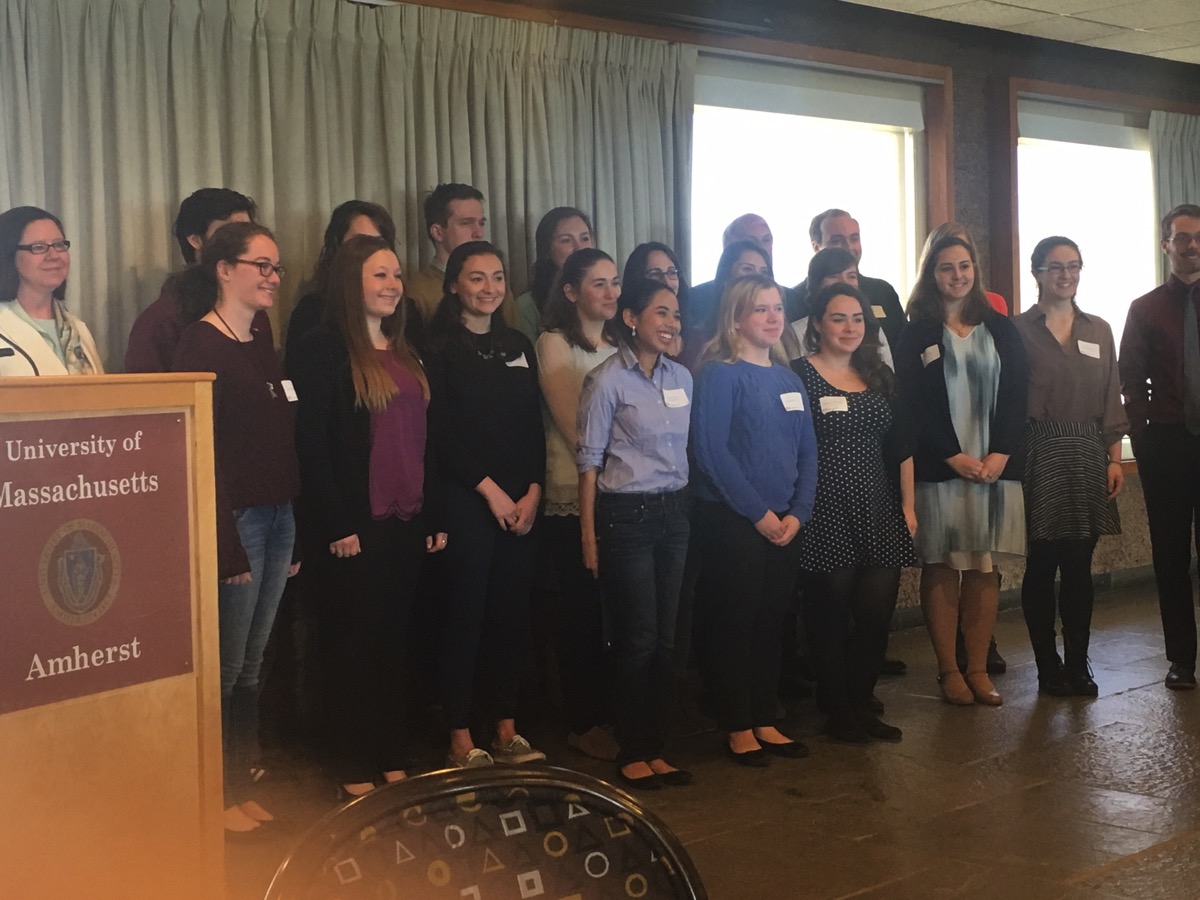
Linguistics majors Megan Shelb, Abigail Williams, Valerie Higgins and Joanna Nevins were awarded scholarships this year by the college of Humanities and Fine Arts. This Saturday, April 16, there was an awards brunch honoring these, and other, students. Below is a picture of all the honorees featuring Joanna and Megan at the far left of the first row. Congratulations!

IMG 0566

Call for papers: Situations, Information, and Semantic Content

Full Title: Situations, Information, and Semantic Content 

Date: 16-Dec-2016 - 18-Dec-2016 

Location: Munich, Bavaria, Germany Contact Person: Kristina

Web Site: http://www.situatedcontent2016.philosophie.uni-muenchen.de 

Call Deadline: 29-May-2016

Backgrounds, Aim, and Scope: 

The semantic content of natural language is multiply situated: Whether an utterance receives one interpretation or another depends on the discourse situation (in which the utterance takes place), on the target situation (which is described by the utterance), and on the interpreting agents' informational situation (which also contains the agents' background knowledge). Over the past decades, work on extralinguistic context-dependence has focused on discourse situations and target situations, and has paid less attention to the dependence of interpretation on the agents' informational situation. However, this kind of information-dependence plays a crucial role in the explanation of a number of semantic phenomena, including the behavior of epistemic/deontic modals and propositional attitude-sentences. Recent research in situated cognition has suggested an even more general scope of semantic information-dependence. The latter assumes that cognition (and therefore, all linguistic understanding) is fundamentally embedded in the situational context of the cognition. 
This workshop aims to bring together linguists, philosophers, logicians, and cognitive and computer scientists to discuss the information-dependence of the semantic content of natural language. It covers all aspects of the interaction between situations, information, and semantic content -- both theoretical and experimental --, including 

- agents' information and semantic content 

- the scope of information-dependence in natural language 

- analyses of semantic phenomena featuring information-dependence 

- experiments on semantic information-dependence 

- the impact of agents' information on attitude attributions - semantic aspects of situated cognition 

- situation theory and situation semantics 

- data semantics and dynamic/update semantics 

- (partial) information and situations 

- the formal analysis of (informational) situations 

- the formal analysis of background knowledge 

- partiality of information - type-theoretic approaches to information 

Invited Speakers: 

- Robin Cooper (University of Gothenburg) 

- Nikola Kompa (Osnabrück University) 

- Roussanka Loukanova (Stockholm University) 

- Friedrike Moltmann (CNRS Paris, New York University) 

- Floris Roelofsen (University of Amsterdam/ILLC) 

- Markus Werning (Ruhr University Bochum) 

- Thomas Ede Zimmermann (Goethe University of Frankfurt) 

- more speakers to be confirmed 

UMass at UUSLAW

The University of Connecticut is hosting the Conn-Umass-Smith Language Acquisition Workshop (UUSLAW) today, April 17, and UMass is represented by Nadine Balbach who is giving the talk “ `Everyone but me’ — Children Acquiring the Different Notions of but in Quantified Sentences” and by Tracy Conner who is giving the talk “Acquiring Ellipsis."

Bhatt at UPenn

Rajesh Bhatt is giving an invited colloquium talk on April 14 at the University of Pennsylvania. The title of his talk, which reports on joint work with Vincent Homer, is “PPIs and Movement in Hindi-Urdu.” An abstract follows.

Typically, Positive Polarity Items (PPIs), e.g. `would rather', cannot be interpreted in the scope of a clausemate negation (barring rescuing or shielding) (Baker 1970, van der Wouden 1997, Szabolcsi 2004 a.o.):

1a. John would rather leave.

1b. *John wouldn't rather leave.

The scope of most of them is uniquely determined by their surface position. But PPI indefinites are special: they can surface undernegation and yet yield a grammatical sentence under a wide scope interpretation:

2. John didn't understand something.ok: SOME > NEG;*NEG > SOME

Here we address the question of the mechanism through which a   PPI ofthe `some' type  takes wide scope out of an anti-licensingconfiguration. One possibility is (covert) movement, another is mechanisms that allow indefinites to take (island-violating) ultra-wide scope such as choice functions (Reinhart 1997). The relevant configurations that have motivated choice functions for other languages can be set up for Hindi-Urdu too.

We can therefore assume that a device that generates wide-scope for indefinites without movement is available in Hindi-Urdu too. We show that in Hindi-Urdu at least,  this device is unable to salvage PPIs in the relevant configuration. Only good old fashioned overt movement does the needful. If we think of overt movement in Hindi-Urdu as being the analogue of covert movement elsewhere, then the Hindi-Urdu facts are an argument that it is movement, albeit covert, that salvages PP Is in English too, not alternative scope-shifting devices. We explore whether the conclusion from Hindi-Urdu does in fact extend to English.

Dillon at Northwestern

Brian Dillon gave a colloquium talk at Northwestern University on Friday, April 8. A title and abstract follow.

Grammatical illusions in sentence processing: At the interface of performance and competence

One question of interest for psycholinguists is the question of how closely real-time sentence processing routines align with grammatical knowledge: does the competence grammar directly constrain sentence comprehension, or does it play a secondary role, 'cleaning up' the results of a comprehension process driven by heuristic processes (e.g. Lewis & Phillips, 2015; Patson & Ferreira, 2007; Townsend & Bever, 2001)? Much experimental work has provided evidence for the view that the human sentence processor is fairly directly constrained by grammatical knowledge even at the earliest stages of analysis, suggesting a very tight link between grammatical knowledge and the sentence processor. However, a puzzle for this view is the observation that there are many apparently simple grammatical constraints, such as subject-verb agreement, that comprehenders seem unable to accurately apply during comprehension (e.g. Wagers, Lau & Phillips, 2009). Such 'grammatical illusions' have been accounted for by appealing to independently motivated aspects of the parser, such as an interference-prone working memory architecture (Phillips, Lau & Wagers, 2011; see also Frazier, 2015).

Research on grammatical illusions has generated a wealth of psycholinguistic data that bears on when, and how, grammatical constraints guide the analysis of linguistic input. Overall the data reveal a pattern of 'selective fallibility': some linguistic dependencies fall prey to grammatical illusions quite readily, others do not (Phillips et al, 2011). This leads to an important theoretical question which is the focus of my talk: when, and why, do comprehenders violate grammatical constraints during sentence comprehension? In this talk, I will review some of the work in this area, and discuss processing models that have been proposed to account for these processor-grammar divergences. I will then discuss two case studies from our group at UMass Amherst on the processing of reflexive binding dependencies (work with Shayne Sloggett) and the licensing of negative polarity items in comprehension (work with Jon Ander Mendia and Ethan Poole) that provide new insight into the factors that create grammatical illusions in comprehension. These studies suggest that some grammatical illusions actually have grammatical bases, reflecting 'subgrammatical' linguistic constraints. This study suggests that grammaticality illusions are no mere performance errors; instead, they are regular and predictable behavior that provides a unique window into normal grammatical mechanisms and normal processing mechanisms alike.

03 April 2016

Kathryn Davidson gives department colloq

Kathryn Davidson (Harvard) will give the department colloquium on Friday, April 8 at 3:30 in ILC N400. A title and abstract of her talk follow.

Title:
Combining imagistic and discrete components in a single proposition: The case of sign language classifier predicates

Abstract:
Classifier predicates in sign languages (also known as "depicting verbs") have both discrete and imagistic components: they participate fully in the grammar as verbs and involve categorical handshapes that agree with the subject, but also have an obligatory "gestural" component that psycholinguistic experiments have shown are interpreted in an analog and iconic way. Understanding how to treat these verbs in a formal semantic system is therefore a challenge. In this talk I will draw parallels with work on quotation and attitude reports to introduce an analysis of classifier predicates involving the notion of an iconic "demonstration of events". I will also present corpus data from bimodal (sign/speech) bilingual blended utterances that sheds light on the syntax/semantics of classifier predicates. Finally, I will discuss extensions of this analysis of classifier predicates to formal semantic analyses of gesture.

Saskia Ottschofski speaks at LARC

Saskia Ottschofski (University of Tübingen) will give a talk presenting work she is carrying out while visiting the University of Maryland at LARC this week. Her talk is entitled “Can acquisitional data give insights into the semantics of pronouns and definites?” LARC meets in ILC N451 at 12:20 Wednesday, April 6.

UMass at GLOW

The 39th annual meeting of the Generative Linguistics in the Old World is being hosted by the University of Göttingen April 5-8. UMass is represented by:

Sakshi Bhatia, Leland Kusmer and Ekaterina Vostrikova who are presenting the paper “Indirect interaction of person and number"

Ethan Poole who is presenting the paper “The locality of dependent case."

Jeremy Pasquereau who is presenting the paper “Overt movement of comparative quantifiers in European French."

alumnus Keir Moulton, with Nino Grillo, who is presenting the paper “Clausal determiners and long distance AGREE in Italian."

Jon Ander Mendia who is presenting the paper “Conventionalizing at least some determiners."

Stefan Keine, Jon Ander Mendia and Ethan Poole who are presenting the paper “It’s tough to reconstruct"

You can learn more about GLOW here.

UMass at phoNE

NYU is hosting phoNE this Saturday, April 9. UMass is represented by Deniz Ozyildiz and Alexei Nazarov who are giving talks. A complete schedule follows.

Saturday, April 9

11:30-12      Luca Iacaponi (Rutgers): Non-stringent markednessrelations: evidence from Consonant Harmony

12-12:30      Chris Geissler (Yale): Explaining Vowel Harmony in Lhasa Tibetan

12:30-1:30   lunch

1:30-2           Deniz Ozyildiz (UMass)

2-2:30           James Whang (NYU)

2:30-2:50      break

2:50-3:20       Juliet Stanton (MIT): Trigger deletion in Gurindji

3:20-3:50       Gašper Beguš (Harvard) Unnatural phenomena and gradient phonotactics

3:50-4:10       break

4:10-4:40       Shu-hao Shih (Rutgers)

4:40-5:10       Alexei Nazarov (UMass)

5:10-5:30       break

5:30-6            Erin Olsen (MIT)

6                business meeting

The conference takes place on the first floor of the Linguistics Department, which is at 10 Washington Place in Manhattan.

LinguistList Fund Drive!

Barbara Partee writes:

The Linguist List fund drive for 2016 has begun.

http://funddrive.linguistlist.org/         

Linguist List has great value for everyone, but it's easy to take it for granted, like Wikipedia (which also needs support.) The second "Linguist of the Day" this year is Gary Holton (http://funddrive.linguistlist.org/linguists/) of the University of Alaska, one of whose main specializations is language documentation. He tells on his post there how crucial Linguist List has been in getting the linguistic community together to develop best practices for fieldwork, documentation, archiving, etc, often in cooperation with NSF and other entities. There's one good reason right there.     

Linguist List also revolutionized the whole business of job postings and job searches. We used to have to submit a job description to a print journal and/or the LSA Bulletin and/or some MLA publication, I forget what, with a tight deadlines followed by a long wait before the announcement appeared, and it was all very cumbersome and awkward.     

And of course the calls for papers for conferences etc -- now they reach linguists everywhere, getting rid of the unintentional but inevitable discrimination that resulted from the fact that conference organizers were dependent on the mailing lists they had, and those often didn't reach many independent scholars or scholars at small schools or scholars abroad. Now if you have access to internet you have access to all that information, thanks to the fact that Linguist List is the recognized clearing house that everyone will send their conference information to.   

And on an on -- Linguist List is probably of value to you in more ways than you've ever realized, especially if you're of a young enough generation that it has always been there, as far as you've been aware.     

They've been through a labor-intensive transition period the last couple of years, changing leadership as Helen Aristar-Dry and Anthony Aristar retired and Damir and Malgorzata Cavar took the helm, and the whole operation moved from Eastern Michigan University to the University of Indiana. They had to skip the fund drive the first year of the transition because they had no time or staff to mount one. They did have one last year and were moderately successful. But they really really need our help this year. All the funds that are raised go to supporting graduate students who help keep Linguist List running. The goal this year is $79,000, and they really need to reach it.     

As usual, there are various challenges. Right now, with things just starting up, UMass Amherst happens to be tied for third in the university challenge -- but that could change fast, since we're third at a total of $300 with just 2 donors. (http://funddrive.linguistlist.org/university/) But if lots of us would jump in quick with whatever gift we can afford, I hope we can at least stay in a good respectable top 10% or so.     

http://funddrive.linguistlist.org/donate/

Call for papers: DSALT

DSALT: Distributional Semantics and Linguistic Theory

ESSLLI 2016 Workshop

15-19 August 2016, Bolzano, Italy

* Two-page abstract submission deadline: April 7 2016 *

URL: http://esslli2016.unibz.it/?page_id=256

WORKSHOP DESCRIPTION

The DSALT workshop seeks to foster discussion at the intersection of distributional semantics and various subfields of theoretical linguistics, with the goal of boosting the impact of distributional semantics on linguistic research beyond lexical semantic phenomena, as well as broadening the empirical basis and theoretical tools used in linguistics. We welcome contributions regarding the theoretical interpretation  of distributional vector spaces and/or their application to theoretical morphology, syntax, semantics, discourse, dialogue, and any other subfield of linguistics. Potential topics of interest include, among others:

* distributional semantics and morphology: How do results in the distributional semantics-morphology interface impact theoretical accounts of morphology? Can distributional models account for inflectional morphology? Can they shed light on phenomena like productivity and regularity?

* distributional semantics and syntax: How can compositionality at the semantic level interact with syntactic structure? Can we go beyond the state of the art in accounting for the syntax-semantics interface when it interacts with lexical semantics? How can distributional accounts for gradable syntactic phenomena, e.g. selectional preferences or argument alternations, be integrated into theoretical linguistic accounts?

* distributional semantics and formal semantics: How can distributional representations be related to the traditional components of a semantics for natural languages, especially reference and truth? Can distributional models be integrated with discourse- or dialogue-oriented semantic theories like file change semantics or inquisitive semantics?

* distributional semantics and discourse: Distributional semantics has shown to be able to model some aspects of discourse coherence at a global level (Landauer and Dumais 1997, a.o.); can it also help with other discourse-related phenomena, such as the choice of discourse particles, nominal and verbal anaphora, or the form of referring expressions as discourse unfolds?

* distributional semantics and dialogue: Distributional semantics has traditionally been mostly static, in the sense that it creates a semantic representation for a word once and for all. Can it be made dynamic so it can help model, for example, phenomena related to Questions Under Discussion (QUDs) in dialogue? Can distributional representations help predict the relations between utterance units in dialogue?

* distributional semantics and pragmatics: Distributional semantics is based on the statistics of language use, and therefore should include information related to pragmatics of language. How do distributional models relate to such aspects of pragmatics as focus, pragmatic presupposition, or conversational implicature?

SUBMISSIONS

We solicit two-page (plus references) abstracts in at most 11pt font. No proceedings will be published, so workshop submissions may discuss published work (as well as unpublished work). The abstract submission deadline is April 7, 2016. Submissions are accepted by email at dsalt2016@gmail.com.

IMPORTANT DATES

Deadline for abstract submission: April 7 2016
Author notification: May 15 2016
Workshop dates: August 15-19 2016

Alice Harris on the road

Alice Harris is giving a talk entitled “Origins of Metathesis in Batsbi, Part II: Intransitive Verbs” at the Sixteenth Spring Workshop on Theory and Method in Linguistic Reconstruction, which meets in Ann Arbor April 1-3. And on April 4th, she’ll be giving a colloquium talk at the University of California Berkeley entitled “Affix Order, Multiple Exponence, and Morphological Reconstruction."

Vernon Valiquette at Luthier's Coop

“Vernon Valiquette” will be playing a short set of Iggy and the Stooges songs with the Electric Eyes from 4:30 - 5 at the Luthier’s Co-op, Easthampton on Saturday April 9th. They are closing a panel discussion that starts at 3 in which music scholars Chris O'Leary and Steve Waksman are speaking on Iggy Pop's music and his influences. This event is part of the  Easthampton Book Fair http://www.easthamptoncityarts.com/bookfest. 

27 March 2016

Raffaella Zanuttini gives Freeman Lecture

Raffaella Zanuttini (Yale University) will give the Freeman Lecture this year on Friday, April 1 in room S211 of the Integrative Learning Center at 3:30. Her talk, “Discovering Grammatical Diversity in American English” is based on the research carried out by the Yale Grammatical Diversity Project which she founded. You can learn more about the Project here.

Dillon at MIT tomorrow

Brian Dillon will give a talk at MIT tomorrow, Monday March 28, at 1PM. The title of his talk is “Which noun phrases is this verb supposed to agree with... and when?” The abstract follows.


The study of agreement constraints has yielded much insight into the organization of grammatical knowledge, within and across languages. In a parallel fashion, the study of agreement production and comprehension have provided key data in the development of theories of language production and comprehension. In this talk I present work at the intersection of these two research traditions. I present the results of experimental research (joint work with Adrian Staub, Charles Clifton Jr, and Josh Levy) that suggests that the grammar of many American English speakers is variable: in certain syntactic configurations, more than one NP is permitted to control agreement (Kimball & Aissen, 1971). However, our work suggests that this variability is not random, and in particular, optional agreement processes are constrained by the nature of the parser. We propose that variable agreement choices arise in part as a function of how the parser stores syntactic material in working memory d uring the incremental production of syntactic structures.

Kingston at Yale

John Kingston is presenting joint work with Amanda Rysling, Alexandra Jesse and Robert Moura at the Yale Linguistics Colloquium tomorrow, Monday March 28. The title of his talk is “Order matters in parsing coarticulation."

Covadonga Sánchez speaks at LARC on Wednesday

Covadonga Sánchez from the Spanish linguistics unit of LLC will give the talk “The realization of subject focus in L2 Spanish: Results from a Pilot Study” in LARC this Wednesday, March 30, at 12:20 in ILC N451.

Terrell Morgan speaks in Hispanic Linguistics talk series

The Hispanic Linguistics Talk series features Terrell Morgan (Ohio State University) on Friday, April 1 at 3PM in Herter 601. The title of his talk is “Cultura fonológica: Expanding the notion of `phonological competence’ in second language acquisition.” 

Professor Morgan is also giving a workshop on Saturday April 2nd at the UMass Center at Springfield, which is designed for high school and middle school teachers of Spanish. His talk is from 10 to 1 in room 014 at the Springfield UMass Center. For a description, and to register for tickets, go here.

Summer Dissertation Writing Retreats

John McCarthy writes:

I am writing to draw your attention to the dissertation writing retreats that will be offered this summer under the joint sponsorship of the Graduate School’s Office of Professional Development and the University Writing Center. These week-long workshops offer extensive structured time to write, receive feedback, and develop effective writing strategies.
 
Doctoral students who have already begun writing or who will be ready to begin writing by summer are welcome to apply. Two workshops are currently being planned:

June 6-10, 2016 from 9am-4pm
June 20-24, 2016 from 9am-4pm
 
This is the third summer in which we have offered these workshops, and the benefits – writing blocks overcome, chapters finished, dissertations defended – demonstrate the effectiveness of this approach. These workshops offer more than just a quiet place to write; they also provide expert guidance in the process of writing and how to increase productivity.
 
Please apply by April 19, 2016. You can find additional information and links to the application form here: http://bit.ly/2016Flyer
 
There is, of course, no charge to participants, and the Graduate School provides childcare scholarships of up to $150 to participants who need them.

Tracking the Human Mind

Angelika Kratzer writes:

You are all cordially invited to a symposium featuring some of the fellows of the 2015/2016 SIAS (Some Institutes for Advanced Study) Summer Institute. The topic of the symposium is: 

Tracking the Human Mind in Attitude and Speech Reports

Saturday, April 16, 10:00 AM to 1:00 PM. Integrative Learning Center N400. The symposium will be followed by a reception.

 A detailed program will follow. 

Being one of the most interdisciplinary working groups of the 2015/2016 SIAS Summer Institute, the group on Attitude Ascriptions & Speech Reports, designed two projects that promise to make a positive contribution to the longstanding communication problem between neuroscience and linguistic research. In her dissertation, the neuroscientist in the group, Jorie Koster-Hale, found that epistemic properties of other people’s beliefs are represented via response patterns of neural populations in canonical belief ascription regions in the brain (so-called ‘Theory of Mind’ regions). These properties relate to the kind of evidence that ground a belief: whether it was good evidence or not, or whether it was visual or auditory evidence. Those kinds of properties do not only play a major role in philosophical discussions of knowledge ascriptions, they are also grammaticalized in verbal inflectional paradigms in many lesser-known languages (so-called “evidentials”). In addition, they trigger a significant dichotomy in the class of attitude verbs across languages: verbs in the believe family (believe that, suspect that, conjecture that) can be used to report false beliefs, while verbs in the know family (know that, discover that, reveal that, hear that, see that) cannot - those ‘factive’ verbs can only describe attitudes that are properly connected to reality. The SIAS Attitude Ascription and Speech Report group recognized those fascinating connections and found a common language to construct  joint projects that will bring together their collective expertise in neuroscience, cognitive development, language acquisition, epistemology, theoretical linguistics and semantic typology under headings like ‘factivity/veridicality’ and ‘knowledge first’.  Projects of this kind could become models for collaboration between researchers in the sciences and the humanities.

More info about the 2015/2016 SIAS Summer Institute: http://nationalhumanitiescenter.org/sias/index.htm

Jason Overfelt goes to Minneapolis

WHISC is pleased to announce that Jason Overfelt has accepted a one year Assistant Professor position at the University of Minnesota at Minneapolis. He will start there in Fall 2016.

The Fourteenth Annual New York St. Petersburg Institute

St. Petersburg State University is hosting the fourteenth annual New York St. Petersburg Institute of Linguistics, Cognition and Culture from July 11 to July 29 this summer. Stony Brook University is the coordinating institute. 

The Institute is open to advanced undergraduate and graduate students from all backgrounds and countries interested in comparative and formal approaches to theoretical linguistics and cognition as well as cultural and media studies. Minimum Education Level: Current Undergraduate (Grads welcome as well) 

Description: 

Participants create their own study program from seminars in the following fields: 

- Generative Linguistics (Syntax, Semantics, Phonology, Morphology) 

- Cognitive Science (Cognitive Psychology, Musical Cognition) 

- Cultural Studies (Critical Cultural Studies, Women’s & Gender Studies, Islamic & Religious Studies, Film & Media Studies,…)

2016 Linguistics/Cognitive Studies Faculty: 

- John F. Bailyn (Stony Brook University) 

- Miloje Despić (Cornell University) 

- Sabine Iatridou (Massachusetts Institute of Technology) 

- Roumyana Pancheva (University of Southern California) 

- Maria Polinsky (University of Maryland) 

- Irina Sekerina (CUNY Graduate Center) 

- Sergei Tatevosov (Moscow State University) 

- Marc van Oostendorp (University Leiden) 

- Susi Wurmbrand (University of Connecticut) 

More information can be found here:

http://linguistlist.org/issues/27/27-1339.html

DGfS 2016 Summer School

Tübingen University is hosting the German Linguistic Society's (DGfS) summer this August. Daniel Altshuler (Hampshire College) will be offering a course on temporal interpretation of narrative discourse and our own Lyn Frazier will be offering a course on processing at the syntax-discourse interface. You can learn more here.

20 March 2016

Amy Rose Deal gives department colloquium

Amy Rose Deal (UC, Berkeley) will give the department colloquium on Friday, March 25 at 3:30 in ILC N400. A title and abstract of her talk follow.

Title:

Shifty asymmetries: toward universals and variation in shifty indexicality

Abstract:

Indexical shift is a phenomenon whereby indexicals embedded in speech and attitude reports depend for their reference on the speech/attitude report, rather than on the overall utterance. For example, in a language with indexical shift, "I" may refer to Bob in a sentence like "Who did Bob think I saw?". The last 15 years have seen an explosive growth in research on indexical shift cross-linguistically. In this talk, I discuss three major generalizations that emerge from this work, and present a theory that attempts to explain them. The account that I develop concerns the syntax of indexical shift along with its semantics, and has consequences for the linguistic encoding of attitudes de se. Throughout the talk I will exemplify indexical shift primarily, though by no means exclusively, with data from original fieldwork on Nez Perce.

Bernhard Angele at Cognitive Brown Bag

Bernhard Angele of Bournemouth University (UK) will give the Brown Bag presentation on Wednesday March 23 from 12-1:20 in Tobin 521B. A title and abstract of his talk follows.

Title:

They’re onto us! The phenomenon of participants detecting display changes and what it can tell us about the reading process

Abstract:

In the boundary change paradigm (Rayner, 1975), when a reader's eyes cross an invisible boundary location, a preview word is replaced by a target word. Readers are generally unaware of such changes due to saccadic suppression. However, some readers detect changes on a few trials and a small percentage of them detect many changes. I will present three experiments which combined eye movement data with signal detection analyses to investigate display change detection. On each trial, readers had to indicate if they saw a display change in addition to reading for meaning. On half the trials the display change occurred during the saccade (immediate condition); on the other half, it was slowed by 15–25 ms (delay condition) to increase the likelihood that achange would be detected; we also manipulated the properties of the parafoveal preview word. Using this new paradigm, we found that subjects were (1) highly sensitive to display change delays, and (2) more sensitive to display changes which involved a change of letter identity (e.g. jNxVa to gReEn) than to display changes which involved a change of visual features, but kept letter identity constant (e.g. gReEn to GrEeN). Finally, (3) subjects were significantly more sensitive to display changes when the change was from a non-wordlike preview (xbtchp to garden) than when the change was from a wordlike preview (puvtur to garden), but the preview benefit effect on the target word was not affected by whether the preview was wordlike or non-wordlike. Additionally, we did not find any influence of pre-boundary wordfrequency on display change detection performance. Our results suggest that display change detection and lexical processing do not use the same cognitive mechanisms. We propose that parafoveal processing takes place in two stages: an early, orthography-based, pre-attentional stage, and a late, attention-dependent lexical access stage.

Post-baccalaureate research positions at University of Maryland

The Department of Linguistics at the University of Maryland, is looking to fill up to four full-time positions for post-baccalaureate researchers. 

Starting date for all positions is Summer/Fall 2016. Salary is competitive, with benefits included. The positions would be ideal for individuals with a BA degree who are interested in gaining significant research experience in a very active research group as preparation for a research career. Applicants must already have permission to work in the US, or be a Canadian citizen or permanent resident, and should have completed a BA or BS degree by the time of appointment. The ability to interact comfortably with a wide variety of people (and machines) is a distinct advantage. Applicants may request to be considered for all four positions. 

The positions are open until filled. For best consideration, applications should be submitted by April 1st, 2016. However, review of applications will begin immediately.

 
Positions #1–#2: Baggett Research Fellowships

Baggett Fellowships are full-time positions. Fellows can pursue research in linguistics, cognitive (neuro-)science of language, language acquisition, or computational modeling. 1–2 positions are available for 2016-2017. Positions are for one year and are not renewable.Contact: Dr. Andrea Zukowski (zukowski -at- umd -dot- edu) Application requirements

Further details on just the Baggett positions


Position #3: Research Assistant in Psycholinguistics/Cognitive Neuroscience

This person will be involved in all aspects of studies of language comprehension using behavioral and neuroscientific techniques, including electrophysiological brain recordings (training provided). The person will also contribute to Maryland's Language Science program. Previous experience in (psycho)linguistics preferred. 1 year initial appointment, possibility of extension.Contact: Dr. Colin Phillips (colin -at- umd -dot- edu) Application requirements

Position #4: Research Assistant in Syntax and Morphology

This person will be involved in all aspects of syntactic analysis of several languages, some of which are new to the study of linguistics, using methods of morpho-syntactic analysis and corpus construction (training provided). The person will also assist in bibliographical research and website construction.The person will also contribute to Maryland's Language Science program. Previous experience in linguistics preferred. 1 year initial appointment, possibility of extension.Contact: Dr. Maria Polinsky (mpolinsky -at- gmail -dot- com)  Application Requirements

Call for papers: Sinn und Bedeutung

Sinn und Bedeutung 21 will take place in Edinburgh, from Sun 4th-Tues 6th September 2016.

Confirmed invited speakers:

-Sigrid Beck (Eberhard Karls Universität Tübingen)

- Paul Elbourne (Magdalen College, Oxford)

We invite abstract submissions for oral presentations or posters, devoted to natural language semantics, pragmatics, philosophy of language, and psycholinguistic investigations related to meaning. Oral presentations will be scheduled for 40 minute slots (30 minutes talk + 10 minutes discussion).

Abstracts should contain original research that, at the time of submission, has neither been published nor accepted for publication. One person can submit at most one abstract as sole author and one abstract as co-author (or two co-authored abstracts).

Abstracts must be anonymous, in PDF format, 2 pages (A4 or letter), in a font size no less than 12pt, and with margins of 1 inch/2.5cm. Please submit abstracts via EasyChair (see link below) no later than March 31, 2016.

Abstracts should be submitted via EasyChair, using the following link:
https://easychair.org/conferences/?conf=sub21

For further information, please contact Rob Truswell (rob.truswell@ed.ac.uk).

Call for papers: IATL

We are pleased to announce the 32nd annual conference of the Israel Association for Theoretical Linguistics (IATL), which will take place at the Language, Logic and Cognition Center at the Hebrew University of Jerusalem, October 25-27, 2016. The conference will consist of a general session as well as a special session on experimental and historical approaches to semantics.

General Session:

We invite submissions of abstracts for 30 minute presentations of previously unpublished research in all areas of theoretical linguistics.

Special Session – Experimental and historical approaches to semantics:

Research into issues in natural language semantics from experimental, on the one hand, and historical perspective, on the other hand, has been gaining in prominence in recent years, not least because it provides new ways of evaluating extant linguistic hypotheses as well as impetus for the development of new ones. We invite submissions of abstracts on experimental and historical studies that will expand the empirical domain of, and be informed by, formal semantic theory.

Invited Speakers:

Cleo Condoravdi (Stanford)

Uli Sauerland (ZAS)

Abstract Submission Guidelines:

Abstracts should be no longer than two pages, including examples and references. Page format: A4, 2,54cm (one inch) margins on all sides, 12-point font, single line spacing. Submissions are restricted to at most one single-authored and one co-authored abstract.

Please submit abstracts to the IATL EasyChair site:
https://easychair.org/conferences/?conf=iatl32

Please register at the site as an author, and when you receive a password, you can enter the site and submit your abstract. The abstract should be submitted in PDF format through the 'Upload Paper' section near the bottom of the page. (Note: Higher up on the page, in the 'Title and Abstract' section, there is a box for a plain-text abstract. Since we do not require a shorter abstract, you may simply retype the title of the paper in the abstract box and the intended session.) When submitting your abstract, please indicate on the top of the abstract whether you intend your paper to be considered for the general session or the special session (or both) (say, in parentheses following the title).

Deadline: March 31, 2016

Important Dates:
March 31, 2016: Abstract submission deadline

Late May, 2016: Notification of acceptance to authors

October 25-27, 2016: IATL 32 Conference

IATL 32 web site: http://www.iatl.org.il/?page_id=970

If you have questions or encounter any problems, please contact Elitzur Bar-Asher Siegal ebas@mail.huji.ac.il or Luka Crnic luka.crnic@mail.huji.ac.il.

Call for papers: NISM 2016

NISM 2016: New Ideas in Semantics and Modeling 

Paris, September 7-8 2016

http://nism2016.sciencesconf.org/

We are very pleased to announce the first edition of the new series New Ideas in Semantics and Modeling 2016 (NISM2016), which will take place in Paris, September 7 and 8, 2016.

The conferences New Ideas in Semantics and Modeling resume the Journées de Sémantique et Modélisation (JSM 2003-2010), targeting the renewed community in Formal Semantics and Pragmatics. Papers from any theoretical framework are welcome, granted that new empirical data are clearly complemented with a formal analysis.

This year, the conference will feature a thematic session on definites, indefinites, demonstratives and referential terms, in honor of Francis Corblin, founder of the JSM.

Talks will be 35 minutes, followed by 10 minutes for discussion.

In addition to the general session, submissions are also invited for the special session on definites, indefinites, demonstratives and referential terms.The conference will also feature a poster session.

Invited Speakers

Elizabeth Coppock (Gothenburg University & Swedish Collegium for Advanced Study)

Henriette de Swart (Utrecht University)

Paul Portner (Georgetown University)

François Recanati (Institut Jean-Nicod, ENS-EHESS-CNRS)

Abstract submission:

Papers in formal semantics and pragmatics are welcome. Experimental papers are welcome, granted that they provide a formal analysis of the data.

Abstracts (neither submitted nor published elsewhere) are limited to two per author, with at most one paper being single-authored.
Abstracts, including references and data, should be limited to two single spaced pages (A4 or US Letter) with one inch margins, minimum font size 12pt (Times New Roman). They must be in PDF format. Examples should be interspersed throughout the text.
Abstracts can be submitted in English or French, but the language of the conference will be English.

Anonymous abstracts must be submitted online at http://nism2016.sciencesconf.org, by March 31, 2016.

Abstracts will be triply blind-reviewed.

Proceedings:
We plan to publish the proceedings of the conference.

Organizers

Claire Beyssade (Structures Formelles du Langage, Paris 8 University)

Alda Mari (Institut Jean-Nicod, ENS-EHESS-CNRS)

David Nicolas (Institut Jean-Nicod, ENS-EHESS-CNRS)

Schedule:
Deadline for abstract submission: March 31, 2016

Notification of acceptance: May 31, 2016

Conference : 7-8 September 2016

Computational Phonology position at NYU

VISITING ASSISTANT PROFESSOR OF COMPUTATIONAL PHONOLOGY

Department of Linguistics

Graduate School of Arts and Science

New York University

The Department of Linguistics at New York University invites applications for a one-year visiting assistant professor position in computational phonology, beginning September 1, 2016 (pending administrative and budgetary approval). Applicants should have a strong research record and a demonstrated ability to teach. We seek outstanding scholars who employ computational methods in investigating phonological questions, phonological learning, and/or the psycholinguistics of speech processing or perception. Responsibilities include teaching undergraduate and graduate courses, and supervising student research.

Applicants should submit an application including a description of their research program; a teaching statement; curriculum vitae; three references; and work samples. Linguists that work on endangered languages and/or under-researched languages are encouraged to apply.

An application is "complete" as soon as all required documents have been uploaded and the required number of referees have been identified. Note that files can still be updated even after an application is complete.Review of application materials will begin on April 1, 2016, and any recommendation letters received by April 15, 2016, will receive full consideration.

https://www.nyuopsearch.com/applicants/jsp/shared/position/JobDetails_css.jsp

For further information about this position, please contact Professor Chris Barker (chris.barker@nyu.edu).

UMass at PLC 40

The University of Pennsylvania hosted the 40th meeting of the Penn Linguistics Conference this weekend. UMass was represented by:

Alumna Gillian Gallagher, who gave the invited talk “Categorical Phonotactics and Language Universals"

Alumnus Martin Walkow, who gave the poster “Syntactic Parallels between Verbal and Nominal phi-Morphology in (Classical) Arabic."

Alumna Anne-Michelle Tessier who gave the talk “Weigh(t)ing the Evidence: Avoidance and Constraint Interaction in Phonological Development."

and 

Brian Dillon, who gave the Keynote Address: “Grammatical Illusions in sentence processing: At the interface of performance and competence."

You can learn more here.

13 March 2016

Conditionals

http://xkcd.com/1652/

ACAL 47

The 47th Annual Conference on African Linguistics is being hosted by the University of California, Berkeley on March 23-26. UMass is represented by:

Rodica Ivan and Deniz Ozyildiz who are giving the paper “The Somali microscope: pronouns, determiners and possession.” (Their abstract is here,)

William Bennett, Kristine Yu and alumnus Wendell Kimper with Christopher Green who are giving the paper “Acoustic correlates of harmonic classes in Somali."

Alumna Rose-Marie Déchaine, who is giving the paper “Shona root classes: implications for the lexicon and beyond,” and, with Herman Keupdjio, “Compound pronouns in Bamileke Medumba"

Lisa Selkirk who is giving the paper “Edge-sensitivity in Bantu sentence topology: Luganda, Xitsonga, Bemba"

Leland Kusmer who is giving the paper “Prosody and the conjoint/disjoint alternation in Tshivenda"

Alumna Meredith Landman who is giving the paper “Quantification in Kipsigis"

Alumnus Ken Safir gives the paper “Actual clauses in Lubukusu and what they mean for a symmetric theory of clausal complementation."

You can learn more about the conference here.

Julianne Chaloux gets internship in the SCALE workshop

Former Linguistics RA Julianne Chaloux has been offered a summer internship position in the annual SCALE workshop hosted by Johns Hopkins University's Human Language Technology Center Of Excellence. Congratulations, Julianne!

Berezovskaya at MIT

UMass visitor Polina Berezovskaya will present “ `Small Degrees’: Degree Modification in Nenets” at the MIT LingLunch on March 17th.

Chomsky in Las Vegas

http://www.theonion.com/article/noam-chomsky-announces-las-vegas-residency-52508

TESOL Teacher Training course this summer at Hampshire

TESOL Teacher Training Course
Summer 2016 @ Hampshire College JUNE 6—July 1, 2016
tesol.hampshire.edu [2]

Teaching ESL/EFL (English as a Second Language/English as a Foreign Language) has become a growing field as cultures and economies globalize. The ultimate goal of this course is for participants to be prepared for actual teaching situations and be confident as TESOL instructors/tutors. Acquiring a TESOL certificate can lead to teaching opportunities around the world.

Now in its fourth year, the TESOL TEACHER TRAINING COURSE AT HAMPSHIRE COLLEGE is a proven training ground for students and professionals interested in global education. Through the course, you'll develop a philosophy of teaching values and practices, learn from peer teaching and peer feedback, plan lessons and other teaching materials, and practice action research skills to understand what goes on in the foreign language classroom. Our practice-based approach is grounded in a comprehensive overview of the history of methods for Teaching English to Speakers of Other Languages, along with a critical examination of the underlying principles of these methodologies.

TUITION AND FEES
Tuition: $2,500
Room: $904

MEALS
Participants can chose to purchase meals daily in our dining commons
and/or chose to prepare their own meals in their condo-style living
quarters.

APPLY NOW! Applications are accepted on a rolling basis

IMPORTANT DATES TO REMEMBER
April 3 / Priority Deadline for all applications
April 11 / Tuition Discount Deadline (all payments must be received in
order to receive 15% tuition discount)
May 1 / Application Deadline (application materials must be submitted)
May 15 /  Payment Deadline (all payments must be submitted)

QUESTIONS? Email tesol@hampshire.edu

Why you should make UMass your destination abroad

An article about UMass by visiting student Alberto Moron Hernandez has appeared in Manchet — the newsletter of the Department of Linguistics and English at the University of Manchester.

SALT 26 program announced

The University of Texas at Austin, who is hosting the Twenty-Sixth meeting of Semantics and Linguistics Theory in early May, has just released the program and UMass is well-represented:

Alumnus Florian Schwarz, with Jérémy Zehr, Cory Bill, Lyn Tieu and Jacopo Romoli will present the paper “Presupposition projection from the scope of `none’: universal, existential, or both?"

Alumnus Chris Davis who, with Eric McCready, will present the paper “Expressives and Alternatives"

Alumnus Luis Alonso-Ovalle is presenting the paper “Are All Concessive Scalar Particles the Same? Probing into Spanish “Siquiera."

Jon Ander Mendia will present the paper “Reasoning with Partial Orders."

Alumna Suzi Lima will present the paper “On object denoting nouns: defining atoms"

Alumnus Kyle Rawlins, with Aaron Steven White, will present the paper “A computational model of S-selection” and, with Justin Bledin, the paper “Epistemic resistance moves."

For more information, go here.

Call for papers: ESSLLI

*ESSLLI 2016 STUDENT SESSION*

Held during the 28th European Summer School in Logic, Language and Information

Bolzano, Italy, August 15-26, 2016

*EXTENDED Deadline for submissions: March 15th, 2016*
https://easychair.org/conferences/?conf=essllistus2016

*ABOUT:*
The Student Session of the 28th European Summer School in Logic, Language, and Information (ESSLLI) will take place in Bolzano, Italy, August 15th to 26th (http://esslli2016.unibz.it). We invite submissions of original, unpublished work from students in any area at the intersection of Logic & Language, Language & Computation, or Logic & Computation. Submissions will be reviewed by several experts in the field, and accepted papers will be presented orally or as posters and selected papers will appear in the Student Session proceedings by Springer. This is an excellent opportunity to receive valuable feedback from expert readers and to present your work to a diverse audience.

*ORAL/POSTER PRESENTATIONS:*
Note that there are two separate kinds of submissions, one for oral presentations and one for posters. This means that papers are directly submitted either as oral presentations or as poster presentations.
Reviewing and ranking will be done separately. We particularly encourage submissions for posters, as they offer an excellent opportunity to present smaller research projects and research in progress.

*SUBMISSION GUIDELINES:*
Authors must be students, and submissions may be singly or jointly authored. Each author may submit at most one single and one jointly authored contribution. Submissions should not be longer than 8 pages for an oral presentation or 4 pages for a poster presentation (including examples and references). Submissions must be anonymous, without any identifying information. More detailed guidelines regarding submission can be found on the Student Session website:
http://www2.sfs.uni-tuebingen.de/esslli-stus-2016/.

*SPONSORSHIP AND PRIZES*
As in previous years, Springer has kindly agreed to sponsor the ESSLLI student session. The best poster and best talk will be awarded Springer book vouchers of 500€ each.

*FURTHER INFORMATION:*
Please direct inquiries about submission procedures or other matters relating to the Student Session to marisa.koellner@uni-tuebingen.de and rziai@sfs.uni-tuebingen.de.

ESSLLI 2016 will feature a wide range of foundational and advanced courses and workshops in all areas of Logic, Language, and Computation. For further information, including registration information and course listings, and for general inquiries about ESSLLI 2016, please consult the main ESSLLI 2016 page: http://esslli2016.unibz.it.

Frana gets the De Vincenzi prize

Ilaria Frana has received the Marica De Vincenzi prize for best paper by an Italian researcher selected for IGG (Incontro Grammatica Generativa). The paper was “Mica as a Common Ground Management operator” (collaborative work with Kyle Rawlins). The prize is offered by “Fondazione Marica De Vincenzi Onlus”. WHISC as acquired the celebratory group picture from the event (from left to right: Nino Grillo, Francesca Foppolo, me and Carlo Gerace.)

12744168 10153246655692665 7605204149560697763 n

EvoLang 2016

For the first time in 12 years the Evolution of Language (EvoLang) conference is taking place in the United States. There is still time to register, so don’t let this unique opportunity pass you by. EvoLang 2016 is organized by the University of Southern Mississippi and will take place March 21st-24th in New Orleans, LA at the Lavin-Bernick Center on the Tulane University campus. A wide variety of disciplines
will be represented, including: linguistics, psychology, anthropology, primatology, biology, animal behavior, and computer science. The conference opens with a variety of workshops and there is an opening night reception at Mardi Gras World with food and an open bar that is included in your registration. Some notable attendees include Simon Kirby, Tecumseh Fitch, and Terrence Deacon, as well as our plenary speakers. If you are interested in attending please visit our website http://www.usm.edu/gulfcoast/evolang-2016 to register and see the schedule of speakers. Make sure you sign up for the banquet at the Audubon Tea Room on Thursday night. There will be live music and amazing food. Registration is closing soon, so make sure to register ASAP.

06 March 2016

UMass hosts FASAL 6 this weekend

The Sixth meeting of Formal Approaches to South Asian Languages will meet March 12-13 at UMass. The talks are all held in ILC N400 and there is no registration fee. Everyone is welcome.

UMass is represented by:

Sakshi Bhatia and Ethan Poole who are giving the talk “Deriving subject and anti-subject orientation"

Alumna Amalia Gnanadesikan who will be presenting the poster “Coda-Onset Asymmetries in Dhivehi"

and

UMass visitor Konstantin Sachs who will be presenting the paper “A Movement Approach for Multi-Head Correlatives — Evidence from NPIs and Islands”

For more information, go here.

Tracy Conner in LARC on Wednesday

Tracy Conner will present her work in LARC on Wednesday, March 9, at 12:15 in ILC N458.

Daniel Altshuler at Semantics Seminar Journal Club

Angelika Kratzer writes:

Daniel Altshuler from Hampshire College will join the Semantics Seminar Journal Club this coming Wednesday (March 9) to facilitate discussion of the paper “On double access, cessation, and parentheticality”, which he co-authored with Valentine Hacquard, Thomas Roberts, and Aaron White. Everyone is welcome - you don’t have to be in the seminar, and you don’t have to be in the Journal Club. The Journal Club meets every Wednesday in N400 at 4:15 PM. You can download the paper here:

https://udrive.oit.umass.edu/kratzer/altshuler-et-al.pdf

Daniel will give a short presentation of the paper, but since it’s a Journal Club, the discussion will assume that everyone has looked at the paper in one way or other. 

NASSLI 2016

Kristen Syrett writes:

The North American Summer School for Logic, Language and Information 2016 is being hosted by Rutgers this July.  More information is available on the NASSLLI 2016 website, which we continue to update. The local organizing committee would like to spread the word that early bird registration is now in effect, until April 15. In addition, we are pleased to advertise information about the student scholarships and presentations during the student session. Please encourage your students to apply for either/both, and to attend NASSLLI. We have a great lineup of classes and instructors!

WHISC notes that those great instructors include Hampshire College faculty Daniel Altshuler and UMass alumni Kyle Rawlins and Craige Roberts.

Study Linguistics in St. Petersburg this summer

John Bailyn writes:

Study with world-class Linguists and Psychologists through the Linguistics Intensive track of Stony Brook’s “Explore St. Petersburg!” Study Abroad Program, which will be held this summer for the 14th year IN ST. PETERSBURG, RUSSIA. The dates are JULY 9 – AUGUST 7, 2016. More information can be found here: http://advancedrussian.org/

• Earn 3-6 credits
• Study together with students from other countries
• Research internships available
• No knowledge of Russian  required (all seminars in English)
• Mini-fellowships of $500 and $1000 available

APPLICATION DEADLINE IS MARCH 15, 2016!

*Late applications possible (until April 1) if space remains*

For information about how to apply, go here.

 NYI's lineup of Linguistics and Cognitive Psychology faculty for summer 2016 includes:

John F. Bailyn (Stony Brook) Musical Cognition, Syntax

MILOJE DESPIC (UConn) Syntax, Morphology

SABINE IATRIDOU (MIT) Syntax, Semantics

MARC VAN OOSTENDORP (Leiden) Phonology

ROUMYANA PANCHEVA (USC) Syntax, Semantics

MARIA POLINSKY (UMD) Experimental Syntax, Universals

IRINA SEKERINA (CUNY) Psycholinguistics,Cognitive Psychology

SERGEI TATEVOSOV (Moscow State) Formal Semantics

SUSI WURMBRAND (UConn) Syntax

Additionally, there will be Cultural studies and Women's and Gender studies faculty as well!

Robert Staubs goes to Mitre

Congratulations to Robert Staubs, who has been hired as a Senior Data Scientist by Mitre Corporation.

Pater on the road

Joe Pater presented "Learning in Typological Prediction: Grammatical Agent-Based Modeling” (joint work with Jennifer Culbertson, Coral Hughto and Robert Staubs) yesterday (March 5th) at the UNC Chapel Hill Spring Colloquium. He’ll be taking the talk on the road again Friday March 11th when he presents it in the University of Maryland Colloquium series.

Conner and Park get Dissertation Fellowships

Congratulations to Yang-Sook Park and Tracy Conner who have each been awarded a Summer 2016 Dissertation Fellowship. Congratulations!

NEST at UMass

UMass hosted the annual meeting of New England Sequencing and Timing yesterday, March 5. UMass was represented by the paper “Lexical knowledge is available, but not always used, very early,” by Amanda Rysling, John Kingston, Adrian Staub, Andrew Cohen, Jeffrey Starns and Anthony Yacovone. You can find a full schedule of events here.

Dillon, Staub, Levy and Clifton in Language

Dillon, Staub, Levy and Clifton's paper, "Which noun phrases is the verb supposed to agree with? Object agreement in American English", has been accepted for publication in Language. 

DEAFinitions at Hampshire

Hampshire College is hosting a Dear Studies Conference March 25-26. All talks are at Franklin Patterson Hall on the Hampshire College campus. Registration is obligatory, but appears to be free. You can learn more here.

Oxford Handbook of Developmental Linguistics

The Oxford Handbook of Developmental Linguistics edited by Jeff Lidz, William Snyder, and UMass faculty Joe Pater, will be appearing in May, and its cover and table of contents can now be seen on the OUP website.

https://global.oup.com/academic/product/the-oxford-handbook-of-developmental-linguistics-9780199601264?cc=us&lang=en&#

The volume contains chapters by UMass faculty Gaja Jarosz and Tom Roeper (co-authored with Jill de Villiers), and alumna Anne-Michelle Tessier.

28 February 2016

UMass at LabPhon 15

Two submissions from UMass Linguistics to Laboratory Phonology 15, to be held at Cornell University, 13-16 July 2016, have been accepted for presentation as posters:

Kevin Mullin: Phonotactically-mediated compensation for coarticulation

Amanda Rysling, John Kingston, Adrian Staub, Andrew Cohen and Jeffrey Starns: Lexical knowledge is available, but not always used, very early

Lisa Sanders, Claire Moore-Cantwell, Joe Pater, Robert Staubs and Benjamin Zobel: ERP evidence for the ecological validity of artificial language learning

Call for papers: Comparative Germanic Syntax Workshop

The 31st edition of the Comparative Germanic Syntax Workshop will be a historic one as this will be the first CGSW to be held in Africa. Stellenbosch University in South Africa’s beautiful Western Cape Province will be hosting this meeting, which will take place on 2-3 December 2016.

Invited Speakers

Roland Hinterhölzl (Venice)

Jason Merchant (Chicago)

Tarald Taraldsen (Tromsø)

Call for papers

We invite abstracts for thirty-minute talks (followed by ten minutes of discussion) on any aspect of comparative Germanic syntax, including diachronic syntax. Given the location of the conference, we are also very interested in research focusing on lesser studied Germanic varieties, particularly those that have developed and/or been used in contact situations, including “extraterritorial” varieties ofcontinental Germanic. Papers focusing on formal aspects of “non-standard” varieties and on phenomena like code-switching are also very welcome, as are papers considering how aspects of the structure of non-Germanic languages spoken in southern Africa (may) have impacted on the structure of Germanic languages spoken in this part ofthe world.

Abstract Guidelines

Abstracts should not exceed two pages, with 2.5cm margins on all sides and a font size of 12pt. This includes data, references and diagrams.

Each author may submit no more than one single-authored and one co-authored abstract, or two co-authored ones.

Abstracts must be anonymous and prospective presenters should submit their abstract in pdf to:
http://conferences.sun.ac.za/index.php/cgsw31/cgsw31/about/submissions#online

Submissions

The deadline for submission is 31 May 2016.

Notification of acceptance by 1 July 2016.

Further informationPlease feel free to visit the conference website at the following address:

http://conferences.sun.ac.za/cgsw31.

Here, you will (in due course) find information regarding CGSW 31 itself, a pre-CGSW31 workshop involving international researchers (seebelow), visa applications, travel, and accommodation.

For local (Stellenbosch-related) information, please contact Erin Pretorius: erink@sun.ac.za

For directly CGSW-related information, please contact Theresa Biberauer: mtb23@cam.ac.uk

29th CUNY conference on Psycholinguistics

The University of Florida Gainesville is hosting the Twenty Ninth meeting of the CUNY conference on Psycholinguistics March 3-5. UMass is represented by:

Lap-Ching Keung and Adrian Staub who are presenting the paper “Closest conjunct agreement in English: A comparison with number attraction."

Alumna Katy Carlson, with Benjamin Lee, Sarah Nelson and Blake Clark, is presenting the poster “Comparative ellipsis has an object bias, though subjects are more frequent."

Caroline Andrews and Brian Dillon are presenting the poster “Computation of Agreement is Verb-Centric Regardless of Word Order."

Alumni Jesse Harris and Katy Carlson are presenting the poster “Correlate not optional: PP sprouting in ‘much less’ ellipsis."

Alumnus Greg Carlson, with Thais M. M. de Sa, Maria Luiza Cunha Lima and Micheal Tanenhause present the poster “Experimental evidence that “weak definite” noun phrases are not interpreted as generics"

Jérémy Pasquereau and Brian Dillon are presenting the poster “Grammaticality illusions are conditioned by lexical item-specific grammatical properties."

Alumna Margaret Grant with Sonia Michniewicz and Jessica Rett present the poster “Incremental interpretation in cases of individual/degree polysemy"

Alumnus Jeff Runner, with Alyssa Ibarra, present the poster “Informational focus in Spanish pronoun resolution: answering the QUD"

Brian Dillon, with Akira Omaki and Zoe Ovans, present the poster “Intrusive reflexive binding inside a fronted wh-predicate."

Brian Dillon, Nicolleta Biondo and Francesco Vespignani present the poster “Structural Constraints strongly determine the attachment of termporal adverbs."

Adrian Staub, with Francesca Foppolo, Carlo Cecchetto, Caterina Donati and Vincenzo Moscati present the poster “Minding the gap: The parser avoids relative clause analyses whenever it can."

Alumnus Paul de Lacy, with Karin Stromswold and Gwendolyn Rehrig present the poster “Passive sentences can be predicted by adults."

Shayne Sloggett and Brian Dillon present the poster “Person blocking effects in the processing of English reflexives."

Alumna Margaret Grant with Kelly-Ann Blake and Frederick Gietz present the poster “Prediction and inhibition of syntactic structure: Evidence from either (of the)… or."

Alumnus Jeff Runner, with Yahang Xu, presents the poster “Reflexive Retrieval in Mandarin Chinese: Evidence against the local search hypothesis."

Alumnus Michael Terry and alumna Masako Hirotani, with Erik Thomas and Sandra Jackson present the poster “The processing of third person singular -s by African American English speaking second graders: an auditory ERP study."

Alumnus Keir Moulton, with Kyeong-min Kim and Chung-hye Han, present the poster “The syntax of null objects: evidence from inter-speaker variation."

For more information, go here.

21 February 2016

Cable at MIT

Seth Cable gave a colloquium talk at MIT last Friday, February 19. The title of his talk was: “The Curious Implicatures of Optional Past Tense in Tlingit (and other languages).” An abstract follows.

Some languages appear to have a morpheme that combines the meaning of past tense with a variety of additional implications, the nature of which depend upon the aspectual marking of the verb. For non-perfective verbs (imperfective, habitual, future,etc.), the additional implication is that the event/state in question fails to extend into the present. For perfective verbs, however, the additional implication is either that (i) the result state of the event fails to extend into the present, or (ii) some natural, expected consequence of the event failed to occur. Importantly, unlike the superficially similar ‘cessation implicatures’ of past tense in languages like English, these aforementioned implications cannot be directly cancelled. Consequently, prior authors have viewed these additional inferences as semantic in nature, as being encoded directly in the lexical semantics of the morpheme (Leer 1991; Copley 2005; Plungian & van der Auwera 2006). Under this view, the morphemes in question express a special category of tense, one that has been labeled ‘discontinuous past’ by Plungian & van der Auwera (2006).

Through in-depth investigation of one such ‘discontinuous past’ marker in the Tlingit language, I argue that – to the contrary – the special inferences of these morphemes are not semantic, and are instead defeasible pragmatic inferences. Consequently, putative instances of ‘discontinuous past’ are in their semantics simply past tenses. I provide a formalized analysis of the pragmatic inferences associated with these past tenses, whereby they ultimately follow from (i) the optionality of the tense markers in question, and (ii) a special principle relating to the inherent topicality of the utterance time. The empirical and analytic results align well with a restrictive theory of cross-linguistic variation in tense semantics, one where the only tense categories across language are Past, Non-Future, and (maybe) Present (Cable 2013).

Tony Woodbury visits this week

John Kingston writes:

Tony Woodbury, from the University of Texas Austin, will be visiting from 22 Feb-5 Mar to work with our colleague in Anthropology, Emiliana Cruz, and me. Let me know if you'd like to get together with him.

Hammerly at Syntax Workshop

Syntax Workshop on Monday (4:30 in ILC N451) will feature a talk by Chris Hammerly entitled: (Un)interpretability and the representation of morphosyntactic features. Here’s an abstract:

In the talk, I argue that the distinction between uninterpretable and interpretable features is unnecessary. All of the functions that have been attributed to this distinction can either be derived directly from mechanisms of the grammar, or subsumed under other independently motivated representational properties of features. I focus particularly on deriving facts regarding the interpretation of features at LF, with a keen eye towards the use of interpretability in agreement systems. This is very much work in progress, so I ask people to bring their favorite instance of where the interpretability distinction has been used to see if my claim holds up.

LSA February Spotlight: Ivy Hauser

Our own Ivy Hauser is the LSA’s member spotlight this month! Check it out here.

Tony Woodbury gives talk on Friday

Tony Woodbury will give a talk in the colloquium slot at 3:30 PM next Friday 26 February 2016 in ILC N400. The title of his talk is: The ‘genius' of the language: discovering the pervasive plan and unique design in linguistic description.

LARC

Mike Clauss writes:

Next week at the meeting of LARC we're going to try something new: having a reading group discussion.

LARC meetings have traditionally been focused on new and in-development acquisition research being done by UMass community members. This provides us all a lot of opportunity to workshop our ideas and fine tune experimental designs. But, there is a wide world of acquisition work out there, some of which makes assumptions that we often don't think too much about here, or uses methodologies which might not be widely used here. So, reading recent journal articles on acquisition work will be a way to learn about the variety that exists, and make sense of the sort of talks we are likely to see at places like BUCLD and other acquisition conferences where people of various theoretical backgrounds (and, in particular, psychologists working on acquisition) tend to be.

To that end, we will be reading and discussing next week articles from a recent issue of Language Acquisition (Vol 22 Issue 3; 2015 -- available online through the library). There are four articles; feel free to come having read any number of them. The titles are below.
The effect of input on children's cross-categorical use of polysemous noun-verb pairs (Lippeveld and Oshima-Takane)Object clitic omission in Child Spanish: evaluating representational and processing accounts (Mateu)Bootstrapping the syntactic bootstrapper: probabilistic labeling of prosodic phrases (Gutman, Dautriche, Crabbe, and Cristophe)Isomorphism for all (but not both): floating as a means to investigate scope (Tieu)

The hope is to have a largely student-run discussion, but anyone who is interested in acquisition in general or any of these particular topics should feel free to come, listen, and share thoughts.

LARC meets Wednesdays at 12:15 in ILC N458.

DGfS in Konstanz February 24-26

The 38th annual meeting of the Deutsche Gesellschaft fur Sprachwissenschaft will be held at Konstanz University this weekend. UMass is out in force:

Alumnus Kenneth Drozd is giving an invited talk “Cumulative universal quantification."

Tom Roeper, with Rebecca Woods, will be presenting the paper “Separating Tense and Assertion: Evidence from Embedded V2 and Child Language” and, with Jill de Villiers will be presenting the paper “How representations determine stages of acquisition.” and with Jennifer Rau, will present the paper “Children fail to repair presuppositions.

Magda Oiry will present the paper “How children deal with a contextually canceled presupposition."

Alumna Elena Benedicto will also be presenting the paper “Classifiers as agreement…or not?" 

Alumnus Florian Schwarz, with Cory Bill, Jeremy Zehr, Lyn Tieu and Jacopo Romoli, will present the paper “On the acquisition of presupposition projection."

You can learn more here.

Staubs goes to MITRE

Robert Staubs has recently started a position at MITRE as a senior data scientist. MITRE is a not-for-profit organization that exclusively does work in the public interest for government clients. Congratulations Robert!

Woodbury at Sound Workshop

John Kingston writes:

Tony Woodbury will present his joint work with Stephanie Villard on tone in Zacatepec Chatino in Sound Workshop on Friday 26 February 1-2 in ILC N451.

UMass at AAAS

Tom Roeper writes:

Last weekend Barbara Pearson and I (and Megan Armstrong was there too) participated in the Family Science section of AAAS in Washington where all kinds of booths on science, geo-science, lego-robots, astronauts were present--and a booth with about 30 language folks, from profs to grad students to undergrads, interacted with children (usually using ipads, as we did) on language issues from phonetics to recursion (our domain). It was supported by NSF and the Language outreach program of the University of Maryland. We had a great time---particularly with the many autistic children who came--illustrating, playing with, and explaining recursion in terms of possessives.PP's, compounds, and relative clauses. Next year it will be in Boston and it might be nice to have a larger UMass contingent.

Call for papers: Sinn und Bedeutung

Sinn und Bedeutung 21 will take place in Edinburgh, from Sun 4th-Tues 6th September 2016.

We invite abstract submissions for oral presentations or posters, devoted to natural language semantics, pragmatics, philosophy of language, and psycholinguistic investigations related to meaning. Oral presentations will be scheduled for 40 minute slots (30 minutes talk + 10 minutes discussion).

Abstracts should contain original research that, at the time of submission, has neither been published nor accepted for publication. One person can submit at most one abstract as sole author and one abstract as co-author (or two co-authored abstracts).

Abstracts must be anonymous, in PDF format, 2 pages (A4 or letter), in a font size no less than 12pt, and with margins of 1 inch/2.5cm. Please submit abstracts via EasyChair (see link below) no later than March 31, 2016. When you submit your abstract, you will be asked to indicate whether you would like it to be considered for a talk, a poster or both.

Abstracts should be submitted via EasyChair, using the following link:
https://easychair.org/conferences/?conf=sub21

For further information, please contact Rob Truswell (rob.truswell@ed.ac.uk).

UQAM Cognitive Science Summer School

Host Institution: Université du Québec à MontréalCoordinating Institution: Université du Québec à Montréal

Website: http://www.summer16.isc.uqam.ca/page/renseignement.php?lang_id=2

Dates: 20-Jun-2016 - 01-Jul-2016

Location: Montréal, Québec, Canada

Focus: Reasoning is an important component of human cognitive ability, and, as such, it is investigated by an extremely broad range of disciplines and interdisciplinary endeavors, including many branches of linguistics. The University of Quebec at Montreal thus welcomes linguists and language scholars interested in reasoning to attend its two-week summer school that focuses on this theme.Minimum Education Level: BA

Description:Registration is now open for UQAM's Cognitive Science Summer School, taking place from June 20 to July 1 2016 on our campus in downtown Montreal, just steps from Jazz Fest and other cultural activites. This year's theme is 'Reasoning' and the two-week program covers topics related to a wide range of linguistic subdisciplines including language acquisition, pragmatics, modality, computational linguistics, and Bayesian psycholinguistics in addition to other areas of cognitive science. An ensemble of more than 50 internationally-renowned researchers will team teach these topics via lectures and discussions, held entirely in English. We welcome the participation of graduate students as well as post-graduate scholars, faculty and other professionals. Continuing education or course credit may be possible.

For further details, including the full program and list of instructors, see the summer school website. 

Linguistic Field(s):

Cognitive Science

Computational Linguistics

Language Acquisition

Linguistic Theories

Philosophy of Language

Pragmatics

Psycholinguistics

Semantics

Tuition: 150 CAD

Registration: 01-Feb-2016 to 17-Jun-2016

Contact Person: Elizabeth Allyn Smith

Email: eallynsmithaddress-marker.gifgmail.com

15 February 2016

Seth Cable talks in Semantics Workshop

Seth will be presenting his paper “The Curious Implicatures of Optional Past Tense in Tlingit (and other languages,” in Semantics Workshop this week. Semantics Workshop meets on Wednesday in ILC N458 from 12:20-1:10.


14 February 2016

Lingle on Tuesday

This term’s Lingle (the Linguistics Majors Mingle) will meet on Tuesday, February 16, at 5PM in ILC N400. The Lingle will be devoted to the ways in which majors can prepare for non-academic jobs.