23 March 2013

Second Call for Papers: SPE 6

*SEMANTICS AND PHILOSOPHY IN EUROPE 6 (SPE6)*

It is our pleasure to announce the 6th Semantics and Philosophy in
Europe Colloquium (SPE6), which this year will take place in St
Petersburg during the White Nights.

Place: Bobrinsky Palace, Faculty of Liberal Arts and Sciences (Smolny
College), St. Petersburg State University, St Petersburg, Russia
Time: June 10-14, 2013


*INVITED SPEAKERS*

*GENERAL SESSION*
Barbara Partee (University of Massachusetts, Amherst / Moscow University)
Kjell Johan Saebø (University of Oslo)

*SPECIAL SESSIONS*
[1] The Interface between Linguistic Semantics and Philosophy of Mind
Berit Brogaard (University of Missouri, Saint Louis)
Frances Egan (Rutgers University)
Scott Soames (University of Southern California)
Tutorial:
Robert Matthews (Rutgers University)
Friederike Moltmann (IHPST (Paris1/ENS/CNRS), Paris)

[2] The Status of Semantics in the History of Generative Grammar
John Collins (University of East Anglia)
Wolfram Hinzen (Durham/Barcelona)
Robert May / Adam Sennett (UC Davis)
Howard Lasnik (University of Maryland)

[3] Empirical Methods in the Investigation of Semantics
Erica Cosentino (Calabria/Bochum)
Tatiana Chernigovskaya (St Petersburg State University / NRC
Kurchatov Institute , Moskow)
Natalia Slioussar (Utrecht/ St Petersburg State University)
Markus Werning (Bochum)

*Abstract Submission Details:*
Please send an anonymous two-page long abstract with to: slioussar@gmail.com


In the subject field of the e-mail, please mention SPE6 abstract .In the body of the e-mail please specify whether the submission is for the general session or one of the special sessions and mention title and your name, affiliation, and e-mail address.

*Abstract Submission Deadline:* March 22, 2013
*Notification of Acceptance:* April 5, 2013

*Organizing Committee of SPE6:*
Berit Brogaard, Tatiana Chernigovskaya, Wolfram Hinzen, Robert
Matthews, Robert May, Friederike Moltmann, Natalia Slioussar, Markus Werning, Ede Zimmermann

Here is the Conference Website

Agreement in Verse

Agreement in Verse

Do you know
that the key to my heart
and the cupboards is missing?

I heard you
and she have a spare.
All is well; I will wait

for the locksmith
is busy. Which keys
does his specialty

store make these
days? ‘Cause whichever
is best are the ones

I request.
But they must be alike:
where each one is the same as

all others,
and all are the same
as each one. For the way

to men’s hearts
is their stomachs and via
the locked kitchen cabinets.

- Joshua Levy

Linguistics Summer School in St. Petersburg

John Bailyn writes:

I hope everyone there is doing well. Please let your advanced Linguistics UG students and graduate students know about the exciting opportunity to study at the NY-St. Petersburg Institute of Linguistics, Cognition and Culture (NYI-XI), which will be held this summer for the 11th year in St. Petersburg, Russia. The dates are July 15-August 2, 2013. (With participation from your faculty again, as usual - Rajesh will be back for the 2nd year).

NYI's lineup of Linguistics and Cognitive Psychology faculty for summer 2013 include:

John F. Bailyn (Stony Brook)
Rajesh Bhatt (UMass, Amherst)
Janet Dean Fodor (CUNY Graduate Center)
Jerry Fodor (Rutgers University)
Caroline Heycock (University of Edinburgh)
Sabine Iatridou (MIT)
Jaye Padgett (UC Santa Cruz)
Roumyana Pancheva (USC)
Sergei Tatevosov (Moscow State University)

All seminars are in English and no Russian language knowledge is required.

(There are also 8 faculty in Cultural and Media studies, see website for details)

There are two ways US-based students can participate:

i) Through Stony Brook's 4-week Study Abroad Program, students can earn 3-9 transferable credits. Russian language and culture courses are offered in addition to Linguistics, Cognitive and Cultural Studies Courses at NYI, a cultural program, optional trip to Moscow and other program highlights. 4-week Study Abroad Program dates are July 6-August 4, 2013.

For more information, visit: http://www.stonybrook.edu/studyabroad/shorts_russia.html The current application deadline is March 29, 2013, though we anticipate it will be extended to April 15, 2013.

ii) Through NYI's "Direct Linguistics Participation Program", US Linguistics students may attend the 3-week NY Institute program without paying US tuition, taking 4 Linguistics/Cognitive Studies seminars of their choice. Russian language courses, cultural program and excursions are not available. This option does not provide any transferable credits, but students receive a Certificate of Completion form NYI. Direct Participation Program dates are July 12-August 4, 2013.

Students interested in NYI's Direct Participation Program should contact Prof John Bailyn directly at john.bailyn@stonybrook.edu for details.

Johnson in Hong Kong

Kyle Johnson gave a talk on Friday, March 22  ("The Antecedence Conditions on Ellipsis Aren't Proprietary") at the Workshop on the Syntax of Ellipsis sponsored by the TT Ng Chinese Language Research Centre at the Chinese University of Hong Kong. More information is here.

UMass at Potsdam

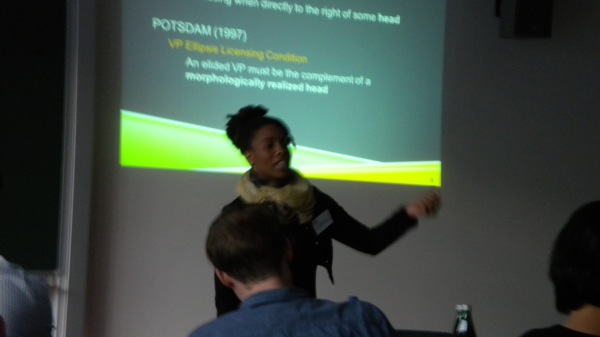
The 35th annual meeting of the German Society of Linguistics was held in Potsdam March 12-15, and UMass was well represented. Tom Roeper gave a talk entitled "What should a theory of interfaces tell us about the acquisition path for discourse coherence?" UMass alumnus Jeff Runner gave a talk entitled "Syntactic Structure, information structure, and lexical effects on null and overt subject conprehension in Spanish." Tracy Conner gave her talk "Overt functional heads license ellipsis: a unified account of VP-ellipsis and ellipsis in possessive DPs."  Nick LaCara gave his talk " Inversion, deletion, and focus in as-parentheticals." UMass alumnus Florian Schwarz gave a talk entitled "Weak definites and Kinds of Events." Ellen Woolford gave her talk "A hybrid approach to agreement typology: MP+OT." And, finally, UMass alumnus Winfried Lechner gave a talk entitled "Notes on the Duke of York." Nick has sent the following photos as proof.

DSCN2536DSCN2515DSCN2487

10 March 2013

LARC/Acquisition Lab meeting tomorrow

Magda Oiry writes:

Please join us on Monday, March 11 in the Partee Room (South College, room 301) at 12:10  for two presentations:

Andie Faber: "Experimental considerations for Gender Constraints in L2 Acquisition"

Michael Clauss:  "Implicit clauses and (apparent) partial movement in child English"

UMass in "Linguistic Derivations and Filtering"

Hans Broekhuis and Ralf Vogel's "Linguistic Derivations and Filtering" has appeared in the Advances in Optimality Theory series by Equinox Press. UMass alumna Jane Grimshaw's paper "Last resorts: A typology of 'do'-Support" appears in this volume along with a paper by John McCarthy and Kathryn Pruitt ("Sources of Phonological Structure") and another by Ellen Woolford ("Aspect splits and parasitic marking"). 

Congratulations Ellen, Kathryn, John and Jane!

UMass at FASAL

The third meeting of Formal Approaches to South Asian Languages (FASAL) is meeting this weekend at the University of Southern California in Los Angeles. Rajesh Bhatt, along with co-authors K.V. Subbarao and Vanlal Hmar, is presenting a paper entitled "A-bar Movement and Ergativity in Hmar." And Stefan Keine is presenting his paper "Long-Distance Agreement, Improper Movement and the Locality of Agree."

Professorship in Pragmatics at University of Konstanz

The Department of Linguistics in the Faculties of Humanities at the University of Konstanz invites applications for a Junior Professorship in Pragmatics (Salary Scale W 1) with expertise in formal pragmatics and/or experimental pragmatics, to be filled by the winter semester 2013/2014.

The selected candidate is expected to carry out research in pragmatics and teach courses both at the undergraduate (BA, Lehramt) and graduate level (MA, Ph.D.). Cooperation with existing and planned research proposals at the department is expected.

Recent doctoral graduates of outstanding quality may apply. We are interested in candidates who have an excellent international publication record, as shown for example by an outstanding dissertation, publications in established linguistic journals, conference papers and awards, and who exhibit strong skills in the classroom. For further information please contact Prof. Maribel Romero Sangüesa at: maribel.romero@uni-konstanz.de or by phone +49(0)7531/88–2728.

The University of Konstanz is an equal opportunity employer and tries to increase the number of women in research and teaching.

The University of Konstanz encourages disabled people to apply. They will be given preference if appropriately qualified.

The University of Konstanz has been certified as a family-friendly institution by the Hertie Foundation and ist committed to further the compatibility of work and family life.

The University of Konstanz offers a „Dual Career Program“. Information can be obtained from: http://www.uni-konstanz.de/dcc.

Applications including a CV, a list of publications, a record of teaching experience, photocopies of academic degree certificates as well as a completed submission form (see pdf-link below) and reference to Job Offer No. 2013/045 must reach the head of the Faculty of Humanities at the University of Konstanz at the latest by April 5th, 2013.

The application documents will be electronically processed and not returned.

For further information, please contact via e-mail: Geist.Sektion@uni-konstanz.de.

Application form: http://rz157.wwwdns.rz.uni-konstanz.de/files/pdf/uploads/Bewerberbogen2013045.PDF


Call for Papers: Sinn und Bedeutung

Sinn und Bedeutung 18,
11-13 September 2013, University of the Basque Country in Vitoria-Gasteiz

2nd Call for papers:
We invite abstract submissions for 45 (35+10) minute oral presentations or posters devoted to natural language semantics, pragmatics, the syntax-semantics interface, psycholinguistic studies related to meaning, and the philosophy of language. Abstracts should contain original research that, at the time of submission, has neither been published nor accepted for publication. One person can submit at most one abstract as sole author and one abstract as co-author (or two co-authored abstracts). Abstracts must be submitted electronically in PDF format. Submissions should be anonymous and not reveal the identity of the author(s) in any form (e.g., references, file name or properties of the abstract). Abstracts must not exceed two pages in letter-size or A4 paper, including examples and references, with 2.5 cm (or 1 inch) margins on all sides and 12-point font size. When you submit your abstract, you will be asked to indicate whether you would like it to be considered for a talk, a poster or both.

Abstracts should be submitted via EasyChair, using the following link:

https://www.easychair.org/conferences/?conf=sub18

Invited Speakers:
David Barner (University of California, San Diego)
Gennaro Chierchia (Harvard University)
Luisa Martí (University of Kent)
Maribel Romero (Universität Konstanz)

Important dates:
Submission deadline: April 15, 11:59 PM, CET
Notification of Acceptance: June 10
Conference dates: September 11-13

Contact: sub18.basquecountry@gmail.com

Webpage: https://sites.google.com/site/sub18bc


Call for Papers: ILLS 5

The Illinois Language and Linguistics Society’s 5th Conference will be hosted on the University of Illinois at Urbana-Champaign (UIUC) campus on April 5-7, 2013. For those of you who are not familiar with the conference, this is an annual graduate student run conference on topics pertaining to language and linguistics. As a student run conference, it is fully dependent and enriched by the participation of students. Even if you are not a graduate student, we would be delighted to have you! Undergraduates, post-docs, professors, and anyone in between is welcome! This year Professors Michael Kenstowicz (MIT), Carrie Gillon (Arizona State) John Rickford (Stanford), Ryan Shosted (UIUC) and Zsuzsanna Fagyal (UIUC) are our invited speakers. They will be featured along with a number of competitively selected international graduate students. This year’s special topic is minority languages, although papers on a variety of topics will be presented. Here is a link to the website for more information including a conference schedule. Registration is open until the day of the conference; however, to help with scheduling we would greatly appreciate it if you register by April 2, 2013. Register here for the conference and the reception. If you have any questions, please do not hesitate to contact us, whether it is about the conference itself, housing, travel, or anything else! Direct your questions to Marissa Goldrich at goldrch2@illinois.edu<mailto:goldrch2@illinois.edu>.

09 March 2013

PsychoSyntax meeting

Brian Dillon writes:

We'll be meeting again this Monday, 3/11, at 3pm in the Partee Room,  like usual! This week, Shayne and I will present Mauner and Koenig's  (2000) article, "Linguistic vs. Conceptual Sources of Implicit Agents in
Sentence Comprehension" (You may find the paper here:).

After discussing the findings in that paper, Shayne will present some pilot data he's collected and thoughts on follow-up experiments... it'd be great if you could come and give feedback on the topic!

03 March 2013

Laura Benua passes

We have learned recently that Laura Benua died of a heart attack on February 21. Laura received her PhD from UMass in 1997 with an influential dissertation on Phonology and Morphology. She had a position at the University of Maryland for a number of years, but left that job in order to devote herself to teaching in New York City public school system. She was a lovely person and a dear friend to many of us. For those who knew her, this is a devastating loss.

There is a service for her today at Nyack, New York, where her home is. A memorial page has been established here, and you can read more about Laura's linguistic career on Eric Bakovic's blog, here.

Paula Menendez-Benito gives department colloq on Monday

Paula Menedez-Benito (University of Goettingen) will give the department colloquium tomorrow, Monday, March 4th at 4:00PM in Machmer W-27. The title of her talk is "Epistemic Indefinites," and an abstract follows.

Epistemic Indefinites: The Case of Spanish

(joint work with Luis Alonso-Ovalle (McGill))

Across languages, we find epistemic indefinites, existential determiners that signal ignorance on the part of the speaker (see Haspelmath (1997)). Over the last fifteen years, a substantial body of work on the semantics of epistemic indefinites has appeared (see references in Alonso-Ovalle and Mene ́ndez-Benito (to appear)). Taken together, these studies outline a research program that aims to provide an explanatory semantic typology of epistemic indefinites by determining across which parameters epistemic indefinites can vary, how these parameters interact, and why. The work presented in this talk contributes to this enterprise by analyzing the epistemic effect of Spanish "algu ́n," and investigating the interaction of this effect with number morphology.

In its singular form, Spanish algu ́n conveys speaker’s ignorance. By using "alga ́n" in (1a), the speaker signals that she does not know which student María married. Hence, it would be odd for her to add a namely continuation that explicitly identifies the student in question, as in (1b). Surprisingly, the plural version of "algu ́n," "algunos," does not trigger an ignorance effect, as shown by (2). This talk provides an account of the contrast between (1) and (2). We will argue (i) that the epistemic effect of "algún" comes about because this item imposes an anti-singleton constraint on its domain of quantification, and (ii) that the interaction of this constraint with plural morphology blocks the epistemic effect. The talk also reports on work in progress that extends this account to the complex determiner "algu ́n que otto," which conveys an ‘I don’t know how many’ effect (witness (3)). The picture that emerges from this investigation is that epistemic effects triggered by indefinites are linked to properties of the domain of quantification, such as the size of the domain, its internal structure, and the type of entities quantified over.


(1) a. María se casó con algún estudiante.

           María married with ALGUN student

           (Maria married some student or other.)

      b. María se casó con algún estudiante # en concreto con Juan.

           María married with ALGUN student namely Juan

         (Maria married some student or other, namely John.)

(2) María vive con algunos estudiantes, en concreto con Pedro y con Juan.

      María lives with ALGUNOS student, namely Pedro and Juan

     (Maria lives with some student, namely Pedro and Juan.)

(3) María vive con algún que otro estudiante.

      María lives with ALGUN QUE OTRO student

      (Maria lives with students --- I don't know how many.)

Acquisition Lab/LARC meeting tomorrow

Magda Oiry writes:

This coming Monday, we will meet for a new acquisition lab / LARC meeting in the Partee Room at 12:05 to hear two presentations:

Andie Faber: "Experimental considerations for Gender Constraints in L2 Acquisition"

and 

Rama Novogrodsky, Seth Cable and Tom Roeper: "Acquisition of Each/every and Event Separation"

Paula Menendez-Benito gives talk on Tuesday

Paula Menendez-Benito will give a semantics talk on Tuesday, March 5, at 4:00PM in Machmer W-27. A title and abstract follow.

On Choosing Randomly

(joint work with Luis Alonso-Ovalle (McGill))

Many languages have indefinites that trigger modal inferences in the absence of an overt modal. Some of these items signal speaker’s ignorance. Others indicate that an agent made a random choice. While the former type has received a lot of attention in recent years (see Alonso-Ovalle and Mene ́ndez-Benito (to appear) for references), random choice indefinites are comparatively less studied (but see Choi (2007); Choi and Romero (2008); Alonso-Ovalle and Mene ́ndez-Benito (2011)). This talk paves the way towards a better understanding of random choice indefinites by analyzing the interpretation and distribution of Spanish "uno cualquiera."

The sentence in (1) illustrates the random choice reading of "uno cualquiera": (1) can be understood as saying that Juan took a card and that his choice was indiscriminate. This reading has a restricted distribution. Cases like (1), where "uno cualquiera" is in object position, are ambiguous between the random choice reading and an evaluative reading that conveys that Juan took an unremarkable card (and is compatible with him having chosen the card carefully.) In subject position, only the evaluative reading is available: (2) can only mean that an unremarkable student spoke.

(1) Juan cogio ́ una carta cualquiera. 

       John took a card CUALQUIERA.

(2) Hablo ́ un estudiante cualquiera.

      Spoke a student CUALQUIERA


We argue that "uno cualquiera" introduces a modal component that is anchored to the event described by the sentence. This component derives the random choice reading of sentences like (1) (roughly, that the agent’s decision is compatible with any of a number of actions under consideration), and blocks the random choice reading of (2) by deriving a contradiction. Our proposal is in line with some recent work on verbal modality where modal domains are projected from small particulars (events or individuals), rather than from whole worlds (see Hacquard (2006, 2009); Kratzer (2012)).

Nazarov at PRG on Thursday

This Thursday, March 7, Alex Nazarov will be presenting a paper to PRG, which meets at Packards in Northampton at 6:30. 

Nick LaCara at SRG on Thursday

Jason Overfelt writes:

Please join us this Thursday (March 7th) at 6:30p for a meeting of the Syntax Reading Group.  This week we will be hearing a practice talk by Nick LaCara titled `Inversion, deletion, and focus in as-parentheticals'.  The meeting will be at Elizabeth's place at 50 Phillips Place in Northampton.  Bring $5 for pizza or your own dinner.

LaTeX for Linguistics Workshop on Wednesday

Jeremy Cahill of the Linguistic Club writes:

Linguistics Club invites you to join us next Wednesday for an interactive LaTeX workshop!

WHEN: Wednesday, March 6, 5:30 - 7:30 PM
WHERE: Machmer W-15

Presenters Felix Lehmann, Steffen Hildebrandt, and Ilia Kurenkov will cover LaTeX basics as well as tools for linguistic typesetting. To get the most out of the workshop, make sure to bring a laptop (no installation required -- just internet access). Check out the attached flyer to see a bit of LaTeX in action.

{ What is LaTeX? A (free) document preparation system widely used by professional linguists, mathematicians, and others with unusual typesetting needs or who just want their documents to be of very high quality. }

Space is limited!

Sign up here: http://bit.ly/UMassLaTeX

or RSVP at: jccahill@student.umass.edu

Call for Papers: Tbilisi Symposium on Language, Logic and Compuatation


THE TENTH INTERNATIONAL TBILISI SYMPOSIUM ON
LANGUAGE, LOGIC AND COMPUTATION

23-27 September 2013
Gudauri, Georgia

http://www.illc.uva.nl/Tbilisi/Tbilisi2013
***********************************************************************
CALL FOR PAPERS

The Tenth International Tbilisi Symposium on Language, Logic and
Computation will be held on 23-27 September 2013 in Gudauri,
Georgia. The Programme Committee invites submissions for contributions
on all aspects of language, logic and computation. Work of an
interdisciplinary nature is particularly welcome. Areas of interest
include, but are not limited to:

* Algorithmic game theory
* Computational social choice
* Constructive, modal and algebraic logic
* Formal models of multiagent systems
* Historical linguistics, history of logic
* Information retrieval, query answer systems
* Language evolution and learnability
* Linguistic typology and semantic universals
* Logic, games, and formal pragmatics
* Logics for artificial intelligence
* Natural language syntax, semantics, and pragmatics

Authors can submit an abstract of four pages (including references) at
the EasyChair conference system here:

http://www.easychair.org/conferences/?conf=tbillc2013

PROGRAMME

The programme will include the following invited lectures and
tutorials.

Tutorials:

Logic: Rosalie Iemhoff (Utrecht)
Language: Daniel Altshuler (Duesseldorf)
Computation: Samson Abramsky (Oxford)

Invited Lectures:

Balder ten Cate (Santa Cruz)
Agata Ciabattoni (Vienna)
Thomas Colcombet (Paris)
Galit Sassoon (Jerusalem)
Alexandra Silva (Nijmegen)
Sergei Tatevosov (Moscow)

WORKSHOPS

There will also be a workshop on Algebraic Proof Theory organized by
A. Ciabattoni and R. Iemhoff and a workshop on Aspect organized by
D. Altshuler, D. Hole and S. Tatevosov. More information can be found
on the TbiLLC website.

PUBLICATION INFORMATION

Post-proceedings of the symposium will be published in the LNCS series
of Springer.

IMPORTANT DATES

Submission deadline: May 1, 2013
Notification: July 1, 2013
Final abstracts due: August 1, 2013
Registration deadline: September 1, 2013
Symposium: September 23-27, 2013

Programme and submission details can be found at:

http://www.illc.uva.nl/Tbilisi/Tbilisi2013/