Kristine Yu writes:
Just a quick reminder that abstracts are due for the Manchester Phonology Meeting January 31.
http://www.lel.ed.ac.uk/mfm/21mfm.html
Kristine Yu writes:
Just a quick reminder that abstracts are due for the Manchester Phonology Meeting January 31.
http://www.lel.ed.ac.uk/mfm/21mfm.html

WSCLA 18 -- abstract deadline extended by one week
The 18th Workshop on Structure and Constituency in Language of the Americas (WSCLA 18) will take place at the University of California, Berkeley on April 5-7, 2013.
New abstract submission deadline: Monday, January 21, 2013
The central objective of this workshop is to bring together linguists who are engaged in research on the analytic study of the Aboriginal languages of the Americas so that they may exchange ideas across theories, language families, generations of scholars, and, importantly, across the academic and non-academic communities that are involved in language maintenance and
revitalization.
The following invited speakers have been confirmed:
- Judith Aissen (UC Santa Cruz)
- Ewa Czaykowska-Higgins (University of Victoria)
- Monica Macaulay (Wisconsin)
- B'alam Mateo Toledo (CIESAS)
- Joyce McDonough (Rochester)
- Andrés Salanova (Ottawa)
- Maziar Toosarvandani (MIT)
- Lorna Williams (University of Victoria)
Abstracts are invited for papers in any area of formal linguistics (including phonetics, phonology, morphology, syntax, semantics, and pragmatics) within any theoretical framework. We welcome papers that address diachronic, sociolinguistic, or applied topics from a formal perspective, and we are especially interested in papers seeking to relate the interests of formal linguists and the concerns of indigenous communities.
Abstract submission guidelines:
- Abstracts must be submitted in PDF format with the filename PaperTitle.pdf (where PaperTitle is the title or a clear abbreviated version of it. No punctuation or spaces.)
- Abstracts must be anonymous. Author name(s) must not appear on the abstract or file name. In addition, be sure to remove any author name in the document properties of the PDF file.
- Abstracts must not exceed 2 pages in length including references and examples
- Minimum 12pt font size, 1 inch margins
Abstracts should be sent as a PDF attachment to:
wscla18@socrates.berkeley.edu
Abstract submission deadline: January 21, 2013
Contact info: wscla18@socrates.berkeley.edu
For further information, please see the conference website:
http://linguistics.berkeley.edu/~wscla/
The seventh annual McGill Canadian Conference for Linguistics Undergraduates - McCCLU - will be held on March 15th, 2013- March 17th 2013.
It will again be hosted at McGill University, Montreal, by the Society of Linguistics Undergraduates of McGill - SLUM. The aim of this conference is to encourage original endeavors into the world of research as well as to enrich the present academic undergraduate community within the field of linguistics.
We are now calling for undergraduate students to submit abstracts for presentation at the conference on any subject matter within the domain of linguistics. Each abstract should detail material for a 20-minute presentation, with a 10-minute question period on issues raised afterward. Abstracts should be a maximum of one page in length (12 point font, 1 inch margins) and submitted online to http:// linguistlist.org/easyabs/mccclu2013 by January 25th, 2013.
For further information, please visit our blog at: mccclu2013.blogspot.com. Should you have any other questions please email us at mccclu2013@gmail.com
Brian Dillon writes:
We're set to have PsychoSyntax on Mondays at 3pm. The first meeting is 1/28, in the Partee Room, and we will meet biweekly after that. The first order of business will be to hammer out a presentation schedule, so come ready to volunteer yourself and your work!
It looks like we'll have time to actually get into some fun science in our first meeting, as well. If so, I'll volunteer myself to present something from one of the in-progress projects going on around here, and so we can hit the ground running.
For CSL Lab RAs (and folks who are interested in hanging out in the CSL lab, seeing ongoing projects, and getting involved!): our meeting times will also be Mondays at 3pm. We will meet on the weeks that PsychoSyntax does not meet, starting Monday 1/22, in Bartlett 11.
Barbara writes:
Volodja are I are in Mexico for a couple of weeks mixing business and pleasure. I spent Jan 14-17 at El Colegio de Mexico consulting with Josefina García Fajardo and my colleagues in a project on determiners in Spanish and in Yucatec Maya, and with the 7 PhD students of the Linguistics Program about their planned dissertation projects. On Thursday the 17th, I gave a public lecture, “La cuantificación y tipología semántica”. Everything on all four days was in Spanish, though I note that Russian words were continually trying to emerge (and occasionally emerging), even though Volodja and I tried to keep our own conversations in English. Those work days are being followed by an 8-day trip around the Yucatan, followed by two days back in Mexico City visiting with Josefina before returning to Amherst Jan 28.
Seth Cable writes:
Happy New Year! And, with a new year comes a new session of UMAFLAB (the UMass Funny Languages Breakfast)!
What is UMAFLAB, you might ask? Well, the purpose of UMAFLAB is to bring together individuals with a shared interest in puzzling linguistic data, optimally (but not necessarily) from understudied or minority languages.
*Presentations are always informal*. We are *not* looking for polished work or practice talks (though those are welcome). Rather, participants are free to present any puzzles they like. They needn't have any analysis in mind; indeed, part of the fun of the group is hearing other people's thoughts on some difficult problem.
Thus, if all you have is an interesting pattern worth 'boggling at', that's perfect for our group (particularly if it's from an otherwise not-very-much-talked-about language or variety). For example, a run down of all the crazy data obtained during some recent field work (or experimental work, or whatever) would be quite ideal.
As the name suggests, our meetings are typically in the morning, with some breakfast item served. However, the schedule is always flexible, if it turns out that most people can't make it in the morning.
So, if you'd at all be interested in being part of such an endeavor, please let me know! I'd like to begin scheduling soon our first organizational meeting of the semester, so if you could also let me know what days/times would work out best for you, that would greatly appreciated!
The linguistics department at Tel-Aviv University is proud to announce the 1st graduate student workshop in memory of Professor Tanya Reinhart, which will take place on April 11th, 2013.
MA students and PhD students not having submitted their dissertation in Linguistics by April 2013 are invited to submit abstracts of their research in all areas of theoretical linguistics, psycholinguistics, or neurolinguistics.
Papers will be allotted 20 minutes for presentation plus 10 minutes for discussion. Invited Speaker: Idan Landau, Ben Gurion University.
Length: Up to two single spaced A4 pages with 2.5 cm margins, typed in 12-point Times New Roman.
Format: Abstracts must be anonymous and in pdf format.
Submission: To submit your abstract, please send it totau.linguistics.workshop@gmail.com no later than February 1st. Please state your name and affiliation in the body of the message.
Important dates: Deadline for submission: 1 February 2013 Notification of acceptance: 1 March 2013 Workshop: 16:00 – 19:30, 11 April 2013
Contact info: tau.linguistics.workshop@gmail.com
The annual meeting of the Linguistic Society of America met January 3-6 in Boston this year, and UMass were well represented in the poster sessions. These included:
Andrew Weir, poster: "Article drop in headlines: failure of CP level Agree"
Anisa Schardl, poster: "Simple partial movement and clefts"
Nick LaCara: "*On the table lay a book, and on the sofa did too: ellipsis, inversion and why they are bad together"
Elizabeth Bogal-Allbritten and Anisa Scheardl "Expressing uncertainty with "gisa" in Tshangla"
and
Jeremy Hartman, with Paul Marty, Peter Graff, Steven Keyed: "Biases in word learning: the case of non-myopic predicates"
WHISC is please to announce that Noah Constant's paper, "English rise-fall-rise: a study in the semantics and pragmatics of intonation" has been published in Linguistics and Philosophy. Take a look:
http://www.springerlink.com/openurl.asp?genre=article&id=doi:10.1007/s10988-012-9121-1
Congratulations Noah!
First Call for Papers
ESSLLI 2013 STUDENT SESSION
Held during
The 25th European Summer School
in Logic, Language and Information
Düsseldorf, Germany, August 5-16, 2013
Deadline for submissions: April 1st, 2013
https://www.easychair.org/conferences/?conf=essllistus2013
ABOUT:
The Student Session of the 25th European Summer School in Logic, Language, and Information (ESSLLI) will take place in Düsseldorf, Germany on August 5-16, 2013. We invite submissions of original, unpublished work from students in any area at the intersection of Logic & Language, Language & Computation, or Logic & Computation. Submissions will be reviewed by several experts in the field, and accepted papers will be presented orally or as posters and will appear in the student session proceedings in Springer. This is an excellent opportunity to receive valuable feedback from expert readers and to present your work to a diverse audience.
A SEPARATE POSTER SESSION: Note that this year there are two separate kinds of submissions, one for the oral presentations and one for the posters. This means that papers can be directly submitted as posters. Reviewing and ranking will be done separately. We particularly encourage submissions for posters.
More detailed guidelines regarding submission can be found on the Student Session website: http://stus2013.loriweb.org/, (links to previous years' proceedings are also available there).
Please direct inquiries about submission procedures or other matters relating to the Student Session to margotcolinet@gmail.com
For general inquiries about ESSLLI 2013, please consult the main ESSLLI 2013 page, http://esslli2013.de/.
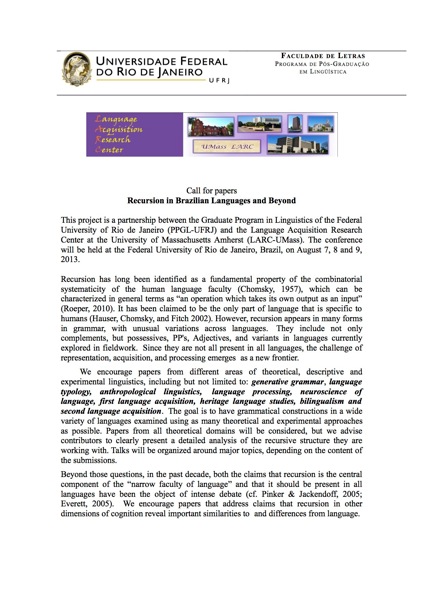
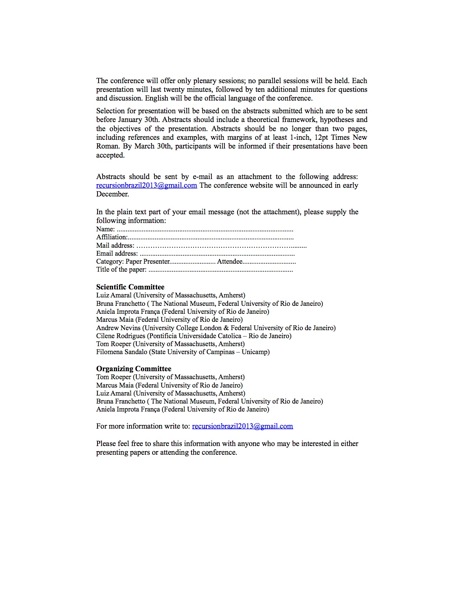
The Graduate Program in Linguistics of the Federal University of Rio de Janeiro and the Language Acquisition Research Center at UMass are sponsoring a conference on recursion at the Federal University of Rio de Janeiro August 7-9, 2013. Papers from different areas of theoretical, descriptive and experimental linguistics are sought. More information can be found in the poster below.
Barbara Partee writes:
Mark Liberman and I will be Co-Editors of the newly established Annual Review of Linguistics, the 45th journal in the Annual Reviews series. You can read about Annual Reviews here: http://www.annualreviews.org/ . (Linguistics isn’t listed there yet – it was just officially approved today, December 15, 2012.)
Tom Roeper was traveling in Germany in the first week of December. He served as an advisor to the German Ministry on Science for the evaluation of the Zentrum fur allgemeine Sprachwissenschaft in Berlin, and he gave a talk at the Max Planck Center for Neurolinguistic and Cognition in Leipzig. His talk: "Formal and Empirical approaches to recursion -- prospects for neurosciences."
Welcome home, Tom.
The Society of Linguistics Undergraduate Students (SLUGS) at the
University of Toronto is excited to announce its 6th annual Toronto
Undergraduate Linguistics Conference (TULCON), to be held on March 1-3, 2013!
TULCON is a great opportunity for undergraduate linguists to meet their
peers, share their work, and further their appreciation for linguistics
and language-related studies.
We invite research, complete or in progress, from any area of linguistics.
Abstracts should be approximately 500 words in length (not including
references). Please submit your abstracts in .pdf or .doc (NOT .docx)
format to tulcon2013@gmail.com by Sunday January 27, 2013. In your
submission, please indicate whether you would like to present a talk or a
poster during our poster session. Speakers will have the opportunity to
present for 20 minutes, followed by an additional five-minute question
period.
Citizens of countries who require a visa to enter Canada may submit
abstracts early. In your submission, please indicate approximately how
much time you require to secure your visa. We will try our best to review
your abstract and send notification of acceptance at an earlier date.
Stay tuned for more announcements about registration in the near future!
If you have any questions, please contact us at tulcon2013@gmail.com.
Kristine Yu writes:
The McGill Linguistics Undergraduate club writes:
You are invited on behalf of the Society of Linguistics Undergraduates at McGill to the 7th annual McGill Canadian Conference of Linguistics Undergraduates (McCCLU). This year, the conference will take place the weekend of March 8th, 2013 at McGill University. We are now accepting abstract submissions to present at the conference on any subject matter within the domain of linguistics. Each abstract should detail material for a 20 minute presentation, with a 10 minute question period. Abstracts should be a maximum of page in length (12 point font, 1 inch margins) and submitted online to http://linguistlist.org/easyabs/mccclu2013 by January 15, 2013.
For further information, please visit our blog at: mcclu2013.blogspot.com. Should you have questions, please email us at mcclu2013@gmail.com
Brian Dillon gave a talk "Agreement Attraction in Production" to the Linguistics Club last Wednesday, December 5.
Jonathan Bobaljik will give the department colloquium Frida, December 7, at 3:30 PM in Machmer E-37. A title and abstract follow.
Suppletion Beyond Superlatives
In Bobaljik (2012) [Universals in Comparative Morphology. MIT Press], I provided an extended argument, from the morphology of comparative and superlative formation, for abstract hierarchical structure in words, prior to the rules of vocabulary insertion that map this structure to phonological exponents. The key evidence is drawn from suppletion (good-better-best). I argue that in suppletion - by definition the most irregular of morphological phenomena - there are a number of (near) universal patterns that emerge across large, cross-linguistic samples. For example, (virtually) no language has a suppletive pattern of the sort: *good-better-goodest or *good-gooder-best -- if either the comparative or the superlative is suppletive (w.r.t. to the positive), then so is the other. The explanation of these patterns, I submit, requires (hidden) structure, in this case, a structure in which the superlative always properly contains (is derived from) the comparative, and is never directly attached to the adjective. Thus, forms like English tall-est must have a hidden comparative.
The results from the study of comparatives and superlatives, if correct, should extend beyond this morphological domain and provide a test for abstract structure in morphology much more generally. After summarizing the work on comparatives and superlatives, I report on the current state of efforts to go further and investigate the generalized predictions in other suppletive domains, including suppletion for verbal number and pronominal case.
John Kingston writes:
We'll have one more lab meeting this semester, next Monday, 3 December, 4-5:30 PM. Its purpose is to take stock of where we are for all on-going experiments. One, Yu-hoo, has reached a very interesting stage (not only a possible failure to replicate, but perhaps even a reversal of effects reported by Yu (2010)!), so Shifra, Megan, and I will discuss it in some detail. (We're still very short on male participants in this experiment, so any help pulling in those of the Y-chromosome persuasion would be appreciated!)
If anyone wants to request some other kind of sustenance than the usual bagels, cheese, and hummus, let me know. Otherwise, as usual be there or be [].
Freshly recovered from oral surgery, Kristine Yu gave a colloquium talk at New York University on Friday, November 30th. A title and abstract follow.
The learnability of tones from the speech signal
It is an unremarkable matter of course but a remarkable miracle of human cognition that children learning tonal languages learn maps from the speech signal to the abstract phonological tone concepts of their native language, which could be any tone language of the world. This talk is on work towards a characterization of what it is that is being learned---the class of possible maps from the speech signal to tonal categories in natural language. By studying the structure of this class of tonal maps, we can assess the learnability of the class under a mathematically precise criterion for successful feasible learning. Since the structure of tonal maps is conditioned on the phonetic space in which they are defined, we present work on determining an appropriate phonetic parameterization of the speech signal for the domain of the tonal maps, using cross-linguistic experimental data from Bole, Beijing Mandarin, Cantonese, and White Hmong. We also present results from both human perception experiments and computational modeling hinting at structure in tonal maps that would make them feasibly learnable.
Sinn und Bedeutung 18, 11-13 September 2013, University of the Basque Country in Vitoria-Gasteiz
We invite abstract submissions for 45 (35+10) minute oral presentations or posters devoted to natural language semantics, pragmatics, the syntax-semantics interface, psycholinguistic studies related to meaning, and the philosophy of language. Abstracts should contain original research that, at the time of submission, has neither been published nor accepted for publication. One person can submit at most one abstract as sole author and one abstract as co-author. Abstracts must be submitted electronically in PDF format. Submissions should be anonymous and not reveal the identity of the author(s) in any form (e.g., references, file name or properties of the abstract). Abstracts must not exceed two pages in letter-size or A4 paper, including examples and references, with 2.5 cm (or 1 inch) margins on all sides and 12 point font size. When you submit your abstract, you will be asked to indicate whether you would like it to be considered for a talk, a poster or both.
Abstracts should be submitted via EasyChair, using the following link:
https://www.easychair.org/conferences/?conf=sub18
Invited Speakers:
David Barner (University of California, San Diego)
Gennaro Chierchia (Harvard University)
Luisa Martí (University of Kent)
Maribel Romero (Universität Konstanz)
Important dates:
Submission deadline: April 15, 11:59 PM, CET
Notification of Acceptance: June 10
Conference dates: September 11-13
Contact: sub18.basquecountry@gmail.com
Conference:
Austronesian Formal Linguistics Association XX (AFLA XX)
Call Deadline: January 25, 2013.
Conference website: http://ling.uta.edu/~afla20
Contact Persons: Joseph Sabbagh, Nathan Eversole (aflauta20@gmail.com)
Description:
The Department of Linguistics at UT Arlington will host the 20th
annual meeting of the Austronesian Formal Linguistics Association. The conference dates are May 17-19, 2013.
AFLA is an organization which promotes the study of Austronesian
languages from a formal perspective. We will elicit talks on all
aspects of formal linguistics (e.g. language acquisition, morphology,
phonology, phonetics, semantics, syntax) of Austronesian languages. In addition to promoting the formal study of Austronesian languages, we especially encourage work by speaker-linguists and junior scholars.
Invited Speakers:
Sandra Chung (University of California, Santa Cruz)
Eric Potsdam (University of Florida)
Norvin Richards (MIT)
Abstracts are invited for 30 minute talks (20+10) or poster presentations on any aspect of formal linguistics (morphology, phonetics, phonology, syntax, semantics) of any Austronesian language(s). Abstracts on experimental or psycholinguistic research of any Austronesian language(s) are also invited. Submission limitations are one singly-authored abstract and one jointly-authored abstract, or two jointly-authored abstracts per applicant. Abstracts should be limited to a maximum of two Letter-sized (or A4) pages (for text, examples, trees, tableaux, and references), with margins of one inch and in 12 pt. type.
Abstracts should be submitted online by January 25, 2013, at the following URL:
http://linguistlist.org/confservices/afla20
The University of Texas at Arlington (UTA) is located in Arlington,
Texas, situated between Dallas and Fort Worth. Arlington is easily
accessible by two major airports: DFW and Love Field.
The Department of Linguistics at the University of Ottawa will host the MOT (Montreal-Ottawa-Toronto) Phonology Workshop March 15-17, 2013. Abstracts on any topic in phonology (including interfaces with phonetics and morphosyntax) should be submitted electronically. Abstracts should not exceed 500 words, including examples and references.
Deadline for receipt of abstracts: Friday, February 1, 2013.
Send abstracts to:
Marie-Hélène Côté <mhcote@uottawa.ca>
Please circulate this call for papers among your colleagues and students. The call is reproduced in the attached pdf documents (one in English, one in French), which you are invited to print and post.
LANGUAGE PLASTICITY: GENES, BRAIN, COGNITION, COMPUTATION
NSF-IGERT Ph.D. Fellowships at the University of Connecticut
Website: http://igert.cogsci.uconn.edu; Brochure; Flier
We are pleased to announce a new graduate training program at the University of Connecticut, funded by the U.S. National Science Foundation (NSF) Integrative Graduate Education and Research Traineeship (IGERT) program. We will admit 27 IGERT Fellows over the next 4 years. IGERT Fellows receive five years of full funding, including two years of NSF IGERT stipend ($30,000 per year) and three years at normal departmental levels. Trainees enter through any of 7 Ph.D. programs: Linguistics; Speech, Language, & Hearing Sciences; Physiology & Neurobiology; and 4 programs in Psychology: Behavioral Neuroscience, Clinical, Developmental, and Language & Cognition. (Note that NSF stipends are available only to U.S. citizens and permanent residents, but others can apply to the program and can receive full funding at standard departmental levels.) Trainees complete normal home department specialist training, but also a common core of "Foundations" courses that provide them background in the fundamental ideas, methods, and terminology in each participating domain sufficient to allow them to work in collaborative, interdisciplinary teams. Course-based work is integrated with hands-on training and access to cutting edge tools for neuroscience, cognitive neuroscience, genetics, and computational modeling.
Why are we bringing together these areas in our training program? Unifying cognitive and biological approaches will allow language development, processing, and disorders (acquired and developmental) throughout the lifespan to be studied in the context of complex, dynamic interactions of genes, environment, neurobiology, cognition, and culture, affording new insights into the nature of language. Today, cognitive and biological fields are weakly linked. Cognitive domains coupled with Behavior Genetics provide correlational clues to possible genetic bases for language disorders; causality can begin to be assessed with true experiments with gene knock-out or knock-down animal models using methods of Behavioral and Molecular Neuroscience and Genetics (focusing on sensory and cognitive traits associated with language). Currently, such research focuses primarily on language disorders, and there is little transfer back from biological to cognitive domains. Our training program prepares a new generation of scientists not just to accelerate transfer between cognitive and biological domains, but to unify them, and realize the potential for biological approaches to inform not just the bases of disorders, but the bases of mechanisms supporting language plasticity and cognitive and computational theories of language development and processing more generally.
OPPORTUNITIES. In addition to NSF Fellowships, funds are available to support research costs, international internships with partners in Europe and Asia, and trainees have access to leading scientists and state-of-the-art laboratories.
DIVERSITY. We share NSF's mission to increase participation in science by underrepresented groups. UConn and our IGERT provide mentoring and support systems for all Ph.D. students, with particular attention to the concerns of underrepresented groups. Women, minorities, and Deaf individuals are especially encouraged to apply.
APPLY! To be considered for our IGERT training program, see our website (http://igert.cogsci.uconn.edu) for application details. NSF Fellowships are available only to U.S. citizens or permanent residents, but others may join the program as IGERT Associates, funded by normal departmental mechanisms. Departmental application deadlines vary between December 1, 2012 and January 1, 2013.
Participating Faculty
Psychology
James Magnuson, PI, Perception, Action, Cognition; Haskins Labs
Holly R. Fitch, Co-PI, Behavioral Neuroscience
Ken Pugh, Co-PI, Perception, Action, Cognition; Haskins Labs
Heather Bortfeld, Developmental; Haskins Labs
Marie Coppola, Developmental; joint appointment in Linguistics
Inge-Marie Eigsti, Clinical; Haskins Labs
Deborah Fein, Clinical
Joseph LoTurco, Physiology & Neurobiology; Behavioral Neuroscience
Letitia Naigles, Developmental
Heather Read, Behavioral Neuroscience
Jay Rueckl, Perception, Action, Cognition; Haskins Labs
Whitney Tabor, Perception, Action, Cognition; Haskins Labs
Linguistics
William Snyder, Co-PI
Diane Lillo-Martin
Speech, Language and Hearing Sciences
Carl Coelho, Co-PI
Bernard Grela
Emily Myers; Haskins Labs; joint appointment in Perception, Action, Cognition
Pradeep Ramanathan
Tammie Spaulding
Haskins Labs / Yale Child Study Center
Elena Grigorenko
Kyle Johnson, following earlier gigs this semester by Rajesh Bhatt and Kristine Yu, will give a colloquium talk at New York University this Friday, December 7. A title and abstract follow.
An ellipsis without an antecedent: Andrews Amalgams
I will argue that the best analysis of Andrews Amalgams (as found, for example, in "She ate you'll never believe how many apples") involves an unorthodox outcome from the linearization procedure, as in Guimaräes's 2004 UMaryland dissertation. That outcome arises in part by virtue of the licensing condition on ellipsis that determines where sluices can be. This means that the condition which licenses ellipsis is not something that also enforces the condition that the ellipsis must have an antecedent. We must find a way of explaining why these things are normally paired which is less deterministic than Jason Merchant's well-known proposal.
Annahita Farudi will defend her dissertation, "Gapping in Farsi: A cross-linguistic investigation" on Wednesday, November 28, at 4:00 PM in Barlett 205.
Paul Smolensky will give the department colloquium on Friday, November 30, in Machmer E-37 at 3:30pm.
Title: Gradient Symbols in Linguistic Competence and Performance
Ubiquitous in the study of cognition is the need to reconcile discrete combinatorial structure (as in linguistic representations) with continuous or ‘gradient’ structure. For example, this arises in psycholinguistics both empirically — in relating grammar to observables — and theoretically — as in partial ‘activation’ of competing alternatives. This reconciliation is also required for reducing discrete combinatorial grammatical computation to neural computation over continuous activation patterns. A general approach to this integration is Gradient Symbolic Computation, in which representations are combinatorial but consist in weighted blends of symbolic constituents. I will introduce a general cognitive architecture based on optimization, in which markedness, faithfulness and correspondence relations play central roles within and between all cognitive components. Of primary concern are computations in which symbolic blends are transient states between (nearly) discrete input and output states. I will discuss the relation between (i) faithfulness between symbolic representations and (ii) continuous similarity of the activation patterns realizing those representations, illustrating with general patterns in speech errors. I will close with speculations about potential roles of non-transient symbolic blends in syntactic competence and performance.
Suzi Lima writes:
The Foundation for Endangered Languages has just announced that its 2012 grant application round is now open. Priority will be given to projects that focus on the revitalization of endangered languages and support the use of endangered languages in various spheres of community life (home, education, cultural and social life). Any language documentation proposals must have a clear and immediate relevance to prospects for language revitalization.
Full details and application forms are available on the FEL website athttp://www.ogmios.org/grants/index.htm. The deadline for submission of proposals is 31st December 2012.
Magda Oiry writes:
This Monday, due rescheduling, Athulya Aravind will present his work in the acquisition lab / LARC meeting. The title of his talk is:
"First and Second Order Complementation: New Experimental Directions".
Tom Roeper writes:
William Snyder will be giving a guest lecture in the class on Multiple
Grammars where he will discuss his approach to Grammatical Conservatism in Acquisition.
The class meets at 230 Monday November 19th in Herter 211.
Everyone is welcome.
Tom Roeper ( and Luiz Amaral)
Joanna Blaszczak writes:
Brian Smith writes:
Jason Overfelt writes:
I would like to introduce myself as your new SRG coordinator. I will be doing my best to take over for Anisa who has done a wonderful job. Thanks, Anisa!
Our final meeting this semester was last Thursday, but it's never too early to start planning ahead. If you think you would like to talk at SRG next semester, then feel free to email me once you know. You should feel free to present a practice talk, discuss a term paper you're working on, or just throw out some puzzling data.
Barbara Pearson writes:
Tracy Conner, Janice Jackson and I presented a paper on "Dialect Awareness: Foundations for Effective Education of African American English-speaking Children" at the American Speech-Language and Hearing Association annual meeting in Atlanta on Thursday, November 15, 2012. The paper was based on an article to appear in Developmental Psychology, January 2013, a themed edition on "Deficit versus Difference? Interpreting Diverse Developmental Paths" (and is already available on-line). As part of Tracy's answers to an engaged audience, she was able to refer people to her poster in the following session: New Diagnostic Criterion: Obligatory Possessive Marking in African American English.
Magda writes:
I gave a talk at the University of Maryland on Wednesday Nov. 14th entitled "The acquisition of Long-Distance questions" in a seminar co-taught by Valentine Hacquard and Jeff Lidz. I discussed a case of "Poverty of the Stimulus": children are able to acquire the syntax and the felicity conditions of Scope Marking without ever been exposed to it. My visit was supported by a grant from the National Science Foundation to Hacquard and Lidz on "Acquiring the semantics and pragmatics of attitude verbs".
Call for papers
CSSP 2013
The 10th Syntax and Semantics Conference in Paris
September 26-28, 2013
Université Paris Diderot, Amphi Buffon, batiment Buffon
15 rue Hélène Brion, 75013 Paris
Invited speakers
Ricardo Etxepare (CNRS UMR 5478)
Tim Fernando (Trinity College Dublin)
Bart Geurts (U. Nijmegen)
Louisa Sadler (U. Essex)
Submission deadline: April 15th, 2013
The 8th Syntax and Semantics Conference in Paris (CSSP 2009) will
take place on September 26-28th, 2013.
The Conference welcomes papers combining empirical inquiry and
formal explicitness. CSSP aims at favouring comparisons between
different theoretical frameworks.
CSSP conferences combine a general session and a thematic session.
Submissions for the general session may address any topic on
syntax, semantics, or the syntax-semantics interface. The thematic session will focus on experimental syntax and semantics
We invite submissions for 40-minute presentations (including 10
minutes for discussion). Abstracts should be at most 2 pages in
length (including examples and references) written in French or
English. The same person may submit at most one abstract as a sole
author and one as a co-author. Preference will be given to
presentations that are not duplicated at other major conferences.
Abstracts will be refereed blindly by an international programme
committee.
For the submission procedure, please see :
http://www.cssp.cnrs.fr/cssp2013/soumission/index_en.html
Tom Ernst will teach two undergraduate courses at Haverford College (as part of the Tri-College linguistics program, also including Swarthmore and Bryn Mawr Colleges) in the spring semester. The courses are Structure of Chinese, and Seminar in Syntax.
Suzi Lima will be giving "The count/mass distinction in Yudja (Tupi): quantity judgment studies" at the “Mass/Count in Linguistics, Philosophy and Cognitive Science” colloquium. On December 20-21, 2012 a the Ecole Normale Supérieure in Paris.
The colloquium will be preceded by a one-day tutorial on the mass/count
distinction given by Friederike Moltmann (IHPST) and David Nicholas (IJN).
If you are interested in attending, registration is required. It is done in two steps: (i) pre-registration on the conference website, (ii) final registration and payment on-site. To pre-register, create an account on the conference website, log in, and fill in the registration form.
More information, and a program are available on the
conference website:
http://mass-count.sciencesconf.org/
Abstracts were sent to the Acoustical Society of America meeting in Montreal this June. They are:
Kristine Yu and Kate Silverstein: "Voice quality and dispersion in
tonal inventories"
Jeremy Cahill, Kevin Mullin, and John Kingston: "Spectral contrast effects when Ganong effects are delayed"
Kevin Mullin, Diego Alves and John Kingston: "Lexical effects are independent of distant phonetic context effects."
Shifra Sered, Megan Whiteford and John Kingston: "How do autistic traits influence speech perception?"
Claire Moore-Cantwell: "Syntactic predictability influences duration."
Kristine Yu writes:
I'm delighted to announce that our very own Noah Constant will be giving a talk on Tuesday, 11/13 at 3:45pm in the Partee Room on part of his dissertation work. His abstract follows below. Please join us!
Refreshments will be served.
Title: The Prosody of English Contrastive Topic
In this talk, I give a phonological account of English contrastive topic (CT) constructions, as in (1), where the subject displays a CT intonation contour.
(1) Where do the grad students live?
MOST of them... live in NORTHAMPTON.
L+H* L- H% H* L- L%
I will review the means different languages use for marking CT, and situate my account of English within a framework that can make sense of the cross-linguistic facts. In particular, the account seeks to explain (a) where CT meaning is encoded, (b) why CT's are often dislocated to an initial position, and (c) how the presence of a CT can affect prosodic structure.
Ariel Goldberg, Associate Professor Psychology at Tufts, will be speaking at noon on Wednesday, November 14, in the ASH lobby at Hampshire College. A title and abstract of his talk follow.
Title: "Towards a theory of the phonological processing of multimorphemic words: The Heterogeneity of Processing Hypothesis"
Abstract: Although there has been extensive research investigating the lexical aspects of multimorphemic word processing (e.g., whether words are represented in a holistic or decomposed fashion), very little is known about how post-lexical phonological processes operate over multimorphemic words in production. I propose the Heterogeneity of Processing Hypothesis, which takes as its basis a simple observation: since post-lexical phonological processes in general are influenced by lexical properties, the post-lexical processing of morphologically complex words will have multiple lexical influences. Two consequences of this organization are identified: 1) post-lexical representations must be assembled on the fly, binding together phonemes from different morphemes and 2) phonemes inherit different levels of activation depending on the properties of their parent morpheme. I argue that both of these consequences will cause post-lexical processing to vary across the word, that is, processing is predicted to be heterogeneous. In the first case, weaker structural relationships between the phonemes in different morphemes will cause phonological processes to be weaker when acting across morphemes than within. In the second case, different levels of activation will cause each morpheme to have different articulatory properties (e.g., hyperarticulation, vowel space, etc.). I report three studies supporting weaker heteromorphemic processing and morpheme-based levels of activation.
Jason Overfelt will be speaking at the final SRG meeting this semester at Barbara and Volodja's place on Thursday at 6:30p. People should bring $5 for pizza or their own dinner.
Jason will be talking about object marking and hidden argument structure alternations in Tigrinya ditransitive constructions.
Brian Dillon will be giving a talk at the Ling Lang Lunch at Brown University's Cognitive, Linguistic, and Psychological Sciences department this Wednesday, November 14th. He will be presenting joint work with Lyn Frazier and Charles Clifton on "Syntactic complexity across the at-issue / not-at-issue divide."
Abstract:
Much work in psycholinguistics has been dedicated to uncovering the source of complexity effects in syntactic processing (Chomsky & Miller 1963; Gibson, 1998; Levy, 2007; Lewis, 1996; Lewis & Vasishth, 2005; Yngve, 1960; i.a.). There are many theoretical accounts of syntactic complexity effects, starting from Chomsky and Miller's (1963) observations on the difficulty of self-embedding, to the introduction of new discourse referents while simultaneously maintaining syntactic predictions (Gibson, 1998), among many others. One recent and influential model attempts to reduce syntactic complexity to interference effects related to memory retrieval (Lewis & Vasishth, 2005), In the present talk I present joint work with Lyn Frazier and Chuck Clifton that investigates the source of syntactic complexity by looking how the at-issue / not-at-issue distinction relates to syntactic complexity effects. Not-at-issue content like appositives and parentheticals do not directly contribute to the truth conditions of a sentence, and so have been argued to form a separate 'dimension' of meaning (Potts, 2005). In a series of judgment experiments, it is seen that syntactic complexity in the not-at-issue dimension does not lead to complexity effects in offline judgments, while complexity in at-issue content does. I then present eye-tracking data that helps to locate the source of the complexity effects in online comprehension. The results provide initial evidence that i) the parser distinguishes at-issue and not-at-issue content, and ii) the complexity effects observed in the present data cannot be reduced to retrieval interference. I suggest that at-issue / not-at-issue distinction is used to structure parsing routines by maintaining distinct stacks for different types of linguistic content, thereby minimizing complexity for the sentence as a whole.
Suzi Lima is in Tel Aviv this week. On Tuesday, November 13, she will present her paper "Counting as a context dependent operation in Yudja (Tupi)" at Bar-Ilan University.
Congratulations Suzi!
Ellen Woolford gave the lead off talk at the OT Workshop Nov 9-10 at Johns Hopkins University in Baltimore.
Her talk was entitled: "Two Types of Portmanteau Agreement: Syntactic and Morphological."
For more information, see http://mind.cog.jhu.edu/JHUOT
Congratulations Ellen!
Nick LaCara writes:
This weekend I attended the Ellipsis2012 workshop (http://webs.uvigo.es/ellipsis2012/index.php) at the Universidade de Vigo, Spain, where I presented work from my first GP. The paper was titled "Comparative deletion in /as/-parentheticals". I got to talk to Maribel Romero, who gave a plenary talk---I'm sure she'd be happy for me to say 'hi' to the department on her behalf. I also got to catch up with Luis Vicente, who visited the department back in 2005. It was a really fun conference with a lot of great talks. Well worth the trip!
Barbara gave the prestigious Baggett Lectures at the University of Maryland last week. Her talks were on the history of formal semantics.
On November 7 she gave the general audience talk: "Logic and Language: A History of Ideas and Controversies."
On November 8 and 9 she gave two talks for the linguists:
"The Starring Role of Quantifiers in the History of Formal Semantics"
and
"Pivotal Moments in the `Naturalization' of Formal Semantics"
Congratulations Barbara!
Former semantics guru Malte Zimmerman writes:
I would like to draw your attention to the following call for application for a short-term grant (up to 1 year) within the collaborative research centre 632 on information structure at Potsdam University and Humboldt University Berlin.
The call has also been posted on the LinguistList
The 18th Workshop on Structure and Constituency in Languages of the Americas (WSCLA 18) will take place at the University of California, Berkeley on April 5-7, 2013.
The central objective of this workshop is to bring together linguists who are engaged in research on the analytic study of the Aboriginal languages of the Americas so that they may exchange ideas across theories, language families, generations of scholars, and, importantly, across the academic and non-academic communities that are involved in language maintenance and revitalization.
The following invited speakers have been confirmed:
- Judith Aissen (UC Santa Cruz)
- Ewa Czaykowska-Higgins (University of Victoria)
- Monica Macaulay (Wisconsin)
- B'alam Mateo Toledo (CIESAS)
- Joyce McDonough (Rochester)
- Andrés Salanova (Ottawa)
- Maziar Toosarvandani (MIT)
- Lorna Williams (University of Victoria)
Abstracts are invited for papers in any area of formal linguistics (including phonetics, phonology, morphology, syntax, semantics, and
pragmatics) within any theoretical framework. We welcome papers that address diachronic, sociolinguistic, or applied topics from a formal perspective, and we are especially interested in papers seeking to relate the interests of formal linguists and the concerns of indigenous communities.
Abstract submission guidelines:
- Abstracts must be submitted in PDF format with the filename PaperTitle.pdf (where PaperTitle is the title or a clear abbreviated version of it. No punctuation or spaces.)
- Abstracts must be anonymous. Author name(s) must not appear on the abstract or file name. In addition, be sure to remove any author name in the document properties of the PDF file.
- Abstracts must not exceed 2 pages in length including references and examples
- Minimum 12pt font size, 1 inch margins
Abstracts should be sent as a PDF attachment to:
wscla18@socrates.berkeley.edu
Abstract submission deadline: January 14, 2013
Notification of acceptance: January 19, 2013
Contact info: wscla18@socrates.berkeley.edu
Brian Dillon's paper "A single-stage approach to learning phonological categories: Insights from Inuktitut" was published online in Cognitive Science this week. See:
http://onlinelibrary.wiley.com/doi/10.1111/cogs.12008/abstract
Congratulations Brian!
John Kingston gave an address at the Linguistics Club meeting last Wednesday (November 7). His talk had the gripping title "When the meat meets the mind."
The UConn, UMass and Smith Language Acquisition Workshop took place yesterday, November 10, at the Math Lounge. UMass was well represented.
Andie Faber presented "L1 and L2 Processing of subject pronouns with Epicene and Bigender Antecedents."
Michael Clauss presented "Illicit LF Movement child English"
Maria Turrero presented "Measuring distances: long distance and medial interpretations of wh-islands in L2 speakers of Spanish: Methodological considerations."
and
Fernanda Mendes gave "Inalienable possession in English and Brazilian Portuguese: differences between body-part names and relationship names"
John Kingston writes:
The next Phonetics Lab meeting with be held Monday, 5 November 2012, 4-5:30. We will discuss plans for submitting abstracts to the Montreal meeting of the Acoustical Society of America next June and if possible compose first drafts. The deadline is 15 November 2012. Not to be missed! We try to fit round bagels into square brackets.
Magda Oiry writes:
Walter Sistrunk will finally present his work in the lab acquisition / LARC meeting:
The Syntax of Zero in African American Relative Clauses
Relative clauses in African American are distinct from those used in Standard English. The purpose of this study is to give a description of the observed patterns and to discover the principles at work which explain why these distinct patterns exist in both African American and Standard English. Pesetsky & Torrego’s (2003) (P&T) analysis of relative clause subject-nonsubject asymmetry accounts for zero object relatives while restricting zero subject relatives. However, an analysis that restricts zero subject relatives poses a problem for African American English (AAE), where zero object relatives and zero subject relatives occur. I argue P&T’s (2003) analysis can still account for zero subject relatives if we considered other move operations in AAE.
We will meet in Herter 301 at 12.
Everyone is welcome!
UUSLAW will meet on Saturday, November 10, in the Math Lounge. The schedule will include Fernanda Mendes, Mike Clauss and Gustavo Freire. Magda Oiry writes:
"The event is free and laid-back. We will have dinner at my place afterwards. We are likely to start around 10 and finish around 5. People can get in touch with me if they have questions."
Information about the event can be found at http://blogs.umass.edu/moiry/workshops/uuslaw-fall-12/
Tom Roeper is just back from a whirlwind tour of the United Kingdom last week. He gave talks at Cambridge University and Durham University on "Pair-Merge and Simplify: The acquisition path and the meaning of adjunction." He also gave a talk, "Avoid Phase: Wh Infinitives and the Acquisition Path" at York University and another, "How Abstract are Language Disorders?" at the University of Reading.
Welcome back, Tom!
Rajesh Bhatt and Kyle Johnson were at a conference on "Sharing" (Workshare 2012) in Nantes over the weekend. Johnson delivered a paper on Amalgams, and Bhatt gave comments on a paper by Uli Sauerland on Sharing and Binding. More information about the workshop is at Workshare 2012
Walter Sistrunk will present "The Syntax of Zero in African America Relative Clauses" (abstract below) at the lab acquisition/LARC meeting tomorrow, Monday October 29, in Herter 301 at noon. Everyone is welcome!
Relative clauses in African American are distinct from those used in Standard English. The purpose of this study is to give a description of the observed patterns and to discover the principles at work which explain why these distinct patterns exist in both African American and Standard English. Pesetsky & Torrego’s (2003) (P&T) analysis of relative clause subject-nonsubject asymmetry accounts for zero object relatives while restricting zero subject relatives. However, an analysis that restricts zero subject relatives poses a problem for African American English (AAE), where zero object relatives and zero subject relatives occur. I argue P&T’s (2003) analysis can still account for zero subject relatives if we considered other move operations in AAE.
Nick Lacara will present a paper at SRG this Thursday, October 31, at dinnertime. SRG meets at Elizabeth Bogal-Allbritten's house in Northampton. Bring $5 for pizza, or your own dish!
Luis Vicente writes:
SFB632, a research center integrating several dozen people from the
University of Potsdam, the Free University of Berlin, and Humboldt
University, is offering 4 one-year scholarships for visiting PhD students
whose research focuses on Information Structure (no pun intended). The grants will cover the period April 2013 to March 2014. The prospective students will be affiliated to one or two of the SFB subprojects, for which see http://www.sfb632.uni-potsdam.de . Please refer to the attached document for more details. The deadline for application is December 18.
Barbara Partee gave a colloq talk at Rutgers on October 23 that can be heard at:
https://ruccs1.rutgers.edu/talks/20121023_talk.html
The title of her talk is "Psychologism and anti-psychologism in the history of formal semantics."
Anisa gave a talk yesterday, October 26, at Information, Discourse Structure, and Levels of Meaning (IDL12) at the Universitat Autònoma de Barcelona. Her talk was entitled "Common ground mismatch: evidence from a discourse particle."
Congratulations Anisa!
Ryan Kasak from Yale writes:
We would like to invite you to a workshop on the uses of phylogenetics in linguistics to be hosted at Yale University on Friday, December 14, 2012 in New Haven, Connecticut. Speakers will include Charles Nunn (Harvard University), Erich Round (University of Queensland), and Claire Bowern (Yale University). The workshop will take place on-campus in room 208 of the Whitney Humanities Center (WHC), located at 53 Wall Street, New Haven, CT 06511. This workship is being offered at no cost to attendees, and is especially pertinent to those in the area of linguistics, ecology, and anthropology. Please contact Sean Gleason (sean.gleason@yale.edu) or Ryan Kasak (ryan.kasak@yale.edu) to RSVP.
Please see http://pamanyungan.sites.yale.edu/phylogenetics for more information.
The deadline to pre-register for BUCLD 37 is Tuesday, October 23, 2012. By pre-registering not only will you receive a reduced rate for the conference, but you will also be able to check-in at the registration desk quickly and proceed to the various exciting talks without waiting in line. Regular full-price registration will continue to be available online from Wednesday, October 24 through Tuesday, October 30. To register, please visit the following website: http://www.bu.edu/bucld/conference-info/registration/
For general information on the conference including the full schedule, please visit: http://www.bu.edu/bucld
You can also register for the Society for Language Development Symposium “Neuroplasticity and language” on Thursday November 1, 1-4pm through our website. The SLD would also like to announce a new student award. Please see their website for more information: http://www.bcs.rochester.edu/sld/symposium.html
John Hale, Associate Professor of Linguistics at Cornell, will present the department colloquium on Friday, October 26, at 3:30PM in Machmer E-37. The title and abstract of his talk follow.
Experience as a Control Strategy for Incremental Parsing
This talk presents a family of computer models that are intended to capture syntactic aspects of incremental human sentence comprehension. These algorithmic models build on the Garden Path Theory of Frazier, Clifton & colleagues as well as the seminal work of Rick Lewis. However, they go beyond these classic approaches by introducing experience as a key element of the control strategy. The talk assesses the implications of this move by looking at attachment ambiguities and garden path sentences. Along the way, we re-encounter some classic questions about the inter-relationships between learning, grammar and cognitive architecture that can be answered, at least provisionally, by expressing the model within Soar 9, where reinforcement learning is applicable at all levels of abstraction. This demonstration illustrates one way that grammar might fit into the rest of cognition.
Jeremy Cahill writes:
Next Wednesday, Jérémy Pasquereau, a UMass Amherst PhD student in
linguistics, will speak at Linguistics Club.
Speaker: Jérémy Pasquereau
Title: "Language description & endangered/understudied languages: an
apprentice's view from the Caucasus."
Time: Wednesday, October 24 at 5:30 PM
Place: 301 South College
RSVP: jccahill@student.umass.edu
Jérémy writes: "My presentation will have two main parts: one about
linguistic diversity and obsolescence and another one about 'my
personal experience.'"
For more on Jérémy's work: http://blogs.umass.edu/jpasquer/
All are welcome. Antonio's pizza will be provided.
Barbara and Volodja will be at Rutgers from late Sunday October 21 to early Wednesday. They will meet with colleagues and students, Barbara will conduct a couple more interviews for her history project, and Barbara will give two talks.
October 22, 2012. An invited seminar talk in Gilbert Harman and Ernie Lepore's Philosophy of Language Seminar on Semantics and Pragmatics, http://www.princeton.edu/~harman/Courses/PHI534-2012-13/. Barbara's topic: Context dependence and implicit arguments.
October 23, 2012. Invited talk in the Rutgers Cognitive Science colloquium series http://ruccs.rutgers.edu/ruccs/index.php/talks/ruccs-colloquia “Psychologism and Anti-psychologism in the History of Semantics”.
Aleksei Nazarov writes:
You are all cordially invited to the Amherst College Choral Society
Family Weekend Concert, which will take place Saturday, October 27 at
12 PM, in Buckley Recital Hall (the modernist building closest to the
B43 bus stop) at Amherst College. The Amherst College Concert Choir,
of which I am a member, will sing, among others, a chorus from an opera recently composed by Cheryl Zoll's husband, Eric Sawyer. Other works to be performed include parts of Brahms' motet "Warum ist das Licht gegeben dem Mühseligen?", the gospel classic "Elijah Rock", the beautiful number "Gold" from the musical "Once", and good ol' traditional Amherst College songs ("The Amherst team is out to win today"). The concert is FREE for Five College students with ID, $5 for children and senior citizens, $10 for general admission.
Tickets may be reserved by email to mchernin@amherst.edu or phone call to (413) 542-2484.
Dan Swingley, University of Pennsylvania, gave the department colloquium last Friday, October 19. The title and abstract of his talk follows.
Phonetic learning and phonological interpretation
What do infants learn when they begin to discover their language? Cognitive psychologists considering phonological development generally favor perceptual-learning, "bottom up" accounts of phonetic category learning, and tend to identify such categories with phonological categories. Clinicians generally view the lexicon as more important and hold that much of the developmental action takes place after the first year. I will argue for a hybrid in which the lexicon is important, but right from the beginning. Young infants learn words and sounds at the same time--but take a long time to figure out how phonological categories should be interpreted. I will discuss possible solutions to the problem of phonetic category discovery, and experiments on phonetic interpretation in word learning and word recognition.
Maria Turrero will present the following paper in the acquisition lab / LARC meeting:
"Spanish L2 speakers and wh- island constraints: experimental ideas"
The meeting is Monday, October 15, in Herter 301 at noon.
Everyone is welcome!
Anisa Schardl writes:
SRG will be meeting this Thursday at 6:30pm at the home of Partee et
al., 50 Hobart Lane in Amherst. Ethan Poole will be talking about
partitive case in Finnish. Bring money for pizza or BYOD.
Joe Pater will present on "learning probabilities over derivations" at the next McCarthy-Pater grant group meeting, Friday, October 19, in the Partee room at 11. He'll be talking about the work on Harmonic Serialism in the paper below, and will also discuss the general approach, including about how it can be applied to other derivational approaches to OT, with a summary of some work on learning in stratal OT that Alex Nazarov and he did last semester.
Staubs, Robert and Joe Pater. To appear. Learning serial constraint-based grammars. In John McCarthy and Joe Pater, eds. Harmonic Grammar and Harmonic Serialism. London: Equinox Press. http://people.umass.edu/pater/staubs-pater-serial-learning.pdf
The annual North East Linguistics Society meeting takes place October 19-21 at the City University of New York. UMass will be well represented:
Papers:
Andrew Weir (graduate student) "Why-stripping targets Voice Phrase"
Seth Cable (faculty) "Distance distributivity and pluractionality in Tlingit (and beyond)"
Elliott Moreton (alumnus) with Katya Pertsova "Pastry phonotactics" (delicious!)
Michael Becker and Maria Gouskova (alumni) "Source-oriented generalizations as grammar inference in yer deletion"
Posters:
Maria Biezma (alumna) (with Daniel Siddiqi and Andrew Carnie) "Counterfactuality in non-standard subjunctive conditionals"
Workshop on Languages with and without articles 2013
The workshop will be held Feb 28 - March 1st 2013
Salle de conférences, 59 rue Pouchet 75017 Paris.
Invited speakers :
- Daniel Büring (Universität Wien)
- Östen Dahl (Stockholm)
Call deadline : November 25, 2012.
The workshop is organised by the project "Calcul de la référence nominale: langues avec et sans articles" of the Fédération Typologie et Universaux du Langage (CNRS FRE 2559) which aims to bring together researchers in
-- L1 and L2 language acquisition,
-- sign language linguistics and
-- comparative syntax and semantics.
We encourage submissions exploring the linguistic means used to establish the reference of a nominal expression, including, but not limited to, the following questions:
- what is the role of definite and indefinite articles in establishing the
reference of the DP?
- how are the effects of definite and indefinite articles achieved in
languages that lack those articles?
- what are the semantic distinctions involved in languages that
distinguish two distinct definite articles (see Ebert 1970, Löbner 1985
and much subsequent literature) or two indefinite articles (see von
Heusinger, Klaus & Klein, Udo (to appear) The Distribution of two
Indefinite Articles in Uzbek and references cited there)?
- what is the difference between definite and demonstrative determiners?
We welcome work on formal syntax and semantics, L1 and L2 acquisition of (in)definiteness in spoken and sign languages.
We invite submissions for 25-minute presentations (plus ten-minute
discussions).
Abstracts should be at most 2 pages in length (including examples and
references) written in French or English.
Abstracts must be anonymous and should be sent by e-mail (plain ASCII, rtf, ps or pdf) to : pcabredo //AT// univ-paris8.fr
Please write the (first) author's name plus the word 'abstract' in the
subject line of your message (e.g., 'Dupont abstract'), and include author name(s), affiliation, contact information and the title of the abstract in the body of the email. For co-authored papers indicate the email address that we should use for correspondence.
Website :
http://www.umr7023.cnrs.fr/-Journees-LSALAA-2013-Workshop-.html E-mail : pcabredo //AT// univ-paris8.fr
Abstract Submission Deadline : 25 nov / 25 Nov 2012
Notification of Acceptance : 20 déc / Dec 20th, 2012
Workshop : Thur 28 Feb and Fri 1st March 2013
The Linguistics faculty of the Computer Science Department at Brandeis University invites applications for a Ph.D. position under the supervision of Dr. Sophia A. Malamud, starting in September 2013. In addition to tuition remission, there is a stipend of $22,000 renewable for 4 years.
Individuals are encouraged to apply who have an interest in formal semantics, formal pragmatics, computational approaches to semantics, pragmatics, and discourse, and/or linguistic annotation for meaning-related phenomena. The research topic will lie in the overlapping areas of modality, mood, sentence type, speech act modifiers, modelling of dialogue, and indirectness.
Applicants should have a Bachelor's or Masters degree or equivalent in linguistics, computational linguistics, speech technology, cognitive science, computer science, or a related discipline.
For more details on the linguistics faculty at Brandeis Computer Science, or on Dr. Malamud specifically, see
Sophia Malamud, Assistant Professor (website)
Brandeis Research Lab for Linguistics and Computation faculty (website)
We strongly encourage a preliminary expression of interest in the project. Please contact Sophia A. Malamud (smalamud at brandeis.edu), attaching a CV in pdf or txt format, or a link to an online CV.
Details regarding the PhD program can be found at http://www.brandeis.edu/programs/computerscience/phd.html
For more information on the application procedure, please see the Graduate School website (http://www.brandeis.edu/gsas/apply/index.html)
In order to ensure full consideration for funding, applications (including all supporting documents) need to be received by January 15, 2013.
John Kingston writes:
Schedule of upcoming Phonetics Lab meetings:
Tuesday 9 October = a UMass Monday:
On-going and prospective experiments, John Kingston;
Prospective grant proposal, all.
Monday 22 October:
Abstracts of papers to be presented at the Fall meeting of the Acoustical Society of America in St. Louis, all;
Abstracts to be submitted by us to the Spring meeting (see separate announcement), all.
Monday 5 November:
Kirikiri tone, Kristine Yu.
All meetings are held 4-5:30 PM in Bartlett 6.
Bagels, occasional baked goods, cheese, and spreads, including one for vegans, are provided. For now, bring your own coffee.
Claire Moore-Cantwell writes:
The next meeting of the phonology reading group will happen:
Tuesday October 9
6:30 pm
36 Orchard st. #3, in Northampton (Kristine's place)
Brian Smith will be presenting his work on phonologically conditioned
ineffability using UR constraints.
Bring snacks/drinks if you can!
*** SALT23 *** Final Call for Abstracts ***
Semantics and Linguistics Theory 23 will be held at UC Santa Cruz, May 3-5, 2013. We invite submission of abstracts for 30 minute oral presentations (with 10 minute discussion periods) or posters on any topic in natural language semantics.
Abstracts must not exceed 3 pages (please note the new page limit) on letter-size paper, including examples and references, with 1 inch
margins on all sides and 12 point font size. The abstract should have a clear title but should not identify the author(s). The abstract must
be submitted electronically in PDF format. Submissions are limited to 1 individual and 1 joint abstract per author, or 2 joint abstracts per author.
SALT does not accept papers that by the time of submission have
appeared or have been accepted for publication in a peer-reviewed
journal. Preference will be given to presentations not duplicated at
other major conferences (including LSA, NELS, WCCFL).
To submit an abstract, please go to the following EasyChair page:
https://www.easychair.org/conferences/?conf=salt23
Abstract submission opens on October 8, 2012. The deadline for
abstract submission is December 2, 2012 11:59 PM, PST.
More details about the conference are/will be available on the SALT 23 webpage:
http://babel.ucsc.edu/salt/
Please direct any inquiries to:
salt23ucsc@gmail.com
Important Dates
Submission deadline: December 2, 2012, 11:59pm PST
Notification of acceptance: Early February 2013
Conference date: May 3 - May 5, 2013
Seth Cable's paper, "Reflexives, Reciprocals, and Contrast" was accepted to the Journal of Semantics.
Congratulations Seth!
The fifth meeting of Generative Approaches to Language Acquisition North America meets at the University of Kansas October 11-13. The program includes several UMass citizens, including:
Jeremy Hartman with Yasutada Sudo and Ken Wexler "Principle B and Phonologically Reduced Pronouns in Child English"
Angelik van Hout with I. Barcia del Real Marco and M. J. Ezeizabarrena "Comprehension vs. production asymmetries in the acquisition of PF and IPF aspect in Spanish"
Angelik van Hout with A. Schouwenaars and P. Hendriks "Word order overrules number agreement: Dutch children's interpretation and production of which-questions"
Tom Roeper and Seth Cable with Rama Novogrodsky "The interpretation of "each" and "every" in language acquisition"
Karen Jesney "A Learning-Based Account of L1 vs L2 Cluster Repair Differences"
Suzi Lima "The acquisition of the count/mass distinction in Yudja (Tupi)
For more information, go to http://www.galana2012.ku.edu/home.html
The Call for Papers for ICA 2013, a joint meeting of the 21st
International Congress on Acoustics, the 165th Meeting of the Acoustical Society of America, and the 52nd meeting of the Canadian
Acoustical Association, to be held in Montreal, Quebec, Canada, 2-7
June 2013, is now posted online at acousticalsociety.org. Please note that a printed copy of the Call for Papers will no longer be sent to
members by postal mail.
The deadline for receipt of abstracts is 15 November 2012. Over 90
special sessions are being organized and a Proceedings containing all papers will be published. Other events include 5 plenary lectures by recognized experts, an exposition showcasing the latest products in all fields of acoustics, and a technical tour of La Maison Symphonique-home to the Montreal Symphony Orchestra. The opening ceremonies for ICA 2013 will be an exciting and entertaining event. An evening concert at Eglise Saint-Jean-Baptiste will feature the orchestral group I Musici.
Last Monday, October 1, Seth Cable presented his paper "Distance Distributivity and Pluractionality in Tlingit (and Beyond)" at the Monday Colloquia series Yale University's Linguistics Department.
Miriam Butt gave a talk last Friday, October 5. Miriam is
Professor of Linguistics and Chair of the Department of Linguistics
(Fachbereich Sprachwissenschaft) at the University of Konstanz. She is best known for her theoretical linguistic work on complex predicates and on grammatical case, and for her computational linguistic work in large-scale grammar development within the Pargram project. Recently she has been also involved in interdisciplinary work on the visualization of linguistic data.
The title, and abstract, of her talk was:
Deep Natural Language Processing
This talks provides a look at the capabilities of deep linguistic
natural lanuguage processing in the context of ParGram, an
international effort at building grammars for languages as diverse as
English, French, Welsh, Wolof, Georgian, Urdu, Japanese, Indonesian,Arabic and Murrinh-Patha. The aim is to build these grammars using not only the same theoretical assumptions (based on Lexical-Functional Grammar) but also the same computational methods. While the process of computational grammar devleopment is, of course, inherently interesting, we will also discuss the broader uses of computational grammars, for example in systems like IBM's Watson and Powerset's information retrieval system.
The underlying development platform XLE/XFR (used by Powerset and in the ParGram effort) was developed at PARC over a number of years. The talk will focus on the various powerful analysis possibilities this system allows for, including a version of Optimality Theory and an integration of statistical information to constrain and inform both parsing and generation. The talk will also touch on the assumptions about the underlying grammar architecture that are made, e.g., with respect to the morphology-syntax and the syntax-semantics interface.
The Acquisition Lab/LARC meeting is Monday, October 1, in Herter 301 at noon. Tom Roeper and Luiz Amaral will give presentations on:
1) Age effects and the acquisition of recursive possessives in Wapichana
2) Updates on their collaboration with Brazilian partners and the 2013's conference on Recursion at UFRJ
3) Parsing effects in Recursion in Karaja
Everyone is welcome!
Valentine Hacquard (University of Maryland) will give the department colloquium this Friday, October 5, in Machmer E-37 at 3:30. There will be a dinner reception for her at Rajesh Bhatt's house in Northampton.
Title: Attitude Problems
Children seem to lack a full understanding of verbs like 'think' until their fourth birthday, but show no such difficulties with verbs like ‘want’. A common explanation for this asymmetry links it to conceptual development. Under this view, children lack the ability to attribute beliefs to themselves and others (theory of mind) until age 4. On the other hand, the concept of desire is held to develop much earlier. Thus, children do not have the same difficulties with verbs reporting desires than with those reporting beliefs. However, several issues cast doubt on this conceptual development hypothesis. This talk explores an alternative, semantic explanation for the asymmetry in children's understanding of think and want, which doesn't rely on a fundamental change in conceptual structure.
Andrew Weir will give a practice talk for NELS entitled " 'why' Stripping targets voice phrase" at the S Reading Group this Thursday, October 4, at 6:30. The meeting is at Barbara and Volodja's place (50 Hobart Lane). BYOD(inner), or bring dinner-money.
Anisa Schardl will give a poster on "Simple Partial Movement and Clefts" at this year's LSA meeting in Boston.
Congratulations Anisa!
The Northeast Computational Phonology Workshop meets Saturday, October 6, at the University of Maryland. There will be two talks by members of the UMass linguistics community.
Joe Pater will present joint work with UMass alumnus Elliott Moreton in a paper entitled "Incremental Maximum Entropy phonotactics and the Shepard complexity hierarchy"
and
Presley Pizzo will give a talk entitled "An online model of constraint induction for learning phonological alternations"
Amanthis Miller writes:
We are happy to invite you to come see Professor Bolozky at Ling Club speaking on "Two recent phonological phenomena in Israeli Hebrew phonology and their possible implications". He was kind enough to write an abstract, which is down there below the dotted line. All are welcome to come, there will probably be pizza!
When: Wednesday 10/3 at 5.20 PM
Where: 301 South College - Partee Room
RVSP: jccahill@student.umass.edu
If you have any questions, please email Jeremy or me! See you there!
****************
Two phonological phenomena in Israeli Hebrew (IH) will be introduced, pre-tonal lengthening (PTL) and i > e centralization (CENT), both of which had precedents in Ancient Hebrew. Both have recently been observed in IH in generally-similar environments, but their scope of application is limited to certain colloquial registers and to some groups of speakers, and even then the processes involved are not applied consistently. Still, the motivation for each could be similar, at least in part, to what it was in ancient Hebrew.
Historical PTL was probably intended to distinguish Hebrew lexical items from comparable Aramaic ones among the predominantly bilingual population; in IH it may signal a general rhythmic change, but may also constitute an attempt to avoid opacity-causing qualitative vowel reduction (as in English). CENT was and is just an “ease of articulation” phonetic process. Both apply to unstressed vowels.
Since PTL generally applies in open syllables, and CENT in closed ones, a single possible explanation is suggested --- in terms of syllable structure --- that can account for both.
John Kingston writes:
The spring meeting of the Acoustical Society of America will be held relatively nearby in a very interesting city, Montreal, 2-7 June 2013.
It's a joint meeting with the International Congress on Acoustics and the Canadian Acoustical Association. I'm writing to you now because the deadline for a 200 word abstract is (as always) very early, 15 November 2012, and because this is a potentially interestingly different venue to present your work. Abstracts are submitted via:
acousticalsociety.org
All submissions are accepted, although you have to join the society at the meeting in order to register. This is VERY cheap for students (and VERY expensive for anyone else).
Could we consider an expedition north next June? We'll discuss this at the next Phonetics Lab meeting, 10 October 2012.
Kristine has proposed that we discuss selected abstracts from the fall meeting at the lab meeting after that on 22 October 2012. She'll be sending around an announcement about that shortly. That will give a chance to can see what an ASA abstract is like and what kind of papers are given at the meeting.
The last time a lot of us from the Lab went was to the meeting in Providence in 2006. We gave a brace of posters and got excellent and intense feedback. (I recommend giving a poster because talks are just 15 minutes total which leaves little time for discussion.)
Starting this academic year, Magda Oiry has joined the Linguistics Department faculty. Magda completed a dissertation on the acquisition of long-distance dependencies by French learners at the University of Nantes in 2008, and is an expert on both the syntax of questions and their acquisition. She will have a joint appointment with the Department of Languages, Literatures and Cultures.
Welcome Magda!
Magda Oiry writes:
The Thirty Fourth annual meeting of the German Society of Linguistics meets this March in Potsdam. They have a special workshop on "Parenthesis and Ellipsis" that will include papers by Nick LaCara and Tracy Conner. Mr LaCara's paper is entitled "Inversion, Deletion, and Focus in "as" Parentheticals," and Ms Conner's paper is "Overt Functional Heads License Ellipsis: A Unified Account of VP-Ellipsis and Ellipsis in Possessive DPs."
Congratulations Tracy and Nick!
The fourth annual Tampa Workshop in Linguistics will take place at the University of South Florida in Tampa on March 21 and 22. The keynote speaker this year is former UMass syntax guru Jason Merchant. The deadline for abstracts is December 31. For more information, see http://www.tampalinguistics.org
Andrew Weir's poster "Article drop in headlines: failure of CP-level Agree" was accepted to the LSA's meeting this January in Boston.
Congratulations, Andrew!
Anisa Schardl and Elizabeth Bogal-Allbritten will give a post at the annual meeting of the Linguistic Society of America meeting this January in Boston. Its title is: "Expressing uncertainty with `gisa' in Tshangla."
Congratulations Anisa and Elizabeth!
Nicholas LaCara will give a series of presentations in the upcoming months. He will give "Comparative deletion in "as" parentheticals" at the Ellipsis 2012 conference in November at the Universida de Vigo, Spain. (For more information, see http://webs.uvigo.es/ellipsis2012/index.php). And he will give a poster at the LSA's meeting in Boston this January, which, rumor has it, might be entitled "On the table lay a book, and on the sofa did too: Ellipsis, locative Inversion and why they are bad together."
Congratulations Nick!
To be, or to be with atelicity,
That is the question:
Whether ‘tis Nobler in the mind to suffer
In fits and starts with countless pains and strife,
Or to take Arms against the dogged Fates,
And by opposing end them: to die, to sleep
Forever; and by sleep, to say we end
All relapse of the thousand Natural shocks
That Flesh is heir to. ‘Tis an intermission
Devoutly to be wished? To die to sleep,
To sleep, perchance to Dream; Ay, there’s the rub,
For in that sleep of telic death, alas,
What dreams may come amount to only one.
Would we expect that dreams come frequently
And often? In those dreams that kids jump rope,
And ample teeth fall out of bloody throats?
When we have shuffled off this mortal coil,
There is but one event for us in store:
To dream of nothing evermore.
--Joshua Levy