27 October 2013

Apple Tasting

Saturday, October 26, was the annual department tasting party. This year, continuing the smashing success of last year’s party, the theme was apples and their products. In addition to such pomological achievements as the Golden Russet, the Fuji, the famed University of Minnesota Honeycrisp, and the sensational Winter Banana (all from UMass’s Cold Spring Orchard), there was a Bhatt-curated selection of hard ciders, fine cheeses, Rysling-shaken (Apple)Jack Rose cocktails,  and apple-themed baked goods. 

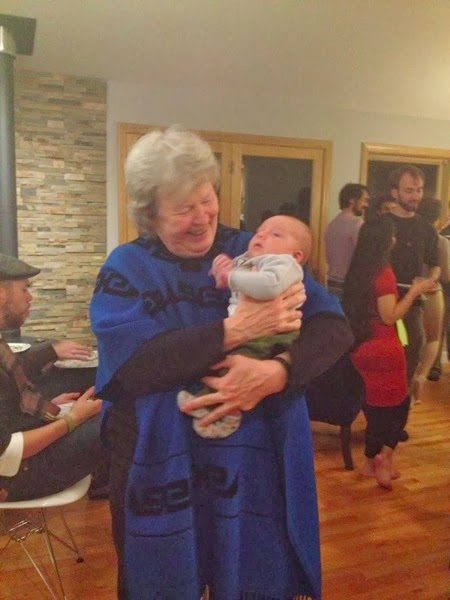
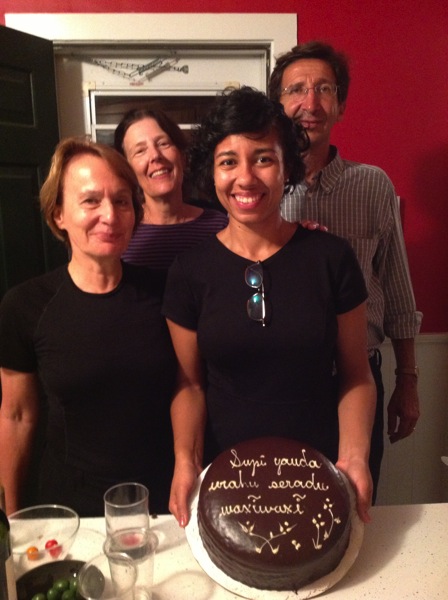
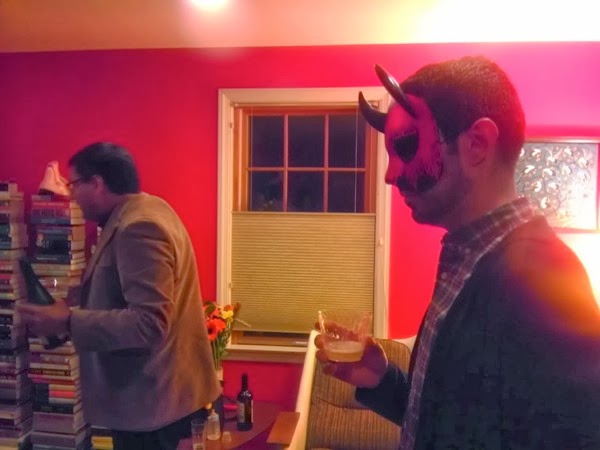
And there were characters.

IMAG0748IMG 0126

IMAG0735Mail Attachment

IMG 0136

971493 10151710315483483 1432991875 n

IMG 0140IMAG0767

21 October 2013

William Snyder speaks in Oiry/Johnson Seminar on Wednesday

William Snyder (UConn) will give a talk entitled "Evidence of parameter-setting in the acquisition of English particles and datives" in the seminar on Arguments and Acquisition that Magda Oiry and Kyle Johnson are conducting. His talk is on Wednesday, October 23, at 4PM in Dickinson 210. Everyone is welcome.

20 October 2013

Adam Albright gives colloq on Friday

Adam Albright (MIT) will give the department colloquium on Friday, October 25, in Machmer E-37 at 3:30. A title and abstract follow.

Modeling the acquisition of phonological alternations with learning biases
[joint work with Young Ah Do, Georgetown University]

What expectations do learners bring to the task of acquiring alternations? We provide evidence for three biases: (1) a bias against alternations, favoring uniform paradigms (McCarthy 1998); (2) a bias in favor of alternations that target broader classes of segments (Peperkamp et al. 2006); (3) a substantive bias against perceptually salient alternations (Steriade 2001). 

Learners’ biases were probed using Artificial Grammar experiments, in which adult English speakers were taught singular~plural pairs in a “Martian language”, and were then asked to produce or rate plural forms. In the artificial language, obstruent-final stems exhibited either voicing alternations (dap~dabi) or continuancy alternations (brup~brufi), for both labial-final and coronal-final stems.  By manipulating the frequency of labials vs. coronals, we were able to vary the amount of data concerning different segmental alternations. If learners are biased to expect non-alternation, then we expect fewer alternating responses for the rarer segment, and this is indeed what we observe: participants often produce non-alternating responses for the rarer segment, even though non-alternation was unattested in the training data.

By manipulating the relative proportion of voicing vs. continuancy alternations across the two places of articulation, we were able to pit frequency of segmental alternations (p~f > p~b) against feature-level frequency (voicing > continuancy). If learners expect alternations to target natural classes, rather than individual segments, then we expect subjects to prefer the alternation that is overall more frequent across both classes.  In general, this is indeed what we find: subjects prefer to generalize the featurally more frequent alternation, even if it is less frequent for particular segment pairs.  However, the effect of feature-level frequency differs significantly depending on the feature. Comparing across experiments, we find that subjects more readily extend voicing alternations across different places of articulation than continuancy alternations.  We attribute this to a learning bias against certain featural alternations.  Finally, we show how these relative preferences can be modeled using a regularized maximum entropy model of constraint weighting.

Phonology gurus arrive

Joe Pater writes:

In the first half of November we will have the great pleasure of having not only Elliott Moreton and Sharon Peperkamp visiting us as phonology gurus, but also Anne-Michelle Tessier in our midst as well. I'm writing now primarily to encourage people to get in touch with the three of them, whom I've cc'd, to set up meetings. Meeting with students is the primary function of a guru-ship, and Anne-Michelle has indicated that she'd also like to get (re-)acquainted with the current denizens of South College while she's here. Please visit their websites to find out about their research - I could never do justice to any one of them with a short blurb. 

Peperkamp - 1st week of November -  http://www.lscp.net/persons/peperkamp/
Moreton - 2nd week of November - http://www.unc.edu/~moreton/ 
Tessier - 1st 2 weeks of November - http://www.ualberta.ca/~annemich/

Sharon and Anne-Michelle will both be talking at Phonology 2013 November 9th and 10th (please register *today* if you haven't already), and Elliott will be giving a colloquium November 15th. There will also be further classes and PrG events that will be announced separately. 

http://blogs.umass.edu/phonology-2013/

Acquisition Lab/LARC on Wednesday

Magda Oiry writes:

The acquisition lab / LARC meeting this Wednesday (Partee room 12:15 to 1:15) will be a "conference round-up" where we discuss ideas from the recent conferences we have been involved in: acquisition of quantification, Multiple grammars, Rio conference on recursion.

Everyone is welcome!

Call for Papers: Experiencers in Natural Language Semantics

Modeling experiencers in natural language semantics

January 13-16, 2014, Tezpur, Assam, India

Workshop hosted by the 5th Indian School on Logic and its Applications (ISLA 2014)

Webpage of the local organisation: http://www.tezu.ernet.in/isla2014/index.htm


Invited speakers

Eric McCready (Aoyama Gakuin University)
Brendan Gillon (Mc Gill)
Carla Umbach (Zentrum für Allgemeine Sprachwissenschaft)


Meeting description

There is a long-standing tradition of using logical and, more specifically, model-theoretic tools in the analysis of natural languages. Building on this tradition, our workshop aims at addressing one specific issue that has been the topic of discussion lately in the areas of formal semantics, applied logic, computational linguistics, and philosophy. The issue at stake is the notion of experiencer, across languages and across linguistic categories. For example, it is commonly assumed that in a sentence like "Deeti's performance astonished Raj", Raj occupies the role of the experiencer. One of the open questions currently under debate is whether this experiencer argument remains present in derived adjectives such as 'astonishing', as in "Deeti's performance was astonishing". Another open question is whether derived adjectives like 'astonishing' belong to the same semantic category as morpho-syntactically simple adjectives like 'nice' or 'great', which are commonly classified under the label of evaluative adjectives and have elicited a heated debate in semantics and in philosophy. Yet another question is the role of experiencers in other linguistic constructions such as, e.g., evidential markers (which do not exist in English but do e.g. In Japanese). In addressing these and other questions concerning experiencers, our workshop aims at reaching a better understanding of the nature of argument structure in natural language, which we take to be a key element in understanding the logical patterns that linguistic constructions give rise to, and in modeling the logic of natural language. Our interdisciplinary workshop will provide a platform for a fruitful exchange between those working in foundational areas in logic and those who are interested in the applications of logic to natural languages.


Call for Papers

We invite abstracts for 40-minute presentations (30 + 10) to be submitted by October 22 to both of the following addresses:

berit.gehrke@upf.edu
isidora.stojanovic@upf.edu

Please include your name, affiliation and the title of the abstract in the body of the e-mail. Abstracts should be anonymous and should not exceed 2 pages in length (A4 or letter-size), in 12 pt. font, with 1-inch/2,5-cm margins, including examples and references. The language of the submissions and the presentations will be English.


Important dates

October 22, 2013: Deadline for abstract submission
October 31, 2013: Notification of acceptance
January 5-17, 2014: ISLA 2014
January 13-16, 2014: Workshop dates


14 October 2013

Roberto Zavala Maldonado speaks on Friday

Roberto Zavala Maldonado, a linguist from CIESAS-Sureste, will give a talk entitled "Preferred Argument Structure in Chol (Mayan), an agentive language," at 3:30 on Friday, October 18 in Machmer E37. Professor Maldonado, an expert on Mayan and Mixe-Zoquean, languages will be here all week and is available for meetings. To make an appointment, get in touch with Rajesh Bhatt.

Rajesh Bhatt gives colloq talk at Michigan

Rajesh Bhatt presented joint work with Stefan Keine at a department colloquium at the University of Michigan on October 4. A talk and abstract follows.

An Argument for Semantically Contentful Head Movement

In this presentation we develop an argument that head movement may
have semantic effects and that it can hence not be a PF phenomenon.
The argument is based on novel facts regarding scope in infinitival
complementation structures in German. We show that every element
inside the infinitival clause must take scope over the matrix verb if
the embedded clause is a VP that remains in situ. If, by contrast, the
embedded clause is either a vP or a VP that undergoes movement, no
such wide scope is possible. We propose that wide scope of embedded
elements is the result of syntactic verb cluster formation: The
infinitival verb incorporates into the higher verb. To obtain the
observed scope facts, we suggest that the verb cluster is semantically
interpreted via Function Composition. Supplemented with standard
assumptions about the interpretation of movement, this account derives
the wide scope of material inside the embedded clause.

PhD position at Université Paris Diderot

PhD position at Université Paris Diderot: Verbal ellipsis in Portuguese and English

The Université Paris Diderot (Paris 7) is offering a fully funded three year PhD grant in linguistics on the topic of "Post-verbal ellipsis in Portuguese and English". Research is to be conducted at Paris Diderot, under the joint supervision of Philip Miller (Université Paris Diderot, Paris 7) and Sonia Cyrino (Unicamp, Universidade estadual de Campinas). The position is expected to open in January 2014, subject to final confirmation of funding, with a salary of at least 1400 euros per month. A detailed description of the project is included at the end of the document.

Qualifications
Candidates must have excellent command of Portuguese (Brazilian or European) and English. They must hold a master's degree in linguistics (or in a related field), and have research experience in one or more of the following specialties: syntax and semantics of Portuguese, syntax and semantics of English, ellipsis and anaphora, discourse pragmatics, corpus linguistics, psycholinguistics.

Application
Candidates should send a CV, a .pdf copy of their Master's thesis, a statement of interest, and the names of three references (with their contact information) to Philip Miller (philip.miller@univ-paris-diderot.fr) and Sonia Cyrino (cyrino@iel.unicamp.br) by October 27 2013.

NELS 44

This weekend, UConn, Storrs is hosting NELS 44, where the following members of the department will give posters.

Visiting professor Ilaria Frana will give a poster with UMass alumnus Kylito Rawlins entitled: `Mica' questions and bias.

Andrew Weir will give the poster "Fragment answers and the Question under Discussion."  

Shayne Sloggett will give the poster "Case Licensing in processing: Evidence from German"

Alumna Junko Shimoyama will also give a talk with Alex Drummond entitled "QR as an agent of vehicle change: Evidence from Japanese and Hindi comparatives.

Bhatt/Keine get paper accepted to Linguistic Variation

Linguistic Variation has accepted for publication "Complete and Defective Agreement in Kutchi" by Rajesh Bhatt and Stefan Keine. Congratulations!

Japanese/Korean Linguistics 23

MIT is hosting the Twenty-Third meeting of the  Japanese/Korean Linguistics conference. UMass alumna Junko Shimoyama is an invited speaker, and there are talks by alumni Chris Davis, Kiyomi Kusumoto, and Jennifer Smith. Go here for more information.

07 October 2013

Lap-Ching Keung on Wednesday

Lap-Ching Keung is giving a talk this week in our Brown Bag (Wednesday, Tobin 521B, 12-1:15). The title of his talk is "Effects of Discourse Status and Planning Difficulty on Acoustic Variation".

His abstract is:

Repeated words within a discourse tend to be acoustically reduced. This variation can be explained by a pragmatic selection rule (discourse status) or by speaker facilitation (planning difficulty). For this experiment, we ask whether these effects are part of the same cognitive system or different systems. Participants saw an array of four objects and described a sequence of two movements like, "The chiddle moved above the hamel. The *cammer moved above the neeken." The *target?s discourse status and planning difficulty were manipulated. Durations were longer for new vs. given and novel vs. familiar, which replicated findings from previous research. More importantly, at the target noun, there was a trend towards an interaction. Givenness had a greater effect on novel targets. Although not significant, onset latency patterned in the same way as target duration, showing a correlation between the two factors. These results together suggest that discourse status is partially mediated by planning difficulty, which further suggests that the two effects are operating from the same cognitive system.

Valentina Brunetto at LARC on Wednesday

Magda Oiry writes:

Valentina Brunetto a post-doc fellow from England and Italy will present 

"Acquisition of near-reflexivity" 

at the LARC meeting on Wednesday, October 9 at 12:15 in the Partee Room.

Everyone welcome!

Workshop on Quantification a roaring success

Barbara Pearson writes:

We want to report the success of the LARC Workshop on the Acquisition of Quantification, which took place October 4 and 5 in the Math Lounge 1634 at UMass Amherst and was attended by roughly 70 students and more senior experts from Canada, the UK, Hungary, The Netherlands, France, Italy, and Germany, plus New England, New York, New Jersey, and Michigan.  Tom Roeper set the tone with his opening comments: "Why are there no methods, only theories: Experimental style and the historical path from syntax to discourse in the acquisition of quantification."  Invited talks by Julien Musolino (Rutgers), Bill Philip (Utrecht), and Martin Hackl (MIT) stimulated lots of discussion that spilled over into the breaks and shared meals. Congratulations to organizers Jeremy Hartman and Magda Oiry, with help from Mike Clauss, Tom Roeper, Tom Maxfield and Barbara Pearson.

They are now turning their attention to publishing a Proceedings.

World Phonotactics Database

From the Department of Linguistics at Australian National University:

We wish to announce the public release of the World Phonotactics  
Database, an online searchable relational database containing  
information about phonotactic restrictions from around the world.  
Using the database, you can compare and contrast phonotactic patterns  
in different languages, group languages by features, investigate the  
frequencies of different settings for different features, view the  
areal distribution of such patterns through the use of the interactive  
map, and check correlations with other phonological features.

The World Phonotactics Database includes phonotactic information on  
over 2300 languages, with segmental data for an additional 1400. At  
their most basic level, each language entry includes information on  
phonemic inventories, restrictions on consonant and vowel placement,  
and phonotactic restrictions concerning specific sounds in coda and  
onset position. The database, which was implemented by James  
McElvenny, contains extensive coverage, and is continuously updated as  
more data becomes available.

As in any project of this size, the database will contain errors,  
whether these be errors in the coding of information or errors in the  
sources consulted. We welcome any feedback correcting these errors as  
well as any other suggestions or comments you may have. We can be  
contacted at phonotactics@anu.edu.au.

For more information and access to the database itself, please visit
http://phonotactics.anu.edu.au

30 September 2013

Workshop on the Acquisition of Quantification

The Linguistics Department will be hosting a workshop on the acquisition of quantification on Friday and Saturday in the Math lounge (Graduate center). Alumni Angeliek Van Hout, Bart Hollebrandse and Gennaro Chierchia have papers, as do locals Tom Roeper, Jill and Peter de Villiers, Amanda Rizun, Jeremy Hartman, Seth Cable, Rama Novogrodsky, and Magda Oiry. There are invited talks by Julien Musolino and Martin Hackl. 

Schedule and information can be found at http://blogs.umass.edu/moiry/workshop-quantification/

29 September 2013

Assistant Professor Position at Hampshire College

Joanna Morris from Hampshire College writes:

Hampshire College, an independent, innovative liberal arts institution, is accepting applications for an Assistant Professor of Linguistics in the School of Cognitive Science. The position carries a 4-course per year teaching load and also includes supervision of undergraduate concentrations and thesis projects. The area of specialization is open. We are particularly interested in candidates who have successful records in undergraduate teaching and who can make connections across the cognitive or neural sciences.

Hampshire College, located in Amherst, MA, is a member of the Five Colleges, Incorporated, a nonprofit educational consortium established in 1965 to promote the broad educational and cultural objectives of its member institutions which, along with Hampshire, include Amherst College, Mount Holyoke College, Smith College, and the University of Massachusetts Amherst.

The consortium fosters close academic collaboration, and facilitates intellectual communities and broad curricular and co-curricular offerings.  All members of the consortium benefit from the shared use of educational and cultural resources and facilities, including a joint automated library system. Students are allowed to register for nearly any course offered on any of the five campuses.

Hampshire's unique academic program requires that students work closely with a faculty committee to design and carry out a personalized course of study, the concentration.  A concentration may range from a plan of study similar to that of a traditional college major to a highly individualized program of study that encompasses several disciplines or areas of conceptual thought and understanding.   There are no courses that are required of all students, and faculty are encouraged to develop innovative interdisciplinary courses that introduce students to their intellectual passions and that explore new, cutting edge areas of scholarship.

The review of applications will begin November 1, 2013 and continue until the position is filled.  A Ph.D. is required at time of appointment, July 1, 2014. Hampshire College offers a competitive salary and comprehensive benefits. Applicants should submit the following: 1) letter of application; 2) curriculum vita; 3) teaching statement with descriptions of potential courses; 4) research statement and 5) three professional references via our website at http://jobs.hampshire.edu/

Hampshire College is an equal opportunity institution, committed to building a culturally diverse intellectual community and strongly encourages applications from women and minority candidates.

PRG on Thursday

Claire Moore-Cantwell writes:

PRG will meet on October 3, 7:30pm, chez Ivy.  We will be 
discussing Robert's paper which he is planning to submit to Phonology.  
Further details to follow.

A Language Acquisition position at Boston University

Boston University is currently searching for an Assistant Professor specializing in language acquisition and linguistic theory, and will be conducting interviews at the BUCLD and LSA meetings for applicants in attendance. The application deadline is OCTOBER 1.

For more information: https://academicjobsonline.org/ajo/jobs/2803

Kai von Fintel on howtobecomeaprofessor.com

UMass Alumnus and MIT's Associate Dean of Humanities, Arts and Social Sciences Kai von Fintel is interviewed about how to be come a linguist. Check it out here.

Call for papers: SALT

Semantics and Linguistic Theory (SALT) 24 will be hosted by the Linguistics Department of New York University on May 30 through June 1, 2014.

Invited Speakers:

    Emmanuel Chemla (ENS)

    Valentine Hacquard (Maryland)

    Lauri Karttunen (Stanford)

    Sarah Moss (Michigan)

The conference will be preceded by a series of tutorials on Formal Semantics Beyond Spoken Language, on May 29.

The abstract submission deadline is Monday, December 2, 2013, 11:59 pm EST. We expect to make notifications of acceptance in late February.

Detailed instructions are available at: http://www.nyu.edu/salt2014

Please direct inquiries to salt2014inquiry@gmail.com or reply to this message.

BUCLD Registration open

38th Annual Boston University Conference on Language Development

November 1-3, 2013

Keynote Speaker:

Elena Lieven, Max Planck Institute for Evolutionary Anthropology / University of Manchester

Plenary Speaker: 

CANCELED: Heather van der Lely, Harvard University

Unfortunately, Heather van der Lely's plenary address has been cancelled for health reasons. We regret that we cannot hear her address and wish her the best in recovery.

Symposia:

Saturday - 'Resolving A Learnability Paradox in the Acquisition of Verb Argument Structure: What have we learned in the last 25 years'

Ben Ambridge (University of Liverpool) (organizer)
Adele Goldberg (Princeton University)
Joshua Hartshorne (Massachusetts Institute of Technology) & Jesse Snedeker (Harvard University)
Steven Pinker (Harvard University) 

Sunday - 'A new approach to language learning: filtering through the processor'

Helen Goodluck (University of York) (organizer)
Lyn Frazier (University of Massachusetts, Amherst)
Colin Phillips (University of Maryland, College Park)

We would like to remind you that the deadline to pre-register for BUCLD 38 is Tuesday, October 23, 2013. By pre-registering not only will you receive a reduced rate for the conference, but you will also be able to check-in at the registration desk quickly and proceed to the various exciting talks without waiting in line. Regular full-price registration will continue to be available online from Thursday, October 24 through Tuesday, October 29. To register, please visit the following website:

http://www.bu.edu/bucld/conference-info/registration/

For general information on the conference including the full schedule, please visit:

http://www.bu.edu/bucld

Also, you can register for the Society for Language Development Symposium "Mechanisms of Word Learning" on Thursday October 31, 1-6pm through our website. The SLD would also like to announce their student award. Please see their website for more information:

http://www.bcs.rochester.edu/sld/symposium.html

Johnson in Leipzig

Kyle Johnson is giving a talk entitled "The Empty Category Principle and linearization" at the 28th Comparative Germanic Syntax Workshop Saturday, October 5 at the University of Leipzig. The Workshop's website is here.

25 September 2013

Akira Omaki speaks at department colloq

Akira Omaki of Johns Hopkins will be giving a colloquium:
Friday, Sept. 27, 3:30 pm
in Machmer E-37.

Title and abstract are below.

Learning to parse syntactic dependencies

Much psycholinguistic research has investigated the relation between distributional information and expectations in language comprehension. One way to study this relation is to examine how expectations arise during sentence processing in adults as a function of relevant distributional information in corpora. An alternate approach is to explore how such predictive behaviors grow in children as a result of relevant distributional information that accumulates over a longer period of time. This presentation will discuss a series of studies that explore the second approach, with a focus on learning and processing of non-local dependencies. The first part of the talk explores the role of transitional probability information (and its breakdown) in learning a dependency between 'is' and 'ing' (e.g., John is kick-ing the ball). It is shown that 15 month old infants, who generally do not demonstrate sensitivity to the co-occurrence of is and ing, can use statistical (ir)regularities and learn to detect the co-occurrence relationship after a few minutes  of exposure to input in the lab. The fact that children rely on distributional information to discover non-local dependencies makes it feasible that the acquired representations with statistical information may guide parsing of such non-local dependencies. The second part of the talk presents developmental research on comprehension of various wh-questions. It is shown that children's syntactic expectations in filler-gap dependency processing may be slightly different from the type of expectations that have been observed in adults, despite the fact that the distributional information available for children should fully support adult-like expectations. I will discuss implications of such findings for psycholinguistic models of syntactic predictions, as well as relevant linguistic and cognitive factors that may need to grow before adult-like predictive behaviors emerge.

22 September 2013

Clauss at LARC/Language Acquisition Lab on Wednesday

Magda Oiry writes:

Michael Clauss will present 

"Exploring the distinction between Wh clauses and Question clauses in Child English"

at the LARC meeting on Wednesday, September 25 at 12:15 in the Partee Room.

Everyone welcome!

Andrew Weir in Leiden

Andrew Weir gave a paper, "Fragment Answers and congruence with Question under Discussion" at the Identity in Ellipsis Conference at Leiden University yesterday, September 21. For more information about the conference, click here.

Call for papers: GLOW 37

The annual meeting of the Generative Linguists of the Old World will take place in Brussels April 2-11, 2014. In addition to the main colloquium, there will be a workshop on "Phonological Specification and Interface Interpretation" and another workshop on "Understanding Possession."  Paula Fikkert, John Harris and Bert Vaux are invited speakers to the first workshop, and Chris Barker and Kilu von Prince are invited speakers to the second workshop. Two page abstracts should be submitted by December 1, 2013. More information can be found here.

Lisa Green in Ithaca

Lisa Green will give a talk at Cornell entitled  "Inversion in African American English: When Negation Isn't Enough" on September 26 (Thursday).

Call for Papers: Representing the Speech of Others

(Re)presenting the Speech of Others

Date: 13-Mar-2014 - 14-Mar-2014
Call Deadline: 01-Dec-2013
Location: Groningen, Netherlands
Organization: Franziska Köder & Emar Maier
Hosted by the ERC project BLENDS
Contact: f.koder@rug.nl
--------------------------------------------------------------
https://sites.google.com/site/representing2014/
---------------------------------------------------------------

There are different ways of reporting what someone else has said. Common forms of speech reports are direct speech (Mary said 'I am sick') and indirect speech (Mary said that she is sick). Pretense and role play are closely related phenomena. Like in direct speech, someone engaging in role play adopts the perspective of another person and produces utterances from that shifted standpoint (I am sick) (Harris, 2000). Another interesting parallel is that children start to use speech reports and to engage in role play at around the same time, namely at two to three years of age. This is well before they pass standard false belief tests (at around four) which are often taken to be the hallmark of Theory of Mind and metarepresentation (e.g. Perner, 1991).

Since at least some forms of reported speech exhibit recursion, intensionality, and/or clausal embedding, this developmental gap may shed new light on the debate over the relationship between Theory of Mind and the syntax/semantics of recursive embedding (e.g. de Villiers & de Villiers, 2000). The aim of the conference is to discuss the cognitive and conceptual relationship of reported speech, pretense and cognitive abilities such as perspective-taking, metarepresentation and Theory of Mind.

Keynote Speakers:

- Paul L. Harris
- Josef Perner
- Jill de Villiers

Call for Papers:

We invite authors to submit an anonymous two-page abstract by 1 December 2013
, for a talk of 20 minutes plus 10 minutes discussion or a poster. Submissions should be made via Easychair. We welcome theoretically and empirically oriented contributions addressing some of the following topics of interest from the perspectives of (psycho)linguistics, philosophy, psychology or semantics.

Topics of Interest:

- Development of reported speech
- Development of pretense/ role play
- Direct and indirect speech
- Perspective shift, role shift, deictic/indexical shift
- Theory of Mind / mindreading
- Metacognition and metarepresentation

Barbara in London and Cambridge

Barbara is in England Sept 24-29 for a big conference and a little workshop. On September 25, she and Luigi Rizzi will be the two speakers at a small workshop organized by Ian Roberts at the University of Cambridge on “Formal Approaches to Linguistic Theory”, where her talk will be “The starring role of quantifiers in the history of formal semantics”. Then on Sept 26-27, she’ll be one of the speakers in a big conference in London sponsored by the British Academy, organized by Ian Roberts and Theresa Biberauer, on the theme “The Cognitive Revolution 60 Years On” . Her talk there will be “How syntax and semantics have provoked different views of linguistic competence.”

Call for abstracts: CHRONOS 11

The deadline for abstracts for Chronos 11 (11th International Conference on Actionality, Tense, Aspect, Modality/Evidentiality), which will take place in Pisa on 16--18 June 2014, is  31 October 2013. For more information go here.

In addition to the main session, of particular note is the variety of interesting workshops proposed.

18 September 2013

Psych! Evening on Wednesday

Brian Dillon writes:

Just a reminder that Psych! Evening Meeting #1 is tonight, at 7:30. Address is 181 Main Street, Apt C, Northampton (next to the Haymarket). The paper we're going to be discussing is " Towards a model of grammaticality judgments" by Markus Bader and Jana Häussler. For our first meeting we'll try and do a little planning for the semester, and then we'll have an informal discussion of the Bader and Häussler paper. It's a useful paper to read and think about for people using acceptability judgments in their work (which is an awful lot of us!)... and it raises enough interesting questions that there should be plenty to talk about. I'll provide beer, wine, and snacks.

15 September 2013

Ivan Sag 1949-2013

It is with sadness that WHISC notes the passing of Ivan Sag this week. Ivan was professor of linguistics at Stanford, where he had been since 1979. He graduated from MIT with a dissertation on Ellipsis in 1976. He died on Tuesday, September 10, after a three year battle with cancer. Stanford hosted a workshop in honor of Ivan's forty years in the field last Spring, and there are a series of tributes to him that can be found at the workshop's website.

Barbara Partee gives keynote at Princeton

Barbara Partee writes:

On Sept 14-15 I will be one of the keynote speakers at a conference at Princeton organized by a group of philosophy students there; the name of the conference is taken from the name of a 1979 paper of Barbara’s, “Semantics – Mathematics or Psychology?”. [https://sites.google.com/site/crnap2013/]. My talk will be “Changing Perspectives on the  “Mathematics or Psychology” Question”. (The question alludes to the clash between the Fregean and Chomskyan traditions.) The other keynote speaker will be Paul Pietroski of the University of Maryland. The conference is under the aegis of The Collaborative Research Network in Analytic Philosophy (CRNAP), a collaboration among Princeton, Oxford, the Jean-Nicod Institute, and Australian National University.

Workshop on the Acquisition of Quantification in October

On October 4-5 the department will host a Workshop on the Acquisition of Quantification, co-sponsored by LARC, ICESL, and the University of Massachusetts at Amherst.
 
Attendance is free if one registers before Sept, 27.
 
Information and a program can be found at http://blogs.umass.edu/moiry/workshop-quantification/
 

Workshop at Yale

A free mini-workshop on Imperatives, embeddability and politeness will be hosted by the Linguistics Department at Yale on October 17. The Workshop starts at 9:15 and runs to 5:30. The three talks are:

"Typology of Root Phenomena" by Shigeru Miyagawa

"Speech Style in Root and Embedded Imperatives" by Miok Pak, Paul Portner and Raffaella Zanuttini

"Embedded imperatives across languages: Too rare to expect, too frequent to ban" by Magdalena Kaufmann

If you plan on attending, write to raffaella.zanuttini@yale.edu for more information.

Suzi Lima is defended

Suzi Lima defended her dissertation on Monday, August 26 with flying colors. Her dissertation, "Counting and Measuring in Two Tupi Languages," passed the muster of this outsized committee: Seth Cable, Gennaro Chiercia, Chuck Clifton and co-chairs Angelika Kratzer and Lyn Frazier. 

Photo

Call for papers: Semantics and Philosophy in Europe 7 in June

The seventh "Semantics and Philosophy in Europe" colloquium (SPE 7) will be hosted by the Zentrum für Allgemeine Sprachwissenschaft (ZAS)  in Berlin on June 26-28 , 2014. The deadline for abstracts is February 1. For more information click here.

Gennaro Chierchia has a birthday

Barbara Partee writes:

On September 6, there was a surprise 60th birthday party for UMass PhD Gennaro Chierchia at Harvard (his birthday was Sept 10; by the time this note is published it should be safe to reveal that there will have been another surprise event in honor of his birthday, at Sinn und Bedeutung in the Basque Country during the week.) Gennaro was presented with a festschrift edited by his former students Ivano Caponigro and Carlo Cecchetto entitled From Grammar to Meaning:The Spontaneous Logicality of Language, including articles by Partee, Chomsky, Rizzi & Belletti, and others, and including as an appendix a play written at UMass in 1984 by Ray Turner and Kathy Adamczyk, dramatizing Gennaro and Ray's stormy collaboration on property theory.
 
At the party, Gennaro was presented with copies of the book inscribed by Chomsky and by Partee.  UMass faculty attending the celebration besides me were Lisa Selkirk, Angelika Kratzer, Tom Roeper, Lyn Frazier, and adjunct faculty member Vladimir Borschev.

The party turned out to be a complete surprise to Gennaro, even though Gennaro's wife Isa Orvieto was one of the planners, together with Ivano and Carlo. 

 
IMG 4549

09 September 2013

UMAFLAB meets on Friday

Seth Cable writes:

I'm very happy to announce that the first meeting of the UMAFLAB (UMass Funny Language Breakfast) will be this Friday at 9AM in room 301 of South College (the Partee Room).

This will be a short, purely organizational meeting, where we'll set up our schedule of meetings for the term. Thank you to everyone who wrote in mentioning an interest in presenting!

As another brief reminder about what UMFLAB is: the purpose of UMAFLAB is to bring together individuals with a shared interest in puzzling linguistic data, optimally (but not necessarily) from understudied or minority languages. *Presentations are always informal*. We are *not* looking for polished work or practice talks (though those are welcome).  Rather, participants are free to present any puzzles they like. They needn't have any analysis in mind; indeed, part of the fun of the group is hearing other people's thoughts on some difficult problem.

Thus, if all you have is an interesting pattern worth 'boggling at', that's perfect for our group (particularly if it's from an otherwise not-very-much-talked-about language or variety). For example, a run down of all the crazy data obtained during some recent field work (or experimental work, or whatever) would be quite ideal.

LARC/Acquisition Lab Meetings on Wednesdays: Meghan Armstrong this week

Magda Oiry writes:
 
Welcome back everyone and welcome to newcomers!
 
This year the acquisition lab LARC meeting will meet on *Wednesdays* from *12:15 to 1:15* in the Partee room (South college 301).
 
We will meet every other Wednesday.
 
Our first meeting will be this Wednesday, September 11. Meghan Armstrong, a new faculty member in Hispanic Linguistics (LLC) will be presenting on 'Child comprehension of belief state intonation in Puerto Rican Spanish'.

We will also do introductions and try to lay out an agenda for the semester.
 
Make sure you're on the mailing list: go to https://list.umass.edu/mailman/listinfo/ling-acquisition

Tom Ernst at Dartmouth this year

Tom Ernst will be teaching at Dartmouth this academic year. In the Fall, he'll be teaching their Introduction to Syntax course, and in the Spring, a course on Dialects. 

Seth Cable gets an NSF

Seth Cable has been awarded a three year grant from the National Science Foundation for "The Verbal Morpho-semantics and clausal architecture of Tlingit.  A brief description of the grant follows.

Congratulations Seth!

The Verbal Morpho-semantics and Clausal Architecture of Tlingit
 
This project will conduct detailed, theoretically-informed fieldwork upon the Tlingit language (Lingít, /ɬin.kít/), a highly endangered and understudied language indigenous to Alaska, British Columbia, and the Yukon. The project will focus upon aspects of the language related to the expression of time and possibility, as well as the nature of the language's relatively flexible word-order. 
 
This project will yield results of significance to both professional linguists and community members striving to learn Tlingit as a second language. Both groups will directly benefit from the collection of new Tlingit language data, given the language's status as highly endangered. In addition, study of the specific linguistic phenomena identified in this project will make distinct, important contributions to diverse areas of linguistic theory. For example, the investigation of word-order and sentence structure in Tlingit is expected to establish for linguists the existence of ‘covert A-scrambling’, a grammatical process whose existence is predicted by theory, but which has thus far not been definitively documented. Furthermore, study of the grammatical means by which Tlingit expresses the concepts of time and possibility will inform specific debates surrounding the extent to which languages vary in the expression of these concepts, thus probing deep and long-standing questions relating to human nature and the structure of human cognition. 
 
Beyond these technical results, this project will advance ongoing efforts to document, maintain and revitalize the growing number of endangered languages throughout the world, mitigating the inevitable and catastrophic language death that will occur by the end of this century. This project will uncover subtle grammatical generalizations of no small importance to the growing number of persons learning Tlingit as a second language. Moreover, the digital recordings and field reports made during this project will be added to the archives stored at the Sealaska Heritage Institute and the Alaska Native Language Archive, preserving for future Tlingit generations the voices and the words of their forebears.

The Psycholinguistic Evening Meetings

Brian Dillon writes:

This fall semester John Kingston and I would like to resurrect the great tradition of the UMass Psycholinguistics evening meetings. We invite you to join us for the Psycholinguistics Evening Meetings... Psych! (EM).
 
Psych! (EM) will meet every 2-3 weeks during the semester. It will function mainly as a reading group / journal club, as well as a venue for discussion of in-progress projects in Psycholinguistics. If there's a psycholinguistics paper you've been dying to read or some puzzling data you've been dying to discuss, an experimental technique you would like to talk about, then this is the venue! Psych! (EM) also intends to be a forum for discussion of technical / methodological issues related to the various experimental paradigms that people are using around the department. 
 
If you'd like to receive further updates on PsychEM meetings, please sign up for the *ling-psych mailing list*. Meeting announcements and information will be sent out to that mailing list. You can sign up for the list here: https://list.umass.edu/mailman/listinfo/ling-psych
 
Our first meeting will be Wednesday September 18th at 7:30pm, at my house in Northampton (181 Main St, Apt C). I'll provide beer and snacks. For this meeting we'll do our semester planning, and read 'Towards a model of acceptability judgments' by Markus Bader and Jana Häussler (here's a link that will work on campus: http://journals.cambridge.org/production/action/cjoGetFulltext?fulltextid=7802268). The (informal) discussion will be led by Brian.

PRG meets on Thursdays

Claire Moore-Cantwell writes:

You are cordially invited to Phonology Reading Group (PRG) meetings this 
semester.  They will take place in Northampton, at 7:30 pm on Thursdays, 
approximately every other Thursday, starting next week:

Thursday, Sept. 12, 7:30 pm
Location: 16 Main st., apartment 2A (Shayne and Amanda's place, 
directions below)
Topic: 'Effects of sonority on phonological inventories' By Ivy Hauser
Food: Bring your own take-out

Directions: enter through the first set of doors leading to Pho Vietnam, 
then turn immediately right. Open the door just beyond the mailboxes. Go 
upstairs one flight, turn left, then left again, to arrive at our 
apartment door.

M@90

Michael Kenstowicz from MIT writes:

The MIT Department of Linguistics is holding a workshop/conference on Stress and Meter on Sept. 20-21 entitled M@90. As the conference name suggests, it is intended to celebrate Morris' 90th birthday and honor the fundamental work he has done in these areas of research (as in so many others). The conference has a website (http://m90.mit.edu/) and we are asking attendees to register in order to know how many people to expect. There is also a Tabula Gratulatoria to which you can submit messages for best wishes, etc. 

Program in Informatics

The School of Computer Science announces a new program in Informatics through BDIC, which will eventually turn into a major in the School. If you are interested in Informatics or in the Computer Science major, you should attend a meeting Monday, September 9, at 4 PM in 150/151 Computer Science Building.

More information about the Informatics program may be found atwww.cs.umass.edu/informatics.

02 September 2013

Michelle McBride joins the Linguistics Department

With great pleasure, WHISC announces that  Michelle McBride assumed the duties of department secretary on July 29th. Step into the main office this week and join us in welcoming her to the department.

Town Meeting on Friday

John Kingston writes:

As we do at the beginning of each year, we will kick off the year with a town meeting in the department lounge on the third floor of South College on the first Friday of the Fall semester at 3:30. This year that's 6 September. We'll also take a group picture and individual pictures for the board outside the first floor entrance, so come dressed as you would want to be photographed.

Department Picnic Sunday, Sept. 8

Please come to the annual beginning-of-the-year potluck picnic / party to greet the new school year and welcome new faculty, new students, new visitors. Bring friends and family!

When: SUNDAY, September 8, starting at 3:30, continuing on into the evening

Where: 50 Hobart Lane, Amherst, 01002. (413) 549-4501 -- Barbara and Volodja's.

Hobart Lane is a small street that goes east off North Pleasant just a short distance north of the university, opposite Puffton Village, near the Crestview /Presidential Apartments bus stop. 50 Hobart Lane is a big white house on the left, near the end. The street sign may be missing; but in that case it’s the only street around there with a pole but no sign. 

The party will be outdoor/indoor; dress casual. The picnic will be held rain or shine!

We don’t set up a volleyball net anymore, but do bring other outdoor stuff. We have a croquet set, and badminton raquets and birdies, and there’s ping-pong in the basement.

Food and drink: Potluck

We'll have a charcoal grill, and some beer, wine and non-alcoholic beverages (more needed). Bring things to eat in any category. International foods most welcome! (If you aren't up for cooking, you can bring beer or wine, or cheese, or fruit, etc.) We'll likely start eating around 4:30 or 5:00.

Elizabeth Bogal-Allbritten invited speaker at SULA

Elizabeth Bogal-Allbritten has been invited to speak at the next meeting of the Semantics of Under-represented languages in the Americas, which will be held in May at the University of British Columbia.

Congratulations Elizabeth!

P Reading Group meets this Friday

Claire Moore-Cantwell writes

The first official PRG MEETING will be a joint breakfast meeting with the Sound Seminar, FRIDAY SEPT. 6th AT 9AM, in the PARTEE ROOM.

Undergraduate Research Assistants in Psychology

Alexandra Jesse writes:

We are currently looking for undergraduate research assistants to work in the Language, Intersensory Perception, and Speech (short: LIPS) lab in the Psychology Department. Positions are open starting Fall 2013. Ideal applicants are those who can commit to a longer time period.

The work within the LIPS lab falls within the area of Psycholinguistics. We examine how listeners recognize speech from hearing and seeing a speaker talk. In particular, we are interested in the time-course of recognizing words - both from listening and from lip-reading, how listeners adjust to a speaker's idiosyncratic pronunciations, and what happens to these processes when people get older. We use eye-tracking and other behavioral methods to address these questions, as well as EEG.

You can visit our website for more information:
http://lips.psych.umass.edu

Typical tasks of our research assistants are:
- help with finding stimuli for an experiments (e.g., selecting words, making nonwords)
- help with recording, annotating, and editing of speech materials for the experiments
- assist with recruitment, scheduling, and testing of participants
- attend & prepare for weekly lab meetings
- do administrative research-related tasks

The typical commitment of our research assistants during the school year is 9hrs/week, for 3 credits. You would be enrolled in Psych 398B, but this course can count as an elective towards your linguistics degree. Please contact me if you have any questions about how these credits can be applied to your degree in Linguistics. Other majors are of course also eligible to apply.

So if you are interested in the position, please contact me as soon as possible for more information and for an application form. Once you return the completed application form, we will then contact you to schedule for an interview. We will then also require a letter of recommendation. Therefore, if you are interested, please respond to this email as soon as possible.

Please send any inquiries to participate@lips.psych.umass.edu

Bogal-Allbritten and Cable fill NLS

The recent issue of Natural Language Semantics (vol. 21.3) is an all UMass issue. It contains Seth Cable's article "Beyond the past, present, and future: towards the semantics of graded tense in Gikuyu" and Elizabeth Bogal-Allbritten's article "Decomposing notions of adjectival transitivity in Navajo."

Congratulations Seth and Elizabeth!

Department Colloq schedule announced

Mike Clauss and Claire Moore-Cantwell announce:

The Fall 2013 Colloquium Series has been scheduled! Lots of exciting talks to look forward to this coming semester.
 
9/27 - Akira Omaki (Johns Hopkins) 
10/25 - Adam Albright (MIT)
11/1 - Tim Hunter (Minnesota)
11/22 - Jon Gajewski (UConn)
 
Jason Merchant and Naomi Feldman were also both invited, but cannot make it this semester; they will thus be coming some time in the Spring semester to give colloqs.
 
In addition to these four talks, there will be a talk on 11/15 by Phonology Guru Elliot Moreton from UNC; more details on Professor Moreton's stay as Guru to come separately.

SNEWS at MIT in November

Aron Hirsch and Wataru Uegaki at MIT write:

We are pleased to announce that MIT will be hosting this year's SNEWS (Southern New England Workshop in Semantics) on November 16th (Sat). SNEWS is an annual student-run workshop where graduate students in the Southern New England area can present their work in semantics/pragmatics and receive feedback in an informal setting. Students are invited to present their ongoing work on any topic in semantics and pragmatics - theoretical and/or experimental methodology. Universities that have participated in the past include Brown, UConn, Harvard, UMass, MIT and Yale.

The workshop website can be found here: http://web.mit.edu/wuegaki/www/snews/

Call for papers: International Conference on Linguistics at Petra

The first meeting of the International Conference on Linguistics will take place November 19-21 at Al-Hussein Bit Talal University in Petra Jordan. Papers in syntax, semantics, morphology, phonology and psycholinguistics in English, French and Arabic are sought. The deadline for abstracts is October 6. Invited speakers are Hamida Demirdache, Abbas Benmamoun and Basil Hatim. For more information, go here.

Sinn und Bedeutung at the University of the Basque Country

Sinn und Bedeutung 18 takes place this month in Vitoria-Gasteiz in the Basque Country of Spain. UMass alumnus Florian Schwarz is giving a talk "An experimental comparison between presuppositions and indirect scalar implicatures" with Jacopo Romoli. The invited speakers include UMass alumni Maribel Romero and Gennaro Chierchia. For a full schedule, go here.

Tim Austin named Provost at Duquesne University

UMass alumnus Tim Austin (1977)  has been named provost and vice president for academic affairs at Duquesne University in PIttsburgh, effective July 15. For the full scoop, go here.

A report from the Rio Institute on "Recursion in Brazilian languages and Beyond"

Tom Roeper writes:

The Rio Institute on "Recursion in Brazilian languages and Beyond" was a great success---in both English and Portuguese. It involved 16 different indigenous languages with representative native speakers of
Piraha, Wapachana, Kuikuro and many others. [A great set of pictures and brief descriptions of each talk are available on Facebook under "Recursion in Brazilian Languages".] And there was a great mix of faculty, visitors, and graduate students from Brazil and abroad. It was very well organized by Professor Marcus Maia, a UMass visitor last year.

The first section involved fieldwork with two Piraha speakers. It was a wonderful circus with loads of current and former UMass folks getting into the act: Luiz Amaral, Bart Hollebrandse, Uli Sauerland, and Ana Perez (I was good at keeping an eye on the experimental setups--but was hopeless in parsing the tonal sentences---Luiz somehow, magnificently, figured out how to do it.) Recursion in PP's, adjectives, relative clauses, and sentences were explored with pictures, and
most successfully acting out. The monolingual Piraha speaker resisted for an hour acting out PP-DP recursion (roughly: ``put the penny in the box on the chair on board on the floor'') but then spontaneously produced PP-PP cases "put the penny on the floor on the board on the chair in the box") and then comparable cases were easy. While the sessions were a bit chaotic (will be available on Youtube soon), they are really pilots for two talented graduate students who will go to the Piraha for a year in Sept.

The conference involved a variety of papers with presentation of PP and possessives-recursion experiments on a common model from half a dozen Indian languages, Portuguese, and Japanese. There was obvious pride among the Indians and researchers in having accomplished co-ordinated research on complex constructions.

Also from UMass: Suzi Lima made two terrific presentations (and she will be co-ordinating further research soon), Bart Hollebrandse, Ana Perez, Jon Nelson, and Luiz Amaral made presentations (and I gave a keynote). Terue Nakato's providing parallel experiments in child Japanese to the work in Wapachana and elsewhere made the common character of human languages stunningly clear.

Then courses: Ana Perez gave a very nice course on her recent results with recursion among bilinguals and across constructions, Luiz Amaral and I gave a bilingual course on Multiple Grammars, and Uli Sauerland did a Fieldwork course exploring a variety of structures with native speakers. Andrew Nevins gave a course exploring intonation and recursion.

Personal View: it was extremely gratifying to me to see acquisition methods extended to fieldwork in a coordinated fashion---very promising.In a letter to some participants I wrote:

"    Altogether it was an amazing, inspiring, and historic Institute.  It begins to fulfill the promise of linguistics I think.  We are building--through a common event-- a community which reaches from sophisticated questions in mathematical linguistics, to linguistic theory, fieldwork, acquisition techniques, and pedagogical grammars.  Questions remain alive in all these areas---but each domain benefits from the intermingling of ideas long before "established results" are available.     Each area, and each person, should feel empowered to make the (provisional and reversible) decisions of how to borrow knowledge.  Those in linguistic theory must be able to choose the version of mathematical recursion needed, the acquisition student chooses the version of linguistic theory he/she wants, the fieldworker sees what can be adapted to fieldwork, and the teacher envisions how it will work as pedagogy.    Equal partners in each step of this process is what does and will make it work.  This institute contributes to a responsible intellectual culture with a real ladder between theory and practice.  It can be a worldwide model of how cooperation can proceed."

04 June 2013

Knowledge and Culture postdoc

There is a 3-year postdoc position available in the project coordinated at Leiden University, "Knowledge and culture" (subproject 2: Language and number). Please see this for further details. If you have any question, please address them to the project leader, Johan Rooryck: j.e.c.v.rooryck@hum.leidenuniv.nl.

Barbara in Scotland

Barbara Partee presented a talk at the Arché 2013 Philosophy of Semantics Workshop May 25-27 at St. Andrews, Scotland (http://www.st-andrews.ac.uk/arche/events/event?id=659). Her talk was entitled “The History of Formal Semantic Practice and its Relation to Foundational Problems”. Barbara writes that the workshop seemed designed to probe controversial foundational issues, and she had been looking forward to it with a mix of eagerness and trepidation. (Her own talk discused some of those issues but at the same time agrees with the last page of the Heim and Kratzer textbook: linguists know, and sometimes care, about issues at the foundation of formal semantics, but worrying about them mostly doesn’t get in the way of “doing” formal semantics. Linguists qua linguists tend to be instrumentalists and tend to appreciate any theory that helps to give good explanations of linguistic phenomena.)

WHISC whisks

away to vacationland.

21 May 2013

Rajesh Bhatt returns as UC Guru

Rajesh Bhatt spent last week as the inaugural linguistics guru at the University of Chicago. WHISC has learned that several members of the University Chicago linguistics community report enlightenment.

Call for abstracts: Workshop on the Acquisition of Quantification

UMass will sponsor a Workshop on the Acquisition of Quantification October 4-5 2013. The call for abstracts is below.

Website: http://blogs.umass.edu/moiry/workshop-quantification/

Invited Speakers:

Martin Hackl (Massachusetts Institute of Technology)
Julien Musolino (Rutgers University)
William Philip (University of Utrecht)

We invite abstracts for 20-minute talks and poster presentations on all aspects of quantification in first and second language acquisition, bilingualism, and language disorders. Abstracts should not exceed 2 pages, including data and references, and should be submitted online via the EasyAbs system (http://linguistlist.org/easyabs/Quantification).

Deadline for submission: July 1, 2013
Notification of acceptance: Before August 15, 2013

Organizing committee: Luiz Amaral, Michael Clauss, Jeremy Hartman, Barbara Pearson, Magda Oiry, Tom Roeper.

Meeting email: acquisition workshop at linguist.umass.edu

Michael Becker goes to Stony Brook

In the Fall, Michael Becker will be moving from a tenure-track job in
the Linguistics Department at Indiana University to at tenure-track
job in the Linguistics Department at Stony Brook University.
Congratulations, Michael, and welcome back to the Atlantic Ocean!

Workshop on Prosody in Sentence Processing next week

There will be a Workshop on Explicit and Implicit Prosody in Sentence Processing on May 30 and 31 in 1634 Lederle Graduate Research Center.  Mara Breen from Mt. Holyoke will be presenting a paper as will UMass regulars Adrian Staub, Chuck Clifton, Kristine Yu and Ilaria Frana.  For a schedule, click here.

Anisa Schardl goes to Swarthmore

Anisa Schardl has accepted a one-year position teaching at Swarthmore in the Fall. Congratulations Anisa!

Recursion in Brazilian Languages and Beyond project

LARC  is one of the sponsoring organizers of the Recursion in Brazilian Languages and Beyond conference, which will take place in the first week of August in Rio de Janeiro. UMass alumni Ana Perez-Leroux, Bart Hollebrandse will give papers, as will Jon Nelson, Luiz Amaral, and Suzi Lima. Tom Roeper gives one of the Keynotes: "Recursion typology and the Acquisition Path." Tom Roeper writes that there will be a small institute with courses associated with the conference that Luiz Amaral, Ana Perez-Leroux, Uli Sauerland and Tom Roeper will be teaching at.
 
For more information, go to:


Anisa in Iceland and a call for abstracts to a workshop on Heritage languages


Anisa Schardl writes:

Last week, I gave a talk at the 25th Scandinavian Conference of Linguistics at the University of Iceland.  Link to the program:

https://conference.hi.is/scl25/call-for-papers/

Andries Coetzee was also there.  I've attached photographic evidence.

P.S.  Maybe other people want to go to Iceland?  There is going to be a
workshop on heritage languages in the Americas.  Abstracts are due by the end of the month.

http://conference.hi.is/heritagelanguages/

Iceland 181

Roeper in Irvine

Tom Roeper gave a talk on May 8th at the Cognitive Science Center at the University of California, Irvine entitled "How Interfaces Guide Acquisition: frequency, recursion, and the Strong Minimalist Thesis."

12 May 2013

Mike Clauss at AFLA 20

Mike Clauss presents his paper "Optional V2 and the Left Periphery in Tuvaluan" at the Austronesian formal Linguistics Association meeting at the University of Texas at Arlington on Saturday, May 18th. For more information about AFLA, go here.

Congratulations Mike!

Call for papers: Identity in Ellipsis

20-21 September: Identity in Ellipsis Conference

On 20 and 21 September 2013, LUCL is hosting the conference 'Identity in Ellipsis'.

Identity in Ellipsis

Identity in ellipsis is a long-standing issue in linguistics. Virtually all accounts of ellipsis phenomena assume that the elided material must be identical in some way or other to material in a suitable antecedent available in the discourse. The nature of the identity condition   and its precise formulation is under heated debate in current research. The main question is whether identity holds at some syntactic level of representation, or some semantic one, or both. 
The syntactic account of identity (Sag 1976, Williams 1977, Fiengo & May 1994, Chung et al. 1995, Baltin 2012, Johnson 2012, Chung 2013) holds that ellipsis is recovered under a form of structural identity with the antecedent, defined over phrase markers of some sort, in most but not all cases, identical LF representations. Clearly, surface identity is not required, as shown by possible inflectional differences on verbs (see Warner 1985 for exceptions, and Lasnik 1995 for an account), cf. (1). 

(1)       a.         They eat nattoo and John [ eats nattoo ], too.           
           b.         John has eaten nattoo and Bill may [ eat nattoo ], too. 

Semantic accounts, on the other hand, operate with an identity relation stated purely over semantic representations (Dalrymple et al 1991, Sag & Hankamer 1984, Hardt 1993, Ginzburg and Sag 2000, Merchant 2001, Anderbois 2011). Support for the semantic approach comes from various phenomena. One is 'vehicle change' (Fiengo and May 1994), others are syntactic mismatches of the kind in (2) (Merchant 2005): 

(2)       I remember meeting him, but I don't remember when [ I met him ].

Semantic accounts are also supported by the availability of non-isomorphic antecedents in clausal ellipsis like sluicing (Postdam 2007, Vicente 2008, van Craenenbroeck 2010). 
Syntactic identity is heavily supported by the lack of argument structure alterations (Chung 2006) and the lack of active-passive mismatches in clausal ellipsis (Merchant 2008), such as (3), since active and passive sentences differ from each other only in their syntax but not in their semantics.

(3)       *Joe was murdered, but we don’t know who [ murdered Joe ].

In addition to purely syntactic and semantic approaches, there also exist 'hybrid' approaches, according to which both semantic and syntactic identity can guide the recovery of the elided material. In the most prominent type of hybrid approach (Kehler 2002), it is the discourse relation between the elliptical clause and its antecedent that determines the choice between syntactic and semantic identity and impacts the elidability of constituents.

Psycholinguistic research on ellipsis has also begun to address the issue of ellipsis identity, in order to understand what guides the parser in the recovery of the antecedent. It has been found that various forms of antecedent-ellipsis mismatches receive a systematic cline of acceptability (Kim et al 2011), which might suggest that identity is syntactic but non-identical ellipsis can be 'repaired' and become acceptable if the repair is not too difficult (Arregui et al 2006).

Call for abstracts

We invite abstracts that bear on the identity condition on ellipsis from theoretical and experimental angles, addressing the issue of identity in any language. In particular, questions that the conference seeks to address include – but are not limited to – the following: 

  • Does ellipsis need syntactic or semantic identity, or both?
  • What is the role of discourse in determining which kind of identity is required?
  • Are there differences in identity across small and large ellipses (clausal vs. predicate ellipsis)?
  • Are there cross-linguistic differences in the kind of identity ellipsis requires?
  • Under which conditions can ellipsis sites be non-isomorphic to their antecedent?
  • What is the role of extralinguistic material in the recoverability condition in ellipsis?
  • Which psycholinguistic methodology can be used to address the identity issue?
  • How can we integrate experimental and theoretical approaches into one coherent model?


Submission guidelines
 
Abstracts are invited for 30-minute oral presentations (plus 10 minutes for discussion) and a poster session. Abstracts should not exceed two pages, including data, references and diagrams. Abstracts should be typed in at least 11-point font, with one-inch margins (letter-size; 8″ ½ by 11″ or A4) and a maximum of 50 lines of text per page. Abstracts must be anonymous and submissions are limited to 2 per author, at least one of which is co-authored. Only electronic submissions will be accepted. Please submit your abstract to identitycondition@gmail.com by 15 June 2013.

Invited speakers

We are pleased to announce that the following invited speakers have agreed to give a talk:

- Jeroen van Craenenbroeck 
- Jason Merchant 
- Gary Thoms

Selection committee

Lobke Aelbrecht, Enrico Boone, Jeroen van Craenenbroeck, James Griffiths, Kyle Johnson, Marjo van Koppen, Anikó Lipták, Jason Merchant, Andrés Saab, Bobby Ruijgrok, Erik Schoorlemmer, Gary Thoms, Mark de Vries.

Organizing committee

Enrico Boone, Anikó Lipták and Bobby Ruijgrok

Important dates

Abstract submission deadline: 15 June, 2013

Notification of acceptance: 15 July, 2013

Conference dates: September 20-21, 2013


Call for papers: Workshop on pronouns

Call for papers: The Impact of Pronominal Form on Interpretation

Date: 15-17 November 2013
Call Deadline: July 28th 2013

Meeting Description:
Pronouns can vary along two dimensions: (i) their interpretation (e.g., free vs.  syntactically bound vs. donkey pronouns) and (ii) their form (e.g., personal vs. clitic vs.  null vs. demonstrative pronouns). The goal of this workshop is to bring together recent  advances bearing exactly on the interplay of the two, e.g. how do choices along one dimension restrict the possible choices along the other one?

Invited Speakers:
Peter Bosch (University of Osnabrück)
Paul Elbourne (QMUL)
Irene Heim (MIT)
Martina Wiltschko (UBC)

Commentators for invited talks:
Vera Hohaus (University of Tübingen)
Gerhard Jaeger (University of Tübingen)
Jacolien van Rij (University of Tübingen)
Ede Zimmermann (University of Frankfurt)

Discussion: Current pronominal issues at the syntax-semantics interface
Uli Sauerland (Harvard/ZAS Berlin)
Sarah Zobel (University of Tübingen)

Call for Papers:
We invite submissions for 30-minute talks plus 10 minutes for discussion. Abstracts must  be anonymous, in PDF format, 2 pages (A4 or letter), in a font size no less then 12pt, and  with margins of 1 inch/2.5cm. Please submit abstracts via EasyAbs (see link below) no
later than July 28th, 2013.

Abstract submission link: http://linguistlist.org/easyabs/pronouns2013

Ideal submissions to this workshop might involve (but are not limited to) the following  components (individually or in combination):

- Experimental testing using methods from psychology/the cognitive sciences.
- Novel empirical findings (e.g. from corpus work), which shed light on pronouns
at the syntax-semantics interface.
- Potential extensions of current syntactic-semantic approaches to pronouns to
accommodate other pronominal classes (e.g. null pronouns, demonstratives).- Diachronic shifts of the pronominal form and interpretation.
- Recent developments concerning (anti-)logophoricity.
-Comparisons of quantifier-variable readings contrasting null pronouns with
overt pronouns.
- The cross-linguistic distribution of demonstrative pronouns and their comparison
to personal pronouns.
- Semantic differences between clitic pronouns and non-clitic pronouns.

• For questions or inquiries, please contact: pritty.patel-grosz@uni-tuebingen.de 

Organisational Committee
Katrin Axel-Tober (University of Tuebingen)
Patrick Grosz (University of Tuebingen)
Pritty Patel-Grosz (University of Tuebingen/SFB 833)

For more information, go here.

Call for Papers: BUCLD 38

The 38th Annual Boston University Conference on Language Development will take place at BU on NOVEMBER 1-3, 2013.

 Keynote Speaker:

Elena Lieven, Max Planck Institute for Evolutionary Anthropology / University of Manchester

Plenary Speaker:

Heather van der Lely, Harvard University

Submissions of abstracts for 20-minute talks are now being accepted at:

http://www.bu.edu/bucld/abstracts/abstract-submission/

DEADLINE. All submissions must be received by 8:00 PM EST, May 15, 2013.

Submissions that present research on any topic in the fields of first and second language acquisition from any theoretical perspectives will be fully considered, including: Bilingualism, Cognition & Language, Creoles & Pidgins, Dialects, Discourse and Narrative, Gesture, Hearing Impairment and Deafness, Input & Interaction, Language Disorders, Linguistic Theory, Neurolinguistics, Pragmatics, Pre-linguistic Development, Reading and Literacy, Signed Languages, Sociolinguistics, and Speech Perception & Production.

A suggested format and style for abstracts is available at:

http://www.bu.edu/bucld/abstracts/abstract-format/

NEW THIS YEAR: SYMPOSIUM PROPOSALS

 We are also soliciting proposals for a 90-minute symposium on a common theme on any topic likely to be of broad interest to the conference attendees. The symposium format is open, but has frequently included 2-3 speakers presenting research from differing angles on a common theme. We anticipate including two such symposia in the schedule, one being the Saturday lunchtime symposium, the other closing the conference on Sunday. Proposals should include a list of potential participants and a specification of the format, and should name at least one organizer who will be able to work with the BUCLD organizing committee in setting up the symposium and lining up participants. Submissions can be sent by email to abstract@bu.edu with "Symposium proposal" indicated in the subject line. Please limit symposium proposals to 1000 words or fewer.

 DEADLINE. Same as for abstracts, 8:00 PM EST, May 15, 2013.

 Decisions on symposia will be made by June, so that organization can begin, with the goal

of having all participants confirmed by July.

FURTHER INFORMATION

General conference information is available at:

http://www.bu.edu/bucld

Questions about abstracts and symposia should be sent to abstract@bu.edu

Call for papers: Countability Workshop in Düsseldorf

Abstracts are solicited for presentations which address theoretical or empirical issues (i) in the study of the mass/count distinction in the nominal domain as well as (ii) the parallel distinction(s) in the verbal domain.

Topics of particular interest include (but are not limited to):

- cognitive basis of countability, its grammatical manifestations and sources for the cross-linguistic variation in its encoding

- relations between count and non-count meanings, sort-shifting, type-shifting, and coercion

- vagueness and gradations of individuation, mess and neat mass nouns

- parallels and differences in the counting and measuring for noun and verb meanings

- corpus-based and psychological evidence for the distinction between count and non-count meanings

- computational modeling


Submission Details

Abstracts must be anonymous, no longer than 2 pages, in PDF format and sent via email to countability.ddorf.submit@gmail.com. Prospective speakers may submit abstracts for one single-authored and one co-authored paper. All abstracts will be reviewed anonymously by at least two reviewers. Abstracts should not include the authors’ names, and authors are asked to avoid self-references.


After submitting your abstract, please send a separate email to countability.ddorf.submit@gmail.com with the following information:


- Title of the talk

- Name of author(s)

- Affiliation(s)

- Address(es)

- Phone number(s)

- Email address(es)


Important dates

Abstract Submission Deadline: July 1, 2013

Notification of acceptance: July 15, 2013

Workshop: September 16-17, 2013


Invited Speakers

David Barner (University of California at San Diego)

Gennaro Chierchia (Harvard University)

Jenny Doetjes (Leiden University)

Scott Grimm (Pompeu Fabra University)

Manfred Krifka (Humboldt University and Center for General Linguistics, Berlin)

Fred Landman (Tel Aviv University)

Susan Rothstein (Bar Ilan University)

Tobias Stadtfeld (Bochum University)

Roberto Zamparelli (University of Trento)


Conference Organizers

Hana Filip (Heinrich Heine University)

Christian Horn (Heinrich Heine University)


Contact

countability.ddorf@gmail.com


Submission of abstracts

countability.ddorf.submit@gmail.com

Stefan Keine gets Graduate School Fellowship

Congratulations to Stefan Keine who has been awarded a Graduate School Fellowship for next year.

Postdoc position at Ruhr University Bochum

The Chair of Philosophy of Language and Cognition at the Ruhr University Bochum invites applications for
 
A PHD OR POSTDOC STIPENDIARY FELLOWSHIP
 
in
 
PHILOSOPHY OF LANGUAGE/NEUROLINGUISTICS/NEUROSEMANTICS
The candidate should have a strong interest in questions at the interface between philosophy of language and linguistics, with a focus on the semantics and/or pragmatics of natural language. Some background in logic or formal semantics would be welcome. The successful applicant will be expected to actively contribute to an interdisciplinary research endeavor that among others involves the use of EEG methods.
 
The position will be filled either with a PhD candidate or a postdoc and will run until 31 December 2015. The position will be part of the international and interdisciplinary Mercator Research Group “Structures of Memory”. The main language of communication of the Research Group is English.
 
Depending on qualification, the stipendiary fellowship will match the net income of a
 
• 50% TV-L E13 position (PhD candidate, approx. 1300€/month),
• 75% TV-L E13 position (advanced PhD candidate/early postdoc, approx. 1700€/month),
• 100% TV-L E13 position (postdoc, approx. 2100€/month), respectively.
 
Applications should be sent electronically to jobs-mrg1phil@rub.de by June 15, 2013, and specify the name of the position and whether a PhD or postdoc stipendiary fellowship is applied for. They should include a statement of interest (not more than one page), a CV, a list of publications, copies of relevant certificates and diploma, one letter of reference and the names of two further referees. We regret that we will not be able to return any submitted material and send out negative notifications.
 
For further information please visit the webpage http://www.ruhr-uni-bochum.de/phil-lang or contact Professor Markus Werning (markus.werning@rub.de) directly.
 

06 May 2013

Field Methods presentations tomorrow

Alice Harris and Kristine Yu write:

Faculty and grad students are invited to hear talks on Dzongkha, the language we focused on this semester in field methods.  Talks will be in Dickinson 206, beginning at 12:00 tomorrow, May 7.

12:00   Nick LaCara, "The Structure of Nominal Phrases in Dzongkha"

12:30   Mike Clauss, “Converbs in Dzongkha”

1:00   Kristine Yu, “Tone and voice quality in Dzhongka + building a speech corpus”

1:30   Alice Harris, “Preliminary description of comparatives and of relative clause constructions”

Please feel free to bring a brown-bag lunch.  Homemade desserts will be available.

Yu gets a Mellon Mutual Mentoring Grant

Kristine Yu has been awarded a 2013-14 Mellon Mutual Mentoring grant that will be used to build a prosody team among many  faculty spread across the Five Colleges, including: Brian Dillon, Jeremy Hartman, Magda Oiry, Luiz Amaral, Mara Breen, Emiliana Cruz, Gwyneth Rost, Adrian Staub, Mary Andrianopoulos, Seth Cable, Chuck Clifton, Lyn Frazier, LIsa Green, Angelika Kratzer, Lisa Green and John McCarthy.

Congratulations Kristine!

Call for Papers: Phonology 2013

Joe Pater writes:

We are seeking high quality unpublished research in all areas of phonology for presentation at Phonology 2013, to be held November 8-10 on the campus of the University of Massachusetts Amherst. This is planned to be the first in an annual series of general phonology conferences, to be held at a different location each year. In addition to the invited speakers, there will also be oral and poster presentations selected through abstract review. All oral presentations will be published in an on-line conference proceedings. Abstracts should be anonymous, and a maximum of 2 pages in 12 point font, figures and references included. They can be submitted at http://linguistlist.org/easyabs/phonology-2013. The deadline is midnight US EST, Wednesday July 1. 

Invited Speakers
John McCarthy, UMass Amherst
Sharon Peperkamp, LSCP Paris
Kevin Ryan, Harvard University

The research presentations will take place November 9-10. On November 8, we will hold a tutorial workshop on "Computational and Experimental Methods in Phonology". The full schedule is TBA, but we are pleased to announce three of the tutorials now:

John Kingston, UMass Amherst "Octave/Matlab scripting for Psychtoolbox" 
Lisa Sanders, UMass Amherst "ERP methods for phonology"
Brian Smith, UMass Amherst "Corpus phonology in R"

Kingston gets CHFA grant for fieldwork

John Kingston got a CHFA grant to fund fieldwork on the Otomanguean languages, Chatino and Chinanteco, of Oaxaca this June and July. He'll be working closely with Emiliana Cruz of our Anthropology Department and Tony Woodbury of the Linguistics Department at the University of Texas, Austin on the phonetics and phonology of tone in Chatino, and with Mario Chavez Peon of CIESAS-DF on the same phenomena in Chinanteco.

Congratulations John!

New Linguistics Blog

Barbara Partee writes:

There’s a new blog, “History and Philosophy of the Language Sciences”, edited by James McElvenny at the University of Sydney. I’m the invited author of the third post in it, ‘On the history of the question of whether natural language is “illogical”’, which came out on May 1. For now, new posts are planned weekly. Here’s the blog address: http://hiphilangsci.com/.

Call for Papers: Old World Conference in Phonology

11th Old World Conference in Phonology (OCP 11)
Leiden University Centre for Linguistics (LUCL), Meertens Instituut Amsterdam
22-25 January 2014

Invited Speakers:

Adamantios I. Gafos (University of Potsdam)
Silke Hamann (University of Amsterdam)
Alan Prince (Rutgers University)

The Leiden University Centre for Linguistics (LUCL) and the Meertens  
Instituut Amsterdam are proud to announce that the eleventh Old World  
Conference in Phonology (OCP 11) will take place in Leiden and  
Amsterdam from 23 to 25 January 2014. It is organised by a group of  
local phonologists and follows in the line of previous OCP  
conferences, which have been held in Leiden, Tromsø, Budapest, Rhodes,  
Toulouse, Edinburgh, Nice, Marrakech, Berlin, and Istanbul.

The conference will be preceded by a workshop on the relationship  
between phonetics and phonology on 22 January. Everyone attending the  
conference is very welcome to attend the workshop, too.

Pre-Conference Workshop on the Relationship between Phonetics and Phonology:

During the last years a special attention has been devoted to the  
relationship between phonetics and phonology. However, most of the  
questions dealing with the role of phonetics in formal models of  
phonology are still unanswered. As a matter of illustration, some of  
these questions are the following: are phonological features grounded  
in phonetics, or are they substance-free? If features are grounded in  
phonetics, are they based on articulation or acoustics? Is the mapping  
between the phonological output and phonetics a direct or an indirect  
one? Should functional explanations of phonological patterns be  
included in formal phonology, or are synchronic phonological patterns  
just phonetically arbitrary, meaning that those explanations do not  
belong to grammar but to other theories such as sound change? How is  
metrical structure reflected in phonetics? (How) should phonetic  
variation in the speech signal be captured in phonological theory?

Local Organizers:

Chair: Björn Köhnlein
Bert Botma
Ben Hermans
Frans Hinskens
Claartje Levelt
Kathrin Linke
Etske Ooijevaar
Marc van Oostendorp
Marijn van ?t Veer
Secretary: Francesc Torres-Tamarit

Call for Papers:

Abstracts for presentation as either talks or poster papers can be  
submitted on any phonological issue (theoretical or empirical).

For the main conference, we invite abstracts either for an oral  
presentation of 20 minutes (followed by 10 minutes of discussion) or  
for poster presentation.

For the workshop, we invite submission of abstracts for an oral  
presentation of 20 minutes (followed by 10 minutes of discussion).

Abstracts must be anonymous and no longer than two pages, including  
examples and references. Submissions are restricted to one  
single-authored and one co-authored abstract. The conference language  
is English: abstracts and talks will be in English.

Page format: A4, 2,54 cm (one inch) margins on all sides, 12-point  
font, single line spacing
File format: .pdf

Important Dates:

Deadline for abstracts: 15 September 2013
First call for papers: 29 April 2013
Second call for papers: 15 July 2013
Last call for papers: 1 September 2013
Notification of acceptance: 1 November 2013
Main conference: 23-25 January 2014
Pre-conference workshop: 22 January 2014